Mealybugs on Oleander: Causes, Checks & Safe Fixes
Quick answer
Mealybugs (Pseudococcidae) appear on Nerium oleander as soft, white cottony masses tucked deeply into whorled leaf axils, along branch forks, and under terminal flower bracts. They pierce vascular tissue to extract phloem sap, producing sticky honeydew that fosters black sooty mold (Capnodium). First step: Put on heavy nitrile gardening gloves to guard against toxic cardiac glycosides in oleander sap, isolate the shrub, and spot-dab visible clusters directly with 70% isopropyl alcohol on a cotton swab before applying insecticidal contact sprays.
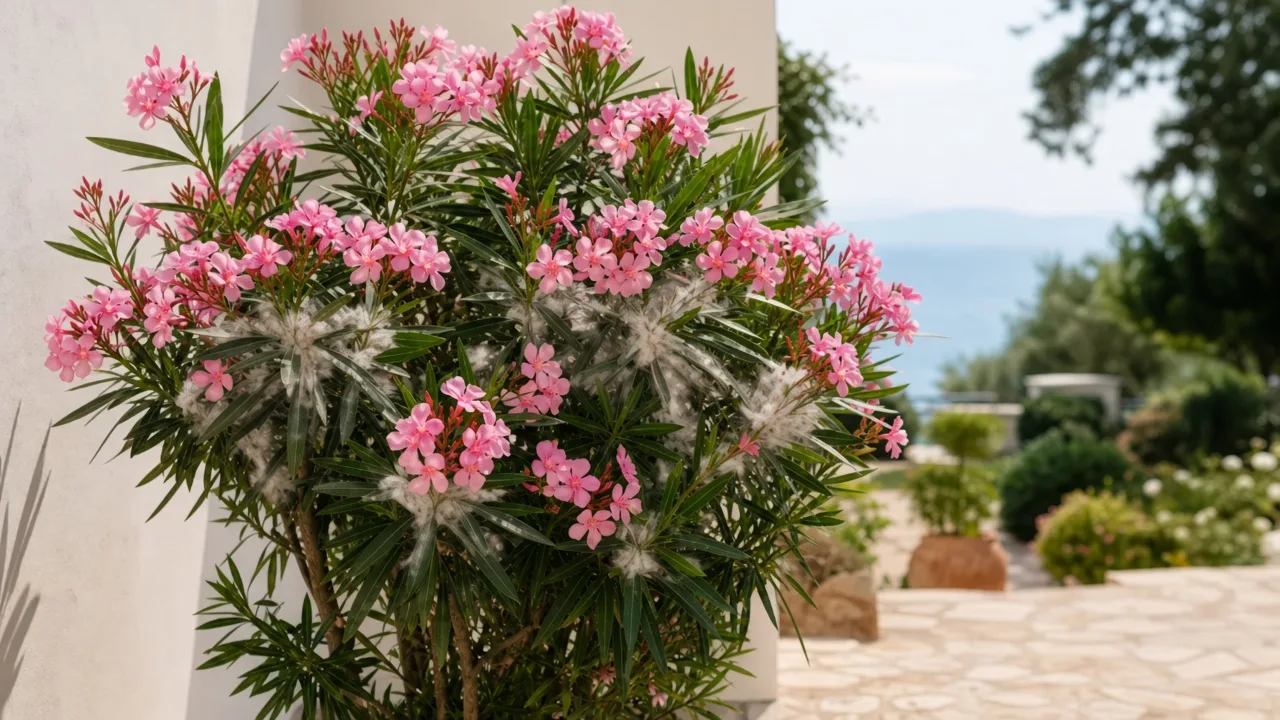
Mealybugs on Oleander: Causes, Checks & Fixes
This guide covers mealybugs on Oleander. See also the general Mealybugs guide, watering, and light pages for this plant.
Mealybugs on Oleander: Causes, Checks & Fixes
Quick answer
Mealybugs (Pseudococcidae) colonize Oleander (Nerium oleander) by establishing dense, white cottony aggregations in protected botanical crevices—most notably within the sunken axils of whorled leaves, inside developing floral bracts, and along green branch forks. These unarmored scale relatives pierce the shrub’s vascular tissue with needle-like stylets to ingest nutrient-rich phloem sap. As they feed, they excrete copious amounts of sticky, sugar-laden waste liquid known as honeydew, which rapidly colonizes with velvety black sooty mold (Capnodium) and attracts protective trails of sweet-seeking ants.
For universal unarmored scale biology, crawler lifecycles, and greenhouse management principles across all species, explore our comprehensive mealybugs pest guide. On Nerium oleander, successful control requires navigating the plant’s unique whorled leaf architecture, preventing secondary fungal smothering of evergreen foliage, and maintaining strict safety protocols due to cardiac glycosides present in plant sap.
First step: Don protective waterproof gardening gloves to shield your skin from toxic milky latex sap, isolate the infested shrub, and dab visible wax clusters directly with 70% isopropyl alcohol on a cotton swab to dissolve protective filaments before initiating contact soap or oil sprays.
When to use this page vs other Oleander guides
Sap-feeding pests and environmental stressors on Nerium oleander share overlapping symptoms like sticky foliage, stunted shoots, and yellowing leaves. Use this diagnostic routing table to ensure you treat the exact underlying agent:
| Symptom pattern on Oleander | Most probable cause | Recommended guide |
|---|---|---|
| White, cottony wax cushions nestled in leaf whorls and floral bracts; sticky honeydew | Mealybugs (Pseudococcidae) | This diagnostic guide |
| Bright canary-yellow or orange insects clustered densely on soft new shoot tips | Oleander aphids (Aphis nerii) | Oleander aphids |
| Stippled yellow speckles with fine silk webs on leaf undersides during hot, dry weather | Two-spotted spider mites | Oleander spider mites |
| Lower foliage yellowing uniformly, dropping; soggy, slow-draining potting substrate | Saturated root zone | Oleander overwatering |
| Inward-curling leaves, crispy brown foliage margins, aborted flower buds in heat | Severe root dehydration | Oleander underwatering |
| Generalized yellowing across mature leaves without insects, webs, or honeydew | Cultural or light stress | Oleander yellow leaves |
| Comprehensive diagnostic and cultural problem overview across all care topics | Mixed cultural symptoms | Oleander problems hub |
What mealybugs look like on Nerium oleander
Mealybugs are easily distinguished by their soft, segmented oval bodies enveloped in hydrophobic, powdery white wax secretions. On Nerium oleander, species such as the citrus mealybug (Planococcus citri) and longtailed mealybug (Pseudococcus longispinus) thrive in warm microclimates, appearing as small, stationary cushions that look like specks of cotton lint or miniature sea shells clinging to stems.
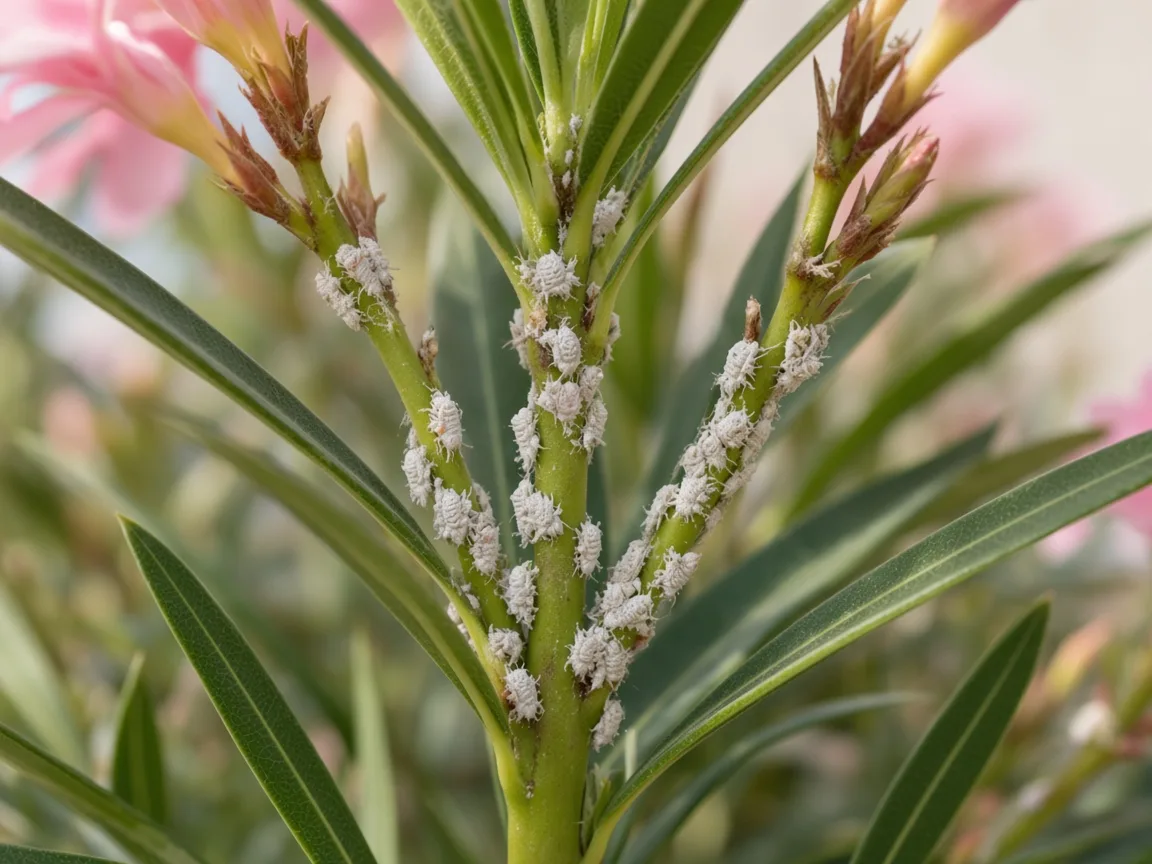
White cottony mealybug clusters (Pseudococcidae) tucked into the whorled leaf axils of Nerium oleander.
Adult females measure roughly 2 to 4 mm in length, are wingless, and produce fringed waxy filaments along their body margins. The longtailed mealybug displays tail filaments that can exceed its body length. Immature nymphs (crawlers) are tiny, yellow to pale pink, mobile, and lack the thick waxy coating of mature females, making them the primary stage that disperses across stems and onto adjacent container shrubs.
Key visual diagnostic markers on Nerium oleander include:
- Cottony mass aggregations: Clusters of white waxy webbing in stem clefts containing dozens of pinkish eggs (ovisacs) or huddled nymphs.
- Glistening foliar glaze: Upper surfaces of lower leaves become coated in clear, sticky honeydew dropped from colonies feeding higher in the canopy.
- Sooty mold colonization: Patches of dark, charcoal-like fungal residue growing on honeydew deposits, blocking sunlight from reaching photosynthetic cells.
- Foliar distortion and chlorosis: Stems supporting heavy infestations show localized leaf yellowing, cupping, premature leaf senescence, and stunted flower development.
Where mealybugs hide: Whorled leaf axils and floral bracts
Nerium oleander features a distinctive botanical morphology: stiff, leathery, linear-lanceolate leaves arranged along the stems in whorls of three (and occasionally opposite pairs). The junction where each leathery petiole clasps the woody stem forms a narrow, recessed pocket.
Mealybugs exploit these exact structural niches:
- Whorled leaf axils: The tight angular clefts between the tripartite leaf bases and the stem provide sheltered micro-environments shielded from torrential rain, mechanical hose sprays, and intense midday Mediterranean sun.
- Terminal flower cymes and floral bracts: Oleanders produce terminal trusses of showy blossoms. Developing flower buds are subtended by delicate green bracts and pedicels; mealybugs crowd under these small scales to feed on exceptionally tender, unlignified tissue, causing flower buds to abort before opening.
- Branch crotches and woody fissures: As oleander canes mature into woody stems, bark fissures and branching junctions offer rough crevices where gravid females deposit waxy egg sacs.
- Basal root flares and container rims: While foliar mealybugs feed above ground, populations frequently migrate down to the soil line and shelter under loose bark right at the root collar.
Because mature oleander leaves develop a thick, waxy cuticle, mealybugs rarely feed on the open, tough blade surfaces. Focusing your inspections on the axillary junctures of leaf whorls is critical to catching an infestation before it spreads.
Why Oleander gets mealybugs: Honeydew, sooty mold, and ant trails
Mealybugs thrive on Nerium oleander primarily when environmental conditions and cultural practices create lush growth without natural ecological checks.
Vascular phloem feeding and honeydew production
Mealybugs use piercing-sucking stylets to tap directly into the plant’s vascular phloem sieve tubes. Because phloem sap consists predominantly of water and sucrose with low amino acid concentrations, the insects must filter immense quantities of fluid to acquire sufficient dietary nitrogen. The surplus water and sugar are expelled continuously as sticky honeydew.
Secondary sooty mold (Capnodium)
When honeydew coats the evergreen foliage below feeding sites, saprophytic fungi—most commonly belonging to the genus Capnodium—colonize the sugary medium. While sooty mold does not invade internal plant tissues, the thick black fungal mycelium acts as a physical barrier. By preventing sunlight from reaching chloroplasts, extensive sooty mold reduces photosynthesis, causing gradual vigor decline, leaf drop, and poor flower initiation on container specimens.
Mutualistic ant trails (Formicidae)
A major reason mealybug populations explode on garden and patio oleanders is mutualism with foraging ants. Attracted to rich honeydew, worker ants establish active vertical trails up oleander canes. In exchange for carbohydrate harvests, ants aggressively harass and repel beneficial predatory insects, including lady beetle larvae (Cryptolaemus montrouzieri), green lacewing larvae, and minute parasitoid wasps. Managing ants is therefore essential to restoring natural biological control.
Toxicity and mechanical treatment safety: Glove precautions for Nerium sap
Nerium oleander is widely celebrated for its rugged drought tolerance and continuous summer blooming, but all parts of the shrub are extremely toxic. The tissues contain potent cardiac glycosides—primarily oleandrin, neriine, and folinerin—which disrupt cellular ATPase sodium-potassium pumps and can induce fatal cardiac arrhythmias upon ingestion.
       ┌────────────────────────────────────────────────────────┐
       │             SAFETY MANDATE: NERIUM TOXICITY            │
       │                                                        │
       │  • Wear waterproof nitrile or rubber gardening gloves.  │
       │  • Never crush mealybugs or stems bare-handed.         │
       │  • Avoid touching eyes, nose, or mouth during cleanup. │
       │  • Wash pruners and sprayers thoroughly after use.     │
       │  • Safely discard alcohol swabs in sealed trash.      │
       └────────────────────────────────────────────────────────┘
When cleaning mealybugs, scraping waxy masses, or pruning heavily infested floral shoots, stems and leaf attachments exude a viscous, milky white latex sap. Direct dermal contact with this sap frequently triggers severe contact dermatitis, blistering, and intense irritation.
Furthermore, handling crushed mealybugs that have fed on oleander sap can transfer cardenolides onto bare skin. Never conduct mechanical removal, swab dabbing, or water-jet rinsing without durable waterproof gloves. If sap contacts bare skin, wash immediately with warm water and soap. Ensure spent swabs, dislodged plant debris, and prunings are bagged securely away from pets, children, and livestock, as documented by ASPCA Animal Poison Control.
Step-by-step diagnostic inspection: Mealybugs vs. lookalike symptoms
Before applying treatments, confirm that the white residues on your oleander are indeed living Pseudococcidae colonies and rule out lookalike physiological and fungal symptoms.
Physical confirmation steps
- The alcohol swab dissolution test: Moisten a cotton swab with 70% isopropyl alcohol and firmly press it against a suspected white cluster. If the substance is mealybug wax, the filament structure will dissolve instantly, revealing a yellowish-brown or pink insect body that turns orange-gray as it dies. Mineral salts, dried sap, or fungus will not dissolve in this characteristic manner.
- Examine leaf whorl joints: Pull back the leaves of a whorl gently under bright light or a 10× hand lens. Look for oval, segmented nymphs moving slowly along the stem crevice.
- Trace ant activity: Observe the main stem for ants moving systematically between the soil mix and branch tips. Where ants congregate around leaf joints or floral buds, honeydew-producing scale or mealybugs are almost invariably present.
- Check root zone transitions: Inspect the lower 5 cm of the stem where it meets the potting medium. Shake off loose topsoil to confirm whether root mealybugs (Rhizoecus spp.) are colonizing the root flare as a white powdery crust.
Symptom lookalike comparison
| Observed feature on Oleander | Diagnostic clue | Key confirming distinction |
|---|---|---|
| Cottony, fluffy white clusters in leaf whorls | Mealybugs (Pseudococcidae) | Dissolves with alcohol; reveals oval insect; sticky honeydew present |
| Flattened, immobile brown or tan waxy scales | Armored / soft scale insects | Hard or leathery shell; no fluffy cotton threads; adheres tightly to bark |
| White powdery film spreading across upper leaf blades | Powdery mildew | Flat fungal mycelium on leaf surfaces; wipes off dry; no honeydew or ants |
| White crusty droplets on stems or pruning cuts | Dried latex sap | Rigid, rubbery dried sap; does not dissolve into an insect under alcohol |
| Bright yellow/orange teardrop insects on shoots | Oleander aphids (Aphis nerii) | Distinct warning coloration with black cornicles and legs; no cottony wax |
| Fine webbing on shoot tips with yellow foliar stippling | Two-spotted spider mites | Microscopic mites; delicate silk webbing over blades; dry environment |
First fix: Isolate and spot-treat with isopropyl alcohol
The most effective, targeted first step for managing mealybugs on Nerium oleander is precision mechanical eradication combined with an isopropyl alcohol spot treatment:
- Isolate the shrub immediately: Relocate potted oleanders at least 2 to 3 meters away from other ornamental shrubs and patio containers to halt crawler migration.
- Equip personal safety gear: Put on waterproof nitrile gardening gloves and eye protection before handling the shrub.
- Spot-treat with 70% isopropyl alcohol: Dip a clean cotton swab or small artist’s paintbrush into standard 70% isopropyl alcohol. Press the swab firmly into every visible cottony cluster nestled in the whorled leaf axils, along branch unions, and behind floral bracts.
- Dissolve egg sacs: Rub the swab over waxy egg masses to break down the protective hydrophobic filament coatings and desiccate emerging crawlers.
- Dispose of contaminated swabs: Seal used cotton swabs and removed debris in a plastic bag before discarding them in household trash.
[!IMPORTANT] Always perform alcohol spot treatments in the early morning or evening. Do not dab alcohol in direct midday sun or high heat, as rapid alcohol evaporation under intense ultraviolet light can occasionally cause localized cosmetic foliar burning on tender juvenile shoots.
Secondary treatments: Horticultural oil and insecticidal soap sprays
For widespread infestations where hundreds of mealybugs hide deep inside dense mature oleander canopies, spot dabbing alone cannot reach every juvenile crawler. Secondary contact sprays are required.
Insecticidal soap sprays (potassium salts of fatty acids)
Insecticidal soaps function strictly on contact by penetrating and dissolving the insect’s protective waxy cuticle and disrupting cell membrane integrity, as outlined by Colorado State University Extension.
- Dilution and mixing: Use a commercial potassium salts of fatty acids product mixed at a 1% to 2% concentration (typically 2 to 4 tablespoons per gallon of clean water).
- Targeted application: Direct the spray nozzle upward and into leaf whorls, coating the undersides of leaves, branch crotches, and the base of flower trusses until run-off.
- Repeat cadence: Spray once every 5 to 7 days for a minimum of 3 to 4 consecutive weeks. This interval intercepts freshly hatched crawlers as they emerge from hidden egg sacs that contact sprays could not penetrate.
Horticultural oil and neem oil applications
Refined narrow-range horticultural oils (mineral-based) or clarified hydrophobic extract of neem oil kill mealybug adults and crawlers by suffocating their spiracles (respiratory openings).
- Rate: Apply a 1% to 1.5% horticultural oil emulsion, ensuring complete coverage of woody stems and leaf axils.
- Temperature caution: Do not apply horticultural oils or insecticidal soaps when outdoor temperatures exceed 90°F (32°C) or when the oleander is under severe drought stress. In hot Mediterranean or subtropical summers, spray strictly at dawn or dusk to avoid severe phytotoxic foliar scorch.
Ant management: Disrupting the honeydew supply chain
If worker ants continue to patrol your oleander, insecticidal soap and oil treatments will face constant setbacks because ants will clean colonies, disperse crawlers, and drive away beneficial predators.
Disrupt the ant-mealybug partnership using these integrated measures:
- Prune clearance: Trim any low branches or foliage that contact surrounding walls, garden fences, or ground surfaces, creating a single access point via the main stem or container base.
- Sticky barrier collars: On large shrubs or potted plants, wrap a strip of waterproof duct tape or heavy paper around the trunk (sticky side out) and coat it with a horticultural adhesive resin (such as Tanglefoot). Ensure no plant sap leaks under the wrap.
- Enclosed ant bait stations: Place slow-acting borate-based liquid ant baits near the base of the container or planting bed. Worker ants will carry the sweet toxic bait back to the subterranean nest, eliminating the entire queen colony without broadcasting chemical pesticides onto your shrub.
Recovery timeline and realistic expectations
Recovering from a mealybug infestation on Nerium oleander requires persistence over several care cycles:
WEEK 1:
├── Don protective gloves; isolate plant
├── Dab visible wax clusters with 70% alcohol
└── Spray insecticidal soap into leaf whorls

WEEKS 2–3:
├── Re-inspect leaf whorls and floral bracts
├── Spot-dab newly emerged crawlers
└── Repeat soap/oil contact spray every 5–7 days

WEEKS 4–6:
├── Ant trails cease; sooty mold flakes off
├── Apical meristems push clean, straight foliage
└── Resume baseline full-sun care and feeding- Days 1–3: Treated adult mealybugs collapse and turn brownish-gray. Sticky honeydew output ceases.
- Weeks 2–3: A second wave of tiny yellow crawlers may hatch from sheltered ovisacs. Continued weekly contact sprays are necessary to break the reproductive cycle before crawlers reach sexual maturity.
- Weeks 4–6: Sooty mold gradually weathers, dries, and flakes away during overhead hose rinses or heavy rain as honeydew reserves disappear.
- Tissue recovery limits: Leaves that were severely curled, stunted, or scarred by stylet punctures will not regenerate unblemished margins. However, healthy evergreen oleanders will initiate clean, upright shoot growth and fresh terminal flower buds once pest pressure lifts.
Mistakes to avoid on Oleander
Avoid these common missteps when eradicating mealybugs on Nerium oleander:
- Applying high-nitrogen fertilizers during an infestation: Feeding a pest-stressed oleander with heavy nitrogen triggers surges of soft, succulent vegetative growth, providing ideal nourishment for mealybugs and expanding colony size.
- Spraying oil in full midday sun: Applying horticultural oil or insecticidal soap during high midday heat (above 90°F / 32°C) causes acute leaf burn and defoliation on oleanders growing in full sun.
- Handling plant tissue without gloves: Scraping mealybugs with bare fingernails or pruning without protective gloves exposes you to poisonous cardiac glycosides and irritating milky sap.
- Ceasing treatment after a single application: A single alcohol dab or soap spray leaves microscopic crawlers and egg sacs intact deep inside whorled leaf pockets, leading to full colony resurgence within 14 days.
- Ignoring the ant population: Failing to exclude ants allows them to defend surviving mealybugs, defeat beneficial predatory insects, and transport crawlers to uninfested branches.
Oleander care cross-check and long-term prevention
Healthy, culturally balanced oleanders possess natural defenses that resist severe pest colonization. Align your baseline maintenance with the shrub’s core environmental requirements:
- Light exposure: Nerium oleander requires full sun—minimum 6 hours of direct solar exposure daily. Growing oleanders in shaded, humid courtyards produces weak, elongated stems with thin cuticles that invite mealybug infestations. Refer to our Oleander light guide to optimize seasonal positioning.
- Proper watering discipline: While mature landscape oleanders tolerate drought, container shrubs need deep, thorough watering whenever the top 5 cm (2 inches) of soil becomes completely dry. Avoid constant soil saturation, which stresses roots; check the Oleander watering guide for seasonal cadence.
- Free-draining soil mix: Maintain a porous, fast-draining substrate composed of 50% potting loam, 25% coarse grit or sand, and 25% perlite or pumice to prevent root asphyxiation, as detailed in the Oleander soil guide.
- Sanitary pruning practices: Annually prune out dense, crossing interior branches in early spring to facilitate air circulation and sunlight penetration throughout the canopy. Wear protective gear and wash pruners immediately, following instructions in the Oleander pruning guide.
- Quarantine protocol: Isolate newly purchased oleanders or tender patio specimens for 14 days before placing them among established landscape collections.
- Whole-plant monitoring: Scout leaf whorls and floral stems monthly during peak growing season, consulting the Oleander care hub and the Oleander problems hub at the first sign of physiological distress.
When to worry
On large, mature landscape oleanders, minor mealybug colonies residing on a few branch terminals represent primarily a cosmetic annoyance that rarely threatens the shrub’s structural survival.
However, escalate your intervention promptly under these critical conditions:
- Infestation of young potted or dwarf specimens: Container-grown shrubs possess smaller root systems and foliage reserves; heavy phloem sap loss can lead to rapid terminal dieback and branch death.
- Complete flower bud abortion: When mealybugs engulf every emerging floral truss, preventing all summer blooming and causing terminal shoot deformities.
- Sooty mold covering over 40% of the canopy: Extensive fungal crusts that choke out light across major foliage sections will weaken the plant’s overall carbohydrate reserves, leading to chlorosis and severe seasonal leaf drop.
- Symptoms of bacterial leaf scorch: If oleander leaves exhibit brown, necrotic margins bordered by yellow bands along with branch wilt, test for Xylella fastidiosa (spread by sharpshooter leafhoppers), which is fatal and cannot be remedied by mealybug treatments.
Related Oleander guides
- Oleander Overview — Complete species profile, landscape culture, and safety rules
- Oleander Watering Guide — Deep irrigation cycles and pot drainage management
- Oleander Light Guide — Full direct sun requirements for dense, pest-resistant growth
- Oleander Soil Guide — Fast-draining soil mixes for containers and landscape beds
- Oleander Pruning Guide — Shaping techniques, seasonal timing, and sap protection
- Oleander Fertilizer Guide — Balanced feeding schedules to avoid excess tender growth
- Oleander Aphids — Managing bright yellow oleander aphids on terminal shoots
- Oleander Spider Mites — Identifying stippled foliage and delicate silk webbing
- Oleander Yellow Leaves — Differentiating pest damage from watering and light issues
- Oleander Problems Hub — Complete index of physiological, fungal, and insect disorders
Conclusion
Mealybugs (Pseudococcidae) are persistent sap-feeding pests that exploit the sheltered whorled leaf axils and flower bracts of Nerium oleander, producing sticky honeydew and triggering secondary sooty mold. Eradicating them requires patience and careful horticultural hygiene rather than indiscriminate spraying. By donning protective gloves to guard against toxic cardiac glycosides, spot-treating visible clusters with 70% isopropyl alcohol, following up with targeted insecticidal soap sprays in cool hours, and excluding honeydew-seeking ants, you can eliminate mealybug colonies and preserve your oleander’s vigorous growth and vibrant floral displays.
Related tool
Use the Humidity Calculator to check atmospheric vapor pressure deficit and drying rates around your oleanders, ensuring post-treatment contact sprays and rinsed foliage dry rapidly to prevent secondary fungal infections while suppressing sap-feeding pests.