Yellow Leaves on Oleander: Chlorosis Causes, Checks & Fixes
Quick answer
Yellow leaves on Oleander (Nerium oleander) stem from five distinct biological drivers: normal seasonal senescence of interior foliage, root hypoxia from waterlogged soil, iron chlorosis induced by alkaline soil pH (above 8.0), nitrogen deficiency, or early Oleander Leaf Scorch (Xylella fastidiosa). To determine the cause, inspect the leaf location and vein pattern: if only lower interior leaves turn golden while branch tips surge with growth, it is harmless senescence. Interveinal yellowing with green veins on new terminal leaves signals iron lockup in high-pH soil. In contrast, limp yellowing on lower branches indicates soggy roots, while localized chlorotic halos bordering dry leaf margins signal incurable bacterial scorch.
Yellow Leaves on Oleander: Chlorosis Causes, Checks & Fixes
This guide covers yellow leaves on Oleander. See also the general Yellow Leaves guide, watering, and light pages for this plant.
Yellow Leaves on Oleander: Chlorosis Causes, Checks & Fixes
Quick answer
Yellow leaves on Nerium oleander are not a single generic complaint; they represent a distinct foliar reaction to one of five specific physical or biological stressors. On an outdoor, sun-loving Mediterranean shrub, the most frequent culprits are normal seasonal senescence of shaded interior leaves, root hypoxia caused by waterlogged soil, iron deficiency chlorosis triggered by high soil pH (above 8.0), nitrogen depletion, and Oleander Leaf Scorch (Xylella fastidiosa), an incurable vascular infection transmitted by sharpshooter leafhoppers.
To resolve the issue, examine the spatial distribution of the yellowing. If golden leaves appear strictly on the oldest wood inside the canopy while outer shoot tips grow vigorously, your oleander is simply shedding obsolete leaves before its spring or summer growth push. If the yellowing is concentrated on tender, newest growth with dark green veins tracing a pale blade, the plant is locked out of iron by alkaline soil. If widespread yellowing coincides with soggy soil, saturated roots are suffocating from oxygen starvation.
For universal diagnosis of chlorotic foliage across all garden species, consult our global yellow leaves symptom guide.
What yellow leaves look like on Oleander
Nerium oleander bears narrow, thick, leathery, lance-shaped leaves arranged in whorls of three along tough cane-like stems. Because healthy oleander foliage has a dense cuticle and robust vascular architecture, yellowing patterns provide clear visual diagnostic clues:
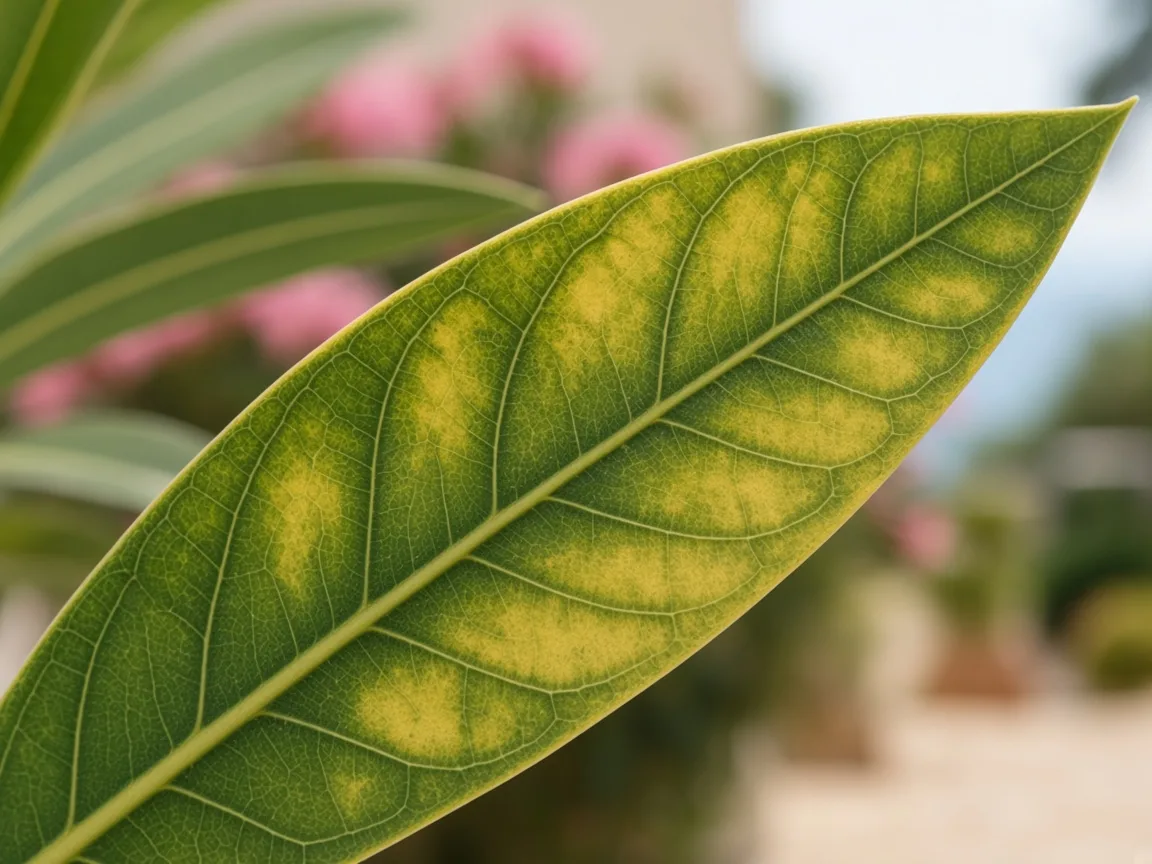
Close-up of Nerium oleander foliage displaying interveinal chlorosis and early vascular discoloration.
- Normal physiological senescence: Oldest leaves at the base of branches turn a clean, uniform butter-yellow. The leaf blade remains smooth without necrotic spots or scorched edges, detaching effortlessly from the stem node at the slightest touch.
- Overwatering root hypoxia: Mature lower and mid-canopy leaves fade from lustrous deep green to a dull, sickly yellowish-green. Foliage feels slightly soft or flaccid rather than leathery and crisp, frequently accompanied by premature leaf shedding across multiple stems.
- High-pH iron chlorosis: Yellowing begins strictly on the youngest, terminal leaf whorls at the branch tips. Leaf tissue between the veins turns ivory or pale chartreuse, while the central midrib and lateral secondary veins remain sharply defined in dark green.
- Nitrogen deficiency: Uniform, pale chlorosis starts on the oldest lower leaves and gradually migrates upward through the shrub. Unlike iron deficiency, the veins yellow at the exact same rate as the rest of the blade, resulting in an overall washed-out, yellowish-green shrub canopy.
- Bacterial leaf scorch (Xylella): Asymmetric yellowing appears on an isolated branch. The yellow chlorosis forms an irregular, vivid golden-yellow ribbon or halo bordering crispy brown, necrotic leaf tips and margins.
When root health or vascular transport is severely compromised, chlorosis is quickly followed by drooping leaves and progressive canopy dieback.
Why Oleander leaves turn yellow: 5 distinct causes
As documented by NC State Extension and the Missouri Botanical Garden, Nerium oleander is an exceptionally rugged, drought-tolerant shrub adapted to rocky stream banks, coastal bluffs, and Mediterranean climates. Despite its resilience, distinct physiological and environmental disturbances disrupt chlorophyll production:
1. Normal seasonal senescence before active growth flushes
Oleander is an evergreen perennial, but individual leaves have a finite lifespan of one to two years. In late spring and early summer, mature shrubs produce massive flushes of new terminal vegetative shoots and flower panicles. To fuel this demanding growth, the shrub reallocates nitrogen, phosphorus, and potassium from older, interior foliage shaded by the dense outer canopy. These senescing leaves turn bright yellow and drop. This natural turnover occurs annually on healthy specimens and is completely harmless.
2. Overwatering and root hypoxia in saturated soils
While oleanders tolerate brief periods of excess water in landscape settings with coarse gravelly soils, containerized shrubs and heavy clay garden beds present severe risks of waterlogging. When potting media or native soil remains continuously saturated, pore spaces stay filled with water rather than air, causing severe root hypoxia (oxygen starvation). As detailed by UF IFAS Extension, deprived of oxygen, root hairs cannot produce the cellular ATP required for active nutrient uptake. Without functional feeder roots, the plant cannot transport minerals upward, triggering widespread foliar yellowing that mimics drought stress. If left uncorrected, opportunistic water molds trigger fatal root rot.
3. Iron deficiency chlorosis in high pH (>8.0) soils
Oleanders are widely cultivated in arid, alkaline regions where native soils are rich in calcium carbonate and have a pH exceeding 7.5 to 8.2. In such alkaline substrates, iron is abundant but chemically converted into insoluble ferric hydroxide precipitates ($Fe(OH)_3$), which plant root systems cannot absorb. As explained by New Mexico State University Extension, iron is essential for chlorophyll biosynthesis but is physiologically immobile within plant tissue. Because the shrub cannot pull iron from older leaves to supply new cells, newly expanding terminal foliage exhibits severe interveinal chlorosis—creamy yellow leaf blades mapped with contrasting dark green veins.
4. Nitrogen deficiency across mature foliage
Nitrogen is the primary building block of amino acids, proteins, and the chlorophyll molecules that give oleander leaves their deep green color. Because nitrogen is highly mobile within plant phloem, a shrub growing in impoverished, unfertilized container soil or lean, sandy landscape beds will scavenge nitrogen reserves from older leaves to support terminal growth points. According to Clemson Cooperative Extension, nitrogen-deficient oleanders exhibit slow, stunted growth, thinner cane development, and a gradual, uniform yellowing that starts at the base of the shrub and creeps upward.
5. Oleander Leaf Scorch (Xylella fastidiosa) early banding
In warm, frost-free agricultural and suburban zones (especially California, Texas, Arizona, and the Gulf Coast), Oleander Leaf Scorch represents the most devastating cause of foliar yellowing. Transmitted by xylem-feeding insects such as the glassy-winged sharpshooter (Homalodisca vitripennis), the bacterium Xylella fastidiosa colonizes water-conducting xylem vessels, according to UC IPM. As bacterial populations multiply and secrete extracellular polysaccharides, the plant produces defensive tyloses that effectively plug its own vascular pipelines. Before terminal leaves turn necrotic and brown, the margin develops a distinct, bright yellow chlorotic band that separates dying tissue from the still-green basal blade.
Diagnostic comparison: Pinpoint your Oleander’s chlorosis
Use this species-specific diagnostic matrix to identify which factor is causing your oleander leaves to turn yellow:
| Diagnostic Marker | Normal Senescence | Overwatering / Hypoxia | High pH Iron Chlorosis | Nitrogen Deficiency | Bacterial Leaf Scorch (Xylella) |
|---|---|---|---|---|---|
| Canopy Location | Oldest, interior leaves along woody canes | Lower and middle canopy across all branches | Youngest, newest leaves at terminal shoot tips | Bottom foliage first, gradually moving upward | Single branch or localized sector (“flagging”) |
| Color Pattern | Solid bright golden-yellow | Dull, faded, pale yellowish-green | Creamy yellow blade with dark green veins | Uniform pale chartreuse to yellow; veins fade too | Vivid yellow halo bordering brown crispy margins |
| Leaf Texture | Normal leathery texture until drop | Soft, limp, or slightly droopy | Normal to thin, leathery | Thin, leathery, undersized leaves | Dry, brittle, curled margins |
| Soil Moisture | Variable; typically well-watered | Constantly wet, soggy, or sour-smelling | Alkaline (pH > 7.8), often dry or caliche | Lean, sandy, or aged container substrate | Any moisture level; occurs in moist soil |
| Shrub Growth | Vigorous terminal shoots and active buds | Stalled growth; root tips blackened | Stunted terminal growth; pale young whorls | Weak, spindly canes; sparse flowers | Progressive branch dieback; terminal wilt |
The first fix: What to do today
Before applying any fertilizer, micronutrient spray, or heavy pruning cut, execute this single diagnostic first step:
Inspect the root zone and test soil moisture depth. Insert a wooden dowel, moisture meter, or your finger 5 to 7 centimeters (2 to 3 inches) deep into the root ball.
- If the soil is drenched, muddy, or emits a sour odor: Immediately suspend all supplemental irrigation. Elevate container pots on pot feet to ensure drainage holes are completely unobstructed, and discard any standing water collected in saucers or cachepots. For saturated landscape beds, pull back heavy organic mulches from the shrub trunk to allow topsoil aeration.
- If the soil moisture is moderate and yellowing is confined to terminal new growth: Test the root-zone soil pH using an accurate probe or test kit. A reading above 7.8 confirms iron lockup, pointing to nutrient chelation rather than irrigation adjustments.
- If yellowing is confined to interior leaves on a vigorous shrub: Take no action. The shrub is naturally shedding old foliage to support vigorous terminal flowering wood.
Step-by-step remediation protocol
Follow these four targeted protocols to treat confirmed physiological or pathological chlorosis:
Step 1: Remediate waterlogged soil and root hypoxia
If soggy conditions have suffocated root hairs:
- Allow the container potting mix to dry until the top 5 centimeters are completely dry to the touch before offering more water.
- If growing in a container without adequate perlite or coarse bark, plan a spring repotting using our open, well-aerated potting mix outlined in the Oleander soil guide.
- For landscape oleanders planted in poorly drained, dense clay basins, re-grade surrounding soil to divert surface runoff away from the root flare. For future plantings in heavy soil, install shrubs on raised berms 15 to 25 centimeters above native grade.
- Review your seasonal irrigation schedule using the Oleander watering guide to prevent cyclic saturation.
Step 2: Correct high-pH iron deficiency
When soil pH exceeds 7.5 to 8.0, standard iron sulfate or iron EDTA chelates become ineffective because iron precipitates out of solution in alkaline conditions:
- Apply Fe-EDDHA chelate: Drench the root zone with iron chelated specifically with EDDHA (ethylenediamine-N,N’-bis(2-hydroxyphenylacetic acid)), which remains chemically stable and plant-available in alkaline soils up to pH 9.0, as recommended by New Mexico State University Extension.
- Foliar application for rapid green-up: Dissolve a water-soluble chelated micronutrient spray containing iron and zinc, and spray the leaves in early morning or evening when temperatures are below 85°F (29°C) to prevent foliar scorch.
- Long-term pH reduction: Incorporate finely ground elemental sulfur or acidic organic matter (such as composted pine bark) into the top 5 centimeters of the landscape root zone to gradually lower soil pH toward the ideal 6.5 to 7.5 range.
Step 3: Replenish depleted nitrogen reserves
For starved shrubs with uniform pale yellow foliage:
- Apply a balanced, slow-release granular fertilizer formulated for woody ornamentals (such as a 10-10-10 or 12-4-8 analysis with micronutrients) around the drip line in early spring and mid-summer.
- Water thoroughly immediately after broadcasting fertilizer granules to dissolve nutrients and distribute them evenly through the root zone.
- Avoid late-autumn nitrogen applications, which stimulate tender, frost-susceptible growth flushes that will suffer severe cold damage during winter freezes.
Step 4: Manage suspected Oleander Leaf Scorch (Xylella)
If asymmetric branch yellowing and marginal scorch match Xylella fastidiosa:
- Put on heavy-duty, waterproof gardening gloves and safety goggles. Nerium oleander contains lethal cardiac glycosides (including oleandrin and neriine) in its milky sap that trigger severe contact dermatitis and accidental ingestion toxicity, as documented by NC State Extension.
- Prune infected branches at least 30 to 45 centimeters (12 to 18 inches) below the lowest visible yellowing or scorched foliage, cutting back to a sturdy branch union or the main trunk.
- Disinfect pruner blades between every single cut with 70% isopropyl alcohol to avoid transferring bacterial pathogens.
- Understand that Xylella moves systemically through xylem vessels. Severe pruning may temporarily improve shrub appearance, but there is no chemical cure. If the shrub continues declining over subsequent seasons, dig up and destroy the entire plant to prevent glassy-winged sharpshooters from acquiring the bacteria and transmitting it to surrounding healthy oleanders.
- Never burn oleander trimmings, as smoke carries aerosolized toxic cardenolides that cause severe pulmonary and systemic poisoning upon inhalation.
Recovery timeline and realistic expectations
Remediation success is measured by the health of newly emerging foliage, not the reversal of existing yellow tissue:
- Weeks 1 to 2: Existing bright yellow senescent leaves will drop cleanly. In overwatered shrubs, halting excess moisture stops yellowing from spreading to higher canopy tiers. Root respiration resumes as pore spaces drain.
- Weeks 3 to 4: In shrubs treated for iron chlorosis with Fe-EDDHA root drenches, newly expanding terminal leaves emerge pale green rather than yellow, with vein contrast gradually softening.
- Months 2 to 3: A fully recovered oleander pushes robust whorls of thick, leathery, dark green leaves from branch terminals. Flower bud clusters initiate normally on current-season wood.
Yellow leaves that have completely lost their chlorophyll will never revert to green. Allow them to shed naturally or gently sweep them away.
Common mistakes to avoid
Avoid these frequent diagnostic and cultural pitfalls when treating yellow oleander foliage:
- Fertilizing a waterlogged shrub: Pouring synthetic fertilizer into a pot with suffocated, rotting roots increases soil osmotic salinity, accelerating root desiccation and burning remaining feeder roots.
- Using iron EDTA on high-pH desert soils: Standard iron EDTA breaks down rapidly when soil pH climbs above 7.2, making the applied iron immediately insoluble and wasting the treatment. Always use Fe-EDDHA for alkaline soils.
- Assuming all yellowing is a disease: Pruning off healthy branches because lower interior leaves turned yellow during seasonal turnover unnecessarily disfigures the shrub and removes future flowering wood.
- Shallow, daily sprinkling: Frequent light surface watering keeps topsoil damp while leaving deep root zones dry, encouraging weak surface rooting and increasing soil surface salt crusts.
- Burning or composting toxic prunings: All parts of Nerium oleander contain cardiac glycosides. Never burn debris or add trimmings to compost piles accessible to grazing pets or livestock.
Preventing yellow leaves: Long-term Oleander care
Maintain vibrant, deep green oleander foliage season after season through disciplined cultural care:
- Uncompromising full sun: Position oleanders where they receive at least 6 to 8 hours of unfiltered, direct sunlight daily. Inadequate sunlight reduces photosynthesis and prompts premature lower leaf shedding, as detailed in our Oleander light guide.
- Calibrated deep watering: Follow the soak-and-dry cycle outlined in our Oleander watering guide. Soak the entire root ball thoroughly, then allow the top 5 centimeters to dry completely before re-irrigating.
- High-porosity potting substrate: If cultivating in containers, use a gritty, porous mix consisting of 50% premium potting soil, 25% coarse perlite or pumice, and 25% composted pine bark chips to ensure rapid drainage.
- Annual soil pH monitoring: Test soil pH every spring if gardening in limestone or caliche regions, applying elemental sulfur to keep the root environment comfortably between 6.5 and 7.8.
When to use this page vs other Oleander guides
Differentiate yellowing leaves from other closely related foliar problems:
- Yellow leaves vs. Brown tips: If leaves display apical and marginal crispy browning without broad canopy chlorosis, consult our guide on Brown Tips on Oleander.
- Yellow leaves vs. Root rot: If yellowing is accompanied by a foul root-ball odor, mushy black roots, and continuous stem dieback in wet soil, follow the Oleander root rot guide.
- Yellow leaves vs. General overwatering: If the entire canopy wilts and droops while saturated, review our dedicated protocol for Oleander overwatering.
- Comprehensive pest and disease diagnostic: For full pest inspections covering oleander aphids, scale, and spider mites, visit our Oleander problems directory.
Related Oleander guides
Explore our comprehensive cultural care library to keep your Nerium oleander thriving:
- Oleander Overview & Botanical Care — Complete species profile, hardiness zones, and cultivation basics.
- Oleander Watering Guide — Deep irrigation cycles, drought tolerances, and container water management.
- Oleander Soil Guide — Substrate recipes, clay soil management, and pH balancing.
- Oleander Light Requirements — Solar benchmarks, seasonal light adjustments, and bloom optimization.
- Oleander Plant Problems Hub — Diagnostic guides for all fungal, bacterial, physiological, and pest disorders.
Related tool
Calculate proper container watering volumes and seasonal irrigation schedules with our Plant Watering Calculator.