Brown Tips on Oleander: Salt Scorch, Drought & Bacterial
Quick answer
Brown tips on Oleander (Nerium oleander) are primarily triggered by fertilizer salt accumulation in container soil, severe root dehydration during peak summer heat, or incurable vascular infection from Oleander Leaf Scorch (Xylella fastidiosa). To diagnose, examine the pattern: uniform tip browning across the canopy indicates cultural salt or drought stress, which recovers after leaching the soil and deep watering. Irregular brown tips with a vibrant yellow halo restricted to individual branches indicate bacterial leaf scorch transmitted by sharpshooters.
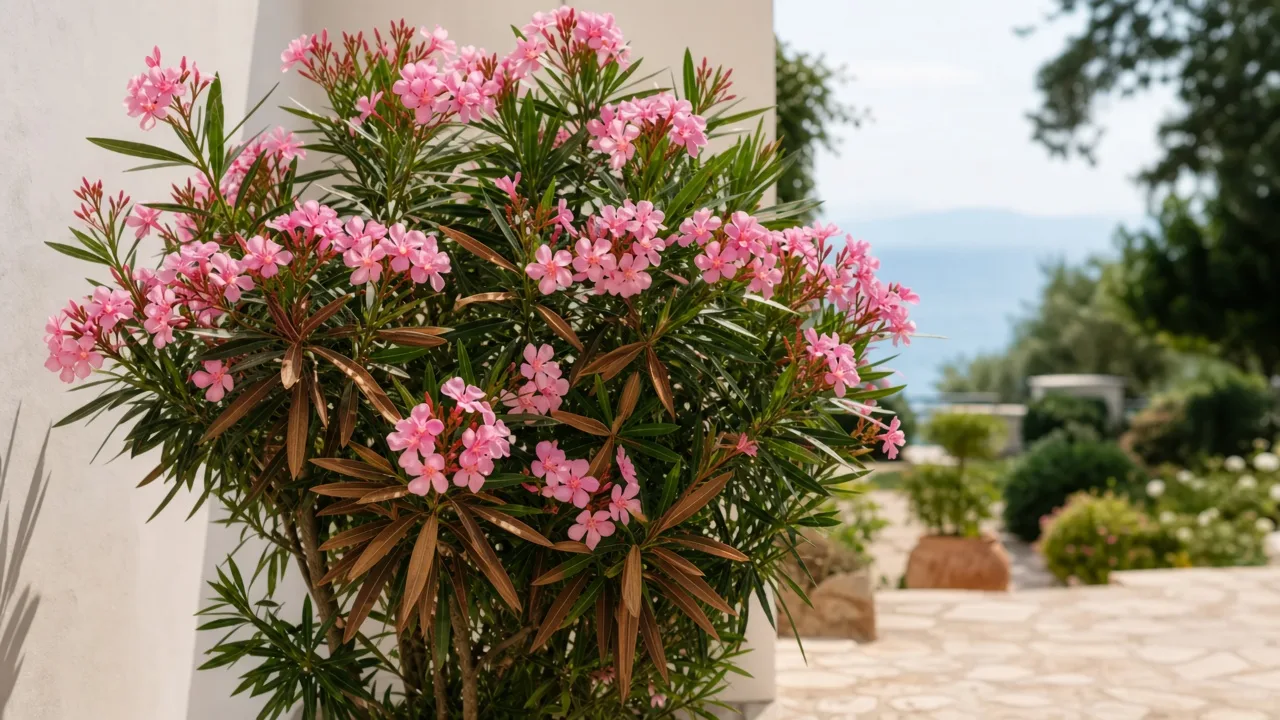
Brown Tips on Oleander: Salt Scorch, Drought & Bacterial Scorch Fixes
This guide covers brown tips on Oleander. See also the general Brown Tips guide, watering, and light pages for this plant.
Brown Tips on Oleander: Salt Scorch, Drought & Bacterial Scorch Fixes
Quick answer
Brown tips and crispy leaf margins on Nerium oleander represent localized tissue necrosis at the furthest extremities of the plant’s vascular plumbing. In home gardens and container culture, the three primary culprits are soluble fertilizer salt buildup in the root zone, acute root dehydration during hot weather, and Oleander Leaf Scorch (Xylella fastidiosa), a fatal bacterial disease transmitted by sharpshooter leafhoppers. To address the problem, perform a root-zone moisture check: if soil is dry or crusted with white mineral residue, flush the container with abundant water to leach out salts and restore deep hydration. If tip browning appears on a single branch with a distinctive bright yellow halo separating brown tissue from green blade, isolate the plant and inspect for bacterial scorch.
For universal chlorosis and necrosis diagnostics across indoor and outdoor plants, explore our comprehensive guide on brown leaf tips.
What brown tips look like on Oleander
Oleander leaves are thick, stiff, and leathery, arranged in whorls of three along upright branches. When leaf tips die back, the symptoms present distinct tactile and visual characteristics:
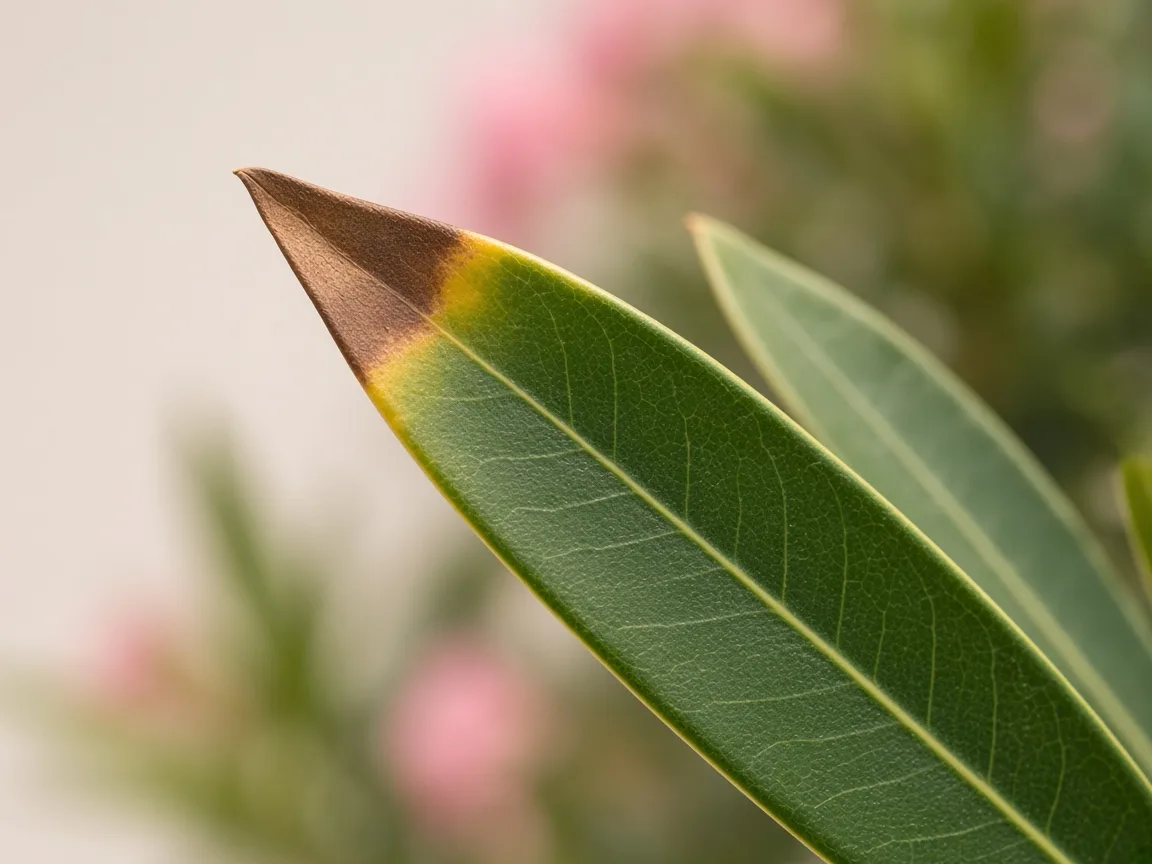
Close-up of Nerium oleander leaf tip showing dry, necrotic brown tissue with a characteristic chlorotic margin.
- Apical necrosis: The sharp point (apex) of the lance-shaped leaf turns pale tan, reddish-brown, or dark chocolate-brown, becoming dry, brittle, and papery to the touch.
- Inward marginal advancement: In chronic cases, the browning creeps along the outer leaf margins toward the petiole, leaving the central midrib green.
- Chlorotic transitional halo:
- Cultural stress (Salt/Drought): A faint or narrow pale green border separates necrotic brown tips from healthy tissue.
- Bacterial scorch (Xylella): A vibrant, wide, neon-yellow chlorotic band consistently marks the border between dead brown margins and living green tissue.
- Soil surface mineral crusts: A powdery white or yellowish chalky film visible on the potting mix surface or the rim of terracotta pots confirms heavy fertilizer or tap water salt accumulation.
- Canopy distribution: Environmental drought and salt burn appear evenly across the outer sunny canopy; bacterial disease attacks individual branches, causing unilateral flagging.
If left uncorrected, widespread marginal necrosis reduces total photosynthetic leaf area, predisposing the shrub to canopy thinning, drooping leaves, and slow growth.
Why Oleander leaves develop brown tips
Nerium oleander is naturally adapted to Mediterranean stream banks, gravelly arroyos, and coastal scrub, thriving in full sun and well-draining soils, as documented by NC State Extension and Missouri Botanical Garden.
Key physiological and pathological drivers of leaf tip necrosis include:
1. Soluble fertilizer salt buildup (Osmotic root burn)
Synthetic fertilizers release soluble mineral ions (nitrates, potassium, phosphorus, sulfates). In containers, unabsorbed salts accumulate in the substrate. As the soil dries slightly, the concentration of salts spikes, reversing natural osmotic pressure and pulling moisture backward out of tender root hairs. Deprived of water, the furthest cells at the leaf tips desiccate and die.
2. Acute summer drought and container heat stress
While established landscape oleanders boast deep root networks that withstand intense drought, containerized shrubs have restricted root volumes, as highlighted by UF IFAS Extension. In summer, intense solar radiation heats container walls, accelerating evaporation. When water loss through stomata outpaces root uptake, xylem conduits suffer cavitation, cutting off water to apical leaf tips and producing severe underwatering.
3. Bacterial Leaf Scorch (Xylella fastidiosa)
In regions such as California, Texas, and the southern United States, Xylella fastidiosa poses a severe threat, as detailed by UC IPM. This bacterium is vectored into xylem vessels by sharpshooters (particularly the glassy-winged sharpshooter, Homalodisca vitripennis). As bacteria multiply, they form a thick biofilm and trigger host tyloses that physically clog xylem channels. Leaves at the tips of infected branches starve of water, turning crispy brown with a vivid yellow halo.
4. Cold injury and freezing drafts
Oleander is cold-hardy in USDA Zones 8 through 10, tolerating brief dips to 20°F (-6°C), according to Clemson Cooperative Extension. However, prolonged winter freezes or cold wind drafts damage tender apical tissues, resulting in dark brown or black tips across terminal foliage.
5. Root rot and waterlogged soil
Ironically, chronic overwatering in poorly draining, heavy clay soil suffocates roots by creating anaerobic conditions. As root systems decay from root rot, the plant loses its hydraulic absorption capacity, causing top foliage to display paradoxical drought scorch and yellow leaves.
Diagnostic comparison: Salt Burn vs. Drought vs. Bacterial Scorch
Use this matrix to pinpoint the exact cause before taking corrective action:
| Diagnostic Feature | Fertilizer / Salt Burn | Acute Drought Scorch | Bacterial Leaf Scorch (Xylella) |
|---|---|---|---|
| Canopy Location | Uniform across outer and older leaves | Canopy-wide on exposed sunny branches | Confined to one branch or sector initially |
| Yellow Halo | Narrow, pale, or nonexistent | Faint pale green transitional zone | Striking, broad, vibrant golden-yellow band |
| Progression Rate | Slow, correlates with dry cycles | Sudden, follows missed watering in heat | Relentless, progresses down the entire branch |
| Response to Deep Soak | Halts with thorough water leaching | Plants re-pressurize within 24 hours | No recovery; continues dying despite irrigation |
| Soil Evidence | White chalky crust on soil surface | Bone-dry, crumbly, pulling away from pot | Variable; occurs in perfectly moist soil |
Step-by-step remediation protocol
Restore healthy foliage growth and eliminate root stress with this four-step sequence:
Step 1: Leach container potting mix
If fertilizer salts or hard water minerals have accumulated:
- Place the potted oleander outdoors or in a wash area where water can drain freely.
- Slowly pour fresh, tepid water—equal to roughly double the volume of the container—across the soil surface.
- Allow water to stream continuously through the drainage holes, dissolving and flushing away concentrated mineral salts.
- Repeat this leaching cycle 30 minutes later, then let the container drain completely.
Step 2: Calibrate deep watering practices
Avoid shallow, frequent sprinkling. Water potted oleanders deeply until water emerges freely from bottom drain holes, then allow the top 5 centimeters of soil to dry before watering again. During extreme summer heat, check container moisture daily.
Step 3: Prune damaged tips with strict safety precautions
Dead leaf tips can be trimmed for aesthetic improvement:
- Safety first: Put on heavy-duty, waterproof gardening gloves and eye protection. Nerium oleander contains lethal cardiac glycosides that irritate skin and eyes upon contact.
- Using sharp, sterilized bypass shears, trim the brown tips, leaving a 1-millimeter margin of brown tissue so you do not cut into live green cells and cause fresh latex sap leakage.
- Wash all pruning tools thoroughly with warm soapy water and rubbing alcohol immediately after use.
Step 4: Manage suspected Bacterial Leaf Scorch
If symptoms match Xylella fastidiosa (yellow halos, isolated branch dieback):
- Prune the affected branch back to the main trunk or at least 30 centimeters below all visible scorch symptoms using sterilized pruners. Disinfect blades with 70% isopropyl alcohol between every cut.
- Note that Xylella is systemic; pruning may delay branch loss but cannot cure an infected plant. If the shrub continues declining, remove and destroy the plant to prevent sharpshooters from spreading the pathogen to neighboring landscape oleanders.
Long-term cultural practices to prevent brown tips
Maintain unblemished, vibrant oleander canopies year-round:
- Balanced, gentle fertilization: Avoid high-salinity synthetic fertilizers. Apply a balanced, slow-release granular fertilizer formulated for woody ornamentals once in early spring and once in mid-summer, avoiding late-autumn feedings that induce frost-sensitive soft growth.
- Container potting substrate: Pot container oleanders in a high-porosity blend containing 60% quality potting soil and 40% coarse perlite or pumice to prevent compaction and salt retention.
- Seasonal winter protection: In USDA Zone 7 or below, move potted oleanders into a cool, bright, frost-free greenhouse or garage before temperatures drop below 25°F (-4°C).
- Sharpshooter monitoring: Inspect garden shrubs for glassy-winged sharpshooters and control weed reservoirs around property perimeters to reduce insect vectors.
Related tool
Track container soil moisture and calculate proper watering volumes for your shrub with our Plant Watering Calculator.
Related oleander problems: