Aphids on Oleander: Identification, Checks & Safe Fixes
Quick answer
Bright golden-yellow oleander aphids (Aphis nerii) cluster thickly on tender terminal shoots, flower buds, and leaf whorls of Nerium oleander, sequestering toxic cardiac glycosides that deter most common predators. First step: Put on durable gardening gloves to protect against toxic milky sap, and use a strong, focused jet of water to physically dislodge aphid colonies from shoot tips before reaching for insecticidal sprays.
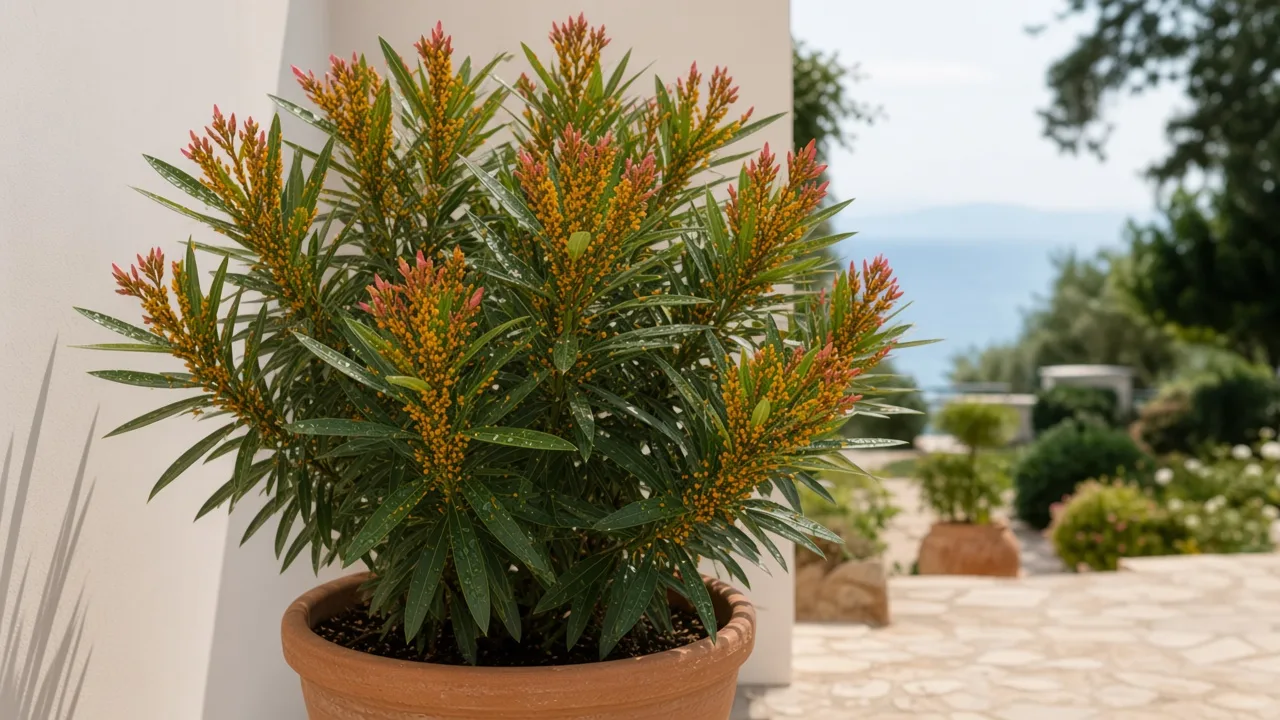
Aphids on Oleander: Causes, Checks & Fixes
This guide covers aphids on Oleander. See also the general Aphids guide, watering, and light pages for this plant.
Aphids on Oleander: Causes, Checks & Fixes
Quick answer
Bright golden-yellow oleander aphids (Aphis nerii) colonize the tenderest terminal shoots, unexpanded leaf whorls, and floral pedicels of Nerium oleander. They pierce succulent green tissue with sucking mouthparts to drain carbohydrate-rich phloem sap, producing copious amounts of sticky honeydew that coats evergreen leaves and encourages velvety black sooty mold. Unlike most common garden pests, these aphids sequester toxic cardenolides directly from oleander sap, granting them chemical protection against many vertebrate and insect predators.
For general aphid lifecycles, honeydew production, and broad garden management strategies, visit our comprehensive aphids pest guide. On oleander, the diagnostic reality centers on distinctive yellow-and-black coloration, chemical toxicity shared between host and pest, and frequent biological regulation by tiny parasitoid wasps that turn aphids into swollen brown mummies.
First step: Put on durable, waterproof gardening gloves to protect your skin from toxic cardiac glycosides in oleander sap, inspect the colony for parasitoid wasp mummies, and use a forceful, narrow jet of water from a hose nozzle to dislodge active colonies from terminal shoots before considering chemical sprays.
When to use this page vs other Oleander guides
Sap-feeding insects and cultural stresses on Nerium oleander can create overlapping symptoms. Use this routing table to confirm whether aphids are your primary problem:
| Observed symptom pattern | Most probable cause | Recommended guide |
|---|---|---|
| Bright golden-yellow bugs clustered on shoots; sticky honeydew and black sooty mold | Oleander aphids (Aphis nerii) | This diagnostic guide |
| White, waxy cotton-like cushions in leaf axils and beneath stem nodes | Mealybugs (Pseudococcus spp.) | Oleander mealybugs |
| Fine stippled yellow speckling with delicate silk webbing on leaf undersides | Two-spotted spider mites | Oleander spider mites |
| Lower leaves yellowing uniformly and dropping; soggy, foul-smelling potting substrate | Chronic moisture saturation | Oleander overwatering |
| Stems drooping, dry curled foliage, rapid bud abort in heat | Dehydrated root ball | Oleander underwatering |
| Scattered yellow foliage without honeydew or visible pests | Environmental or nutrient shift | Oleander yellow leaves |
| Whole-plant diagnostic and symptom overview | Mixed cultural or disease issues | Oleander problems hub |
What oleander aphids look like on Nerium oleander
The oleander aphid (Aphis nerii Boyer de Fonscolombe) is one of the most visually distinctive insect pests found in temperate and subtropical landscapes. Unlike cryptic green or translucent brown aphids that camouflage against plant stems, oleander aphids exhibit striking aposematic (warning) coloration.
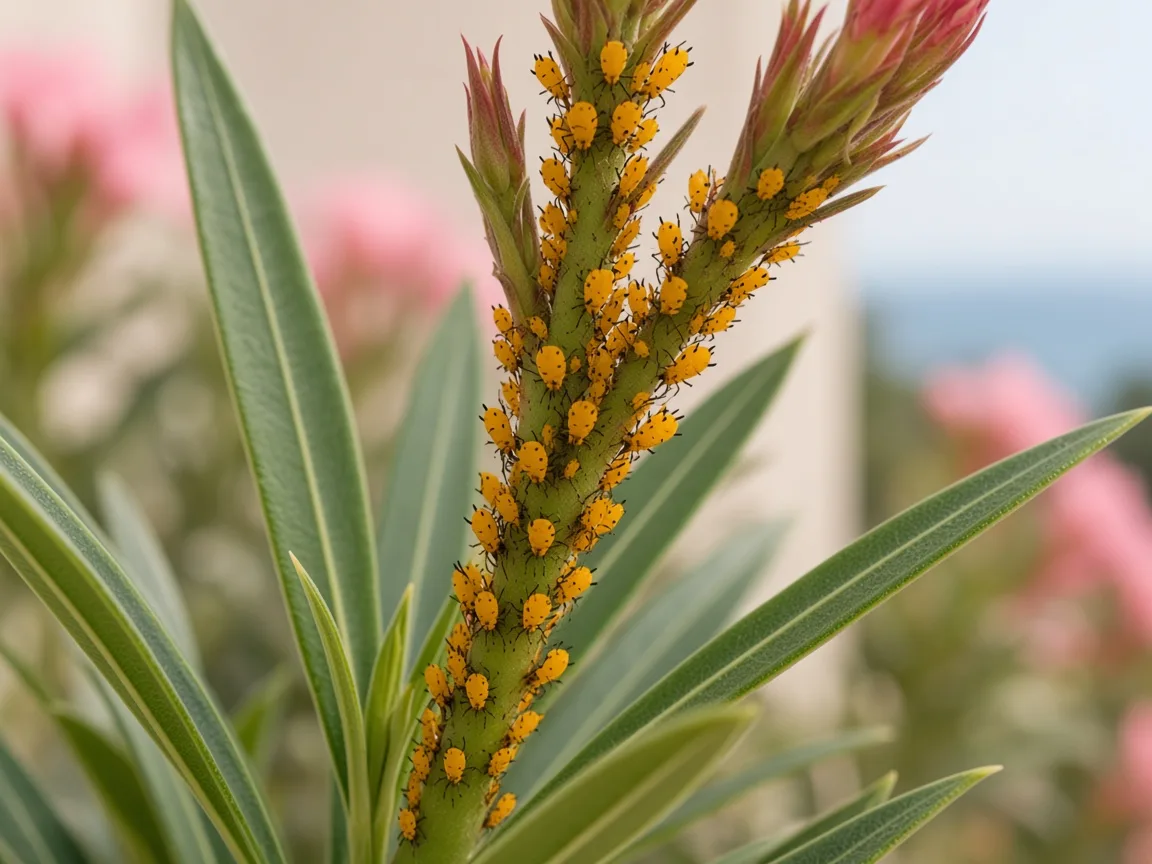
Golden-yellow oleander aphids (Aphis nerii) with contrasting black cornicles and legs crowded along a tender Nerium oleander terminal shoot.
Adult wingless females (apterae) measure approximately 1.5 to 2.5 mm in length. Their bodies display a vibrant, saturated canary-yellow to warm golden-orange hue that contrasts sharply against dark green oleander foliage. Under close inspection or magnification with a 10× hand lens, several key morphological features become evident:
- Contrasting jet-black appendages: The antennae, walking legs, and cauda (tail structure) are shiny black.
- Prominent black cornicles: A pair of cylindrical, upright tubular structures (cornicles or “exhaust pipes”) near the posterior end of the abdomen are entirely black, protruding distinctly from the bright yellow body.
- Winged alate forms: When colonies become overcrowded or food quality declines on maturing shoots, winged females develop. These alates possess smoky-veined, transparent wings held tent-like over their darker, yellow-and-black patterned bodies.
- Nymphal stages: Immature aphids resemble miniature versions of the adults, displaying paler yellow coloring and shorter black cornicles as they develop through four molting instars.
Damage on Nerium oleander presents as clustered colonies packed shoulder-to-shoulder along the softest green stems. As hundreds of individuals feed simultaneously, they excrete clear droplets of sugary waste fluid known as honeydew. This liquid runs down stems and pools on the broad, leathery leaf surfaces below. Within days, airborne fungal spores germinate in these sugar deposits, developing into a dusty or crusty black film of sooty mold that impairs photosynthesis without directly invading the plant’s vascular tissue.
Where aphids hide on Oleander foliage and flower buds
Nerium oleander is a robust, Mediterranean evergreen shrub characterized by stiff, leathery lanceolate leaves typically arranged in whorls of three. Because mature oleander foliage features a thick, waxy cuticle and fibrous internal structure, aphids cannot easily pierce the tough epidermis of older leaves. Instead, colonies focus strictly on tender juvenile tissue:
- Terminal shoot tips and apical buds: The softest tissue on an oleander is found at the apex of vigorously extending stems. Aphids pack into the crevices where young whorled leaves emerge from the terminal shoot.
- Flower trusses and pedicels: Developing flower buds and the tender floral stems (pedicels) that support blooming cymes provide rich, unprotected phloem sap. Dense clusters often envelop flower buds, causing them to distort, brown, or drop before opening.
- Undersides of newly unfurled leaves: Before young leaves harden into their leathery mature state, aphids line the prominent whitish midribs on the lower leaf surface.
- Vigorous water sprouts: Fast-growing vegetative shoots that emerge from the base or inner canopy following heavy spring pruning produce exceptionally soft tissue that attracts early spring colonizers.
Inspect each terminal branch independently. Because winged females arrive on air currents, one sunny branch tip or flowering terminal may host a heavy colony while neighboring branches remain completely uninfested.
The chemical defense: How oleander aphids sequester cardenolides
The interaction between Nerium oleander and Aphis nerii represents one of the most fascinating ecological adaptations in ornamental horticulture. All vegetative parts of oleander contain potent, bitter-tasting cardiac glycosides (principally oleandrin and neriine) that disrupt cellular sodium-potassium pumps and are toxic to grazing animals and humans.
While these secondary metabolites deter mammalian herbivores and most chewing insects, oleander aphids have evolved biochemical mechanisms to ingest, tolerate, and concentrate these compounds. As they drink phloem sap, the aphids sequester cardiac glycosides within their own body tissues and hemolymph.
This chemical storage confers significant defensive advantages:
- Aposematic deterrence: The aphids’ vibrant yellow-and-black coloration advertises their unpalatability to visual predators such as songbirds, lizards, and predatory bugs.
- Predator resistance: Generalist beneficial insects that readily consume green peach aphids or melon aphids often avoid oleander aphids, or experience reduced fitness and larval mortality if they consume them in large quantities.
- Handling hazard: The presence of concentrated cardenolides within both the plant tissue and the feeding insects means gardeners should never rub, crush, or clear colonies with bare skin. Always handle infested branches with gloves to prevent dermal absorption or accidental transfer to the mouth or eyes.
Natural enemies and the Lysiphlebus testaceipes mummy check
Despite their toxic chemical defenses, oleander aphids are not completely invulnerable. A specialized group of beneficial insects can tolerate or bypass these defenses, playing a vital role in natural population suppression. Chief among these is Lysiphlebus testaceipes, a tiny solitary endoparasitoid braconid wasp.
Before initiating any spray application, perform a mummy check using a 10× magnifying glass:
- Look closely at the center and edges of the aphid aggregation on the oleander stem.
- Identify aphids that appear swollen, spherical, and immobile, transformed into hard, papery shells that range in color from pale tan to metallic bronze or dark golden-brown. These are parasitized aphid mummies.
- Check for circular exit holes with clean-cut lids on the upper rear of the mummy’s abdomen. An exit hole indicates that an adult Lysiphlebus testaceipes wasp has completed its larval development inside the host, chewed its way out, and emerged to mate and parasitize dozens of additional aphids.
- Observe predatory larvae: Syrphid fly larvae (maggot-like green or yellow predators) and certain specialized lady beetle adults (Cycloneda sanguinea and Harmonia axyridis) occasionally feed on oleander aphid colonies, though they are less consistent than parasitoid wasps.
The 20% rule for biological control: If you observe that 20% to 30% or more of the aphids in a cluster have swollen into brown mummies, biological parasitism is actively expanding. In warm weather, Lysiphlebus testaceipes can collapse an aphid outbreak within 7 to 10 days. Applying broad-spectrum insecticides or even heavy oil sprays will destroy these emerging adult wasps, eliminating your most effective biological ally and triggering a severe pest rebound.
Why Oleander gets aphid infestations
Oleander aphid infestations are rarely random accidents; they correspond to specific physiological conditions of the shrub and microclimate factors in the landscape:
- Excessive nitrogen fertilization: Pushing oleanders with high-nitrogen fertilizers stimulates rapid, succulent vegetative growth with thin cell walls and high free-amino-acid concentrations in the sap. This creates ideal nutrition for aphid colonization. Oleander naturally thrives in moderate to lean soils; avoid heavy feeding and align your routine with our oleander fertilizer guide.
- Obligate parthenogenesis: In warm climates, oleander aphid populations consist entirely of females that reproduce via thelytokous parthenogenesis. Every adult female gives birth to live, pregnant female nymphs without requiring fertilization. Under temperatures between 70°F and 85°F (21°C–29°C), a generation can develop in under a week, allowing a single colonizer to multiply into hundreds within 14 days.
- Warm, dry weather with low wind: Dry, sunny conditions accelerate reproductive rates while allowing honeydew to dry into thick glaze. Oleanders growing in stagnant, sheltered corners receive less wind disturbance, enabling colonies to expand uninterrupted.
- Ant mutualism: Ants—particularly Argentine ants (Linepithema humile) and pavement ants—are strongly attracted to honeydew. Ants actively patrol infested shoots, physically attacking parasitoid wasps and predatory larvae to protect their sugary food source, effectively shielding aphid colonies from biological control.
- Improper pruning timing: Severe shearing or late-spring pollarding forces dense clusters of tender juvenile shoots right when winged aphids are migrating. For structural safety and balanced growth, follow the timing outlined in our oleander pruning guide.
How to confirm the diagnosis: Step-by-step inspection protocol
Accurately identifying the pest and assessing infestation severity ensures you take the right corrective action without shocking the shrub. Follow this systematic inspection protocol:
- Put on protective gear: Wear puncture-resistant nitrile or rubber gardening gloves and eye protection. Oleander stems exude milky white sap when bruised or bent, which can irritate sensitive skin.
- Inspect terminal shoots and bud clusters: Examine the topmost 4 to 6 inches (10–15 cm) of vigorously growing branches. Look for clusters of bright yellow, soft-bodied insects gathered tightly around the stem axis and bud bases.
- Check for sap-feeder honeydew: Feel the upper surfaces of leaves positioned directly beneath terminal shoots. A sticky, glossy sheen confirms active sap extraction from above.
- Assess for sooty mold development: Look for dark gray or black velvety residue on lower foliage. Confirm that the black discoloration wipes away with a damp cloth, leaving intact green leaf tissue underneath—this proves it is superficial sooty mold on honeydew, rather than necrotic leaf spots or bacterial blight.
- Count parasitoid mummies: Using a 10× hand lens, tally the ratio of healthy yellow aphids to swollen, immobile tan-brown mummies. Note whether exit holes are visible.
- Check base and trunk for ant trails: Look along the primary woody trunks at the soil line for steady columns of ants traveling upward toward the branch tips.
First fix for Oleander: Strong water knockdown and mechanical removal
The most effective, environmentally responsible first step against oleander aphids is physical water dislodgment.
Action: Adjust a garden hose nozzle to a strong, narrow jet spray (or use a pressurized pump sprayer filled with clean water). Direct the spray upward and inward through the infested terminal shoots, bud clusters, and leaf whorls, blasting aphid clusters off the plant.
Why this works as the single best first intervention:
- High nymph mortality: Aphids are soft-bodied, wingless, and relatively fragile. Dislodging them with high water pressure ruptures delicate mouthparts and bodies.
- Poor climbing mobility: Once knocked to the ground or washed into landscape mulch, wingless nymphs rarely possess the stamina or navigational ability to locate and re-climb a tall, woody oleander trunk. Ground predators (ground beetles, wolf spiders, and predatory mites) quickly consume grounded aphids.
- Preserves beneficial wasps: Parasitoid wasps and predatory larvae clinging to stems withstand water jets far better than soft-bodied aphids, leaving your biological control system intact.
- Cleanses honeydew and dust: Water pressure instantly rinses sticky honeydew from lower foliage, depriving sooty mold of its carbohydrate food source and removing road dust that inhibits natural predators.
- Sap safety: High-pressure water knockdown eliminates the need to touch, pinch, or wipe toxic plant tissue or squish cardenolide-laden insects by hand.
Container care note: If your oleander is grown in a patio pot, tilt the container slightly away from the spray trajectory or cover the potting soil with plastic wrap during the wash. This prevents heavy jets of water from over-saturating the substrate, safeguarding against drainage issues covered in our oleander watering guide.
Step-by-step recovery and treatment plan
After performing your initial water knockdown, execute the following secondary management steps over the subsequent two weeks:
Step 1: Manage ant access
If ant trails were identified climbing the main stems, place a physical barrier to block them. Wrap a 3-inch band of heavy paper or masking tape around the lower woody trunks (never apply adhesive directly to tender green bark) and coat the exterior of the paper band with sticky pest barrier (such as Tanglefoot). Without ant bodyguards harassing them, parasitoid wasps and hoverfly larvae will quickly eliminate any aphids that survive water rinsing.
Step 2: Scout at 48 to 72 hours
Re-inspect terminal shoots two to three days after the initial water spray. Small pockets of newly emerged nymphs or aphids sheltered in tight bud crevices may remain. If isolated clusters persist and parasitoid mummies comprise less than 20% of the population, proceed to targeted treatment.
Step 3: Targeted insecticidal soap spray
If colonies rebound and natural predators are absent, apply a commercially formulated insecticidal soap (potassium salts of fatty acids) diluted according to label directions (typically a 1% to 2% solution):
- Spray thoroughly to achieve complete contact coverage on terminal clusters, bud crevices, and leaf undersides. Soaps work strictly by disrupting insect cell membranes upon direct wet contact; they offer no residual killing action once dry.
- Apply strictly during the early morning or late evening when temperatures are below 85°F (29°C) and the plant is not in direct midday sun. Spraying oils or soaps under intense hot sun can cause phytotoxic foliar scorch on tender growth.
- Avoid spraying open flowers to prevent petal discoloration.
Step 4: Selective pruning of severe flower trusses
If a small number of terminal flower trusses are overwhelmingly encrusted with aphids, honeydew, and heavy sooty mold, prune them out using sharp, bypass hand shears. Make clean cuts just above a leaf node. Always wear gloves, collect clippings directly into a plastic disposal bag, and wash your pruners thoroughly afterward.
Step 5: Clean residual sooty mold
Wipe or rinse lower leathery leaves with plain water or a very mild horticultural soap solution to wash away weathered sooty mold. Once the aphids are gone and honeydew production stops, existing mold gradually dries, peels, and washes off with rain and regular overhead watering.
Recovery timeline and improvement signs
Oleanders are vigorous, resilient woody shrubs that rebound rapidly from pest damage once sap extraction ceases.
| Timeframe | Expected plant response | What to look for |
|---|---|---|
| Day 1–3 | Immediate colony knockdown; honeydew rinsed away | 80% to 95% reduction in active yellow aphids; clean, non-sticky lower leaves |
| Day 4–7 | Residual nymphs stabilize; parasitoid mummies expand | Appearance of tan-brown mummies; absence of ants; no new sticky honeydew |
| Week 2 | Parasitoid wasps emerge; terminal growth resumes | Circular exit holes in mummies; apex leaves beginning to extend cleanly |
| Week 3–4 | Fresh floral flushes develop; sooty mold flakes off | Distorted older leaves remain scarred but new growth emerges flat and vigorous; clean blossoms |
Signs of genuine recovery:
- Terminal shoots and floral trusses extend without curling or puckering.
- No fresh, glossy droplets of honeydew appear on upper leaf surfaces.
- Remaining mummies show clean circular exit holes, confirming adult wasp emergence.
- The shrub maintains firm, upright stem architecture and normal flowering rhythm under full outdoor sunlight.
Signs of treatment failure or secondary decline:
- Dense yellow aphid clusters reappear across multiple branch terminals within 5 days (indicates uncontrolled ant activity or failure to hit cryptic crevices).
- Black sooty mold continues to spread across newly opened leaves (indicates continuous honeydew deposition).
- Stems become soft or leaves drop prematurely without sap feeders present—if this occurs, cross-check for root problems using our oleander soil guide.
Lookalike symptoms and differential diagnosis
Before treating an oleander, rule out other common pests and physiological conditions that share similar visual markers:
| Symptom / Marker | Oleander Aphid (Aphis nerii) | Oleander Caterpillar (Syntomeida epilais) | Mealybugs (Pseudococcus spp.) | Two-Spotted Spider Mites (Tetranychus urticae) |
|---|---|---|---|---|
| Pest appearance | Bright canary-yellow bodies, jet-black legs and cornicles | Orange-red caterpillars with black hair tufts and white spots | Oval, segmented pinkish bodies coated in white powdery wax | Microscopic oval bodies (yellowish-green with 2 dark spots) |
| Primary feeding site | Terminal shoot tips, pedicels, tender young whorls | Foliage margins across young and mature leaves | Branch forks, leaf axils, hidden stem crevices | Undersides of mature and intermediate leaves |
| Feeding mechanism | Piercing-sucking (phloem sap) | Chewing (defoliating leaf tissue) | Piercing-sucking (phloem sap) | Piercing-sucking (cell contents) |
| Characteristic sign | Sticky honeydew and black sooty mold | Skeletonized leaf tissue, missing leaf margins, black frass pellets | White cottony egg sacs and sticky honeydew | Fine, dusty silk webbing and pale foliar stippling |
| Leaf distortion | Curled, puckered, or stunted new growth | Ragged, chewed foliage; defoliated shoot tips | Stunted shoot growth; yellowing in leaf axils | Bronzed, bleached, or prematurely dropped leaves |
Mistakes to avoid when managing aphids on Oleander
Avoid these common horticultural errors that worsen aphid problems or risk personal safety:
- Applying broad-spectrum synthetic pyrethroids or organophosphates: Chemical insecticides like permethrin, bifenthrin, or malathion kill beneficial insects (Lysiphlebus testaceipes wasps, lady beetles, and hoverflies) far more effectively than they kill aphids. Because aphids reproduce rapidly through parthenogenesis, survivors multiply without natural controls, leading to massive secondary pest outbreaks.
- Handling plants or squishing aphids bare-handed: Both the host shrub (Nerium oleander) and the aphids (Aphis nerii) contain concentrated cardiac glycosides. Never crush colonies by hand or rub stems without wearing gloves.
- Burning pruned oleander clippings: If you prune out heavily infested shoots, never dispose of them in a fire pit or burn pile. Inhaling smoke from burning oleander wood or foliage can cause severe pulmonary and systemic intoxication. Always seal trimmings in garden bags for municipal green waste disposal.
- Over-fertilizing with high-nitrogen formulas: Applying fast-release chemical fertilizers stimulates excess succulent growth that serves as an open invitation for migrating aphids. Stick to balanced, slow-release formulas applied sparingly in spring.
- Spraying insecticidal soap in full midday sun: Applying soap solutions when temperatures exceed 85°F to 90°F (29°C–32°C) under direct sun causes severe leaf burn (phytotoxicity). Always spray at dusk or on overcast mornings.
- Flooding container soil during water knockdown: Repeatedly blasting a potted oleander without covering the container substrate can saturate the root zone, turning a minor foliar pest issue into a life-threatening root problem.
How to prevent aphid infestations next time
Maintaining cultural vigor and practicing early-season scouting are your best defenses against severe infestations:
- Provide abundant full sun: Grow oleander where it receives at least 6 to 8 hours of unfiltered direct sunlight daily. Strong sun produces sturdy, thick-walled foliage and firm stems that resist aphid stylet penetration. Review lighting conditions in our oleander light guide.
- Ensure fast soil drainage: Plant oleanders in well-drained, porous soil or potting substrates amended with perlite or coarse sand. Established shrubs are drought-tolerant; allowing the top 2 inches (5 cm) of soil to dry between waterings prevents stress that invites opportunistic pests. Consult our oleander soil guide for ideal soil recipes.
- Scout early in spring: Begin checking terminal shoots weekly as soon as daytime temperatures regularly exceed 65°F (18°C). Dislodging the first one or two colonizing females prevents exponential population explosions later in the season.
- Avoid heavy summer shearing: Perform structural pruning in late winter or early spring before seasonal growth begins. Avoid midsummer shearing that forces soft flushes during peak aphid flight periods.
- Support biodiversity: Plant nectar-producing flowering companion plants (such as sweet alyssum, dill, and coreopsis) nearby to provide pollen and nectar for adult parasitoid wasps and hoverflies.
When to worry
On mature, established landscape oleanders, moderate aphid colonies on terminal tips are primarily an aesthetic issue rather than a fatal threat. A healthy shrub can easily tolerate 10% to 15% shoot colonization without suffering permanent structural harm, and natural enemies will often balance the population if left unsprayed.
However, escalate your intervention promptly under the following circumstances:
- Young container-grown oleanders: Small potted plants possess limited leaf area; heavy sap drain on terminal tips can arrest growth and cause severe stem dieback.
- Total floral truss collapse: When high-density colonies colonize every emerging flower bud, preventing normal summer blooming.
- Severe sooty mold covering more than 40% of the canopy: Thick sooty mold blocks sunlight from reaching photosynthetic pigments, weakening overall carbohydrate production and causing premature leaf drop.
- Symptoms of bacterial leaf scorch: If leaf tips turn brown and die back with a distinct yellow halo on plants showing vascular wilt, inspect for glassy-winged sharpshooters and evaluate for Xylella fastidiosa infection rather than aphid damage alone.
Related Oleander guides
- Oleander Overview — Complete botanical profile, landscape culture, and safety
- Oleander Watering Guide — Proper deep watering cycles and container moisture control
- Oleander Light Guide — Full sun exposure requirements for pest-resilient shrubs
- Oleander Soil Guide — Fast-draining soil mixes for landscape borders and pots
- Oleander Pruning Guide — Pruning techniques, seasonal timing, and sap safety
- Oleander Fertilizer Guide — Balanced feeding schedules to avoid excess tender growth
- Oleander Spider Mites — Distinguishing fine webbing and foliar stippling from aphid damage
- Oleander Mealybugs — Managing white cottony sap-feeders in branch axils
- Oleander Yellow Leaves — Diagnosing nutritional, watering, and seasonal leaf yellowing
- Oleander Problems Hub — Comprehensive symptom solver for all physiological and pest issues
Conclusion
Oleander aphids (Aphis nerii) are specialized pests that exploit the softest new growth on Nerium oleander, relying on bright warning coloration and sequestered cardiac glycosides to deter common predators. Successful management does not require aggressive chemical warfare. By putting on protective gloves, checking first for beneficial parasitoid wasp mummies (Lysiphlebus testaceipes), knocking down colonies with strong water jets, and excluding honeydew-seeking ants, you can protect your oleander’s terminal shoots and vibrant summer blossoms safely and naturally.
Related tool
Use the Humidity Calculator to check the vapor pressure deficit and atmospheric drying rate around your oleanders, ensuring foliage and stems dry rapidly after water rinses to avoid fungal leaf spotting while managing sap-feeding pests.