Spider Mites on Oleander: Identification, Checks & Safe
Quick answer
Two-spotted spider mites (Tetranychus urticae) thrive in hot, arid summer heat or dry indoor winter air, piercing the tough foliage of Nerium oleander to cause fine chlorotic stippling, bronzing, and delicate silk webbing in leaf axils. First step: Put on waterproof gardening gloves and eye protection to guard against toxic oleander sap, then use a forceful jet of water to knock down webbing and dislodge mite colonies before applying insecticidal soap or releasing predatory mites.
Spider Mites on Oleander: Identification, Checks & Safe Treatment
This guide covers spider mites on Oleander. See also the general Spider Mites guide, watering, and light pages for this plant.
Spider Mites on Oleander: Identification, Checks & Safe Treatment
Quick answer
Two-spotted spider mites (Tetranychus urticae) are microscopic arachnid pests that pierce the stiff, leathery foliage of Nerium oleander to extract cellular sap, leaving behind a characteristic pattern of fine chlorotic stippling, dusty bronzing, and delicate silk webbing across leaf axils and branch tips. Because spider mites flourish in hot, arid conditions, infestations peak during parched summer heat outdoors or in dry, heated living spaces during winter overwintering.
For foundational mite biology, life cycle charts, and global eradication tactics across all indoor and landscape plants, refer to our comprehensive spider mites pest guide. On oleander, successful control requires accounting for the shrub’s leathery leaf structure, understanding why toxic cardiac glycosides fail to deter these pests, and following essential dermal protection protocols whenever spraying, washing, or pruning this poisonous plant.
First step: Put on waterproof gardening gloves, long sleeves, and eye protection to guard against toxic cardiac glycosides in oleander sap, then use a forceful jet of water focused on leaf undersides and branch axils to knock down webbing and dislodge active colonies before rotating in insecticidal soaps or predatory mites.
When to use this page vs other Oleander guides
Sucking pests, environmental drought, and vascular diseases on Nerium oleander can create deceptively similar foliar symptoms. Use this diagnostic routing table to determine whether spider mites or another underlying factor requires your attention:
| Observed symptom pattern | Primary diagnosis | Recommended guide |
|---|---|---|
| Microscopic stippling, bronzing, and fine silk webbing in leaf axils | Two-spotted spider mites (Tetranychus urticae) | This diagnostic guide |
| Dense clusters of bright canary-yellow insects on tender shoots and flower buds | Oleander aphids (Aphis nerii) | Oleander aphids |
| White cottony cushions in leaf whorls and stem nodes; sticky honeydew | Mealybugs (Pseudococcidae) | Oleander mealybugs |
| Uniform crispy leaf tips and marginal scorch across mature foliage | Drought stress or fertilizer salt accumulation | Oleander brown tips |
| Localized branch browning with a bright yellow chlorotic margin | Oleander Leaf Scorch (Xylella fastidiosa) | Oleander problems hub |
| Overall stem droop and dull foliage in dry potting mix | Dehydrated root ball | Oleander underwatering |
| Yellowing lower leaves that drop prematurely; wet, soggy root ball | Over-saturation and root hypoxia | Oleander watering guide |
What spider mite damage looks like on Oleander
Because Nerium oleander possesses tough, coriaceous (leathery) foliage, early spider mite feeding can go unnoticed until a substantial population is established. Unlike soft-leaved houseplants that wilt rapidly when attacked, oleander leaves maintain their rigid structural form even under heavy pest pressure.
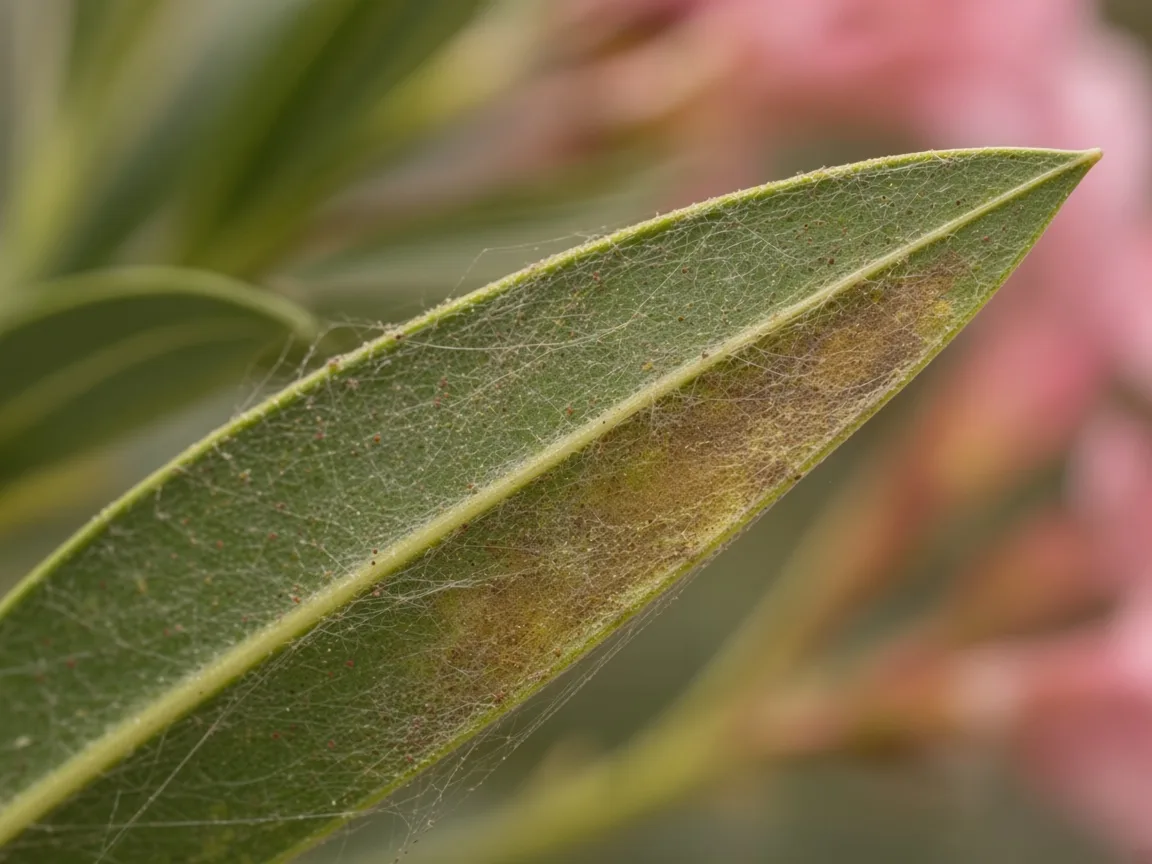
Fine chlorotic stippling, bronzing, and delicate silk webbing produced by two-spotted spider mites (Tetranychus urticae) on Nerium oleander foliage.
When two-spotted spider mites (Tetranychus urticae) colonize an oleander, look for these progressive visual and tactile symptoms:
- Foliar stippling: As hundreds of mites puncture epidermal cells with their needle-like cheliceral stylets, they suck out the liquid contents, including green chlorophyll. This produces thousands of microscopic, pinpoint white or pale yellow specks across the upper surface of the leaf blade, known as fine chlorotic stippling.
- Bronzing and bleaching: As feeding intensifies, individual stipples coalesce. The deep olive-green color of healthy oleander foliage fades into a dull, matte yellow, grayish-bronze, or metallic coppery hue. Affected leaves lose their natural sheen and feel unusually rough and dry.
- Silk webbing in leaf axils: Spider mites produce fine silken strands to protect themselves from predators and create micro-climates of higher humidity. Look closely where the leaf petiole joins the woody stem (the leaf axils) and across the terminal whorls of three leaves. In advanced cases, sheets of fine, veil-like silk span entire branch tips.
- Dusty foliar undersides: The undersides of infested leaves look dirty and gritty, covered with cast-off white nymphal exuviae (molted skins), round translucent eggs, and minuscule amber-to-greenish arachnids that resemble moving specks of dust.
- Premature leaf shedding: Badly damaged leaves become completely chlorotic, turn brittle tan, and drop prematurely from the lower branches, leaving bare, leggy woody stems with sparse foliage clustered only at the tips.
Why Oleander is vulnerable: Arid conditions and indoor winter air
Nerium oleander is a classic Mediterranean shrub celebrated for its outstanding drought tolerance and affinity for intense, baking sunlight. Learn more about optimal sun parameters in our Oleander light guide. Paradoxically, the exact cultural environments in which oleander thrives outdoors are the precise microclimates that trigger explosive spider mite outbreaks.
The hot, arid summer catalyst
Spider mites have an exceptionally rapid reproductive cycle governed by ambient temperature. In moderate conditions (70°F / 21°C), Tetranychus urticae takes roughly two to three weeks to develop from egg to reproductive adult. However, during hot, dry conditions exceeding 85°F to 90°F (29°C to 32°C) with relative humidity dipping below 40%, this cycle accelerates dramatically.
Under peak summer conditions, a single female can mature in as little as 5 to 7 days, laying up to a dozen eggs per day. Combined with a lack of rainfall and low atmospheric moisture, outdoor landscape oleanders or container specimens on hot sunny patios can see a handful of dormant mites mushroom into an overwhelming colony of tens of thousands within two weeks.
The indoor overwintering trap
In USDA Hardiness Zones 7 and colder, potted oleanders are brought indoors to overwinter in frost-free garages, sunrooms, or bright living spaces. Indoor heating systems drastically reduce indoor relative humidity, often driving ambient levels down to 20% to 30%. In this arid, still indoor air—devoid of natural predatory insects and rain washdown—spider mites that overwintered invisibly on stem crevices or under leaf scars break dormancy and proliferate aggressively across branch terminals.
Oleander leaf morphology: How thick cuticles hide early stippling
Understanding the botanical architecture of Nerium oleander explains why gardeners often fail to detect spider mites until foliar damage is severe:
- Thick, waxy upper cuticles: Oleander leaves are adapted to conserve water in arid Mediterranean climates through a heavy, protective cuticular wax layer on the adaxial (upper) leaf surface. This waxy barrier masks early cell puncture marks. By the time noticeable yellowing or bronzing reflects through the thick cuticle, thousands of epidermal cells have already died.
- Sunken stomatal crypts on leaf undersides: The abaxial (lower) surface of oleander foliage features deep stomatal crypts lined with microscopic hairs (trichomes) designed to minimize transpiration. Spider mites instinctively colonize these sheltered crypts and depressions along the prominent whitish midrib. The microscopic hairs provide scaffolding for silk anchoring and protect the mites and their spherical eggs from passing air currents.
- Rigid structural fibers: Unlike herbaceous plants that droop or curl quickly under pest-induced water loss, oleander’s thick internal sclerenchyma fibers keep the leaf blade rigid and flat. The plant gives no macroscopic structural warning until the chlorophyll loss is so total that the leaf abruptly browns and abscises.
Cardiac glycosides vs. spider mites: Why natural plant toxins fail
Every portion of Nerium oleander—from its woody roots to its floral petals—contains dangerous concentrations of cardiac glycosides, predominantly oleandrin, neriine, and folinerin. While these secondary metabolites act as a potent physiological deterrent against grazing mammals, deer, rodents, and many broad-spectrum insect chewers, two-spotted spider mites are completely unbothered by them.
Research into mite genomics shows that Tetranychus urticae possesses an extraordinarily diversified set of detoxification gene families, including cytochrome P450 monooxygenases, glutathione S-transferases, and carboxyl/cholinesterase enzymes. Because spider mites have evolved to feed on over 1,100 plant species across distinct botanical families, their digestive enzymes allow them to neutralize or excrete complex plant toxins without suffering cell membrane or cardiac disruption. Gardeners must never assume that an oleander’s natural toxicity will protect it from arachnid infestation.
Sap safety protocol: PPE and safe washdown of a poisonous shrub
Before executing any physical or chemical intervention on an infested oleander, you must establish strict personal protective protocols. Cutting, scrubbing, or forcefully washing Nerium oleander foliage can rupture plant tissues, releasing a milky white latex sap containing concentrated cardiac glycosides that pose dermal and ingestion risks.
Follow these safety rules:
- Wear impervious nitrile or heavy rubber gardening gloves: Standard cloth gardening gloves absorb milky sap and press it against your skin, potentially causing contact dermatitis, numbness, severe rashes, and blistering.
- Wear eye protection: Never spray high-pressure water or foliar treatments onto an oleander at eye level without safety glasses. High-velocity hose backspray carrying droplets of oleander sap can cause intense chemical conjunctivitis and temporary corneal irritation.
- Wear long sleeves and wash tools immediately: Wear washable long sleeves that can be laundered immediately after garden work. If shears are used to prune out heavily webbed terminal tips, sterilize them with 70% isopropyl alcohol and dispose of clippings in closed trash bags. Never burn oleander clippings, as the aerosolized smoke carries toxic glycoside particles that induce severe respiratory distress.
Diagnostic checks: How to confirm spider mites on Oleander
Do not treat an oleander based on visual bronzing alone, as nutrient imbalances and root stress can also discolour foliage. Confirm live mites using this systematic diagnostic procedure:
1. The white paper tap test
Take a standard sheet of white printer paper or an index card. Hold it directly underneath a branch showing dull, stippled leaves or fine webbing. With your gloved hand, strike the branch firmly three or four times. Wait five seconds, then observe the paper in bright light.
- Dislodged dust and plant debris will remain motionless.
- Spider mites will appear as tiny round specks (yellow, amber, greenish, or reddish-brown, roughly 0.5 mm in size) that begin crawling slowly across the white surface. If you smear your finger across the walking specks, they leave tiny greenish or yellow streaks.
2. Hand lens inspection (10× to 20× magnification)
Examine the underside of the leaf along the pale midrib using a jeweler’s loupe or magnifying glass:
- Look for adult mites possessing oval bodies with two distinct dark lateral spots on the abdomen.
- Look for spherical, translucent-to-pearly eggs anchored to the leaf surface among fine silken strands.
- Look for white papery molted skins (exuviae), which indicate an actively reproducing, growing population.
3. Webbing mapping
Inspect leaf axils where the petioles clasp the stem, particularly around the three-leaf whorls at branch apices. In early stages, silk strands are barely visible; in advanced infestations, dense webbing wraps around entire flower clusters and terminal bud tips.
First fix: Pressurized water spray and mechanical dislodgement
The most effective, non-toxic first response for spider mites on oleander is immediate mechanical removal. A forceful jet of water shatters the delicate silk micro-climate, drowns nymphs, and blasts thousands of active adults off the plant. Because spider mites are weak crawlers, dislodged mites on the ground rarely succeed in climbing back up the woody stems before dying of dehydration or predation.
Step-by-step washdown technique
- Move potted plants: If your oleander is in a container, move it to an open outdoor area or a shower stall where pressurized water can drain freely without blowing onto neighboring susceptible ornamentals.
- Adjust hose nozzle: Set a garden hose nozzle to a concentrated “flat” or “jet” pattern that delivers strong physical force without tearing healthy leaves.
- Spray from underneath: Hold the nozzle low and angle the spray upward. Focus directly on the undersides of leaves, sweeping methodically from the base of the plant toward the branch tips.
- Scour leaf axils: Direct the blast into the crevices where leaves meet the stems to purge accumulated webbing, eggs, and dust.
- Cover the root ball: For container-grown oleanders, tilt the pot slightly so excess run-off drains away rather than saturating the potting medium. To maintain root aeration, ensure your plant is potted in an open, gritty substrate as outlined in our Oleander soil guide.
- Repeat cadence: Water washing kills no eggs. Repeat this pressurized rinse every 3 to 4 days for two consecutive weeks to dislodge newly hatched nymphs before they reach reproductive maturity.
Secondary biological and chemical treatments
When high summer temperatures or dense shrub canopies prevent water sprays alone from resolving the outbreak, escalate to biological controls or targeted, non-persistent contact sprays.
Biological control: Releasing predatory mites
In outdoor garden settings, enclosed patios, or greenhouses, releasing commercial predatory phytoseiid mites provides continuous, self-sustaining eradication without chemical residues.
- For moderate temperatures and higher humidity: Release predatory mites such as Phytoseiulus persimilis. Phytoseiulus persimilis is an obligate spider mite predator that feeds voraciously on all life stages of Tetranychus urticae. It operates most effectively between 68°F and 80°F (20°C to 27°C) when relative humidity is maintained above 60%.
- For hot, arid Mediterranean conditions: Release Neoseiulus californicus (formerly Amblyseius californicus). This species tolerates lower humidity (down to 40%) and higher summer temperatures (up to 95°F / 35°C), making it far better suited for landscape oleanders during summer heatwaves. It can also survive on pollen when spider mite populations drop, preventing sudden predator starvation.
- Predator release rules: Release predatory mites in the early morning or evening when temperatures are cool. Mist the oleander lightly before release to give the predators drinking water. Never apply any chemical insecticides, neem oil, or sulfur within 14 days before or after releasing biological controls, as residues will kill the beneficial predators.
Chemical rotation: Insecticidal soaps and horticultural oils
If predatory mites are not viable, rotate between low-impact contact miticides. Spider mites reproduce so rapidly that they develop resistance to synthetic miticides within a few generations; however, physical smothering agents bypass genetic resistance.
- Insecticidal soaps (potassium salts of fatty acids): Soaps dissolve the protective waxy outer cuticle of the mites, causing rapid fatal desiccation upon direct contact. Mix at 1% to 2% according to label directions and thoroughly drench both the upper and lower leaf surfaces. Soaps leave no toxic residue once dry, making them safe for plants and beneficials visiting hours later.
- Horticultural oils (paraffinic mineral oils or refined neem oil): Oils coat the breathing spiracles of mites and suffocate eggs. Apply a 1% to 2% summer-weight horticultural oil during the cooler hours of early morning or late afternoon.
The critical oil-and-heat safety rule
Nerium oleander leaves can suffer severe phytotoxic burn if horticultural oils are applied during high temperatures or intense direct sun. Never spray horticultural oil when ambient temperatures exceed 85°F to 90°F (29°C to 32°C), or when the shrub is suffering from root drought. Ensure the plant is deeply hydrated 24 hours before spraying. Follow proper watering techniques detailed in our Oleander watering guide.
Spray rotation schedule
To completely break the pest reproductive cycle, execute this 14-day rotation:
- Day 1: Perform thorough pressurized water washdown to knock down webbing and majority adults.
- Day 3: Apply insecticidal soap spray, thoroughly coating leaf undersides and axils.
- Day 7: Apply 1% horticultural mineral oil spray to target surviving adults and newly laid eggs.
- Day 11: Apply insecticidal soap spray to eliminate freshly emerged nymphs before they mature.
- Day 14: Inspect with a 10× hand lens; if crawling mites persist, repeat a final soap or water treatment.
Chemical warning: Why broad-spectrum insecticides make mites worse
A frequent and disastrous mistake made by homeowners is spraying common garden insecticides containing synthetic pyrethroids (e.g., bifenthrin, cyfluthrin, permethrin) or carbaryl on oleanders infested with spider mites.
According to university extension research, broad-spectrum insecticides kill beneficial natural predators—such as minute pirate bugs (Orius spp.), predatory thrips, lacewings, and native phytoseiid mites—while failing to eliminate spider mites. Furthermore, sub-lethal doses of pyrethroids have been shown to stimulate reproductive rates in female two-spotted spider mites (hormoligosis), leading to severe secondary population explosions far worse than the initial infestation.
Lookalike symptoms on Oleander
Before applying any treatment, ensure you have correctly identified spider mite activity rather than one of these common oleander lookalikes:
| Suspected issue | Key distinguishing features | How to verify |
|---|---|---|
| Lace bugs (Corythucha spp.) | Coarse, bleached foliar stippling accompanied by shiny, hard black tar-like fecal drops on leaf undersides. No fine silk webbing. | Inspect leaf undersides for flattened lace bugs with clear, reticulated lace-like wings. |
| Thrips (Thysanoptera) | Silvery, bleached patches on petals and leaves, fine dark fecal specks, distorted new growth. | Tap branch over paper; thrips are slender, elongated insects that flick or hop rather than crawl slowly. |
| Under-watering / drought stress | Foliage loses turgor and dulls; leaves curl inward lengthwise along the midrib; no stippling or webbing. | Check soil moisture 2 inches down; inspect our Oleander underwatering guide. |
| Oleander Leaf Scorch (Xylella fastidiosa) | Dramatic yellow chlorotic band separating necrotic brown leaf margins from green tissue; localized to individual branches. | Look for xylem-feeding sharpshooters; leaf margins scorch without any webbing or surface stippling. |
| Nutritional chlorosis | Interveinal yellowing with green veins on new growth (iron deficiency) or uniform pale yellowing on older leaves (nitrogen deficiency); no stippling. | Review feeding protocols in our Oleander problems hub. |
Long-term recovery and prevention
Once active mite colonies are eliminated, implement cultural practices that discourage spider mites from recolonizing your oleanders:
1. Maintain adequate root hydration
While oleander is famed for surviving extreme drought once established in landscape soil, prolonged drought stress alters the plant’s sap chemistry, increasing soluble nitrogen and amino acids that make foliage substantially more nutritious for spider mites. Provide consistent, deep irrigations during extended summer dry spells.
2. Boost ambient humidity for overwintering plants
When bringing container oleanders indoors for the winter, group plants together on pebble trays filled with water (ensuring pot bottoms sit above the water line), run an ultrasonic room humidifier, or mist foliage periodically with soft water. Keeping relative humidity above 50% slows mite reproduction to near zero.
3. Wash down landscape shrubs periodically
In dry, dusty Mediterranean or desert climates, dust accumulation on oleander leaves inhibits natural predators and promotes mite proliferation. Every 2 to 3 weeks during hot, rainless periods, give outdoor oleanders a vigorous hose rinse in the early morning so foliage dries quickly under full sun.
4. Prune out dense, crowded canopies
Spider mites thrive in stagnant, sheltered foliage inside neglected, dense bushes. In early spring, prune out weak, crossing branches and open up the interior canopy to maximize airflow and sunlight penetration. Wear gloves during pruning, and review proper seasonal pruning cuts in our Oleander pruning guide.
Related Oleander guides
Explore our comprehensive care guides to keep your Nerium oleander vigorous, resilient, and pest-free:
- Oleander Overview — Botanical profile, landscape hardiness, mature sizing, and toxicity handling protocols
- Oleander Watering Guide — Deep irrigation strategies for summer heat, winter rest, and container moisture control
- Oleander Light Guide — Full sun exposure benchmarks, indoor winter overwintering, and UV requirements
- Oleander Soil Guide — Gritty, well-draining soil mixes for containers and landscape planting beds
- Oleander Problems Hub — Complete diagnostic index for resolving chlorosis, wilt, bacterial scorch, and pest infestations
Related tool
Use our interactive Humidity Calculator to calculate the vapor pressure deficit (VPD) and atmospheric drying rates around your oleanders. Maintaining ideal humidity levels during indoor winter overwintering halts spider mite reproduction while preventing fungal leaf spotting.