Fungus Gnats on Oleander: Identification, Larval Control &
Quick answer
Fungus gnats (Bradysia spp.) on container Oleander (Nerium oleander) indicate that the potting soil is remaining continuously saturated, fostering fungal growth that feeds subterranean gnat larvae. While adult gnats are harmless fliers, high larval populations feed on delicate feeder roots and root hairs, impairing moisture absorption on this drought-adapted shrub. First steps: allow the top 5 to 7 cm of potting mix to dry out completely, place yellow sticky cards near the soil line to catch adults, and drench the root zone with Bacillus thuringiensis israelensis (BTI).
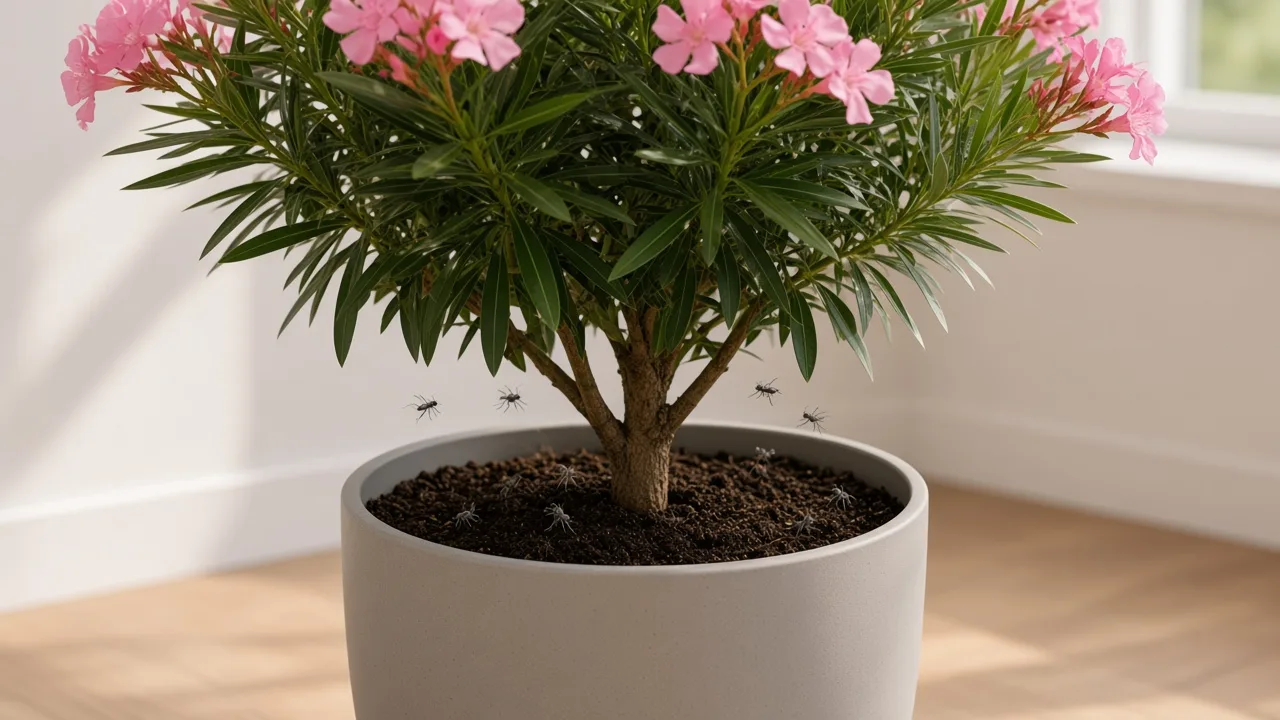
Fungus Gnats on Oleander: Identification, Larval Control & Soil Drying
This guide covers fungus gnats on Oleander. See also the general Fungus Gnats guide, watering, and light pages for this plant.
Fungus Gnats on Oleander: Identification, Larval Control & Soil Drying
Quick answer
Fungus gnats (Bradysia species) around container-grown Nerium oleander are an unmistakable biological indicator of chronic soil saturation and excess organic moisture. While adult gnats are harmless fliers that do not feed on oleander stems or foliage, their underground larvae consume root hairs and mycorrhizae within the upper 5 to 8 centimeters of damp potting soil. In container oleanders, root damage causes subtle foliage stress, including drooping leaves and heightened vulnerability to root rot. To eradicate them quickly, let the top 5 to 7 centimeters of potting substrate dry out completely, position yellow sticky cards horizontally above the soil, and drench the root column with Bacillus thuringiensis israelensis (BTI).
For universal lifecycle and eradication strategies across indoor and outdoor container plants, consult our comprehensive guide on fungus gnats.
What fungus gnats look like on Oleander
Fungus gnat infestations on oleander present both surface behavioral symptoms and root-level warning signs:
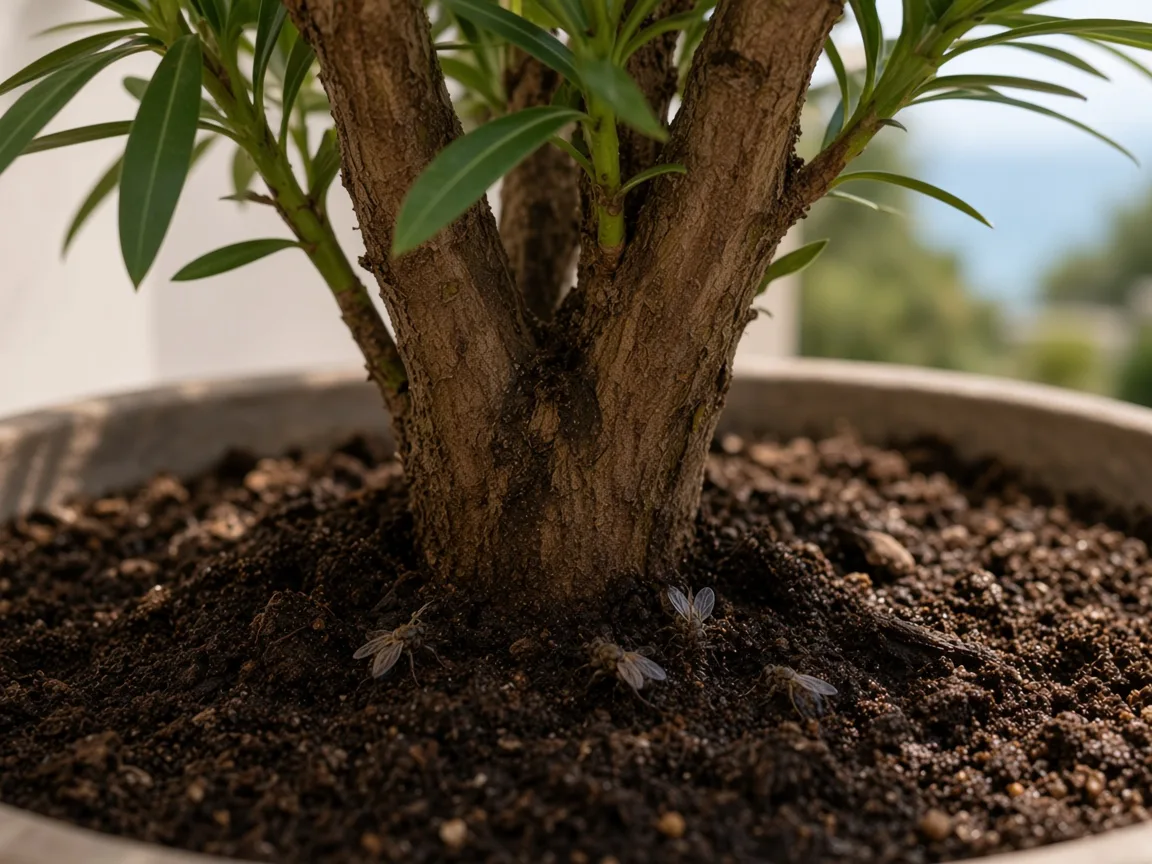
Close-up of the soil surface of a potted Oleander showing adult fungus gnats resting on damp potting substrate.
- Weak, erratic adult fliers: Tiny (2 to 3 mm), delicate grayish-black flies that flutter weakly around the base of the woody oleander trunk, hovering just above the soil surface or scattering when the container is moved.
- Glassy larvae in the root zone: Scraping aside the top layer of damp potting mix reveals slender, translucent-white maggots (4 to 6 mm) featuring shiny, jet-black head capsules wriggling among peat fibers.
- Subterranean root feeding: Larval feeding strips away microscopic root hairs responsible for water and nutrient intake. On young or newly potted oleanders, this manifests above ground as slight foliar limpness or brown tips.
- Algae or mold presence: A green algal haze or white saprophytic mycelium often coats the soil surface, confirming excessive moisture retention that attracts ovipositing female gnats.
- Distinguishing from lookalikes: Unlike shore flies with stout bodies and short antennae, fungus gnats possess long, mosquito-like legs, beaded antennae longer than their heads, and a distinct Y-shaped wing vein, as detailed by UC IPM.
If left unchecked in waterlogged containers, persistent larval root grazing promotes pathogenic fungal invasion, causing canopy thinning and slow growth.
Why container Oleanders attract fungus gnats
In their native Mediterranean and subtropical habitats, oleanders establish deep, resilient taproots and fibrous networks in rocky stream beds and well-aerated gravel banks, as documented by NC State Extension and Missouri Botanical Garden.
When grown in containers, specific cultural conditions foster gnat outbreaks:
1. Chronic surface moisture and over-irrigation
Oleanders are highly drought-tolerant once established. However, frequent, shallow watering keeps the top layer of potting mix permanently damp, creating the saturated microhabitat necessary for gnat eggs to hatch within 3 to 4 days, as noted by the Wisconsin Horticulture Division of Extension.
2. Dense, peat-based potting substrates
Standard commercial potting soils rich in uncomposted peat moss, coir, or wood fines retain high moisture and support decaying organic matter. This fungal mycelium serves as the primary nutrition for early-instar larvae.
3. Inadequate pot drainage and stagnant saucers
Pots without generous drainage holes or containers left standing in water-filled drainage trays remain anaerobic at the base, predisposing lower roots to fungal rot that draws saprophytic insect colonies.
4. Overpotting young shrubs
Planting a small oleander into an oversized container leaves a large volume of soil uncolonized by roots. This unoccupied soil stays wet for weeks after irrigation, turning the pot into a protected fungus gnat breeding incubator.
Step-by-step eradication protocol
Break the 21-day life cycle of fungus gnats using this integrated cultural and biological approach:
Step 1: Adult capture with yellow sticky cards
Insert small yellow sticky cards horizontally or on low stakes 2 to 4 centimeters above the potting soil surface. Adult gnats are strongly attracted to yellow and become trapped, preventing females from laying successive generations of eggs.
Step 2: Biological larval drench with BTI
Target the subterranean larval stage using Bacillus thuringiensis israelensis (BTI):
- Dissolve BTI granules (such as Mosquito Bits) in warm water for 30 minutes, or dilute a commercial liquid BTI formulation according to label directions.
- Strain out solids and pour the solution generously through the potting soil until it runs out the bottom drainage holes, delivering bacterial spores directly to feeding larvae.
- Re-apply the BTI drench every 7 days for three consecutive weeks to eliminate emerging generations, as recommended by UC IPM.
- Alternatively, drench with beneficial entomopathogenic nematodes (Steinernema feltiae) to actively hunt and parasitize larvae in the potting mix.
Step 3: Implement deep dry-down intervals
Withhold water until the top 5 to 7 centimeters of potting mix are dry and firm to the touch. Oleander handles root-zone drying effortlessly, while gnat eggs and delicate young larvae desiccate and die in dry soil.
Long-term cultural practices to prevent fungus gnats
Maintain healthy container roots and deter future infestations permanently:
- Top-dress with inorganic grit: Apply a 2- to 3-centimeter top-dressing of coarse horticultural sand, pumice, or decorative pea gravel over the potting mix. This dry, abrasive barrier physically prevents adult gnats from reaching organic matter to lay eggs.
- Switch to high-porosity potting mix: Repot container oleanders in a gritty mix containing 50% premium potting soil, 30% coarse perlite or pumice, and 20% coarse granite grit to ensure rapid water transit, adhering to container benchmarks from UF IFAS Extension.
- Water deeply and empty saucers: When watering, soak the soil thoroughly until water drains freely, then immediately empty the drainage saucer to eliminate standing water reservoirs, matching landscape recommendations from Clemson Cooperative Extension.
- Maximize direct sun and ventilation: Position potted oleanders in full sun (6+ hours daily) with good outdoor air circulation. Sunlight dries the surface soil quickly and breezes deter weak-flying adult gnats.
Related tool
Optimize your watering schedule and monitor substrate dry-down times with our Plant Watering Calculator.
Related oleander problems: