Drooping Leaves on Oleander: Causes, Root Checks & Turgor
Quick answer
Drooping leaves on Oleander (Nerium oleander) indicate a collapse of hydrostatic turgor pressure within the plant's leathery leaf blades and petioles. Because oleander foliage is naturally stiff and upright, drooping is an urgent diagnostic signal triggered either by acute root zone dehydration or root suffocation and rot from waterlogged soil. First steps: probe the root zone 5 cm deep. If the soil is dry and shrunken, provide a slow, deep watering soak; if saturated, heavy, or sour-smelling, cease watering immediately and inspect lower roots for fungal decay.
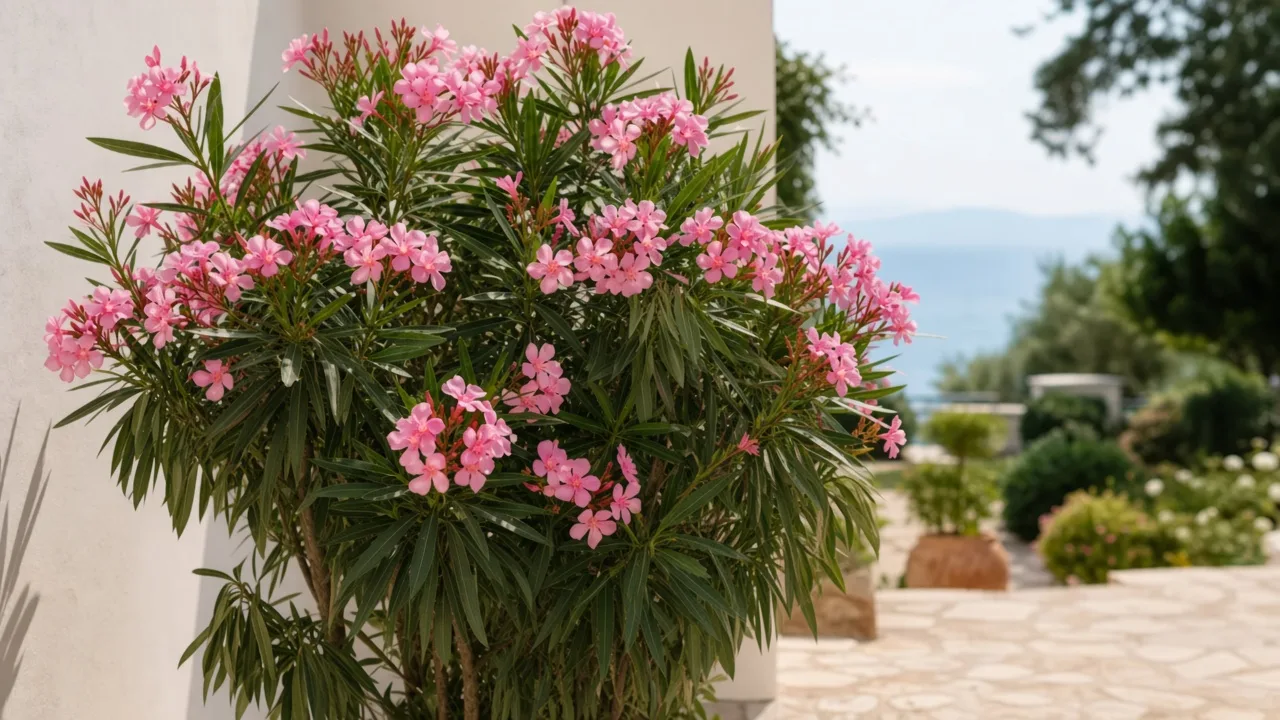
Drooping Leaves on Oleander: Causes, Root Checks & Turgor Recovery
This guide covers drooping leaves on Oleander. See also the general Drooping Leaves guide, watering, and light pages for this plant.
Drooping Leaves on Oleander: Causes, Root Checks & Turgor Recovery
Quick answer
Drooping leaves on Nerium oleander signal a severe failure of internal hydraulic turgor pressure. Under healthy conditions, oleander leaves are exceptionally stiff, fibrous, and leathery, held firmly outward in whorls of three. When these structural leaves sag or point limply downward, the plant is experiencing either acute root-zone dehydration (underwatering) or vascular root suffocation from waterlogged substrate (overwatering and root rot). To diagnose, test the soil moisture 5 centimeters below the surface: if bone-dry and crumbly, supply a deep, slow watering flush. If cold, muddy, and foul-smelling, stop watering immediately, verify container drainage, and inspect roots for fungal decay.
For universal diagnosis and recovery protocols across woody ornamentals, explore our comprehensive guide on drooping leaves.
What drooping leaves look like on Oleander
Because Nerium oleander foliage is semi-rigid and leathery, drooping presents distinct structural deformities compared to soft herbaceous plants:
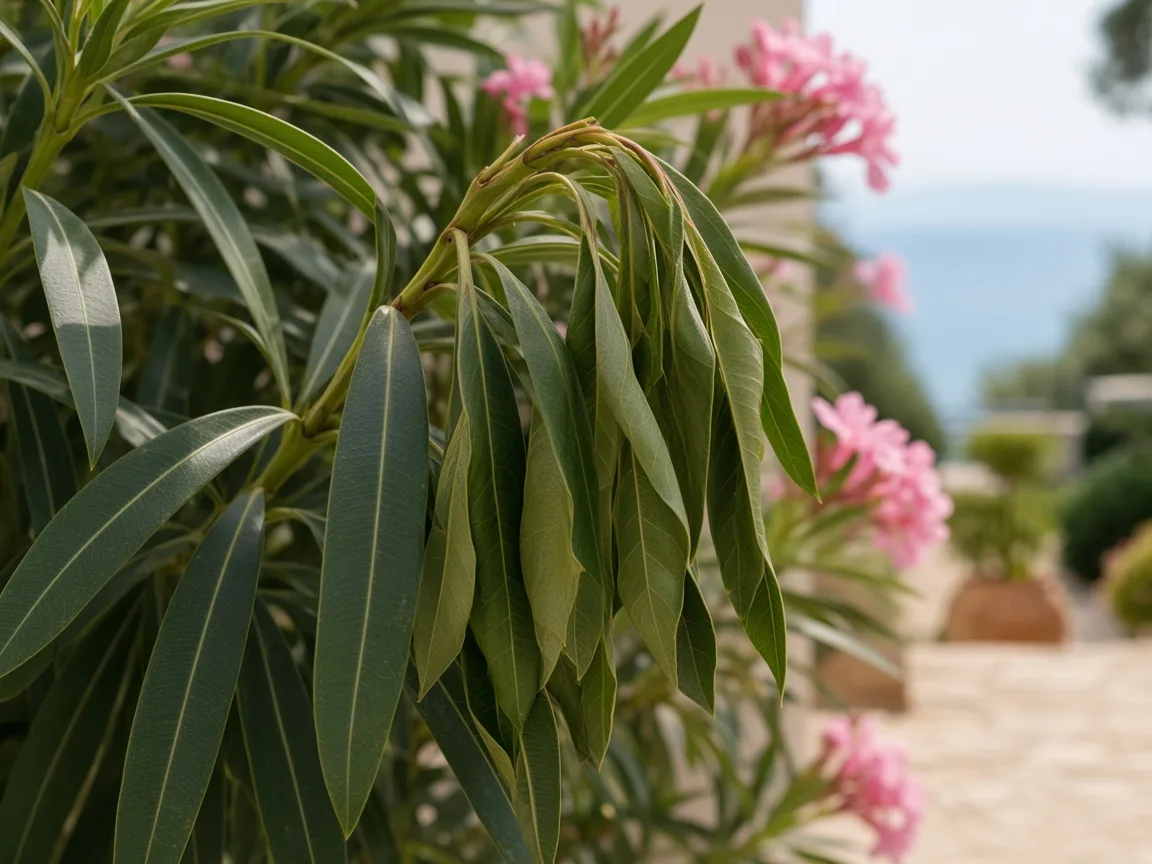
Close-up of Nerium oleander branch showing limp, downward-pointing leathery leaves with loss of cellular turgor.
- Downward petiole sag: Leaves lose the firm, outward-pointing angle typical of healthy whorls, sagging vertically against the woody stem.
- Inward blade curl and cupping: Leaf margins curl inward longitudinally toward the prominent pale central vein, a drought-defense mechanism aimed at minimizing exposed stomatal surface area.
- Flaccid, dull texture: The upper leaf surface loses its glossy, dark green luster, feeling pliable, rubbery, or leathery-limp rather than crisp and rigid.
- Associated tip necrosis: Drought-stressed drooping foliage rapidly develops crisp brown tips, while chronically waterlogged drooping leaves display lower canopy yellow leaves.
- Flower and bud abortion: Emerging floral trusses and tender pedicels droop, shrivel, and abort prematurely.
If prolonged, persistent turgor loss halts new vegetative extension, resulting in canopy dieback and pronounced slow growth.
Why Oleander leaves droop
Nerium oleander is a resilient, sun-worshipping Mediterranean shrub adapted to warm climates and drought cycles, as documented by NC State Extension and Missouri Botanical Garden.
The physiological causes of foliar droop include:
1. Acute root-zone moisture deficit (underwatering)
In containers or during prolonged hot droughts, potting soil can dry out completely within hours. When soil water potential drops below the root uptake threshold, xylem columns suffer cavitation (air bubble embolisms), cutting off water flow to the leaves and causing cells to lose hydrostatic pressure.
2. Root asphyxiation and decay (overwatering)
Despite being drought-hardy, oleanders in heavy, compacted soils or pots without drainage holes suffer rapid root rot, as detailed by Clemson Cooperative Extension. Excess water fills soil pore spaces, starving roots of oxygen. Rotting roots cannot absorb water, causing the canopy to wilt and droop paradoxically in soaking wet mud from root rot.
3. Container heat stress and high transpirational demand
Container-grown oleanders kept on concrete patios or reflective surfaces absorb intense radiant heat, as noted by UF IFAS Extension. When air temperatures soar and winds pick up, evaporative transpiration from broad evergreen leaves exceeds the hydraulic throughput capacity of container root balls, leading to transient afternoon sag.
4. Transplant and repotting disturbance
Moving an established oleander or repotting into a larger container tears fragile microscopic root hairs. Until new root tips regenerate and re-establish hydraulic contact with the surrounding substrate, the shrub droops in bright sunshine.
5. Oleander Leaf Scorch (Xylella fastidiosa)
Early stages of Xylella infection can cause individual branch terminals to droop and flag before distinct marginal browning appears, a dynamic documented by UC IPM.
Diagnostic triage: Underwatering vs. Overwatering
Determine whether dry roots or waterlogged decay is causing leaf droop before applying corrective measures:
| Diagnostic Check | Underwatering (Dehydration) | Overwatering (Root Suffocation) |
|---|---|---|
| Soil Feel (5 cm deep) | Bone-dry, dusty, pulled away from pot walls | Wet, muddy, cold, or water-soaked |
| Container Weight | Extremely light; lifts with minimal effort | Unusually heavy and waterlogged |
| Leaf Blade Texture | Rubbery, dry-pliable, margins curled inward | Soft, limp, spongy, lower leaves yellowing |
| Lower Foliage Color | Dull olive-green; crispy brown tips | Pale chlorotic yellow; brown mushy blotches |
| Root Inspection | Firm, tan, fibrous, dry | Dark brown, black, slimy, sour swampy odor |
| Response to Deep Soak | Full recovery and leaf lift in 2–6 hours | Leaves remain limp; soil stays saturated |
Step-by-step recovery protocol
Restore cellular turgor and foliage rigidity using this systematic remediation sequence:
Protocol A: Rehydrating parched root systems
- Gradual bottom-soak: For potted oleanders whose soil has become hydrophobic, place the container in a large basin or saucer filled with 5 to 8 centimeters of tepid water for 30 to 45 minutes to re-wet the core substrate.
- Top-water flush: Remove from the basin and pour water thoroughly across the top of the mix until water drains freely from all drainage holes.
- Temporary shade: Move the container to a bright spot sheltered from intense midday sun for 24 hours while vascular tissues re-pressurize.
Protocol B: Rescuing waterlogged, rotting root systems
- Halt irrigation immediately: Empty all standing water from saucers or cachepots.
- Slide and inspect roots: Carefully unpot the shrub wearing protective gloves. Gently wash away soggy, sour potting mix.
- Surgical root pruning: Using sterile bypass pruners, prune away all black, mushy, or slimy roots back to healthy, firm tan tissue. Disinfect pruners with rubbing alcohol after each cut.
- Repot into porous substrate: Repot into a clean pot with generous drainage holes using a fresh mix of 60% quality potting soil and 40% coarse perlite or pumice, following container guidelines from UF IFAS Extension. Withhold water for 3 to 5 days to allow root wounds to callus.
Long-term cultural practices to prevent drooping
Maintain steady hydrostatic turgor and robust plant health:
- Pot sizing and drainage: Ensure containers have multiple unobstructed drainage holes. Repot root-bound plants every 2 to 3 years into pots 5 to 8 centimeters wider to provide sufficient soil moisture buffer.
- Consistent deep watering: In summer, water deeply when the top 3 to 5 centimeters of substrate dry out, ensuring complete root-zone saturation without leaving pots standing in water trays.
- Mulching root zones: Apply a 5-centimeter layer of organic bark mulch over the soil surface in garden beds or large containers to insulate roots from temperature spikes and reduce rapid surface evaporation.
- Full sun and air movement: Provide at least 6 hours of direct daily sunlight to support robust vascular development, following recommendations from the Missouri Botanical Garden.
Related tool
Calculate optimal container watering volume and intervals for your shrub with our Plant Watering Calculator.
Related oleander problems: