Wilting on Oleander: Causes, Checks & Fixes
Quick answer
Wilting on Oleander (Nerium oleander) is driven by three distinct mechanisms: acute root-zone drought in containers, root rot from waterlogged substrate, or Oleander Leaf Scorch caused by the xylem-clogging bacterium Xylella fastidiosa. To diagnose, check deep soil moisture and symptom distribution. Dry soil with canopy-wide limpness indicates simple drought that perks up within hours after a deep soak. Wet, sour soil indicates root decay, while branch-by-branch wilting with leaves displaying brown margins bordered by a distinct yellow halo signals incurable bacterial scorch.
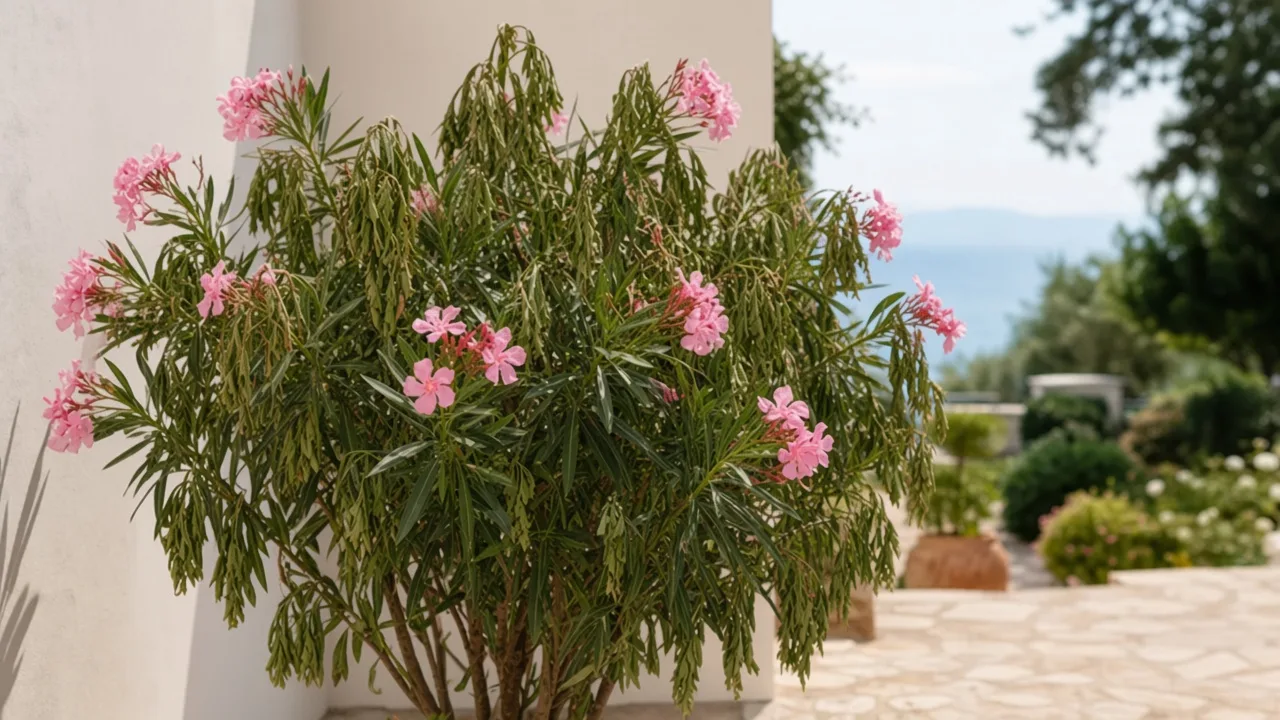
Wilting on Oleander: Causes, Checks & Fixes
This guide covers wilting on Oleander. See also the general Wilting guide, watering, and light pages for this plant.
Wilting on Oleander: Causes, Checks & Fixes
Quick answer
Wilting on Nerium oleander indicates a catastrophic failure of hydrostatic turgor pressure within the plant’s vascular network. Because oleander is adapted to arid Mediterranean climates and possesses thick, leathery evergreen leaves, visible foliar collapse is a high-priority diagnostic alarm. The three primary culprits are acute root dehydration (parched container soil), root suffocation and rot (waterlogged, poorly draining substrate), and Oleander Leaf Scorch, a lethal vascular disease caused by the xylem-limited bacterium Xylella fastidiosa.
To pinpoint the cause, test soil moisture 5 centimeters deep. If the soil is dry and powdery and the entire canopy droops uniformly, administer a deep, slow watering soak. If the root zone is cold, muddy, and foul-smelling, halt irrigation immediately to treat root rot. However, if wilting is localized to individual branches and accompanied by marginal browning with a vivid yellow halo, suspect bacterial leaf scorch, which cannot be cured with water.
For broader physiological mechanisms of hydrostatic collapse across woody and herbaceous species, explore our global guide on plant wilting.
What wilting looks like on Oleander
Healthy oleander foliage consists of tough, leathery foliage arranged in whorls of three along stiff, upright stems. The leaves are naturally lance-shaped, thick, and held outward at a rigid 45-degree angle. Because the leaf blade is reinforced with dense structural sclerenchyma fibers, wilting manifests differently than it does on soft-leaved houseplants:
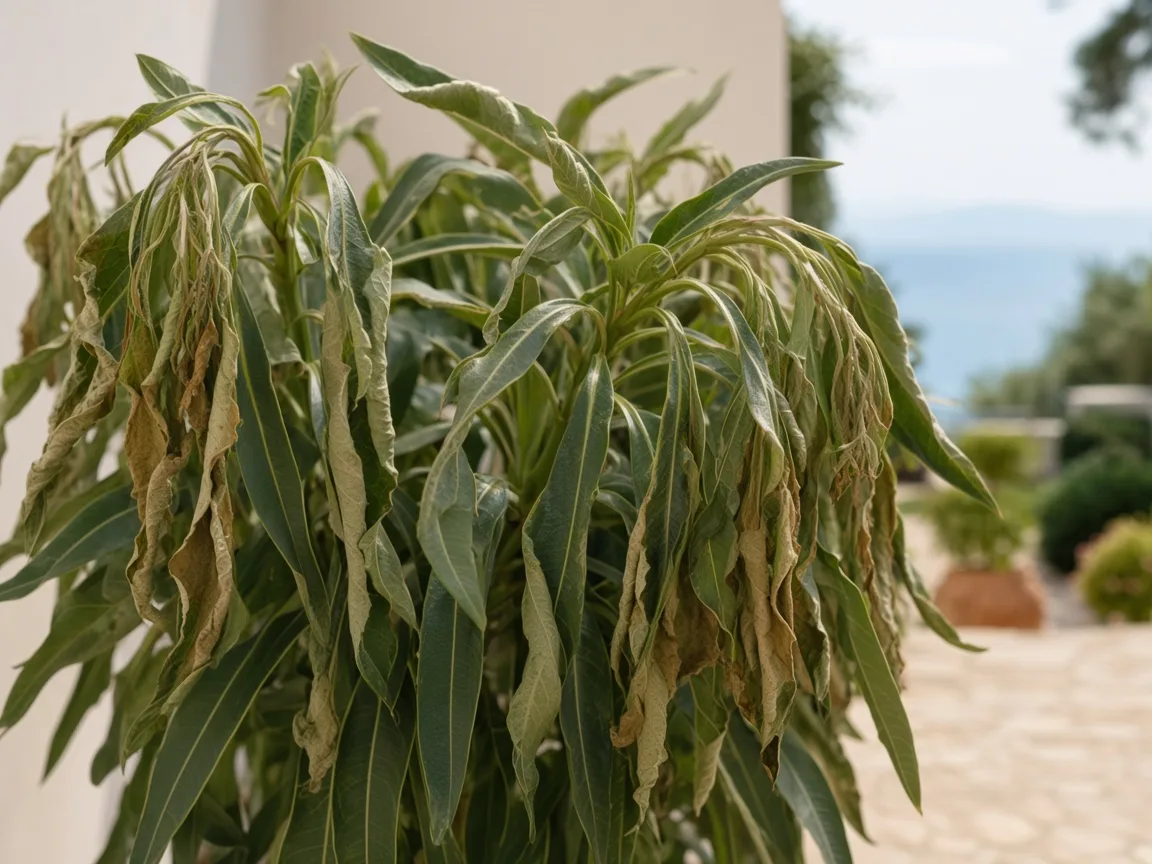
Wilting symptoms on Oleander - compare with healthy tissue on the same plant.
- Petiole and stem sagging: Leaves lose structural rigidity, drooping flat against the branch or angling limply toward the ground.
- Inward blade curling: Leaf margins cup and roll inward along the longitudinal axis toward the prominent white midrib, an evolved defense aimed at sheltering stomatal crypts from drying winds.
- Canopy “flagging”: Rather than an overall collapse, bacterial infection causes unilateral flagging—where a single stem or quadrant wilts and turns brown while the rest of the shrub remains green.
- Marginal scorch with golden halos: Leaves on wilting branches dry out from the tip and outer margins inward. In bacterial scorch, a striking, neon-yellow chlorotic band sharply separates necrotic brown tissue from living green tissue.
- Flower droop and bud drop: Tender floral clusters wilt rapidly, turning brown and drying into papery husks before shedding.
- Texture transition: Foliage loses its smooth, glossy sheen, feeling dull, limp, rubbery, or parchment-brittle upon touch.
Distinguishing these visual cues prevents confusing simple water deficit with systemic bacterial occlusion or advanced root rot.
Why Oleander gets wilting: Core causes and vascular mechanics
Understanding oleander vascular anatomy explains why hydraulic disruption occurs:
1. Acute root-zone water deficit (underwatering)
Although mature landscape oleanders boast extensive root systems that tolerate severe heat and drought, containerized shrubs have confined root zones that dry out swiftly under full sun exposure. In hot summer weather, rapid transpirational water loss in hot weather outpaces the rate at which roots can extract moisture from depleted soil. When soil water potential drops below the root extraction threshold, xylem columns suffer cavitation (air bubble embolisms), terminating water delivery to the canopy and producing limp, drooping leaves.
2. Oleander Leaf Scorch (Xylella fastidiosa)
In warm regions such as California, Texas, Arizona, and the Southeast, oleanders face a devastating threat: Oleander Leaf Scorch. The causal agent is Xylella fastidiosa, a fastidious bacterium transmitted into the shrub’s water-conducting xylem vessels by xylem-feeding insects, most notably the glassy-winged sharpshooter (Homalodisca vitripennis). Once introduced, the bacteria multiply and secrete sticky extracellular polysaccharides (EPS). In response, the plant produces tyloses and gummy deposits in a futile attempt to wall off the infection. Together, the bacterial biofilm and plant defense secretions completely occlude the xylem vessels, blocking the upward flow of water. The foliage on infected branches starves for moisture and wilts, exhibiting unmistakable brown tips bordered by a yellow halo band.
3. Root asphyxiation and root rot (overwatering)
Oleanders are highly adaptable, but they are intolerant of poorly drained, waterlogged soils. When potted in dense, clay-heavy mix or grown in containers without drainage holes, persistent saturation drives all dissolved oxygen out of pore spaces. Deprived of oxygen, delicate root hairs suffocate within 24 to 48 hours and succumb to fungal water molds such as Phytophthora and Pythium. Because decayed roots cannot take up water or minerals, the top of the plant suffers physiological drought, causing leaves to wilt limply even as the soil remains waterlogged.
4. Container root binding and osmotic salt burn
When an oleander becomes excessively root-bound, dense coils of roots displace soil volume, eliminating the container’s moisture-holding buffer. Concurrently, repeated tap water irrigations and synthetic fertilizers cause mineral salts to accumulate. High soil salinity reverses osmotic pressure, drawing moisture out of root cells and resulting in root desiccation and canopy wilt.
Diagnostic matrix: Drought vs. Root Rot vs. Bacterial Scorch
Use this diagnostic matrix to differentiate reversible cultural stresses from incurable bacterial infection:
| Diagnostic Feature | Acute Drought Wilt | Waterlogged Root Rot | Oleander Leaf Scorch (Xylella) |
|---|---|---|---|
| Canopy Distribution | Uniform wilt across all branches | Generalized lower-canopy wilt and yellowing | Isolated branch flagging; one stem wilts first |
| Soil Moisture (5 cm deep) | Bone-dry, crumbly, pulling away from pot | Saturated, muddy, stagnant, foul odor | Variable; often normal moist soil |
| Container Weight | Noticeably light, easy to lift | Heavy, water-laden | Normal weight for soil volume |
| Leaf Appearance | Limp, dull green, margins rolled inward | Soft, limp, lower leaves turn chlorotic yellow | Crispy brown margins with bright yellow halo |
| Root Condition | Firm, tan, fibrous, dry | Dark brown to black, slimy, mushy | Healthy, firm, tan root system |
| Response to Deep Soak | Leaves perk and lift fully in 2–6 hours | Leaves stay limp; rot accelerates | Zero recovery; branch continues dying |
| Long-Term Prognosis | Full recovery with corrected watering | Recoverable if root rot is caught early | Incurable; plant dies within 3–5 years |
How to confirm the cause: Step-by-step diagnostic checks
Execute these systematic checks before applying any treatment:
- Check soil moisture at depth: Push a wooden moisture probe or your finger 5 centimeters into the root zone. Surface dust can hide wet mud below, and dry crusts can conceal root rot.
- Weigh the container: Lift the pot. A container that feels feather-light indicates acute dehydration. An unexpectedly heavy pot indicates waterlogged substrate.
- Inspect the wilt pattern across the canopy: Examine whether every branch droops equally (cultural water stress) or whether only one distinct branch is wilting while adjacent shoots remain turgid (classic Xylella flagging).
- Scrutinize leaf borders for the yellow halo: Look closely at the margin between brown necrotic tissue and live green blade. A sharp, vibrant golden-yellow band is the signature hallmark of Xylella fastidiosa vascular blockage.
- Conduct a root collar and root health check: Gently unpot container specimens or scrape 3 cm of topsoil away from the root flare. Healthy oleander roots are pale tan and fibrous. Black, soft, or sour-smelling roots indicate active root rot.
- Perform the hydration response test: If soil is dry, deliver a generous soaking. If leaves regain structural stiffness within a few hours, drought is confirmed. If foliage remains flaccid over 24 hours despite moist soil, root death or vascular occlusion is present.
The first fix to try
Perform a targeted moisture correction based on deep soil readings: soak parched root balls, or immediately stop watering and empty saucers if soil is wet.
For dry soil, provide a slow, thorough drench until water runs freely from the drainage holes, allowing the root core to rehydrate completely. For wet soil, immediately discard any standing water in collection trays, move the pot into a sheltered, airy location, and allow the top several centimeters of soil to dry out before considering any additional moisture.
Do not apply fertilizer, do not prune live foliage indiscriminately, and do not apply broad-spectrum chemical sprays until the diagnostic checks confirm whether the issue is cultural dehydration, root rot, or bacterial scorch.
Remediation and recovery protocols
Follow the dedicated protocol corresponding to your diagnostic finding:
Protocol A: Rehydrating acute drought wilt
- Gradual root-ball re-wetting: Peat-based potting mixes become hydrophobic when completely dry, causing water to channel down the pot sides without wetting the root ball. Immerse the container in a tub filled with 8 to 10 centimeters of room-temperature water for 30 to 45 minutes until the core is fully moistened.
- Top flush: Lift the pot from the tub and pour fresh water over the soil surface to ensure complete saturation, letting excess water drain away completely.
- Midday shade refuge: Place the shrub in bright, indirect light or morning sun for 24 to 48 hours to reduce transpirational stress while root hydraulic conductance normalizes.
- Mulch surface: Spread a 3-centimeter layer of shredded bark mulch across the soil surface to buffer container temperatures and conserve soil moisture.
Protocol B: Rescuing waterlogged plants with root rot
- Unpot and wash roots: Wearing protective gloves, slide the shrub from its container. Carefully wash away the waterlogged, sour soil mix with gentle water to expose the root architecture.
- Surgical root pruning: Using bypass pruners disinfected in 70% isopropyl alcohol, excise all black, slimy, or hollow roots back to firm, creamy-tan tissue.
- Repot into high-drainage substrate: Repot into a sanitized container with multiple drainage holes using a fresh mix of 60% quality potting soil and 40% coarse perlite or pumice to guarantee rapid drainage, aligning with potting standards from UF IFAS Extension.
- Withhold watering: Keep the fresh soil slightly barely moist for the first 5 to 7 days to allow cut root surfaces to callus and resume cell division without fungal reinfection.
Protocol C: Managing suspected Oleander Leaf Scorch (Xylella fastidiosa)
- Confirm regional presence and vector activity: Verify if Oleander Leaf Scorch and glassy-winged sharpshooters are active in your municipality or county extension district, as documented by UC IPM.
- Sanitation pruning: While pruning cannot cure systemic Xylella infection, cutting symptomatic branches back to the main trunk or at least 30 to 40 centimeters below visible scorch marks can temporarily improve the shrub’s visual appearance and reduce bacterial inocula.
- Sterilize cutting tools between cuts: Disinfect pruner blades between every single cut using 70% rubbing alcohol or a 10% bleach solution to prevent mechanically transferring bacterial cells to healthy branches.
- Vector management: Monitor surrounding landscape plants for glassy-winged sharpshooters (large, 12 mm brown leafhoppers with smoky transparent wings). Reduce weed hosts around the perimeter.
- Planned removal and destruction: Because infected oleanders decline progressively over three to five years and act as permanent reservoirs for sharpshooters to infect neighboring shrubs, plan to remove severely infected specimens entirely.
Recovery timeline and prognosis
- Acute drought wilt: Rapid recovery. Leaves re-pressurize and lift within 2 to 6 hours after deep root soaking. Foliage returns to full rigid turgor within 24 hours. Any tips that suffered cellular death will remain brown, but subsequent flushes will emerge unblemished.
- Root rot remediation: Moderate recovery. Surviving root systems require 3 to 6 weeks to regenerate active feeder roots in porous substrate. New leaf growth from terminal whorls marks renewed root function.
- Oleander Leaf Scorch: Terminal prognosis. Infected shrubs will not recover. Pruning may yield a temporary flush of asymptomatic growth, but symptoms typically reappear within 6 to 12 months as bacteria colonize remaining xylem vessels. Expect complete shrub mortality within 3 to 5 years.
Critical mistakes to avoid
- Do not fertilize a wilting oleander: Applying synthetic fertilizer to a dehydrated or root-rotted plant increases root-zone salinity, worsening osmotic shock and burning surviving feeder roots.
- Never burn oleander wood or wilted foliage: All parts of Nerium oleander contain cardiac glycosides including oleandrin and neriine. Burning cuttings produces toxic aerosolized smoke that causes acute pulmonary irritation, nausea, dizziness, and cardiac arrhythmias upon inhalation.
- Do not compost diseased cuttings: Discard plant material showing signs of bacterial scorch or root rot in municipal landfill waste rather than domestic compost piles to avoid harboring pathogens.
- Avoid daily shallow watering: Sprinkling the soil surface every day keeps topsoil wet while leaving deep container roots desiccated, promoting fungal root rot near the collar while deeper roots starve.
- Do not delay removing confirmed Xylella plants: Leaving dying, scorch-infected oleanders in the landscape provides a continuous feeding reservoir for sharpshooters, endangering surrounding healthy plantings.
Long-term cultural practices to prevent wilting
To establish resilient hydraulic health and prevent future wilting episodes on oleander:
- Optimize container soil porosity: Use a loose, fast-draining potting medium containing equal parts peat or coir, pine bark fines, and coarse perlite to prevent root suffocation, as recommended by Clemson Cooperative Extension.
- Container sizing and drainage holes: Ensure containers possess multiple unobstructed drainage holes. Upgrade container size every 2 to 3 years to provide adequate root volume for moisture buffering.
- Deep, rhythmic irrigation: Water deeply when the top 3 to 5 centimeters of container mix feel dry during peak summer, saturating the entire root zone until water exits the bottom.
- Full sunlight exposure: Grow oleander in full sun (at least 6 hours of direct daily light) to build strong, thick xylem vessels and dense foliage capable of regulating transpiration, following cultural guidelines from the Missouri Botanical Garden.
- Inspect for sharpshooters: Regularly check branch terminals and leaf undersides for sharpshooter leafhoppers and nymph clusters during warm spring and summer months.
Toxicity and handling safety
Nerium oleander is classified among the most toxic ornamental plants cultivated globally. All vegetative tissues—including roots, stems, leaves, flowers, and sap—contain toxic cardenolides (primarily oleandrin, neriine, and folinerin).
When inspecting, handling, or pruning a wilting shrub:
- Wear heavy, puncture-resistant rubber gloves and safety goggles.
- Avoid all contact with the milky white latex sap exuded from broken stems, which causes severe contact dermatitis, skin blistering, and eye inflammation.
- Thoroughly wash pruning tools, hands, and clothing with soap and warm water immediately after servicing the plant.
- Keep pruning trimmings strictly away from children, dogs, cats, and livestock.
When to use this page vs other Oleander guides
- Oleander watering guide - Consult for routine seasonal watering schedules and container moisture benchmarks before problems arise.
- Oleander soil guide - Review optimal substrate formulations, drainage amendments, and container potting blends.
- Oleander light guide - Check daily solar requirements and UV exposure needs for optimal growth.
- Drooping leaves on Oleander - Use when leaves are limp and sagging without marginal scorch or yellow halo patterns.
- Brown tips on Oleander - Reference when foliar tips are crispy from fertilizer salt accumulation or sunburn.
- Oleander problems hub - Browse all documented pest, disease, and environmental issues affecting this species.
Related Oleander guides
- Oleander overview
- Oleander watering
- Oleander light
- Oleander soil
- Oleander problems
- Drooping leaves on Oleander
- Brown tips on Oleander
- Overwatering on Oleander
- Underwatering on Oleander
- Root rot on Oleander
Related tool
Calculate optimal container irrigation volumes and customized watering frequencies for your shrub with our Plant Watering Calculator.