Mealybugs on Philodendron Florida Beauty: Vine Checks &
Quick answer
Mealybugs on Philodendron Florida Beauty show as white cottony tufts tucked into leaf axils, unfurling lobed leaves, hairy red petioles, and where the vine meets its moss pole — often with sticky honeydew. First step: isolate the plant and dab every visible cluster with a cotton swab dipped in 70% isopropyl alcohol before any spraying.
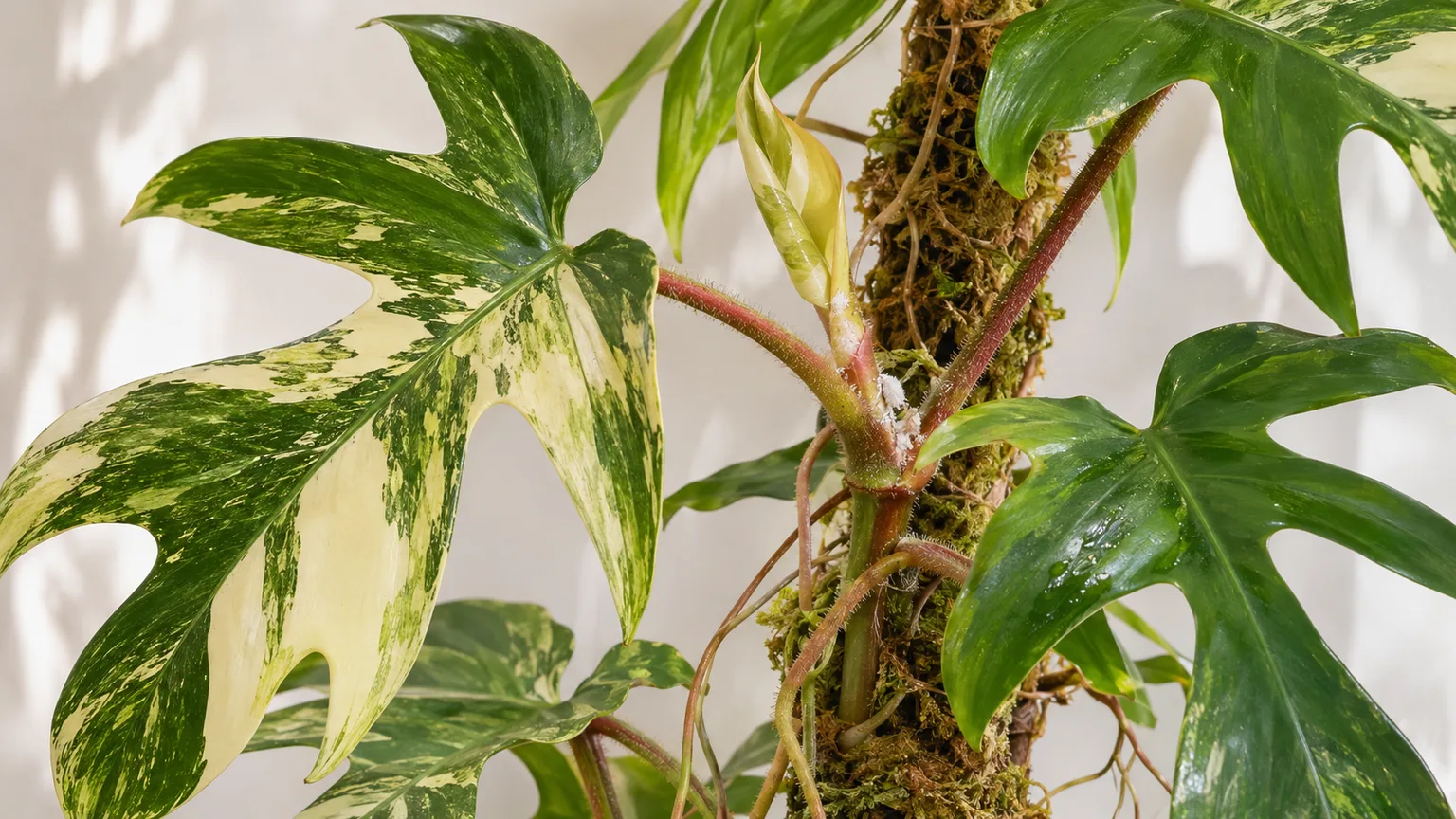
Mealybugs on Philodendron Florida Beauty: Causes, Checks & Fixes
This guide covers mealybugs on Philodendron Florida Beauty. See also the general Mealybugs guide, watering, and light pages for this plant.
Mealybugs on Philodendron Florida Beauty: Causes, Checks & Fixes
Quick answer
Mealybugs on Philodendron Florida Beauty appear as white cottony tufts packed into leaf axils, inside unfurling lobed leaves, along the hairy red petioles, and everywhere the vine presses against its moss pole — often with sticky honeydew on the leaves below. They are soft-bodied sap-sucking insects coated in white waxy material that cluster in sheltered spots and drain young growth.
For general mealybug biology and life cycle, see our mealybugs pest guide. On Florida Beauty, the infestation rides the climbing habit: aerial-root nodes, pole contact points, and the fuzzy squamiferum-type petioles that catch wax and hide crawlers from a casual glance.
First step: isolate the vine from other houseplants and dab every visible cluster with a cotton swab dipped in 70% isopropyl alcohol.
When to use this page vs other Florida Beauty guides
This page is the pest-first entry for white cottony clusters and stickiness on a Florida Beauty vine. Use it when you can find wax tufts, honeydew, or live insects in the hideouts below. If leaves yellow, spot, wilt, or stall with no wax, stickiness, or insects after a careful axil-by-axil inspection, the cause is cultural — recheck your watering rhythm, light level, and soil mix before treating for pests.
What mealybugs look like on Florida Beauty
A healthy Florida Beauty carries deeply lobed leaves splashed with cream on red-tinged petioles, climbing a support with aerial roots gripping the pole. Mealybugs exploit every textured crevice that architecture offers.
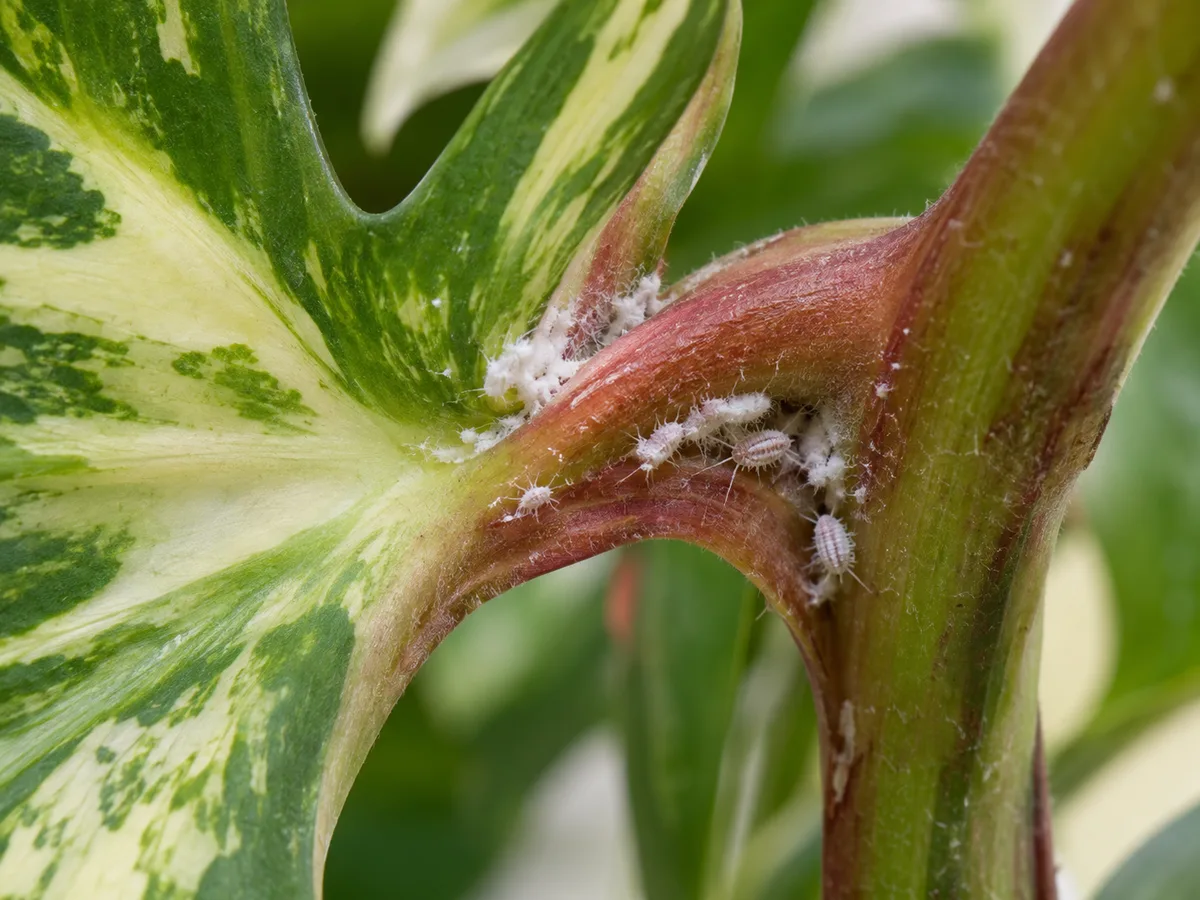
Mealybug wax clusters hide in leaf axils and textured petioles on this climbing philodendron.
Typical signs on this vine:
- White cottony wax packed into leaf axils — the first place glasshouse mealybug is usually noticed — and inside the furled cone of each new leaf
- Wax tufts strung along the hairy red petioles, where the squamiferum-inherited fuzz camouflages crawlers
- Clusters at vine-to-pole contact points, behind aerial roots, under ties, and inside moss-pole wrap fibers
- Sticky shiny honeydew on leaves beneath feeding clusters, sometimes followed by black sooty mold filming over cream variegation
- New lobed leaves emerging small, distorted, or stalled while older foliage looks untouched
- Ants patrolling the vine or pot rim, harvesting honeydew
Unlike dust or perlite flecks, mealybug wax sits in protected joints rather than scattered across open leaf faces, and it smears pale when touched with an alcohol swab.
Where mealybugs hide on this climbing vine
Florida Beauty’s climbing habit creates hiding places a rosette plant never has. Work the vine in this order:
- Unfurling new leaf — the furled cone shelters egg masses and crawlers before the leaf even opens; gently unroll enough to see inside without tearing it
- Leaf axils down the vine — where each petiole meets the stem, the classic sheltered cluster site
- Hairy red petioles — run a fingertip along each petiole; wax filaments snag in the fuzz long before colonies are visible from across the room
- Pole contact points — every spot where stem, aerial root, tie, or stake presses against the moss pole, including inside damp pole fibers
- Stem nodes behind aerial roots — lift each root tip and check the node beneath it
- Pot rim and drainage holes — crawlers shelter around the pot edge; white cottony masses here can signal root-zone mealybugs needing a closer root inspection
This pole-and-petiole search pattern is specific to a supported climbing aroid. A self-heading philodendron guide would send you to the crown; on Florida Beauty the vine-pole interface is the infestation highway.
Why Florida Beauty gets mealybugs
Mealybugs are not unique to philodendrons, but this cultivar’s growth style and collector status stack the odds.
Soft variegated growth feeds them first. The citrus mealybug favors soft-stemmed tropical foliage plants, feeding at stem tips and where leaves meet stems. Florida Beauty’s cream sectors photosynthesize poorly, so the plant pushes tender new growth under bright filtered light — exactly the soft tissue mealybugs prefer.
The damp moss pole shelters them. A pole kept moist for aerial roots stays humid and fibrous at every stem contact point. Those damp crevices protect wax-coated insects from sprays and room airflow while the open leaf faces look clean.
Infrequent handling lets colonies build. Watering only when the top 3–5 cm dries — roughly every 7–10 days in summer — means you may not handle the vine for a week at a time. Females lay eggs under a white waxy coating and nymphs can complete development in about a month in warmth, so one overlooked axil becomes several while the pot sits undisturbed.
New acquisitions arrive infested. Florida Beauty trades at collector prices as cuttings and established vines, and mealybugs travel on new stock. Females do not fly or crawl far, so they are usually brought in on an affected plant — the nursery vine, not your windowsill, is the usual source.
Indoor warmth with no predators. Homes hold the steady warmth mealybugs breed in all year, and outdoor predators never reach indoor vines unless deliberately released.
How to confirm the cause
Work through these checks in order:
- Alcohol smear test — dab a suspect tuft with a cotton swab dipped in 70% isopropyl alcohol. Mealybugs smear pale pink-yellow and die on contact; dust wipes away dry and scale stays glued as a hard disk.
- Unfurl inspection — check inside the newest leaf cone with bright sidelight for wax, orange-pink eggs, or crawlers.
- Pole separation check — gently pull the vine away from the pole at two or three ties and inspect the hidden contact faces and aerial-root nodes.
- Honeydew and ants — sticky residue on leaves below clusters, or ants farming the vine, strongly supports sap-feeder diagnosis.
- Neighbor scan — inspect every plant the vine touches or overhangs. Mealybug crawlers wander to adjacent pots on shared shelves.
- Root check if foliage is clean but the plant stalls — white cottony masses around drainage holes can indicate root mealybugs; unpot and inspect the root ball before assuming a foliage problem.
If cottony clusters smear with alcohol and honeydew or ants are present, mealybugs are confirmed. Treat before overlapping generations spread across every node.
First fix for Florida Beauty
Isolate the vine from other houseplants and dab every visible cluster with a cotton swab dipped in 70% isopropyl alcohol.
Isolation stops crawlers reaching neighbors while you work. Then dab systematically:
- Use isopropyl rubbing alcohol at about 70%, applied so it contacts each insect directly — it kills on contact but only where it touches
- Work axil by axil from the newest leaf down, including inside the unfurl, along each hairy petiole, and at every pole contact point
- Test the alcohol on one leaf first and check the next day, especially on pale cream sectors that scorch more easily than green tissue
- Support the vine while you work so stems do not snap at the ties
- Repeat the dabbing pass weekly until no new wax appears
Make this single correction before repotting, pruning hard, or fertilizing — you need to read whether the population drops.
Step-by-step recovery
Once isolation and the first alcohol pass are done, follow this sequence:
- Day 0 — isolate, alcohol-dab every cluster, and note which nodes were worst so you can compare later
- Days 3–5 — rinse the vine with a steady stream of lukewarm water in the shower or sink, which dislodges light infestations well; wrap the pot so the chunky mix does not get saturated, then let it drain fully
- Days 7–10 — second alcohol pass plus insecticidal soap or horticultural oil on remaining clusters, coating undersides and axils thoroughly. Contact soap sprays work against the crawler stage only with thorough coverage, because wax shields eggs and adults
- Days 14–28 — repeat on a 10–14 day cycle for at least two to three treatments, since eggs and adults survive most sprays and one pass rarely finishes the job; a female lays up to 600 eggs in a cottony mass, so missed clusters restart the colony
- Break ant trails — wipe pot rims and stakes so ants stop guarding honeydew producers
- Trim for appearance only at the end — once pests are gone, remove the worst honeydew-filmed leaves; they will not clean themselves, and new lobed growth replaces them
Hold fertilizer until new growth looks firm for two weeks after the last live cluster. Nitrogen pushes soft shoots that feed the next generation.
Recovery timeline
Waxed, yellowed, or sooty-filmed leaves will not return to crisp cream-and-green form. Expect marks on damaged foliage until those leaves age out naturally. What you should see within three to four weeks of consistent treatment is no fresh wax in previously cleaned axils, no new stickiness, and a clean emerging leaf.
Light cases confined to one or two axils often stabilize within two to three weeks of alcohol dabbing plus one rinse. Moderate infestations along the pole interface may need four to six weeks with repeated soap or oil cycles at 10–14 day intervals, matching the one-to-three-month generation time that lets overlapping life stages hide through a single treatment.
Judge recovery by:
- No new cottony tufts in cleaned axils or pole contacts
- No fresh honeydew on leaves below old feeding sites
- The next unfurling leaf opens clean, well-lobed, and normally sized
- No ants patrolling the vine
Escalate if stems soften at the soil line while pests persist — that pattern needs a root-zone diagnosis rather than more foliar dabbing.
Lookalike symptoms
| What you see | Likely cause | Quick check |
|---|---|---|
| White cottony tufts in axils and pole contacts | Mealybugs (this page) | Smears with alcohol; sticky honeydew |
| Flat brown or tan bumps on stems and petioles | Scale insects | Hard disks that scrape off; no cottony wax |
| Soft pear-shaped clusters on new tips, little wax | Aphids | No heavy wax filaments; often ants present |
| Fine stippling plus silk on leaf undersides | Spider mites | Shake test over white paper; no honeydew |
| White powdery film across open leaf faces | Powdery mildew | Fungal film, not clustered insects; no stickiness |
| Sticky leaves with no visible insects | Early or hidden mealybugs | Re-inspect unfurl, pole contacts, and drainage holes |
| Wrinkled leaves, dry deep mix, no wax | Underwatering | Pot feels light; top 3–5 cm dry |
Mistakes to avoid
Do not drench the whole vine in alcohol or oil without a patch test — cream variegation burns faster than solid-green tissue, and retinoid-red petioles can spot.
Do not assume one dabbing session clears a pole-trained vine. Eggs tucked in pole fibers and the unfurl hatch over days, which is why repeat cycles matter.
Do not spray horticultural oil in hot direct sun or above-label temperatures; move the plant back from the glass and treat in the cool of the morning.
Do not ignore ants while treating insects only with water. Ants farm honeydew producers and move crawlers between plants.
Do not increase fertilizer during an active infestation. Soft nitrogen-pushed shoots are the most attractive tissue on the vine.
Do not soak the root zone repeatedly while rinsing foliage. Soggy chunky mix invites root problems on top of pest damage — wrap the pot and drain fully after every shower rinse.
Do not reach for broad-spectrum insecticides as a first response indoors. Contact methods plus persistence clear most home infestations with less risk to the plant and household.
How to prevent mealybugs next time
Scout leaf axils, the unfurl, and pole contacts during every watering check — a ten-second look while the top centimeters dry is enough to catch the first tuft.
Quarantine new plants away from the collection for at least a month and inspect before the vine touches a shared pole, shelf, or neighbor’s leaves.
Remove dead leaves and spent ties from around the plant, since debris can harbor insects and eggs.
Keep vines spaced so Florida Beauty leaves do not touch neighboring plants, and wipe stakes and ties when you retrain growth upward.
Grow the vine firm: bright indirect light rather than direct scorching sun, warmth in the 65–85°F comfort range, and the top-dry watering rhythm from the watering guide keep new lobes maturing quickly past their most vulnerable soft stage.
When to worry
Treat the same day when clusters reach the newest unfurl, honeydew films multiple leaves, ants patrol the pot, or crawlers appear on shelf mates. Warm indoor rooms let breeding continue all year without the seasonal pause outdoor plants get.
A few tufts in one lower axil on an otherwise vigorous vine rarely threaten the plant if you isolate and dab promptly.
It can be simpler to dispose of a heavily affected plant than to eliminate every insect — consider that only for a badly coated vine that still shows live clusters after six weeks of consistent cycles, and never compost infested material back into houseplant mix.
Related Florida Beauty guides
Use this page when you find cottony wax clusters and stickiness along the vine.
- Philodendron Florida Beauty overview — species profile, climbing habit, and collector buying checks
- Watering — top-dry rhythm; wrap the pot during pest rinses so the mix does not stay soggy
- Light — bright filtered placement that keeps variegated growth firm and less pest-prone
- Soil — chunky aroid mix and drainage that support recovery after repeated washing
Use the Pest Identifier Tool to narrow causes for mealybugs on this plant before changing multiple variables at once.