Overwatering on Philodendron Florida Beauty: Causes, Checks
Quick answer
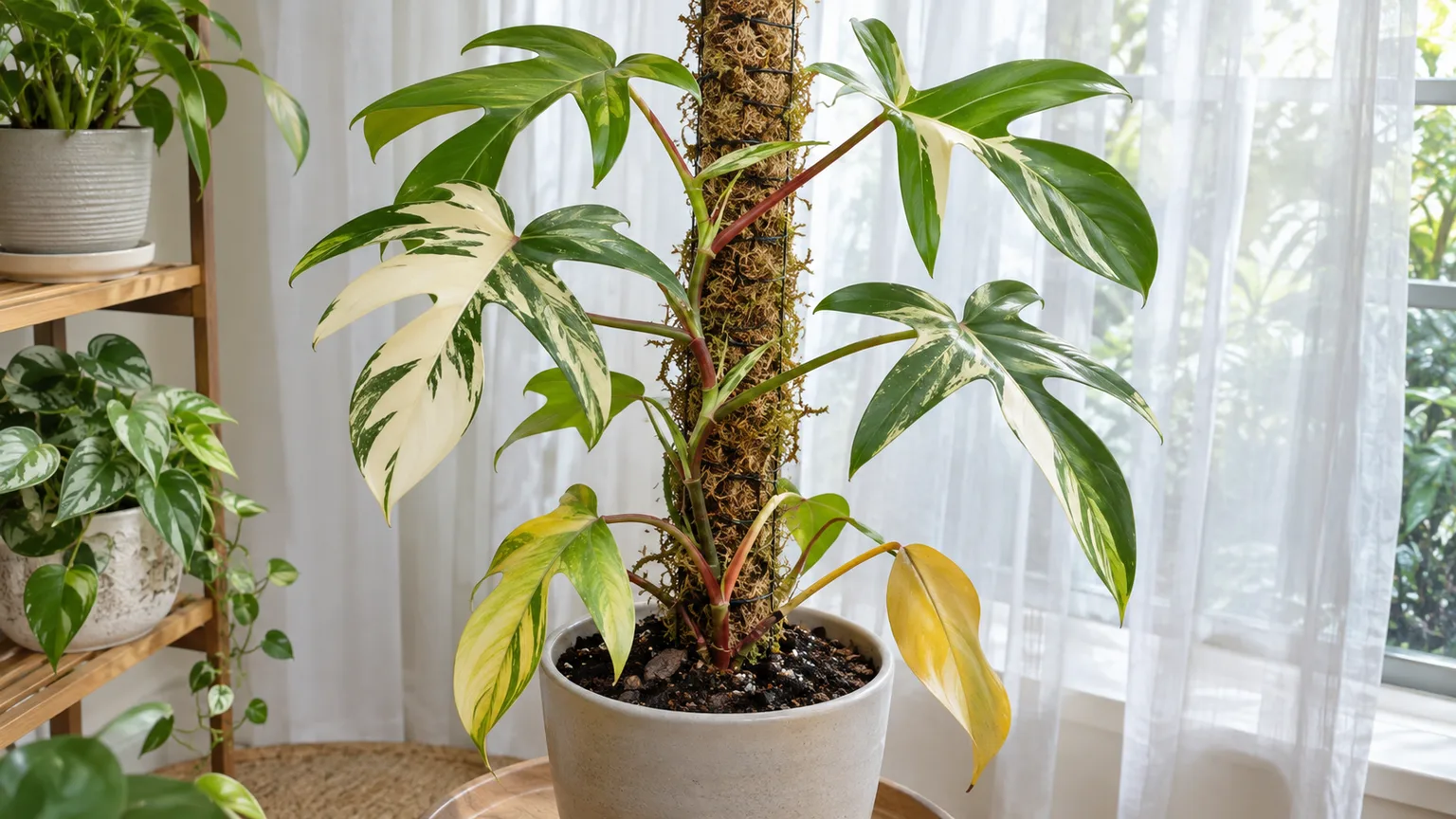
Overwatering on Philodendron Florida Beauty shows as yellow lower leaves spreading upward, limp foliage in a heavy wet pot, and soft red petioles near the soil line. First fix: stop watering, empty all standing water from saucers and cachepots, and let the top 3–5 cm of mix dry before you water again.
Overwatering on Philodendron Florida Beauty: Causes, Checks & Fixes
This guide covers overwatering on Philodendron Florida Beauty. See also the general Overwatering guide, watering, and light pages for this plant.
Overwatering on Philodendron Florida Beauty: Causes, Checks & Fixes
Quick answer
An overwatered Philodendron Florida Beauty tells on itself in a specific order: lower leaves yellow and the yellowing climbs upward, lobed foliage goes limp while the pot still feels heavy, and the red petioles soften near the soil line. Roots sitting in waterlogged mix cannot take up oxygen, so the plant starves in wet soil — a pattern Florida Beauty growers describe as yellowing that starts low and moves up while the mix stays soggy (Cafe Planta). First fix: stop watering entirely, pour off every drop of standing water from saucers and decorative cachepots, and do not water again until the top 3–5 cm of mix feel dry and the pot feels noticeably lighter.
For how chronic wet mix damages houseplant roots in general, see our overwatering guide. On Florida Beauty, the pattern usually shows up first on the cream-splashed lower foliage and the climbing stem base — the sections below explain how to read those plant-only signals.
What overwatering looks like on Florida Beauty
Early overwatering on this hybrid rarely looks dramatic. The lowest lobed leaves fade to yellow while new growth at the vine tip still looks acceptable, which tempts growers to wait. Within days the yellowing spreads upward leaf by leaf, and foliage that was held flat begins to droop even though nobody forgot to water. That combination — yellow climbing upward plus wilt in a heavy pot — is the signature worth memorizing.
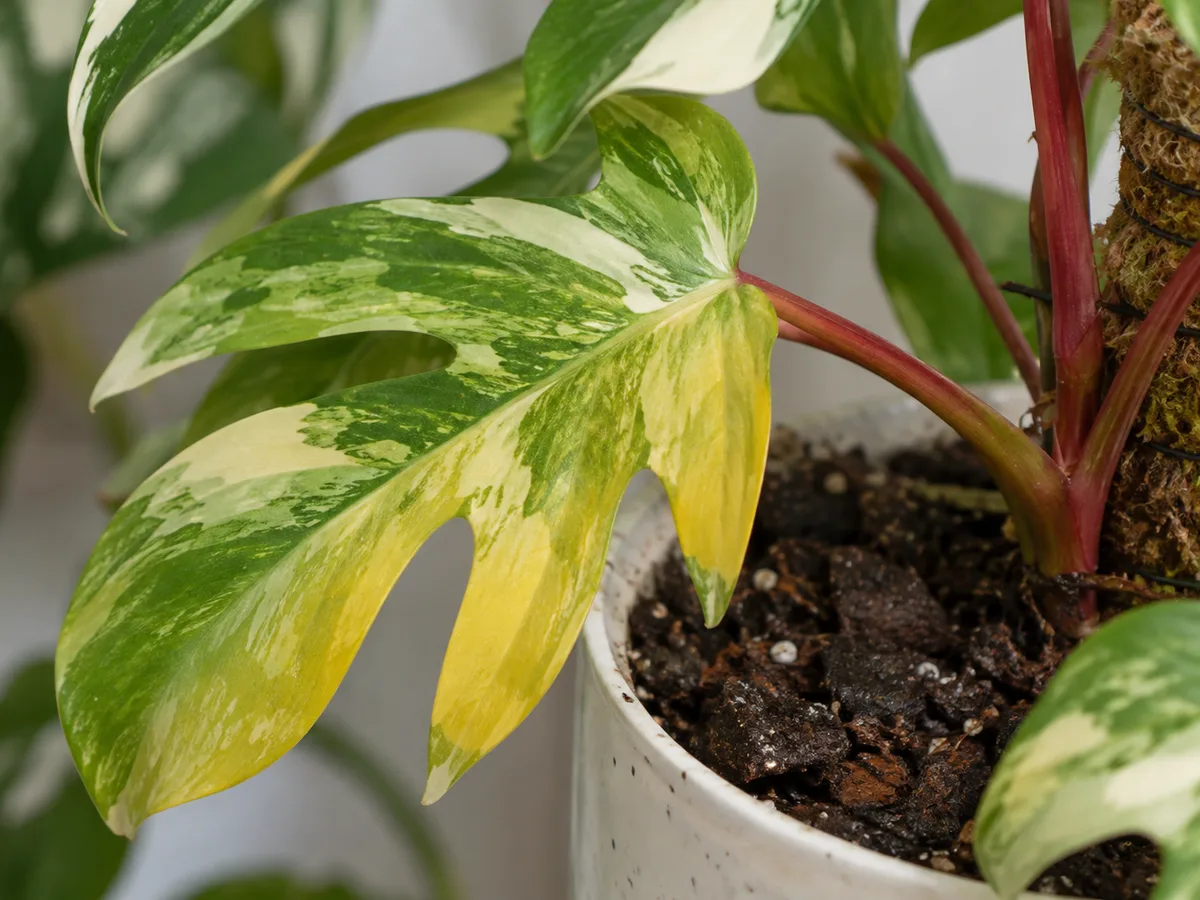
Overwatering often begins with yellowing on lower leaves while the mix remains wet.
Cream and yellow sectors complicate the read. Pale patches may brown or collapse before the green parts of the same leaf show trouble, because variegated tissue carries less chlorophyll than green tissue and runs on a thinner energy margin. Do not mistake a browning cream edge for sunburn or dryness on its own; check the pot weight before deciding. Clemson HGIC notes that yellowing lower leaves on philodendrons trace to too little light or overwatering, so confirm with the soil check below rather than diagnosing from leaf color alone.
Advanced signs leave less room for doubt: petioles that feel soft or look darkened where they meet the mix, a sour or rotten smell rising from the drainage holes, stunted new leaves despite bright light, and clouds of fungus gnats over a surface that never dries. Mushy stem bases mean decay organisms have moved into tissue, not just roots — act the same day.
Why Florida Beauty is easy to overwater
Three traits of this plant stack the odds toward soggy roots. First, the variegation itself: cream-splashed leaves photosynthesize less efficiently than solid-green foliage, so a Florida Beauty with damaged roots has less energy reserve to regrow feeders than a green philodendron in the same pot. It shows stress sooner and recovers more slowly, which makes consistent wet-dry cycling more important here, not less.
Second, the climbing habit invites the moss-pole moisture trap. Aerial roots gripping damp sphagnum pull extra moisture while the pot mix may already be wet, or a grower waters the pole and the pot on the same schedule until both zones stay saturated. Check the pole and the pot independently — a moist pole is not a reason to soak the container, as detailed in our watering guide.
Third, collector setups work against drainage: chunky aroid mix inside a sealed cachepot, a nursery pot with one small hole, peat-heavy bagged soil that looked airy in spring and compacted by autumn. Add winter slowdown — the same summer interval poured through December — and roots sit wet for weeks. None of these causes is exotic, which is exactly why they catch experienced growers.
How to confirm it before you act
Work through these checks in order; they take about five minutes and prevent the classic error of watering a drowning plant.
- Lift the pot. Memorize the heavy just-watered weight versus the light ready-to-water weight. Heavy days after your last drink means water is stuck in the root zone.
- Finger test at depth. Push your index finger 3–5 cm into the mix. Cool soil clinging to your skin means wait; dry and crumbly means the surface is ready. Surface color lies, especially on peat blends that pale on top while staying wet beneath.
- Skewer probe. Slide a dry wooden skewer toward the pot bottom, wait thirty seconds, and feel the shaft. Damp wood low in the column overrules a dry-looking surface.
- Saucer and cachepot check. Tip the outer pot and look for pooled runoff. Hidden reservoirs are the most common reason a “carefully watered” Florida Beauty stays wet.
- Petiole squeeze. Gently press the lowest red petioles. Firm means the stem base is still sound; soft or water-soaked means decay is advancing and you should inspect roots today.
- Root inspection (only if decline continues). Slide the root ball out and look: firm white-to-tan roots are healthy, while brown-to-black slimy roots that slip apart signal rot. A sour smell confirms anaerobic decay.
Drooping deserves one careful distinction, because Florida Beauty wilts from both thirst and root damage. As one philodendron diagnostic guide puts it, drooping follows either dry soil or damaged waterlogged roots, and the soil check — not the leaf angle — tells them apart (Greenery Nest). Limp leaves plus a light, dry pot mean thirst: soak thoroughly. Limp leaves plus a heavy, wet pot mean stop watering and dry out.
First fix for an overwatered Florida Beauty
Do exactly one thing first: stop all watering and remove every trace of standing water. Lift the nursery pot out of its saucer and cachepot, pour off pooled runoff, and set the plant where air moves and bright filtered light reaches it. Then leave it alone until the top 3–5 cm dry and the pot lightens.
This single drying step resolves mild cases on its own and gives you a clean baseline for reading the plant’s response. Do not repot, prune, fertilize, or spray on the same day — stacked interventions hide which change helped and stress roots that are already oxygen-starved.
Step-by-step recovery after the dry-down
Once the surface has dried, proceed by severity.
Mild (yellow lower leaves only, firm petioles, no smell). Resume watering on checks, not the calendar: soak thoroughly until water exits the drainage holes, empty the saucer within thirty minutes, and wait for the next real dry-down. Pick off only fully yellow leaves; leave partly green ones photosynthesizing. Our soil guide explains how to judge whether the mix itself is holding water too long.
Moderate (spreading yellow, soft petiole bases, gnats, sour hint). Unpot, shake off wet mix, and trim every mushy brown root back to firm white tissue with clean scissors wiped with rubbing alcohol between cuts. Repot into fresh chunky aroid mix in a container sized to the remaining root mass — not larger — with open drainage holes. Water once lightly to settle the mix, drain fully, and wait for the top layer to dry before the next soak. See our repotting guide for mix ratios and pot sizing.
Severe (mushy stem base, most roots slime). Cut losses at the healthiest nodes and propagate, as described in the rescue section below. A vine with no functioning roots cannot be watered back to health.
NC State Extension warns that overwatering causes root rot in climbing philodendrons and prescribes moist, well-drained soil with partial shade indoors — which is why every step above moves the plant toward drainage and air, not toward more moisture.
The moss-pole moisture trap
Florida Beauty climbs, and climbing changes the water math. Sphagnum around the pole stays damp for days after the pot surface looks ready, and aerial roots drinking from the pole can keep the upper vine hydrated while the container stays too wet — or fool you into watering the pot because the pole surface looks dry. The RHS advises letting philodendron compost dry slightly between waterings and never leaving plants standing in water, and that applies to both zones separately.
Run two checks: squeeze the pole moss and finger-test the pot. Water each only when its own zone has dried. If you mist the pole daily for aerial roots while also watering the pot weekly, pick one habit — a Florida Beauty with wet feet and a wet pole rots from both ends. When repotting a pole-trained plant, refresh or replace sphagnum that has compacted into a soggy sleeve around the stem, since that sleeve holds decay against the exact tissue where stem rot starts.
Variegation, light, and water use
Pale sectors do not change the watering rule, but they change the stakes. Because cream tissue contributes little photosynthesis, a heavily variegated vine runs closer to its energy limit and flags root damage earlier — often as browning on the white patches while green lobes still look fine. The fix is still roots and drainage, not extra water “for the fragile leaves.”
Light ties directly into dry-down speed. Florida Beauty needs bright filtered light to hold its cream splashes; in dim corners growth stalls, evaporation drops, and a normal watering volume becomes overwatering by default. If new leaves arrive mostly green with stretched internodes alongside yellow lower foliage, suspect low light plus wet roots together and fix placement first — our light guide covers target exposure. Brighter placement will also shorten the dry-down interval, so recheck pot weight for two full cycles after any move.
Node-cutting rescue when roots are gone
This hybrid’s vining nodes are its escape hatch. When the root ball is mostly slime but the upper stem still shows firm green tissue with cream patterning, cut the vine into sections with one node each, choosing pieces where the stem itself still carries cream striping — variegation travels through nodes, so green-stemmed cuttings root into green plants.
Root cuttings in damp (not wet) sphagnum or water with the node submerged and leaves above the line, in bright indirect light with airflow. Move them to chunky mix once new roots reach 5–8 cm with white tips, as covered in our propagation guide. This rescue only works with firm stem tissue; cuttings taken from mushy stem bases rot in the jar.
Mistakes to avoid
- Watering on schedule. “Every Sunday” without a finger check is how most Florida Beauty overwatering starts. The calendar reminds you to look, not to pour.
- Daily sips. Small frequent top-ups keep the upper layer moist while the lower root ball alternates between dry and airless. Soak fully, drain, then wait.
- Leaving runoff. Empty saucers and cachepots within thirty minutes, every time. Standing water creates oxygen-free conditions at the pot bottom within days.
- Fertilizing a stressed plant. A drowning root system cannot use nutrients, and salts add osmotic stress. Hold all feeding until new growth looks healthy for at least two weeks — timing details are in our fertilizer guide.
- Repotting, pruning, and spraying the same day. One intervention at a time lets you read the response and keeps a weakened plant from absorbing three shocks at once.
- Reading wilt as thirst. Limp leaves in a heavy wet pot mean roots cannot deliver water. Adding more water deepens the oxygen deficit.
Recovery timeline
Mild cases stabilize fast: yellowing stops spreading within one to two weeks of corrected watering, and firm new leaves emerge within three to four weeks in active growth. Moderate cases that needed root trimming take longer — expect six to eight weeks before fresh lobed growth with stable cream patterning, since the plant must rebuild feeders first. Winter rescues run slower; cool short days mean both drying and regrowth drag, so judge by new growth rather than the calendar.
Improvement looks like yellowing that halts, petioles that stay firm, and new leaves that open without browning on the cream sectors. Worsening looks like continued upward yellowing after two dry-down cycles, softening that climbs the stem, or recurring sour smell — all signs to unpot and look at roots rather than waiting another week. Fungus gnats fading away as the surface dries is a useful secondary signal, since their larvae depend on constantly damp organic soil.
How to prevent it next time
Anchor prevention to checks, not dates. In bright summer growth, most indoor Florida Beauty plants need water about every 7–10 days once the top 3–5 cm dry and the pot lightens; in winter the same plant may go 10–14 days or longer. Keep the structural defenses permanent: chunky bark-and-perlite mix refreshed before it compacts, a pot with real drainage holes, saucers emptied after every soak, and the nursery pot lifted out of cachepots to drain. Clemson HGIC traces philodendron root rot to slow-draining mix or overly frequent watering, so either fix — faster mix or longer intervals — breaks the cycle. Recalibrate whenever the season, the light, or the pot changes, because each one rewrites the dry-down speed.
When to use this page vs other Florida Beauty guides
- Florida Beauty watering — Use for routine schedules, moisture-check technique, and seasonal rhythm once this crisis has passed.
- Florida Beauty soil — Use when the pot stays heavy for many days despite correct intervals; the mix texture is the bottleneck.
- Florida Beauty light — Use when yellowing pairs with green reversion and stretched internodes; dim placement is slowing dry-down.
- Florida Beauty repotting — Use when roots need fresh mix or a different pot size after trimming rot.
- Florida Beauty propagation — Use when the root system is beyond saving and node cuttings are the recovery path.
Related Florida Beauty guides
- Watering Philodendron Florida Beauty — moisture checks, seasonal intervals, and clean watering technique.
- Best soil for Philodendron Florida Beauty — chunky aroid mix ratios and drainage tests.
- Philodendron Florida Beauty light needs — bright filtered exposure that protects variegation and speeds dry-down.
- Repotting Philodendron Florida Beauty — when and how to refresh mix and size containers.
- Propagating Philodendron Florida Beauty — node cuttings for rescue and multiplication.
- Fertilizing Philodendron Florida Beauty — feeding only once recovery growth resumes.
Related tool
Use the Root Rot Risk Checker to score drainage, watering rhythm, and early rot signs for overwatering on this plant before changing multiple variables at once.