Root Rot on Philodendron Florida Beauty: Causes, Checks &
Quick answer
Root rot on Philodendron Florida Beauty is likely when the mix stays wet and roots are dark, soft, or sloughing. First, slide the root ball out to inspect it; if rot is confirmed, trim only decayed roots and repot into fresh airy mix. Recovery depends on how much firm root and stem remain.
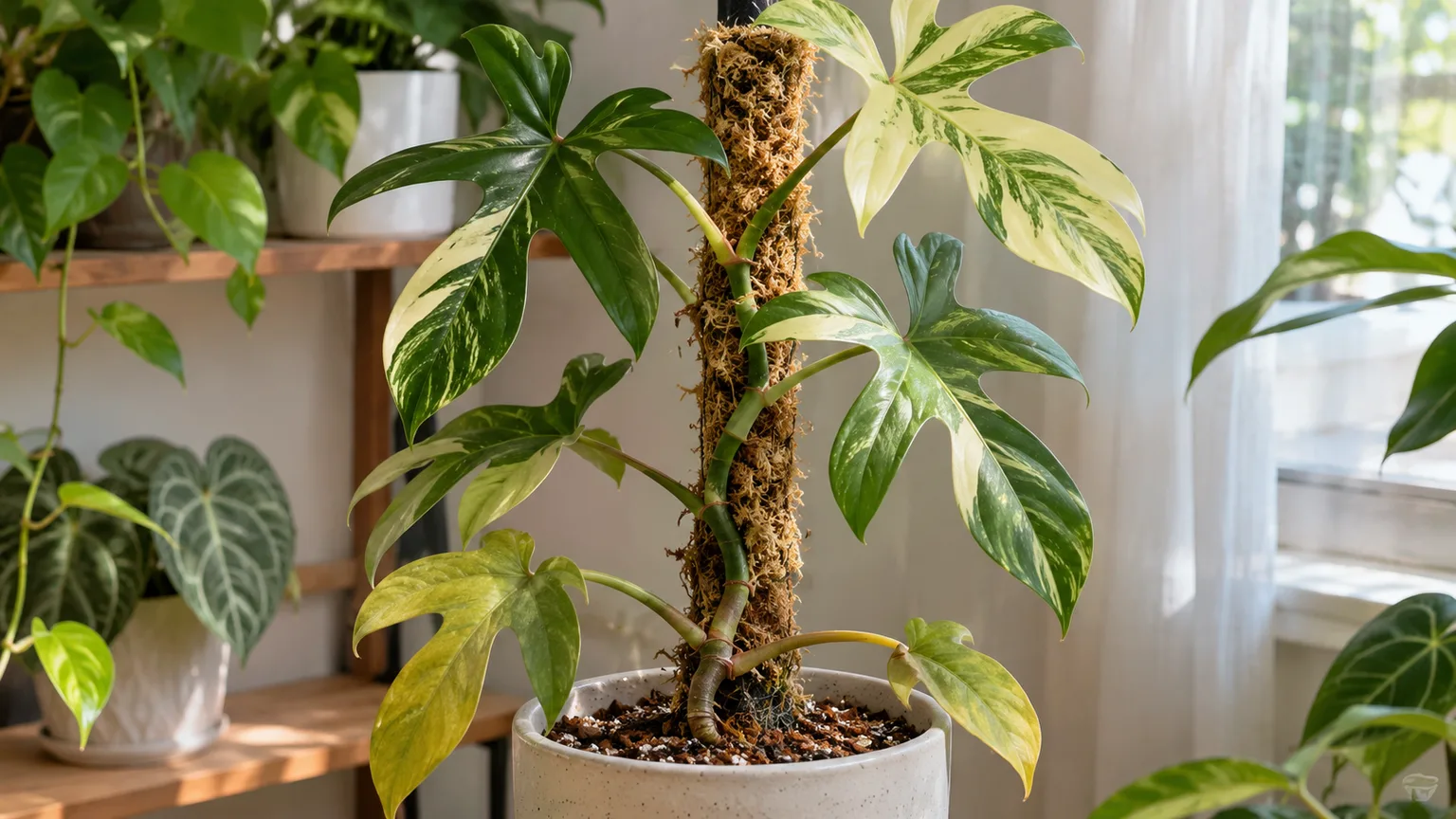
Root Rot on Philodendron Florida Beauty: Causes, Checks & Fixes
This guide covers root rot on Philodendron Florida Beauty. See also the general Root Rot guide, watering, and light pages for this plant.
Root Rot on Philodendron Florida Beauty: Causes, Checks & Fixes
Quick answer
Root rot on Philodendron Florida Beauty is most likely when the mix stays wet around its climbing root system. First, slide the plant from its pot and inspect the roots; if they are brown or black and mushy, rinse away old mix, trim only decayed tissue with clean scissors, and repot into fresh chunky aroid mix. For how chronic wet mix damages roots in general, see our root rot guide. On Florida Beauty, the pattern usually shows up as yellowing lower leaves plus a stem base that softens where it meets damp mix or a soaked moss pole. Start with the Florida Beauty overview if you need to check the hybrid’s normal climbing habit and care context.
What root rot looks like on Florida Beauty
The earliest sign is lower leaves turning yellow, then brown, and dropping while the newer lobed leaves stall — the Connecticut Agricultural Experiment Station notes this bottom-up yellowing with poor vigor as the classic philodendron root-rot pattern. Because Florida Beauty is a pedatum × squamiferum climber, the vine tells on itself: internodes feel soft instead of firm, the reddish hairy petioles droop even though the mix is damp, and growth of new lobed leaves stops. In advanced cases the stem base near the soil line turns brown and mushy, and the pot gives off a sour, decayed smell when you lift the root ball.
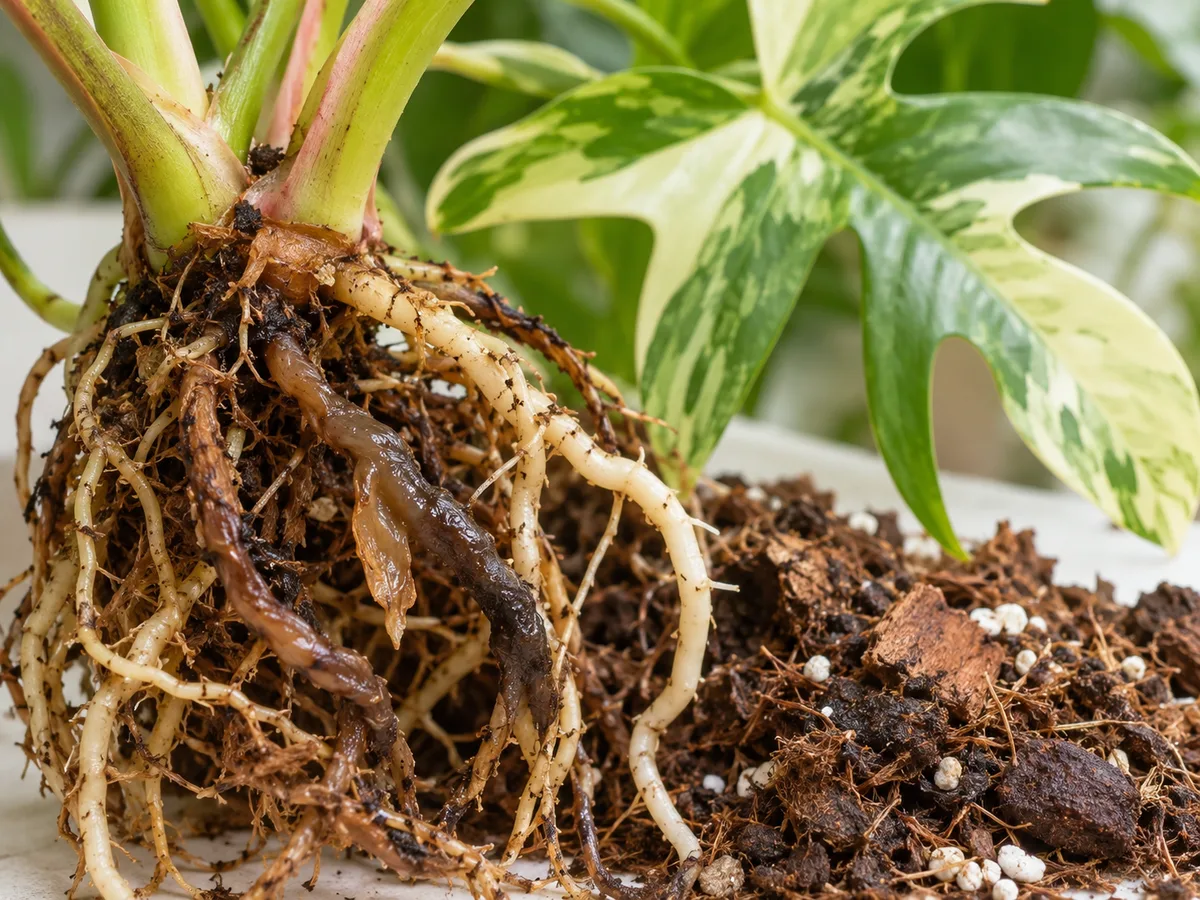
Brown-black, softened roots show rot; firm pale roots are the tissue to preserve during trimming.
Healthy Florida Beauty roots are white and firm to the touch, while rotted ones look brown to black, feel mushy, and smell rotten — a contrast grower guides describe as the single most reliable home diagnosis (Philodendron root rot signs). If you hold a suspect root and pull gently, Pythium-infected roots let their soft outer cortex slide off the firm inner stele, a diagnostic slip test extension pathologists teach for water-mold rots (water molds).
Why Florida Beauty gets root rot
Three traits of this hybrid stack the odds. First, it is sold and repotted as a collector plant, often into dense peat-heavy retail mix that compacts within months and holds water against roots evolved for bark and leaf litter. Clemson Extension warns that philodendron root rot usually results from a mix that drains slowly or from watering too often, and that pots must never stand in water (evenly moist, but not soggy). Second, its variegated cream sectors photosynthesize poorly, so the plant uses water more slowly than a solid-green philodendron in the same window — the same watering schedule that suits a green heartleaf keeps Florida Beauty soggy. Third, dim light compounds everything: in low light the vine drinks even less, the mix stays wet for days, and water-mold pathogens get the saturated conditions they need.
Moss-pole moisture traps
This is the Florida Beauty–specific cause most generic guides miss. The vine is meant to climb, and growers keep sphagnum moss poles damp so aerial roots attach — but a pole kept soaking wet holds moisture directly against the stem and the nodes entering it. Stem-base rot at the pole junction can advance while the pot mix itself feels only mildly damp, so the owner keeps watering “normally” as the vine collapses from the middle. Keep the pole barely damp to the touch, never dripping, and let it approach dryness between mistings. When you check for rot, inspect the nodes embedded in the pole first, not just the roots in the pot.
Variegation, light, and dry-down
Florida Beauty needs brighter filtered light than solid-green philodendrons because its cream splashes barely photosynthesize — and that light level directly controls how fast the mix dries. A plant in a dim corner with a weekly watering routine is at higher risk: water use may drop and the mix can stay wet longer. Compare placement with the plant’s light guide before changing the watering routine. Move it to bright filtered light, then recalibrate watering to the pot (top 3–5 cm dry) rather than the calendar. Check the soil guide for the airy mix this climber needs. The Royal Horticultural Society’s philodendron guidance centers on exactly this combination of bright filtered light and open mix, and Florida Beauty punishes you faster than most when either is missing.
How to confirm the cause
Work in this order so you only unpot once. First, lift the pot: if it still feels heavy many days after watering, the root zone is waterlogged. Second, push a finger or wooden skewer 3–5 cm deep — damp-obviously-wet at that depth a week after watering confirms poor dry-down. Third, examine the stem base at the soil line and every node entering the moss pole for browning, softness, or a sour smell. Fourth, slip the root ball out and rinse the mix off under lukewarm water so you can see root color and firmness clearly. Brown-to-black, mushy roots that shed their outer layer when tugged — the sloughing symptom nursery pathologists describe as outer root tissue that can be pulled away from the inner core — confirm pathogenic rot rather than simple overwatering stress.
The first fix to try
Do one thing first: unpot, rinse, trim to firm white tissue, and repot into fresh chunky sterile mix. Shake and rinse all old mix from the roots, cut every mushy brown or black root back to where the tissue is white and firm, and wipe scissors with rubbing alcohol between cuts. Repot into a clean pot with drainage holes using fresh potting mix plus perlite and orchid bark — never reuse the old mix, since extension guidance stresses that control starts with a sterile potting mix and clean pots. Water lightly once to settle the mix, empty the saucer, and then leave the plant alone to dry down.
Step-by-step recovery
After the repot, place the plant in bright filtered light at 18–29°C and hold off on fertilizer entirely — feeding a root-pruned plant burns the few working roots it has left. Water only when the top 3–5 cm dry out, which may take noticeably longer than before since the root system is smaller. If the moss pole survived, keep it nearly dry until new growth resumes so the trimmed stem base stays aerated. Remove leaves that are fully yellow or collapsed, but keep any leaf that is still mostly green and firm, since the recovering root system needs whatever photosynthesis it can get. Do not apply fungicide drenches meant for outdoor beds to a houseplant without a label that clears indoor philodendron use; the repot plus dry-down is the treatment.
Node-cutting rescue when roots are gone
Florida Beauty’s climbing habit gives you a backup most rosette plants lack: stem nodes root readily. If unpotting reveals no firm roots at all, or the stem base is soft and discolored several centimeters up the vine, cut above the rot into green firm stem and take one or two sections, each with a node and preferably an aerial-root nub showing cream on the stem. Root the cutting in water or damp perlite in bright filtered light, changing water every few days, and pot up once new white roots reach 3–5 cm. Choose sections with stable cream patterning if you want the variegation to carry forward. This is propagation as triage, not decoration — take the cuttings the same day you confirm total root loss.
Recovery timeline
Judge everything by new growth, not by old leaves — damaged leaves never un-yellow. If the rot is contained and firm roots remain, leaf decline may slow over the next few weeks; new growth can take longer and varies with light, temperature, and season. Do not use a fixed 3–6-week deadline as proof of success or failure. The next leaf may differ in variegation; one leaf alone cannot confirm reversion or recovery. If yellowing spreads to new leaves or the stem base softens further after the repot, unpot once more — missed mushy tissue is the usual reason — or fall back to node cuttings.
Lookalike symptoms
Root rot is easily confused with plain underwatering, cold damage, or natural aging, so rule these out. Underwatered Florida Beauty wilts with dry, lightweight mix and crispy leaf edges; root-rot wilt happens in heavy, damp mix with soft yellowing leaves. Cold damage (below about 13°C / 55°F) blackens leaf patches quickly after a chill event and the roots stay white and firm — rot blackens roots first and leaves second. Normal aging drops one oldest leaf at a time while new growth continues; rot disrupts new growth and stacks multiple yellowing leaves at once. Phytophthora-type rots are genuinely hard to separate from nutrient or drought decline above ground, since symptoms mimic deficiency and wilt (swim through saturated soil) — which is why the unpot-and-look step is non-negotiable.
Mistakes to avoid
Do not fertilize a stressed, freshly repotted Florida Beauty; salts burn trimmed roots and extension sources specifically warn against overfertilizing rot-stressed philodendrons. Do not move the plant to a bigger pot “so it can recover” — excess mix stays wet and restarts the cycle; same size or one size down is correct. Do not stack repotting, heavy pruning, and pest sprays on the same day; the repot is the day-one action and everything else waits. And do not keep the moss pole soaked to “help aerial roots recover” — wet pole contact is what rots stem bases.
How to prevent it next time
Prevention is pot, mix, and rhythm. Keep the plant in a chunky aroid mix with drainage holes, and recalibrate watering to the skewer test rather than the calendar — our watering guide sets the baseline at 7–10 days in summer and 10–14 days in winter. Empty saucers and cachepots after every soak so the roots never sit in standing water. Give bright filtered light to keep the variegated canopy actually transpiring, hold humidity at 55–70% with airflow rather than constant misting, and refresh compacted mix at repotting time every two to three years.
When to worry
Most early-caught cases are fixable, but be honest about two endpoints. If rot has consumed the entire root system and climbed the stem past every salvageable node, the mother plant is finished — root the best remaining tip cutting and compost the rest. Severely symptomatic plants with collapsed crowns rarely recover even with perfect aftercare, a point the Connecticut station makes bluntly for philodendrons. Act early precisely so you never have to make that call.
Related Philodendron Florida Beauty guides
Use the Florida Beauty problems hub to compare symptoms across the vine. If roots are firm but the mix stays wet, the overwatering guide covers watering stress without confirmed root decay. For baseline intervals and dry-down checks, see the watering guide.
Related tool
Use the Root Rot Risk Checker to narrow causes for root rot on this plant before changing multiple variables at once.