Root Rot on Philodendron Majestic: Causes, Checks & Fixes
Quick answer
Root rot on Philodendron Majestic usually starts with a chunky mix that stayed wet too long or a constantly soaked moss pole keeping the stem base damp. First step: slide the plant out of its pot and check the roots — firm white roots mean a watering problem, brown mushy ones mean rot to trim.
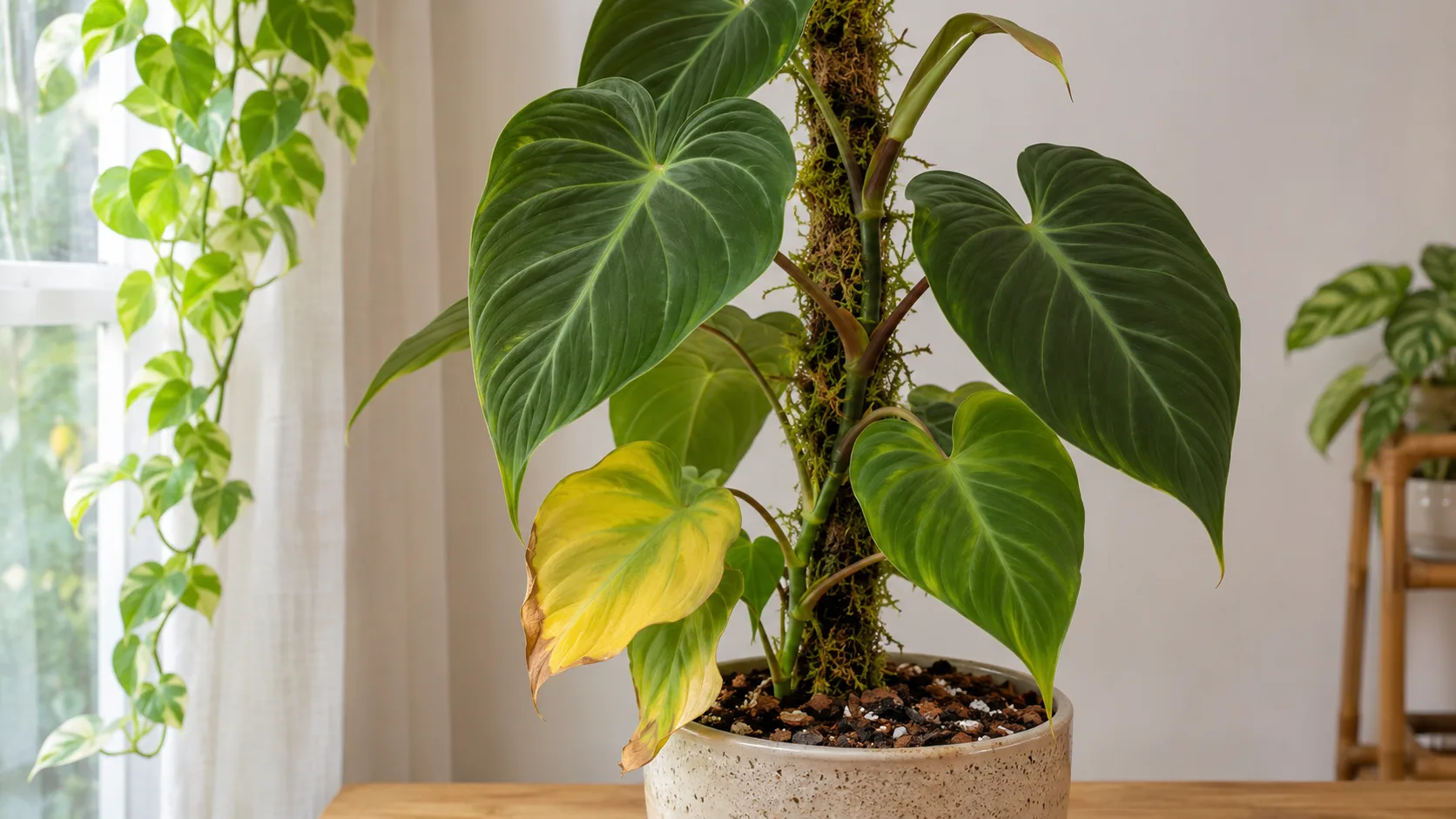
Root Rot on Philodendron Majestic: Causes, Checks & Fixes
This guide covers root rot on Philodendron Majestic. See also the general Root Rot guide, watering, and light pages for this plant.
Root Rot on Philodendron Majestic: Causes, Checks & Fixes
Quick answer
Root rot on Philodendron Majestic almost always traces to the root zone staying wet too long: a bark mix that never dried, a pot without drainage, a saucer left full, or a moss pole kept permanently soaked against the stem. Lower velvet leaves turn yellow and drop while the mix still feels damp, and growth stalls at the tip.
For how wet mix damages roots in general, see our root rot guide. On Majestic, the pattern shows up through its velvet leaves and climbing stem first — read those before reaching for fungicide.
First step: slide the plant out of its pot and look at the roots. Firm, pale roots mean you caught a watering problem early. Brown or black mushy roots with a sour smell confirm rot that needs trimming today.
What root rot looks like on Philodendron Majestic
Majestic’s big velvet leaves are honest reporters. The earliest sign is usually one or two lower leaves turning soft yellow, then brown at the edges, and dropping — while the potting mix still feels moist days after watering. New leaves may emerge smaller, with duller silver veining, or stall inside the cataphyll entirely.
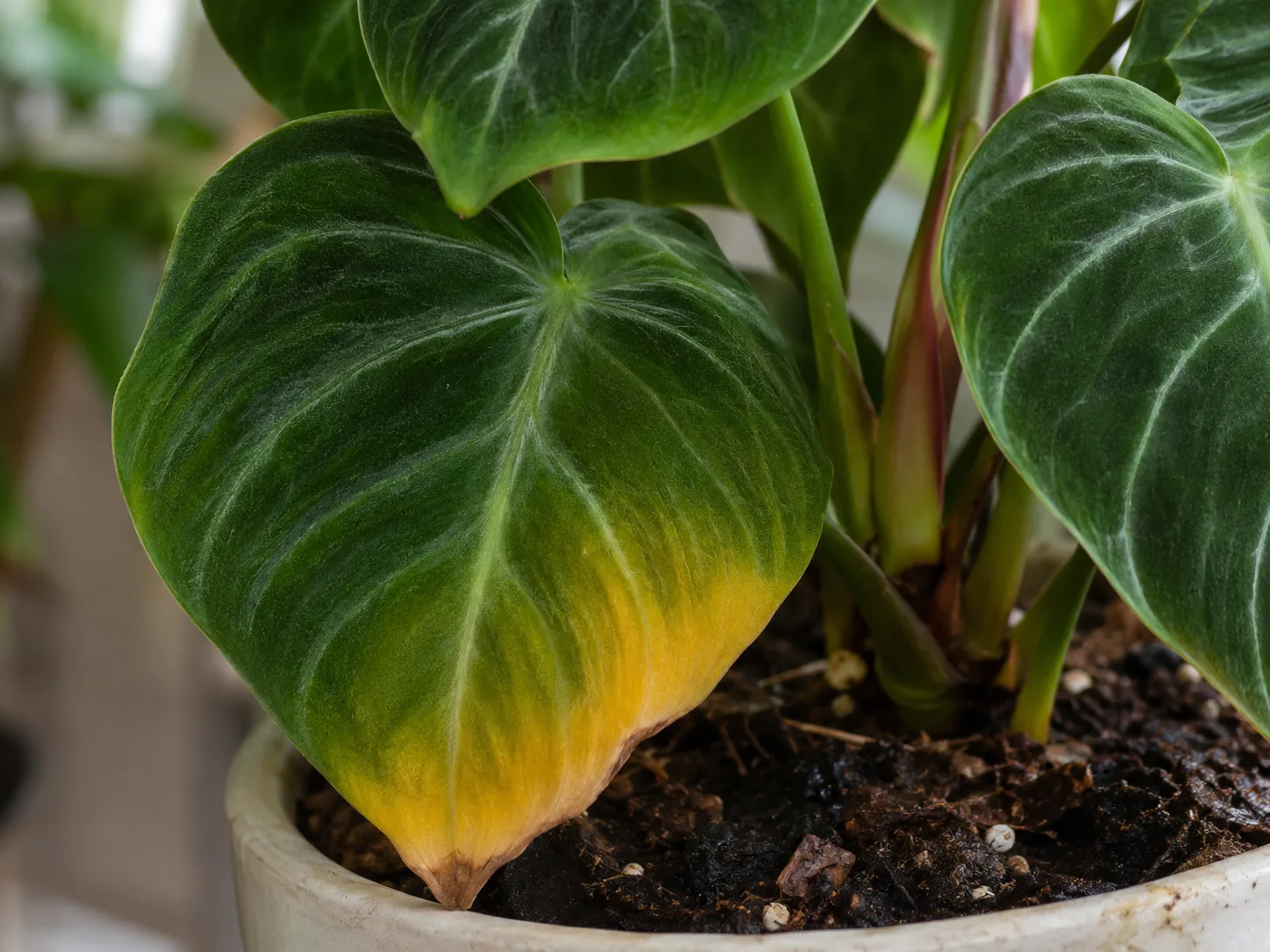
Soft yellowing on lower leaves while the mix remains moist can signal a failing root system.
This matters because Majestic is a vigorous climber that normally pushes leaves steadily in good light. When the tip stops producing while lower leaves yellow, the roots are failing to deliver water — the classic paradox where a rotting plant looks thirsty. Do not water it “back to health”; check the roots instead.
What you will not see early: spots with halos (that points to bacterial leaf spot), silvery stippling on velvet undersides (check for spider mites), or crisp brown margins on otherwise firm leaves in dry air (a humidity problem). Root rot yellowing is soft, limp, and bottom-up.
Why Majestic is vulnerable
Philodendron roots are fine feeders built for airy, fast-draining conditions around tree trunks — not dense, soggy potting soil. Connecticut’s plant health handbook notes philodendron root rot that yellows lower leaves first, progressing upward as vigor collapses. Majestic amplifies the risk in three ways.
First, its large velvet leaves transpire heavily in the 60–75% humidity it prefers, so growers water generously — but in dim indoor light the mix dries far slower than expected. Second, collectors often pot it in rich, moisture-holding soil rather than the chunky bark-and-perlite aroid mix it needs. Third, the moss pole invites daily soaking that keeps the stem base and upper root zone permanently damp. Each factor alone is survivable; combined, they suffocate roots until water displaced the air around them and they simply drown.
The moss-pole moisture trap
This is the most Majestic-specific cause on this page, so rule it out early. A textured pole the aerial roots can grip is standard culture for this hybrid — but a pole that never dries becomes a wet compress against the stem base and the top of the root ball.
Check where the stem meets the mix. If sphagnum or coco fiber is black, slimy, or sour-smelling at the base while the grower keeps the pole “always moist,” rot often starts at the stem base rather than deep in the pot. Water the pole when you water the pot per our watering guide, then let both approach the dry-down point together. A moist pole roots can grip is the goal; a dripping one is a hazard.
Also confirm the aerial roots are facing the support and rooting into barely damp fiber — not buried in wet mix. Burying climbing stems to “stabilize” the plant is a common mistake that rots nodes.
How to confirm: the root inspection
The only way to confirm rot is to look at the roots. Dark, mushy roots with a sour decay smell are diagnostic; firm, pliable, pale roots rule rot out. Work in this order:
- Lift the pot. Heavy days after watering plus damp mix means the root zone never breathed. Compare against our soil guide expectations for a chunky mix.
- Smell the drainage holes. A sour or swampy odor is a strong rot signal before you even unpot.
- Slide the root ball out. Brush mix away gently. Healthy Majestic roots are firm and white to tan. Rotted ones are brown to black, slimy, sometimes with the outer sheath sliding off to leave a thin thread.
- Squeeze the stem base. Firm means the crown survived; soft or sunken means decay reached the stem, which changes the rescue plan.
- Note the proportion. Less than a third of roots affected is very saveable. More than two-thirds lost pushes you toward the node-cutting backup below.
If roots are firm and white, stop — you have an overwatering scare, not rot. Let the mix dry to the top 3–5 cm, empty the saucer, and review light per our light guide before changing anything else.
First fix for Philodendron Majestic
Unpot the plant and expose the roots today — change nothing else until you have seen them.
This single inspection decides everything downstream: firm roots mean dry-down and patience, rotted roots mean surgery and fresh mix. Watering, misting, fertilizing, or repotting blindly all risk pushing a rotting plant further. Lay the root ball on newspaper, shake off loose mix, and rinse remaining soil under lukewarm water so every root is visible.
Step-by-step rescue
Once inspection confirms mushy roots, proceed in this order:
- Trim with sterilized scissors. Cut away every dead, dark, or slimy root, cutting back into firm pale tissue. Be aggressive — a small leftover pocket of decay recolonizes healthy roots.
- Trim foliage to match. If you removed more than about a third of the root system, prune back a similar share of leaves so the reduced roots can support the canopy. Include any yellowed or collapsed leaves.
- Let roots air-dry. Rest the plant in open air for several hours (up to a day) so cut surfaces callus. Discard all old mix — never reuse it.
- Sterilize the container. Scrub the pot and soak it in a diluted bleach solution, then rinse well — or use a new pot with drainage holes. Undersized is better than oversized here; excess mix stays wet.
- Repot in fresh chunky mix. Use bark, perlite, and potting mix per our soil guide, position the stem at the same depth, and face aerial roots toward a barely damp pole.
- Water once, lightly, then wait. Settle the mix with a modest watering, empty the saucer, and do not water again until the top 3–5 cm dry. Bright indirect light per our light guide speeds recovery; direct sun on a rootless plant scorches velvet leaves.
Hold fertilizer until a new leaf opens cleanly — feeding a plant with no functioning roots burns tissue and feeds pathogens.
Node-cutting backup plan
Here Majestic’s climbing biology is an advantage: philodendrons root readily from stem cuttings with a node, and Majestic nodes already carry aerial roots primed to grow. If the stem base is soft or most roots are gone, take insurance cuttings rather than betting everything on the old root ball.
Choose a firm section of vine with at least one node and a healthy leaf. Cut below the node with a sterilized blade, let the end callus for an hour, then root in damp (not wet) sphagnum or water with the node submerged and leaves dry. Bright indirect warmth and 60–75% humidity root cuttings in two to four weeks. Keep the mother plant’s rescue going in parallel — whichever establishes first becomes your plant.
Recovery timeline
Expect a quiet first week: no further collapse is the first win. Within two to three weeks, remaining leaves should feel firmer and no new yellowing should appear. A clean new leaf within three to six weeks is the real confirmation, since this hybrid grows vigorously once roots function.
Judge progress only by new growth and firmness at the stem base — old yellowed velvet will never turn green again. Escalate to cuttings if softness climbs the stem, the smell returns, or every leaf collapses despite correct dry-down.
What not to do
- Do not water on a calendar schedule to “help it recover.” Follow the watering guide dry-down check every time.
- Do not mist velvet leaves to compensate for wilt — misting spots the foliage and does nothing for dead roots.
- Do not fertilize a rootless or freshly trimmed plant.
- Do not pot into a larger decorative container without drainage, and never leave the nursery pot sitting in a full cachepot or saucer.
- Do not stack fungicide drenches, repotting, and heavy pruning on the same day beyond the single rescue sequence above — one clean intervention, then observation.
How to prevent it next time
Prevention for this hybrid is mostly pot physics plus pole discipline. Keep it in a genuinely chunky aroid mix that falls apart in your fist, always in a pot with drainage holes. Water deeply only when the top 3–5 cm dry, then empty every saucer — the watering guide rhythm of roughly 7–10 days in summer and 10–14 in winter is a starting point, not a schedule.
Give bright indirect light with the pole the roots can grip so the plant actually uses the water you give it. Maintain humidity with a humidifier rather than a spray bottle, and refresh or upsize the pole at repot every year or two instead of burying the stem deeper.
When to worry
Give up on the original root ball — and commit fully to cuttings — when the stem base is mushy through its full diameter, the rot smell persists after trimming, or virtually no firm roots remain. This matches extension guidance that heavily symptomatic philodendrons are unlikely to recover and are better removed before decay spreads to nearby plants. A lost root ball is not a lost plant as long as one firm node survives.
Related tool
Use the Root Rot Risk Checker to score drainage, watering rhythm, and stem condition for root rot on this plant before changing multiple variables at once.