Leggy Growth on Philodendron Selloum: Causes, Checks & Fixes
Quick answer
Leggy growth on Philodendron Selloum is self-heading petiole stretch from low light-not vining behavior. Long weak petioles, small pale new lobes, and a sparse crown leaning toward the window are the pattern. First step: move the center rosette to bright indirect light within 2–4 feet of an east window or behind sheer on south or west glass.
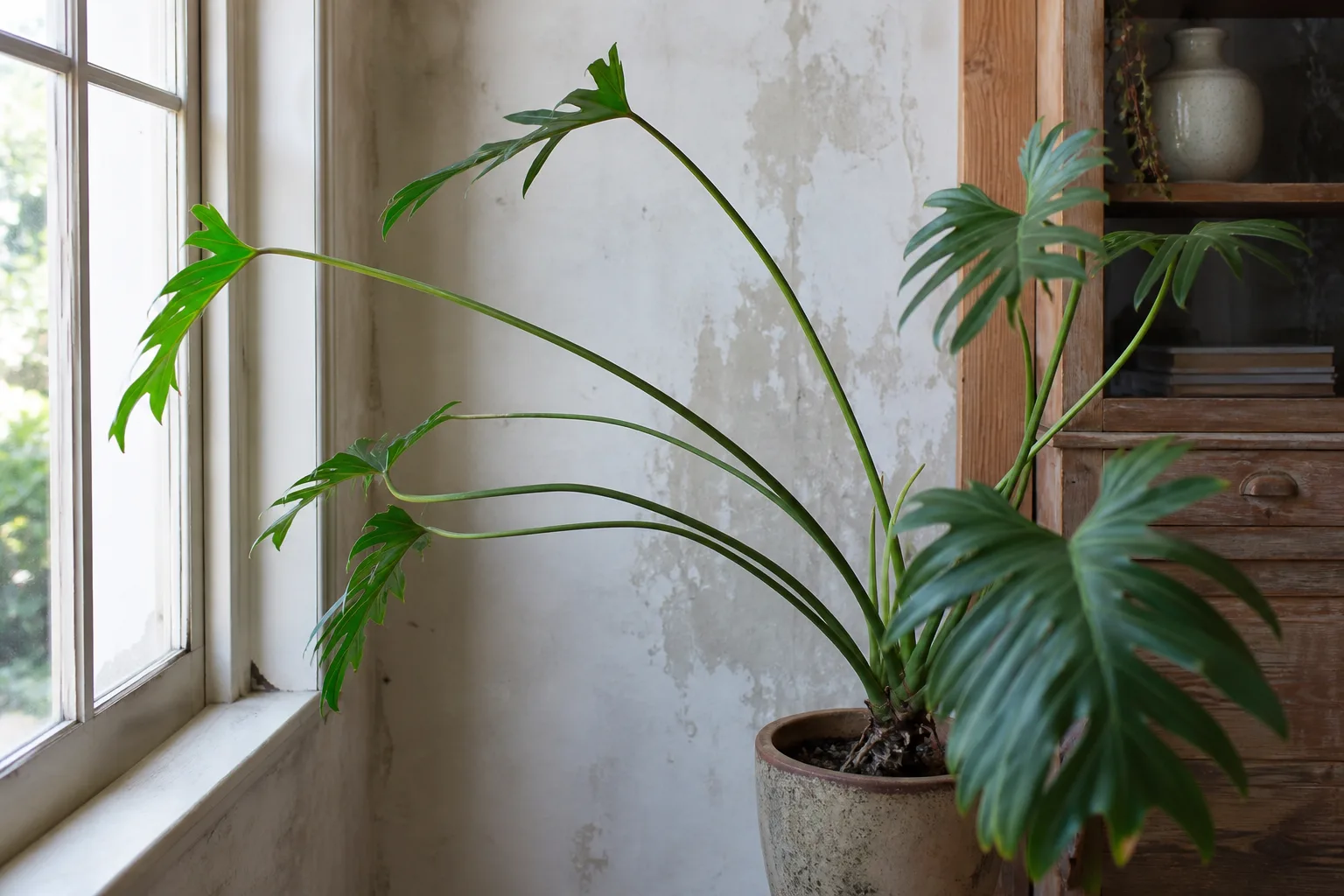
Leggy Growth on Philodendron Selloum: Causes, Checks & Fixes
This guide covers leggy growth on Philodendron Selloum. See also the general Leggy Growth guide, watering, and light pages for this plant.
Leggy Growth on Philodendron Selloum: Causes, Checks & Fixes
Quick answer
Leggy growth on Philodendron Selloum - Thaumatophyllum bipinnatifidum on most nursery tags - is self-heading petiole stretch from insufficient light, not vining behavior. This upright tree philodendron grows from a central crown on long smooth petioles; in dim rooms those stalks elongate, new lobes emerge smaller with fewer or shallower cuts, and the canopy opens toward the brightest source.
First step: move the center rosette to bright indirect light - typically within 2–4 feet of an east-facing window, or 4–6 feet back from south or west glass behind a sheer curtain. Increase exposure gradually over 7–14 days if the plant lived in deep shade; full direct sun scorches leaves on this species.
Scope on this page: This guide focuses on etiolation mechanics - how stretch shows up on a self-heading selloum and what improves after you brighten placement. For room-level placement checks, grow-light specs, and crown-height confirmation, see not enough light. For proactive window strategy on a large floor specimen, see the light guide.
Why Philodendron Selloum gets leggy - and why it is not vining
Insufficient light is the primary cause. Selloum is not a low-light plant. NC State Extension documents high light preference with tolerance for lower light only as a survival band - in that dim band, the plant stretches rather than producing the large deeply lobed architecture it is grown for.
Self-heading stretch vs. climbing philodendron legginess
Climbing philodendrons etiolate along internodes - bare stem sections between leaves - and may produce long runners toward a window. Selloum is non-climbing and self-heading: leaves rise from a short stem on long smooth petioles in a rosette-like crown. When light is too low, the plant lengthens petioles and shrinks new blades instead of sending out a vine.
That distinction matters for diagnosis and fixes. Moss poles, trellises, and “pinch the runner” advice from vining philodendron guides do not apply here. The correction is photons at crown height, not support structure.
Secondary causes that mimic stretch
Over-fertilizing in low light can push weak elongated growth - nitrogen without adequate light produces soft pale tissue rather than firm lobes. Root-bound stress or chronic overwatering in dim corners can also produce pale sparse upper leaves with firm lower foliage, which looks similar from across the room but stems stay limp and soil sour when rot is involved.
Ceiling light alone rarely sustains dense new lobing on a 4- to 10-foot floor specimen whose crown sits far above the window sill. Light intensity drops rapidly with distance from the source; the room can feel bright at eye level while the rosette reads as medium or low light.
What leggy growth looks like on a self-heading tree philodendron
Leggy selloum has a recognizable pattern on the center rosette, not only on aging lower foliage:
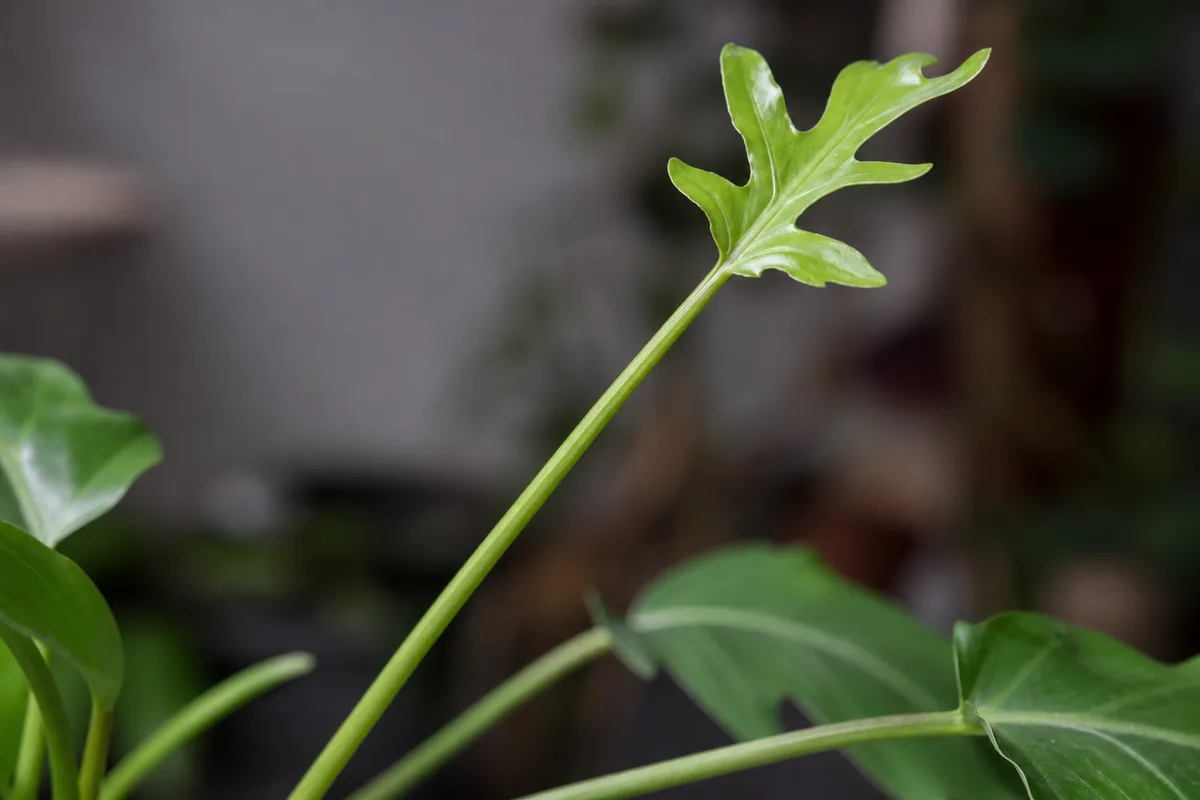
Leggy Growth symptoms on Philodendron Selloum - compare with healthy tissue on the same plant.
- Noticeably longer petioles on newest leaves - compare the stalk on the freshest lobe to one produced when the plant sat closer to glass. Stretch of 30–50% or more over a few months is common in dim placement.
- Smaller leaf blades with shallower lobing - low light produces smaller leaves with fewer or no lobes per NC State. Deep cuts and glossy size are what this species is grown for; dim rooms flatten that architecture first on new growth.
- Pale yellow-green new color - fresh lobes look washed out compared to older darker lower leaves that formed in better light.
- Open sparse crown - fewer active lobes at the top while large older leaves lower on the stem still look impressive, masking the problem.
- Strong lean toward one window - the whole crown angles toward the brightest source. Self-heading plants cannot trail toward light; they tilt and stretch upright.
- Lower older leaves may stay large while top leaves shrink - a hallmark of etiolation, not uniform nutrient deficiency.
Unlike climbing philodendrons, selloum will not produce long bare internodes along a vine. If you see runners and nodes, you may have a different species - see the overview for identity.
How to confirm the cause
Work through these checks before repotting, fertilizing heavily, or mass-pruning:
- Crown-height window distance - Stand at the tallest leaves. Is the rosette more than 4–6 feet from the brightest window? Human eyes adapt quickly and are poor judges of intensity; measure at foliage height, not the doorway.
- New vs. old petiole length - The newest petiole should be similar in proportion to older crown leaves if light is adequate. Dramatic lengthening with shrinking blades confirms etiolation.
- Hand-shadow test at crown height - On a sunny day, hold your hand between window and crown. A soft diffused shadow with recognizable fingers suggests usable bright indirect light. Faint or absent shadow at crown height means the spot is too dim.
- Soil moisture and root firmness - Stick a finger 5 cm (about 2 inches) into the mix. If it stays damp far longer than before with yellowing lower leaves and sour smell, rule out root rot before treating stretch alone. Firm stems and dry-ish mix point to light as the primary issue.
- Recent move or seasonal drop - Did the pot shift farther from glass, or did winter shorten daylight? Stretch can accelerate after either without any watering change.
- Pest check - Spider mites and thrips can pale foliage, but they do not typically lengthen petioles uniformly toward one window. Inspect undersides before assuming light only.
If stems are firm, pests are absent, and new growth shows longer petioles with smaller pale lobes leaning toward glass, low-light etiolation is the most likely cause.
Lookalike symptoms
| Problem | Key signs | How it differs from leggy etiolation |
|---|---|---|
| Not enough light | Small pale lobes, slow dry-down, crown lean | Same root cause - that page covers placement and crown-height checks; this page covers stretch morphology |
| Slow growth | Few new lobes, firm old leaves, little dramatic stretch | Growth nearly stalls; petioles may not lengthen much |
| Overwatering in dim corners | Yellowing, limp petioles, wet pot, sour smell | Light stress alone keeps stems firm; chronic wet mix drives yellowing |
| Nutrient push in shade | Soft pale new tissue after heavy feed | Pattern follows fertilizing, not just window distance |
| Normal lower-leaf drop | Large lower lobes yellow as crown grows | Healthy if new top growth is large and dark |
First fix: brighter filtered light and gradual acclimation
Move the center rosette to bright indirect light.
Relocate so the active growing tip - not just the pot rim - receives strong filtered daylight most of the day. Practical starting points for floor specimens:
- East window: 2–4 feet back from glass, or behind a thin sheer if midday sun is intense.
- South or west window: 4–6 feet back, or directly behind a sheer curtain - avoid unfiltered hot afternoon beams on unacclimated leaves.
- No usable window: Add a full-spectrum LED grow lamp 12–18 inches above the crown, on a timer for 10–14 hours daily during active growth.
Increase exposure gradually if the plant lived in deep shade for months - shift closer over 7–14 days rather than placing it on an unfiltered west sill in one move. Rotate the pot one-quarter turn weekly for even canopy development.
Remove only fully dead or yellowing leaves. Do not mass-prune healthy stretched petioles hoping for bushiness - the crown will look bare while waiting for compact new lobes. Hold fertilizer until two to three new lobes show improved size and color; nitrogen does not replace photons on a tree philodendron.
For large-specimen logistics, slide heavy pots on a plant dolly rather than dragging by the stem. Selloum petioles snap if caught on doorframes.
Recovery timeline - what improves vs. what stays stretched
| Timeframe | What to expect |
|---|---|
| Week 1 | Lean may lessen slightly; existing long petioles look unchanged |
| Weeks 2–4 | First new lobe after the move should show firmer, slightly shorter petiole proportion and a larger blade than the prior leaf |
| Weeks 4–8 | Two to three unfurling cycles with progressively larger, darker, more deeply lobed leaves confirm the fix |
| Beyond 8 weeks | If new foliage stays small and pale, light is still too low - move closer, add a lamp, or verify crown height receives the beam |
Old stretched petioles do not shorten. Pale lower lobes may not regain the deep green or full size of youth. Judge success by new growth only: lobe size, lobing depth, petiole firmness, and color on the freshest leaves from the center rosette.
Signs the problem is improving: tighter new petioles, larger blades, deeper cuts, firmer green tone, less dramatic lean.
Signs it is getting worse: continued petiole lengthening on each new leaf, increasing pale color, soil staying sour and wet with yellowing lower leaves - see root rot if mushy roots appear.
What not to do
- Do not place immediately in full direct western or southern afternoon sun - acclimate over 7–14 days. Unfiltered hot sun scorches glossy leaves and scars tissue that will not heal on a 2-foot lobe.
- Do not assume a larger pot fixes stretch - light is the issue; repotting without brighter placement does not compact petioles.
- Do not confuse normal lower-leaf drop with legginess - large lower lobes senesce as the crown grows; that is healthy if new top architecture is strong.
- Do not fertilize heavily to “replace” light - salts on roots already stressed by dim wet soil worsen weak growth.
- Do not install a moss pole - selloum is self-heading; support structures do not correct etiolation.
How to prevent leggy growth next time
Place selloum where bright filtered light reaches the crown most of the day, not only where the pot looks decorative. Missouri Botanical Garden lists outdoor culture as part shade with morning sun or sun-dappled conditions - indoors, that means your brightest suitable filtered window.
In rooms with weak natural light, run a full-spectrum grow lamp 10–14 hours daily above the rosette before buying a large floor specimen - not after a year of pale small lobes. See the light guide for window-by-direction placement.
Rotate the pot quarterly for even canopy development. Match watering to dry-down speed in actual light - a LeafyPixels indoor starting point is to water when the top 5 cm (about 2 inches) of mix dries. Brighter placement speeds growth and dry-down; dim corners need longer intervals. See the watering guide.
Pet safety: Selloum contains calcium oxalate crystals and is toxic to cats and dogs. Keep large specimens behind barriers if pets chew plants. For ingestion, contact your veterinarian or ASPCA Animal Poison Control at (888) 426-4435.
When to worry
Pure stretch is gradual, but act promptly if:
- Soil stays sour and wet while lower leaves yellow rapidly - possible root rot layered on light stress.
- Multiple leaves yellow and droop within a week without pest signs.
- New growth stays small and pale after six to eight weeks in a spot you believed was bright - crown height is still too dim.
Selloum rarely dies from shade alone, but chronic low light plus overwatering can kill roots. Light correction and watering adjustment together prevent that slide.
Related Philodendron Selloum guides
- Overview - species identity, mature size, and baseline care
- Not enough light - crown-height placement and confirmation when the room may be too dim
- Light - proactive window and grow-light strategy
- Slow growth - when the crown stalls with few new lobes
- Overwatering - wet-soil pale leaves in dim corners
- Root rot - urgency when stretch pairs with sour wet mix
- Yellow leaves - when yellowing is not stretch alone
Conclusion
Leggy Philodendron Selloum is a light problem on a self-heading giant - petiole stretch, not vining internodes. Confirm longer top petioles with smaller pale new lobes, move the rosette to bright filtered light with gradual acclimation, and read success on the next two to three unfurling cycles. Old stretched petioles will not compact; the architecture of the next leaves tells you whether the fix worked.