Mealybugs on Philodendron Splendid: Causes, Checks & Fixes
Quick answer
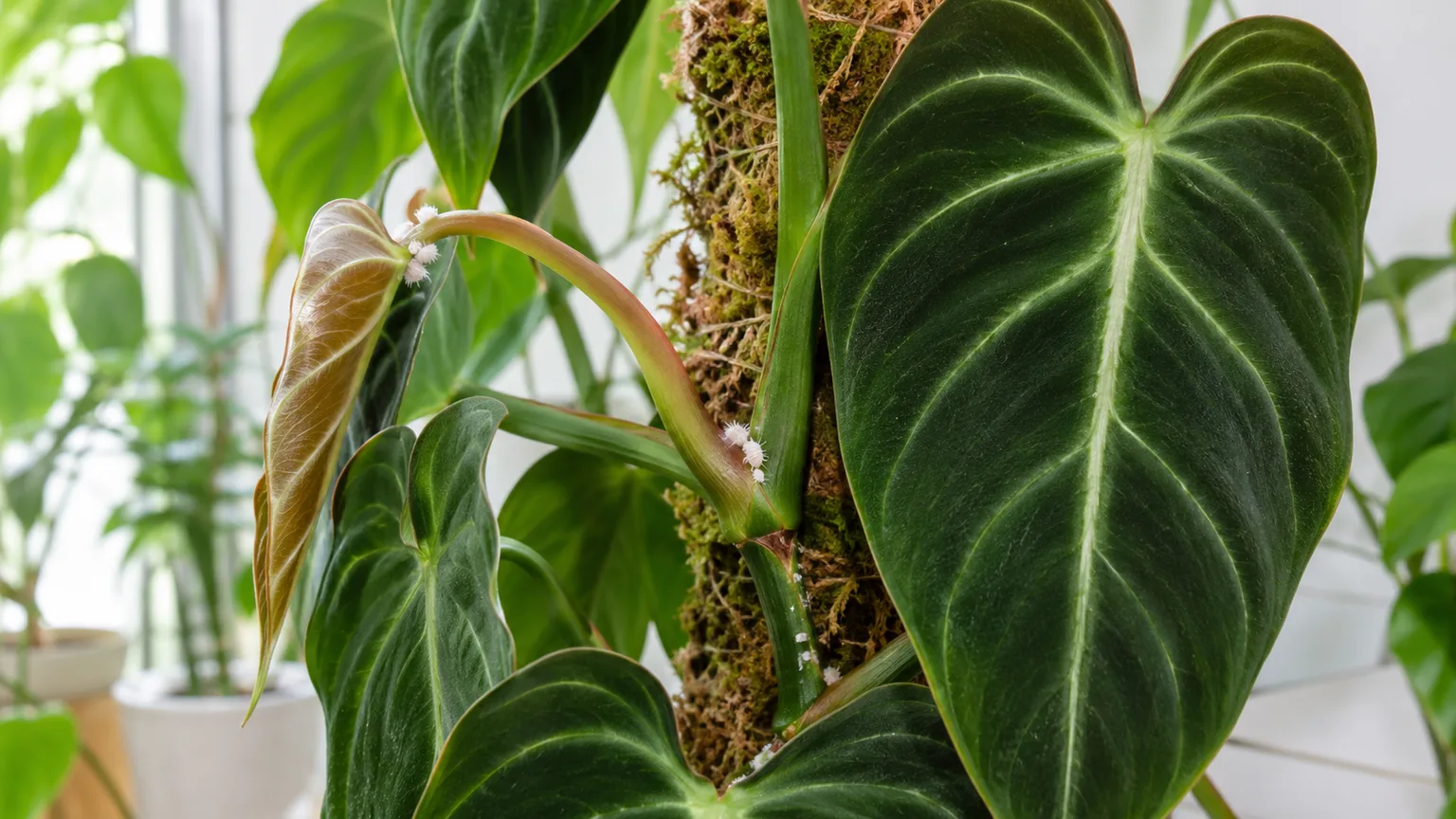
Mealybugs on Philodendron Splendid show as white cottony clusters tucked into leaf axils, stem nodes, and under the unfurling new leaf — often with sticky honeydew and stunted coppery growth. First step: isolate the plant and dab every visible cluster with a cotton swab dipped in 70% (or weaker) isopropyl alcohol, testing one leaf first.
Mealybugs on Philodendron Splendid: Causes, Checks & Fixes
This guide covers mealybugs on Philodendron Splendid. See also the general Mealybugs guide, watering, and light pages for this plant.
Mealybugs on Philodendron Splendid: Causes, Checks & Fixes
Quick answer
Mealybugs on Philodendron Splendid look like tiny white cottony tufts packed into leaf axils, stem nodes, and the folds of the newest unfurling leaf. They are small, soft, wax-covered insects that suck plant sap, and on this velvet climbing hybrid the feeding shows as sticky honeydew, black sooty coating, and new coppery leaves that unfurl small or distorted. For general mealybug biology and life stages, see our mealybug pest guide. On Splendid, colonies cluster where velvet leaves meet the stem and around moss pole ties — not evenly across open leaf faces.
First step: isolate the plant, then dab every visible cottony cluster with a cotton swab dipped in 70% (or weaker) isopropyl alcohol. Test on one small leaf area a day or two beforehand to check for burn. That single targeted pass comes before any sprays, repotting, or fertilizing.
What mealybugs look like on Philodendron Splendid
On Splendid, mealybugs exploit the plant’s architecture. This is a verrucosum × melanochrysum velvet climber with elongated dark leaves, prominent leaf axils, clinging cataphylls, and a moss pole the vine roots into. Each of those junctions is a sheltered feeding site where the waxy coating protects the colony from casual wiping and sprays.
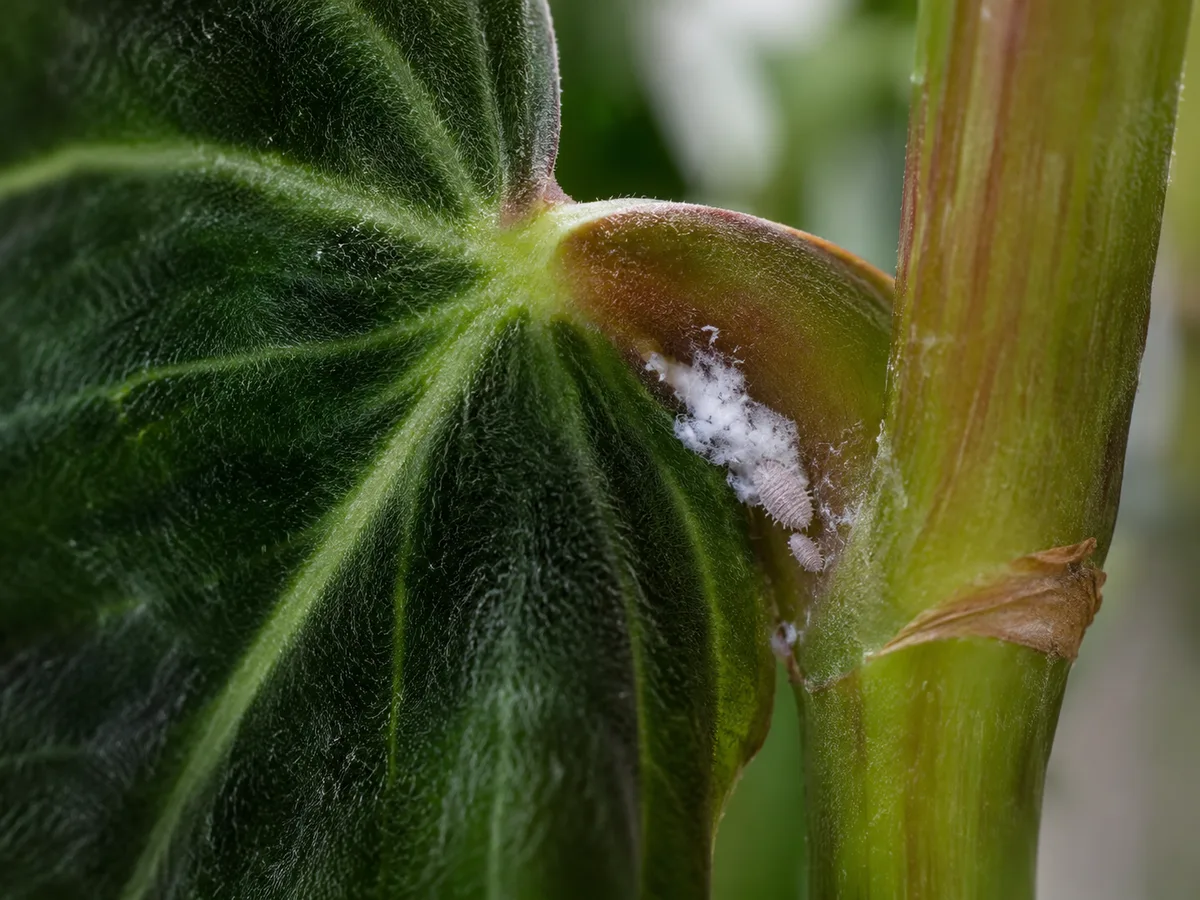
Mealybugs hide in the protected junction between the petiole and stem, where white wax stands out against the dark velvet leaf.
Expect to find:
- White cottony masses wedged where the petiole meets the stem, along stem nodes, and under the unfurling new leaf
- Colonies tucked behind dried cataphyll sheaths and around moist moss pole ties
- Clusters along the underside midrib of velvet leaves, where the texture hides early nymphs
- Sticky honeydew on leaves below the colony and on the pot rim, sometimes with ants traveling the stem
- Black sooty mould growing on honeydew-coated surfaces, dulling the velvet finish
- New coppery growth emerging stunted, rippled, or smaller than the previous leaf
Because Splendid leaves are dark and velvety, early white fluff is actually easier to spot here than on pale plants — but late-stage colonies hidden inside a furled leaf can hold dozens of insects before you notice. Unfurl each new leaf gently during inspection and look inside with a magnifier.
Why Splendid gets mealybugs
Mealybugs rarely start on a healthy isolated Splendid. They arrive, then thrive where conditions suit them:
- New unquarantined plants. Adult female mealybugs do not fly or crawl far, so they are usually brought in on an affected plant. Aroid collections with frequent new imports are the classic entry route.
- Warm, humid, still air. Splendid wants 60–80% humidity and 65–85°F warmth for clean unfurling, and mealybugs are favored by warm conditions and thrive on indoor plants. The same shelf that suits the plant suits the pest — which is why inspection must be routine, not occasional.
- Soft, overfed growth. Fresh flushes pumped by excess nitrogen are easier feeding than firm mature leaves. Hold fertilizer while fighting an infestation.
- Moss pole microclimate. A constantly damp pole with ties and crevices gives crawlers shelter and humidity. Check the pole surface and ties, not just the leaves.
- Stressed, crowded shelves. Plants touching each other let crawlers walk from host to host. Give the vine elbow room while it recovers.
Sooty coating deserves emphasis on velvet leaves: honeydew lands on the leaf below, and sooty mould colonizes the sugar, blocking light from tissue that already photosynthesizes modestly indoors. Wiping honeydew off promptly protects the leaves you are trying to save.
How to confirm the cause
Work through these checks before treating:
- Cotton test. Touch a suspect tuft with an alcohol-dipped swab. Mealybug wax dissolves and reveals a soft oval insect underneath; mineral residue or leaf variegation will not dissolve or smear this way.
- Location pattern. Mealybugs sit in axils, nodes, midribs, and furled new growth. Even white dusting across open leaf faces without axil colonies suggests residue or mildew instead.
- Honeydew check. Run a finger over leaves below the colony. Sticky film, plus ants or black sooty coating, confirms sap-feeding insects rather than fungal spots.
- Lookalike separation. Scale insects are hard brown shields that do not wipe away; spider mites leave fine stippling and silk webbing without cotton masses; whitefly nymphs are flat and fixed to leaf undersides. Signs of mealybugs include white cottony egg masses, wax, sticky honeydew, and ants feeding on honeydew — that combination separates them from the rest.
- Scope count. Note whether colonies sit on one node or five. Single-node finds get spot treatment; multi-node finds need the full repeat routine below.
If you find hard shields, fine webbing with yellow stippling, or winged white specks instead of cotton, you are looking at a different pest and should diagnose accordingly rather than forcing the mealybug routine.
First fix for Philodendron Splendid
Isolate the plant and dab every visible mealybug with an alcohol-dipped cotton swab.
Move Splendid away from other houseplants so crawlers cannot wander across touching leaves. Then, with a swab dipped in 70% (or weaker) isopropyl alcohol, touch each cottony cluster directly until the wax dissolves and the insect beneath is killed. UC IPM advises dabbing houseplant infestations this way and testing on a small part of the plant first to monitor for leaf burn. Work node by node, including inside the unfurling leaf, behind cataphylls, and around pole ties.
That is the whole first fix. Do not spray, repot, prune heavily, or fertilize on the same day — one precise pass lets you read whether colonies return and where.
Step-by-step recovery
After the alcohol pass:
- Re-inspect every 5–7 days for at least three weeks. Eggs hidden in wax and leaf folds hatch in waves, so one pass never ends an outbreak. Re-dab every fresh tuft you find.
- Wash honeydew off leaves. Wipe sticky leaves with a damp soft cloth so sooty mould loses its food base and you can see whether new stickiness appears.
- Escalate to soap or oil only if dabbing cannot keep up. Insecticidal soaps, horticultural oils, and neem oil applied directly to immature mealybugs can reduce numbers, but the waxy adults shrug off contact sprays — target young crawlers and coat thoroughly, following label directions. The Botanical Garden likewise advises treating when crawlers are present and spraying thoroughly since mealybugs hide under leaves and in crotches.
- Refresh the pole zone. If ties or pole sections harbor colonies, replace ties, let the pole dry slightly between mistings, and dab the pole surface.
- Prune only the worst. Snip a single heavily crusted leaf if its axil cannot be cleaned, but keep the rest of the vine intact — Splendid needs its leaves to fund recovery.
- Release quarantine after two clean checks. Keep the plant isolated until two weekly inspections in a row find no fresh cotton, no new honeydew, and clean new growth.
Recovery timeline
With weekly follow-up, visible colonies usually collapse within two to three weeks. The honest marker is the next leaf: a clean, full-sized coppery unfurl with no fresh cotton inside means the cycle is broken, while old soot-stained leaves may look dull for months.
Worsening signs include colonies appearing on previously clean nodes, new leaves emerging progressively smaller, spreading sooty coating, or ants recruiting to the plant. If three weeks of diligent dabbing plus a soap or oil round still shows fresh colonies, consider discarding a badly infested pole, cutting back to the cleanest node section, and restarting the vine — mealybugs hidden deep in pole fibers can outlast leaf treatments.
What not to do
- Do not fertilize a stressed, infested Splendid. Soft forced growth feeds the next generation.
- Do not repot on day one. Root disturbance plus pest stress stalls the plant; repot only if the mix has genuinely failed.
- Do not blast velvet leaves with a harsh hose jet. Splendid’s textured foliage bruises and stays wet, inviting secondary fungal spots — dab precisely instead.
- Do not spray alcohol solutions broadly without a spot test. Velvet aroid leaves can mark, so test first and use the weakest effective strength.
- Do not treat once and stop. Hidden eggs and sheltered crawlers guarantee a second wave if you skip follow-ups.
How to prevent it next time
- Quarantine new plants for two to four weeks before shelving them with your Splendid — examining and isolating all new plants before placing them near clean ones is the single most effective habit. RHS similarly recommends keeping new acquisitions in quarantine for at least a month.
- Inspect axils weekly, especially the unfurling leaf and pole ties. Catching one tuft beats fighting fifty.
- Keep care steady. Watering when the top 3–5 cm dries and holding bright indirect light keep growth firm and inspections easy. Details in the Splendid overview and soil guide help you avoid the soggy, dim conditions that weaken the plant.
- Space climbers apart so vines and poles do not touch, and wipe pole ties when you water.
- Check introductions first whenever colonies recur — the source is usually a neighboring plant, so inspecting new purchases carefully applies to every addition, not just the first one.
When to worry
Treat as urgent when colonies span several nodes, every new leaf unfurls deformed, sooty coating covers multiple velvet leaves, or the infestation keeps rebounding after a month of correct follow-up. At that point the colony likely lives in pole fibers and deep sheaths; replace the pole, cut to clean vine, and restart rather than spraying endlessly. Note that philodendrons prefer warm temperatures between 65 and 85 degrees with high humidity and climbing support — do not try to “dry out” mealybugs by chilling or desiccating a tropical hybrid that needs warmth and moisture.
Related Philodendron Splendid guides
- Splendid overview — placement, humidity, and climbing habit that shape pest pressure.
- Splendid watering — dry-down checks that keep growth firm and inspectable.
- Splendid light — bright indirect levels that support clean unfurling.
- Splendid soil — chunky aroid mix and drainage that prevent stress compounding pest damage.
Related tool
Use the Pest Identifier Tool to narrow causes for mealybugs on this plant before changing multiple variables at once.