Underwatering on Philodendron Splendid: Causes, Checks &
Quick answer
Underwatering on Philodendron Splendid shows as dull, limp velvet leaves with crispy brown edges, plus new coppery leaves that stall mid-unfurl. First step: give one deep, thorough watering until water runs from the drainage holes, empty the saucer, and recheck the mix in a few days instead of dripping small sips daily.
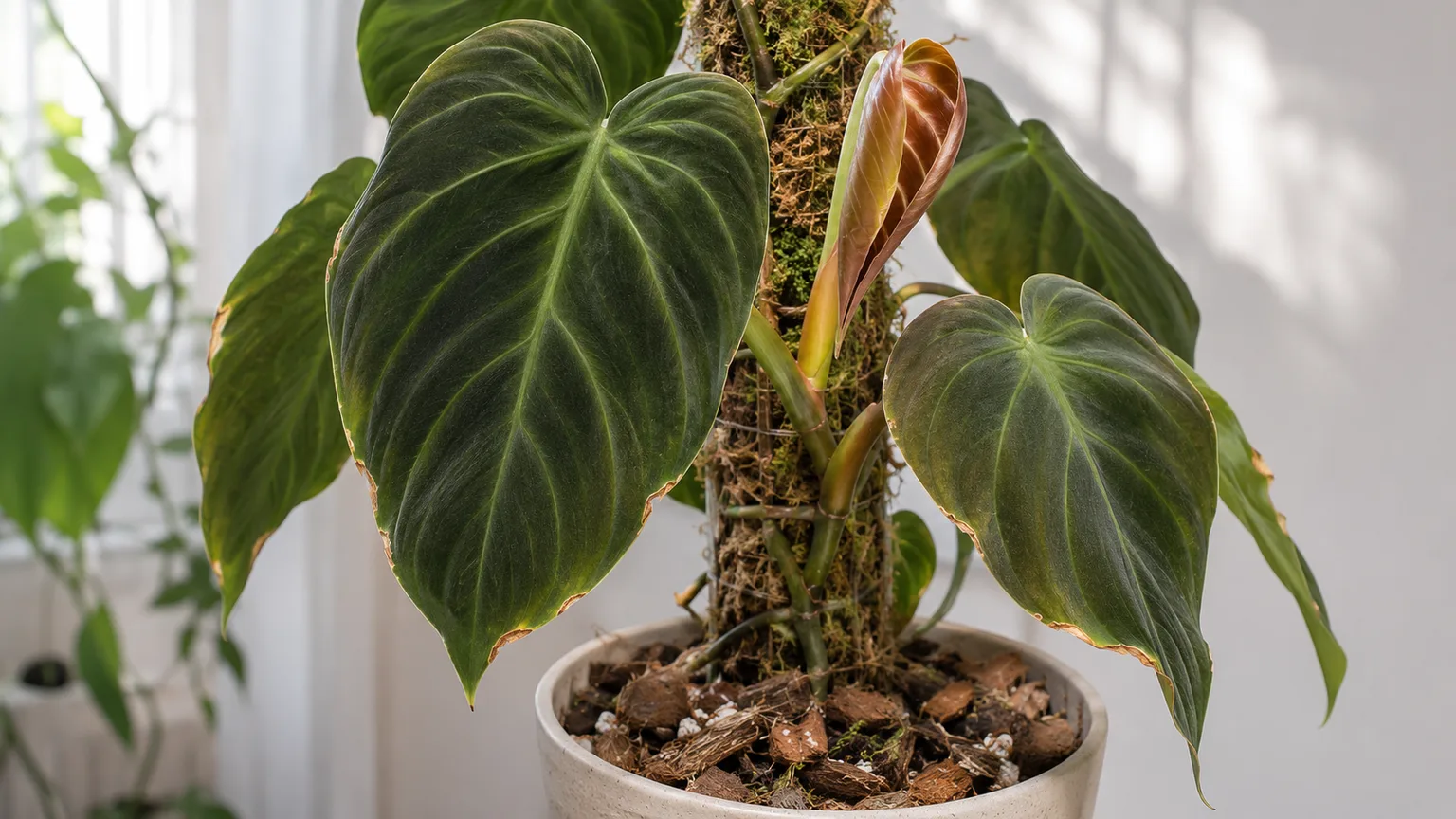
Underwatering on Philodendron Splendid: Causes, Checks & Fixes
This guide covers underwatering on Philodendron Splendid. See also the general Underwatering guide, watering, and light pages for this plant.
Underwatering on Philodendron Splendid: Causes, Checks & Fixes
Quick answer
Underwatering on Philodendron Splendid shows as dull, limp velvet leaves with crispy brown edges, plus new coppery leaves that stall halfway out of their sheaths. First step: give one deep, thorough watering until water runs from the drainage holes, empty the saucer, and recheck the mix in a few days instead of dripping small sips daily.
For the general mechanics of drought stress in houseplants, see our underwatering guide. On Splendid, the pattern almost always starts at the velvet leaf margins and the climbing tip while the chunky bark mix looks deceptively dry on top.
What underwatering looks like on Philodendron Splendid
Splendid is a velvet-leaf climber — a verrucosum × melanochrysum hybrid grown for large, dark, velvety leaves with pale veins and copper-toned new growth. That velvet surface makes dryness unusually readable: leaves lose their sheen and go dull, then droop and feel papery-thin rather than plump. Edges and tips crisp to brown while the veins stay dark, and older lower leaves may yellow and drop as the plant sacrifices them to protect the climbing tip.
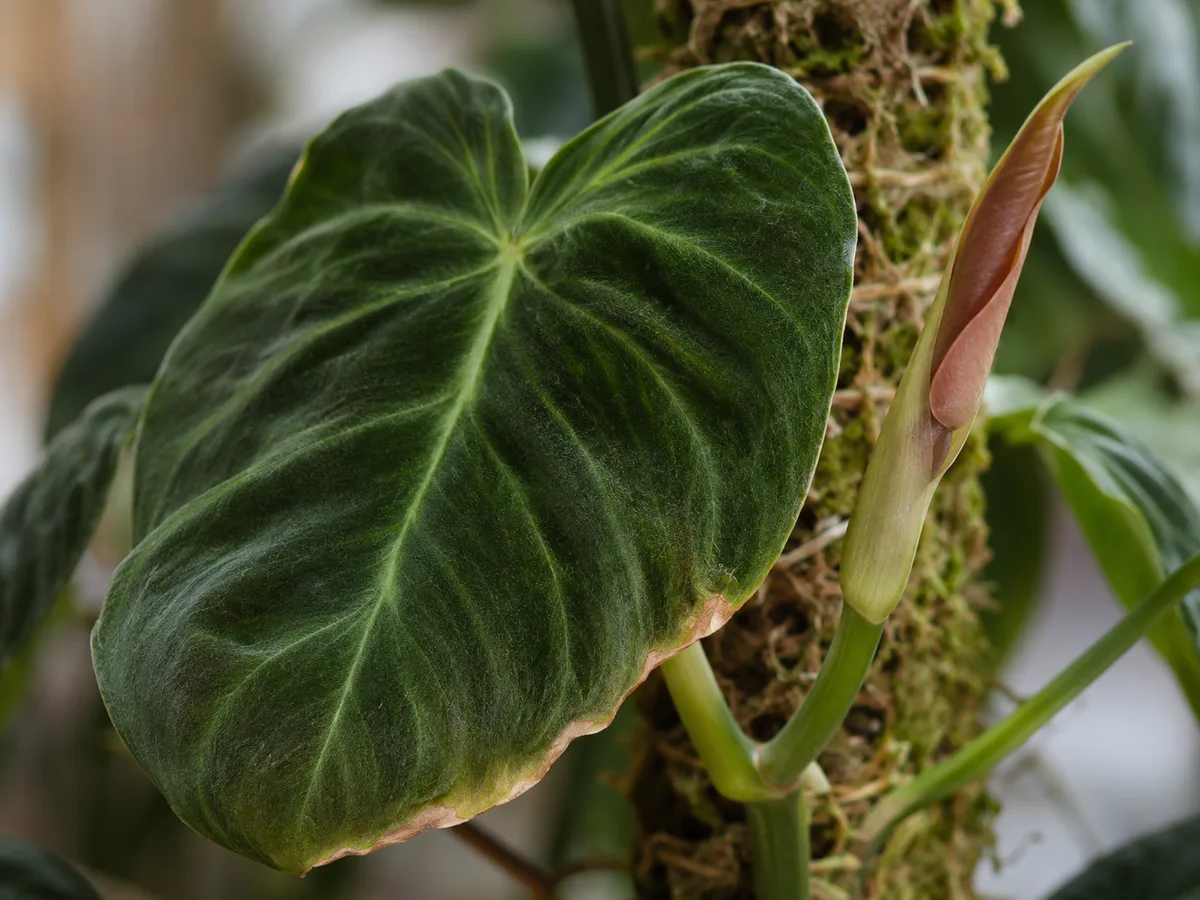
Underwatering can dull the velvet surface and crisp thin margins while a new coppery leaf stalls before opening.
The signature Splendid symptom is a stuck new leaf. Fresh coppery growth emerges wrapped in a sheath, and when the plant is dry — especially combined with low humidity — the leaf stalls mid-unfurl, sometimes tearing as it forces its way out. If your mature leaves are limp but the mix is only slightly dry, check the pole and the air before blaming the watering can.
Why Splendid dries out faster than you expect
Splendid’s parents are climbing epiphytes whose roots evolved gripping bark in airy, fast-draining conditions, so the recommended indoor mix is deliberately chunky — bark, perlite, and coir with air gaps throughout. That structure protects against rot but holds far less water than dense peat, which means the pot can swing from moist to bone-dry in days during warm, bright weather. Philodendrons as a group want moist, well-drained soil high in organic matter rather than a constantly saturated or fully arid mix (NC State Extension).
Three Splendid-specific traps accelerate the drying. First, growers follow the baseline 7–10 day summer cadence into a heat wave or after moving the plant to brighter light, where the same pot dries twice as fast. Second, a large climber on a moss pole in a small pot has far more leaf area transpiring than the root ball can supply between waterings. Third, indoor heating in autumn drops humidity just as growth continues, so leaves lose water faster while the owner is still on a summer schedule.
How to confirm the cause
Work through these checks in order before changing the routine:
- Finger and weight test. Push a finger 3–5 cm into the mix and lift the pot. Dry at your fingertip plus a very light pot means the root zone is genuinely dry. Touching the mix is the most accurate gauge of whether water is needed, and pot weight loss is a reliable backup signal (Clemson Extension).
- Hydrophobic-mix check. Pour a little water on the surface: if it beads and races down the inside of the pot while the center stays dry, the mix has gone hydrophobic and normal top-watering cannot rewet it.
- Drainage reality check. Confirm the pot has real drainage holes and that water actually exits them when you water. Pots without drainage keep the bottom wet while the top looks dry, which confuses every other reading (Epic Gardening).
- Pole and tip inspection. Feel the moss pole and look at the climbing tip. A bone-dry pole with stalled coppery growth and limp mature leaves points to whole-plant dryness, not just surface evaporation.
- Root-ball gap. If the mix has visibly shrunk away from the pot sides, the root ball is severely desiccated and needs a soak, not a sprinkle.
The first fix to try
Water once, deeply: pour slowly and evenly until water flows freely from the drainage holes, which guarantees the bottom two-thirds of the pot where most roots sit actually gets wet (Clemson Extension). Then empty the saucer or cachepot so the pot never sits in the runoff, and leave the plant alone to respond.
Do not fertilize, repot, or prune on the same day you discover the problem. Waiting until leaves wilt to water already stresses philodendrons, and piling interventions onto a thirsty plant makes it impossible to tell what helped (Epic Gardening).
Step-by-step rehydration for a severely dry plant
If the mix repels water or the root ball has pulled from the pot sides, a single top-watering will not reach the roots:
- Set the nursery pot in a basin of room-temperature water up to the mix line and soak 15–20 minutes until the surface feels evenly damp.
- Lift, drain fully, and empty all standing water — philodendrons should never be left standing in water even during rescue (RHS).
- Lightly dampen the moss pole so the aerial roots can drink; climbing types anchor themselves to supports with aerial roots that desiccate fast in dry air (NC State Extension).
- Recheck moisture in three to four days with the finger test and water thoroughly again only when the top 3–5 cm is dry.
If several fine roots have died back, the plant may sulk for a week even with perfect watering — judge by whether limpness stops spreading, not by instant perkiness.
The moss pole dries first: the Splendid-only trap
Splendid climbs — given a support, aerial roots grip it and each new leaf sizes up; left to trail, leaf size stalls and the tip wanders. But the pole is a wick: sphagnum or coir poles dry out well before the pot mix does, and growers who water the pot on schedule while ignoring the pole starve exactly the newest growth. When the pole is crisp-dry and only the climbing tip plus the unfurling leaf look stressed while lower leaves still hold, the pole is the drought zone, not the pot.
Fix it by wetting the pole to lightly damp (not dripping) at each watering, grouping humidity around the crown, and checking pole moisture with a finger squeeze between waterings. A pole that stays lightly moist keeps aerial roots alive so new leaves unfurl cleanly instead of sticking.
Recovery timeline
Mild underwatering — limp leaves but no crisping — usually resolves within a day of a deep soak, with leaves regaining posture and sheen. Stuck new leaves may take a week to finish unfurling once moisture and humidity stabilize, and slight tearing on the stuck leaf is cosmetic.
After severe desiccation with crispy margins and dropped lower leaves, expect two to four weeks before vigorous climbing resumes. Crispy brown edges will not turn green again; prune damaged sections only once new growth looks healthy, since the surviving leaf area still feeds recovery. Judge progress by firm velvet leaves holding posture and fresh copper-toned leaves emerging without stalling.
Lookalike symptoms on Splendid
| What you see | More likely cause | How to tell |
|---|---|---|
| Soft yellow lower leaves, soggy heavy mix | Overwatering | Mix stays wet for days; damage soft and dark, not crisp |
| Silvery stippling plus fine webbing under leaves | Spider mites on velvet foliage | Webbing and stipple pattern while the mix dries normally |
| Stuck new leaves but mix stays moist | Low humidity alone | Finger test shows damp mix; pole dry and air dry |
| Pale bleached patches on upper leaves | Too much direct sun | Crisp pale patches facing the window, pot weight normal |
| Uniform wilt hours after repotting | Transplant shock | Timing matches the repot, roots recently disturbed |
Overwatering and underwatering produce confusingly similar wilting, and both ultimately damage roots — so always confirm with the finger and weight test before treating (Clemson Extension).
Mistakes to avoid
- Watering on a fixed calendar instead of checking the top 3–5 cm and the pot weight; drying speed shifts with light, heat, and season.
- Dripping small daily sips that wet only the surface while the root ball below stays dry — always soak until water exits the drainage holes (Epic Gardening).
- Flooding the pot to compensate and then leaving it standing in a full saucer; rescue water still needs to drain or roots suffocate (RHS).
- Misting velvet leaves heavily while ignoring the dry root ball — damp velvet foliage in weak airflow invites fungal leaf spot without fixing thirst.
- Feeding a desiccated plant to “help it recover” — hold fertilizer until new growth looks healthy for a couple of weeks.
How to prevent it next time
Match the routine to this plant’s epiphytic habit and fast-draining mix. Details on cadence live in the Splendid watering guide; the mix recipe that sets the dry-down rhythm is in the Splendid soil guide; and light levels that drive water use are in the Splendid light guide. Background on the hybrid’s climbing habit and humidity needs is in the Splendid overview.
Practical rhythm: check moisture every few days, water thoroughly when the top 3–5 cm is dry, keep the pole lightly damp, and hold humidity in the 60–80% band this hybrid prefers — philodendrons favor warm, humid conditions around 65–85°F and suffer in cold drafts (NC State Extension). Recheck drying speed whenever seasons change, since temperature, light, and humidity all shift how fast a pot dries (Epic Gardening).
When to worry
Act the same day if most leaves hang limp at once, the climbing tip collapses, or the root ball repels water entirely. Those signal severe desiccation, and fine roots on a climbing aroid die back fast once the bark-based mix fully dries — soak the pot and pole promptly rather than waiting for the next scheduled watering. If the stem base is shriveled and papery rather than firm, the drought has reached the stem; trim back to firm tissue and root the healthiest node cutting as insurance, since Splendid roots readily from nodal sections.
Related Splendid guides
- Splendid watering guide — use when the question is cadence and dry-down depth rather than damage control.
- Splendid soil guide — use when the mix dries too fast or has gone hydrophobic; structure sets the rhythm.
- Splendid light guide — use when faster drying followed a move to brighter light.
- Splendid overview — use for the hybrid’s overall habit, humidity, and support needs.
Related tool
Use the Plant Watering Calculator to narrow causes for underwatering on this plant before changing multiple variables at once.