Overwatering on Philodendron Splendid: Causes, Checks &
Quick answer
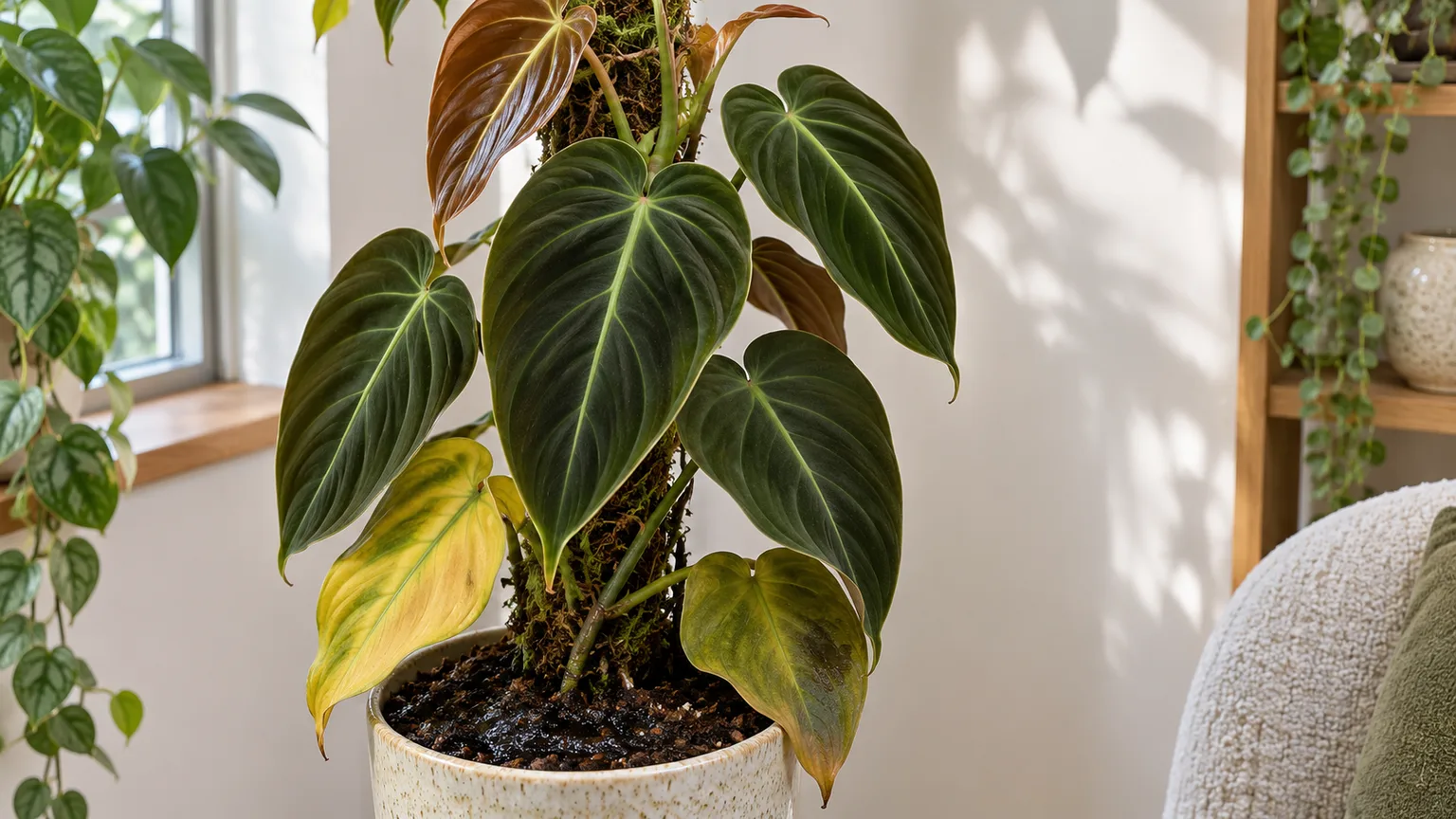
Overwatering on Philodendron Splendid shows as yellowing lower leaves, soft dark patches on velvet foliage, and mix that stays damp for days. First step: stop watering, empty any standing water from the saucer or cachepot, and let the top half of the mix dry before you water again.
Overwatering on Philodendron Splendid: Causes, Checks & Fixes
This guide covers overwatering on Philodendron Splendid. See also the general Overwatering guide, watering, and light pages for this plant.
Overwatering on Philodendron Splendid: Causes, Checks & Fixes
Quick answer
Overwatering on Philodendron Splendid shows as yellowing lower leaves, soft dark patches on the velvet foliage, and potting mix that stays damp for days after watering. First step: stop watering, empty any standing water from the saucer or cachepot, and let the top half of the mix dry out before watering again.
For how chronic wet mix damages roots in general, see our overwatering guide. On Splendid, the pattern usually shows up first on the lowest velvet leaves while a dense or waterlogged mix refuses to dry.
What overwatering looks like on Philodendron Splendid
Splendid is a velvet-leaf climber — a verrucosum × melanochrysum hybrid grown for large, dark, velvety leaves with pale veins and copper-toned new growth. That velvet texture makes overwatering unusually readable: affected lower leaves turn yellow, then develop soft, dark, water-soaked patches rather than crisp brown edges. New coppery leaves may stall mid-unfurl or emerge small and pale while the mix stays wet.
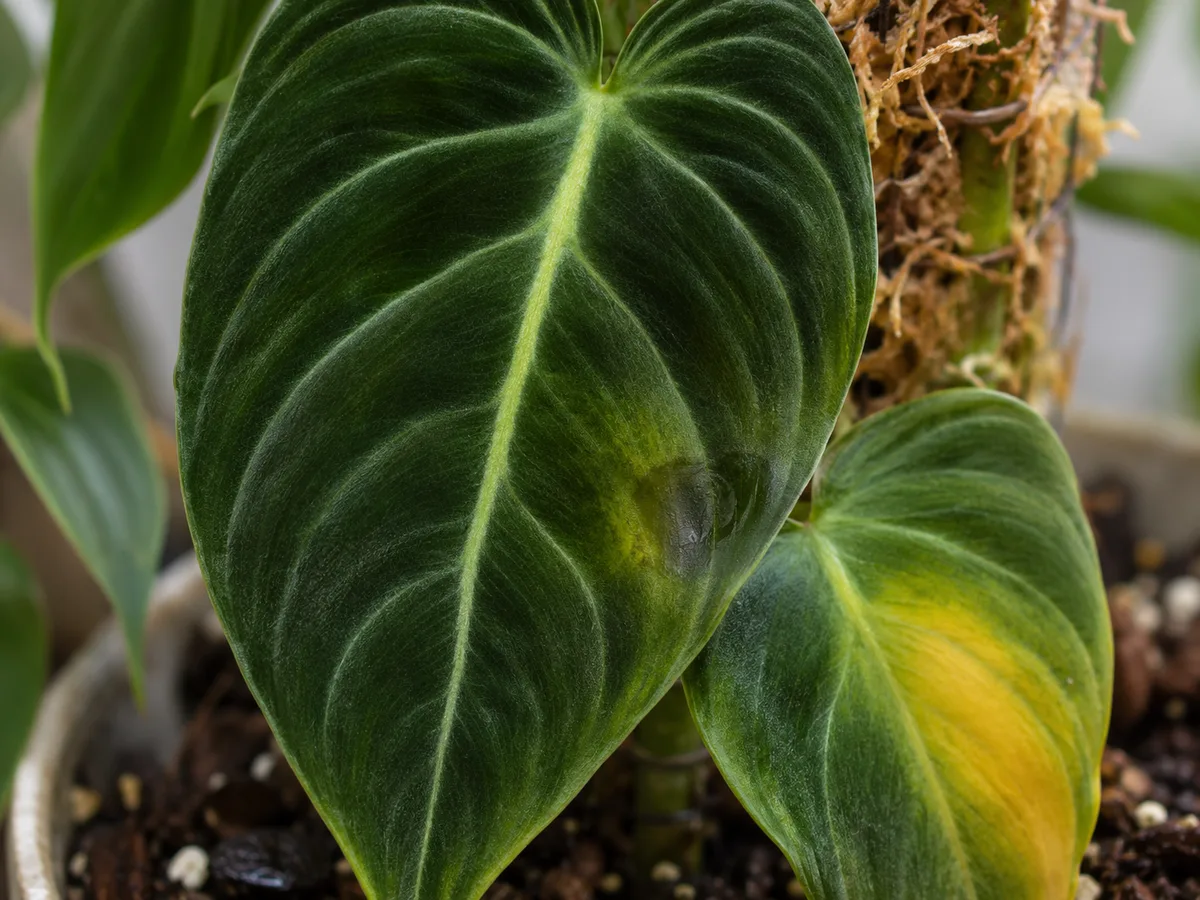
Overwatering causes lower velvet leaves to yellow and develop soft dark patches while the potting mix stays wet.
The classic sequence is lower-leaf yellowing plus a pot that stays heavy. Splendid is notably sensitive to overwatering and root rot, so it is safer to underwater it slightly than to keep it constantly moist (The Spruce). Yellow leaves on this hybrid almost always point to overwatering or poor drainage first, not to a feeding problem.
Why Splendid gets overwatered so easily
Splendid’s parents are climbing epiphytes whose roots evolved gripping bark in airy, fast-draining conditions — water drains away in minutes and air reaches the root surface constantly. In a dense peat-based indoor mix, the air spaces stay flooded, roots suffocate, and rot follows. Root rot on Splendid is a soil-structure problem before it is a watering-frequency problem: watering less often in the same dense mix slows the damage but does not remove the cause.
Three Splendid-specific traps make it worse. First, growers treat it like a basic green philodendron on a fixed weekly schedule instead of checking the pot. Second, low light slows water use, so the same schedule that worked in a bright window waterlogs the plant after a move. Third, an always-sopping moss pole wicks extra moisture into the top of the mix, keeping the exact zone around the stem base wettest longest.
How to confirm the cause
Work through these checks in order before you unpot anything:
- Finger and weight test. Push a finger 3–5 cm into the mix and lift the pot. If the mix feels wet several days after watering and the pot still feels heavy, the roots are sitting wet. Splendid does best when the soil dries about halfway between waterings (The Spruce).
- Drainage audit. Confirm the pot has real drainage holes and no water is pooling in the saucer or cachepot. Philodendrons should never be left standing in water, since saturated compost eventually causes root rot (RHS).
- Mix inspection. Scratch the surface: visible bark and perlite with air gaps is right; smooth, dense, sour-smelling peat that stays dark for a week is the core problem. Overwatering in philodendrons is frequently a drainage failure rather than a watering-can failure (NC State Extension).
- Stem-base feel. Gently squeeze the lowest stem near the mix. Firm is reassuring; soft or translucent signals rot spreading upward and means you skip ahead to unpotting.
- Gnat check. Small flies hovering over the mix point to persistently soggy soil, which also raises fungus and gnat pressure (Bob Vila).
The first fix to try
Empty all standing water — lift the nursery pot out of any cachepot, tip out the saucer, and let the mix drain freely. Then do nothing but wait: allow the top half of the mix to dry before the next watering. This single drying correction resolves mild cases without disturbing roots that are still healthy.
Do not fertilize, repot, or prune on the same day you discover the problem. A stressed Splendid cannot use fertilizer, and stacking interventions makes it impossible to tell what helped.
Step-by-step recovery if roots are rotting
If the stem base is soft, several leaves are yellowing at once, or the mix smells sour, unpot and look at the roots. Overwatered conditions starve roots of oxygen so they rot and die, and soil fungi that thrive in wet mix finish the job (The Spruce).
- Slide the plant out and shake off wet mix. Healthy roots look firm and whitish; rotted ones look dark brown or black, feel mushy, and may smell of decay (The Spruce).
- Trim only the mushy roots with clean scissors, keeping every firm white root.
- Repot into a chunky, airy aroid mix — orchid bark, perlite, and coco coir with a little sphagnum — in a pot with a real drainage hole, as recommended for this hybrid (Plantastica Haven).
- Water once lightly to settle the mix, then resume only when the top half dries.
If the stem base itself is mushy, the plant may still be salvageable as a cutting: take a stem section with at least one node and firm tissue, and root it separately in a small pot of airy mix or water. Splendid roots readily from nodal cuttings, and a node cutting outruns a rotted base.
Moss-pole moisture: the Splendid-only trap
Splendid climbs — given a support, aerial roots grip it and each new leaf sizes up; left to trail, leaf size stalls. But growers who mist the pole daily to encourage attachment can keep the crown zone permanently damp while the lower mix looks dry. If your pole is dripping and the stem base is the softest part of the plant, the pole is the water source, not the watering can.
Fix it by watering the pole only until lightly damp rather than saturated, improving airflow around the crown, and making sure the stem base sits slightly above the mix line rather than buried. Check attachment weekly instead of soaking daily.
Recovery timeline
Mild overwatering — a few yellow lower leaves but a firm stem base — usually stabilizes within two to three weeks once the mix starts drying on schedule. Judge progress by what is new: fresh copper-toned leaves unfurling cleanly and no further yellowing mean the roots are breathing again.
After a root-trim repot, expect four to eight weeks before vigorous climbing resumes. Damaged velvet leaves will not turn green and firm again; prune them only once new growth looks healthy, since they still photosynthesize while the plant rebuilds roots.
Lookalike symptoms on Splendid
| What you see | More likely cause | How to tell |
|---|---|---|
| Crispy brown leaf edges, mix bone-dry and light | Underwatering or low humidity | Pot feels very light; edges crisp rather than soft and dark |
| Pale small new leaves, long bare stem sections | Too little light, no climbing support | No yellowing of lower leaves; growth stretches toward light |
| Silvery stippling plus fine webbing under leaves | Spider mites on velvet foliage | Webbing and stipple pattern, mix drying normally |
| Uniform yellow cast after recent feeding | Excess fertilizer | Leaf-tip burn plus crusty mix surface, not soggy mix |
Cold drafts can also curl Splendid leaves, which mimics wilt from wet roots — check mix moisture before assuming either.
Mistakes to avoid
- Watering on a calendar instead of checking the top half of the mix and the pot weight.
- Leaving the nursery pot inside a water-filled cachepot “for humidity” — roots drown while leaves look fine for a week.
- Repotting into a bigger peat-heavy pot, which holds even more water around already-stressed roots.
- Misting velvet leaves heavily to fix humidity while the mix is soggy; damp velvet foliage in weak airflow invites fungal leaf spot, the other disease to watch on this hybrid (The Spruce).
- Feeding a waterlogged plant to “help it recover” — hold fertilizer until new growth looks healthy.
How to prevent it next time
Match the routine to this plant’s epiphytic habit. Details on cadence live in the Splendid watering guide; the mix recipe that makes overwatering genuinely hard is in the Splendid soil guide; and light levels that keep the pot drying on schedule are in the Splendid light guide. Keep humidity in the 60–80% band Splendid prefers without pushing past it into fungal territory (The Spruce).
Practical rhythm: check moisture every few days, water thoroughly only when the top half is dry so water runs from the drainage holes, empty the saucer, and reassess whenever you move the plant, change seasons, or adjust the moss pole routine. If the pot stays heavy far longer than expected, improve light or refresh the mix before the next watering — background on the hybrid’s needs is in the Splendid overview.
When to worry
Act the same day if the stem base softens, damage spreads across multiple leaves within days, or unpotting reveals mostly brown mushy roots with a sour smell. Those are root-rot signs, and climbing aroids decline fast once rot reaches the stem — overwatering in philodendrons causes root rot that can collapse the plant if the compost stays saturated (RHS). If only firm white roots remain in a tiny fraction, root the healthiest node cutting and compost the rest.
Related Splendid guides
- Splendid watering guide — use when the question is cadence and dry-down depth rather than damage control.
- Splendid soil guide — use when the mix stays wet for days; structure is the likely culprit.
- Splendid light guide — use when slow drying followed a move to dimmer light.
- Splendid overview — use for the hybrid’s overall habit, humidity, and support needs.
Related tool
Use the Root Rot Risk Checker to narrow causes for overwatering on this plant before changing multiple variables at once.