Spider Mites on Philodendron Splendid: Causes, Checks &
Quick answer
Isolate your Philodendron Splendid and rinse the undersides of every leaf with a forceful lukewarm spray — that single wash removes most mites. Repeat the rinse plus insecticidal soap every 5–7 days for three weeks, and hold humidity at 60–80% so new climbing-tip leaves emerge clean.
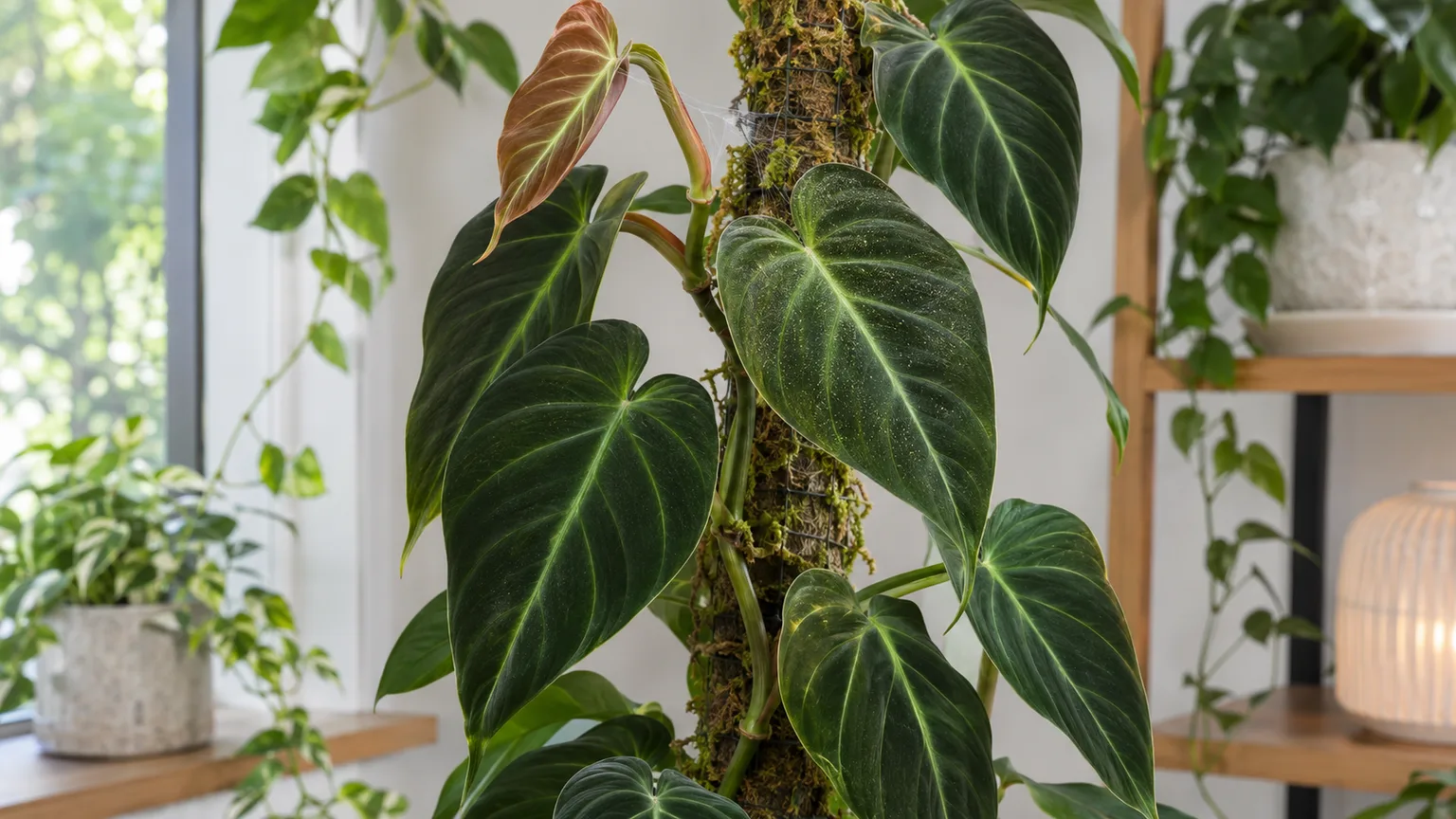
Spider Mites on Philodendron Splendid: Causes, Checks & Fixes
This guide covers spider mites on Philodendron Splendid. See also the general Spider Mites guide, watering, and light pages for this plant.
Spider Mites on Philodendron Splendid: Causes, Checks & Fixes
Quick answer
Isolate your Philodendron Splendid and rinse the undersides of every leaf with a forceful lukewarm spray — that single wash removes most mites. Repeat the rinse plus insecticidal soap every 5–7 days for three weeks, and hold humidity at 60–80% so new climbing-tip leaves emerge clean.
For the general mechanics of how these pests feed and spread, see our spider mite hub. Everything below is about how that pest behaves specifically on Splendid’s velvet climbing foliage.
What spider mites look like on Splendid
On Splendid, mites announce themselves as pale stippling — hundreds of tiny light dots — scattered across the dark velvet blade, followed by a dull, dusty cast that robs the leaf of its sheen. Because the foliage is textured rather than glossy, early stippling blends in; most growers first notice fine webbing strung between the climbing tip, the newest petioles, and the moss pole. Heavy feeding turns leaves yellow-bronze from the edges inward, and badly hit leaves drop.
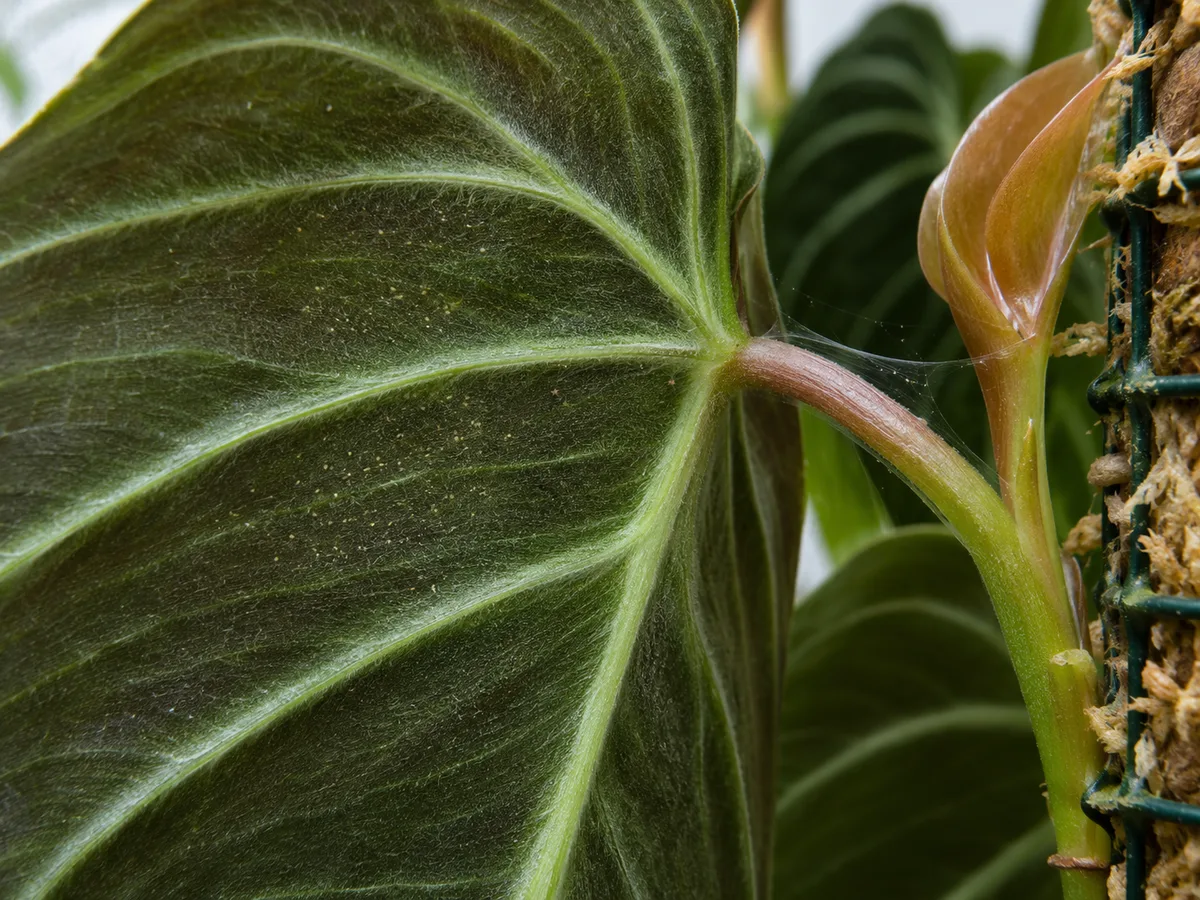
Spider mite feeding leaves tiny pale dots on the velvet blade, with fine webbing near sheltered veins and petioles.
Mites are arachnids related to spiders, live in colonies on leaf undersides, and adults are under 1/20 inch long, so a magnifier is genuinely useful (UC IPM Spider Mites Pest Notes). Confirm with the white-paper test: tap two or three suspect leaves over white paper and look for crawling dots (Missouri Botanical Garden Mites).
Why Splendid’s velvet leaves hide mites longer
Splendid inherits deep velvet texture from its verrucosum parent, and that nap does two unhelpful things: it camouflages early stippling, and it gives mites a sheltered, hairy surface on the underside where sprays bead instead of coating. By the time the damage is obvious on top of the leaf, the colony underneath is usually several generations deep.
This is the first plant-only reason Splendid needs underside-first inspection rather than admiring the tops. Check the undersides of the two newest fully open leaves plus any furled leaf every week when indoor air runs dry — that is where the next outbreak starts, not on old lower foliage.
Dry air plus drought stress: why mites pick this plant
Spider mite damage is worst in hot, dusty conditions and on water-stressed plants (UC IPM Spider Mites Pest Notes). Splendid walks straight into that trap in winter-heated or air-conditioned rooms: it wants 60–80% humidity, yet most homes sit far drier, and its chunky aroid mix can swing from moist to dry fast in bright warmth.
A vine that is slightly drought-stressed between waterings is measurably more inviting to mites, so steady watering matters as much as humidity. Water when the top 3–5 cm dries rather than on a fixed calendar, as the watering guide explains — a plant that never wilts holds mites off far better than one that cycles through dry spells.
Moss pole and climbing tip: where mites concentrate
Splendid is a climber that sizes up only when aerial roots grip a moist support, and that support changes the pest map. Mites cluster where tissue is softest and most sheltered: the unfurling tip leaf, the youngest petioles, and the crevices where petioles and aerial roots press against the moss pole (RHS Philodendron Growing Guide).
Treat the pole as part of the plant during every rinse — spray its surface and the stem-to-pole contact zone, or mites simply retreat there and recolonize. When new copper-toned leaves emerge stunted, stuck, or undersized while older leaves still look fine, the tip colony is the cause, and tip-focused washing is the cure.
How to confirm the diagnosis at home
Work in this order so you do not treat dust or thrips as mites:
- White-paper tap test. Hold white paper under a suspect leaf, tap sharply, and watch for dots that crawl. Mites move; dust does not (Missouri Botanical Garden Mites).
- Underside stippling check. With a phone magnifier, look at the undersides of the newest open leaves for pale feeding dots plus silk at petiole joints. Philodendron-focused guides list stippling plus fine webbing as the paired confirmation sign (Cafe Planta Philodendron Spider Mites).
- Spread pattern. Mites start at the tip and upper leaves in dry air and move downward; damage that starts on the oldest lower leaves first points elsewhere.
- Environment cross-check. Note humidity, recent dry spells, and nearby infested plants — mites drift on air currents and clothing between close-packed aroids.
Skip the spray until two of these four point to mites. A single dusty leaf is a rinse, not an infestation.
First fix: isolate and rinse the undersides
Do one thing first: carry the plant away from other aroids and wash every leaf underside with a forceful lukewarm spray, supporting each velvet blade from above so stems do not snap. Angle the nozzle upward into the undersides, wash the furled tip gently, and soak the moss pole contact zone. This physical removal is the core of light-infestation control — sprayed water on the affected plant every other day from the first stippling, always hitting the undersides (Missouri Botanical Garden Mites).
Let the vine drip-dry in gentle airflow, not blazing sun. Recheck with the paper test after two days. If nothing moves and no fresh stippling appears on the tip leaf, keep rinsing twice weekly for two weeks and you may never need chemicals — a measured rinse-first sequence that philodendron growers report as the reliable opener (Cafe Planta Philodendron Spider Mites).
Step-by-step recovery when rinsing alone is not enough
If live mites persist past the first week, escalate in this order:
- Insecticidal soap, full coverage. Coat every leaf underside until wet, plus tip and pole crevices, every 5–7 days for three weeks to catch hatching eggs. Complete underside coverage with soap or oil is the extension-recommended follow-through (UC IPM Spider Mites Pest Notes).
- Add horticultural oil only for stubborn cases. A light oil layer smothers eggs that soap misses; never apply either spray to a wilted plant or in hot direct sun.
- Prune the worst, keep the vine. Remove one or two fully bronzed leaves at the petiole base to cut egg load, but keep every leaf that is still mostly green — a climber needs its canopy to fund the next tip leaf.
- Stabilize the environment. Return humidity to 60–80% with airflow, keep temperatures in the 18–27°C comfort band philodendrons prefer (NC State Extension Philodendron erubescens), and verify light stays bright but indirect so growth resumes.
Do not reach for broad-spectrum pyrethroid or organophosphate insecticides: extension guidance warns these kill mite predators and frequently flare spider mite populations worse than before (UC IPM Spider Mites Pest Notes). Targeted soap plus water beats a harsh spray every time indoors.
Recovery timeline: read the climbing tip
Old stippled leaves never regain their finish — set that expectation now. Mite feeding drains cell contents leaf by leaf, and heavily infested foliage yellows and drops (UC IPM Spider Mites Pest Notes).
Watch the tip instead. Within two to three weeks of consistent treatment, the next unfurling leaf should open larger, darker, and dot-free; two consecutive clean new leaves means the colony is broken. Stuck or distorted new growth past week four means mites sheltered in the furled leaf or pole — rewash the tip directly and extend soap to a fourth week. A vine that pushes normal copper-toned new growth on schedule has recovered even while older leaves still show scars.
Mistakes to avoid on velvet foliage
- Scrubbing the velvet. Rough wiping crushes the leaf nap and snaps petioles; spray pressure and soft rinsing do the work instead.
- Fertilizing a mite-stressed vine. Feeding forces tender growth that mites colonize first — hold all feed until two clean new leaves open, per the fertilizer guide timing for stressed plants.
- Repotting on day one. Mites live on foliage, not in mix; repotting adds root shock without touching the colony. Repot only if the soil is separately failing.
- Misting as humidity control. Brief misting wets velvet blades without raising room humidity and invites fungal spotting — use a humidifier or pebble tray with airflow instead.
- Treating one plant in a crowded aroid shelf. Mites drift between touching leaves; inspect and rinse immediate neighbors the same week (Biology Insights Spider Mites on Philodendron).
How to prevent mites on Splendid next time
Prevention is environmental, and Splendid’s needs are specific: steady 60–80% humidity with moving air, drought-free watering, and quarantine discipline. Grouping aroids leaf-to-leaf in dry winter air is the classic setup for a shelf-wide outbreak, so give the vine elbow room and wipe or rinse undersides monthly as routine maintenance (Biology Insights Spider Mites on Philodendron).
Quarantine every newcomer away from the collection for two to three weeks with a weekly paper test before shelving it beside Splendid — new plants are the most common mite delivery route indoors. The Splendid overview summarizes the humidity, support, and watering rhythm that keeps this hybrid vigorous enough to outgrow minor pest pressure.
Related Philodendron Splendid guides
- Splendid overview — full care rhythm (humidity, pole, watering) that underpins mite prevention.
- Watering guide — use when stippling coincides with dry spells or wilting; drought stress invites mites.
- Light guide — use when the vine stalls in dim corners, since weak growth recovers from mites slowly.
- Soil guide — use when the mix stays soggy or bone-dry between waterings and watering fixes do not hold.
- Fertilizer guide — use after recovery, when two clean new leaves signal readiness to resume feeding.
Related tool
Use the Pest Identifier to confirm spider mites against other Splendid pests before starting sprays.