Yellow Leaves on Philodendron Splendid: Causes, Checks &
Quick answer
Yellow leaves on Philodendron Splendid most often mean the root zone stayed wet too long in chunky mix that never dried at depth. First step: lift the pot and probe 3–5 cm down — if it feels heavy and cool, hold all water and let it dry before you change anything else.
Yellow Leaves on Philodendron Splendid: Causes, Checks & Fixes
This guide covers yellow leaves on Philodendron Splendid. See also the general Yellow Leaves guide, watering, and light pages for this plant.
Yellow Leaves on Philodendron Splendid: Causes, Checks & Fixes
Quick answer
Yellow leaves on Philodendron Splendid most often mean the root zone stayed wet too long in chunky mix that never dried at depth. First step: lift the pot and probe 3–5 cm down — if it feels heavy and cool, hold all water and let it dry before you change anything else.
One yellow lower leaf on an otherwise firm, climbing vine is usually normal turnover. Several yellow leaves at once, yellowing new growth, or yellowing that climbs the vine means something in water, light, roots, or pests needs attention now.
What yellow leaves look like on Philodendron Splendid
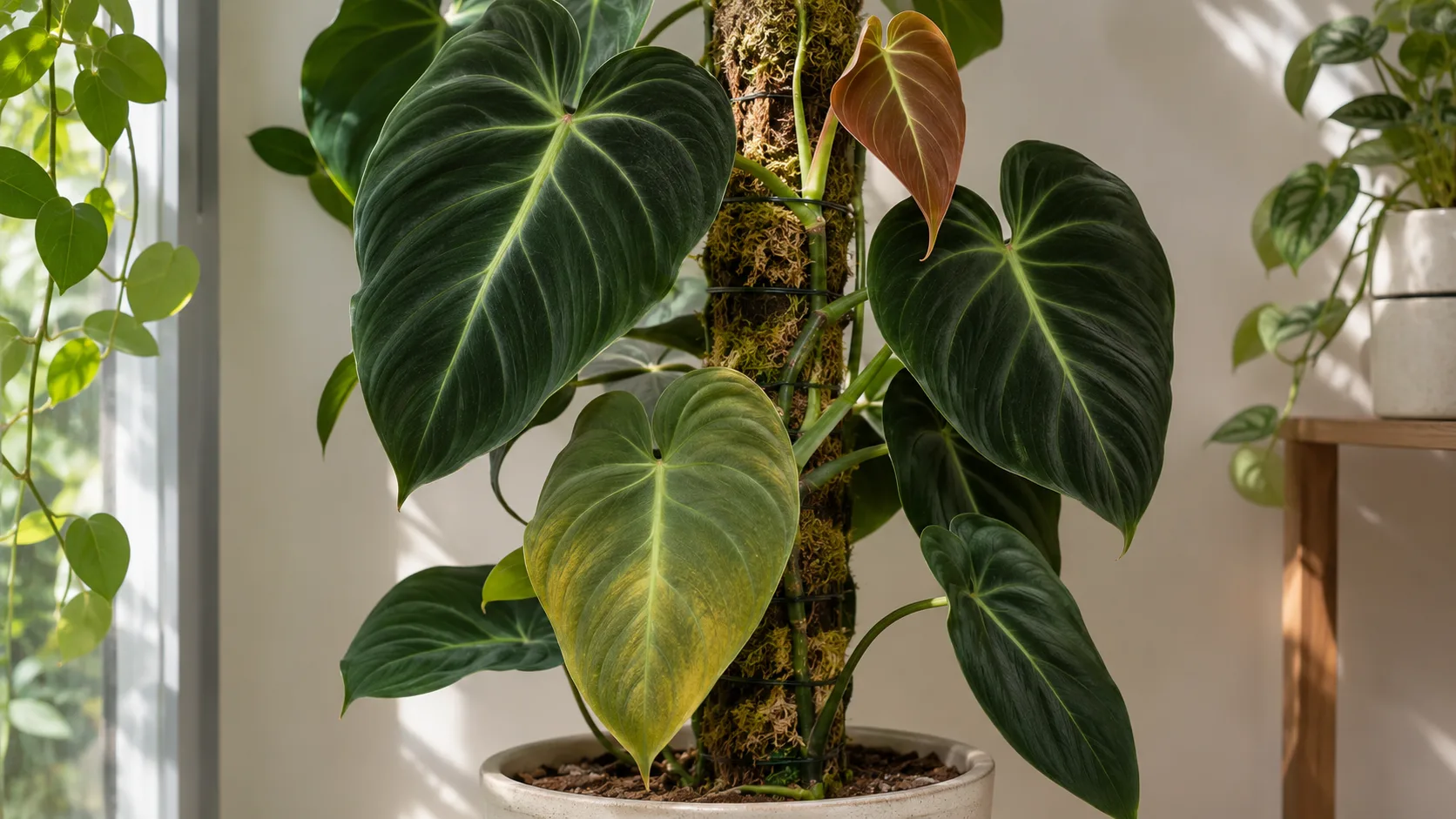
Splendid shows yellowing differently from smooth-leaved philodendrons because of its velvet texture and climbing habit. The dark, suede-like blade first dulls and loses its sheen, then fades to olive and yellow — often starting between the pale veins rather than at the margins. Because the foliage is matte and near-black, early fading is easy to miss until the leaf is already half yellow, so inspect in good daylight with the leaf tilted toward the light.
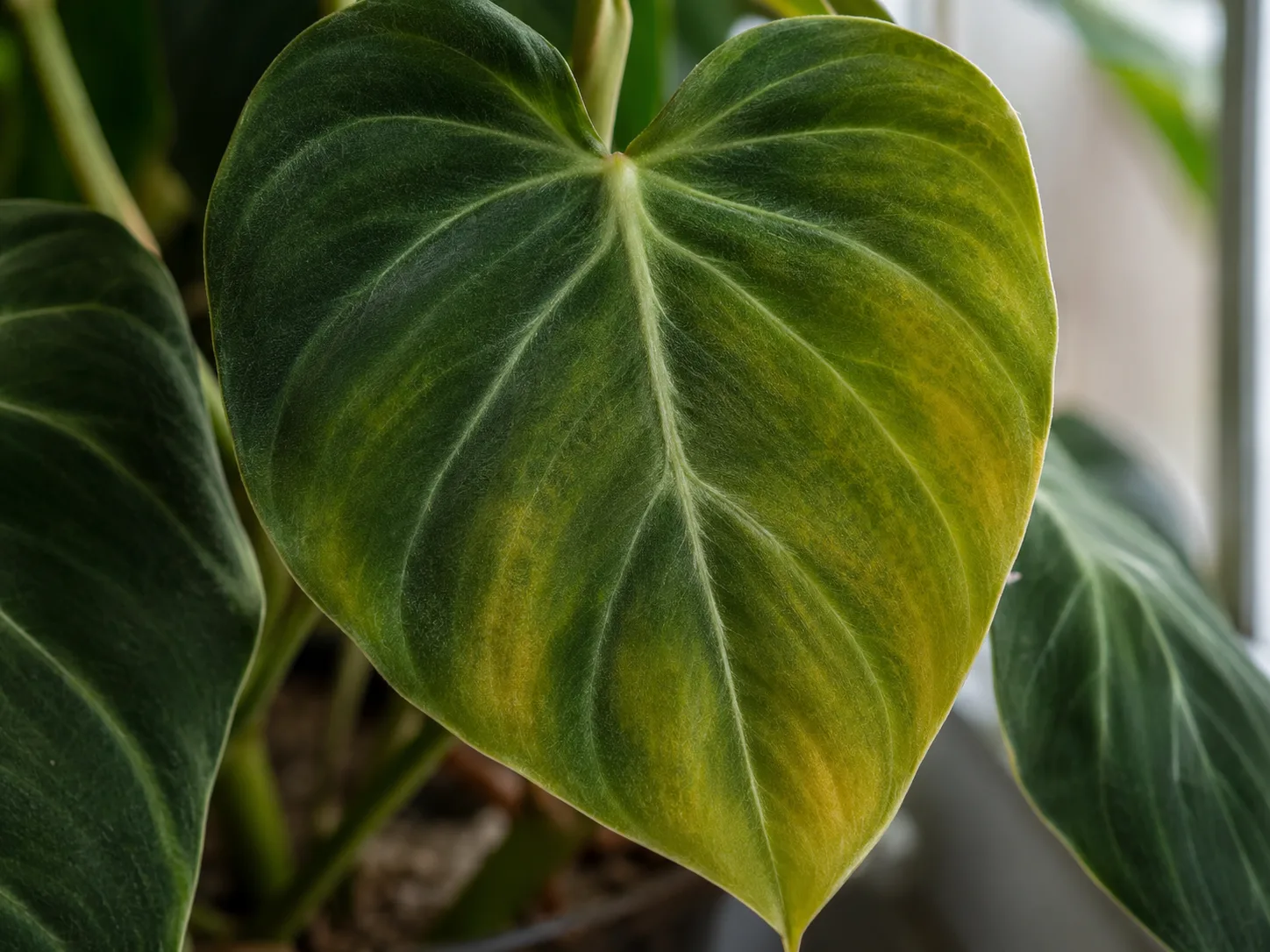
Early yellowing can appear between the pale veins as the dark velvet blade loses its rich color.
Watch where the yellow appears. Lower, older leaves yellowing one at a time while the climbing tip keeps pushing copper-toned new growth usually means natural senescence. Yellowing that starts on lower leaves and moves upward through the vine, especially in heavy mix, is the classic overwatering and root-rot progression. New leaves emerging pale or yellowish while older foliage looks fine points away from water and toward light shortage or a nutrient gap. Yellow patches in the middle of a leaf after a window move suggest sun scorch on velvet that cannot handle direct midday sun.
Why Splendid yellows first: the pot-and-pole moisture split
Splendid drinks from two places at once — the pot root ball and the aerial roots gripping its support — and yellowing often starts when those two zones fall out of sync. The RHS notes that climbing philodendrons root into moist moss poles when trained vertically, and on Splendid that rooting is load-bearing: a dust-dry pole aborts aerial roots and stalls the vine even when the pot moisture looks correct, while a soaked pot with a dry pole confuses every diagnosis because the plant shows drought stress and wet-root stress simultaneously.
The chunky aroid mix adds a second trap. Bark and perlite drain fast at the surface, so the top looks ready days before the center of the root ball has dried. Watering on surface appearance alone keeps the deep roots permanently wet, and wet roots cannot take up nutrients — foliage yellows from effective starvation in soggy mix. The RHS baseline for philodendrons is to let the compost dry out slightly between waterings and take care not to overwater, and on Splendid that check must happen at 3–5 cm deep plus a pot-weight lift, never by surface color. Full depth-check rhythm is in the watering guide.
Low light multiplies the problem. Splendid wants bright indirect light, and the RHS sets the floor at above 15°C in indirect light — dim corners slow water use so the same watering volume keeps roots wet twice as long. A vine that yellowed two weeks after moving to a darker shelf is usually telling you about light, not fertilizer.
How to confirm the cause
Run this sequence before treating anything. It takes five minutes and prevents the classic error of fertilizing or repotting a plant that only needed to dry out.
- Lift the pot. Heavy and cool means wet at depth; noticeably light means dry. Learn this weight — it is more honest than any schedule on a velvet climber.
- Probe 3–5 cm down with a finger or dry chopstick. Soil clinging and cool confirms wet; clean dry wood confirms dry.
- Map the pattern. Lower leaves only, or new growth too? One leaf or several? Fast spread over days or slow fade over weeks?
- Check the pole. Squeeze the fiber near active aerial roots. Dust-dry pole plus wet pot explains stalled tips alongside yellow lower leaves.
- Smell the drainage hole and flex the stem base. Sour odor or soft stem tissue means root damage, not simple thirst — escalate to unpotting.
| What you see | Most likely cause | Confirm with |
|---|---|---|
| Lower leaves yellow first, heavy cool mix | Overwatering / early root rot | Sour smell, black mushy roots on tip-out |
| Limp leaves, light dry pot, crispy edges | Underwatering | Mix shrunk from pot wall, chopstick bone-dry |
| Pale new growth, long internodes, small leaves | Too little light | Recent move, north-facing winter window |
| Yellow patches mid-leaf after a move | Direct-sun scorch | South/west glass with no sheer |
| Spotty yellow, sticky residue, fine webbing | Sap-sucking pests | Leaf undersides and nodes under bright light |
| Whole-plant pale yellow, no fresh mix for years | Nutrient deficiency | Last repot and feed dates |
The first fix to try
Hold water and let the root zone dry to the 3–5 cm checkpoint before you do anything else — if the pot is heavy and cool, that single pause is the whole first fix.
This sounds too simple, which is why people skip it and stack fertilizer, repotting, and sprays on the same day. Wet aroid roots are oxygen-starved, and every additional intervention on a suffocating root system adds stress without addressing the cause. Give the plant one full dry-down, confirm the pot lightens and the probe comes up dry, then water thoroughly once until runoff drains and empty the saucer. If yellowing halts after that single corrected cycle, you had your answer. Only if it keeps spreading past one clean wet-dry cycle should you move to root inspection, light changes, or feeding.
Velvet-leaf inspection: where pests and damage hide on Splendid
Splendid’s dark velvet hides the pests that spotty yellowing warns about. Spider mites, mealybugs, aphids, and scale all feed on philodendrons — NC State lists spider mites, mealybugs, aphids, and scale as the insects to monitor — and on matte near-black foliage their stippling, webbing, and honeydew are nearly invisible until damage is advanced. Inspect with a bright phone light held at an angle: check velvet undersides for fine webbing and pale stipple dots, press nodes and cataphyll seams for cottony mealybug clusters, and run a finger along stems for the sticky film aphids and scale leave behind.
Velvet also changes what counts as damage. Hard tap water splashed on the blades dries into white mineral spots that mimic pest stippling but wipe differently — mineral crust sits on the surface while stippling is pitted into the tissue. Wipe leaves with a soft dry brush rather than a wet cloth, and direct future water at the mix and pole only; NC State’s prevention advice for leaf problems is to water at the base and keep water off the leaves. Test any soap or oil spray on one small leaf area first, because velvet burns more readily than smooth foliage.
Copper new growth deserves its own note. Fresh Splendid leaves emerge bronze to salmon-red before hardening dark — that is normal color, not yellowing. True trouble in new growth looks pale lime-yellow, thin, and undersized, and it points to light or nutrients rather than the watering issues that yellow older leaves first.
Step-by-step recovery
Work through only the branch your confirmation pointed to. One branch at a time.
If overwatering confirmed: stop watering, move the plant to brighter indirect light with gentle airflow, and let the mix dry to depth. If the mix smells sour or more than a few roots are black and mushy on a gentle tip-out, trim dead roots with sterile shears, repot into fresh chunky mix in a clean drained pot, and resume watering only at the 3–5 cm checkpoint. Connecticut’s plant handbook describes the disease end of this road: Rhizoctonia root rot makes leaves gradually turn yellow, brown, and drop, starting on the lower leaves, and it warns to never let the plant sit in standing water — so saucers and sealed cachepots get emptied every time. Step-by-step repot timing is in the repotting guide.
If underwatering confirmed: soak thoroughly once until runoff flows, drain fully, and hydrate the moss pole in the same session so aerial roots recover with the pot. If water runs down the sides without wetting the center, the bark has gone hydrophobic — soak, wait 30 minutes, and soak again. Then return to the probe-and-weight cycle in the watering guide.
If low light confirmed: move the vine within a couple of meters of an east window or behind a sheer on south or west glass, acclimating over a week so existing velvet does not scorch. Expect the next two or three leaves to size up before color fully deepens. Placement detail is in the light guide.
If pests confirmed: isolate the plant, dab visible clusters with alcohol on a cotton swab, then treat with insecticidal soap or horticultural oil per label after a spot test. Repeat at the label interval — one spray never finishes the job — and raise humidity, since dry air favors spider-mite buildup on velvet.
If nutrients suspected: only after water, light, and roots check out. Repot if the mix is years old and compacted, or apply a balanced liquid feed at reduced strength on already-moist soil during active growth. The Spruce’s standing advice for hungry philodendrons is a balanced houseplant fertilizer diluted to half strength — never on a stressed, dry, or newly repotted plant. Full feed discipline is in the fertilizer guide.
Recovery timeline
Judge everything by the newest growth, not by old leaves — yellowed velvet never re-greens. Within one to two weeks of the correct fix, spread should stop: no new leaves joining the yellow list. Within three to six weeks, the climbing tip should push firm copper-toned leaves that harden dark, which is the real all-clear on Splendid.
Signs it is getting worse: yellowing climbing toward the growing tip, soft stem base, new leaves emerging progressively smaller and paler, or sour odor persisting after a dry-down. Any of those means unpot and look at roots the same day rather than waiting out another cycle.
Lookalike symptoms
Three things masquerade as problem yellowing on this hybrid. Normal senescence takes one old lower leaf at a time on a vine whose tip is still pushing healthy growth — prune it and move on; The Spruce likewise notes that the occasional yellow leaf is totally normal on an otherwise healthy philodendron. Bacterial leaf spot starts as tiny water-soaked areas that expand into tan-to-black lesions, sometimes with a fishy odor — that is infection, not care stress, and affected leaves should come off promptly. Direct-sun bleach shows as pale patches mid-leaf facing the glass, not the lower-leaf upward march of root trouble. For how yellowing works as a general symptom across houseplants, see our yellow leaves guide — on Splendid, though, always read the pattern through the pot-and-pole moisture split first.
Mistakes to avoid
Do not fertilize yellow leaves on a hunch — feeding wet or damaged roots burns them and locks in the problem. Do not repot on day one unless sour smell, soft stems, or mushy roots confirm the mix has failed; a stressed climber repotted speculatively often drops more leaves than it keeps. Do not mist velvet foliage overnight in a cool corner to “raise humidity” — wet velvet in still air invites fungal spotting, while a humidifier and damp pole do the actual work. And do not tear stuck cataphylls free by hand; torn velvet scars permanently, whereas patient humidity fixes the next leaf.
Temperature matters more than most owners expect. NC State places climbing philodendrons near 65 to 85 degrees Fahrenheit indoors with protection from cold drafts, and a Splendid parked by a drafty winter window or an air-conditioning vent will yellow from cold stress that no watering tweak can fix. Move it first, diagnose second.
How to prevent it next time
Prevention on Splendid is a rhythm, not a product: probe 3–5 cm and lift the pot before every watering, keep light bright and indirect, hold humidity toward 60–80% so cataphylls unfurl cleanly, and keep the pole evenly damp so aerial roots stay in the game. Refresh bark-based mix every year or two before it compacts into the slow-drying brick that starts most yellowing episodes — the soil guide has the chunky recipe. Flush hard-water salts monthly with plain water until runoff runs clear, and cross-check the whole environment in the overview whenever two problems appear at once, since humidity, light, and root moisture fail together on velvet climbers far more often than any single cause acts alone.
When to worry
Treat it as urgent if stems soften, damage spreads across several leaves within days, or the growing tip stalls and pales — those signal root or crown failure rather than a care wobble. Overwatering sits at the top of every philodendron yellowing list for a reason: The Spruce calls excess water one of the most common causes of yellow leaves on philodendrons and anchors the routine to watering only when the top inch or two of soil has begun to dry out. If your vine matches the severe pattern — sour mix, mushy roots, climbing yellow — skip further waiting and do root surgery the same day. A plant reduced to a firm node with healthy aerial roots can still restart on a damp pole; a plant left to sit in rot cannot.
Related tool
Use the Yellow Leaves Diagnosis Tool to narrow the cause for yellow leaves on this plant before changing multiple variables at once.