Rangoon Creeper Light Needs: Sun and Placement
Rangoon Creeper Light Needs: Sun and Placement
Rangoon Creeper Light Needs: Sun and Placement
A Rangoon Creeper can make metres of green vine in a merely bright spot and still produce a disappointing number of flowers. For Combretum indicum, also sold under the older name Quisqualis indica, light is not just a maintenance setting. Strong outdoor light is one of the conditions that separates a leafy screen from the fragrant white, pink, and red clusters for which Madhumalti is grown.
The species is a woody tropical climber, not a compact foliage plant for a dim room. Kew records it as a climber of the wet tropical biome, while Singapore’s NParks gives it a species-specific full-sun preference. That makes a sunny terrace, courtyard, pergola, or open balcony the right starting point.
Quick answer: how much light does Rangoon Creeper need?
Give an established Rangoon Creeper at least five to six hours of direct sun on most clear days, plus open-sky brightness for the rest of the day. Full sun is the best default for dependable flowering. In very hot inland climates, morning and late-day sun with light shade during the most punishing mid-afternoon hours can preserve foliage without turning the position into deep shade.
Treat that hour range as a practical starting point, not a botanical threshold. Buildings, tinted glass, tree canopies, monsoon cloud, latitude, and season all change the useful light reaching the leaves. The better test is performance: short leaf spacing, firm new growth, and regular flower clusters indicate adequate light; long searching shoots with sparse bloom suggest the plant needs a brighter exposure.
Why Rangoon Creeper needs stronger light than a typical houseplant
Rangoon Creeper’s natural geography and growth form explain the mismatch with generic indoor advice. Kew lists a broad native range across tropical and subtropical Asia, and the Indian Institute of Science herbarium records the species under its established Indian botanical context. It climbs upward and outward, using support to place foliage in brighter conditions rather than remaining a small understory rosette.
NParks describes it as a woody climber reaching about 8 m. A vine with that habit can tolerate temporary shade while shoots search for support, but a permanently dim placement limits the energy available for a large canopy and repeated bloom. This is why a plant against a north wall may stay alive yet fail to look like flowering specimens grown over open pergolas.
Full sun for flowers, not just vine growth
The practical goal is high total daily light, not a single beam landing on a few leaves. A plant receiving two hours of sun and then spending the day under a deep roof overhang has less useful exposure than one receiving morning sun followed by bright, open shade. The whole trained canopy matters because shaded interior stems contribute less than leaves exposed across the trellis.
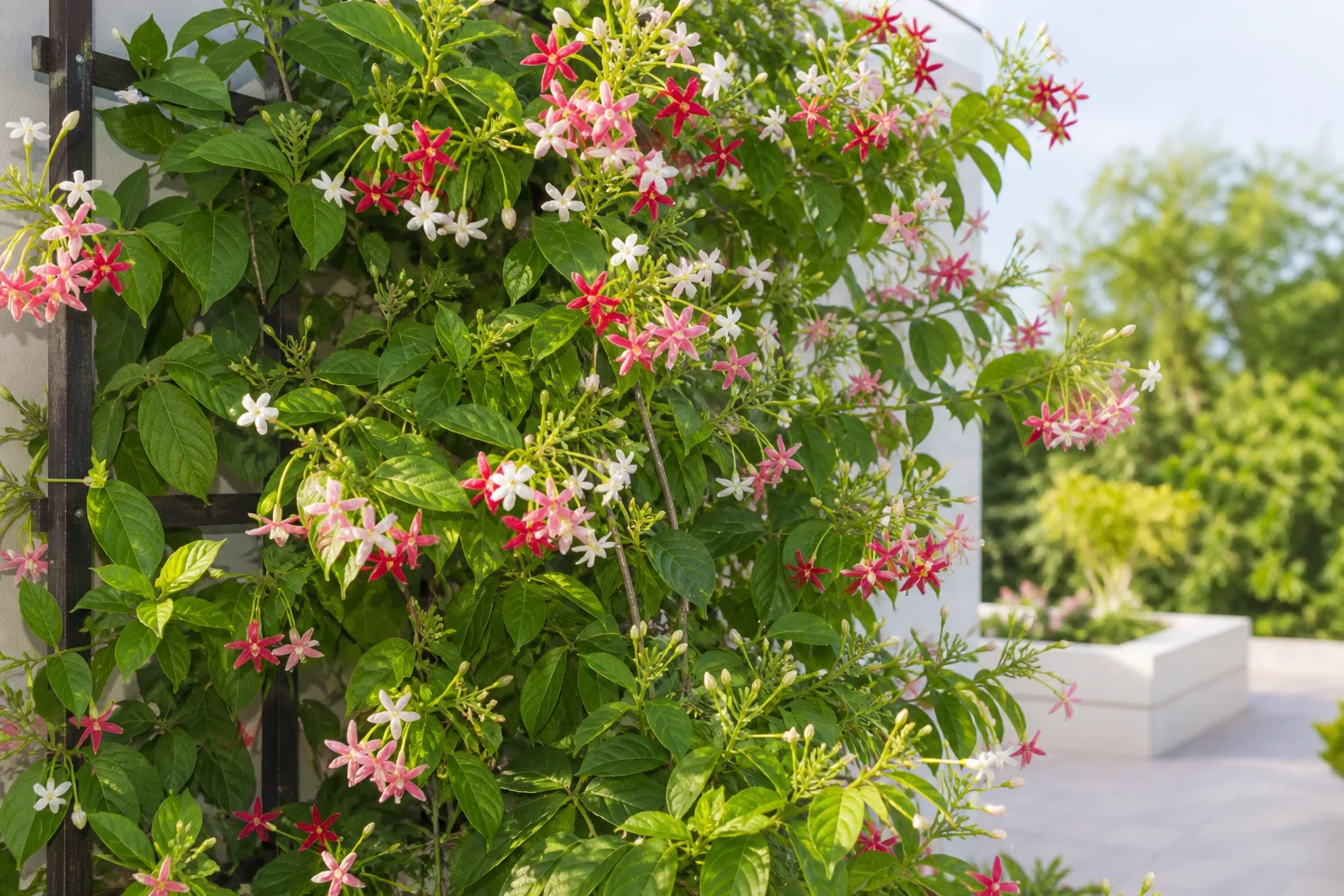
Rangoon Creeper’s floral display also changes after flowers open. NParks documents fragrant flowers that open white and turn pink and then red, while World Flora Online notes that flowering occurs over many months in suitable climates and that colour deepens as flowers age. Mixed colours in one cluster are therefore normal; they do not indicate uneven light.
Flowering performance versus leafy survival
Too little light often produces vigorous-looking but thin vegetative extension before it produces obvious decline. Long internodes, fewer side shoots, and leaves concentrated near the ends of stems are more useful clues than leaf colour alone. If the vine grows but does not flower, improve light first, then check plant maturity, pruning timing, and nutrition rather than reaching immediately for a high-phosphorus fertilizer.
Light cannot guarantee flowers by itself. Recently rooted plants may need time to establish, hard pruning can remove flowering wood, excess nitrogen can favour leafy growth, and chronic drought can cause buds to abort. Use the Rangoon Creeper fertilizer guide only after the placement is bright enough; fertilizer cannot replace photons.
Best placement in gardens, terraces, and balconies
Choose a site with an open view of the sky and support strong enough for an increasingly woody vine. NParks lists trellises, arbours, and pergolas among appropriate landscape uses. A sunny boundary frame, gate, or pergola usually works better than a pot tucked beside a doorway where walls block most of the day.
Train several main shoots across the support instead of allowing one dense knot at the top. Spreading the framework exposes more leaves and flowering laterals to light and improves airflow through the canopy. Keep enough access for future tying and pruning; a bright placement is not useful if the vine grows onto an unsafe roof edge or inaccessible cable.
Choosing an exposure in India and other tropical climates
An east-facing site gives gentle morning sun and is a good starting point for recently purchased or heat-stressed plants, provided it stays bright afterward. South-facing open terraces generally deliver the longest exposure in the Northern Hemisphere and suit established vines well. West-facing balconies can flower strongly but may combine intense afternoon sun with reflected heat from concrete, so root-zone moisture and leaf temperature need closer observation.
A north-facing balcony is the weakest option when a building shades it all day. It can work only if the balcony remains open and sky-bright for many hours; a recessed north balcony is commonly too dim for good flowering. Compass direction is only a shortcut. A lux-meter phone app can compare locations, but repeated readings and the plant’s new growth matter more than one exact number.
Distance from walls, glass, and overhead shade
Concrete walls, metal railings, and glass can make a sunny balcony hotter than an open garden. Keep leaves from pressing against sun-heated glass or dark walls, and leave room for air movement behind the trained canopy. Afternoon shade from a light lattice can reduce heat load while still preserving strong ambient brightness.
Do not assume a spot is “full sun” because one branch receives a narrow sunbeam. Observe the intended support at three or four times during a clear day and total the periods when most of it receives direct light. Repeat the check when seasons change because an overhang that blocks high summer sun may admit lower winter sun, while a deciduous or newly dense tree can change the exposure.
Can Rangoon Creeper take direct afternoon sun?
An established, well-watered Rangoon Creeper can take full tropical sun, and the species is explicitly classified for full sun by Singapore NParks. The important distinction is between a rooted outdoor plant adapted to that exposure and a soft nursery plant moved abruptly from shade cloth into a west-facing heat trap.
Provide temporary afternoon filtering when leaves are newly transplanted, when roots are confined in a small black pot, or when a heatwave follows cloudy weather. Once the plant is established, remove unnecessary shade gradually. Permanent heavy shade used to prevent every wilted afternoon leaf can trade a manageable heat problem for chronic poor flowering.
Acclimating a nursery plant without scorching it
Move the plant through brighter positions over about two weeks. Begin with two or three hours of morning sun, then add exposure every few days while checking the newest leaves. Water according to the root ball rather than soaking pre-emptively every afternoon; the Rangoon Creeper watering guide explains how to match irrigation to faster drying in brighter sites.
Bleached tan patches that appear only on the newly sun-facing side mean the increase was too abrupt. Step back to the last safe exposure and hold it there until fresh growth appears. Old scorched tissue will not turn green again, so judge recovery by clean new leaves rather than by waiting for damaged patches to disappear.
Partial shade and the honest low-light limit
Rangoon Creeper can grow in partial shade, especially where it receives direct morning sun and bright open shade later. What it does poorly is deep, enclosed shade. Penn State Extension’s discussion of low-light interiors highlights that window direction and outdoor obstructions sharply reduce the light plants actually receive, even when a room looks comfortable to human eyes (Penn State Extension).
Indoors behind glass, even a sunny-looking window usually gives the vine less total light and less space than an outdoor support. A mature plant may overwinter beside the brightest available window in a cool climate, but a year-round drawing-room position in India is a poor choice if flowers are the goal. Move it outdoors to a sunny balcony or terrace rather than treating leaf retention as proof that the indoor site is suitable.
Can a grow light replace outdoor sun?
Artificial light can maintain a young plant or supplement a bright window, but replacing tropical outdoor sun over a large woody vine is demanding. Use a broad LED bar or panel designed for plant growth, not a decorative bulb aimed at one shoot. Illinois Extension notes that indoor plant lighting decisions must account for both light intensity and duration, so increasing daily hours cannot fully compensate for a lamp that is too weak or too far away.
For a small plant, start with a strong full-spectrum LED positioned according to the manufacturer’s plant-lighting chart and run it for roughly 12 to 14 hours daily on a timer. Watch the top and sides of the canopy for uneven stretching, then adjust distance or add coverage. For a vine already covering a trellis, outdoor sun is simpler and usually more effective than trying to illuminate every leaf indoors.
Seasonal light changes: summer, monsoon, and winter
In much of India, summer combines long bright days with extreme leaf and container heat. Keep strong morning sun, but consider light afternoon screening where reflected heat repeatedly scorches leaves or dries a pot within hours. Do not respond by moving the plant into permanent darkness; first cool the root zone, improve watering, and use temporary shade during the hottest window.
Monsoon cloud can reduce flowering even when the plant sits in the same physical place. Keep the canopy open through sensible training, remove only tangled or dead growth, and avoid overfeeding a vine already stretching in dull weather. During clearer post-monsoon and winter periods, reassess shadows from nearby structures because the lower sun angle may brighten one position and darken another.
The species is tropical and not adapted to frost. Kew’s wet-tropical classification supports using the brightest protected position when cold weather forces a container plant under cover. Return it to stronger outdoor light gradually after winter protection rather than moving tender leaves into all-day sun in one step.
Signs Rangoon Creeper needs more light
The most persuasive low-light sign is a pattern across new growth, not one yellow leaf. Look for shoots that become longer and thinner, widening gaps between leaves, a canopy leaning strongly toward the open side, and flower clusters that become sparse despite warm weather and otherwise sound care. Soil may also remain wet longer because the shaded plant uses water more slowly.
Move the plant to a brighter position in stages, spread shoots across the support, and observe the next growth flush. Do not hard-prune, repot, and fertilize on the same day; changing one factor at a time makes the response readable. If stronger light produces compact growth but no flowers, investigate maturity and pruning with the Rangoon Creeper pruning guide.
Signs the plant is getting too much sun or heat
True excess-light damage appears mainly on the exposed side: pale or tan papery patches, crisp margins, and abrupt injury after a move from shade. Midday wilting that resolves by evening can reflect temporary heat and water demand, while leaves that stay limp after sunset require a root-zone moisture check. The Rangoon Creeper soil guide helps distinguish a fast-draining hot pot from roots impaired by saturated mix.
Respond first by adding temporary midday screening and checking moisture below the surface. Do not keep the soil constantly saturated to compensate for hot leaves. If damage stops and new foliage stays firm, gradually restore more sun; if the root ball is waterlogged, correct drainage before assuming the plant needs extra shade.
How light changes watering, feeding, and pruning decisions
Brighter exposure raises water use, especially for a large leaf canopy in a container. Check the top 2–3 cm of mix more often after moving into sun, then water deeply when that layer is dry. A shaded plant needs less frequent irrigation, so keeping the old sunny-site schedule after moving it under cover can leave roots wet for too long.
Feed only while warmth and adequate light support active growth. Long, weak shoots in shade are not evidence of fertilizer deficiency, and extra nitrogen may make that imbalance worse. When repotting is genuinely necessary, use the Rangoon Creeper repotting guide and allow the plant to recover in bright filtered light before restoring its full exposure.
Pruning changes which leaves receive light. Thin tangled or crossing growth and train retained stems over the available support rather than shearing the outer surface into a dense shell. For new plants, the Rangoon Creeper propagation guide explains how to give cuttings bright but protected light while roots form.
When to use this page vs other Rangoon Creeper guides
- Use the Rangoon Creeper overview for whole-plant identity, growth habit, support, and basic care priorities.
- Use the watering guide when wilting or slow dry-down makes moisture the immediate question.
- Use the soil guide when a sunny container stays soggy or compacts around the roots.
- Use the fertilizer guide after light is adequate but growth remains weak.
- Use the pruning guide to open a tangled canopy or control a mature vine without sacrificing the next display unnecessarily.
Related Rangoon Creeper guides
- Rangoon Creeper care overview — start with space, support, temperature, and whole-plant expectations.
- Rangoon Creeper watering — adjust irrigation as sun and seasonal drying change.
- Rangoon Creeper soil — build a fertile but freely draining root zone.
- Rangoon Creeper fertilizer — feed active growth without driving soft, leafy excess.
- Rangoon Creeper repotting — move a root-bound vine while protecting its support.
- Rangoon Creeper propagation — root new plants under bright, protected conditions.
- Rangoon Creeper pruning — control size and distribute light through the trained canopy.
Conclusion
Rangoon Creeper light needs are straightforward: full sun is the flowering default, while partial shade is a climate-management compromise rather than the ideal for a showy vine. Start with five to six hours of direct sun and bright open conditions for the rest of the day, then adjust for reflected balcony heat, seasonal cloud, and the plant’s acclimation history.
If Madhumalti is leafy but flower-poor, improve total daily light before changing fertilizer. If newly exposed leaves scorch, filter the hottest hours temporarily and acclimate more slowly instead of retreating to deep shade. Let the next flush of compact growth and flower-bearing laterals confirm that the placement works.