Rangoon Creeper Care: Sun, Water, Soil & Flowers
Combretum indicum
Grow Rangoon Creeper (Combretum indicum) in strong sun with sturdy support, fertile free-draining soil, and regular deep watering. Learn Madhumalti care, pruning, repotting, and safety.
Rangoon Creeper Care: Sun, Water, Soil & Flowers
Start with wateringThe most common care mistake for Rangoon CreeperWatering guide →Rangoon Creeper care essentials
Light
Water
Water deeply when the top 2–3 cm of soil feels dry. Keep young plants evenly moist while they establish, but let excess water drain and never leave the root ball waterlogged.
Soil
Fertile, organic-rich loam that drains freely. For pots, combine potting mix with compost and coarse aeration material. A slightly acidic to neutral pH around 6.0–7.5 is suitable.
Humidity
Temperature
Fertilizer
Feed lightly during active growth only after light, water, and drainage are correct. A balanced slow-release fertilizer or modest monthly liquid feed is enough for most containers; excess nitrogen can encourage long leafy shoots at the expense of flowers.
About Rangoon Creeper
Rangoon Creeper is native to Tropical Asia, from the Indian subcontinent through Southeast Asia, typically reaches 2.5–8 m (8–26 ft) as a supported vine; smaller with regular container pruning indoors, with fast in warm weather with strong light, moisture, and sturdy support growth. Rangoon Creeper has a climbing growth habit and part of the Combretaceae family. It is also known as Madhumalti, Chinese Honeysuckle, Burma Creeper, Drunken Sailor, and Quisqualis indica.
| Detail | Information |
|---|---|
| Also known as | Madhumalti, Chinese Honeysuckle, Burma Creeper, Drunken Sailor, Quisqualis indica |
| Native region | Tropical Asia, from the Indian subcontinent through Southeast Asia |
| Mature size | 2.5–8 m (8–26 ft) as a supported vine; smaller with regular container pruning |
| Growth rate | Fast in warm weather with strong light, moisture, and sturdy support |
| Growth habit | Climbing |
| Scientific name | Combretum indicum |
| Family | Combretaceae |
Rangoon Creeper Care: Sun, Water, Soil & Flowers
Rangoon Creeper needs three things before any detailed care schedule matters: strong light, a permanent support, and enough room for woody stems. This is not a delicate indoor vine. It is Combretum indicum, a vigorous tropical climber commonly called Madhumalti, Chinese honeysuckle, or by its older botanical name Quisqualis indica.
Choose the site first, install the trellis or frame second, and only then plant. Give the root zone deep watering followed by drainage, keep it fertile without overfeeding, and train new shoots while they are flexible. In a suitable warm site, that basic setup is more important than buying special products.
Rangoon Creeper care at a glance
Grow Madhumalti outdoors where it receives at least five to six hours of direct sun. In very hot inland locations, morning sun plus some late-afternoon relief is a practical compromise, but deep shade usually produces more leaves than flowers. Use a strong pergola, gate frame, masonry-mounted trellis, or boundary structure rather than a light decorative stake.
Water when the top 2–3 cm of soil has dried, soaking the whole root zone and allowing excess water to escape. Use fertile, organic-rich loam with open pore space, feed modestly during active growth, and prune after a major flowering flush. Container plants need closer monitoring because they dry faster in heat yet can remain waterlogged during monsoon rain.
Know the plant before choosing a site
Kew accepts the name Combretum indicum, places it in the Combretaceae, and records Quisqualis indica as a synonym. Kew also describes it as a climber of wet tropical regions, native across India and much of tropical and subtropical Asia to northern Australia.
That habitat explains both its vigour and its limits. Warmth, sun, seasonal moisture, and a large root run encourage rapid growth; frost, dim rooms, and cramped supports do not. The Flora of China account describes Q. indica as a woody vine and documents its opposite leaves and terminal flower spikes, useful features when checking a nursery label.
Flowers, growth habit, and mature scale
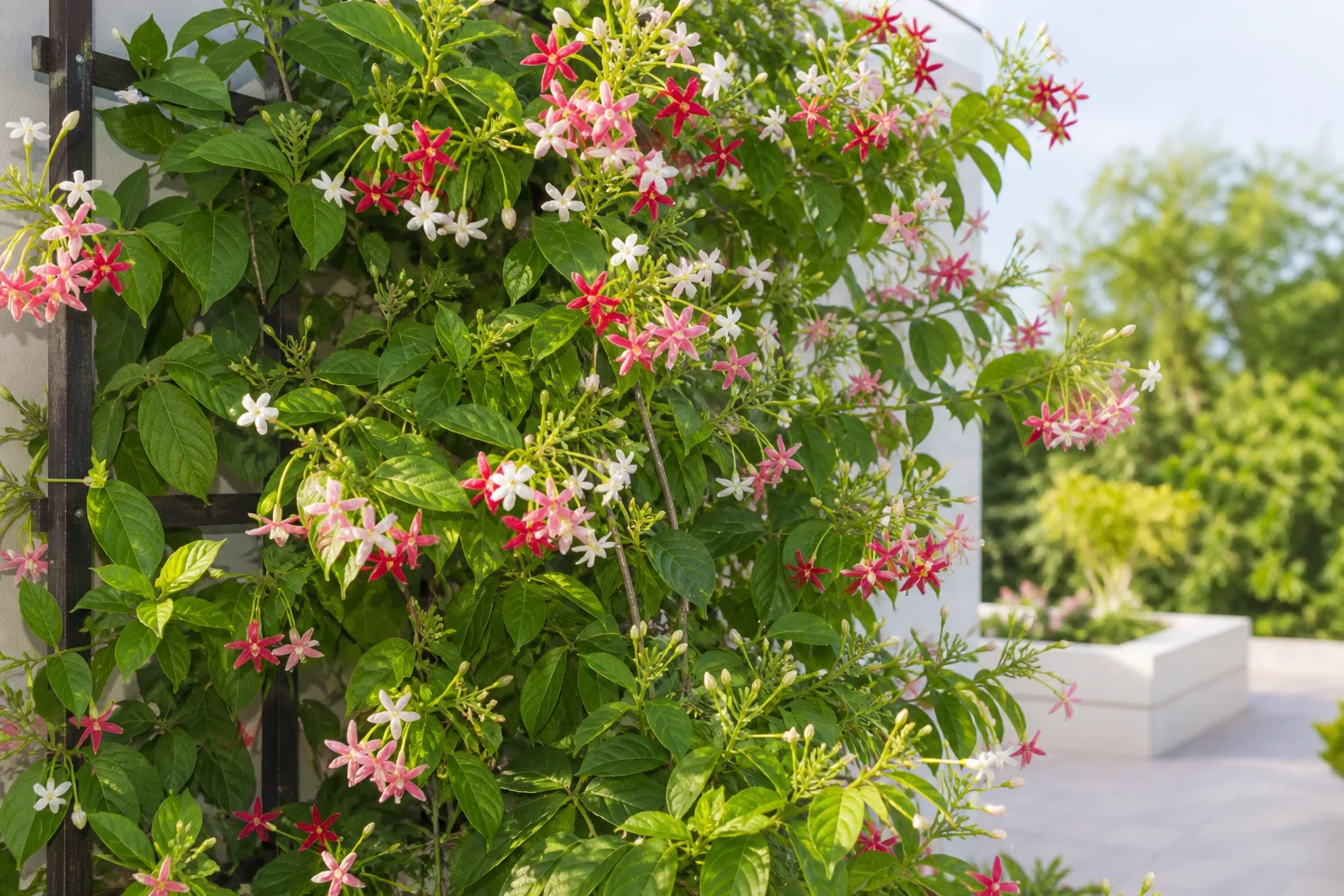
The tubular, fragrant flowers commonly open white, then deepen through pink to red as they age. One cluster can therefore carry several colours at once. This colour change is normal, not a nutrient deficiency or disease.
Supported stems can run several metres and become heavy and woody. A regularly pruned container specimen can stay smaller, but pruning changes its footprint rather than turning it into a tabletop plant. Plan for a mature screen or canopy and keep stems away from gutters, roof tiles, weak railings, cables, and neighbouring trees.
Give Madhumalti sun and permanent support
Flowering is usually strongest in full sun. If a healthy vine makes long soft shoots and broad green leaves but few buds, light is the first condition to investigate. Move a container gradually into stronger sun over a week or two; abruptly exposing shade-grown foliage to intense summer sun can scorch it.
A support should remain stable after rain and after the vine gains weight. The RHS climber guide recommends choosing supports with the plant’s eventual size and attachment method in mind. Rangoon Creeper twines and sprawls, so guide young shoots through or around the framework and use loose soft ties until they hold their route.
Best placement in Indian homes and gardens
A sunny terrace, courtyard, gate, pergola, or warm boundary wall is usually better than an indoor window. Coastal and humid tropical gardens can often use open full-sun positions. In exceptionally hot, dry cities, a site with strong morning and midday sun but protection from the harshest reflected afternoon heat can reduce leaf scorch while preserving flowering light.
Leave air around the canopy and access for pruning. Do not squeeze the vine behind an outdoor AC unit or into a narrow service shaft: hot exhaust, poor airflow, and inaccessible tangled stems create maintenance problems that no watering schedule can solve. Read the dedicated Rangoon Creeper light guide when choosing between two sites.
Water by soil condition, not a calendar
Check the soil before every watering. When the top 2–3 cm feels dry, water slowly until the root zone is thoroughly wet; let a pot drain fully and empty the saucer. Young plants need more consistent moisture while roots establish, but established ground-grown vines usually tolerate a longer interval between deep irrigations than small pots.
Hot, windy weather can make a container need water every few days, while cool weather or prolonged rain can stretch the interval substantially. The University of Minnesota advises checking container moisture frequently because pot material, size, and weather all change water demand. That is why “twice a week” is only a reminder to inspect, not a prescription.
Wet soil plus yellowing or wilt calls for restraint, not another drink. Saturated soil displaces oxygen and damages roots; Missouri Botanical Garden notes that overwatered plants may wilt even though moisture surrounds them. Use the Rangoon Creeper watering guide for seasonal checks and recovery steps.
Use fertile soil that still drains quickly
Rangoon Creeper grows best in fertile loam that holds useful moisture but releases excess water. For a pot, a workable starting mix is about 50% quality potting mix or loam, 30% mature compost, and 20% coarse aeration material such as perlite, fine bark, or coarse sand. Adjust by behaviour: add aeration if the mix remains saturated for days, or add moisture-retentive organic matter if it dries hard within hours.
Drainage holes are mandatory. A gravel layer at the bottom does not repair dense soil or a blocked outlet. University of Georgia container guidance emphasizes that a growing medium must combine water retention with aeration and drainage; Rangoon Creeper needs that balance because a leafy canopy uses substantial water while roots still require oxygen.
Avoid planting at the lowest point of a monsoon-flooded bed. In heavy clay, plant slightly high and improve a broad area rather than creating a small compost-filled hole that collects water. The Rangoon Creeper soil guide covers mix adjustments and drainage diagnosis.
Feed for steady growth without sacrificing flowers
Start with compost and healthy soil, then feed only while the vine is actively growing. For containers, use a balanced slow-release fertilizer according to its label or a modest liquid feed at intervals during warm growth. Do not fertilize a newly repotted, drought-stressed, waterlogged, or visibly declining plant until the root-zone problem is corrected.
More fertilizer does not guarantee more bloom. Excess nitrogen can favour long leafy shoots, and salts can accumulate in containers. University of Minnesota recommends fertilizing houseplants during periods of active growth, a sound principle for potted Madhumalti as well. See the Rangoon Creeper fertilizer guide for product choice, timing, and overfeeding signs.
Prune and train before the vine becomes unmanageable
Train frequently and prune strategically. Remove dead, damaged, rubbing, or badly placed stems whenever needed, then shorten excessive growth after a main flowering flush. This timing lets you see what flowered and reduces the chance of removing the display immediately before it opens.
Make clean cuts with disinfected, sharp tools and take heavy stems down in sections. Never pull a mature tangle from a roof edge or cable. For a step-by-step plan, including renovation of an overgrown plant, use the Rangoon Creeper pruning guide.
Growing Rangoon Creeper in a container
Container culture works when the pot is large, stable, drained, and paired with a support that will not topple. Increase pot size gradually rather than placing a small root ball in an enormous mass of wet mix. Roots emerging from holes, a root ball that dries within a day, or stalled growth despite good light can indicate that repotting is due.
Repot near the start of warm active growth, usually every one to two years for a young plant and less often after it reaches its intended size. Mature specimens can sometimes be root-pruned and returned to the same container by an experienced grower. The Rangoon Creeper repotting guide explains pot sizing and aftercare.
Seasonal care in tropical and subtropical India
Before monsoon, clear drainage holes, secure supports, and remove weak tangled growth that could tear in wind. During prolonged rain, stop automatic irrigation and inspect the root zone rather than assuming a thirsty-looking canopy needs more water. In hot dry months, mulch ground-grown plants while keeping mulch away from the stem base.
Growth may slow and leaves may thin in cool or dry weather. Reduce watering and stop routine feeding when the plant is not actively extending. In frost-prone districts, place containers in a sheltered bright position and protect the root ball; a tropical climber supported by a wall is still vulnerable to cold.
What common symptoms mean
Read symptoms as combinations. One yellow leaf can be old age, while widespread yellowing plus wet soil suggests root stress. Brown crisp margins with dry soil point toward missed watering or hot wind; pale stretched growth with long gaps between leaves points more strongly toward inadequate light.
Leaves but few or no flowers
Check direct sun first, then pruning timing and feeding. A vine shaded by a new building or tree may remain vigorous but fail to set many buds. Heavy nitrogen feeding and repeated trimming of shoot tips can reinforce the problem. Improve one condition at a time and judge the next growth flush rather than changing everything in one weekend.
Yellow leaves, wilt, or stalled growth
Push a finger or wooden skewer into the root zone. If soil is wet and smells sour, stop watering, clear the drain path, and inspect roots if decline continues. If soil is dry and the pot feels light, soak thoroughly once rather than giving daily sips. Persistent decline despite correct moisture warrants checking for scale insects, mealybugs, damaged roots, or a severely compacted mix.
Safety around pets and children
Reliable companion-animal toxicity evidence for Combretum indicum is limited. The plant has no dedicated entry in the ASPCA’s toxic and non-toxic plant database, but absence from that list is not proof of safety. Do not label Madhumalti pet-safe on that basis.
Keep pets and children from chewing the plant or eating fallen fruits and seeds, and remove prunings promptly. Wear gloves if your skin is sensitive. If ingestion occurs or an animal becomes unwell, contact a veterinarian or poison-control professional rather than relying on a gardening article for treatment.
Your first month with a new Rangoon Creeper
Install the final support immediately and tie young shoots loosely. Place the plant in strong light, acclimating it if it came from a shaded nursery. Check moisture daily but water only when the surface layer has dried; observe how quickly the pot changes weight after a thorough soak.
Avoid combining hard pruning, repotting, and heavy feeding on arrival. Let the plant adjust, then make the single most necessary change. Healthy settling-in signs are firm extending shoots, leaves that hold their colour, and new growth beginning to follow the support.
When to use this page vs other Rangoon Creeper guides
Use this overview to decide whether the plant fits your site and to coordinate its whole care system. For a single decision, open the specialist page: light for placement, watering for soil checks, soil for mix design, and fertilizer for feeding.
Use the repotting page when roots have filled a container and the propagation page when you want another plant. A problem that appears to involve several conditions belongs here first; diagnose the root cause before treating one symptom in isolation.
Related Rangoon Creeper guides
The care cluster continues with Rangoon Creeper propagation for cuttings and layering, Rangoon Creeper repotting for root-bound plants, and Rangoon Creeper pruning for training and size control. Return to the Rangoon Creeper plant hub for the profile, safety notes, and all available guides.
Conclusion
Successful Rangoon Creeper care begins with the structure around the plant: strong sun, a durable support, enough root room, and reliable drainage. Water according to soil condition, feed modestly during active growth, and train shoots before they harden into an inaccessible tangle.
For most struggling Madhumalti plants, the best first action is simple: check direct light, then check moisture below the surface. Those two observations separate many flowering problems from root problems and prevent a rushed fertilizer or watering “fix” from making the plant worse.
How to care for Rangoon Creeper?
When should you water Rangoon Creeper?
Water deeply when the top 2–3 cm of soil feels dry. Keep young plants evenly moist while they establish, but let excess water drain and never leave the root ball waterlogged.
- Test the top 2–3 cm with a finger - Water deeply when the top 2–3 cm of soil feels dry.
- water thoroughly when it is dry - Water deeply when the top 2–3 cm of soil feels dry.
- then empty any saucer
- Drain excess water - Keep young plants evenly moist while they establish, but let excess water drain and never leave the root ball waterlogged.
What soil works best for Rangoon Creeper?
Fertile, organic-rich loam that drains freely. For pots, combine potting mix with compost and coarse aeration material. A slightly acidic to neutral pH around 6.0–7.5 is suitable.
- 50% quality potting mix or loam - For pots, combine potting mix with compost and coarse aeration material.
- 30% mature compost - For pots, combine potting mix with compost and coarse aeration material.
- 20% coarse sand, perlite, or fine bark - For pots, combine potting mix with compost and coarse aeration material.
Grower notes for Rangoon Creeper
What matters most with Rangoon Creeper
Rangoon Creeper is a vigorous woody vine, not a compact indoor houseplant. Give it at least 5–6 hours of direct sun, a strong pergola or trellis, and room to climb. Bright light supports the fragrant flower clusters, whose blooms open white and age through pink to red. Weak light may produce plenty of vine but few flowers.
Best placement in a real home
Use a sunny balcony, terrace, courtyard, or garden boundary where the heavy mature stems can be tied to permanent support. Morning sun with afternoon light works well in very hot regions; full sun is best where summers are milder. Keep it warm and protect container plants from frost and cold, drying winds.
Before you buy this plant
Choose a plant with firm green shoots, clean opposite leaves, and no sour smell from the pot. Confirm the label includes Combretum indicum or its older name Quisqualis indica. Check that you have enough space: Madhumalti can cover a large trellis quickly and becomes woody and heavy rather than remaining a delicate tabletop vine.
First month after bringing it home
Install support before the shoots sprawl, then tie them loosely with soft ties. Keep the root ball evenly moist while the plant adjusts, but wait until the surface dries before watering again. Do not combine an immediate repot, hard pruning, and heavy feeding; change one condition at a time and watch the next flush of growth.
Pet-aware note for Rangoon Creeper
Reliable companion-animal safety data for Combretum indicum is limited, and it has no dedicated ASPCA plant entry. Its seeds have a history of medicinal use and should not be treated as pet food. Keep fallen fruits, seeds, and pruned material away from pets and children, and contact a veterinarian after suspected ingestion.
How to tell Rangoon Creeper is settling in
Look for firm extending shoots that begin to twine around their support, followed by healthy leaves and flower clusters in strong light. The sweetly scented tubular blooms commonly open pale and darken as they age, so white, pink, and red flowers can share one cluster. Prune after a major flowering flush to control size without removing the next display.
Is Rangoon Creeper safe for pets?
Rangoon Creeper is not verified as pet-safe and has no dedicated ASPCA listing. Prevent pets from chewing the vine or eating fallen fruits and seeds; call a veterinarian if ingestion causes concern.
Companion-animal toxicity evidence for Combretum indicum (Quisqualis indica) is insufficient for a safe classification. The seeds have biologically active traditional medicinal uses, so do not allow pets or children to ingest them. Treat every animal category as caution pending species-specific veterinary evidence.
Watering Rangoon Creeper
For Rangoon Creeper, test the top 2–3 cm with a finger; water thoroughly when it is dry, then empty any saucer and water about every 3–5 days in hot summer containers and every 7–10 days in cooler weather; always confirm by checking the soil. Water more often during active summer growth and flowering; reduce in cool or dry-season dormancy when leaf growth slows.
| Detail | Information |
|---|---|
| How often | About every 3–5 days in hot summer containers and every 7–10 days in cooler weather; always confirm by checking the soil |
| How to check | Test the top 2–3 cm with a finger; water thoroughly when it is dry, then empty any saucer |
| Seasonal changes | Water more often during active summer growth and flowering; reduce in cool or dry-season dormancy when leaf growth slows |
Signs of overwatering
- widespread yellowing leaves
- soft or blackened stem base
- sour-smelling soil
- leaf drop while the mix remains wet
Signs of underwatering
- limp leaves and tender shoots
- crisp brown leaf margins
- flower or bud drop
- potting mix pulling away from the pot
Soil & potting for Rangoon Creeper
Use a mix of 50% quality potting mix or loam, 30% mature compost, 20% coarse sand, perlite, or fine bark for Rangoon Creeper. Moisture-retentive but free-draining; soggy, compacted soil can rot roots. Target soil pH around 6.0–7.5. Repot every 1–2 years while young; every 2–3 years once mature and maintained by pruning, ideally in early spring or the start of the warm growing season.
| Detail | Information |
|---|---|
| Recommended mix | 50% quality potting mix or loam, 30% mature compost, 20% coarse sand, perlite, or fine bark |
| Drainage | Moisture-retentive but free-draining; soggy, compacted soil can rot roots |
| Soil pH | 6.0–7.5 |
| Repotting frequency | Every 1–2 years while young; every 2–3 years once mature and maintained by pruning |
| Best season to repot | Early spring or the start of the warm growing season |
Signs it needs repotting
- roots circling densely or emerging from drainage holes
- soil drying again within a day
- stalled growth despite warmth, light, and feeding
Humidity & temperature for Rangoon Creeper
Fertilizer & pruning for Rangoon Creeper
Use feed lightly during active growth only after light, water, and drainage are correct. A balanced slow-release fertilizer or modest monthly liquid feed is enough for most containers; excess nitrogen can encourage long leafy shoots at the expense of flowers. for Rangoon Creeper.
| Detail | Information |
|---|---|
| Fertilizer type | Feed lightly during active growth only after light, water, and drainage are correct. A balanced slow-release fertilizer or modest monthly liquid feed is enough for most containers; excess nitrogen can encourage long leafy shoots at the expense of flowers. |
Common problems on Rangoon Creeper
Yellow Leaves
MediumLikely cause: Common on this plant type; confirm with recent watering, light, and root checks.
Quick fix: Inspect the plant and correct the most likely care stressor before stacking treatments.
Full fix guide →Brown Tips
MediumLikely cause: Common on this plant type; confirm with recent watering, light, and root checks.
Quick fix: Inspect the plant and correct the most likely care stressor before stacking treatments.
Full fix guide →Root Rot
MediumLikely cause: Common on this plant type; confirm with recent watering, light, and root checks.
Quick fix: Inspect the plant and correct the most likely care stressor before stacking treatments.
Full fix guide →Overwatering
MediumLikely cause: Common on this plant type; confirm with recent watering, light, and root checks.
Quick fix: Inspect the plant and correct the most likely care stressor before stacking treatments.
Full fix guide →Underwatering
MediumLikely cause: Common on this plant type; confirm with recent watering, light, and root checks.
Quick fix: Inspect the plant and correct the most likely care stressor before stacking treatments.
Full fix guide →Spider Mites
MediumLikely cause: Common on this plant type; confirm with recent watering, light, and root checks.
Quick fix: Inspect the plant and correct the most likely care stressor before stacking treatments.
Full fix guide →Mealybugs
MediumLikely cause: Common on this plant type; confirm with recent watering, light, and root checks.
Quick fix: Inspect the plant and correct the most likely care stressor before stacking treatments.
Full fix guide →Aphids
MediumLikely cause: Common on this plant type; confirm with recent watering, light, and root checks.
Quick fix: Inspect the plant and correct the most likely care stressor before stacking treatments.
Full fix guide →Leggy Growth
MediumLikely cause: Common on this plant type; confirm with recent watering, light, and root checks.
Quick fix: Inspect the plant and correct the most likely care stressor before stacking treatments.
Full fix guide →Slow Growth
MediumLikely cause: Common on this plant type; confirm with recent watering, light, and root checks.
Quick fix: Inspect the plant and correct the most likely care stressor before stacking treatments.
Full fix guide →Wilting
MediumLikely cause: Common on this plant type; confirm with recent watering, light, and root checks.
Quick fix: Inspect the plant and correct the most likely care stressor before stacking treatments.
Full fix guide →Drooping Leaves
MediumLikely cause: Common on this plant type; confirm with recent watering, light, and root checks.
Quick fix: Inspect the plant and correct the most likely care stressor before stacking treatments.
Full fix guide →Low Humidity
MediumLikely cause: Common on this plant type; confirm with recent watering, light, and root checks.
Quick fix: Inspect the plant and correct the most likely care stressor before stacking treatments.
Full fix guide →Not Enough Light
MediumLikely cause: Common on this plant type; confirm with recent watering, light, and root checks.
Quick fix: Inspect the plant and correct the most likely care stressor before stacking treatments.
Full fix guide →Fungus Gnats
MediumLikely cause: Common on this plant type; confirm with recent watering, light, and root checks.
Quick fix: Inspect the plant and correct the most likely care stressor before stacking treatments.
Full fix guide →Mold on Soil
MediumLikely cause: Common on this plant type; confirm with recent watering, light, and root checks.
Quick fix: Inspect the plant and correct the most likely care stressor before stacking treatments.
Full fix guide →