Leggy Rangoon Creeper: Light, Pruning & Fixes
Quick answer
Leggy growth on Rangoon Creeper means long bare canes with small pale leaves and few flowers, usually from too little sun on a naturally fast vine. Move it to full sun first, then prune and tie stems to their support once new compact growth appears.
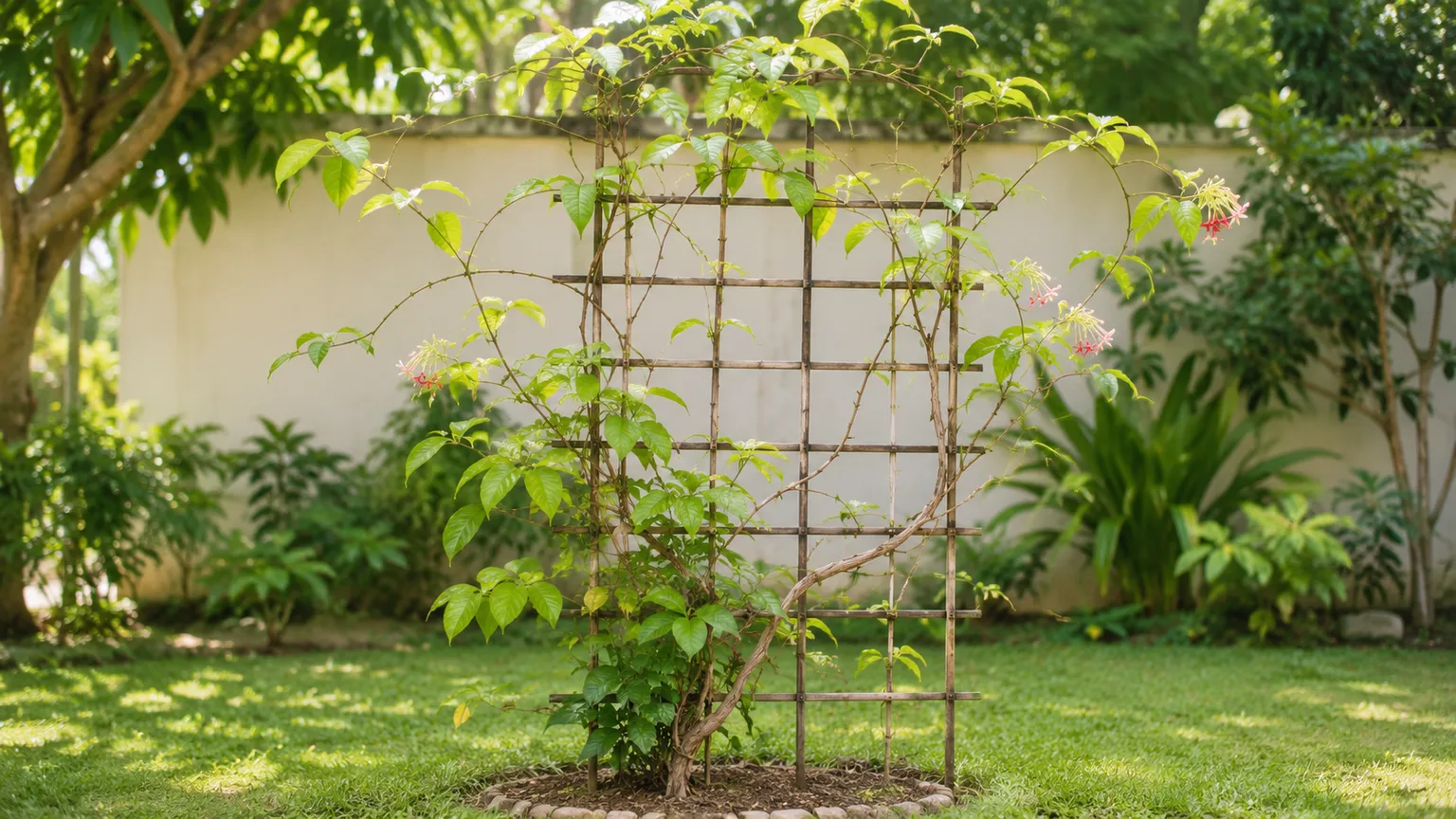
Leggy Growth on Rangoon Creeper: Causes, Checks & Fixes
This guide covers leggy growth on Rangoon Creeper. See also the general Leggy Growth guide, watering, and light pages for this plant.
Leggy Growth on Rangoon Creeper: Causes, Checks & Fixes
Quick answer
Leggy growth on Rangoon Creeper (Combretum indicum, still widely sold as Quisqualis indica) means long, bare canes with wide gaps between small, pale leaves — and usually far fewer fragrant flower clusters than the vine is capable of producing. This is a naturally forceful plant: Singapore’s NParks describes it as a woody climber that climbs by hooks and can reach 8 metres tall, while Cornell’s conservatory notes the vine grows up to 25 feet long. When that energy meets too little sun, it goes into reach instead of bloom.
First fix: give it full sun before you cut anything. NParks lists Full Sun as this species’ light preference. Move containers to the sunniest available position, or clear whatever shades a planted vine, then wait for new growth to emerge tighter and greener before pruning the stretched sections. Cutting first while light stays dim usually produces a second round of the same stretch.
Scope note: this page covers leggy canes, sparse leaves, and bloom loss from shade and missed pruning on Rangoon Creeper. For how light-driven stretch works in general, see our leggy growth guide. On Rangoon Creeper, the pattern usually shows up as bare lower canes with living growth concentrated at shaded-out tips — the sections below explain the vine-specific diagnosis.
What leggy growth looks like on Rangoon Creeper
Healthy Rangoon Creeper carries dense opposite pairs of elliptic leaves along its canes — NParks notes the leaves are arranged in opposite pairs along the stem — with pendant clusters of fragrant blooms through the warm months. A leggy vine breaks that picture in recognizable ways:
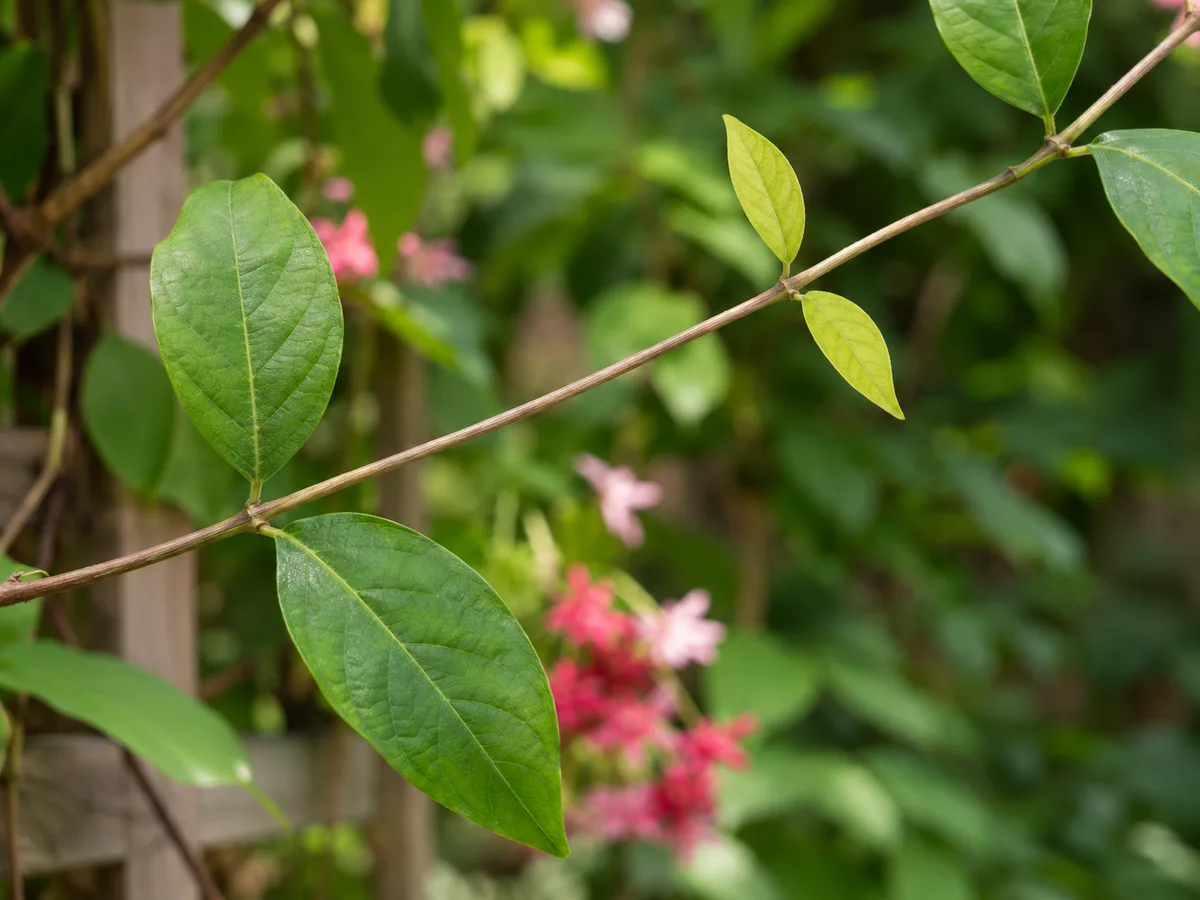
Long gaps between opposite leaf pairs and small pale leaves show shade-stretched growth.
- Long bare cane sections with internodes clearly wider than on older wood from a good season
- Smaller, paler new leaves spaced far apart instead of forming a full screen
- Few or no flower clusters, or buds only at the far shaded-out tips
- Canes reaching sideways over neighboring plants or along the ground rather than climbing their own trellis, with hooks catching nothing
- Soft, floppy extension growth that cannot hold itself up
One normal phase to rule out early: Cornell observes that this plant grows as a shrub in its youth and a rambling vine later. A young plant can look open and awkward before its climbing phase begins. Compare against the plant’s own older wood, described in the Rangoon Creeper hub, rather than expecting nursery-density foliage on every new shoot.
Why Rangoon Creeper stretches
A fast vine in too little sun
This is the main cause. NParks records a fast growth rate with a full-sun preference, and grower references put seasonal extension at 2 to 5 feet in one growing season, with Ugaoo likewise describing its rapid growth as a woody vine. A plant built to add that much cane in a season needs abundant light energy to clothe it in leaves and flowers. In shade it etiolates: longer internodes, thinner tissue, smaller leaves reaching toward the brightest opening. The RHS describes exactly this outcome — weak, pale, spindly growth and fewer flowers — when plants cannot make enough food from light. On Rangoon Creeper the bloom penalty is the giveaway: a shaded vine may still extend impressively while producing almost no fragrant clusters.
Missed pruning and missing support
Rangoon Creeper blooms on wood it is about to make, so an unpruned vine spends each season extending old ropes rather than branching into flowering laterals. Grower guidance is to prune plants regularly to keep it in bounds, and container specimens need it most often. Support matters just as much: the RHS notes climbers need sturdy wires or trellis for support with stems tied in as they grow. A vine with nothing to climb scrambles sideways across soil or neighboring shrubs, which reads as legginess even in decent light. Check the pruning guide for cut placement once you confirm this cause.
Secondary contributors
Crowded planting pits and long-unrepotted containers restrict the root volume a fast vine needs, slowing the dense basal branching that fills the lower trellis. Heavy feeding in a shaded position can push soft, elongated shoots the plant cannot support — nutrients cannot substitute for photons. These are secondary: correct sun and structure first, then judge whether feeding or repotting is still needed using the soil guide.
The bloom cost: prune for flowers, not just shape
Rangoon Creeper’s display is famously dramatic — Cornell describes flowers that open white at dusk, turn pink on the second day and red on the third — but that show only arrives on well-lit new wood. Practical grower guidance is to cut plants back in early spring before flowering from June to September. The logic is straightforward: an early-spring cut removes spent extension, forces branching, and gives the flush months of strong light to mature into blooming laterals.
A vine pruned at the wrong moment pays for it in flowers. Cutting during bud set or early bloom removes the season’s display wood, while never pruning at all leaves the plant spending vigor on ever-longer non-branching canes. Shade compounds both errors, since dim positions produce the RHS’s fewer-flowers outcome regardless of pruning. If your vine is both leggy and flowerless, treat bloom timing as part of the diagnosis, not a separate problem.
How to confirm the cause
Work through these checks before changing anything:
- Sun hours on the leaves. Does the canopy receive direct sun for most of the day? Anything under roughly six hours of direct sun on a plant rated for full sun is suspect. Note buildings, eaves, and neighboring trees that were not there — or were smaller — when the vine last bloomed well.
- Compare new wood with old. Are the newest cane sections longer, barer, and paler than wood from a previous good season? Uniformly long canes with full leaves and flowers are vigor; lengthening gaps with shrinking leaves are stretch.
- Inspect the support. Are the main canes tied to a trellis, fence, or pergola, or are they sprawling sideways and rooting where they touch soil? Untied scrambling plus shade is a double cause.
- Check the bloom record. Did flower clusters decline in the same season the stretch appeared? Parallel decline confirms an energy shortage rather than a one-off pruning miss.
- Rule out root trouble. Firm canes with a normal wet-dry soil cycle point to light and pruning. Constantly soggy mix, sour smell, or soft stem bases point to water problems instead — cross-check the watering guide before touching the light setup.
You do not need to unpot for this diagnosis. Legginess is read on stems, leaves, and sun exposure, not roots.
The first fix to try
Move the plant one decisive step toward full sun — a single change, kept stable.
For containers, that means the sunniest wall, fence, or railing available, with the trellis moved along so canes stay supported during the transition. For planted vines, it means clearing the shade: cut back overhanging branches, move competing pots, or redirect a neighboring screen rather than moving an established root system. If the vine lived in deep shade, stage the move over seven to fourteen days so tender shaded leaves are not scorched on day one.
Then wait. Give the vine two to three weeks in the new position and watch the newest nodes: tighter spacing and greener, fuller-sized leaves confirm the placement works. Only then should secateurs come out. Pruning before this confirmation removes leaves the plant needs for recovery energy and hides whether light was the true cause.
Step-by-step recovery
Once new compact growth proves the light is right, rebuild shape in order:
- Cut back stretched canes. Shorten the worst bare sections to a healthy outward-facing bud or lateral, removing dead wood first. Work in one session but keep the reduction moderate — roughly a third of the tangled mass at most — so enough foliage remains to fuel regrowth. Timing detail: pruning guide.
- Sanitize tools between cuts. Wipe or dip blades when moving between stems, following standard guidance to sanitize pruning shears between cuts, so one diseased cane does not inoculate fresh wounds.
- Tie canes to their support. Fan the retained stems across the trellis or fence and secure them loosely, giving hooks and ties contact points instead of letting new growth flop. The RHS’s tying-in principle for climbers applies directly here.
- Root a backup. If the reshape was drastic, strike a few tip cuttings — NParks lists Stem Cutting (Softwood) among this species’ propagation methods — in warm, humid, lightly shaded conditions before moving them to sun once rooted.
- Recalibrate water and feed. A sunlit, pruned vine transpires faster than a shaded tangle. Check soil depth before each watering rather than keeping the old schedule, and hold fertilizer until new growth looks settled for a couple of weeks.
Do not repot, relocate again, and prune hard in the same week unless roots are clearly failing. One variable at a time is how you learn what worked.
Recovery timeline
Existing bare cane sections will not refill with leaves along their length — judge recovery by what the vine makes next, not by whether old ropes green up.
| Phase | What to expect |
|---|---|
| Weeks 1–3 after the sun move | Little visible change; newest tips firm up and soil dries faster |
| Weeks 4–8 | New leaves emerge closer together, larger and deeper green; laterals break below pruning cuts |
| Rest of the growing season | Trellis fills from the tied framework; first flower clusters form on the new wood if timing allows |
| Next early spring | Annual cutback sets up the first fully managed bloom season |
Worsening signs: new growth stays tiny and pale after six weeks in full sun, canes soften at the base, or leaves yellow across the plant despite corrected light. Recheck drainage and root health via the problems hub rather than cutting harder.
Lookalike patterns to rule out
| Pattern | Canes and leaves | Light and soil | Likely cause |
|---|---|---|---|
| Shade stretch | Lengthening bare gaps, small pale leaves, few blooms | Under six hours of sun; soil may be normal | This guide: sun first, then prune |
| Healthy vigor | Long canes but full-sized leaves and abundant clusters | Full sun; normal dry-down | No fix — train and enjoy |
| Dry stress | Wilting leaves that crisp at edges, stalled tips | Dry deep into the pot; hot exposed position | Water depth issue; see the watering guide |
| Wet-root decline | Yellowing leaves, soft stem bases, sour mix | Soggy, slow-draining soil | Root-zone trouble; route via the problems hub |
| Cool-season thinness | Leaf shedding with otherwise firm wood | Short days, cool nights | Seasonal rest; resume training in spring per the fertilizer guide feeding calendar |
Mistakes to avoid
- Pruning before fixing the sun. Bare cuts in dim conditions regrow as longer, weaker shoots.
- Hard cutbacks during bud season. Removing bloom wood between late spring and early autumn trades the display for shape; save structural cuts for early spring.
- Feeding a shaded vine into bushiness. Extra nitrogen in low light pushes soft stretch, not compact flowering wood.
- Leaving canes unsupported. Untrained stems scramble, shade themselves, and look leggy even where light is adequate.
- Judging recovery by old canes. Bare sections are history; only new spacing and new blooms count.
How to prevent it next time
Site every Rangoon Creeper — planted or potted — where full sun is realistic year-round, not just where the trellis fits the landscape plan. Prune once each early spring before the bloom window, tie that season’s new canes to the support while they are still flexible, and keep containers from becoming root-bound shade traps by repotting on schedule. Pair each spring cut with a watering review, since a sunlit vine in fresh growth drinks faster than its winter self. These four habits — sun, annual cut, tie-in, and seasonal water checks — are the whole prevention program.
When to use this page vs other Rangoon Creeper guides
- Rangoon Creeper hub — start here for whole-plant context and the species baseline.
- Problems hub — jump here when symptoms point away from legginess, such as rot, pests, or spots.
- Light guide — use for placement, sun hours, and shade-sign detail beyond this page’s diagnosis.
- Pruning guide — use for cut technique, timing, and training once light is confirmed.
- Watering and soil guides — use when the pot stays wet or dries oddly, since root trouble mimics decline.
Related Rangoon Creeper guides
- Rangoon Creeper hub — species baseline and growth habit
- Rangoon Creeper problems hub — symptom-specific fix guides
- Rangoon Creeper light — sun needs and placement
- Rangoon Creeper pruning — timing, cuts, and training
- Rangoon Creeper watering — soak rhythm for pots and garden soil
- Rangoon Creeper soil — drainage and mix choices
- Rangoon Creeper fertilizer — feeding around the bloom season
Conclusion
Leggy growth on Rangoon Creeper is a fast vine telling you it is short of sun and overdue for structure: long bare canes, small pale leaves, and missing blooms trace back to shade, skipped spring pruning, or untied scrambling far more often than to hunger or thirst. Confirm with new-versus-old wood and a sun-hour check, move to full sun as the single first fix, then prune and tie only after fresh compact growth proves the placement. Old cane sections never refill — judge success by tighter new nodes and returning flower clusters, and protect the display by keeping structural cuts in early spring.
Related tool
Use the Plant Problem Diagnosis Tool to narrow causes for leggy growth on this plant before changing multiple variables at once.