Fungus Gnats on Rangoon Creeper: Causes, Checks & Fixes
Quick answer
Fungus gnats on Rangoon Creeper mean the compost-rich surface mix is staying damp enough for flies to breed. First fix: let the top 2-3 cm dry fully between waterings and set one yellow sticky trap to confirm numbers are falling. Established vines are rarely harmed; protect fresh cuttings and seedlings instead.
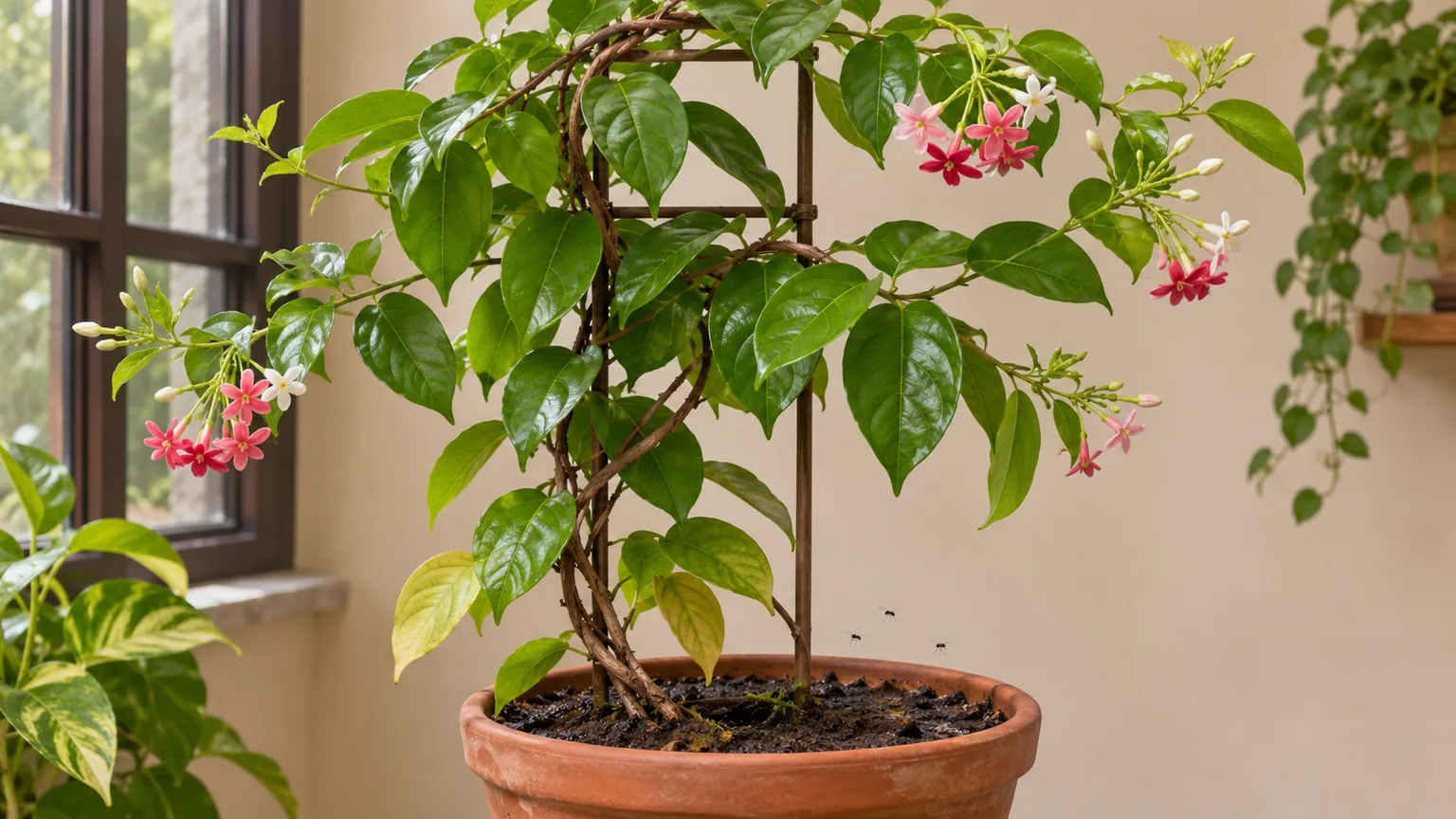
Fungus Gnats on Rangoon Creeper: Causes, Checks & Fixes
This guide covers fungus gnats on Rangoon Creeper. See also the general Fungus Gnats guide, watering, and light pages for this plant.
Fungus Gnats on Rangoon Creeper: Causes, Checks & Fixes
Quick answer
If tiny dark flies puff up every time you brush your Rangoon Creeper pot, the flies are breeding in the damp surface of its compost-rich mix, not attacking the vine itself. Adults head toward the moist upper soil of potted plants to feed and lay eggs, and a Madhumalti container watered every few days in summer stays inviting for them.
First fix: let the top 2-3 cm of mix dry fully before the next watering, and push one yellow sticky trap into the pot edge. That single change plus the trap both treats larvae and tells you within days whether numbers are falling. For how gnats behave on plants in general, see our fungus gnat hub. Everything below is about why Rangoon Creeper pots specifically invite them and what to do next.
What fungus gnats look like on Rangoon Creeper
Adults are delicate, dark brown or black flies approximately 1/8 inch long, weak fliers that hover just above the pot or run across the soil surface rather than settling on leaves. You will notice them most in the morning, when watering disturbs the surface, or when you slide the heavy vine aside and expose the shaded mix beneath its canopy. The larvae live out of sight in the upper mix: slender whitish maggots with distinct black heads that feed where fungi and decaying matter concentrate.
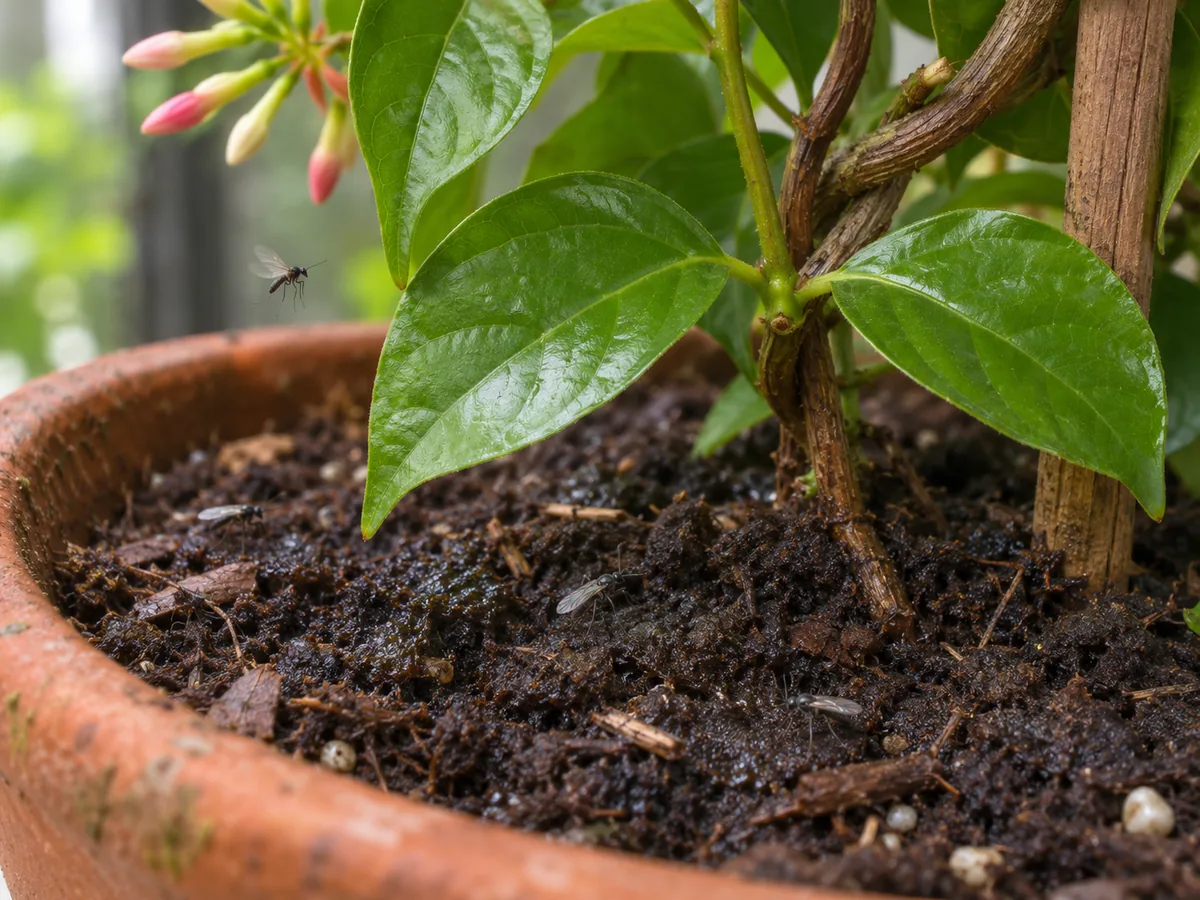
A few weak-flying adults at the moist soil line point to a surface-breeding problem; established vines usually tolerate light infestations.
On a Rangoon Creeper (Rangoon Creeper hub), leaf damage is not the calling card. Leaves stay green and firm while flies circle the pot, which is exactly why growers misread the problem as a foliage pest and spray the vine. If the vine itself shows chewed leaves or stippled foliage with no flies at the soil line, you are likely looking at a different pest covered in the Rangoon Creeper problems hub.
Why Rangoon Creeper pots breed fungus gnats
A compost-heavy mix that stays biologically active
The recommended Rangoon Creeper container mix is roughly half potting mix or loam with nearly a third mature compost. That organic fraction is what powers the vine’s fast warm-weather growth, but damp composts containing high levels of organic matter are precisely the nursery fungus gnats prefer. Females deposit eggs in the surface layer of the mix, and larvae feed on the fungal growth that rich, moist compost supports. No other common vine in the catalog pairs such a heavy compost fraction with such frequent summer watering.
Establishment watering keeps the surface permanently damp
Young Rangoon Creepers are kept evenly moist while they establish, and mature containers in hot weather drink every 3-5 days. That rhythm rarely lets the surface fully dry, especially under the vine’s own dense leaf canopy, which shades the pot and slows evaporation. Check your own pattern against the Rangoon Creeper watering guide: if you water on schedule rather than by the top 2-3 cm finger test, the surface may never dry enough to break the egg cycle.
Big pots, saucers, and monsoon weather
Madhumalti needs a large, stable pot to anchor a heavy woody vine, and large soil volumes dry slowly at depth while wicking moisture back to the surface. Saucers left full after deep watering, mulch layers that cap evaporation, and rainy-season weeks when outdoor pots never dry all extend the damp window. Review drainage and mix structure in the Rangoon Creeper soil guide if the surface still feels wet days after watering.
How to confirm the cause
Work through these checks in order before treating:
- Disturbance test. Tap the pot rim and brush the vine aside. A small puff of tiny dark flies rising from the soil surface, not from the leaves, points to fungus gnats.
- Sticky trap count. Push one yellow sticky card at the pot edge for 48 hours. A catch of small dark flies confirms an active breeding population and gives you a baseline to judge progress.
- Finger test. Press into the top 2-3 cm of mix. If it feels moist less than two days after watering, the surface is staying wet enough for eggs to survive. Persistent surface moisture is the condition to fix.
- Smell and cutting check. Sour-smelling mix or wilting fresh cuttings alongside the flies suggests larvae plus excess moisture together. Firm shoots on the mother vine with flies alone is the mild, common version.
- New-plant audit. Did the flies start after a new nursery plant or a fresh bag of compost joined the balcony? Inspect those pots first, since eggs often arrive in bought-in media.
The first fix to try
Let the top 2-3 cm dry completely, then water deeply and drain, keeping the yellow trap in place. Allowing the upper layer to dry kills eggs and young larvae, which cannot survive dry soil, while the deeper roots of an established vine ride out the pause without stress. This matches the vine’s normal care: the finger test already decides watering, so you are enforcing the rule rather than inventing a new one.
Give this one change two weeks. Check the trap every few days. Falling catches plus a dry surface mean the cycle is breaking. Do not stack a repot, a drench, and pruning onto the same weekend; Rangoon Creeper reads one correction at a time through its next flush of growth, and piling on treatments hides which one worked.
Step-by-step follow-up if flies persist
If trap counts stay high after two weeks of real dry-downs, escalate in this order:
- Top-dress with grit. Spread about 1 cm of coarse sand or fine grit over the surface. Growers report an inch or so of sand on the potting mix dries too fast to sustain eggs, which suits Rangoon Creeper because the barrier sits above the compost without changing the deeper mix the vine feeds from.
- Apply a Bti drench. Bacillus thuringiensis subsp. israelensis targets fly larvae in the soil, and extension guidance lists Bti among controls that suppress fungus gnats without disrupting natural enemies. Practical gnat guides describe this bacterium as a selective larva killer applied through irrigation water. Follow the product label exactly and repeat only as directed.
- Consider nematodes for stubborn pots. Steinernema feltiae nematodes added to the mix attack the larval stage, one of the biological controls the RHS lists for compost-dwelling gnats. This fits large Rangoon Creeper containers where drying the full soil column is slow.
- Repot only failing mix. If the mix smells sour, stays soggy for a week, or has slumped into a dense mass, move the vine into fresh open mix at the right season per the Rangoon Creeper repotting guide. Discard the old mix rather than reusing it. Repotting solely for a few flies is overkill.
Cuttings, layers, and seedlings need extra protection
This is the Rangoon Creeper-specific risk the generic advice misses. Established plants are unlikely to be damaged by fungus gnat larvae, and a mature woody Madhumalti with a deep root system shrugs off a light larval population. But this is also the plant most owners propagate by stem cuttings and layering, and larvae can damage seedlings and uncallused cuttings by feeding on root hairs and young roots.
Practical split: let the mother vine’s surface dry on schedule, but root cuttings in fresh, open, pasteurized mix kept only lightly moist, with a small sticky trap beside the propagation tray. If a cutting wilts while its mix stays wet and flies hover, unpot it: brown, stubby root tips with translucent larvae nearby mean the cutting needs clean media and a restart, not more water.
Recovery timeline
The full gnat life cycle can complete in about a month in warm conditions, so judge progress across one full cycle, not one weekend:
| Phase | What to expect |
|---|---|
| Days 1-3 | Adults still visible; trap starts catching; surface begins drying |
| Weeks 1-2 | Trap counts fall if drying is consistent; larvae decline in the top layer |
| Weeks 3-4 | Few or no new adults if no premature watering restarted the cycle; cuttings root normally |
Worsening signs: rising trap counts after two weeks, spreading leaf yellowing on wet soil, soft stem bases, or a sour pot smell. Those point to overwatering damage underneath the gnat problem. Run the watering and drainage checks in the Rangoon Creeper watering guide before adding more treatments.
Lookalikes to rule out
- Shore flies. Strong fliers with spotted wings that feed on algae on wet surfaces, not on roots. If flies seem athletic and the pot has green algae film, suspect shore flies and fix standing water.
- Fruit flies. Smaller, amber flies hovering around kitchen scraps, fallen flowers, or compost bins rather than the pot surface. Rangoon Creeper drops spent blooms that can draw them; clear fallen flowers before assuming soil gnats.
- Overwatering and root rot. Yellow leaves, leaf drop while the mix stays wet, and soft stem bases with few or no flies is a water problem, not a pest problem. Dry-down is still the fix, but skip the Bti.
- Drain flies. Moth-like flies near drains and saucers that breed in slime, not potting mix. Scrub saucers and clear standing water.
Mistakes to avoid
- Spraying the vine for a soil problem. Foliage sprays miss larvae entirely and waste a treatment on healthy leaves.
- Watering on the calendar. Fixed every-few-days watering without the finger test is what keeps the surface permanently breedable.
- Drowning the pot to drown larvae. Flooding drives larvae deeper and suffocates roots; drying kills them more reliably.
- Reaching for fertilizer. A stressed or infested vine does not need feeding, and excess fertilizer promotes the fungal and algal growth larvae eat.
- Reusing infested mix for cuttings. Old compost carries eggs straight to the most vulnerable material. Start propagation in fresh mix.
How to prevent it next time
Keep the habits that suit this vine and starve the gnats at the same time. Water by the top 2-3 cm test, empty saucers after every drink, and keep the open aeration fraction in the mix so the surface releases moisture between waterings. Let sun and airflow reach the pot surface instead of sealing it under deep mulch or a tight saucer pairing. Refresh compost-heavy mix at repotting intervals rather than topping up old media indefinitely, and quarantine new nursery plants for two weeks with a trap card before parking them beside the creeper. Full routines live in the Rangoon Creeper watering guide and the Rangoon Creeper soil guide.
When to worry
A few flies over firm soil on a vigorous flowering vine is a nuisance, not an emergency. Worry when flies pair with wilting cuttings, sour mix, spreading yellowing on wet soil, or softening stem bases. Those combinations mean moisture damage is compounding the infestation, and the vine needs the drainage inspection in the Rangoon Creeper problems hub the same week, not another spray.
Related Rangoon Creeper guides
Use this page for soil-surface flies and larval treatment on Rangoon Creeper; pick the sibling that matches a different symptom:
- Rangoon Creeper hub - whole-plant baseline: sun, support, and flowering habit
- Rangoon Creeper watering - finger-test rhythm that breaks the gnat breeding cycle
- Rangoon Creeper soil - open, compost-balanced mix that drains without staying soggy
- Rangoon Creeper repotting - when tired mix needs replacing rather than treating
- Rangoon Creeper problems - symptom hub when flies are not the main issue
Conclusion
Fungus gnats on Rangoon Creeper are a moisture signal from a compost-rich container, not a verdict on the vine. Enforce the top 2-3 cm dry-down, monitor with one sticky trap, and reserve grit top-dressing and Bti for pots that stay infested after two honest weeks. Shield cuttings and seedlings while the established vine carries on, and the next flowering flush will arrive without an escort of tiny flies.
How we wrote and verified this guide: Recommendations were checked against UW-Madison Extension, the RHS, Gardening Know How, Family Handyman, Better Homes and Gardens Australia, and Epic Gardening references cited inline. Author: sai-ananth. Reviewer: LeafyPixels Review Board. Methodology: plant problem guidance is reviewed against botanical references, extension resources, and LeafyPixels plant-care data before publication. Claims validation: claims-validator-v1 pass with inline external links documented below. Last reviewed: 2026-08-28.
Related tool
Use the Pest Identifier Tool to confirm fungus gnats against other pests on this plant before changing multiple variables at once.