How to Grow and Care for Australian Tree Fern
Learn Australian tree fern care, from shade and steady moisture to planting, container culture, winter risk, pruning, and spores, with regional cautions.
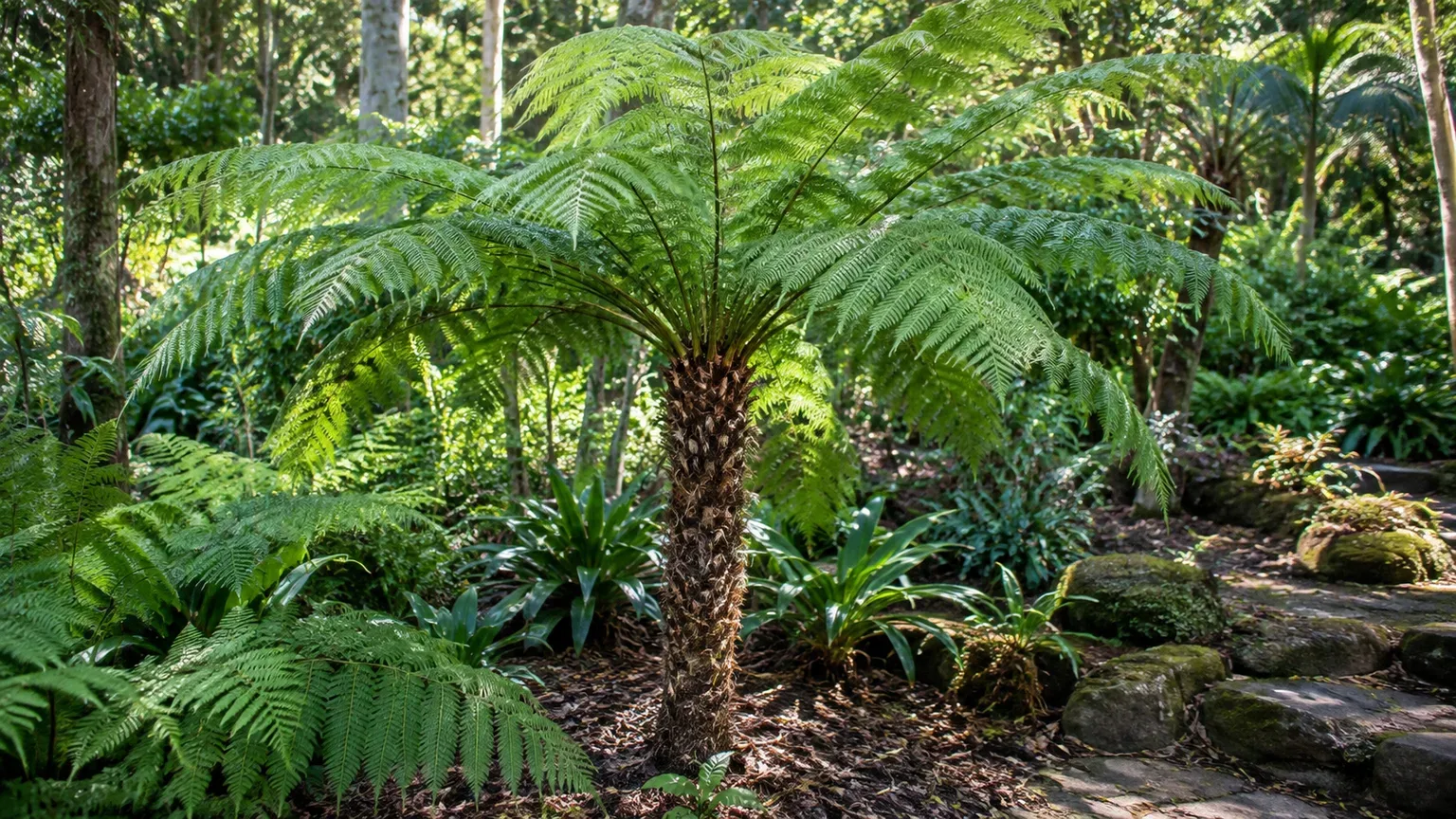
An Australian tree fern makes a dramatic canopy plant, but its size and climate needs rule out many gardens and almost every ordinary living room. Before you buy one, check two things: whether your winters stay mild enough for a tropical fern and whether you have room for fronds that can spread across a small bed. Once those basics fit, the care is straightforward: bright shade, soil that stays evenly moist but drains freely, and protection from frost and drying winds.
The plant sold as Australian tree fern is Sphaeropteris cooperi, formerly widely listed as Cyathea cooperi. It is native to eastern Australia and develops one upright, fibrous trunk topped by long, finely divided fronds. The trunk looks woody, but the plant is a fern, not a branching tree; it reproduces by spores rather than flowers or seeds.
Before You Plant, Know the Fern and Its Scale
A young specimen can look manageable in a nursery pot, then gradually become a landscape feature that is difficult to move. North Carolina State Extension describes mature plants around 15 to 25 feet tall and 10 to 12 feet wide, with even taller specimens in favorable conditions; the UF/IFAS fact sheet gives a height range of 15 to 30 feet. Gardenia lists a similar 15-to-20-foot garden size. These are planning ranges, not promises: climate, protection, age, and growing conditions all matter. Check the NC State Extension Plant Toolbox and the UF/IFAS species fact sheet for their different published descriptions.
Its crown spreads outward as well as upward. Allow open space around the trunk so mature fronds do not crowd a path, roof edge, neighboring plant, or overhead wire. Do not position it where a future canopy would block a window or where strong wind will funnel directly through the long fronds. A sheltered courtyard or humid shade garden is a more sensible match than an exposed, dry lawn.
Botanical labels add a second wrinkle. Older books and nursery tags often use Cyathea cooperi; more current references, including NC State and UF/IFAS, use Sphaeropteris cooperi. If you are checking a plant database, search both names and the common names Cooper’s tree fern, lacy tree fern, and scaly tree fern.
Where Australian Tree Ferns Actually Thrive
This fern suits warm, humid gardens with shade and dependable soil moisture. The University of Florida IFAS Gardening Solutions guide recommends it for shaded landscapes in South and Central Florida and protected spots farther north. NC State likewise describes a warm, humid environment and a preference for shade. The practical takeaway is more useful than a broad zone claim: if your site has recurring hard freezes, treat the fern as a protected container specimen rather than assuming it will survive outdoors.
A shaded garden is not necessarily a dim one. The canopy of taller trees, a north or east side with bright ambient light, or a sheltered spot receiving moving dappled light can work well. Combine shade with air movement and drainage. Deep shade with persistently saturated soil is not the same as a healthy fern habitat.
Growing One Indoors or in a Container
An Australian tree fern is not a compact houseplant. A large conservatory, greenhouse, or bright humid sunroom with substantial ceiling height can accommodate it for longer than a standard home can. Indoors, give the crown room to expand and keep it away from heater vents, cold drafts, and intense afternoon sun through glass. If a room cannot provide headroom and humidity, an indoor position may keep a juvenile plant alive temporarily without being a practical permanent home.
A pot is most useful when winter cold is the limiting factor and you have a protected space to move the plant into. It still needs a roomy, stable container and bright shade outdoors during warm weather. Nurseries Online’s growing notes also describe container culture as an option in colder climates, but container growing does not make the plant small; it only gives you more control over its location.
Choose Light That Protects the Fronds
Start with bright shade or dappled light, especially in hot climates. UF/IFAS recommends shade, while the NC State profile lists conditions ranging from deep shade through partial shade and even full sun. Those broad database fields should not be read as a guarantee that an unacclimated plant will tolerate direct midday sun. A specimen raised under shade cloth can scorch if it is moved abruptly into open sun.
Morning sun can be tolerated in some cooler, humid settings when the root zone never dries, but the safer placement is filtered light with protection from the hottest hours. If the fronds bleach, develop dry brown patches on the exposed side, or curl during hot afternoons, reduce direct exposure and check soil moisture. Move a potted fern gradually over a week or two rather than changing its light environment in one step.
Do not diagnose every brown tip as a light problem. Wind, low humidity, dry soil, salt exposure, transplant stress, and abrupt temperature changes can produce similar symptoms. Look at when damage appears and whether it affects only the exposed side or the whole crown before making a major change.
Plant for Both Moisture and Drainage
Use soil that holds moisture without staying waterlogged. NC State recommends moist, well-drained loamy or sandy soil; UF/IFAS gives a broader tolerance but also emphasizes well-drained ground. A bed with organic matter and a workable structure is preferable to either fast-drying loose sand or compacted clay that remains saturated after rain. If water stands at the planting site after storms, choose a raised or better-drained position rather than trying to fix the problem with frequent surface watering.
Organic mulch helps reduce evaporation and moderates soil temperatures. Keep it spread across the root area but pulled back from the trunk; a wet mulch collar can hide problems and keep the base unnecessarily damp. The Gardenia plant profile similarly emphasizes humus-rich, moist but well-drained soil and a sheltered garden setting.
A Reliable Planting Sequence
Plant in a mild part of the growing season when the plant can settle in before heat or cold stress. In a warm climate that may be spring; in subtropical areas it may be the beginning of a reliably moist growing period. Avoid planting into a heat wave or just before a forecast cold snap.
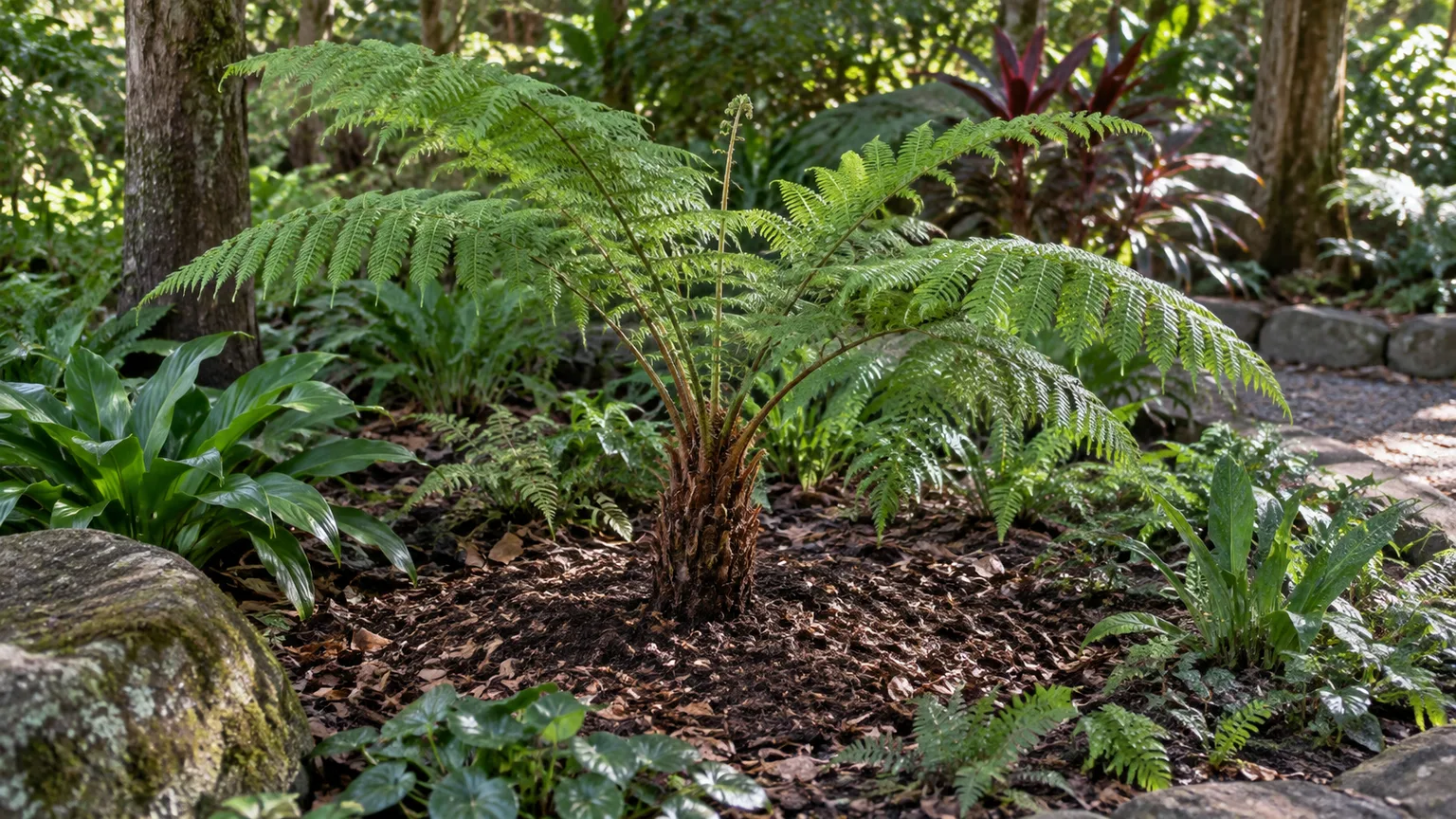
Use this sequence:
- Check the site after rain. Water should drain away rather than remain pooled around the future root zone.
- Dig a broad hole. Make it wider than the root ball but no deeper than the root ball’s existing height.
- Set the root ball at its original level. Keep the stem base and growing crown above the surrounding soil; do not bury the trunk to make the plant seem more stable.
- Backfill with the native soil. Break up large clods and firm gently so the plant stands upright without compacting the bed.
- Water the root zone thoroughly. Let the water soak in, then apply a modest mulch layer, leaving a clear gap around the trunk.
- Support only if needed. If wind rocks the root ball, use a temporary stake or soft ties and remove them once the plant is anchored. Do not lash the crown or constrict the trunk.
Give a newly planted fern extra attention through its first dry spell. Establishment is the period when a missed watering is most likely to set it back, but a constantly flooded planting hole can be just as damaging.
Water by Root-Zone Conditions, Not the Calendar
Keep the root zone consistently moist during active growth, then adjust watering to rainfall, temperature, soil texture, and container size. A fixed rule such as “once a week” is unreliable: a fern in a shaded clay-loam bed after rain may need no irrigation, while a potted plant in warm wind may dry much sooner. Check the soil several inches below the mulch and water deeply when it is beginning to dry, before the root ball becomes bone-dry.
Aim water at the soil around the base instead of directing a concentrated stream into the crown. NC State cautions that crown watering can contribute to root rot and recommends watering at the trunk base. This does not mean the crown must be kept dry during natural rainfall; it means routine irrigation should replenish the root zone rather than leave water sitting in the center of the plant. In a bed, water slowly enough to soak in. In a pot, continue until water drains from the bottom, then empty any saucer.
When fronds brown during hot or windy weather, first check soil moisture rather than automatically misting the leaves. Misting is brief and does not replace water at the roots. Mulch, wind shelter, and deeper root-zone watering are more reliable ways to reduce moisture swings.
Temperature, Frost, and Winter Protection
Cold advice for this species is unusually inconsistent. NC State’s profile displays a broad USDA zone range, while the UF/IFAS fact sheet lists zones 10B through 11 and says it is best where winter temperatures do not drop below freezing. The NC State and UF/IFAS sources therefore do not support treating one hardiness number as a universal guarantee. Local microclimate, exposure, plant size, and duration of cold all affect the result.
Use a conservative plan in frost-prone locations. Keep the fern in a container you can move before cold weather, or select a different plant if the only available outdoor site freezes repeatedly and there is no suitable winter shelter. Do not wait for fronds to blacken before moving it; cold damage may show after exposure has already occurred. A protected greenhouse or conservatory is more dependable than a thin frost cloth over a tall crown.
Potted roots are exposed to colder air on all sides, so move the entire container into a bright, protected space before the first damaging cold. Reduce watering if growth slows, but do not let the root ball dry completely. When spring warmth returns, acclimate it gradually to outdoor light and wind instead of taking it straight from a greenhouse into full sun.
Container Culture and Repotting
Choose a heavy, stable pot with unobstructed drainage holes. A tall, frond-heavy fern can tip in a lightweight container, while a decorative outer cachepot can trap runoff around the roots. Use a moisture-retentive but airy mix intended for large tropical plants; adding coarse bark or another drainage amendment can help if the base mix packs tightly. Do not place gravel in the bottom as a substitute for an open drainage hole.
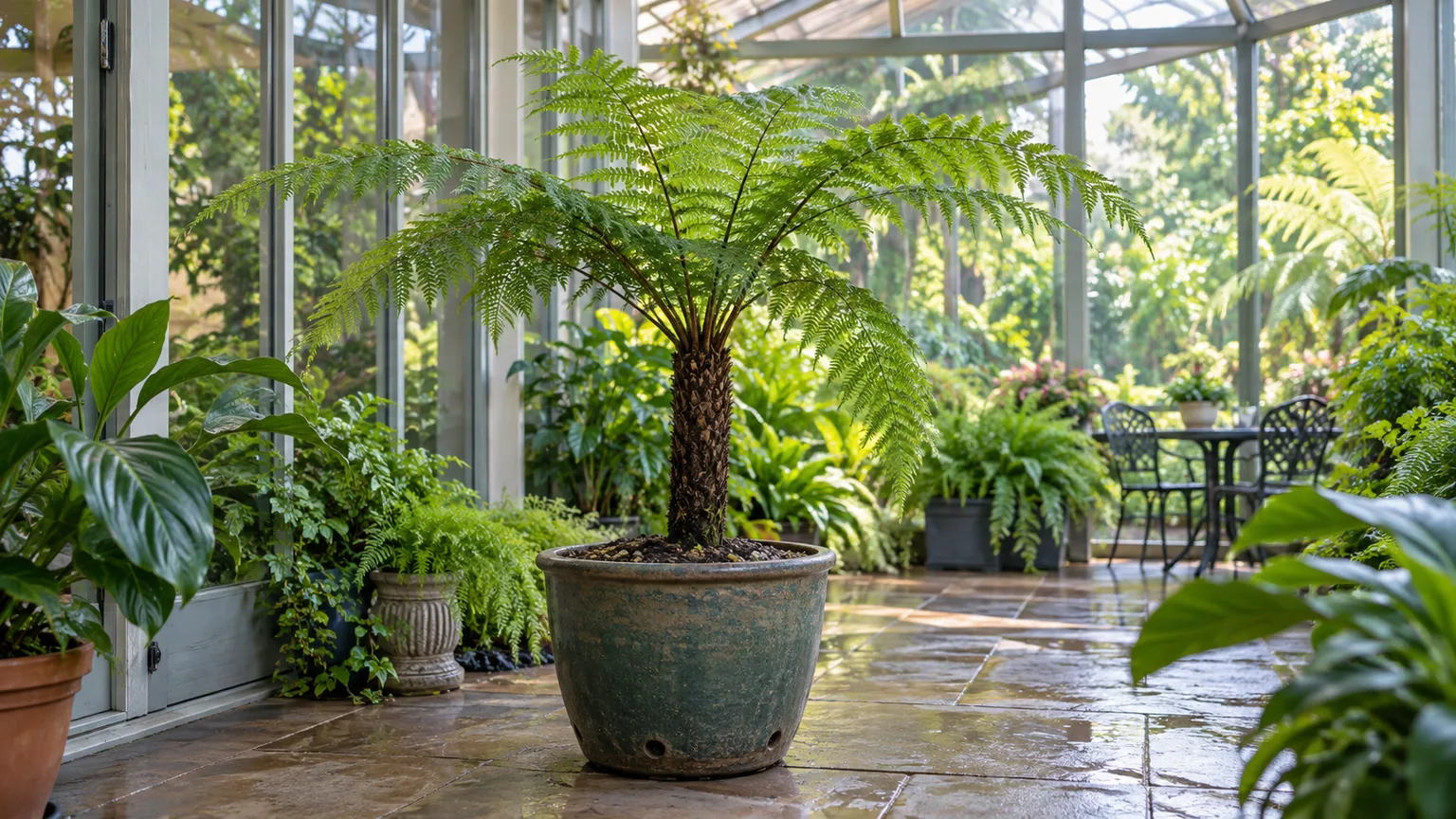
Repot when roots crowd the container, the mix has broken down, or the plant dries so rapidly that routine watering cannot keep up—not simply because another year has passed. Move up one pot size and disturb the root ball as little as practical. A much larger pot can stay wet for too long around a small root system. If the specimen becomes too large to move safely, container culture has reached its practical limit; do not rely on repeated severe root disturbance to keep a giant fern miniature.
A container also increases watering demands and winter vulnerability. Place it in bright shade during warm weather, check moisture more often than you would in a garden bed, and plan the winter destination before the plant outgrows the doorway or conservatory.
Mulch, Fertilizer, and Pruning
A thin layer of organic mulch helps conserve moisture, but keep it away from the trunk. In fertile ground, the fern may need little additional feeding. If growth is weak and conditions are otherwise right, apply a balanced fertilizer at the label rate during active warm-season growth. Avoid heavy applications or feeding a cold, dry, stressed, or dormant plant; excess salts and rapid, soft growth can cause additional problems rather than correcting the real cause.
Remove only dead, badly damaged, or spent lower fronds. Use clean pruners and cut the frond stalk close to the trunk without gouging the trunk or cutting into the central crown. Do not top the plant or remove healthy green fronds to control its height; the growing point sits at the crown, and destroying it can kill the fern. Old fronds naturally fall, leaving the characteristic oval scars around the trunk.
Wear long sleeves and gloves when handling fronds or fiddleheads. UF/IFAS warns that hair-like structures on the plant can cling to skin and clothing and feel itchy. Keep removed foliage out of paths and dispose of it without rubbing it against bare skin.
Propagating Australian Tree Ferns from Spores
Australian tree ferns do not grow from ordinary cuttings or seeds. Mature fronds produce sori—clusters of spore cases—on their undersides. NC State and UF/IFAS both identify spores as the way the species reproduces, so propagation is a patient project rather than a quick way to multiply a garden specimen.
Let a mature frond develop its spore cases before collecting. Place a piece of clean paper beneath a fertile frond and wait for the fine spores to fall; avoid stripping the crown or collecting from a plant that is stressed. Sow the dustlike spores on the surface of clean, pre-moistened, fine-textured propagation medium. Do not bury them under potting soil. Cover the shallow container to retain humidity and keep it warm in bright, indirect light, checking that the medium stays moist without becoming stagnant.
Ferns pass through a small gametophyte stage before visible young fern plants form, so a green film on the medium is not yet a finished seedling. Keep the container humid and avoid disturbing it while the tiny plants develop. Once individual young ferns are large enough to handle, pot them separately and let them establish before exposing them to outdoor wind or direct sun. Because spores are easily dispersed, do not raise or distribute plants in a place where the species is restricted or known to spread invasively.
Pests and Other Care Problems
Spider mites and mealybugs are the pests most often noted by NC State and UF/IFAS. Inspect the undersides of fronds, the bases of stalks, and protected crevices near the crown when new growth looks distorted or stippled. A strong outbreak is less likely when the plant is growing in the right conditions, but a crowded greenhouse or indoor collection can still help pests move between plants.
If you find insects, confirm what they are before treating. Isolate a container specimen from nearby plants, remove a small infestation by hand or with a careful water rinse if the plant can be moved, and repeat inspections over the next few weeks. For a persistent infestation, use only a product labeled for that pest and ornamental plant in your location, following its label. Avoid spraying stressed foliage in hot sun.
Diagnose Brown or Crispy Fronds
Brown fronds are a symptom, not a diagnosis. If only the oldest lower fronds are fading while new central growth looks healthy, normal aging may be the cause. If damage follows a dry, windy spell or a pot dried out between checks, moisture stress is more plausible. If browning follows a sudden indoor-to-outdoor move, cold draft, or sharp light change, acclimation or exposure may be the issue.
Inspect the pattern before changing care. One-sided pale or scorched patches point toward direct sun or wind; widespread crisping suggests that the root ball may have dried; soft, dark tissue around the base or crown calls for checking drainage and reducing standing moisture. Correct the condition first, remove only fully dead fronds, and wait for new growth to judge whether the change helped. Existing brown tissue will not turn green again.
Australian Tree Fern vs. Tasmanian Tree Fern
The Australian tree fern and Tasmanian tree fern are related in name, not identical plants. Australian tree fern is Sphaeropteris cooperi (formerly Cyathea cooperi), native to eastern Australia. The Tasmanian tree fern is generally Dicksonia antarctica, a separate species with a different trunk and growth habit. Nurseries Online notes that the Tasmanian species is associated with cooler climates; verify the botanical name on the label instead of assuming either “tree fern” will tolerate the same conditions.
This matters most when you are choosing a specimen for a marginal climate. A retailer may use a broad common name for several tree ferns, but their cold tolerance, mature size, and care are not interchangeable. Ask for the scientific name and then check the guidance for that species and your region.
Check for Invasive-Plant Risk Where You Live
Do not treat invasive status as a worldwide yes-or-no label. NC State reports that Australian tree fern has naturalized in Hawaiian forests and has weedy tendencies. UF/IFAS’s Florida assessment, by contrast, says it is not a problem species in the area it evaluated. Local climate and ecosystems change the risk.
Before planting, check the current guidance from your local extension service or invasive-species council, especially in islands and warm, wet regions where spores can establish beyond gardens. If it is invasive or restricted where you live, do not plant it or share spores. If local guidance allows it, prevent unwanted seedlings from spreading and dispose of fertile fronds responsibly.
A Seasonal Care Routine
In spring, inspect the crown for healthy new fiddleheads, clear winter debris without pulling attached growth, refresh mulch, and move container plants outdoors gradually once cold risk has passed. Check drainage and confirm that nearby plants have not grown into the space the mature fronds need.
During warm, dry weather, monitor root-zone moisture and water slowly when the soil begins to dry. Recheck pots more often than ground-planted ferns, and watch for pests under fronds. In autumn, stop treating the fern like a hardy tree: move containers to their protected winter space before frost, reduce feeding as growth slows, and keep soil lightly moist rather than saturated.
Conclusion
Australian tree fern care starts with an honest site decision. This is a tropical, large-scale fern for a warm, humid, shaded garden or a spacious protected growing area, not a compact accent for a typical room. Published cold-hardiness claims vary, so use local extension advice and your actual winter exposure rather than trusting a zone number alone.
Give it filtered light, moisture-retentive but freely draining soil, and steady root-zone water adjusted to weather. Protect the crown and trunk from rough handling, prune only dead fronds, and check regional invasive guidance before planting or sharing spores. Those choices address the fern’s main limits while letting its elegant canopy develop without forcing it into the wrong climate or space.



