Baby Tears Plant Care: Light, Soil, Water, and More
Learn how to grow baby tears with bright indirect light, steady moisture, airy soil, and easy pruning—plus a clear plan for wilting, browning, and winter care.
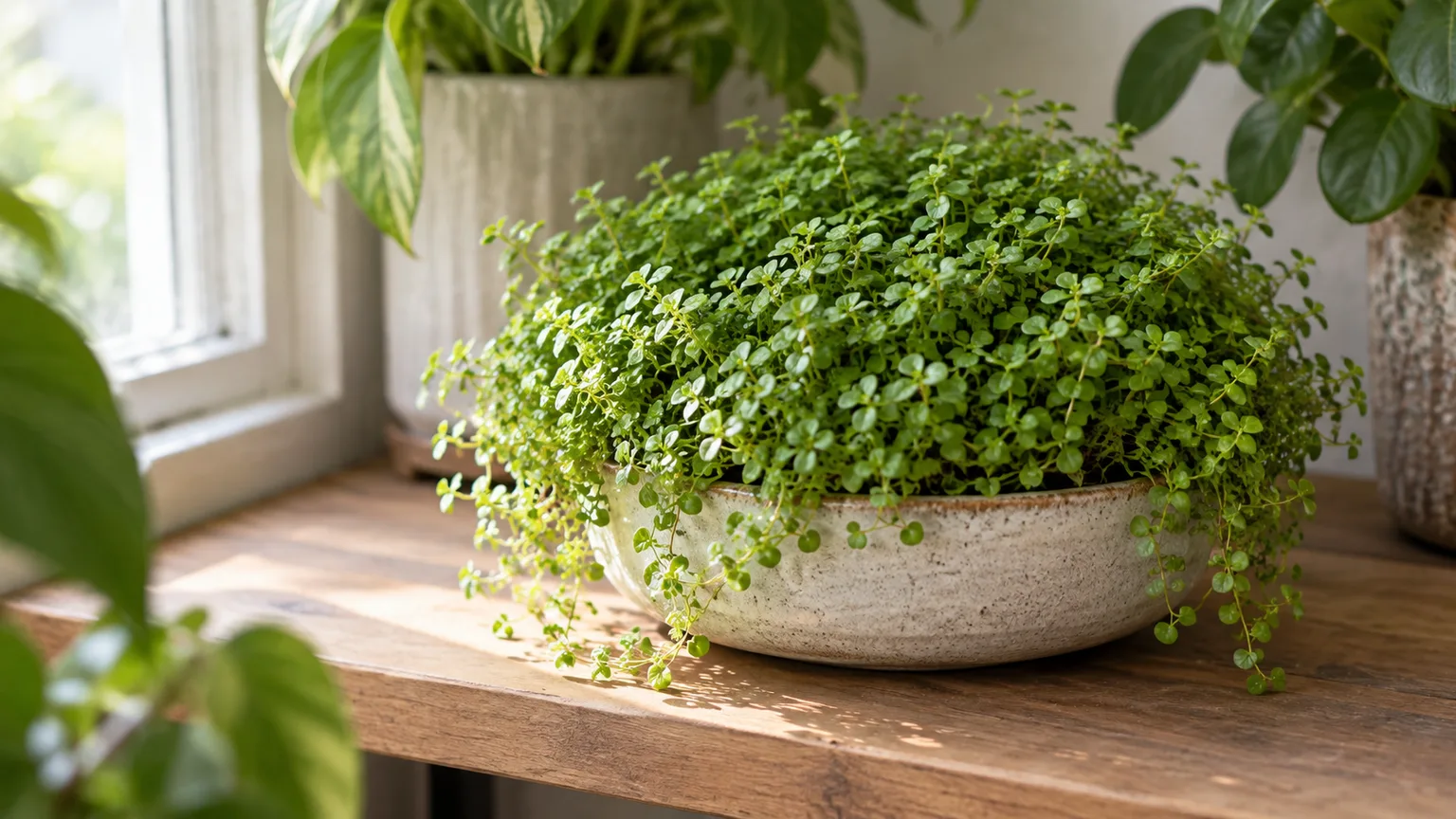
Baby tears is a low, fast-creeping plant with a small root system and a big appetite for steady moisture. Give it bright, filtered light, a shallow pot that drains freely, and soil that stays lightly damp; let it dry hard or sit in stagnant water and the fine foliage can collapse quickly.
The trick is to read the plant and its setup rather than water on a fixed weekday. A crowded pot, a sunny window, winter slowdown, and a sealed terrarium all change how quickly the root zone dries. The guide below shows what to check and how to respond.
Baby Tears at a Glance
| Trait | What to expect |
|---|---|
| Botanical name | Soleirolia soleirolii |
| Plant family | Urticaceae, the nettle family |
| Growth habit | Low, mat-forming perennial with creeping, rooting stems |
| Light | Bright indirect light indoors; partial to full shade outdoors |
| Moisture | Evenly moist soil with good drainage |
| Indoor uses | Shallow pot, hanging basket, terrarium, or vivarium |
| Outdoor range | Commonly listed for USDA Zones 9–11; frost-sensitive |
| Spread | A few inches tall, but several feet wide in favorable garden conditions |
| Flowers | Tiny creamy-white blooms outdoors in late spring or early summer; inconspicuous indoors |
Baby tears is grown for the dense carpet of tiny rounded leaves, not showy flowers. The Missouri Botanical Garden describes a ground-hugging plant that can spread three to six feet wide outdoors, while its small creamy flowers are usually insignificant; that size is a useful warning when choosing a garden site, not a prediction for every indoor pot. Missouri Botanical Garden
You may also see golden, silver, or variegated forms, including ‘Aurea’ and ‘Silver Queen.’ These selections follow the same basic care routine, but the colored stems can lose their pattern if stronger green shoots take over; remove those shoots at their base. Gardener’s Path
Check the Plant Name Before You Buy
The most reliable label to look for is Soleirolia soleirolii. Baby tears is also sold as angel’s tears, Corsican carpet, Corsican creeper, mind-your-own-business, or Paddy’s wig, but common names are not consistent across nurseries and websites. Check the botanical name if you want this particular plant.
A plant labeled “baby tears” may instead be Pilea depressa, a different creeping member of the nettle family. The name “Irish moss” is ambiguous too: NC State Extension applies it to both baby tears and Sagina subulata, a separate carnation-family perennial that forms a moss-like mat of slender stems. Baby tears has tiny rounded leaves on delicate creeping stems, so check the botanical name instead of relying on common labels when choosing a plant for a terrarium or pot. Gardener’s Path NC State Extension NC State Extension
Decide Where to Grow It: Indoors or Outdoors
The same spreading habit that makes baby tears useful as a soft green carpet can make it difficult to manage once stems root into open ground. North Carolina State Extension describes a dense ground cover whose stems root as they spread; Missouri Botanical Garden notes that an established planting can be difficult to eradicate and that even small stem fragments may regenerate. Choose the growing site with that behavior in mind. NC State Extension Missouri Botanical Garden
Indoors: Keep a Damp Mat in a Container
For most growers, a container is the simplest way to control the plant. Use it as a low mound in a wide pot, let its stems spill from a hanging basket, or tuck a small portion into a terrarium where you can trim it before it crowds neighboring plants.
A closed terrarium holds moisture longer than an open pot, so start with a small rooted piece and add water sparingly. Condensation that lingers all day, soft stems, or a stale smell are signs to vent the container and let excess moisture escape. The plant can work in a terrarium, but its vigor may turn a tiny accent into a mat that shades smaller companions. Epic Gardening
Outdoors: Treat It as a Vigorous Ground Cover
Baby tears is generally grown outdoors in warm regions, often Zones 9–11, in moist, shaded ground. Those zone numbers describe winter climate broadly; local frost pockets, summer heat, and drainage still matter. It is not a plant for a sunny, dry bed or a place where a low-growing mat will be walked on.
If you want to try it outside but are unsure how it will behave, begin with a pot placed in the garden rather than planting into the soil. Keep the rim above grade, trim stems before they cross it, and collect rooted pieces instead of leaving them on damp soil. Avoid placing it beside natural areas, waterways, or neighboring beds where unnoticed runners could establish. In colder climates, keep the plant in a movable container and bring it in before frost.
Give Baby Tears Bright, Indirect Light
Indoors, bright light filtered through a sheer curtain or a spot a little back from a bright east- or west-facing window is a reliable starting point. Baby tears can tolerate shade, but very dim conditions tend to slow growth and leave the center thin. Outdoors, partial to full shade protects the small leaves from harsh afternoon sun.
Watch the foliage on the side facing the window. Pale, scorched patches or crispy edges that appear after a move into direct sun point to too much intensity; shift the pot to filtered light and trim only the dead parts. If the mat looks sparse without scorch, move it closer to a brighter window gradually over several days rather than placing it in hot direct sun all at once. Bright indirect light is more useful than either deep shade or a few hours of strong midday sun.
Water When the Surface Begins to Dry
Baby tears has a shallow root zone and dislikes a complete dry-out, so check the mix before the whole pot feels light. Touch the surface and the soil just beneath the foliage; when the top begins to lose its damp feel, water slowly until excess drains from the bottom. Then empty the saucer rather than letting the pot sit in runoff.
A wilted plant is a signal to inspect, not automatic proof that it needs more water. If the mix is dry and the pot feels light, water thoroughly and move the plant out of direct sun while it recovers. If the mix is already wet, add no more water; check drainage and roots instead. Missouri Botanical Garden describes the plant as intolerant of both droughty soil and poorly drained wet soil, which is why the goal is moisture without stagnant conditions. Missouri Botanical Garden
Adjust Watering for Season and Container
A small hanging pot, a shallow terracotta dish, and a closed terrarium will not dry at the same rate. Warm air, direct sun, a fan, or a root-filled container can shorten the interval between checks; cool winter rooms, a glazed pot, and a closed glass vessel can keep the mix damp longer. Use the soil as your schedule.
During active spring and summer growth, you may need to check every few days, especially in a small pot, but water only when the surface starts to dry. In fall and winter, growth slows and the mix loses moisture more slowly, so wait longer between waterings without allowing the root ball to become bone-dry. If water runs straight through a crowded mat, test the soil near the roots; a bound root mass may need repotting rather than repeated small drinks.
Use a Shallow Pot and Airy, Moisture-Retentive Soil
A wide, shallow container suits baby tears’ low mat and small root system. Drainage holes matter more than the pot material: without an exit for extra water, a moisture-loving plant can still end up with roots in stagnant mix. Avoid an oversized, deep container, where unused soil below the roots can stay wet for too long.
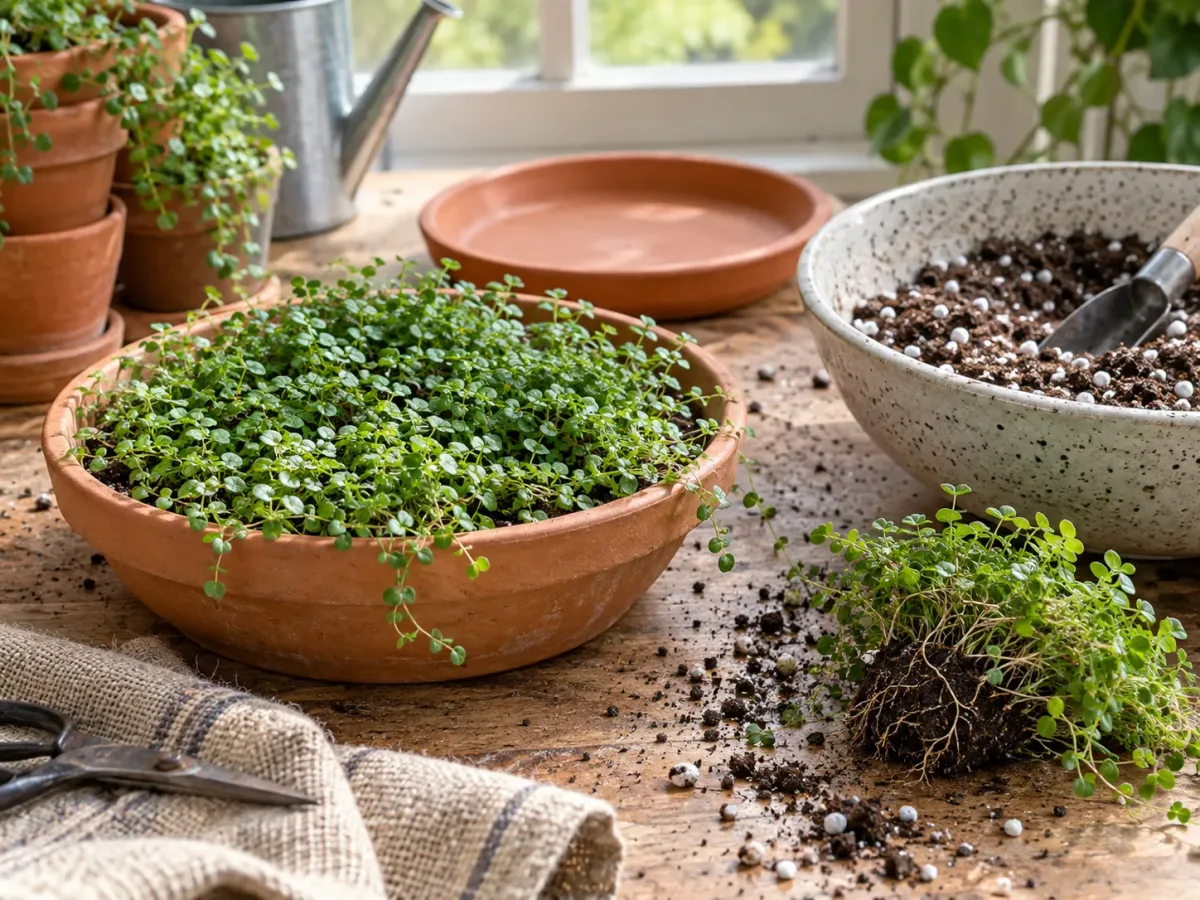
An ordinary indoor potting mix is a good starting point. If it packs tightly after watering, blend in perlite or pumice to open the structure while retaining enough moisture for the fine roots; if it dries almost immediately, use a mix with more organic matter or coir. Aim for a mix that wets evenly, drains excess promptly, and stays lightly moist between checks. You do not need a special soil pH formula or a heavy dose of compost to grow a healthy container plant.
When you repot, water the mix once and watch how the container drains. If the center stays saturated long after the extra water has run out, add more aerating material or choose a lighter mix before moving the plant back; changing the watering interval alone will not fix soil that holds too much water.
Temperature and Humidity: Favor Cool, Even Conditions
Baby tears generally looks best in a mild, stable room rather than beside a radiator, fireplace, or hot afternoon window. Missouri Botanical Garden describes cool conditions as ideal outdoors and notes intolerance to frost and high temperatures; indoors, protect the plant from cold drafts and sudden heat. If a room is comfortable for you and the plant receives filtered light, temperature is usually manageable without a special thermostat.
Humidity helps limit rapid drying, but do not chase one exact percentage. Gardener’s Path suggests high humidity for indoor growth and cautions against repeatedly wetting the foliage; a humidifier near several plants or a naturally humid room can help when the air is very dry. Gardener’s Path Avoid placing the pot where air cannot move at all, especially in a closed terrarium or crowded shelf. If the plant is growing well and its leaves are not crisping, stable moisture and light matter more than reaching a particular hygrometer reading.
Fertilize Lightly During Active Growth
The plant’s compact leaves and fine stems do not need a strong feeding routine. During spring and summer, apply a balanced liquid houseplant fertilizer at half the label strength about once a month, or follow the product’s lower-dose directions. Water first if the soil is very dry, then feed the already moist root zone.
Skip fertilizer in winter when growth slows, and avoid feeding a plant with blackened stems or sour, waterlogged soil. Nutrients cannot correct a drainage problem, and a heavy dose can leave salts concentrated around the roots. If the foliage is pale but the plant otherwise has suitable light and healthy roots, one modest feeding is enough to test whether nutrients are part of the issue; do not increase the dose every week.
Prune to Shape It and Remove Reversion
Pruning is mainly a way to keep the mat attractive and contained. Use clean, sharp scissors to trim stems that grow beyond the pot rim, thin the center if it becomes crowded, or remove damaged foliage. Light, regular trims are easier on the plant than cutting the entire mat back to bare soil.
Variegated, silver, or golden cultivars can produce solid-green shoots. Those shoots may grow more vigorously and gradually hide the colored foliage, so cut a reverting stem back to where it emerges from the mat. Clean away the clippings instead of tucking them into the same pot; a piece with a rooted node can establish again if it stays in contact with moist mix.
Repot Before the Center Smothers or Dries
Baby tears grows quickly enough that the center of a pot can become dense, crowded, and hard to water evenly. Repot when roots fill the container, water drains through before the root ball wets, the mat lifts from the pot as one tight mass, or the center starts dying while the edges continue to grow. A calendar interval is less useful than these visible cues.
Choose a slightly wider shallow pot or divide the plant and return a smaller portion to the original container with fresh mix. Before unpotting, moisten the soil so the mat releases more easily; loosen the rim and support the root ball from underneath instead of pulling on fragile stems. Set the plant at its previous depth, firm the mix lightly, water it through, and let it drain. Give it a few days in bright indirect light while it settles.
Propagate Baby Tears from Rooted Sections
Baby tears is easy to multiply because its stems form roots where they touch damp soil. Spring and early summer are convenient times to propagate because the plant is actively growing, but a healthy indoor plant can often recover from a small division outside that window. The simplest method is to carry roots and stems together rather than trying to grow a bare leaf.
Divide the Mat for the Fastest Start
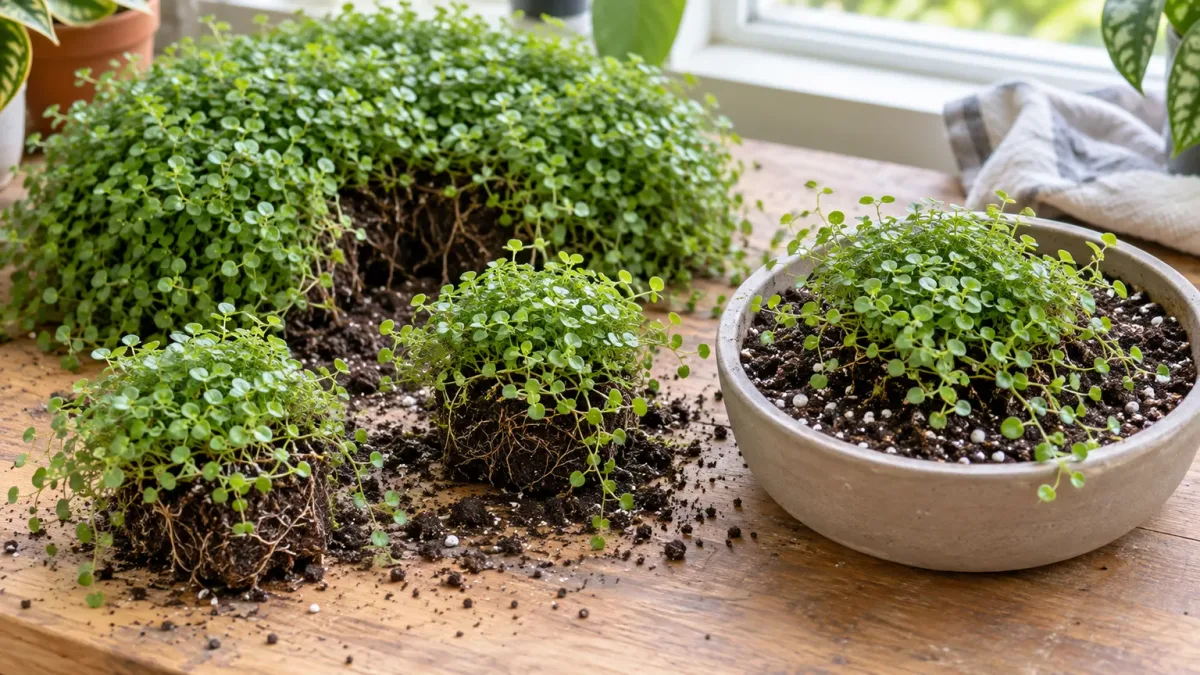
Water the plant the day before dividing so the root mass is moist, not sodden. Tip the pot onto its side, ease the plant out while supporting the foliage, and separate a section that has both roots and several stems. You can tease the mat apart with your fingers or use a clean knife for a firm root mass.
Set each division into a small pot of moist, well-draining mix at the same depth it was growing before. Press the soil gently around the roots, water once, and keep the new plant in bright shade while it re-establishes. A rooted portion with several stems is more forgiving than a tiny tuft without roots, and it shows you quickly whether the division is viable.
Root Cuttings or Layer a Trailing Stem
For a stem cutting, snip a healthy section a few inches long and remove leaves from the portion that will touch the mix. Lay a node against moist potting soil and pin it in place with a small bent wire or a clean pebble; keep the leaves above the soil so air can circulate. A loose clear cover can slow drying for a new cutting, but vent it regularly and remove it once fresh growth appears.
Layering is even simpler when a long stem trails over a basket. Guide a section back onto the soil in the parent pot or into a second small pot beside it, hold a node against the mix, and wait until it resists a gentle lift before severing the connection. Rooting hormone is optional for these methods, not a requirement. Avoid sealing cuttings in a wet bag for weeks; constantly soggy leaves and soil encourage rot.
Diagnose Wilting, Browning, and Root Rot
When the plant changes, check the soil, light, and roots before changing several care habits at once. The symptoms can overlap: a dry plant wilts, but roots damaged by waterlogging also cannot supply water to the foliage. Correct the condition you can confirm, then give the mat time to respond.
| What you see | First check | First response |
|---|---|---|
| Limp stems and a light, dry pot | Root-zone moisture | Water through, drain well, and move from direct sun |
| Limp or yellowing stems with wet soil | Drainage and root condition | Pause watering; inspect roots if the smell or decline continues |
| Crispy leaves on the window side | Sun and heat exposure | Shift to bright indirect light and remove only dead foliage |
| Thin, stretched growth | Light level | Move gradually to a brighter filtered spot |
| Soft black stems or sour soil | Persistent saturation or rot | Unpot, trim clearly rotten roots, and replant in fresh airy mix |
If the soil is wet and lower stems are yellow, do not keep adding water because the plant looks thirsty. Tip the root ball out and look for firm, pale roots versus dark, mushy sections; remove only the clearly damaged tissue with clean scissors and replant what remains in fresh mix and a pot that drains. If most roots have rotted, take healthy rooted tips or cuttings as a backup before discarding the decayed center.
Brown tips alone do not identify one cause. Direct sun, a hot dry room, or a root ball that repeatedly dries can all leave the tiny leaves crispy; check whether damage faces the window and whether the mix is dry before changing humidity. Move the plant to filtered light, restore even moisture, and wait for new growth rather than expecting damaged leaves to turn green again.
Pests, Pet Safety, and Winter Notes
Check the underside of stems and leaves when growth stalls or leaves become sticky, mottled, or distorted. Aphids, whiteflies, and scale can feed on indoor plants, while fungus gnats are more likely where mix stays constantly wet. Isolate a plant with visible pests, rinse off what you can, and use only a product labeled for the plant and setting if a follow-up treatment is needed.
The ASPCA lists Soleirolia soleirolii (Paddy’s wig) as non-toxic to cats, dogs, and horses. That classification is reassuring for a household with pets, but it does not make the plant food; discourage chewing and contact a veterinarian if an animal eats a large amount or shows symptoms. ASPCA Animal Poison Control
For outdoor planting, the Missouri Botanical Garden lists baby tears for USDA Zones 9–11 and says it is intolerant of frost. In colder regions, grow it in a container and bring it inside before freezing weather; a mild cold spell may damage the top growth, but a hard freeze can kill the plant. Zone labels are only a starting point, so watch local forecasts rather than waiting for a permanent frost to prove the plant’s limit. Missouri Botanical Garden
Conclusion
Baby tears stays attractive when you balance moisture with drainage and give the fine foliage filtered light. Use a shallow pot, check the soil instead of following a fixed watering calendar, and ease back during winter when growth slows.
For a small indoor plant, the main decision is how much trimming you are willing to do; for a garden bed, consider its ability to root and spread before you plant it in open ground. If it wilts, test the soil first: a dry root ball needs water, while a wet one needs better drainage and a closer look at the roots.