Best Soil Moisture Meters for Plants
Compare nine soil moisture meters by probe depth, display type, and accuracy limits. Learn when a dial probe helps, when your finger wins, and which model fits your pots.
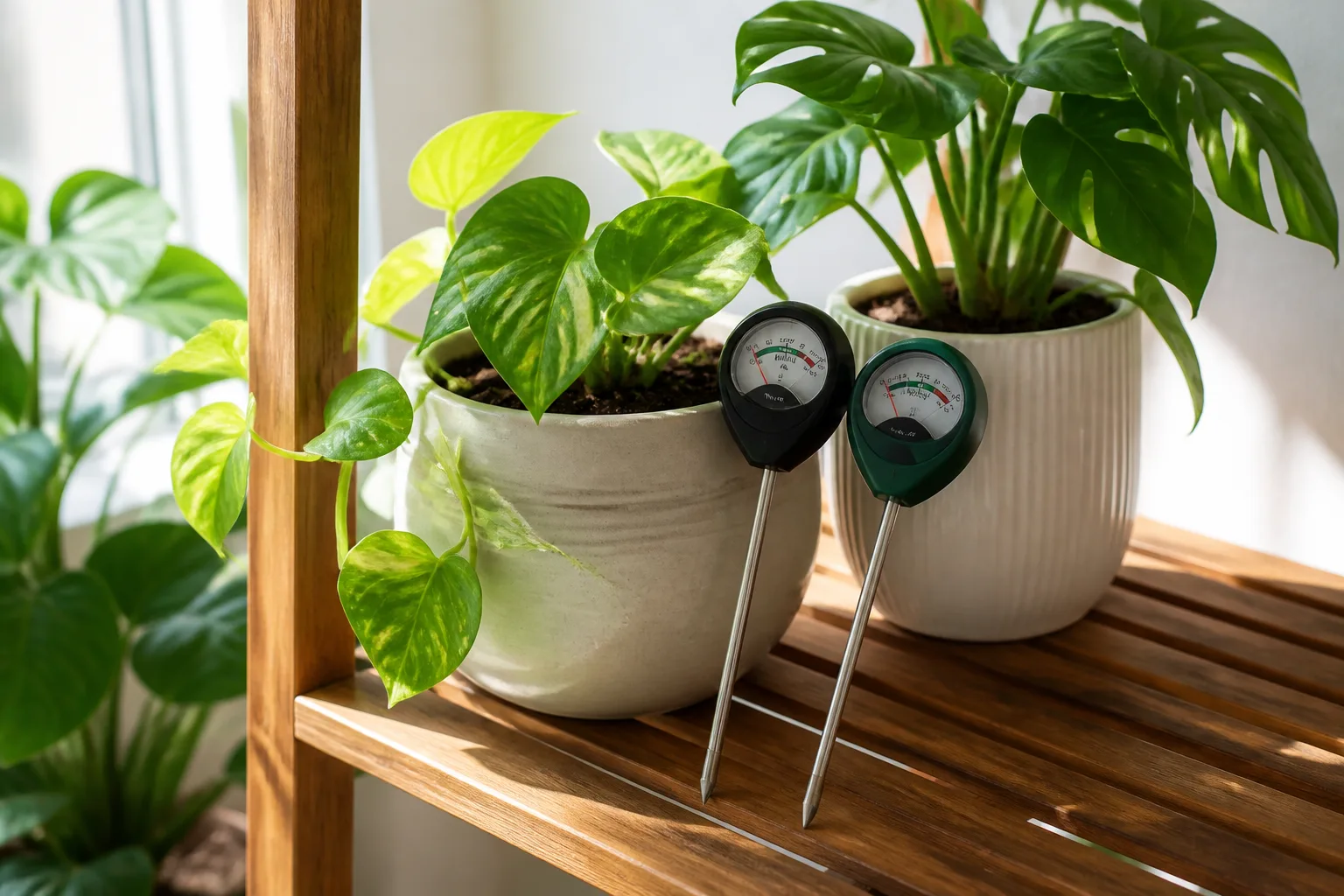
A soil moisture meter is a handheld probe—or a buried wireless sensor—that estimates how wet the root zone is so you water on evidence instead of a calendar. It is not a magic drought alarm. Cheap resistance probes react to dissolved salts as well as water, tall pots dry unevenly from top to bottom, and a wilted leaf can mean drowning or thirst. The meter is a sampling tool. Used with pot weight, a knuckle in the mix, and empty saucers, it can shrink watering mistakes. Used alone, it can push you to soak a plant that is already saturated.
Virginia Cooperative Extension is blunt about the real failure mode: overwatering is how often you water, not how much you pour in one session. UConn’s houseplant watering guidance ranks improper watering as the top killer of indoor plants and tells you to feel the mix about an inch down instead of watering by schedule. Those principles sit underneath every pick on this page. The nine meters below are sorted by job—probe depth, display type, indoor vs outdoor reach, and whether you need pH or WiFi charts—not by affiliate commission tiers.
If you are still deciding whether hardware beats skin, read moisture meter vs finger test first. If you need the full watering skill stack—how wet is enough, when to bottom water, how to flush salts—start with how to water indoor plants the right way.
Do You Actually Need a Soil Moisture Meter?
Buy a meter when geometry or scale makes tactile checks unreliable: deep floor planters where your finger cannot reach the middle, dense foliage that blocks the soil surface, dozens of pots that need a fast first pass, or outdoor containers where the top crust dries while the core stays wet. Skip the purchase—or demote it to backup—when you own small plastic pots you can lift, when you are still learning basic dry-down timing, or when you would rather build the finger-and-weight habit that extension guides still treat as the default.
Winter sharpens the trade-off. Heat and dry furnace air pull moisture faster from small pots while dormant plants drink less. A meter that read “moist” in October can still mean “do not water yet” in January if the root ball is cool and the plant is idle. PlantTalk Colorado pairs pot weight and soil color with feel checks because no single dial replaces context.
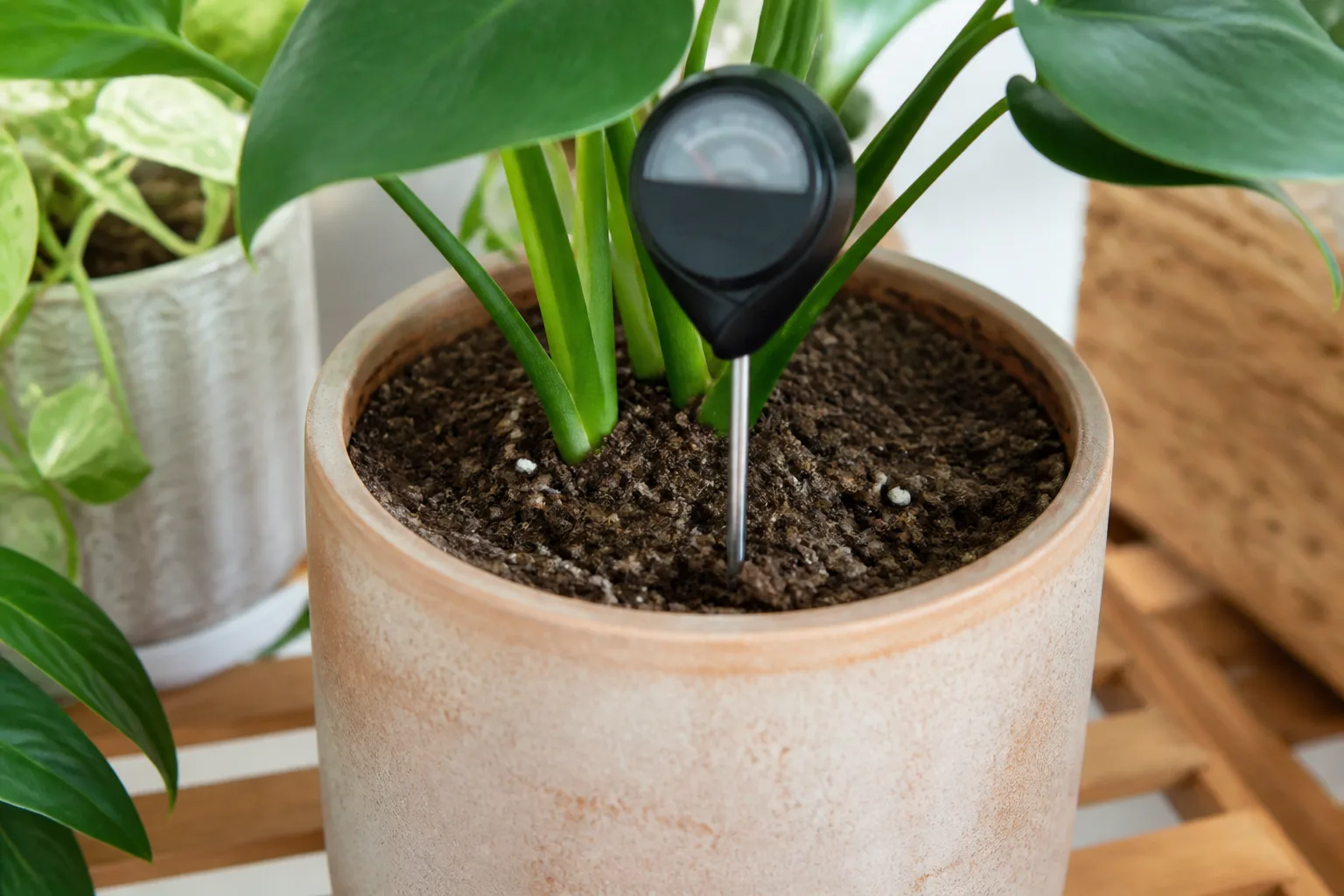
When a Meter Helps—and When Your Finger Wins
A meter helps in 10-inch-plus planters, hanging baskets read from below, raised beds and shrub pots outdoors, collections where you scan twenty plants before lunch, and when you are training yourself on dry-down timing for a new species. Virginia Extension explicitly allows a soil hygrometer or water meter alongside the finger stick test for consistent monitoring.
Your finger wins in 4–6 inch housepots, when you need to catch hydrophobic dry cores (texture beats conductivity), when fertilizer salts may skew a cheap probe, and whenever a plant is wilting—because wilt is ambiguous. NC State Extension warns that people often mistake wilt for thirst and add more water to an already soggy root ball. For that fork, inspect mix and roots before you trust any dial.
| Situation | Meter first? | Better default |
|---|---|---|
| Small reachable pots | Rarely | Finger + lift test |
| Tall floor planter | Often | Meter + skewer confirm |
| Post-fertilizer week | Careful | Finger; leach if dial lies |
| Wilted foliage | No | Diagnose drought vs rot first |
| Outdoor heat wave | Sometimes | Meter deep + saucer discipline |
How Soil Moisture Meters Work
Most sub-$50 analog plant meters use a resistance probe: two metal electrodes in the soil pass a tiny current. More dissolved ions and more water between the probes usually read “wetter.” That is why they are moisture meters in marketing and conductivity meters in practice. They respond to fertilizer salts, hard-water minerals, and even the texture of the mix—not volumetric water content with lab precision.
Capacitive and smart sensors measure dielectric properties of the soil around a sealed tip. They tend to survive longer, corrode less, and track trends more steadily, but they still need a baseline in your potting mix and can misread air gaps or wrong insertion depth. Smart models like the Netro Whisperer add temperature, light, and logging—convenience tools that do not remove the need to calibrate against feel.
Multi-function analog dials that claim pH, “nutrients,” and light on a $10 probe should be read as rough indicators, not lab results. Light sensors on the probe head are not a substitute for knowing window orientation. Nutrient scales on resistance probes mainly reflect salt load. Use them as “maybe fertilize less” hints, not as replacement for soil tests.
Resistance Probes vs Capacitive and Smart Sensors
| Technology | Price band | Strength | Weakness |
|---|---|---|---|
| Analog resistance (two-prong) | $–$$ | Fast, no batteries | Salt skew, glare outdoors |
| Single-probe analog | $–$$ | Easier in dense roots | Still conductivity-based |
| Digital resistance | $$ | Backlit numbers | Same chemistry limits |
| Capacitive handheld | $$–$$$ | Less corrosion | Needs depth discipline |
| WiFi / smart buried | $$$ | Trends, alerts, outdoor | App lag, subscription habits |
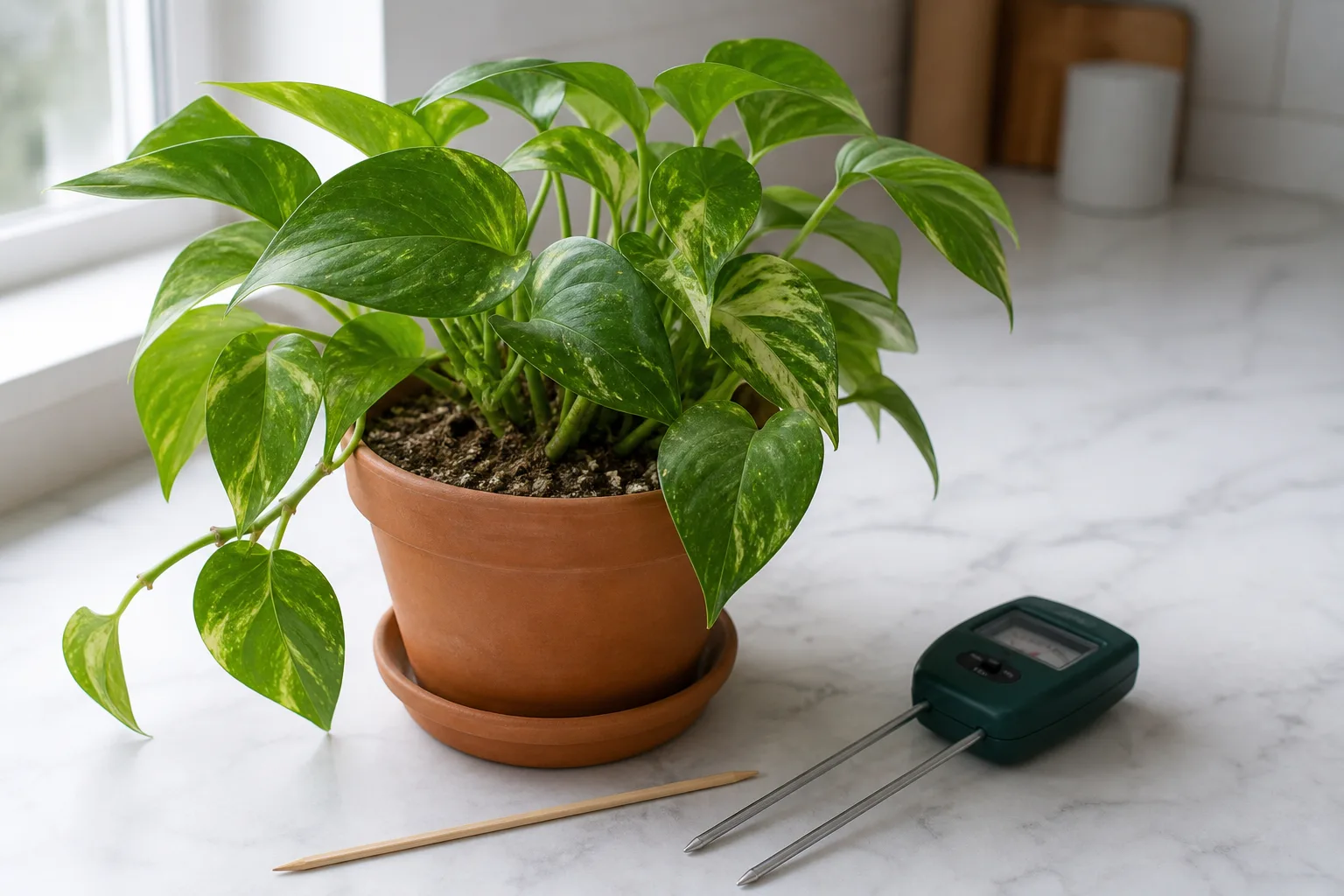
Quick Picks by Job and Budget
Prices shift with sales; specs come from manufacturer listings and the product categories referenced in our sources. Match probe length to pot depth before you match brand prestige.
| Best for | Pick | Probe | Measures | Why it fits |
|---|---|---|---|---|
| Overall versatility | Moistenland Soil Moisture Meter | ~8 in | Moisture, pH, light, nutrients | Tilting head, single sharp probe, quick reads |
| Tight budget | Sonkir 3-in-1 Soil Tester | ~11.5 in | Moisture, pH, light | Battery-free, beginner-friendly dial |
| Deep pots & beds | XLUX Long Probe | ~12.2 in | Moisture only | Longest reach, simple color scale |
| Finicky houseplants | Raintrip 4-in-1 | ~10 in | Moisture, pH, nutrients, light | Waterproof head, fast response |
| Outdoor pH + moisture | Gain Express | ~11.6 in | Moisture, pH | Top-facing dial, sturdy outdoor build |
| Readable numbers | Irtov 4-in-1 Digital | ~7.9 in | Moisture, pH, temp, light | Backlit screen, indoor/outdoor |
| Remote monitoring | Netro Whisperer | buried | Moisture, temp, light, more | Solar WiFi sensor + app charts |
| Simple moisture only | Kensizer Soil Tester | ~7.1 in | Moisture | Color 1–10 scale, small pots |
| Hanging baskets | Luster Leaf Rapitest 1820 | cord probe | Moisture | Handheld dial on a cord |
Best Overall: Moistenland Soil Moisture Meter
The Moistenland Soil Moisture Meter is the most balanced pick for growers who want one analog tool that covers houseplants and patio containers without batteries or apps. The single sharp probe slips through dense root balls more easily than twin-prong designs, and the head tilts up to 90 degrees so you can read the dial without crawling across a garden bed. A mode switch cycles moisture, pH, light, and a nutrient/salt proxy—treat the last two as directional hints, not laboratory numbers.
Readings land quickly after insertion, which matters when you are walking a shelf of mixed tropicals. The ~8-inch probe fits most indoor pots if you insert toward the center, not along the dry wall channel. Downsides are real: the dial is small, glare outdoors is annoying, and repeat tests in the same salty mix can disagree slightly as salts redistribute. Wipe the probe after each pot if you are rotating between fertilized and plain-water plants.
For most readers managing a blended indoor/outdoor collection, this is the one to keep by the watering can—provided you still lift pots and finger-check before you override a “dry” reading on a heavy ceramic planter.
Best Value: Sonkir 3-in-1 Soil Tester
The Sonkir 3-in-1 Soil Tester is the no-apology budget meter: twin metal probes, a mode dial for moisture, pH, and light, and no battery compartment to corrode. At roughly ten dollars, it is the tool you buy for a dorm room jungle or a first apartment shelf, then replace only if you outgrow its limits.
The ~11.5-inch probe reaches deeper than many cheap units, which helps in 8-inch pots. The analog face packs a lot of scales into a small window—readable indoors, frustrating in direct sun. Response after watering is immediate: a bone-dry pothos jumps to “wet” within seconds of a soak, which is excellent for training beginners on how fast moisture moves—or how slowly, if the mix is hydrophobic.
Limitations: no adjustable display, no data logging, and the usual salt-skew on fertilized plants. Pair it with indoor plant watering basics if you are still learning dry-down vs even-moisture species.
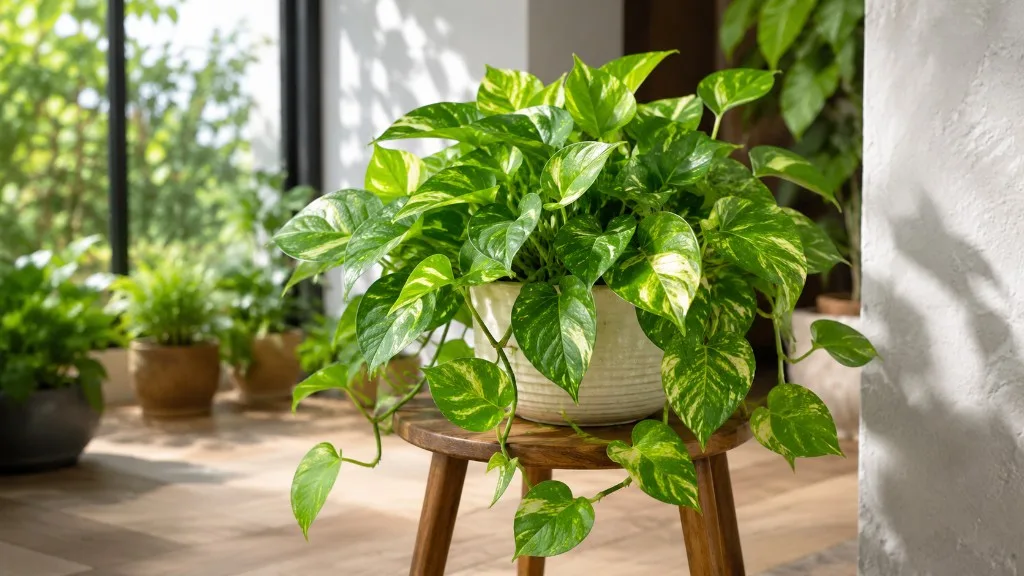
Best Long Probe: XLUX Long Probe Soil Moisture Meter
When the pot is taller than your wrist, short probes lie. The XLUX Long Probe Soil Moisture Meter carries a ~12.2-inch stem—the longest practical reach on this list—and a simple color-coded 1–10 moisture scale with no extra modes to squint at. That simplicity is the point: one job, done at depth.
Use it for floor monsteras, deep fern baskets, shrub containers, and in-ground spots where surface dust misleads your finger. The needle stabilizes fast, and moving the probe a few inches sideways usually shows uniform moisture in well-watered mixes—which is what you want confirmation of, not micro-variance.
Trade-offs: too long for 4-inch succulent pots, moisture-only (no pH), and still a resistance probe that hates salt spikes. Not ideal for shallow windowsill herbs. For those, jump to the Kensizer or trust your finger.
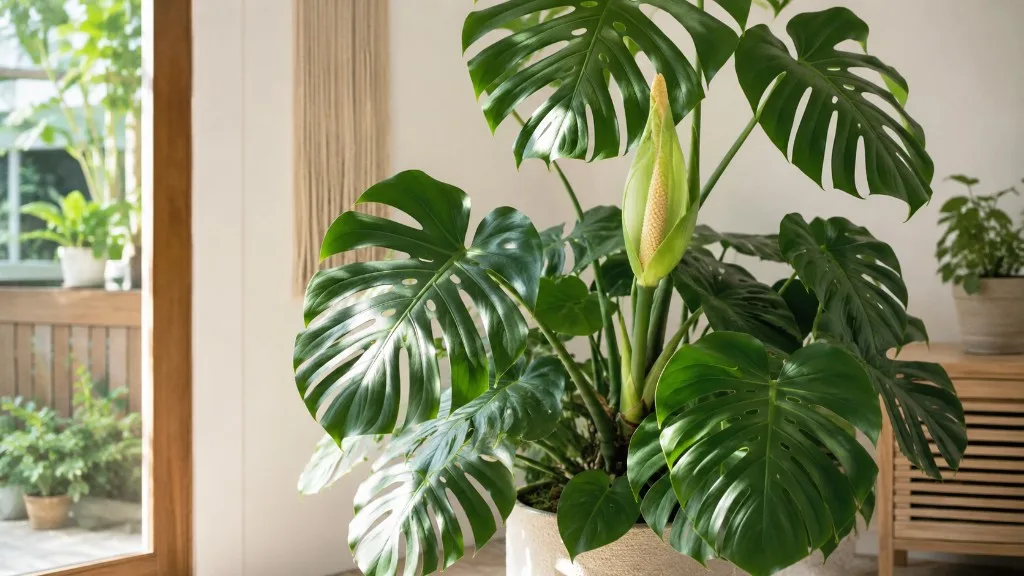
Best for Houseplants: Raintrip 4-in-1 Soil Tester
The Raintrip 4-in-1 Soil Tester targets the finicky indoor crowd: rubber plants, fussy ficus, and tropicals that punish both drought and soggy cores. The ~10-inch probe is sharp enough for compacted store-bought mix, and the manufacturer markets a waterproof head that survives splashes from enthusiastic watering sessions.
Mode switching between moisture, pH, nutrients, and light is fast—helpful when you are learning a new plant’s preferences. The display is clearest in bright rooms; dim corners make the analog face harder to read, which matters if your plants live in basement grow nooks.
Compacted peat can still fight insertion. Rock the probe gently, never wrench it. If the dial barely moves, the mix may be hydrophobic; bottom water or slow top water until the ball hydrates, then re-test.
Best for Outdoors: Gain Express Soil pH & Moisture Meter
Outdoor gardeners need reach and a dial you can read while standing. The Gain Express Soil pH & Moisture Meter puts the gauge on top of the handle with a ~11.6-inch probe thick enough for garden loam and large nursery pots. It measures moisture and pH—useful when you are dialing in blueberries, hydrangeas, or a vegetable row that reacts to alkalinity.
Unlike instant-read indoor picks, Gain Express asks for about ten minutes per placement for stable pH/moisture numbers. That is acceptable for a shrub you are establishing, tedious if you are racing across forty annuals. The unit is marketed waterproof for rain exposure during the wait—still, do not leave it buried overnight.
If you only need fast moisture in deep outdoor soil and never touch pH, the XLUX long probe is simpler. If you also automate irrigation, pair ground truth from this meter with best smart sprinkler controllers so schedules follow soil, not guesswork.
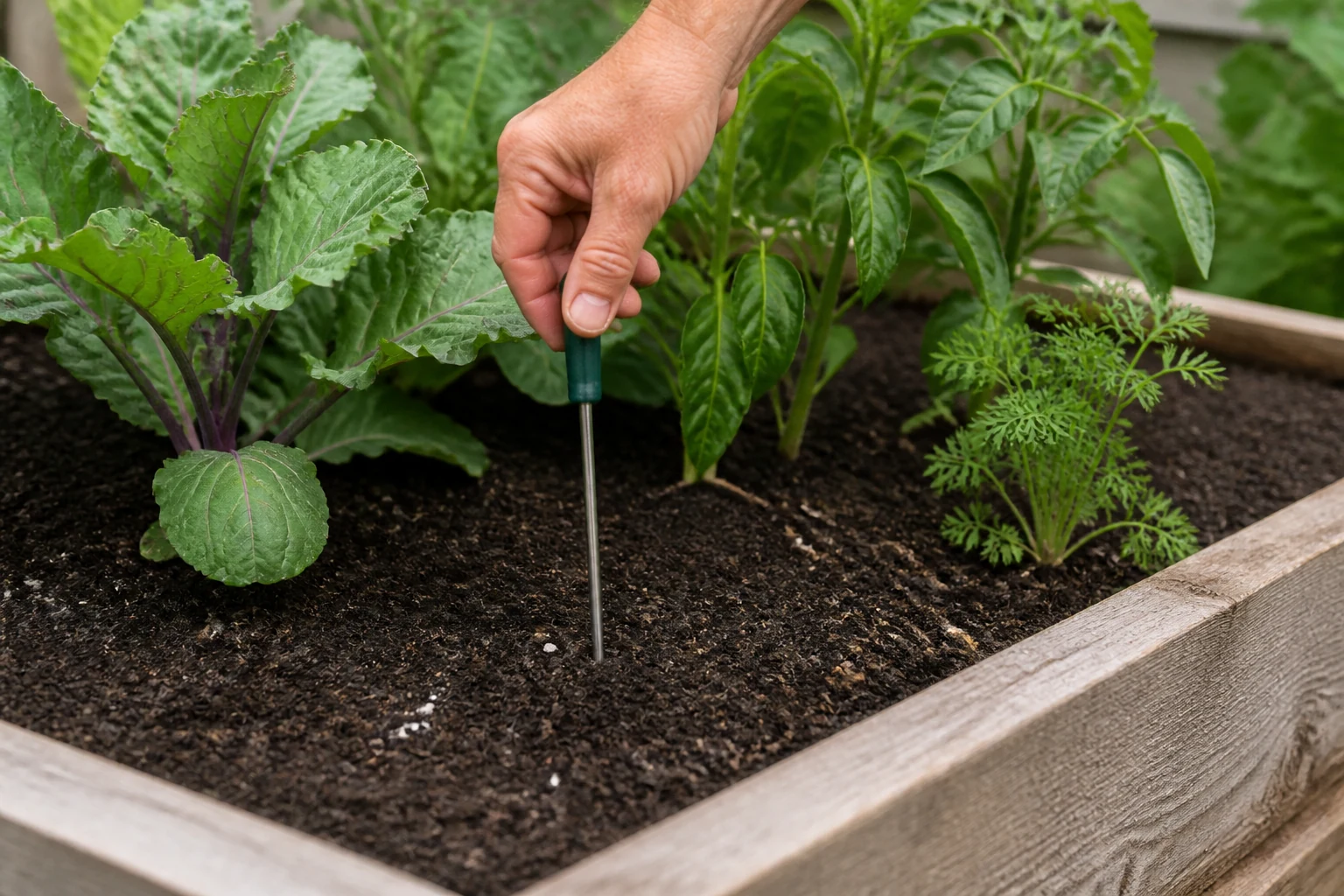
Best Digital: Irtov 4-in-1 Digital Moisture Meter
Analog dials fail in glare. The Irtov 4-in-1 Digital Moisture Meter answers with a backlit LCD showing moisture, pH, temperature, and light on a ~7.9-inch probe suited to shallow-rooted pots and outdoor annuals—not deep tree boxes.
Digital clarity helps beginners who do not yet trust needle position on a color wedge. The trade-off is battery dependency and a display layout that emphasizes temperature more than moisture on some screens—read the moisture field deliberately, not the biggest number on the panel.
Outdoor glare can still wash out LCDs. Midday garden checks may need shade or a cupped hand over the screen. Keep spare batteries; digital meters die mid-round at the worst time.
Best Smart: Netro Whisperer Smart Plant Sensor
The Netro Whisperer Smart Plant Sensor is the outdoor intelligence pick: a solar-powered buried sensor that reports moisture, temperature, light, and more to a phone app with history charts. After heat waves, that log beats walking the yard with a handheld probe every hour.
Strengths: weather resistance, trend lines that show drying speed, optional tie-in to Netro’s smart faucet controllers for closed-loop watering. Weaknesses: no on-device display, app dependency, and moisture updates on an hourly cadence—not real-time twitching as you pour. Use it to learn your beds over seasons, not to decide whether tonight’s dinner-party fern needs a cup of water.
Indoor use is possible but awkward—ambient room light and WiFi reach matter, and a solar puck on a bookshelf looks odd. For a single prized indoor tree, a handheld probe plus finger habit is usually cheaper and faster.
Best Basic: Kensizer Soil Tester
Not everyone needs pH, light, or Bluetooth. The Kensizer Soil Tester is a moisture-only analog unit with a ~7.1-inch probe and a clear 1–10 color scale—red dry, green moist. It is ideal for 4–6 inch housepots, starter succulents (used sparingly), and growers who already own a meter but want a sharper probe tip than their decade-old dial.
Veteran plant parents like the finer scale than old 1–3 wedges: you can see “almost time” vs “seriously dry” without guessing needle position. Wipe the probe, insert near the pot center, and read within a minute. Glare outdoors is the main annoyance—tilt the dial toward shade.
Outdoors in deep soil, the short probe only samples the upper layer. Upgrade to XLUX or Gain Express when the job is depth.
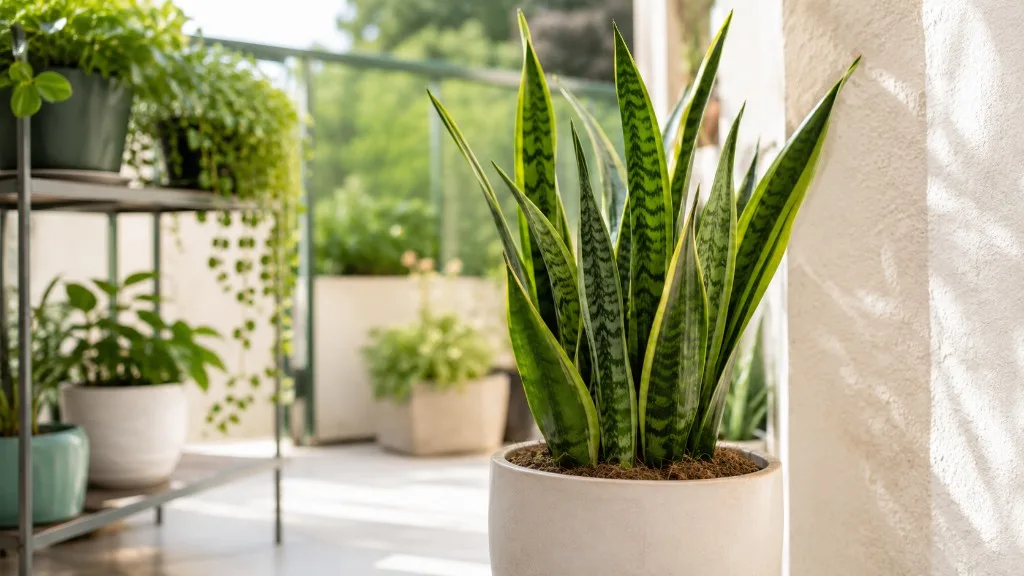
Best for Hanging Baskets: Luster Leaf Rapitest 1820
Hanging baskets punish overhead guessing: the moss line feels dry while the core is soaked, or the opposite. The Luster Leaf 1820 Rapitest separates the handheld dial from the probe via a cord, so you can insert the tip through a bottom hole or past the rim and read the gauge at eye level in your hand.
The package includes a watering guide for many common species—useful when you inherit a porch full of unfamiliar annuals. The probe is wider than pencil-thin competitors; steer clear of fragile hair-root orchids and delicate seedlings.
Stability matters: rest the dial on a table if wobble skews the needle. Clay-heavy Georgia loam after rain reads easier than sun-baked crust. For window boxes with similar reach problems, the cord design beats contorting under the eaves.
Moisture Meter Types Compared
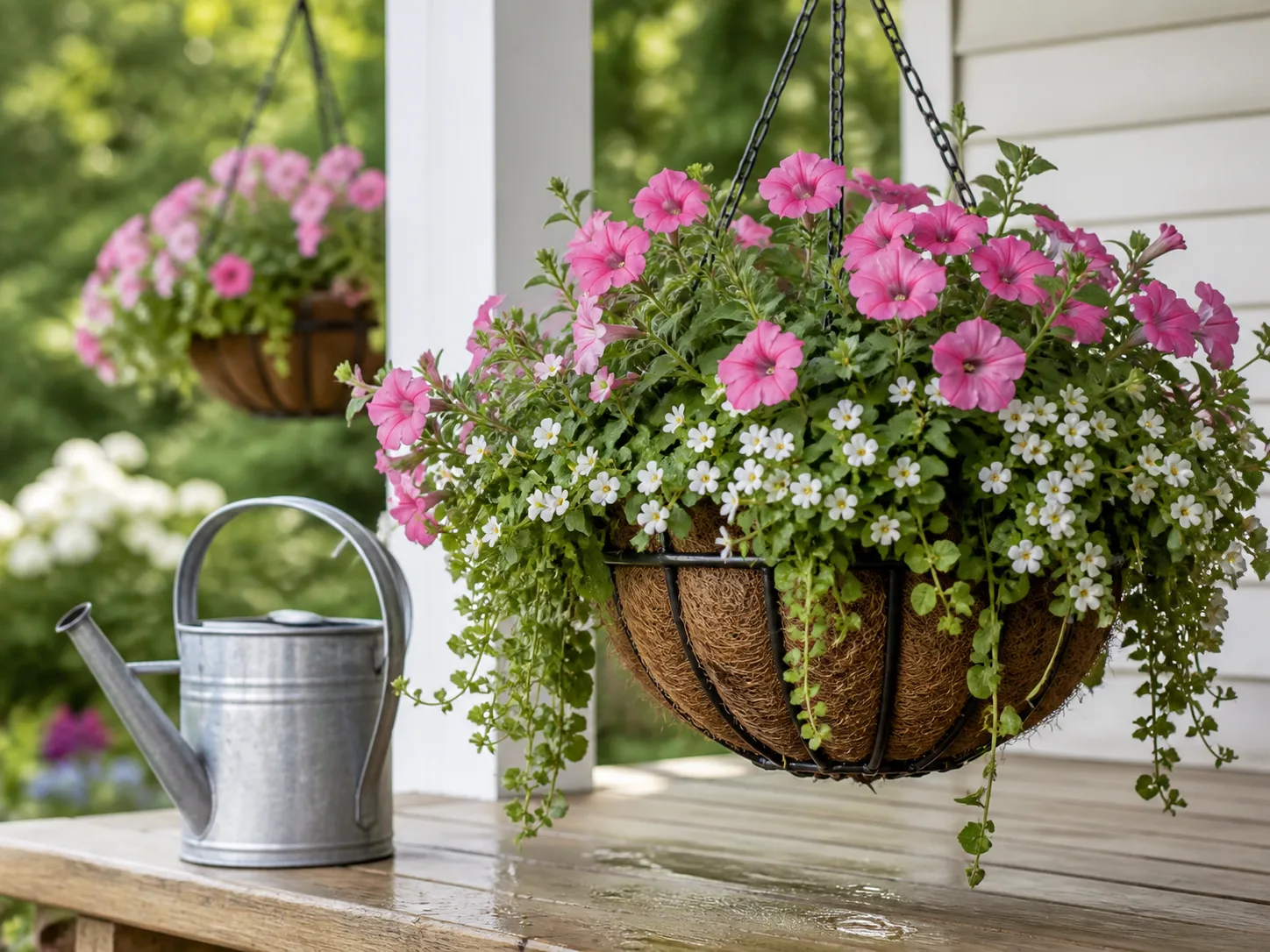
Hardware choice starts with where the roots live, not with how many modes the box advertises. A twelve-inch probe in a four-inch pot samples the drainage layer and lies. A finger in a fifty-pound ceramic planter samples the crust and lies.
Analog vs Digital vs Smart Sensors
| Type | Best for | Batteries | Outdoor glare | Learning curve |
|---|---|---|---|---|
| Analog resistance | Budget, fast scans | None | Harder | Low |
| Digital resistance | Readable numbers | Yes | Medium | Low |
| Smart buried | Beds, automation | Solar/Built-in | N/A (app) | Medium |
| Corded analog | Hanging pots | None | Medium | Low |
Material and build matter after chemistry. Stainless probes resist corrosion better than cheap plated rods left wet in saucers. Do not store probes in soil—manufacturers including Gain Express warn against hours-long burial; corrosion accelerates and readings drift.
What to Look for When Buying a Moisture Meter
Probe length first. Match depth to container geometry per Virginia Extension: tall pots drain and dry faster in the upper inches; sample deep enough to hit the root mass, not just the crust. Small pots: ~7 inches. Standard houseplants: ~8–10 inches. Floor tubs and beds: 11 inches or more.
Single vs twin probes. Single tips penetrate dense aroid mixes more easily. Twin prongs cover more surface area but fight tight root balls—choose based on your collection.
Display readability. Analog: color wedges and tilting heads. Digital: backlight and large moisture digits. Smart: assume you will read a phone, not the garden.
Extra measurements. pH and light can educate, but cheap resistance “nutrient” scales are salt proxies. Buy them as bonuses, not as the reason you water.
Cleaning between plants. Wipe probes to avoid transferring salts or pathogens. Extension growers note that disease can hide in root zones; a quick alcohol swipe on metal tips is cheap insurance.
Budget honesty. A $10 meter that stops overwatering one fiddle-leaf fig pays for itself. A $65 smart puck that you never open the app for is clutter.
How to Use a Moisture Meter Without Bad Reads
Calibrate in your mix. Insert the probe in a pot you know is fully watered after drain, then in one you know is dry. Note dial positions for that peat-bark blend—not a universal “7 means water.”
Sample twice. Probe near the center and halfway between center and rim. Virginia Extension suggests checking when you pull the probe: clinging soil often means moisture remains even if the dial said dry.
Wait after watering. Surface wetness races ahead of the core. A minute is enough for quick meters; Gain Express needs its full soak window for pH.
Watch salt lies. If you fertilized heavily or leach rarely, a wet dial with a light pot means salts, not water. Leach, discard runoff, and finger-check before you soak again.
Hydrophobic signal. Dry dial + water racing down the wall + light pot = dry pockets. Virginia SPES-804 describes lifting the root ball or probing the middle—meters that say dry while pour-through escapes are flagging repellent peat, not thirst.
Wooden skewer backup. Push a bamboo skewer to the bottom, wait thirty seconds, pull, and feel the stick—excellent in tall pots when fingers fail. Free, zero salt skew.
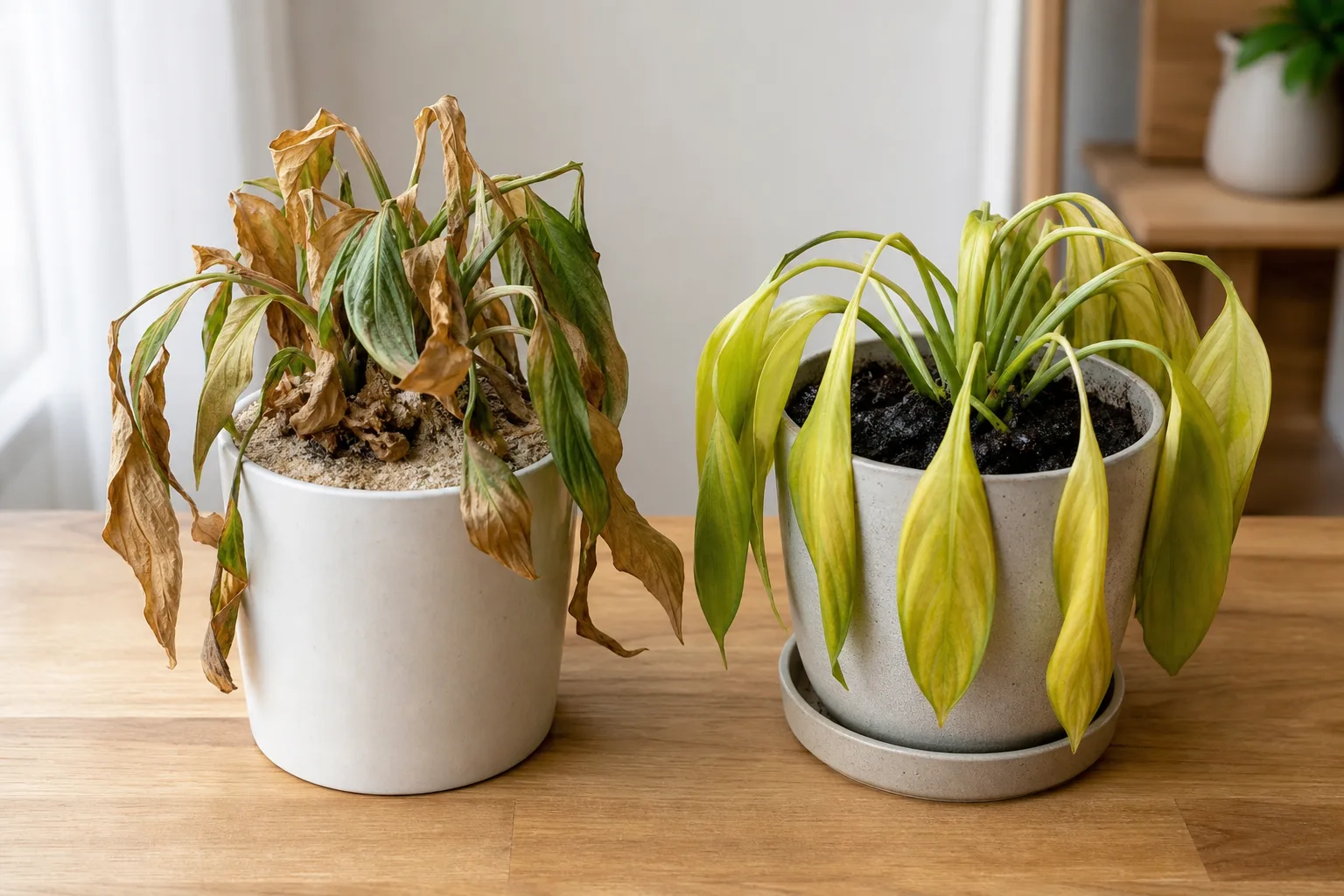
Never water wilt on autopilot. Inspect roots and mix. Use water stress in houseplants when leaves droop but probes disagree.
Seasonal rhythm. Active summer growth drinks faster; winter dormancy needs longer dry-down. RHS watering guidance stresses checking need, not obeying a calendar.
Conclusion
The best soil moisture meter is the one that samples where your roots actually drink—at the right depth, in your mix, with eyes open to salt and hydrophobic lies. Moistenland remains the strongest all-around handheld for mixed indoor/outdoor collections that want multi-mode analog reads without batteries. Sonkir covers beginners on a budget; XLUX wins depth; Raintrip suits fussy houseplants; Gain Express serves outdoor pH+moture patience; Irtov digitizes glare-prone patios; Netro Whisperer logs yard trends; Kensizer simplifies small pots; Luster Leaf reaches hanging baskets.
Buy after you answer two questions: Can your finger or a skewer already reach the root zone reliably? And will you still lift the pot and empty saucers after the dial speaks? Honest yeses to the second matter more than any needle. Keep the meter as a scout—not a boss—and let extension-backed feel checks stay in charge of when water actually flows.