Moisture Meter vs Finger Test for Houseplants
Compare moisture meters and the finger test for houseplants—probe depth, pot size, calibration limits, and when meters give false wet or dry readings.
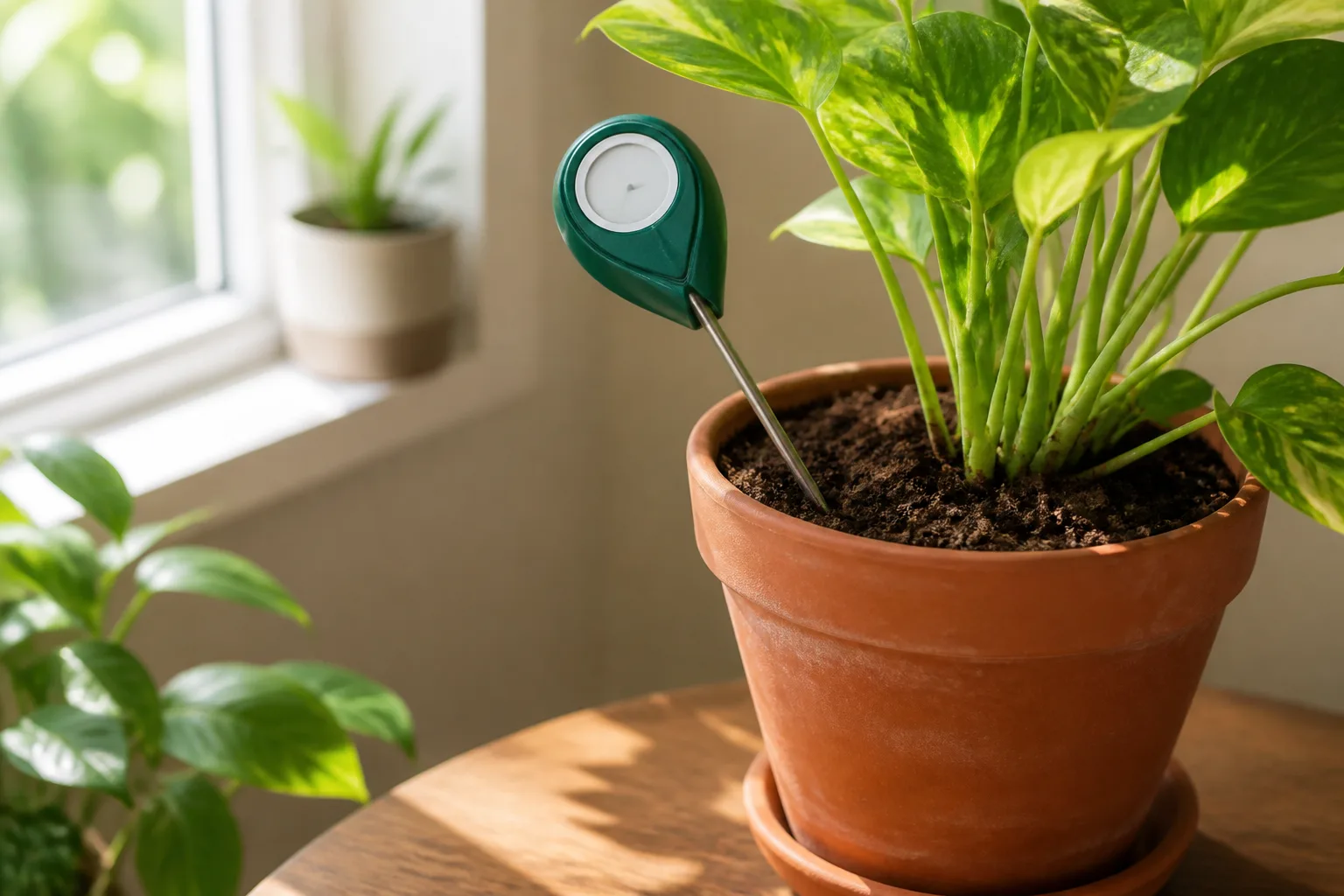
You are stuck between a cheap dial probe and your own knuckle, and both feel like they could be lying. A moisture meter does not “know” when your plant needs water. Neither does your finger. Both are imperfect ways to sample the root zone so you stop watering on a calendar. The useful question is not which gadget is more modern—it is which check fails less often in your pot, mix, and room.
For most houseplants, the finger test is the more reliable default. Extension watering guidance still centers on feeling the mix, and Clemson HGIC calls soil feel the most accurate everyday gauge for indoor plants—while also noting that watering meters vary widely in accuracy and that fertilizer or soil type can skew the reading. A meter can help in large pots, dense canopies, or when you want a quick scan across many plants—but only after you learn when that dial lies. Virginia Cooperative Extension treats the finger stick test and a soil hygrometer or water meter as valid monitoring options, not as competing religions.
This page is the check decision: finger vs meter, calibration limits, pot-size depth, smart-sensor honesty, deep-pot skewer options, and the situations where meters confidently report the wrong answer. If you still need the core watering skills—how wet is enough, how to flush salts, how to empty saucers—use how to water indoor plants the right way after you settle the check.
Written by Sai Ananth; horticulture review by Dr. Ananya Rao (Ph.D. Horticulture; LeafyPixels Editorial Review Board).
Quick Verdict: Finger First, Meter Second
Use the finger test as your primary check when pots are small to medium, the mix is reachable, and you can feel cool dampness versus dusty dryness a knuckle or two down. Clemson’s indoor watering guidance is blunt: stick a finger into the mix up to the first joint and water when it feels dry at the fingertip. UConn’s houseplant watering notes use a similar ~1 inch feel check and warn against watering by the calendar.
Use a moisture meter as a helper when the pot is deep or heavy, foliage blocks the surface, arthritis or mobility makes probing awkward, or you manage dozens of plants and need a fast first pass. Virginia Extension explicitly allows a soil hygrometer or water meter alongside the finger stick test for consistent monitoring.
Trust neither alone when the plant is wilting. Wilt can mean drought or drowning. NC State Extension’s Lee County guidance is clear that people often mistake wilt for thirst and add more water—inspect mix moisture and roots before you soak again. For that fork, use the water stress guide after you finish the moisture check.
What “Reliable” Means for a Watering Check
Reliability here means: the check predicts whether the root zone that matters is dry enough to water, without a high rate of false “dry” or false “wet” answers. A method can feel precise and still be unreliable if it samples the wrong layer, reacts to salts instead of water, or ignores pot geometry.
Houseplant roots do not live only in the top crust. Tall containers tend to dry faster in the upper inches while lower layers stay wetter because gravity pulls moisture downward. Small pots store less water and dry faster than large ones. Terracotta loses moisture through the wall; plastic and glazed pots hold it longer—see terracotta vs plastic pots when material is driving your dry-down. Those physical facts change how any check should be read, whether your tool is skin or a metal probe.
A reliable routine also respects plant type. Even-moisture plants need action when the surface starts drying. Plants that prefer a slight dry-down need you to feel below the top layer before the whole ball goes bone-dry or the plant wilts. PlantTalk Colorado describes that split clearly and adds pot weight and soil color as supporting signals—not as replacements for checking the mix.
How the Finger Test Works
The finger test is a tactile sample of potting mix moisture at a chosen depth. You are not scoring scientific volumetric water content. You are asking a practical question: is this layer still cool and clinging, or is it dry and crumbly?
Clemson frames touch as the most accurate everyday gauge and pairs it with a clay-pot tap test: a dull sound suggests moisture, a hollow sound suggests dryness. RHS houseplant troubleshooting similarly tells you to insert a finger a few centimetres down and water when the medium is very dry—checking moisture instead of watering on a fixed interval. UConn’s guidance matches that habit: feel about an inch below the surface, then water thoroughly so the whole root system gets wet rather than teasing the plant with sips.
Done well, the finger test also catches incomplete watering. After you water, feel again. If the middle is still dry while water raced down the pot wall, the mix may be hydrophobic. Virginia Extension describes that failure mode and recommends slow, repeated hydration—or bottom watering—until dry cores disappear. Your finger is often better than a meter at catching that patchy texture.
Depth Rules by Pot Size
Depth is where most people under-sample. Virginia Extension’s practical range for verifying moisture or dry spots is about 1–3 inches, scaled to container size. Use that as a working map, not a universal law.
In a 4–6 inch pot, one knuckle (roughly the first joint) is usually enough for everyday checks—the Clemson default. In an 8–10 inch pot, go closer to two knuckles or about 2 inches so you are not watering from a dry crust over a still-damp core. In a tall floor planter, sample at least 2–3 inches and, when possible, lift or tip the liner to feel weight and look for wet pockets at the base. Small pots dry fast; large pots hide wet bottoms. Match the sample depth to the water reservoir you are actually managing.
Species preference still overrides the number. Succulents and other arid plants usually need a deeper dry-down than a peace lily that hates hard drought. The depth rule tells you where to sample; the plant type tells you how dry that sample should be before you water.
How Moisture Meters Work Indoors
Most inexpensive houseplant “moisture meters” are metal probes that estimate moisture from electrical resistance between sensor plates. Wetter mix usually conducts better, so the needle swings toward wet. Many units also combine a crude light or pH scale on the same stem. Those extra dials are marketing more often than measurement—treat moisture only, and ignore the rest unless you have a real light meter and a soil test.
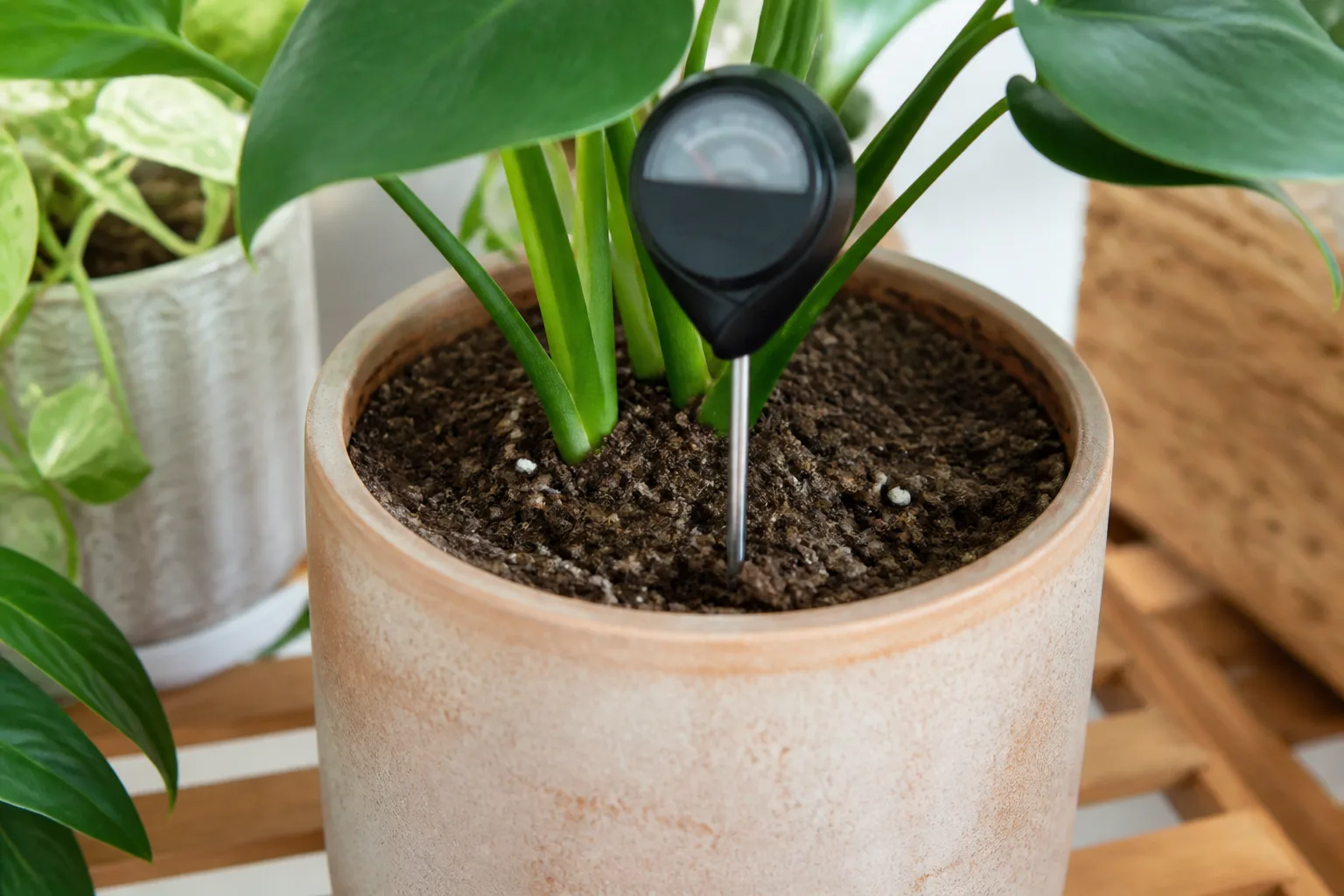
Virginia Extension groups these tools with soil hygrometers or water meters as optional monitoring aids. That endorsement matters: meters are not banned by good horticulture. It also does not mean a $12 probe is a lab instrument. The dial is a relative index for a given mix, salt level, and insertion path—not a percentage of water that transfers cleanly from one pot to another. Digital numbers feel more scientific; they are still relative scouts unless you calibrated them against finger feel and pot weight in that same mix.
Cheap Probes vs Capacitance and Smart Meters
Cheap resistance probes are the default retail tool: no true user calibration curve, battery optional or absent, readings that change with fertilizer salts and air gaps, and a “10” that is not a universal wetness standard. Exposed metal electrodes also corrode over months in salty or acidic mixes, which quietly drifts the baseline.
Capacitive sensors measure how the mix stores electrical charge rather than how easily current flows between bare metal tips. They often last longer, need less power, and are what many “wireless” or app-connected plant sensors use. They are still affected by mix texture, bulk density, and dissolved salts to varying degrees, and they still need a local baseline. A Bluetooth reading that says 42% is not automatically more truthful than a knuckle—it is a different relative index that still fails when the probe sits in bark air gaps or a dry peat channel.
Smart meters do not solve accuracy by being wireless. They solve convenience: phone charts, reminders, multi-pot dashboards. Keep the same rules: calibrate per mix, sample the right depth, pull the probe out between checks when the manufacturer allows, and never let an app overrule a heavy, wet root zone when a plant is wilting. Research-grade soil moisture instruments exist for agriculture and greenhouses; they are rarely what people mean when they ask about a houseplant moisture meter at a big-box store.
Calibration Limits You Cannot Ignore
“Calibration” for a cheap meter usually means teaching yourself what the dial means in your mix—not entering a factory code. Do this once per potting recipe, not once per lifetime.
Water a representative pot thoroughly until runoff, empty the saucer, wait 15–30 minutes, then take a meter reading at your normal depth next to a finger check and a pot-weight lift. Note the wet baseline. Recheck daily as the pot dries until your finger says the plant’s preferred dry-down point has arrived. That dial number—say mid-scale for a chunky aroid mix, or near-dry for a succulent mix—is your local “water soon” mark. Change the mix, fertilizer strength, or water source significantly, and re-baseline.
Limits you cannot wish away:
Meters do not know plant species. A reading that means “water the fern” can mean “wait” for a snake plant.
Meters sample a narrow path. If the probe sits in an air pocket, against a root ball wall, or in a dry peat channel, the dial can scream dry while the opposite side of the pot is soaked.
Pot size changes the useful insertion depth. A 1-inch reading in a 12-inch pot is mostly crust gossip. Push deeper for large containers, still avoiding stabbing the main root mass on every check.
Salt changes conductivity. Fresh fertilizer or hard-water buildup can push readings wetter than the water content alone would suggest. PlantTalk Colorado warns that high soluble salts reduce water uptake and burn foliage—exactly the chemistry that also confuses resistance probes.
No substitute for drainage reality. A meter cannot see a clogged hole, a cachepot swamp, or a saucer left full for hours. Virginia Extension’s overwatering point is still the one that matters: overwatering is usually about how often you water, not how much you apply in a single thorough soak.
First-Hand Notes From Dial, Finger, and Weight Checks
These are dated LeafyPixels collection observations used to pressure-test the finger-first rule. They are local baselines for named pots and mixes—not universal thresholds for every home.
2026-07-12 — 6-inch pothos in peat-based tropical mix (plastic pot), analog resistance probe. After a thorough soak and saucer empty, wet baseline sat near 8–9 on a 1–10 wet scale while the finger felt cool and clinging at one knuckle and the pot felt distinctly heavy. Three days later, the same pot read about 4–5 when the finger first felt dusty at depth and the pot was clearly lighter. That mid-low band became the “water soon” mark for this mix only. Mid-scale was not the water cue—ready-to-water lived lower once the wet baseline was known.
2026-07-18 — same pothos, day after a liquid feed. The dial jumped back toward 7 while the pot still felt light and the mix felt only slightly cool, not wet. Finger and weight said wait; the dial said “moist.” After a thorough flush until runoff and a day of normal dry-down, the dial and finger realigned near the previous 4–5 ready mark. False wet after fertilizer is not a theory in this pot—it is a repeatable resistance-probe failure mode.
2026-07-24 — 12-inch floor Monstera deliciosa in chunky aroid mix (plastic nursery pot inside a cachepot). A shallow 1-inch poke read near-dry while a 2.5–3 inch poke plus finger check still felt damp, and the pot remained heavy. The cachepot had a thin film of leftover water. Watering from the shallow reading would have been a winter-style overwatering mistake even in July. The useful stack was deeper sample + weight + cachepot look, with the meter only as a first pass.
Collection scan habit that stuck: on a 20-plant shelf, a meter first-pass flagged seven “dry” dials in under two minutes. Finger and weight confirmed five were due; two were false dries from air gaps in barky mixes. The meter saved time as a scout. It did not get the final vote.
How this page was researched: recommendations were checked against Clemson HGIC, Virginia SPES-804, UConn houseplant watering notes, PlantTalk Colorado, RHS houseplant troubleshooting, and NC State Lee County overwatering guidance, then compared with the dial/finger/weight notes above. Claims about cheap resistance probes responding to salts and air gaps are practical synthesis for home meters, not a lab calibration standard.
When Moisture Meters Lie
Meters lie in predictable ways. Once you know the patterns, you stop treating the dial like a referee.
Salt, Fertilizer, and False Wet Readings
Resistance probes respond to ions as well as water. After a heavy feed, or in a pot with crusty white fertilizer salts, the meter can read wetter than your finger feels. If the dial says moist but the mix feels dusty and the pot is light, believe the finger and weight. Flush with a thorough top watering until excess drains, discard runoff, and recheck on a clean cycle before you trust the meter again. For salt and watering method trade-offs, see top watering vs bottom watering.
Dry Top, Wet Bottom (and the Reverse)
Tall pots dry at the top first. A shallow meter poke can read “water me” while the lower root zone is still saturated—classic winter overwatering bait when growth has slowed. Virginia Extension notes that taller containers drain more and that the upper few inches dry faster. Sample deeper, lift the pot, and look for standing water in cachepots before you add more.
The reverse also happens. Hydrophobic peat can wet along the pot wall and leave a dry core, or look dry on top after water channelled through without absorbing. Virginia Extension’s hydrophobic checks—light pot after watering, patchy wet/dry when you slip the root ball, dry middle on a finger poke—matter more than any dial. A meter jammed into the wet channel may say wet while roots in the dry core are still thirsty; a meter in the dry core may say dry while the base is swampy. When texture is patchy, slow-soak or bottom-water, then recheck before you keep pouring.
Other common lies:
- Probe touching the pot wall or a drainage crock zone
- Probe left parked in the soil between checks (corrosion, odd baselines, and unnecessary root disturbance)
- Stabbing the same dense root mass on every check until roots shred
- Dead or sticky analog needles parked mid-scale
- Freshly watered surface with dry lower mix still rewetting
- Orchid bark or chunky aroid mixes with large air gaps that break contact—your meter is not “broken,” the path is empty air
Head-to-Head: Accuracy, Speed, and Failure Modes
| Factor | Finger test | Moisture meter |
|---|---|---|
| What it senses | Coolness, cling, texture | Electrical path (cheap probes) or capacitance (many smart sensors) |
| Best strength | Catches patchy or hydrophobic mix | Fast scan across many or deep pots |
| Main failure | Under-sampling depth; personal “feel” drift | Salt, air gaps, wrong depth, false confidence |
| Pot-size fit | Excellent in small/medium pots | Helpful in large/heavy pots if depth is honest |
| Cost / friction | Free; messy hands | Cheap tool; wireless adds convenience, not magic accuracy |
| Extension stance | Primary everyday method (Clemson, RHS, UConn) | Accepted monitoring aid with finger (Virginia) |
Neither method replaces plant observation. Soft yellowing with a heavy, sour pot is not a green light to water because a dial twitched. Crispy margins with a feather-light pot are not a reason to wait because a salt-skewed meter still says moist. Reliability is the whole decision stack—not one sensor.
Which Method Fits Common Plant and Pot Situations
Beginner with a few tropicals in 4–8 inch plastic pots: Finger test. One knuckle for many foliage plants; two for chunkier pots. Add pot weight until it becomes automatic. Pothos watering is a good practice case for this pot size.
Large floor Monstera, Ficus, or palm: Meter as first pass at 2–3 inches, then confirm with finger and a serious lift or tilt. Large root balls hide wet bottoms. For species-level watering cues, see Monstera watering.
Succulents and cacti: Finger or a clean wooden skewer deeper into the mix. Meters in gritty media often bounce between air gaps. Wait for a real dry-down, not a mid-scale panic.
Ferns and other even-moisture plants: Finger the top layer more often. PlantTalk’s rule—water when the top begins to feel dry—beats waiting for a meter to hit bone-dry.
Dense African violet or trailing canopy: Meter or a thin probe helps when you cannot easily reach soil without breaking leaves; still confirm after watering that the root zone actually wetted.
Terracotta vs plastic: Terracotta usually reaches “finger dry” sooner. Do not copy a plastic-pot meter number onto clay without re-baselining.
Winter apartments: Check more carefully and water less often. RHS notes that problems often arise in winter due to overwatering; a dry-looking top is not automatic permission if the pot still feels heavy.
Wooden Skewer Checks for Tall Pots
When a finger cannot reach far enough and a meter keeps hitting bark gaps, a clean wooden skewer or thin bamboo stick is a useful third tool. Push it into the mix at the depth you care about, leave it for a minute, then pull it out. Cool, dark, clinging particles mean moisture; a clean, dry stick with dusty crumbs suggests the layer is dry. Use this for tall floor planters, deep ceramic cachepots, and gritty succulent mixes where resistance probes chatter.
A skewer is still a sample, not a root X-ray. It can miss a wet pocket on the opposite side of the pot, and a brand-new dry stick can look “dry” if you yank it out too fast. Pair it with pot weight. Do not leave metal probes or damp sticks buried for days—pull them out, wipe them, and let the hole close. In orchid bark, expect both meters and skewers to need a second insertion point before you trust the answer.
Build a Three-Check Habit
The most reliable home method is almost never finger or meter. It is a short stack:
| Signal | What “due soon” often looks like | What “wait” often looks like |
|---|---|---|
| Pot weight | Clearly lighter than the post-water baseline | Still heavy for that container |
| Finger / skewer / meter at depth | Dry or barely cool at the plant’s preferred depth | Cool, clinging, or dark and damp |
| Plant look | Soft limpness with a light pot | Soft limpness with a heavy, wet pot (do not water—inspect roots) |
| After watering | Whole root zone moist; runoff stopped; saucer emptied | Dry core remains, or water sits in the cachepot |
- Lift the pot — light vs heavy for that container.
- Finger, skewer, or meter at the right depth — sample the layer roots care about.
- Confirm after watering — mix evenly moist, runoff stopped, saucer emptied.
PlantTalk Colorado lists weight, feel, and color as the practical trio for deciding when to water. Keep the stack boring and you avoid most root-rot seasons. If symptoms already look like drought and flood at once, pivot to water stress, then overwatered plant or underwatered plant as the pattern clarifies. Persistently wet surfaces also invite fungus gnats—fix the moisture habit before you chase pests alone.
Mistakes That Still Cause Overwatering
Buying a meter does not fix a bad habit. These mistakes keep killing roots with or without a gadget:
Watering every Sunday because the schedule feels responsible. UConn’s advice is to check frequently and water when the medium is dry—not when the calendar nags. For method choices after you decide the plant is due, use how to water indoor plants the right way.
Reading only the surface. Crusts lie. Go to knuckle depth or deeper in big pots.
Leaving pots in saucers or cachepots of water. Virginia Extension warns against sitting in drainage water beyond about 60 minutes; NC State flags foil wraps and deep planters that hide standing water.
Trusting wilt alone. Wilt plus wet soil is a root-oxygen emergency, not a thirst cue.
Treating a mid-scale meter reading as a universal “water now” for every species.
Leaving the probe in the pot “for continuous monitoring” on a cheap resistance meter that was never designed for permanent burial.
Ignoring seasonal slowdown. Actively growing summer plants drink more; autumn and winter plants often need longer dry-down windows.
What to Do When Finger and Meter Disagree
Disagreement is useful data. Do not average the two and hope.
If the meter says dry and the finger says damp (or the pot is heavy): do not water. Suspect an air gap, a dry channel, or a probe that never reached moist mix. Reinsert in a second spot, wipe the probe, and recheck weight.
If the meter says wet and the finger says dry (or the pot is light): do not trust the wet dial. Suspect salts, a sticky needle, or a probe sitting in a wet streak. Water only if weight and finger agree the plant is due—and water thoroughly enough to rewet the whole ball.
If both say dry but the plant still wilts after a careful soak: stop pouring and inspect roots and drainage. That pattern belongs to water stress and possible root rot, not to a third gadget.
Related Guides
- How to water indoor plants the right way — thorough soak, runoff, and saucer habits once the check says “water.”
- Indoor plant watering basics — short cheat sheet for frequency myths and pot size effects.
- Top watering vs bottom watering — method choice when salts or hydrophobic mix are part of the story.
- How to bottom water houseplants — slow rewet when the finger finds a dry core.
- Terracotta vs plastic pots — why the same finger depth feels dry sooner in clay.
- Self-watering pots for houseplants — reservoir systems still need root-zone checks.
- Water stress in houseplants — wilt that is not a simple thirst cue.
- Root rot in houseplants — what wet-soil wilt looks like after the check fails.
- Fungus gnats on houseplants — when constantly damp mix invites pests.
- Pothos watering and Monstera watering — species defaults after you choose a check method.
Conclusion: Before-You-Water Checklist
The finger test is the more reliable everyday watering check for most houseplants because it samples texture directly and matches long-standing extension guidance from Clemson, UConn, RHS, and others. A moisture meter is a useful assistant for deep pots and fast collection scans when Virginia-style monitoring is the goal—but cheap probes have hard calibration limits and lie around salts, air gaps, and shallow readings in tall containers. Wireless sensors add charts, not automatic truth.
Before you water, run this stack:
- Lift the pot and compare weight to its post-water baseline.
- Sample at the right depth for pot size (about 1–3 inches) with finger, skewer, or meter.
- If tools disagree, trust finger feel plus weight—not a single dial poke.
- Water thoroughly only when the plant’s preferred dry-down is real, then empty the saucer and confirm the core actually wetted.
Choose finger-first for small and medium pots. Use a meter as a scout in large containers. Always keep pot weight in the loop, and never let a dial overrule a heavy, wet root zone when a plant is wilting. Reliable watering is not a product purchase. It is a repeatable check at the right depth for the pot you actually own.