Self-Watering Pots for Houseplants: Best Plants, Risks and Use
Self-watering pots explained: best and worst plants, salt-flush triggers, reservoir hygiene, and when to skip the reservoir.
The box said “set and forget.” Your plant said otherwise—soft stems, a sour mix, or a white crust that showed up weeks after you stopped top-watering. A self-watering pot can steady moisture for thirsty tropicals, but it is a reservoir plus a capillary path, not a forever autopilot. Get the plant match wrong, overfill the chamber, or skip salt flushes, and you have built a sealed swamp with a pretty fill window.
This guide helps you decide whether a commercial self-watering planter fits a given houseplant, how to run salt flushes and reservoir cleaning on triggers (not vague calendars), and when to empty the chamber for winter. If you want to build a wick jar, bottle drip, or tote reservoir, use our DIY self-watering system guide. For day-to-day moisture checks without a reservoir, start with how to water indoor plants the right way. For timed tray soaks (not permanent reservoirs), see top watering vs bottom watering.
Written by Sai Ananth; horticulture review by Dr. Ananya Rao (Ph.D. Horticulture; LeafyPixels Editorial Review Board).
Quick Decision: Should You Use a Self-Watering Pot?
Use a self-watering pot when the plant prefers evenly moist mix, you travel or miss waterings, and you will still top-flush salts and clean the chamber when film, odor, crust, or hard-water stress shows up. Virginia Cooperative Extension describes these containers as a bottom reservoir with a wick that keeps potting soil evenly moist over time—useful for owners who travel or have limited maintenance time, but not for plants that prefer dryer soil. (Virginia Cooperative Extension)
Skip the reservoir when the plant stores water in thick leaves or rhizomes, when winter light is low and growth has slowed, or when the plant already shows wet-wilt from overwatering. The Royal Horticultural Society notes self-watering containers suit plants that need moisture year-round and dislike permanent wet culture for plants such as citrus that need less water in winter. (RHS)
| Situation | Self-watering pot? | Why |
|---|---|---|
| Peace lily, fern, calathea that crisps between drinks | Yes | Even moisture matches preference |
| Frequent travel, bright room, thirsty aroid | Usually yes | Buffer between visits if you monitor fill |
| Snake plant, ZZ, jade, cactus, many succulents | No | Constant access keeps mix too wet |
| Low-light winter apartment | Often no / pause | Water use drops; reservoir stays full too long |
| White crust, tip burn, hard water | Only with flushes | Subirrigation concentrates salts upward |
| Indicator “full” but plant softens | Empty chamber | Lower zone may still be waterlogged |
What a Self-Watering Pot Actually Is
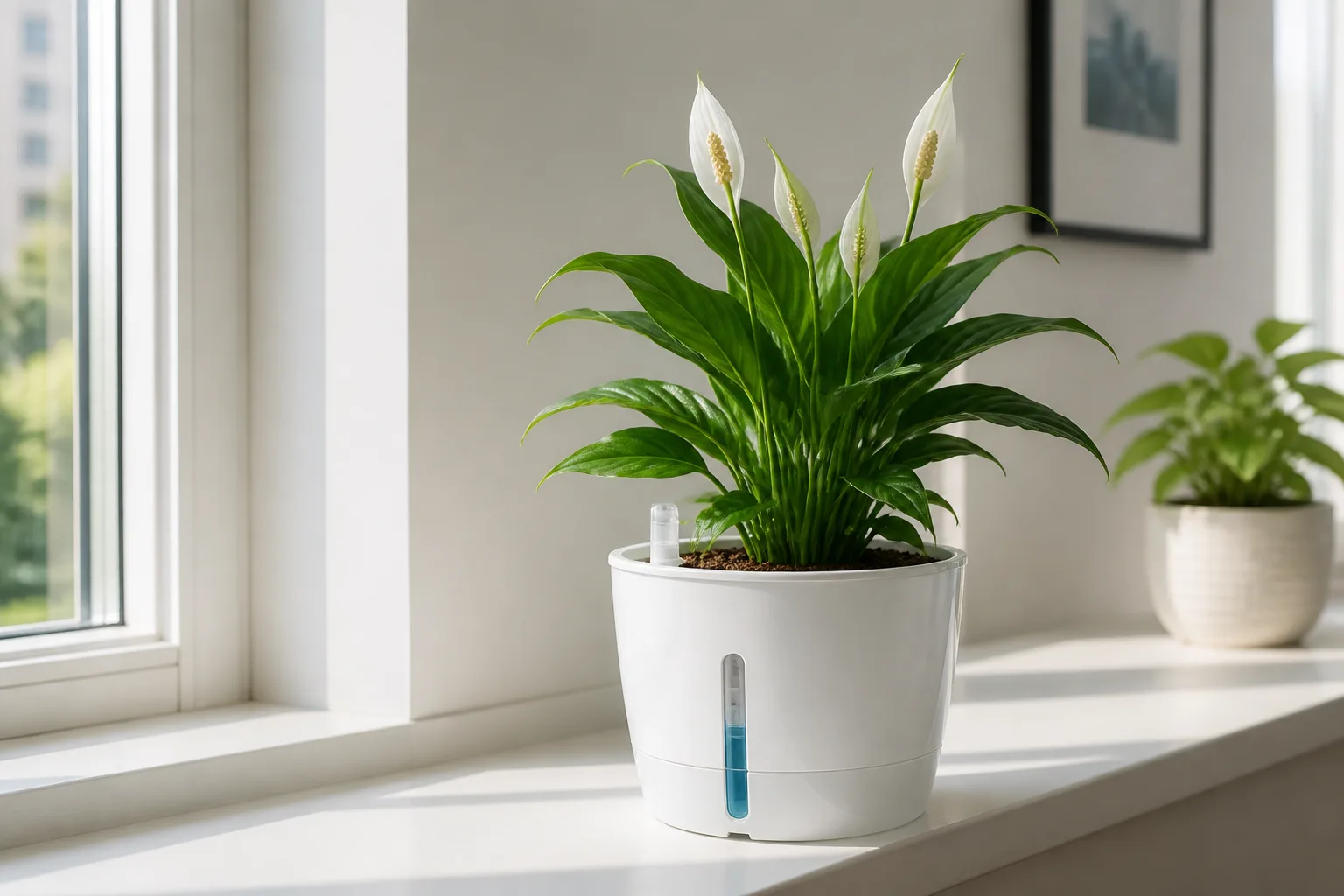
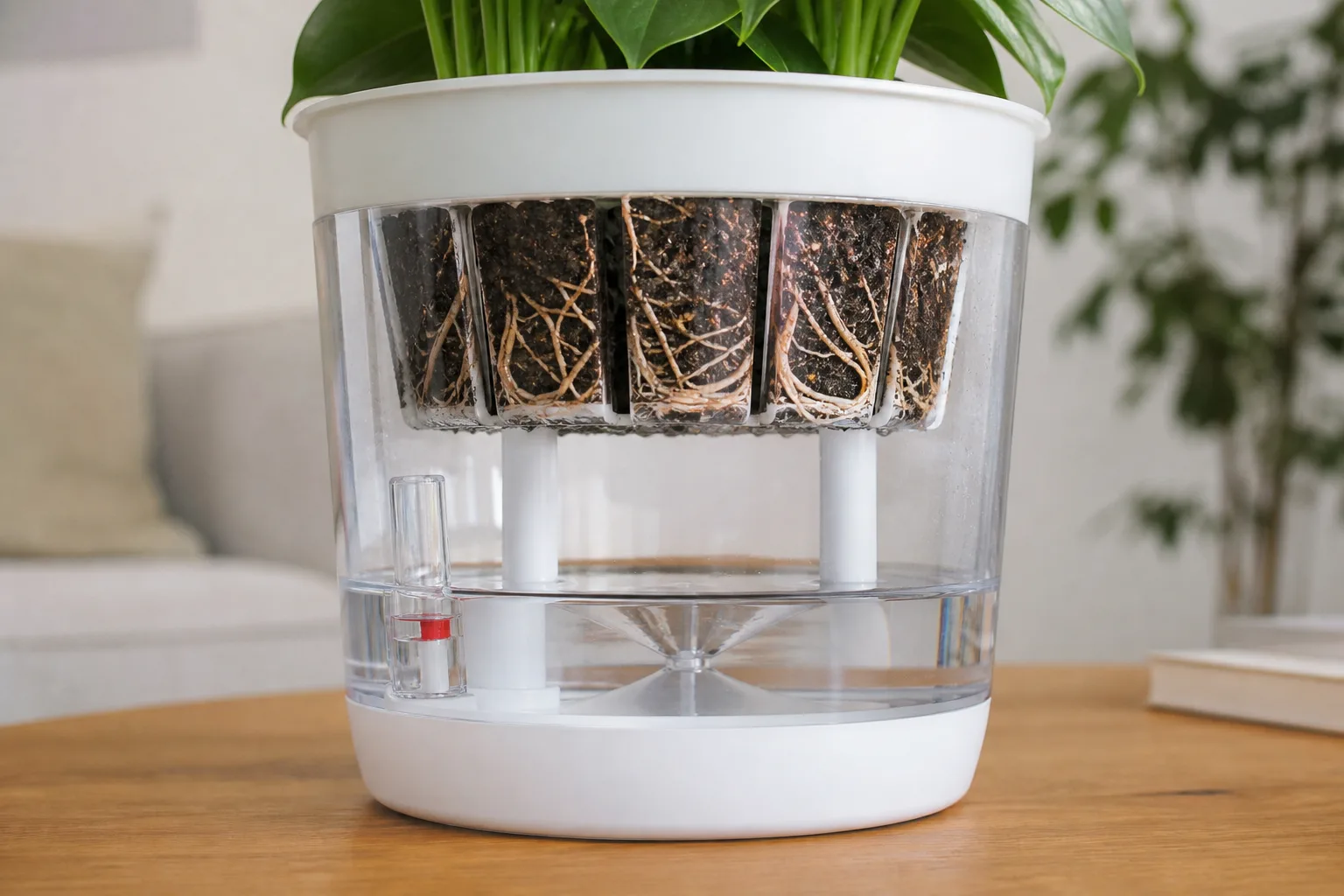
A self-watering pot is a two-part container: a soil chamber above and a water reservoir below, connected by a wick, soil column, or fabric that pulls water upward by capillary action. You refill through a fill tube or side window. Many designs include a water-level indicator. The system maintains moisture; it does not magically match every species’ dry-down rhythm.
Reservoir, Wick, and Capillary Path
Water sits below the root zone. As the mix dries slightly, capillary action moves moisture up through a wick or through a soil “wicking basket” packed into the reservoir. University of Kentucky Cooperative Extension’s wicking-container guidance (AEN-157) explains the same physics outdoors: capillary water rises above the drain-hole water table—often roughly four inches in their design—so roots stay connected to a buffered supply without flooding the surface every day. (UK Cooperative Extension)
Indoors, that means the lower root zone stays wetter than the surface for longer than a normal top-watered pot. That is the feature for moisture lovers and the failure mode for dry-preferring plants. Overflow or a maximum fill line matters: if the reservoir can climb into the soil platform, you no longer have a self-watering pot—you have a sealed swamp.
Missouri Botanical Garden’s overwatering guidance also undercuts a common indicator lie: a dry surface is not always a sign of water need, because the surface dries first and is not a true read of the deeper root zone. (Missouri Botanical Garden) In a reservoir pot, that mismatch is normal—and dangerous if you keep topping the chamber because the top looks dry.
Wick-Basket vs Fabric-Wick Designs
Buyers often confuse two common commercial layouts:
| Design | How water moves | Watch-outs |
|---|---|---|
| Wick-basket / soil column | Potting mix in a perforated insert dips into the reservoir and acts as the wick | Dense mix slows capillary rise; overfilled chambers flood the insert |
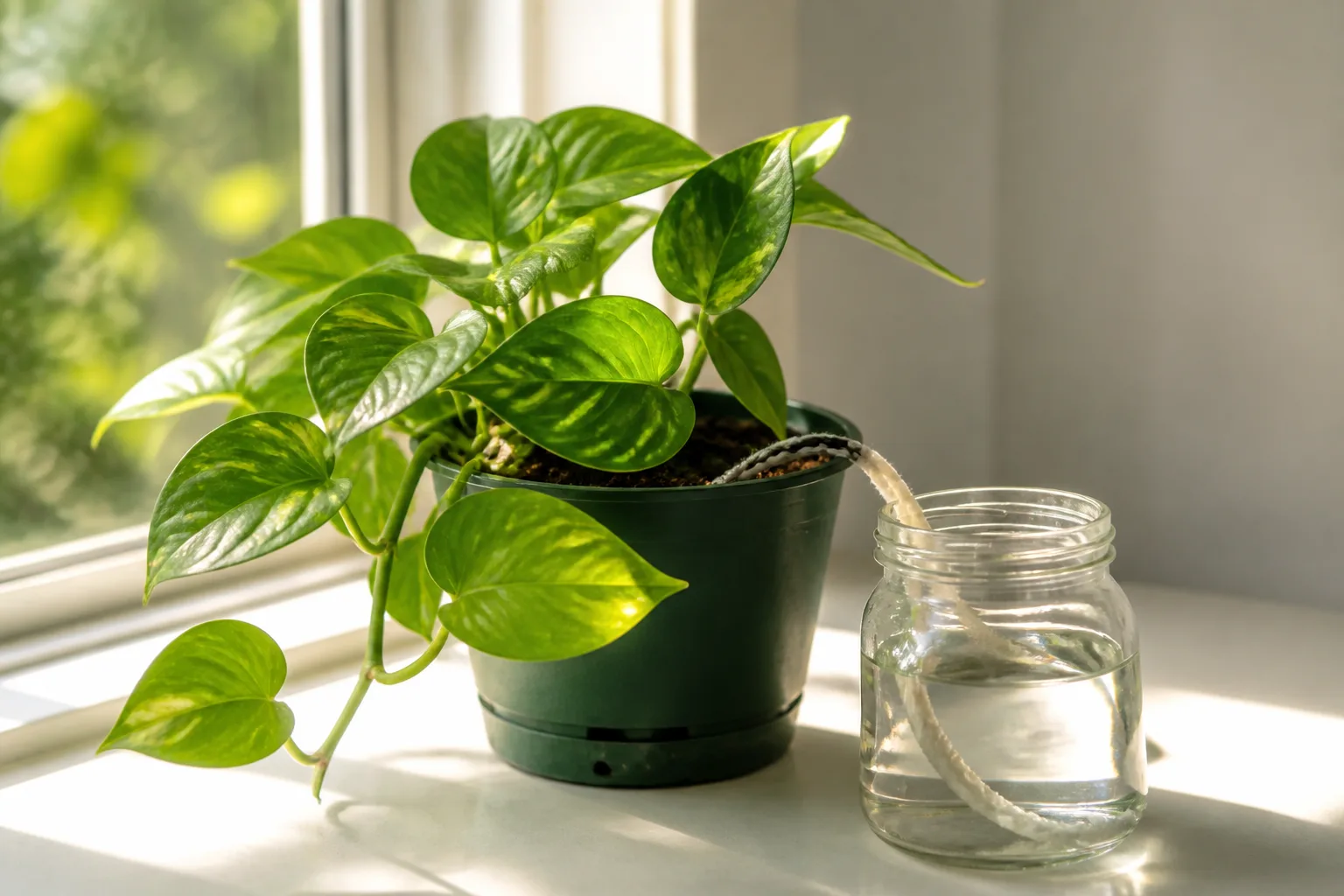
| Fabric or cord wick | Cotton, felt, or synthetic cord bridges reservoir and root ball | Cotton can rot and smell; too many thick wicks keep dry-preferring plants soggy |
| Sensor / “smart” pots | Same reservoir idea plus a float or app cue | Sensors report water presence, not species dry-down—still use finger checks |
Pick the design for serviceability: can you empty, scrub, and replace a wick? A sealed unit you cannot clean is a hygiene trap, not a convenience upgrade.
How It Differs From Bottom Watering and DIY Systems
Timed bottom watering is a short soak in a shallow tray, then you remove the pot and drain. A self-watering pot is continuous subirrigation while the reservoir holds water. They share upward water movement and the same salt-climb risk, but they are not the same chore. Our top watering vs bottom watering guide covers the timed soak; how to bottom water houseplants covers basin steps. This page covers the permanent commercial reservoir.
DIY wick jars and bottle drips can mimic parts of a commercial pot, but you control wick thickness, reservoir size, and overflow yourself. Commercial pots package the chamber, indicator, and fill tube. Use DIY when you need a temporary travel hack or a custom tote; use a commercial pot when you want a long-term growing system for the right plant. RHS treats self-watering containers as a long-term growing solution rather than a short holiday swap. (RHS)
| Factor | Commercial self-watering pot | DIY wick / reservoir |
|---|---|---|
| Best use | Long-term home for moisture lovers | Travel buffer, experiments, custom sizes |
| Control | Fixed wick and chamber | You choose wick count and reservoir volume |
| Overflow | Often built-in indicator/max fill | You must add overflow outdoors / test carefully indoors |
| Salt / hygiene | Same need for top flushes and scrubbing | Same need—plus you must design clean-access |
| Cost | Higher upfront | Low materials cost |
Build steps live in DIY self-watering system: what actually works. Neither design removes moisture checks or salt leaching.
UConn’s soil testing guidance casually lists self-watering containers and wick systems as options for forgetful waterers—useful framing, not a free pass for every species. (UConn Soil Nutrient Analysis Laboratory)
Best Houseplants for Self-Watering Pots
The best candidates like consistent moisture, thin or large leaves that dry the pot quickly in bright rooms, and active growth for most of the year. RHS language is blunt: choose plants that need moisture year-round and do not mind permanent moist conditions. (RHS)
Strong Matches for Even Moisture
These plants usually forgive—or prefer—a moist lower root zone when light and drainage are decent:
- Peace lily — dramatic drought wilt; recovers with even moisture if roots stay oxygenated (wet-wilt is a different problem—soft leaves while the mix is still wet)
- Ferns (Boston fern and many Nephrolepis types) — hate bone-dry peat; benefit from buffered moisture
- Calathea / prayer plants — thin leaves crisp when the pot swings wet-dry violently
- Pothos and many philodendrons — adaptable; reservoir helps in bright, warm rooms
- Fittonia, pilea, and other moisture-loving tropicals — small pots that dry in a day indoors
Match light first. A peace lily in a dim corner still uses little water; a full reservoir in that case is closer to overwatering than to “easy care.”
Situational Matches for Travel Weeks
Some plants are optional matches: good in a self-watering pot during spring–summer growth or while you travel, weaker matches when growth stalls.
- Monstera deliciosa and large aroids in chunky mix — reservoir helps if the mix still drains and you do not keep the chamber topped in winter
- Spider plant — often thrives with even moisture but still needs occasional top flushes for tip burn and salts
- Herbs such as basil or mint on a bright sill — they drink hard in heat; pause or empty the chamber when growth slows
For drought-adapted plants that need a real dry-down, a porous terracotta vs plastic pot with hand watering is usually safer than forcing them onto a wick.
Worst Plants for Self-Watering Pots
Do not put drought-adapted or dry-down specialists on a permanent moisture tap. Virginia Extension states these systems are effective for most houseplants but not for plants that prefer dryer soil. (Virginia Cooperative Extension)
Avoid or only experiment with extreme caution:
- Snake plant, ZZ plant, and similar rhizomatous survivors
- Cacti and most succulents (jade, echeveria, haworthia)
- Rosemary, lavender, thyme, and other Mediterranean herbs indoors
- Citrus and other plants with a clear winter dry-down (RHS flags citrus specifically)
- Any plant already fighting root rot or sitting in a decorative cachepot with standing water and no air gap
If you love the look of a reservoir pot for a snake plant, use it as a decorative outer shell with the nursery pot lifted out of standing water—not as a filled wick system.
Marketing Myths That Get Plants Killed
| Marketing claim | Reality |
|---|---|
| “Works for all houseplants” | Virginia Extension excludes plants that prefer dryer soil. (Virginia Cooperative Extension) |
| “Never water again” / “set and forget forever” | You still refill, top-flush salts, clean algae, and pause in winter. The indicator is not a species coach. |
| “Ends overwatering” | Overfilling past the soil platform, wrong plant choice, and full winter reservoirs cause waterlogging. |
| “No fungus gnats” | Larvae live in moist upper media; a reservoir does not dry the top inch by magic. (Colorado State Extension) |
Treat product copy as a starting bias. Your plant’s water-storage traits and seasonal demand decide whether the reservoir earns its keep.
The Salt Climb Problem
This is the risk marketers skip. When water moves upward and evaporates from the surface, soluble salts from fertilizer and hard water can concentrate near the top of the mix and on the pot rim. That pattern is well documented for subirrigation generally, and a self-watering pot is continuous subirrigation.
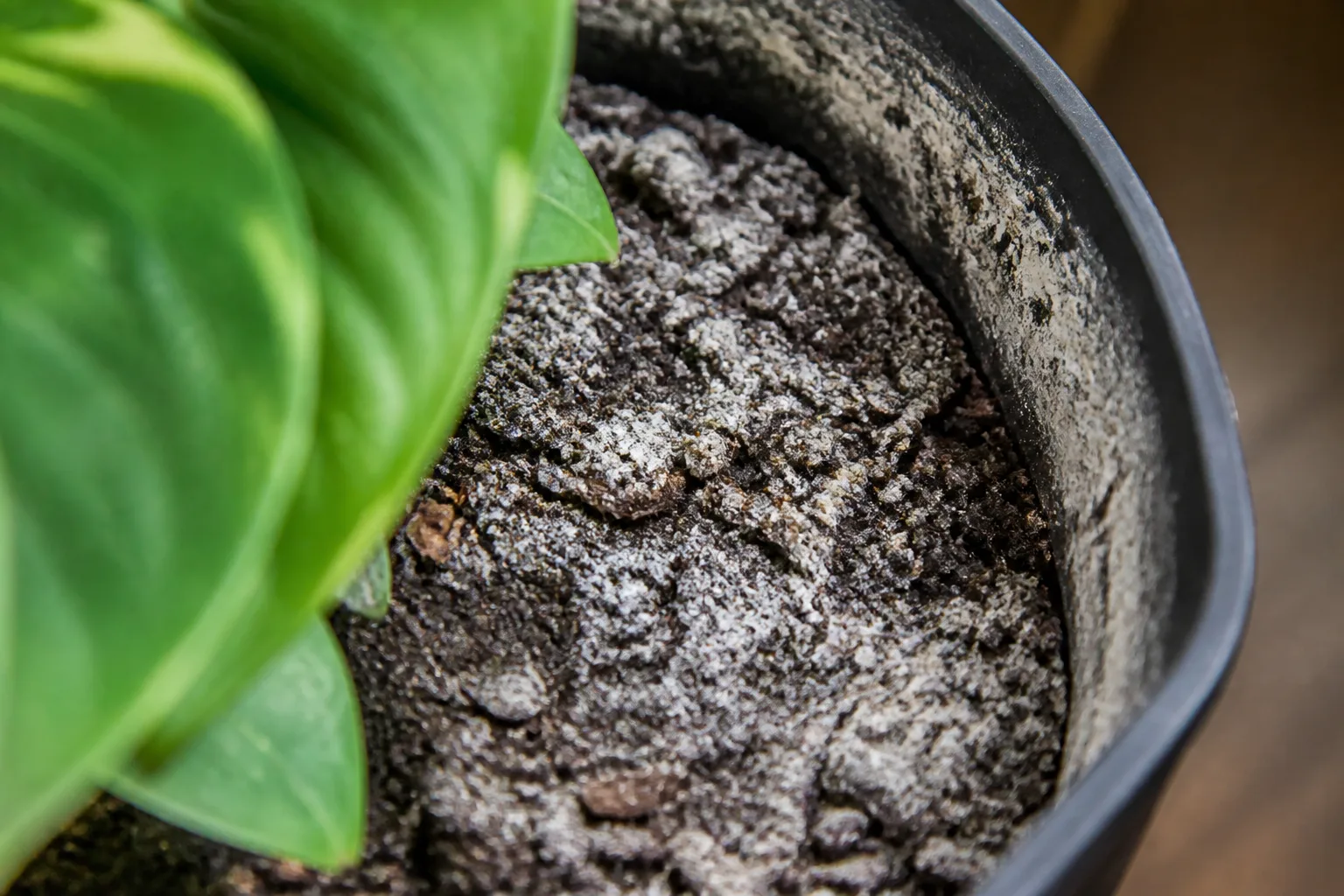
PlantTalk Colorado is direct: watering from the top is generally better than subirrigation for most houseplants because subirrigation can accumulate excess soluble salts in and on the soil surface. High salts reduce water uptake, restrict roots, burn foliage, and limit growth. If you water from the bottom, periodically water from the top to leach salts through the drainage holes. (PlantTalk Colorado)
Self-watering pots make the issue more likely over months because you may never pour enough water through the profile. Hard tap water and regular liquid fertilizer accelerate the climb. White crust on the mix, crispy brown tips, and slowed growth are the usual clues—see our salt build-up and hard water pages when those symptoms show up.
Trigger-Based Salt Flushes
You do not have to quit the reservoir. You do have to top-leach on purpose when triggers appear—not only because a calendar says so.
Flush when any of these show up:
- Visible white crust on the mix or rim
- Tip burn after weeks of hard-water-only refills
- You fertilized into the soil or (worse) into the reservoir
- Growth stalled with crusty surface despite a “full” indicator
- Roughly every four to eight weeks in active growth if you fertilize and none of the above appeared yet
How to flush:
- Let the reservoir run low or empty it.
- Take the pot to a sink or tub.
- Water thoroughly from the top until a generous volume exits the drainage path (Clemson HGIC ties thorough watering to washing out excess salts and wetting the lower root zone). (Clemson HGIC)
- Discard all runoff; do not pour it back into the reservoir.
- Resume reservoir culture only after the mix has drained and is no longer waterlogged.
- Cut fertilizer strength and frequency; salts from feed concentrate faster than salts from plain water.
For tip burn that looks like fertilizer injury, also read fertilizer burn.
Reservoir Hygiene and Cleaning Triggers
Virginia Extension tells owners to check reservoirs regularly and clean them periodically to prevent waterborne diseases or algae. (Virginia Cooperative Extension) Stale water, green film, and sour odor are not cosmetic—they signal biological growth in a dark, wet chamber connected to roots.
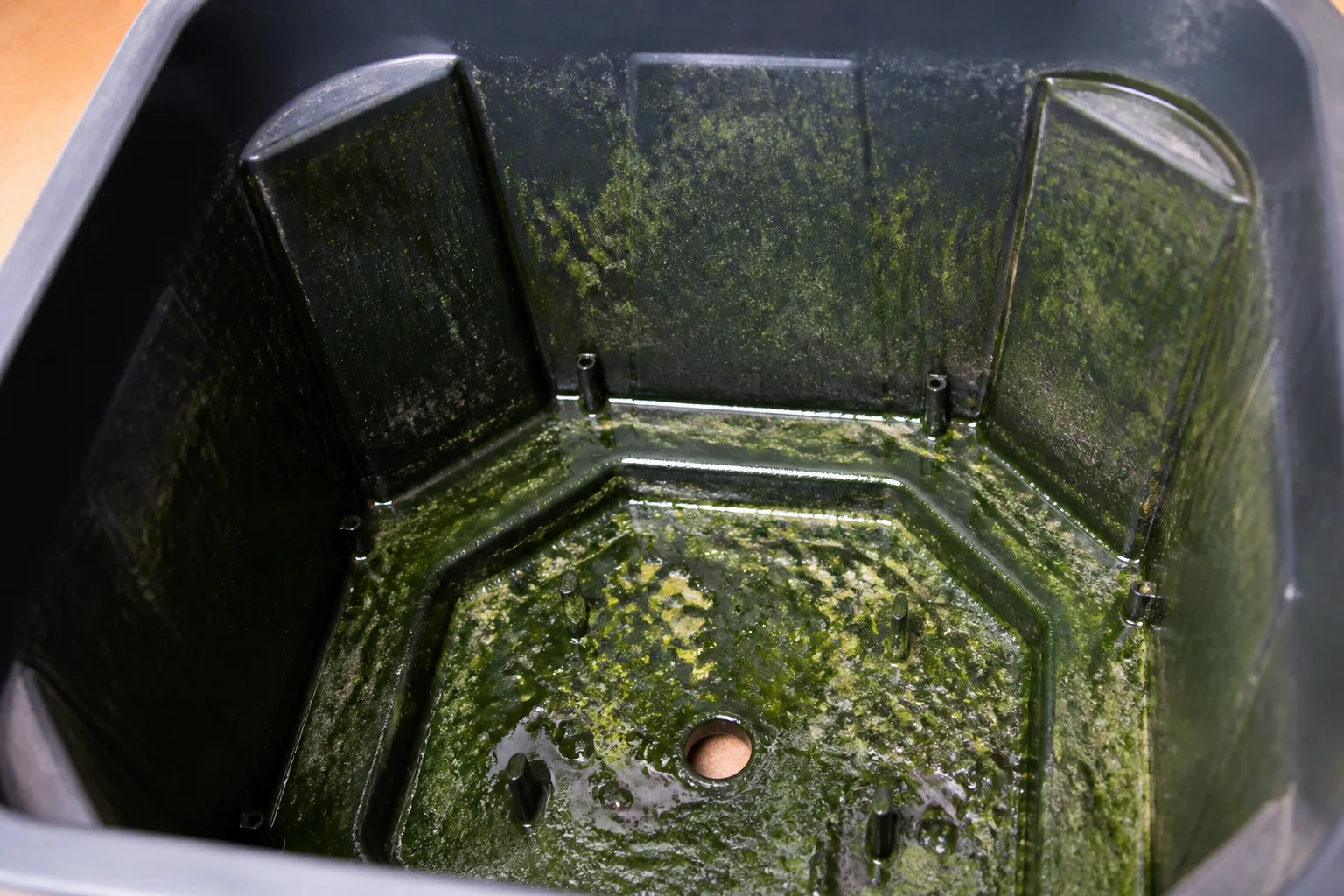
Clean on triggers, not only a fixed date:
- Green film, slime, or cloudy water in the window
- Sour or swampy odor when you open the fill tube
- Warm rooms that keep the chamber biologically active
- You have been dosing fertilizer into the reservoir
- Editorial practice for warm indoor setups: empty and scrub about every two to four weeks even if the water still looks clear
Practical hygiene routine:
- Empty the reservoir completely.
- Scrub the chamber, wick access, and fill tube with hot water; use a bottle brush for corners.
- For stubborn film, a mild vinegar rinse followed by a thorough fresh-water rinse works for mineral and light algae film as an editorial practice—never leave cleaning solution in the wick path.
- Replace degraded fabric wicks; cotton can rot and smell.
- Refill with fresh water. Do not dump saucer runoff or old reservoir water back in—Wisconsin Horticulture warns that drainage water can carry root-rot organisms. (Wisconsin Horticulture)
Keep the fill-tube cap on if your design has one so debris and fungus gnat adults are less tempted to treat the chamber as a pool. Persistently wet media also favor fungus gnats; Colorado State Extension notes larvae live in the moist upper inches of growing media and adults are drawn to moist peat-based mixes. (Colorado State Extension)
How to Use a Self-Watering Pot Correctly
Buying the pot is step zero. Setup and seasonal judgment decide whether the plant thrives.
Setup Week and Indicator vs Finger Check
- Confirm the design has a true separation between soil platform and max water line—and an overflow or clear max-fill mark.
- Use a light, well-aerated potting mix suited to the species, not dense garden soil. Outdoor wicking guidance still applies: media texture controls how well capillary action moves water. (UK Cooperative Extension)
- Pot the plant, water thoroughly from the top once to settle mix and wet the wick path, then drain excess.
- Fill the reservoir to the recommended level—not past the overflow.
- Check moisture at finger depth for several days. The surface may look drier than the lower zone; that can be normal, not a cue to top-water daily or keep refilling because the top looks dry.
- Trust the indicator for reservoir level, not plant thirst. If the plant softens while the window still shows water, empty the chamber and diagnose wet-wilt.
- If the mix stays soggy and the plant softens, empty the reservoir and switch to hand watering until roots recover.
Do not move a rotting plant into a self-watering pot as a “fix.” Fix drainage and root health first.
Never use a reservoir pot as a sealed cachepot with a nursery liner sitting in free standing water and no wick control. That is not self-watering—it is permanent saturation.
Seasonal Refills and Fertilizer Rules
Refill when the indicator drops or the reservoir is nearly empty—not on a rigid calendar. In bright warm months, thirsty plants may empty a small reservoir in days. In winter, the same plant may barely sip; leave the chamber empty or half-filled and water manually when the mix actually needs it. RHS notes winter houseplants can often sit a week or two with moist—not waterlogged—compost if temperatures stay safe. (RHS)
Keep fertilizing light. Feed into the soil from above at reduced strength during growth, then flush periodically. Avoid dumping concentrated fertilizer into the reservoir unless the manufacturer explicitly designs for nutrient solution—and even then, expect faster salt and algae issues. Prefer top-feed + scheduled top flushes over nutrient soup in the dark chamber.
First-Hand Notes From Running Reservoir Pots
These are single-apartment LeafyPixels editorial observations (north-central Ohio)—not universal lab thresholds. They shaped the fit, flush, and winter-pause advice above.
Snake plant on a fabric wick (June 2025): A small snake plant in a discount wick pot stayed plump for about three weeks, then the lower leaves yellowed and the rhizome softened while the indicator still showed water. Emptying the chamber and switching to a dry-down in terracotta stopped the decline; the plant never belonged on a permanent moisture tap, matching Virginia Extension’s dryer-soil caveat.
Peace lily winter overfill (January 2026): A peace lily that thrived on reservoir culture in summer was left with a full chamber under short daylight. Leaves drooped while the mix stayed wet (wet-wilt, not drought wilt). Emptying the reservoir and waiting for mid-depth dry-down before hand watering restored firmness over about ten days. Lesson: summer success does not authorize a full winter reservoir.
Hard-water salt crust (October 2025–March 2026): A self-watering pothos refilled only with hard tap water and dilute feed developed a chalky surface crust after roughly twelve weeks without a top flush. Two thorough sink flushes (runoff discarded) cleared visible crust; tip burn stopped progressing once flushes became trigger-based after fertilizing or crust sightings.
Algae after fertilizer-in-reservoir (August 2025): Dosing liquid fertilizer into a clear-window reservoir on a fern produced green film within two weeks in a warm room. Scrubbing, a mild vinegar rinse, fresh water only, and returning feed to diluted top applications kept the chamber clearer for the next month. Cleaning cadence should accelerate whenever nutrients enter the dark water.
Travel-week success (April 2026): The same peace lily on a half-full reservoir handled a seven-day trip in bright spring light without wilt—because growth was active and the chamber was not topped to the overflow. Travel buffers work best on thirsty plants in growth, not on dry-down species or winter pots.
Common Mistakes That Cause Root Rot
Missouri Botanical Garden explains the core injury: roots in waterlogged soil lose oxygen, die, and then invite pathogens such as Phytophthora in periodically saturated soils. (Missouri Botanical Garden) Wisconsin Horticulture stresses drainage holes plus never leaving plants in drainage water, and not reusing drainage water that can carry root-rot organisms. (Wisconsin Horticulture)
Common self-watering failures:
- Wrong plant on a permanent wick (succulents, snake plant, ZZ)
- Overfilling past the soil platform so roots sit in free water
- Never top-flushing, so salts injure roots that then rot more easily
- Ignoring winter and keeping the reservoir full while light is low
- Skipping reservoir cleaning until slime and odor appear
- Using the pot as a sealed cachepot for a nursery liner with no wick control
- Believing the indicator over finger depth when the plant softens
If leaves yellow from the bottom, growth stalls, and the mix smells sour, empty the reservoir immediately and diagnose with our overwatering and root rot guides before you refill.
Related guides
- DIY self-watering system: what actually works — wick, bottle, tote, and capillary-mat builds
- Top watering vs bottom watering — timed soaks vs overhead; salt-flush logic
- How to bottom water houseplants — basin soak steps without a permanent reservoir
- How to water indoor plants the right way — finger checks, drainage, saucer habits
- Terracotta vs plastic pots — dry-down behavior when a reservoir is the wrong tool
- Hard water and houseplants — mineral load that accelerates tip burn
- Salt build-up — crust and tip-burn symptom path
- Overwatering — wet-wilt diagnosis when a reservoir went too far
- Fungus gnats — wet-media pests that love constantly moist mix
- Root rot — soft brown roots mean you must dry down
Conclusion: Fit + Flush + Clean Checklist
Self-watering pots earn their place when you match them to moisture-loving houseplants, keep the reservoir below the root platform, clean the chamber when film or odor appears, and top-leach salts so upward watering does not quietly burn roots. They fail when you treat them as universal easy-mode for snake plants, succulents, or winter-dormant pots that barely drink.
Do this next:
- Fit — peace lily / fern / calathea yes; snake plant / ZZ / succulent / winter citrus no.
- Fill — to the max mark only; never past the soil platform; never as a sealed cachepot swamp.
- Flush — on crust, hard-water stress, or fertilizing—not only on a vague monthly habit.
- Clean — on film, odor, warmth, or fertilizer-in-reservoir use; discard runoff, never pour it back.
- Pause — empty or half-fill in low-light winter; trust finger depth over the indicator when the plant softens.
A good self-watering pot reduces daily emergencies. It should never hide soggy roots or replace basic watering sense.