Bird of Paradise Care: Light, Water, Splits, and Blooms
Indoor bird of paradise care: bright light, space for tall paddles, watering by dry-down, soil mix, normal leaf splits vs damage, and bloom expectations.
Buy a “bird of paradise” for the orange crane bloom, bring home a giant white Strelitzia nicolai that scrapes a normal ceiling, or panic when mature paddle leaves tear along the veins — and you have already hit the three mistakes that drive most indoor Strelitzia searches. Bird of paradise care indoors is a light-and-space problem first, a dry-down watering problem second, and a fertilizer problem last. Clean vein splits are often normal. Flowers are a multi-year bonus funded by sun, maturity, and a slightly snug pot — not by weekly feed alone.
This page is the practical on-ramp for indoor Strelitzia: confirm the species, place it for real daylight and outward-arching leaves, water by season and pot weight, use free-draining fertile mix, triage splits versus scorch or wet roots, handle outdoor summering, and keep pets away from fruit and seeds. Written by Sai Ananth (B.Pharmacy; LeafyPixels lead writer) and reviewed by Dr. Priya Menon (Ph.D. Botany; indoor plant physiology and stress) on 2026-08-02. Dry-down intervals and window distances below are labeled editorial observations from Strelitzia reginae plants — your windows, pot size, and climate will shift the numbers.
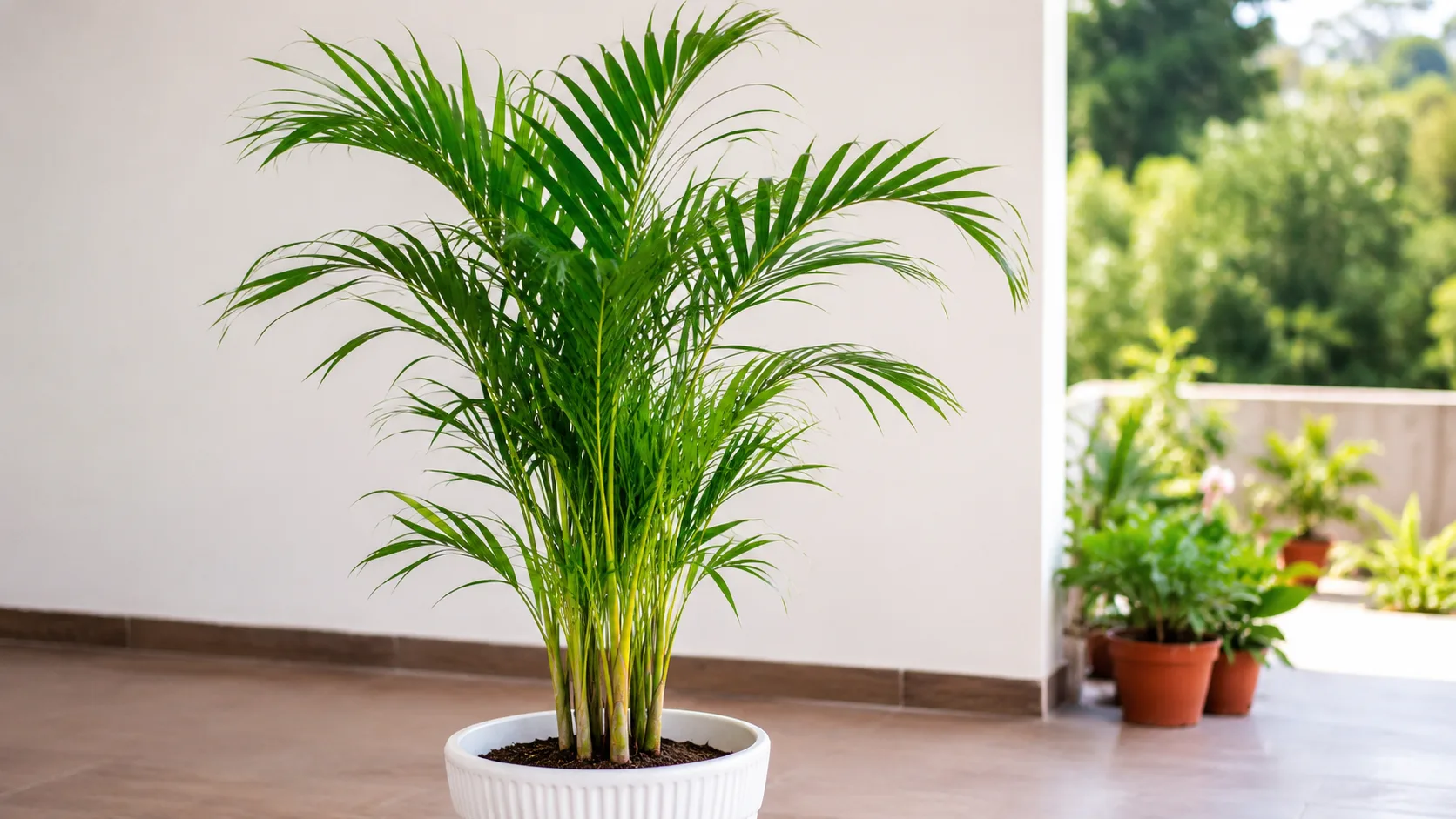
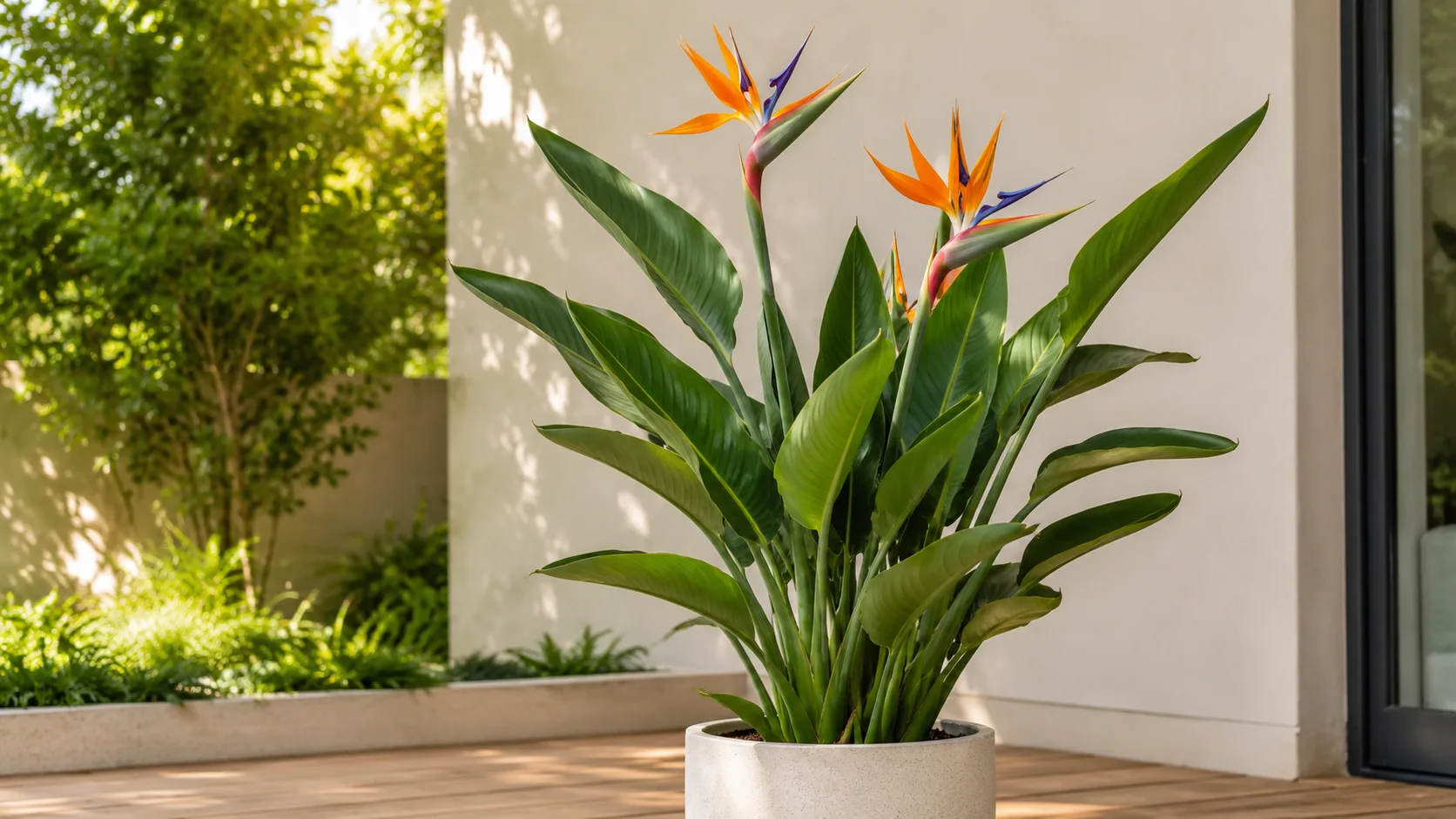
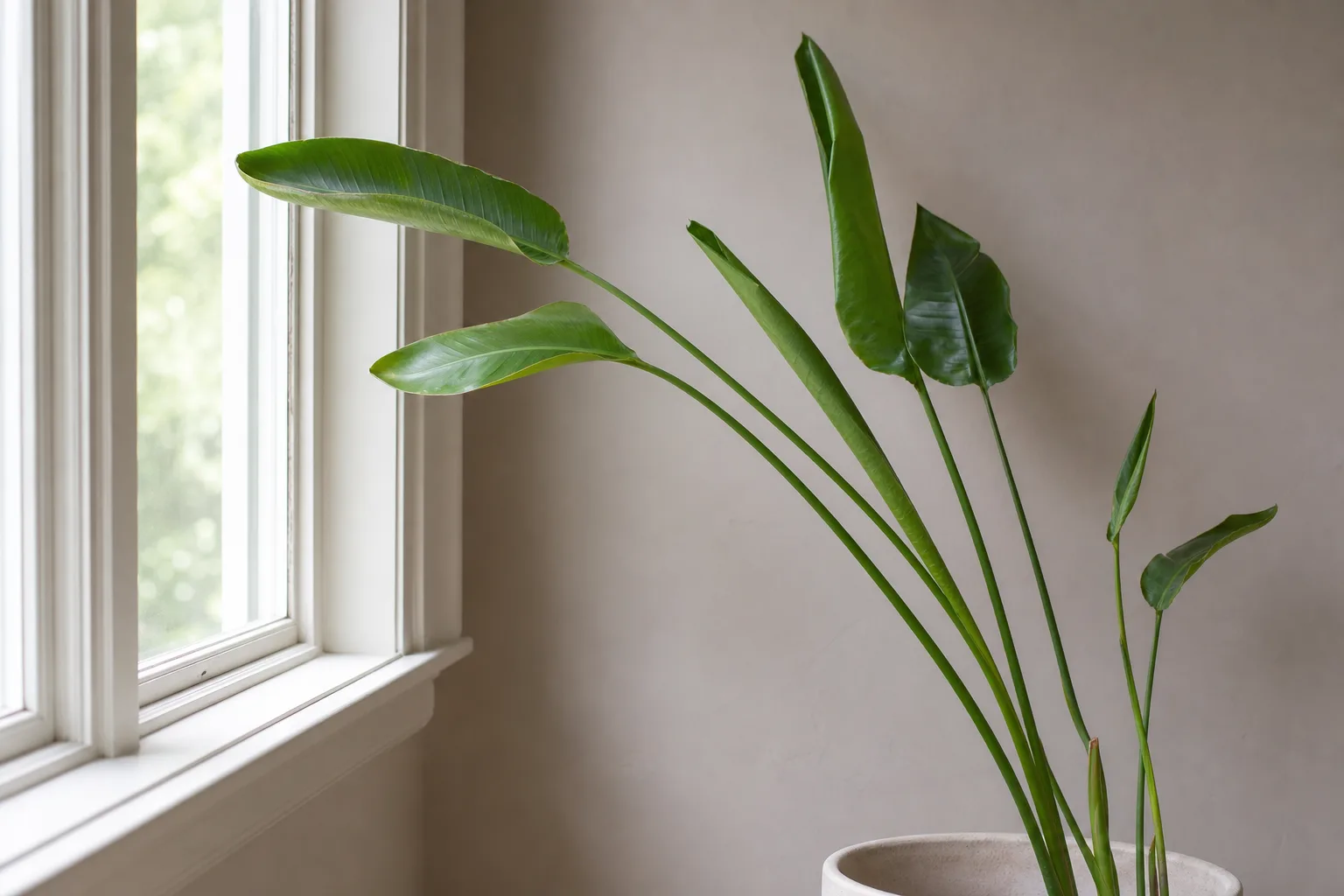
LeafyPixels hero: healthy indoor bird of paradise (Strelitzia reginae) with upright paddle leaves in bright light — the baseline success metric before chasing blooms.
Who This Guide Is For
Use this guide if you are choosing between orange and white “bird of paradise” tags, placing a new plant in a bright room, learning a seasonal watering rhythm, or deciding whether leaf splits mean damage. If you already have soft yellow leaves, a sour heavy pot, or a ceiling-scraping canopy, finish the matching section here, then open the symptom page on the Bird of Paradise care hub. Do not stack fertilizer, a big repot, and a hard prune in the same week unless roots are failing.
Strelitzia reginae vs Strelitzia nicolai: Buy the Right Plant
The retail label “bird of paradise” covers more than one plant. Strelitzia reginae (orange bird of paradise / crane flower) is the clumping houseplant most people should buy for rooms with standard ceilings. Strelitzia nicolai (giant / white bird of paradise) is a tree-scale species sold for tropical drama — and it outgrows many apartments before it ever flowers indoors.
NC State Extension describes S. reginae as a South African clumping tropical with gray-green leaves from underground rhizomes and the famous bird-head inflorescence. Missouri Botanical Garden lists outdoor hardiness roughly USDA zones 10–12, foliage about 3.5–4 feet, and culture of full sun to part shade in rich, loamy soil. The Royal Horticultural Society profiles S. reginae as an evergreen perennial to about 1.5 m (5 ft) with orange and blue flowers from a beak-like spathe — and notes plants may take years to bloom and flower better when slightly pot-bound with adequate light and feed.
Strelitzia nicolai is a different design problem. NC State lists mature outdoor height around 20–30 feet, leaves up to about 6.5 feet long that tear easily in wind, and aggressive roots outdoors. The RHS growing guide warns S. nicolai can reach up to 10 m (33 ft) eventually and is too big for most homes long term. UF/IFAS likewise frames white/giant bird of paradise as a 20–30 ft landscape plant whose banana-like leaves shred in wind. If the nursery tag only says “bird of paradise,” ask for the botanical name before you commit floor space.
| Check | S. reginae (crane flower) | S. nicolai (white / giant) |
|---|---|---|
| Typical indoor role | Manageable statement plant | Atrium / double-height foliage |
| Mature scale | ~3–5 ft indoors (clump) | Often 8–10 ft+ indoors; huge outdoors |
| Flowers | Orange and blue; possible with maturity + light | White and blue; rare indoors |
| Leaf habit | Narrower upright paddles | Broad banana-like blades |
| Best buy if… | You want blooms someday in a bright room | You have height and accept foliage-only |
Size, Flowers, and Realistic Indoor Expectations
RHS guidance is blunt: S. reginae usually needs to be a substantial size and often five to ten years old before it flowers, and seed-raised plants can take five or more years to reach flowering size. That is not a failure of your fertilizer — it is the biology of a slow-to-bloom subtropical. Indoors, treat flowers as a long-term bonus funded by strong light, stable care, and maturity. Treat bold foliage as the baseline success metric.
Retail “already flowering” plants skip some of that wait under nursery glass, then stall blooms for seasons after a dim apartment move. Expect a recovery window measured in seasons, not weeks: restore direct sun and stable dry-down first, keep the pot slightly snug, and do not use a jump into an oversized decorative pot as the “bloom fix.”
Quick Care Snapshot
For healthy indoor bird of paradise, place the plant in the brightest practical light (ideally several hours of direct sun for reginae), water so the mix stays moist but not soggy in active growth and drier in winter, use a fertile, free-draining mix in a pot with a drainage hole, and plan for a canopy that can exceed 1 m (3+ ft) wide as leaves arch outward.
| Care factor | Baseline target | Deeper guide |
|---|---|---|
| Light | Sunny window / conservatory; screen hottest midday if needed | Light guide |
| Water | Moist in spring–summer; fairly dry between drinks in late winter | Watering guide |
| Soil | Loam-based, free-draining mix with grit/perlite | Soil guide |
| Feed | Liquid feed about fortnightly in spring–summer | Fertilizer guide |
| Pot | Slightly snug encourages flowering; step up slowly | Repotting guide |
| Space | Leave room for outward-arching paddles | Hub overview |
If you are still building general indoor watering judgment, pair this with how to water indoor plants the right way. Large leaves lose water fast in heat, so dry-down is tied to light and room temperature more than to a fixed calendar.
Light and Floor Space for Tall Paddle Leaves
Put bird of paradise in the brightest window you can give it — preferably south or west — with clearance for leaves that arch outward. Bright indirect light farther from the glass keeps foliage alive, but growth slows and indoor flowering odds collapse. Space matters as much as foot-candles: an established clump’s long-stemmed leaves can reach well over 1 m (3¼ ft) wide per RHS, and crowding against walls shreds edges while shading the crown.
NC State lists S. reginae for full sun (6+ hours) to partial shade (2–6 hours). Missouri Botanical Garden recommends a well-lit, sunny spot indoors, with screening against very bright direct sun in summer. The RHS positions strelitzias beside a large sunny window or conservatory, with full light and shade from the hottest midday sun under glass. Clemson HGIC likewise prefers full sun and notes a south-facing window as a workable indoor light source.
South and West Windows, Grow Lights, and Acclimation
South and west windows are the default for reginae bloom ambition. Place the pot close enough that midday light actually hits the canopy, then screen with sheer curtains or a temporary setback if new leaves bleach or crisp. East windows often support decent foliage with morning sun; north windows usually produce lean, slow plants unless you add supplemental light.
Leaves formed in a dim shop burn when you suddenly park them in unfiltered afternoon sun. Acclimate over 7–14 days, adding direct exposure gradually. If natural light is weak year-round, a full-spectrum LED on a 12–14 hour timer about 18–30 inches above the canopy is a starting heuristic — then watch new leaves for stretch versus bleach and adjust distance. Wipe dust off paddles occasionally so light reaches the leaf surface. When windows alone cannot fund growth, see grow lights for indoor plants.
LeafyPixels editorial setups (bright S. reginae plants during plant-hub drafting, warm active growth):
| Setup | Placement | Pot | Typical summer dry-down | Outcome noted |
|---|---|---|---|---|
| A — close south glass | ~18–24 inches from unobstructed south window | 12-inch terracotta | About 7–10 days to top-2-inch readiness | Fuller-width new paddles; predictable rhythm |
| B — same plant pulled back | ~3+ feet from the same glass | Same pot | Often 11–14+ days | Stayed green; thinner paddles; “alive but not thriving” |
| C — plastic twin | Same close south band as A | Matching 12-inch plastic | Often 1–2 days slower than terracotta | Held moisture longer; easier to overwater in cloudy weeks |
These are single-room observations, not universal schedules. Your climate, pot volume, and HVAC drafts will move the numbers.
Why Indoor Blooms Stall (Age, Light, Pot Size, Species)
Indoor non-flowering is usually one of four things: wrong species (nicolai), immaturity, insufficient light, or a recent oversized repot that traded bloom pressure for vegetative growth. RHS notes plants flower better when slightly pot-bound and given adequate light and feed. Fertilizer alone will not fund blooms in a dim corner.
Nursery already flowering → apartment stall: A plant that bloomed under glass can go seasons without another spathe after a move into weaker light. Typical recovery path: restore several hours of direct sun, keep the root ball slightly snug, resume spring–summer feeding only after dry-down is stable, and measure progress across seasons — then use the no flowers page for a symptom-specific checklist.
Watering by Season and Dry-Down Checks
Water when the top ~2 inches (5 cm) of mix are partly dry in spring and summer, soak until runoff, empty the saucer, and let the mix get fairly dry between drinks from late autumn into winter. Large paddles move a lot of water in heat; calendars fail when light and room temperature change.
RHS watering guidance for active growth is to keep compost constantly moist but not saturated, with the caveat that plants may need more frequent watering in warm weather because leaves lose water quickly. Reduce watering through autumn; from late November onward, let compost get fairly dry between waterings. Missouri Botanical Garden and NC State align on watering freely in spring and summer and keeping plants drier in winter. Clemson HGIC frames the same habit — wet thoroughly, then allow the mix to dry slightly before watering again, with less frequent winter watering.
In bright, warm rooms, many reginae pots dry enough for a thorough soak about every 7–10 days in summer and every 14–21 days (or longer) in cooler, darker months — those intervals are starting ranges, not laws. Turn the pot a quarter turn at each watering so the plant does not permanently lean into the light. Full seasonal technique lives on the watering guide.
Overwatering vs Underwatering Signals
Chronic wetness shows as yellowing lower leaves, a persistently heavy pot, sour or anaerobic mix, and eventually soft roots — escalate via overwatering and root rot. NC State notes root rot from overwatering or poorly drained soils. Drought stress shows as curling, crispy margins, and limp leaves after the pot went light and the mix pulled from the sides — see underwatering and brown tips. Bird of paradise generally tolerates brief dryness better than sitting in a swampy pot in low winter light.
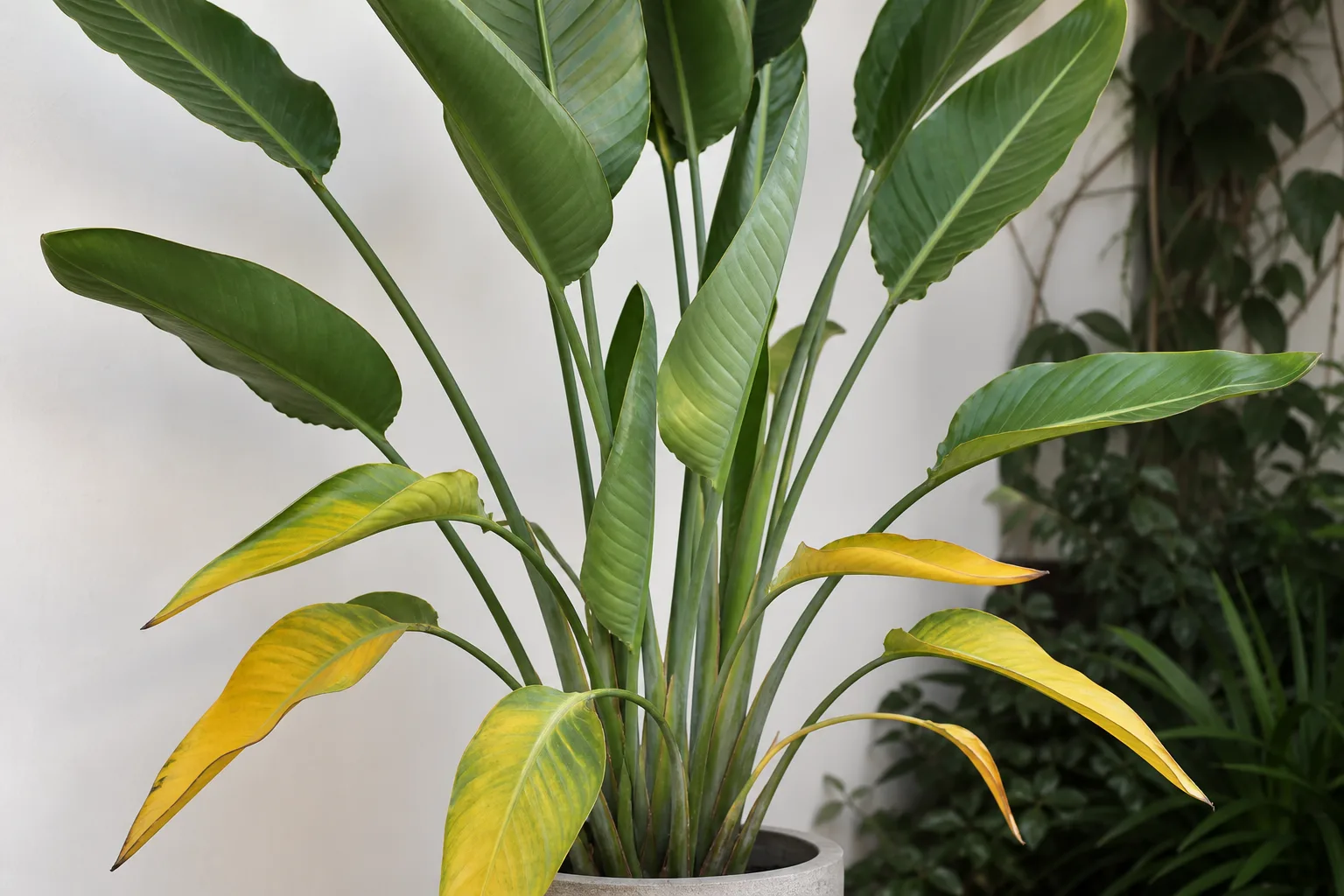
LeafyPixels diagnostic: yellowing lower leaves on bird of paradise — pair with pot weight and smell before assuming a fertilizer fix.
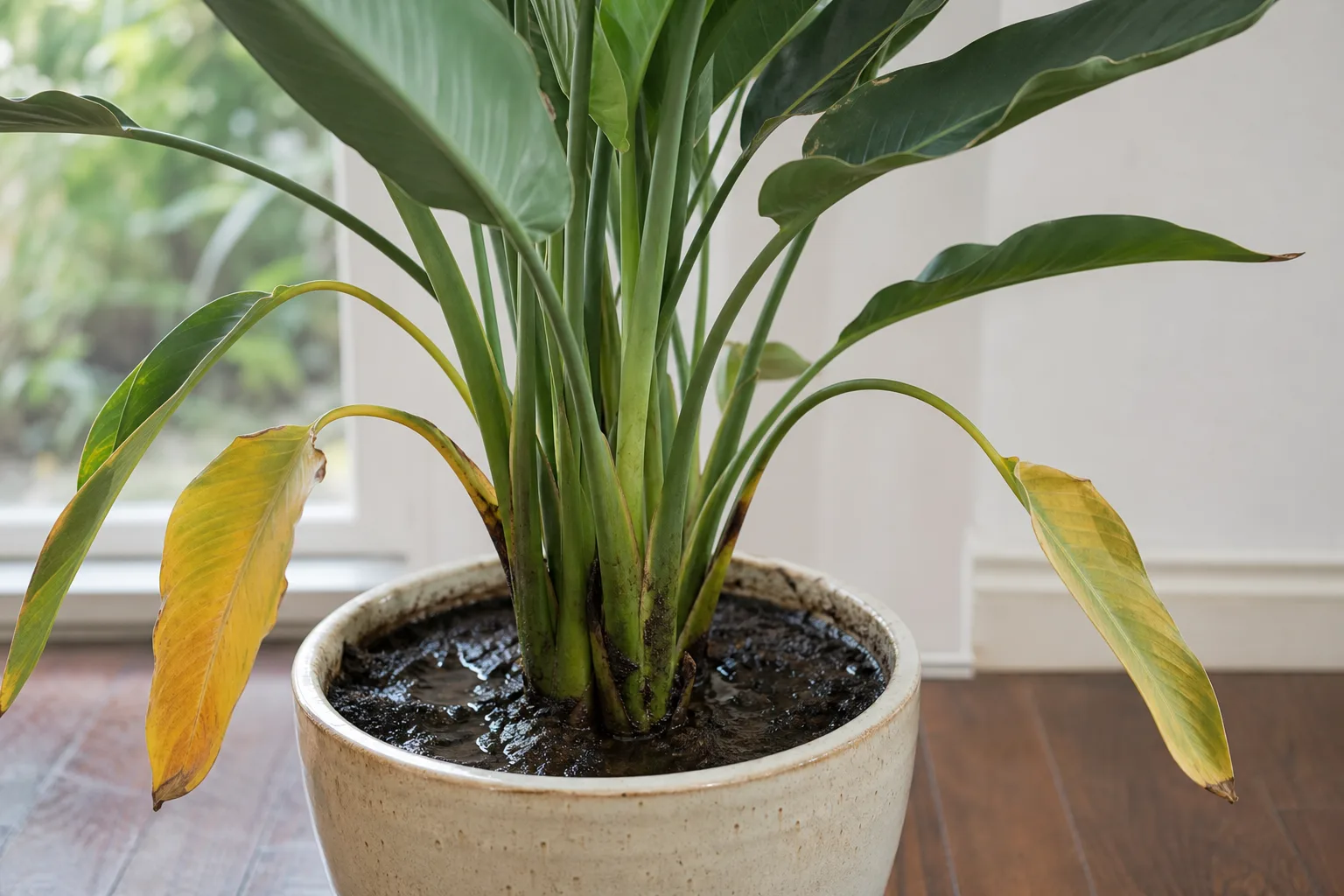
LeafyPixels diagnostic: overwatering pattern — heavy pot, lingering wet mix, and canopy decline that does not improve with more water.
Soil, Pot Size, and When Repotting Helps or Hurts Blooms
Use a fertile, well-drained mix. Missouri Botanical Garden recommends well-drained soil indoors; RHS suggests peat-free loam-based compost such as John Innes No. 3 with added grit. A practical home mix is quality potting soil with roughly 20–30% perlite or grit (and optional bark). In terracotta, expect faster dry-down than the same diameter in plastic — useful in bright rooms, riskier if you already under-water. In plastic or glazed ceramic, watch for leftover wet cores after cloudy weeks. NC State lists good drainage with moist to occasionally dry conditions and a wide soil pH tolerance — focus on structure and drainage more than chasing a narrow pH number.
Newly purchased plants often do not need an immediate repot. RHS recommends keeping plants slightly pot-bound to encourage flowering, then repotting every couple of years in spring after flowering into a pot only slightly larger. Annual top-dressing — refreshing the top ~5 cm (2 in) of compost — gives a boost without sacrificing bloom pressure. Choose a heavy pot for tall, top-heavy clumps, and never skip the drainage hole. Full technique lives on the repotting and soil topic pages.
Should you repot to get flowers? Usually no. Jumping into a much larger pot often delays blooms by prioritizing root and leaf growth. Upsize only when roots fill the container or the mix fails; step up one pot size at a time.
Split Leaves vs Scorch, Pests, and Wet Roots
This is the question that drives half the panic searches: why are the leaves splitting? On Strelitzia, orderly splits along the veins of large paddles are often normal and adaptive. Broad blades catch wind outdoors; tearing along the leaf allows air to pass so petioles are less likely to snap. NC State explicitly notes that S. nicolai leaves are easily ripped or torn by the wind, and RHS flags shredded leaves when plants summer outdoors in windy spots. UF/IFAS makes the same wind-shred point for giant white bird of paradise foliage.
Symmetric, clean splits on otherwise firm, green mature leaves are usually not a watering emergency and not a disease. They are part of how large strelitzia foliage behaves — especially on nicolai, and commonly on mature reginae paddles in drafts or after outdoor time.
How to Tell Adaptive Splits From Damage
Use this decision aid before you change care:
| What you see | Likely cause | What to do |
|---|---|---|
| Clean splits along veins; leaf otherwise firm and green | Adaptive / normal shredding | Accept it; reduce wind/draft exposure if cosmetic |
| Ragged, uneven tears, creases, or crushed tissue on one side | Mechanical damage (pets, doors, furniture, shipping) | Move the plant; prune only fully ruined leaves |
| Bleached patches, crisp sun-facing edges after a move | Scorch / sudden high light | Acclimate; add sheer screen at peak sun |
| Yellowing + soft base + heavy sour pot with splits | Wet roots, not “split disease” | Check drainage; follow root-rot workflow |
| Speckling, webbing, sticky residue with tatty edges | Pests (mites, scale, mealybugs) | Inspect undersides; treat pests |
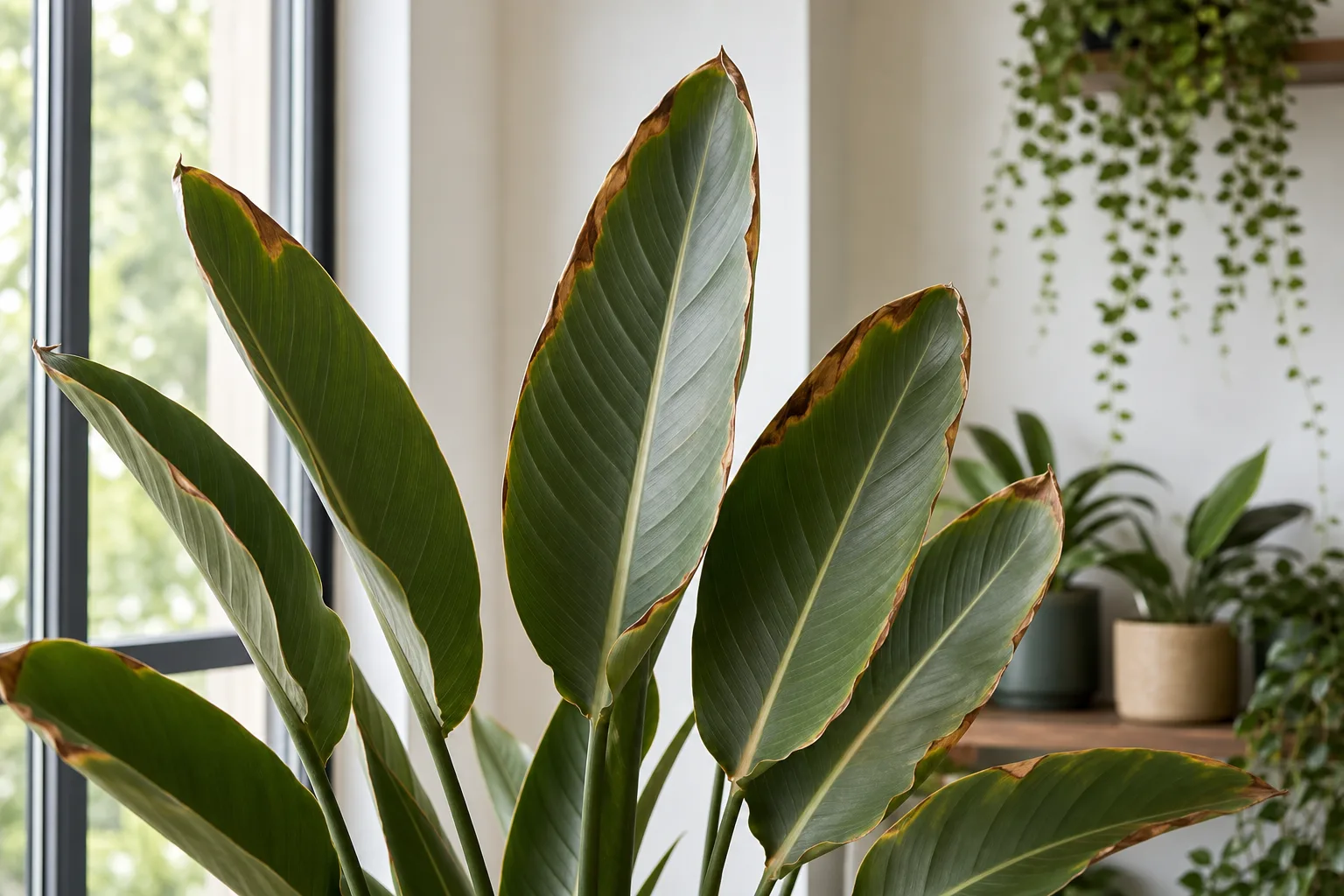
LeafyPixels diagnostic: brown tips and crisp margins — often scorch, dry air, or uneven watering, not the same as clean adaptive vein splits.
Outdoor summering amplifies shredding. RHS advises a warm, sunny, sheltered spot and warns strong wind shreds leaves, snaps stems, or tips top-heavy pots. Indoors, keep the clump out of HVAC blast paths and narrow hallways where people brush the canopy. Remove only leaves that are fully brown or so torn they cannot photosynthesize — cutting every split leaf just wastes canopy. Wear gloves when cutting if sap irritates your skin (NC State notes contact-irritation risk on nicolai handling).
Humidity, Temperature, and Outdoor Summering
Strelitzias like warmth and some humidity. RHS says temperatures should not drop below 10–12°C (50–54°F), with ventilation when rooms exceed about 20°C (68°F). Missouri Botanical Garden cites night temperatures around 55–65°F and suggests moving plants to a semi-shaded outdoor spot with air circulation when outdoor temps rise above 70°F. Clemson HGIC prefers roughly 65–70°F days and cooler nights, with humidity near 60% helpful in dry winters.
Outdoor summering protocol (container plants):
- Harden off over 7–14 days — start with shaded outdoor hours, then increase sun.
- Choose a warm, sunny, sheltered patio spot; stake or use a heavy pot so wind cannot tip the plant.
- Expect more frequent watering in heat; empty saucers after storms.
- Bring the plant indoors before nights approach the 12°C (54°F) floor — do not wait for the first frost scare.
- Quarantine and inspect undersides for pests before the plant rejoins your indoor collection.
Homes are often dry. RHS recommends misting or a tray of damp gravel; a nearby humidifier or pebble tray helps more than occasional mist alone for large canopies — see houseplant humidity guidance and the plant’s low humidity page if tips stay chronically crisp despite correct watering. Dust blocks light on broad leaves; wipe with a damp cloth periodically.
Feeding, Pruning, and Division Basics
These are hungry plants in active growth. RHS recommends a liquid houseplant feed about fortnightly through spring and summer; Missouri Botanical Garden notes regular feeding in spring and summer with a dry-down winter. Clemson HGIC schedules fertilizer every 2 weeks in spring and weekly in summer, then none in fall/winter — and warns that overfertilization can push foliage at the expense of flowers. Practical middle path for most homes: a balanced liquid feed at half to full label strength every 2 weeks from spring through summer while the plant is in bright light and actively drinking; stop or sharply reduce once growth slows and the mix stays wet longer. Do not fertilize a plant sitting in cold, dim conditions with wet soil — fix light and watering first. Details live on the fertilizer guide.
Pruning is housekeeping, not shaping topiary: remove browning or tatty leaves at the base with clean secateurs, and cut spent flower stalks after blooms fade. See pruning.
Division checklist (spring, before strong new growth): lift the clump, cut the rhizome so each piece has a fan of leaves plus roots (Clemson HGIC), pot divisions into snug containers with free-draining mix, keep bright indirect light and even moisture while roots re-establish for several weeks, then return to stronger sun. Flowering on divisions often resumes in a few years — faster than seed, slower than “next month.” Step-by-step detail is on the propagation page.
Common Problems and When to Use the Plant Hub
Most bird of paradise problems are cultural. Yellow leaves often track overwatering, aging lower leaves, or sudden light collapse — start with yellow leaves. Brown tips and edges plus slow growth and no flowers are flagged by RHS as signs conditions are off — check humidity, feed, water, and especially light. Leggy, thin new growth points to not enough light.
LeafyPixels diagnostic: not-enough-light pattern — thinner, stretched growth that needs a brighter window before more fertilizer.
Pest watch list from NC State and RHS: mealybugs, scale, and spider mites (plus aphids on nicolai notes). Inspect leaf undersides and leaf axils monthly. Sticky residue, cottony clusters, or fine webbing mean treat the pest — do not drown the plant hoping water fixes insects. Use mealybugs, spider mites, and aphids for species-specific workflows, and broader pest context from how to tackle indoor plant pests at home.
Pet Safety (Strelitzia vs Mexican Bird of Paradise)
The ASPCA lists Bird of Paradise Flower (Strelitzia reginae) as toxic to dogs, cats, and horses, with GI irritants and clinical signs of mild nausea, vomiting, and drowsiness — caused mainly by fruit and seeds. It should not be confused with Caesalpinia (Poinciana) gilliesii, also called bird of paradise and described by ASPCA as more toxic. Keep seed pods away from pets, place floor specimens out of chew range, and contact a veterinarian or ASPCA Animal Poison Control at (888) 426-4435 if ingestion is suspected.
First-Week Checklist
- Confirm botanical name (reginae vs nicolai) and measure available height and width.
- Quarantine and inspect undersides for mealybugs, scale, and mites before joining other plants.
- Place in the brightest suitable window; acclimate if the nursery was shaded.
- Learn dry-down: note pot weight at purchase, then water only when the top inches justify it.
- Do not repot on day one unless the mix is soggy, compacted, or pest-ridden.
- Wipe leaves, empty saucers, and keep pets away from any fruit or seeds.
- Bookmark hub pages for light, watering, and no flowers before you chase blooms with fertilizer.
Related Guides
- Bird of Paradise care hub — full topic and problem index
- Bird of Paradise light — window placement and bloom light
- Bird of Paradise watering — seasonal dry-down detail
- Bird of Paradise soil — mix and drainage
- How to water indoor plants the right way — soil-check habit
- Grow lights for indoor plants — when windows are weak
- Houseplant humidity guide — dry-air tip burn context
- The 7 best large indoor plants — other statement foliage options
Conclusion
Judge indoor bird of paradise success by seasonal checkpoints, not by one weekend of care:
- Spring: Confirm species and pot size; resume fortnightly feeding only after bright light and dry-down are stable; divide or gently upsize only if roots demand it.
- Summer: Keep the plant close to strong sun (or outdoor sheltered heat); water more often as paddles drink; empty saucers; watch for wind shredding outdoors.
- Autumn: Reduce watering as light drops; bring outdoor plants indoors before nights near 12°C (54°F); quarantine for pests.
- Winter: Let the mix get fairly dry between drinks; stop routine fertilizer; protect from cold drafts; accept that bloom waits for maturity and spring light.
Buy Strelitzia reginae unless you truly have room for nicolai, give the plant a sunny window with clearance for arching paddles, water by season and pot weight, and treat clean vein splits as normal foliage behaviour unless soft roots, pests, or scorch tell a different story. For symptom-level depth, return to the Bird of Paradise hub and work one variable at a time.