14 Pretty Carnivorous Plants That Eat Bugs
Compare 14 carnivorous plants by trap type, growing conditions, beginner difficulty, water, light, and whether they belong indoors or in a bog garden.
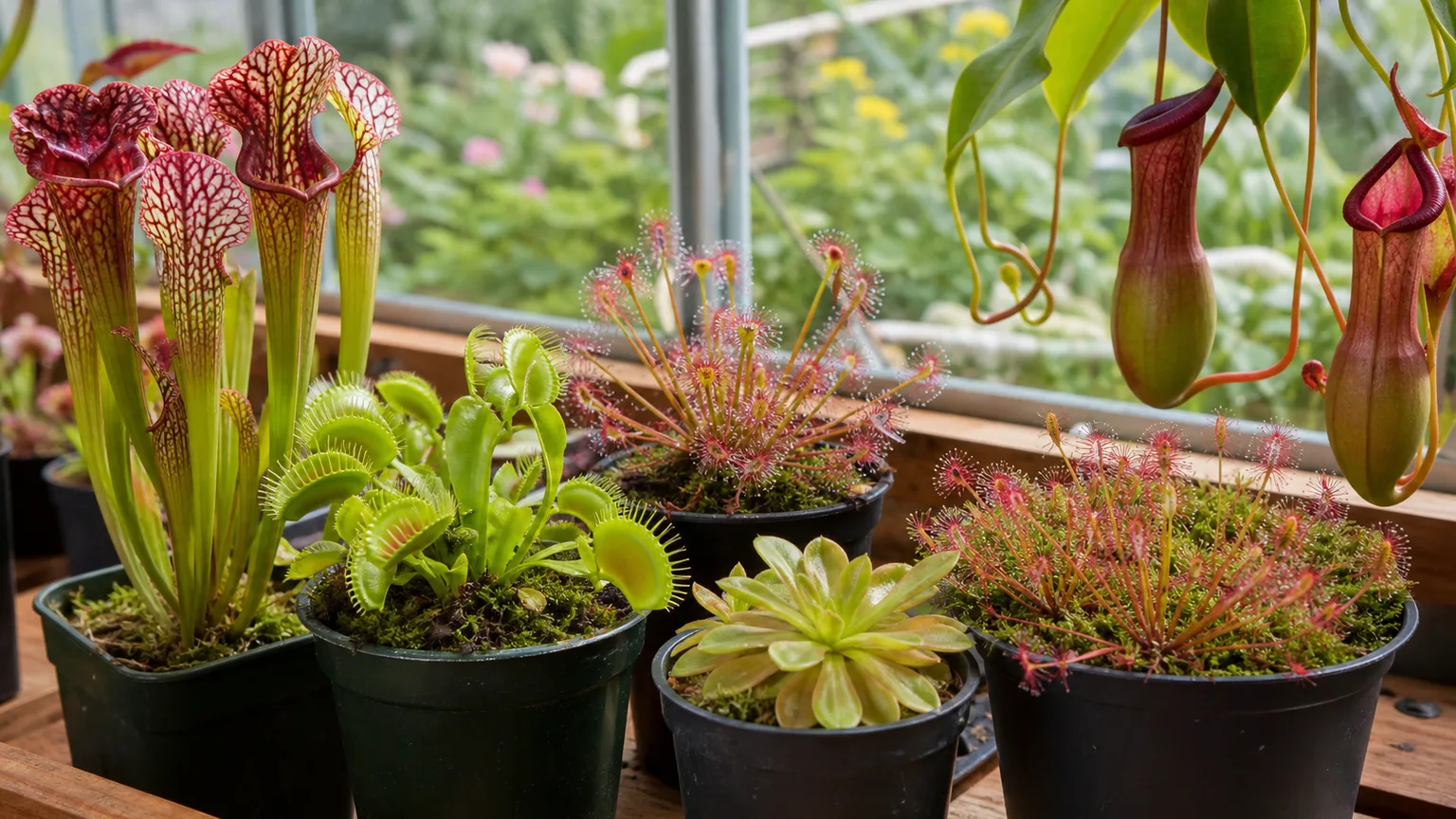
Carnivorous plants are not just novelty houseplants with theatrical traps. They are a remarkably diverse group of plants that evolved to supplement life in nutrient-poor habitats by attracting, capturing, digesting, and absorbing nutrients from small animals. Their colors, shapes, and mechanisms are so varied that a collection can look more like a living sculpture garden than a row of ordinary pots.
The catch is that “carnivorous plant” is not a care category. A Venus flytrap, tropical pitcher plant, and butterwort may all eat insects, but they do not want the same light, water level, temperature, or winter routine. Use the list below to choose by habitat first and appearance second.
What makes a plant carnivorous?
Carnivory is more than a leaf that happens to trap a bug. A true carnivorous plant has a way to attract or intercept prey, hold it, digest it or rely on digestion by organisms inside the trap, and absorb useful nutrients. The Botanical Society of America groups the best-known mechanisms as pitfall, flypaper, snap, and suction traps, while the Natural History Museum describes additional snare-like systems in plants such as corkscrew plants (Botanical Society of America; Natural History Museum).
Most carnivorous plants still depend on photosynthesis for energy. The insects are a nutrient supplement, not a replacement for good light or a healthy root system. That is why feeding a plant more bugs will not rescue one growing in the wrong soil or sitting in a dark room.
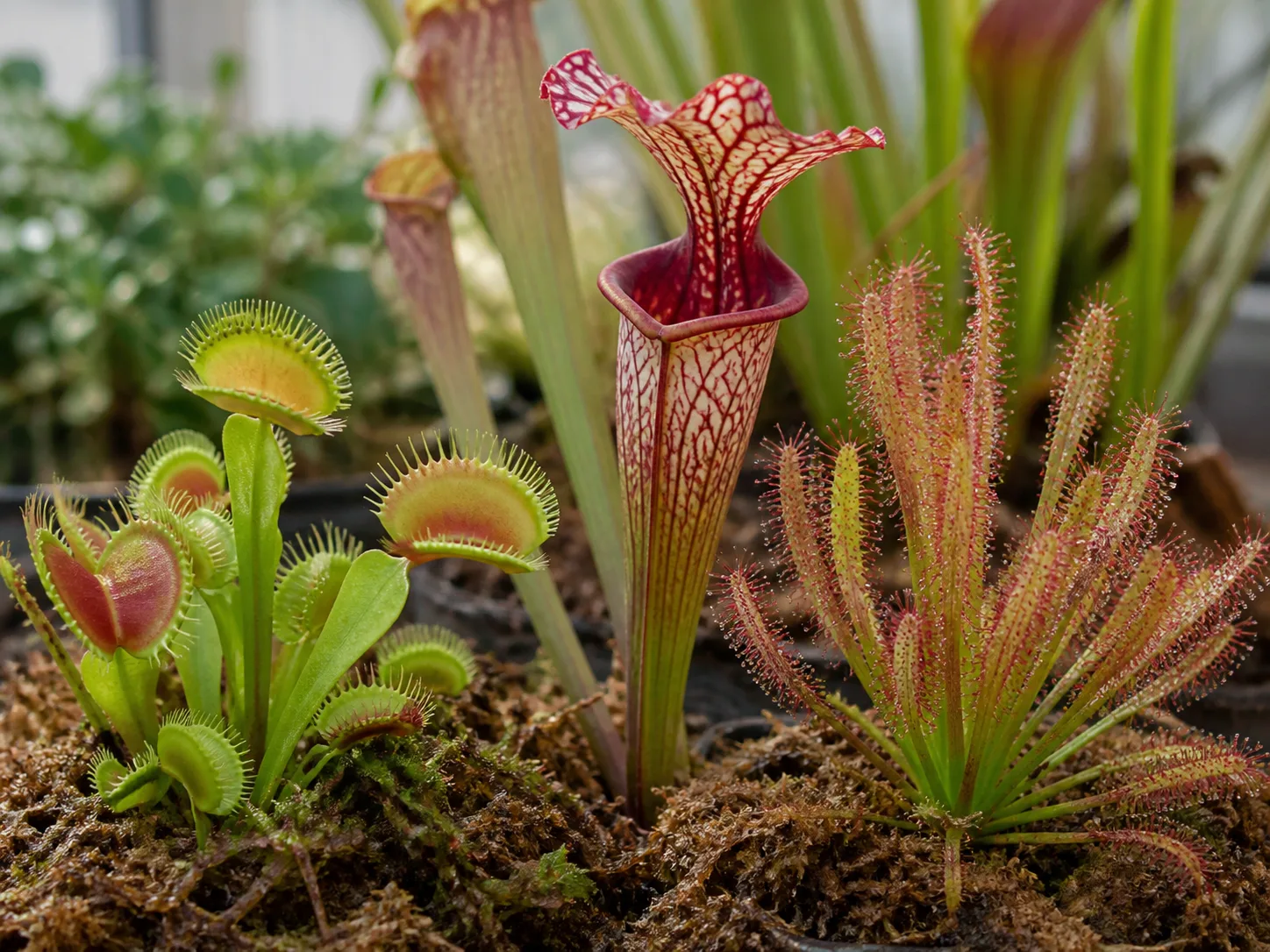
Pitcher plants use pitfall traps: nectar, color, and slippery surfaces draw prey into a tube or cup where escape is difficult. Sundews and butterworts use adhesive traps, coating leaves or tentacles with sticky mucilage. Venus flytraps use a fast snap trap, and bladderworts use tiny underwater suction traps that pull in microscopic or aquatic prey.
Choose by growing conditions before appearance
The prettiest plant at the nursery is not necessarily the right plant for your home. Start by deciding whether you can provide a sunny wet container, a bright indoor shelf, a warm humid hanging basket, or a specialized cool-growing setup.
Best plants for a sunny, wet temperate setup
If you have strong outdoor light, rainwater or distilled water, and a container that can stay consistently damp, begin with North American pitcher plants, Venus flytraps, or a Cape sundew. The RHS lists Cape sundew, Venus flytrap, and purple pitcher plant among relatively easy indoor choices, while UF/IFAS emphasizes that many carnivorous plants are wetland plants needing moisture and lots of light (RHS growing guide; UF/IFAS).
This group is usually more forgiving of seasonal outdoor conditions than tropical Nepenthes. It is also the group most likely to need a winter dormancy, so a sunny windowsill alone is not always enough year-round. Check the species or hybrid label before assuming every plant in a bog tray follows the same calendar.
Best plants for a warm indoor shelf or hanging basket
For a warm home with bright filtered light, look at tropical pitcher plants, Mexican butterworts, and adaptable tropical sundews. Nepenthes is especially effective in a hanging basket because its pitchers dangle below the foliage. It prefers a bright position, but many types scorch in harsh direct sun through glass, and the plant should be kept damp rather than left standing in water.
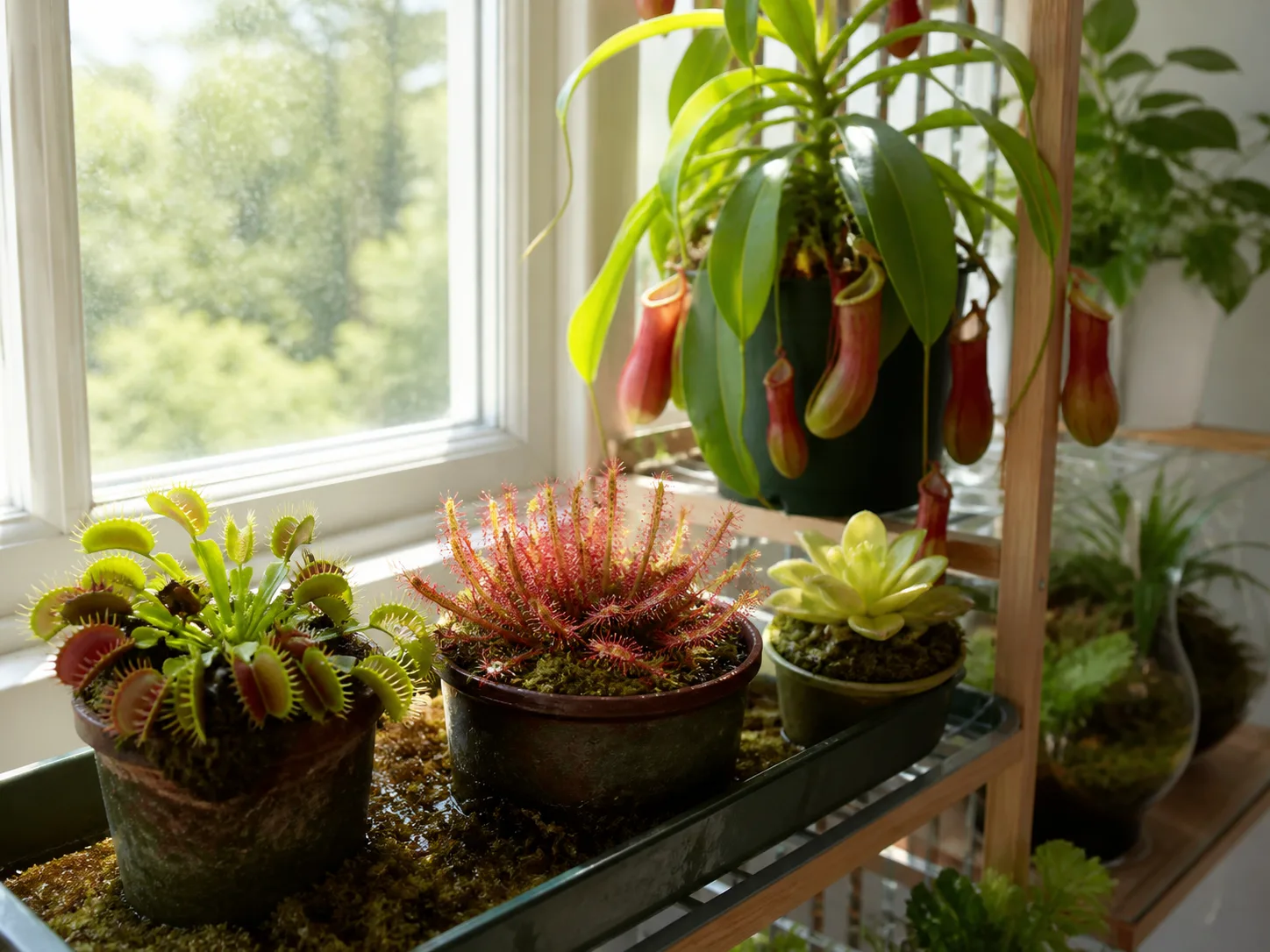
Tom’s Carnivores, a specialist growing resource written by a longtime carnivorous-plant grower, makes the useful distinction that Venus flytraps, Cape sundews, and North American pitcher plants generally want more direct sun and tray watering, while Nepenthes usually wants bright partial sun and watering from above (Tom’s Carnivores). That difference is more important than the fact that both types are sold under the same “carnivorous plant” label.
Collector plants for specialized conditions
Sun pitchers, cobra lilies, highland Nepenthes, and some rare Bornean pitcher plants are beautiful precisely because they come from unusual habitats. They are poor impulse buys for a dry office or a warm apartment with mineral-rich tap water.
If you cannot explain how you will provide the plant’s preferred temperature range, water quality, and growing medium, choose an easier plant first. The fact that a rare species is small does not make it easy; a six-inch collector plant can be more demanding than a three-foot pitcher plant.
14 pretty carnivorous plants to know
North American and temperate favorites
1. Cobra lily (Darlingtonia californica) — The cobra lily, also called the California pitcher plant, has hooded, snake-like pitchers with a forked appendage that makes the plant look ready to strike. It comes from boggy habitats in northern California and southern Oregon and is a specialist choice rather than a beginner windowsill plant. Give it mineral-poor, constantly moist conditions and a root zone that does not bake in summer heat; the Natural History Museum notes that this species relies on bacteria inside its trap rather than producing its own digestive enzymes (Natural History Museum).
2. Purple pitcher plant (Sarracenia purpurea) — This low-growing pitcher plant forms stout, open cups instead of tall trumpets. Its squat red, green, and purple pitchers make it one of the most useful choices for an outdoor bog container, and the RHS identifies it as a relatively easy species for indoor culture as well. It still needs bright light, low-nutrient media, and low-mineral water; “hardy” does not mean it can be planted in ordinary garden soil.
3. Yellow pitcher plant (Sarracenia flava) — Tall, elegant, and often yellow-green with red veining, S. flava makes a strong architectural statement in a sunny bog garden. It is a better choice for growers who can provide full light and a reliably wet, acidic, nutrient-poor root zone. The tall pitchers may need a sheltered location if wind regularly bends them.
4. White trumpet pitcher plant (Sarracenia leucophylla) — The white upper portion and dark red venation make this one of the most dramatic pitcher plants in cultivation. It brings color even when other bog plants are not flowering, but the show depends on strong light. Fine Gardening’s account of hardy Sarracenia grown in sunken containers is a useful reminder that these plants can be integrated into a landscape when their wet, low-drainage conditions are contained separately from neighboring plants (Fine Gardening).
5. Sundew (Drosera spp.) — Sundews range from tiny rosettes to upright plants with long, tentacle-covered leaves. Their sparkling droplets are sticky mucilage, not ordinary dew, and some species slowly curl their tentacles around struggling prey. The genus is broad, so match the species to the setup: Cape sundew is a forgiving starting point, while temperate sundews may need a cool winter cycle and some species prefer wetter conditions than others.
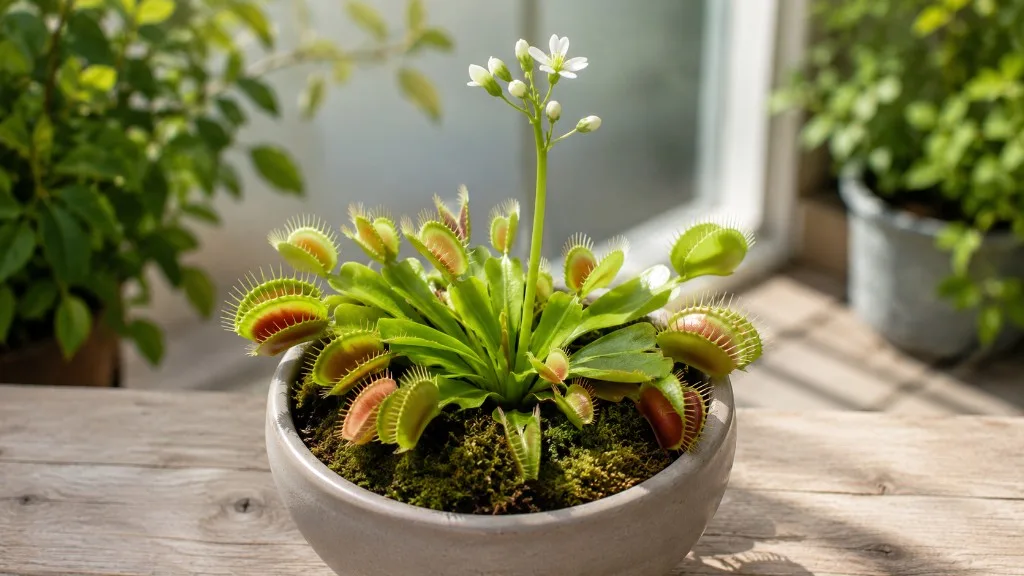
6. Venus flytrap (Dionaea muscipula) — The iconic snap trap is a single species with many cultivated forms. Its hinged leaf lobes close when trigger hairs are stimulated, but repeatedly poking the traps for entertainment costs the plant energy and shortens the useful life of those leaves. Give it strong light, low-mineral water, a low-nutrient medium, and a winter dormancy if the cultivar and climate require it. A healthy flytrap is fascinating without being forced to close by a finger.
Tropical and highland pitcher plants
7. Tropical pitcher plant (Nepenthes spp.) — Tropical pitcher plants, often called monkey cups, produce hanging traps from climbing or trailing stems. They are among the most rewarding carnivorous houseplants when given bright light, steady warmth, airy media, and consistent humidity. The genus includes lowland species that want warm conditions and highland species that appreciate cooler nights, so a generic “keep it humid” instruction is not enough. Do not place every Nepenthes in a water-filled tray; many prefer an evenly damp, well-drained mix.
8. Sun pitcher plant (Heliamphora spp.) — Sun pitchers come from high-elevation tepui habitats in northern South America. Their upright, open pitchers often have a spoon-like nectar structure and can glow green, red, or burgundy in bright light. They are collector plants that generally need excellent light, very clean water, high humidity, and cooler night temperatures than a typical tropical houseplant room provides.
9. Western Australian pitcher plant (Cephalotus follicularis) — Also called the Albany pitcher plant, Cephalotus stays compact and forms small, striped pitchers close to the soil. It appeals to growers who like intricate detail rather than towering leaves. The RHS lists it among carnivorous plants suitable for indoor growing, but it still needs specialized low-nutrient media and careful watering; keep the mix moist without treating it like an aquatic plant.
10. Villose pitcher plant (Nepenthes villosa) — This highland species is prized for its dense, textured pitchers and rich orange to red coloration. It is not a beginner’s substitute for a common garden-center Nepenthes. Its highland origin means that cool nights, strong light, excellent airflow, and very pure water matter more than simply increasing humidity with a closed dome.
11. Kinabalu pitcher plant (Nepenthes kinabaluensis) — This Bornean pitcher plant produces large, colorful traps and belongs in the collector category. It needs a carefully controlled environment rather than a casual bathroom shelf. Buy only from a reputable nursery that can identify the plant and explain its parentage and growing conditions; rarity is not a care instruction.
12. Veitch’s pitcher plant (Nepenthes veitchii) — The broad, striped peristome and often colorful pitchers make N. veitchii one of the most visually distinctive Nepenthes. Its needs vary with the form and growing lineage, which is another reason to treat the nursery’s provenance and care notes as essential. A bright, humid setup with airy media is a starting point, not a guarantee of pitcher production.
Sticky, aquatic, and compact carnivores
13. Bladderworts (Utricularia spp.) — Bladderworts are the group that most clearly breaks the “plant in a pot” stereotype. Aquatic species float rootlessly and use tiny bladder traps that create suction when triggered, while terrestrial species can be grown in very moist media. Some are grown as much for their small, orchid-like flowers as for their nearly invisible traps. Choose an aquatic or terrestrial species deliberately; the watering instructions are not interchangeable.
14. Butterwort (Pinguicula spp.) — Butterworts form flat, glossy rosettes whose leaves act like flypaper for fungus gnats, fruit flies, and other small prey. Their flowers can be surprisingly pretty, often rising above the sticky leaves on thin stems. UF/IFAS cautions that sundews and butterworts should not be completely flooded, unlike many American pitcher plants; moderately moist conditions are safer for these rosettes (UF/IFAS). Mexican butterworts are popular indoor choices, but many enter a seasonal succulent-like phase in which watering must be adjusted.
How to care for carnivorous plants without common mistakes
The basic rule is simple: copy the plant’s habitat, not the care routine of your other houseplants. Carnivorous plants often fail because a gardener uses fertile potting soil, tap water, a dark shelf, or a watering method that works perfectly for a pothos.
Water quality and watering method
For most carnivorous plants, water quality matters as much as water quantity. Rainwater, distilled water, or appropriately purified reverse-osmosis water is safer than ordinary tap or bottled drinking water because dissolved minerals can accumulate in the media and damage sensitive roots. The RHS recommends rainwater whenever possible and notes that repeated use of mineral-containing water can create harmful buildup in the compost (RHS growing guide).
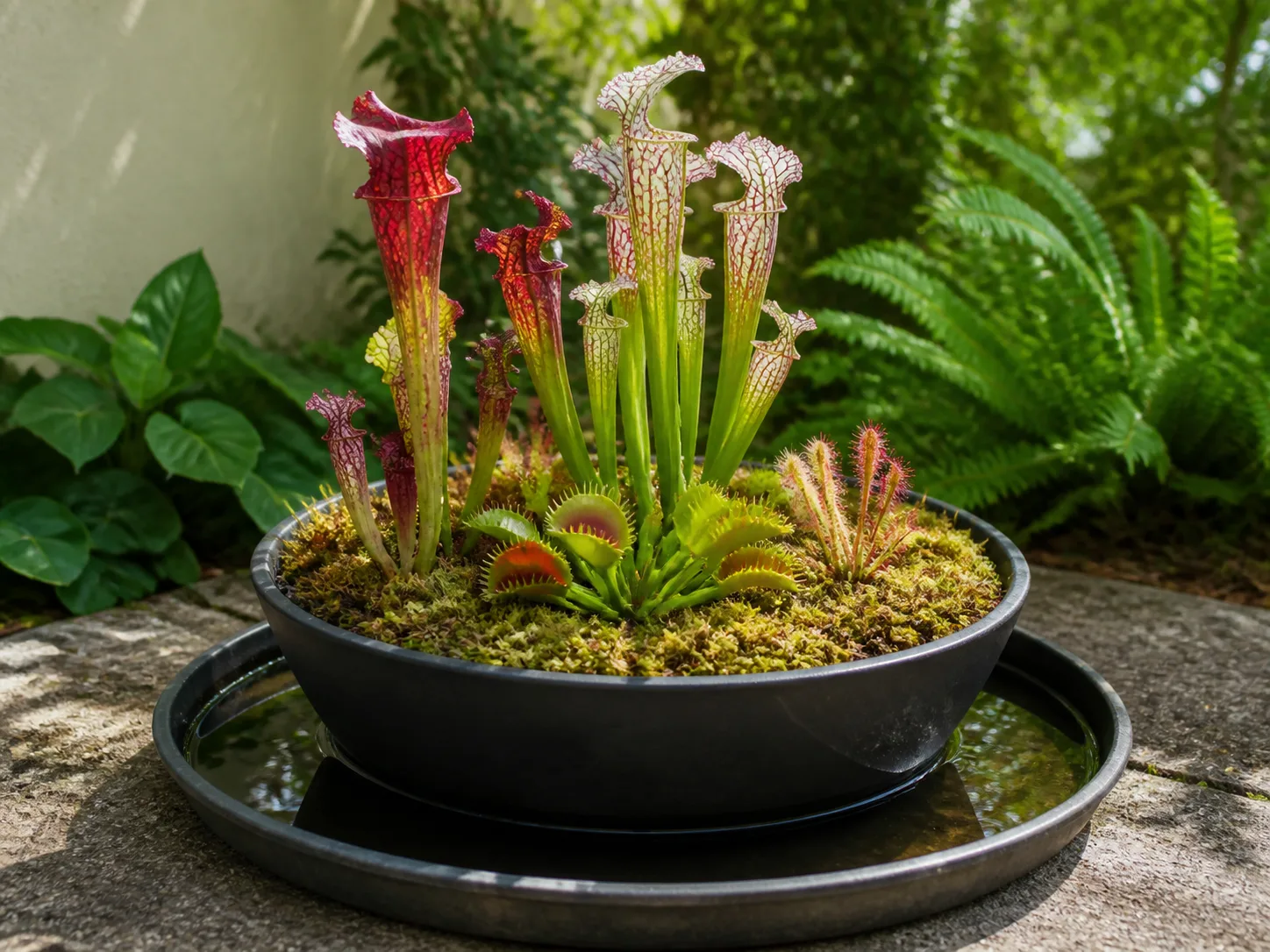
Temperate bog plants such as many Sarracenia, Venus flytraps, and some sundews can be grown with the pot sitting in a shallow tray of water during active growth. The medium should remain damp, but the tray should not become a stagnant, foul-smelling swamp. Tropical Nepenthes usually wants an airy mix kept damp from above rather than a permanently waterlogged pot, and butterworts need a lighter hand than an American pitcher plant.
If your plant declines after a few weeks, test the water before changing five other variables. Water stress can look like a light problem, a soil problem, or a pest problem, and mineral buildup is easy to miss because the pot may still feel perfectly wet.
Low-nutrient media and containers
Never place a carnivorous plant in standard potting soil, garden compost, manure-rich mix, or a fertilizer-loaded houseplant blend. These plants evolved in soils where nutrients were scarce; rich media can burn roots or disrupt the conditions that make the trap strategy useful.
Use a commercial carnivorous-plant mix or a species-appropriate blend based on clean sphagnum, sand, bark, perlite, or other low-nutrient ingredients. The RHS reports encouraging results from peat-free Sarracenia mixes, including sustainably produced sphagnum with finely sieved pine bark, and warns against ordinary soil and potting compost (RHS growing guide). Because formulas vary by genus, a mix suitable for a bog Sarracenia may hold too much moisture for a Nepenthes.
Plastic pots are often the safest default because they do not leach minerals into the media. If you use ceramic, choose a fully glazed container and confirm that it has suitable drainage. Repot when the plant has outgrown its container or the media has broken down, not on an annual schedule that ignores the species’ growth cycle.
Light, humidity, and temperature
Light is the main source of the plant’s energy, so a bright room that looks sunny to you may still be too dim for a flytrap or Sarracenia. Many temperate carnivores develop stronger color and sturdier growth in bright direct light. Tropical Nepenthes often prefers bright filtered light or gentle morning and evening sun, depending on the species and cultivar.
Humidity is not a substitute for light. A sealed terrarium may create a humid atmosphere while blocking airflow and reducing usable light. Specialist grower Tom’s Carnivores warns that domes can become mold-prone for Venus flytraps and North American pitcher plants, while tropical pitcher plants may tolerate or benefit from higher humidity during acclimation (Tom’s Carnivores). Use airflow and gradual acclimation instead of assuming every carnivorous plant should live under plastic.
Temperature is where the groups separate most sharply. Venus flytraps and many Sarracenia need a cool winter rest, whereas tropical Nepenthes generally do not need dormancy. Highland species such as N. villosa and many Heliamphora are particularly difficult in a consistently warm room.
Feeding and winter dormancy
Do not fertilize the growing medium unless a specialist recommendation for that exact plant says otherwise. Healthy outdoor plants can catch their own prey. Indoors, an occasional appropriately sized insect may help, but feeding is not the first fix for a plant that lacks light, pure water, or suitable media.
Never feed Venus flytraps meat, cheese, pet food, or other kitchen scraps. A trap is a living leaf, not a garbage disposal. Nepenthes traps are less dependent on live prey, but that does not make routine heavy feeding necessary.
Dormancy is not universal. Temperate Venus flytraps, many Sarracenia, and some sundews slow down or die back during winter; Cape sundews and tropical Nepenthes can grow without a cold rest. Follow the species’ needs, reduce watering only as appropriate, and do not interpret normal seasonal dieback as immediate death.
Are carnivorous plants good for bug control?
They can catch bugs, but they are not a dependable replacement for pest management. A sundew or butterwort near houseplants may catch some fungus gnats, and a Venus flytrap may take an occasional fly. That is a small local benefit, not a way to clear an infestation or protect an entire garden.
The plant also cannot choose the pest you want removed. Its trap may be inaccessible to adult mosquitoes, too small for a particular insect, or inactive because the plant is dormant or stressed. If fungus gnats are multiplying, reduce consistently wet conditions where larvae breed and address the underlying plant-care problem; keep the carnivorous plant as an interesting supplement, not the entire plan.
How to buy them and protect wild populations
Buy from a nursery or grower that can identify the plant and describe its water, light, and dormancy needs. A reputable seller should be able to tell you whether a Nepenthes is lowland or highland, whether a Pinguicula is Mexican or temperate, and whether a “bladderwort” is aquatic or terrestrial.
Do not remove plants from the wild. The Botanical Society of America identifies habitat destruction and over-collection as major conservation threats and recommends nursery-propagated plants from reputable growers. That matters especially for rare Darlingtonia, Heliamphora, and Bornean Nepenthes, where a beautiful specimen may have a much more troubling origin than its label suggests (Botanical Society of America).
For a first purchase, choose a plant whose habitat you can reproduce: Cape sundew for an adaptable sticky trap, Venus flytrap if you can provide strong light and a winter plan, a hardy Sarracenia hybrid for a sunny bog container, or a beginner-friendly Nepenthes if your home is warm, bright, and humid enough. The right first plant is not the rarest one; it is the one you can keep in the conditions it evolved to use.
Conclusion
The best carnivorous plant is the one that fits your conditions, not merely the one with the most dramatic trap. Cobra lilies and Heliamphora reward specialized growers, Nepenthes transform a warm bright shelf into a hanging display, and Sarracenia, sundews, butterworts, and Venus flytraps offer more realistic starting points when their water and light needs are respected.
Give these plants low-mineral water, low-nutrient media, appropriate light, and the right seasonal temperature pattern, and their strange beauty becomes surprisingly sustainable. Treat them like ordinary houseplants or buy them as a quick fix for bugs, and even the prettiest trap will eventually tell you what it is missing.



