8 Coreopsis Varieties for Every Sunny Garden
Compare 8 coreopsis varieties by color, height, bloom time, hardiness, spread, and water needs so you can choose the right tickseed for your garden.

Coreopsis, also called tickseed, is not one uniform plant. The genus includes compact edging plants, airy threadleaf mounds, upright native species, short-lived perennials, and annuals that can fill a sunny gap in one season. Flowers range from clear yellow to pink, red, orange, cream, and bi-color patterns, while mature heights run from less than a foot to several feet.
That range is useful only if you choose by growing habit as well as flower color. A dry, hot curbside bed calls for a different coreopsis than a cool container patio or a moist pollinator border. The eight varieties below are organized around those real garden decisions, with the limitations that are easy to miss on a plant tag.
How to choose a coreopsis that will actually fit your garden
Start with the site, not the catalog photograph. Count the hours of direct sun, check whether water drains quickly after rain, and decide whether you want a tidy clump or a plant that can travel by runners, rhizomes, or seedlings. Most coreopsis flowers best with at least six hours of sun, although threadleaf types can tolerate light shade at the cost of some density and bloom.
Next, match the plant’s mature width to the bed. Compact ‘Nana’ and many modern hybrids are easier at a path edge or in a pot, while ‘Golden Showers’ and tall native species need room to breathe. A plant that is only 12 inches tall in the nursery may become a 24-inch-wide mound after two seasons, especially in a fertile bed.
Finally, decide how much permanence you need. Coreopsis grandiflora can be spectacular but is often short-lived as a perennial, so it is best treated as a plant you will divide, allow to reseed, or replace periodically. Threadleaf coreopsis can be longer lived when drainage and fertility are right. Coreopsis tinctoria is an annual, but its self-sown seedlings can make it feel perennial in an open, naturalistic garden.
At a glance: perennial, annual, and spreading types
The word “coreopsis” covers several different strategies. Clump-forming species such as large-flowered tickseed make a defined plant and are easier to keep inside a formal border. Rhizomatous or stolon-forming types can knit together a slope or meadow edge, but they may need editing when planted beside small, slow-growing neighbors. Annual plains coreopsis grows quickly from seed and gives you strong color in the same season.
| Variety | Best garden use | Typical habit | Main trade-off |
|---|---|---|---|
| Large-flowered tickseed | Sunny border or rock garden | Upright clump | Often short-lived |
| ’Early Sunrise’ | Early color and containers | Compact clump | Needs deadheading for repeat bloom |
| Lanceleaf coreopsis | Native or naturalistic planting | Upright clump | Can look loose after peak bloom |
| ’Moonbeam’ | Airy border and long color | Fine-textured mound | May decline after several years |
| ’Zagreb’ | Low edging and mass planting | Compact, spreading clump | Can outgrow a tight edge |
| ’Golden Showers’ | Taller back-of-border planting | Upright threadleaf | Flops in rich, wet soil |
| Pink coreopsis | Cool-summer beds and pots | Low, fine-textured perennial | Needs more even moisture |
| ’Limerock Ruby’ | Warm-color containers and borders | Hybrid mound | Hardiness varies; often grown as an annual in cold areas |
| Plains coreopsis | Quick annual color and meadows | Upright annual | Self-sows freely and may need staking |
1. Large-flowered tickseed (Coreopsis grandiflora)
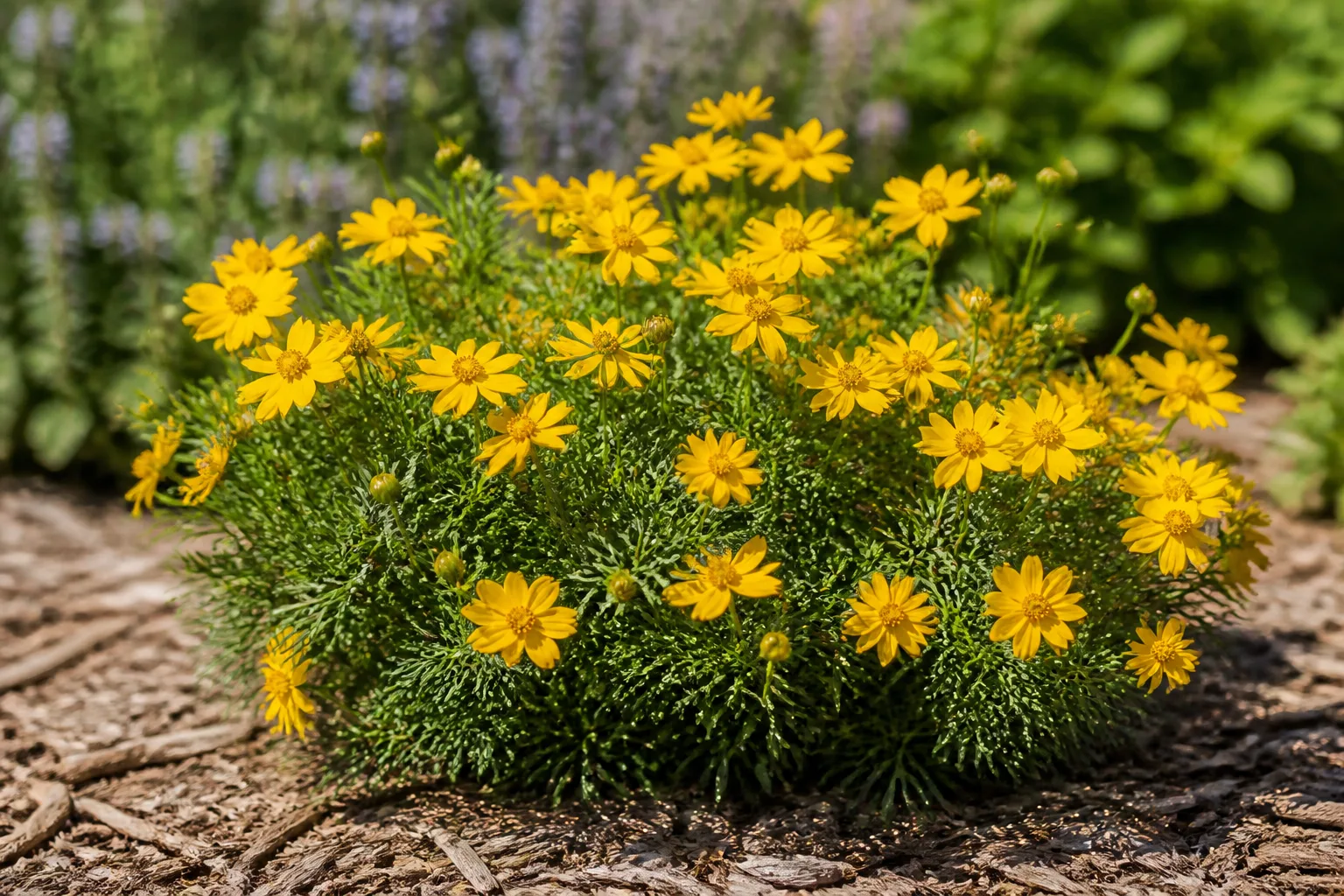
Large-flowered tickseed is the classic choice when you want bright yellow daisies on an upright, clump-forming plant. The species generally grows about 1 to 3 feet tall and wide, with flowers roughly 2 to 2.5 inches across and a late-spring-to-late-summer bloom window. The petals may be notched, and many cultivars add burgundy or darker centers for stronger contrast.

North Carolina State Extension describes it as a native perennial that prefers a sunny, well-drained, drier part of the garden and notes that it may not always remain perennial. That caveat matters: a plant can be botanically perennial yet still disappear after a few seasons in a hot, wet, or poorly drained site. Let a few seed heads mature or plan to divide young clumps in early spring so the planting does not vanish all at once.
‘Early Sunrise’ for an earlier, fuller display
‘Early Sunrise’ is a useful pick when you want the large-flowered look in a relatively compact package. It produces semi-double yellow flowers, often begins earlier than many other coreopsis, and stays around 18 inches tall in common garden conditions. It works in a sunny border, rock garden, or large container, but its fuller flowers can look tired if faded blooms are left in place for too long.
Choose it for a bright focal patch rather than as a guaranteed long-lived backbone. Shear lightly after the first flush instead of cutting into a dry, exhausted crown, and keep the crown from sitting in winter-wet soil. Choose it for a bright focal patch rather than as a guaranteed long-lived backbone. Shear lightly after the first flush instead of cutting into a dry, exhausted crown, and keep the crown from sitting in winter-wet soil.
2. Lanceleaf coreopsis (Coreopsis lanceolata)
Lanceleaf coreopsis brings a more natural wildflower character than many polished hybrids. Its narrow, lance-shaped leaves form a basal clump, while yellow flowers rise on stems that can reach roughly 1 to 2 feet. The early-to-midseason bloom makes it especially useful for starting a pollinator border before later summer perennials take over.

This is one of the better choices for a native planting, roadside-style bed, or sunny area where you want a plant to look at home rather than tightly bred. It handles poor, well-drained soil and drought after establishment, but it still needs regular watering during its first growing season. Do not read drought tolerance as permission to let a newly planted root ball dry repeatedly.
Lanceleaf can self-sow, which is helpful in a meadow and less helpful in a highly edited bed. Remove seed heads before they ripen if you want to keep the clump in its original footprint. After the main bloom, the foliage may look sparse; combining it with ornamental grasses or later perennials hides that lull better than placing it at the front of a formal border.
3. ‘Moonbeam’ threadleaf coreopsis
‘Moonbeam’ is prized for a softer effect: fine, thread-like foliage forms a light green mound, and small lemon-yellow flowers hover above it from early summer toward frost. The pale color is easier to combine with lavender, blue, white, and deep red flowers than the stronger gold of some cultivars. It is one of the most versatile choices for a mixed perennial border because the foliage stays useful even when the plant is between flushes.

Use ‘Moonbeam’ where you want movement and texture rather than a dense block of color. It is also a strong candidate for a dry garden once established. Cornell University’s growing guide describes threadleaf coreopsis as easy-care, drought-tolerant, and long-blooming in sun and well-drained soil, while also recommending division every two to three years to maintain vigor.
The limitation is longevity. Some gardens keep ‘Moonbeam’ for many years; others see the clump thin after two or three seasons. That is not always a watering failure. Heavy soil, excessive fertility, winter moisture, or a crowded crown can shorten its performance, so take a division while the plant is still vigorous rather than waiting for a dead center.
4. ‘Zagreb’ threadleaf coreopsis
‘Zagreb’ is a lower, more assertive threadleaf choice, with small golden flowers and fine foliage that can form a broad mound. It is particularly good at the front of a sunny border, beside a path, or in a mass where a repeated ribbon of color looks intentional. The plant usually stays in the roughly 12-to-18-inch range, but the width can expand when the clump is happy.

The decision here is about spread. ‘Zagreb’ is a better ground-covering edge than a solitary specimen, yet it can crowd a delicate neighbor if you plant it at the same spacing you would use for a strictly clumping perennial. Give it room to knit together, then divide the outside pieces in spring if the bed begins to look congested.
Like other threadleaf types, it flowers best in lean, well-drained soil. A little compost at planting is reasonable in poor ground, but repeated feeding can produce soft foliage and fewer flowers. If you want a formal, compact appearance, shear after the first flush rather than trying to deadhead every tiny bloom one by one.
5. ‘Golden Showers’ threadleaf coreopsis
‘Golden Showers’ is the choice for gardeners who like the airy threadleaf texture but need more height. It can reach roughly 2 to 3 feet, with dark yellow flowers held above fine foliage. The taller stems give it presence at the back or middle of a border, where a shorter ‘Moonbeam’ might disappear among neighboring plants.

Its height makes site preparation more important. NC State Extension notes that threadleaf coreopsis can tolerate infertile, sandy, or rocky soil, while rich or moist soil can make the stems weak and prone to flopping. Put ‘Golden Showers’ in the sunniest, fastest-draining part of the bed, and avoid a high-nitrogen fertilizer that pushes leaves and stems faster than the roots can support them.
After the first bloom, cutting the plant back by about half to two-thirds can encourage fresh growth and a later flush. Do this when the plant has finished its main display but still has enough growing season left to recover. If the stems are already leaning, a midseason shear is usually more effective than adding a late stake to a crowded clump.
6. Pink coreopsis (Coreopsis rosea)
Pink coreopsis is the useful exception to the yellow-dominant coreopsis palette. Coreopsis rosea has fine foliage and pink flowers on a relatively low plant, making it a natural fit for a cool-toned border, rock garden, or container where yellow would be too bright. Cultivars such as ‘Heaven’s Gate’ add pink or pink-purple flowers with contrasting centers.

Do not place it in the same drought category as threadleaf coreopsis. Pink coreopsis prefers consistently moist but well-drained soil and is less tolerant of prolonged heat and drought. The goal is not soggy soil; it is a root zone that does not swing from saturated to bone dry. A pot with drainage holes and a light mulch layer in the garden can make that moisture rhythm easier to maintain.
This is also a plant where winter and summer climate matter. It is a particularly good choice for regions with cooler summers, while hot climates may require afternoon protection and closer attention to water. If your site is both hot and dry, choose a yellow threadleaf type instead of forcing pink coreopsis into conditions it does not enjoy.
7. ‘Limerock Ruby’
‘Limerock Ruby’ supplies the deep red color many gardeners want from coreopsis, with orange or red blooms above a fine-textured plant. It is a hybrid related to pink and threadleaf coreopsis rather than a straightforward species selection. The color is excellent for containers, warm-toned borders, and combinations with silver foliage or blue flowers.

Treat hardiness claims with care. Nursery tags and regional trials do not always agree, and this cultivar is often sold as a hardy perennial in warmer zones but grown as an annual in colder gardens. Plant it after the soil has warmed, provide full sun and sharp drainage, and do not assume that a winter mulch can compensate for a crown sitting in cold, wet soil.
Its watering preference is also more nuanced than “drought tolerant.” Water deeply when the root zone is dry, then let the surface dry before watering again. In a container, that may mean checking often during a hot spell; in the ground, it usually means less frequent but thorough irrigation while the plant establishes. Remove faded flowers if you want the red display to keep cycling.
8. Plains coreopsis (Coreopsis tinctoria)
Plains coreopsis is the annual to choose when you want fast, bright color from seed. Its yellow-and-maroon flowers have a strong wildflower look, and the plants can bloom from summer into early fall. Cornell University lists it as an annual that tolerates heat and drought, can be direct-sown, and may self-sow persistently. It is a natural fit for a meadow patch, cutting garden, or temporary gap while slower perennials establish.

This is not the best selection for a neat, permanent border unless you are willing to edit seedlings. It can become tall and loose, and crowded plants may need a light cutback or support. Leave some seed heads if you want another generation; remove them promptly if you want to keep the plant from moving through the bed.
Because it is annual, seed timing is part of the design. Direct sow after the danger of severe frost has passed in spring, or follow your region’s guidance for fall sowing. Scatter seed on prepared soil and press it in rather than burying it deeply; light and shallow placement help many wildflower seeds emerge evenly.
Plant coreopsis for the strongest first season
Plant nursery-grown coreopsis after the worst frost risk has passed, or in fall where your climate allows roots to settle before winter. Dig a hole no deeper than the root ball and only slightly wider. Set the crown at soil level, backfill without burying the stems, and water slowly enough to settle air pockets.
The first season is about root establishment, not proving drought tolerance. Water when the upper few inches of soil begin to dry, then soak the root zone thoroughly. A light mulch ring can reduce evaporation, but keep mulch away from the crown so the base stays dry and airy.
Space by mature width, not by the size of the starter pot. A practical range is 12 to 20 inches for many garden cultivars, with more room for tall or spreading forms. If you are planting a mass, a slightly closer spacing fills the bed faster but increases humidity and competition; wider spacing takes longer to knit together and makes disease scouting easier.
Water, soil, and fertilizer: the lean-soil rule
Most coreopsis wants sun and drainage more than rich soil. Sandy, rocky, or ordinary loam can work well as long as excess water leaves the root zone. Clay is not automatically disqualifying, but a low spot that stays wet after rain is a poor match for drought-adapted threadleaf and large-flowered types.
Fertilizer is usually optional. UF/IFAS describes coreopsis as adaptable across soil textures and highly drought tolerant once established, while extension and horticultural guidance repeatedly point to well-drained, not overly rich soil. If plants produce lots of floppy foliage and few flowers, stop feeding first; do not respond by adding more fertilizer.
Watering should follow the plant and the weather. New transplants need a consistent rhythm, mature plants need help through prolonged heat or drought, and pink coreopsis needs more even moisture than a dry-bed threadleaf. Avoid shallow daily sprinkling, which wets the foliage and encourages a weak surface root system without solving a dry root zone.
Deadheading, shearing, and dividing without losing vigor
Deadheading is a choice, not a rule every gardener must follow. Remove spent flowers when you want a tidier display and more energy directed toward new buds. Leave a few seed heads when you want self-sown plants, winter structure, or food for seed-eating wildlife; just understand that the next generation may not match the parent cultivar exactly.
When an established clump becomes sparse or flowering slows, shear it back after the main flush rather than trimming a few stems at a time. For many coreopsis, cutting back by roughly one-half is enough to remove tired growth and encourage a new mound. Taller threadleaf plants may tolerate a stronger cut, but leave time for regrowth before frost.
Divide in early spring or fall when the plant is actively rooted but not in peak summer heat. Lift the clump, separate healthy outer sections with roots and shoots, discard a dead center, and replant divisions at the original depth. Division is especially useful for short-lived or crowded clumps; it is not a cure for a site that stays wet or shaded.
Common coreopsis problems and the quick diagnosis
Flopping stems: First check light and soil. Rich, wet ground and insufficient sun encourage tall, weak growth; a crowded mature clump can also lose support. Improve drainage, reduce fertilizer, divide if the center is congested, and shear after the first flush rather than waiting until the stems collapse.
Few flowers: Count direct-sun hours before blaming the cultivar. Then check whether nitrogen-rich feeding has produced leaves at the expense of buds, whether the plant is newly transplanted, and whether spent flowers are setting seed. Moving a mature plant is often less effective than correcting light and fertility around the existing crown.
Yellowing or collapsing at the base: Persistent wetness points to root or crown stress, not thirst. Pull back mulch, inspect the soil several inches down, and let the bed dry between waterings. If the crown is soft or roots are dark and decayed, replanting in a better-drained position may be the only durable fix.
Powdery mildew or leaf spots: Humid, crowded foliage and poor airflow create the conditions. Thin congested growth, water the soil rather than the leaves, and remove badly affected debris. UF/IFAS lists leaf spots, rust, powdery mildew, aphids, leaf beetles, and mites as occasional rather than inevitable problems; diagnose the pattern before treating.
A plant disappears after a few years: Short-lived does not mean mislabeled. Large-flowered types may decline after several seasons, and even ‘Moonbeam’ can thin in a stressful site. Save seed where appropriate, divide while the clump is healthy, and keep a replacement plan for cultivars whose color or form is worth the extra attention.
Design pairings for borders, containers, and pollinators
Use coreopsis as a connector between bold flowers and fine-textured plants. ‘Moonbeam’ and ‘Zagreb’ soften the base of coneflower, salvia, or ornamental grasses, while ‘Golden Showers’ can repeat a yellow note behind shorter perennials. Pink coreopsis provides a cooler bridge between blue flowers and silver foliage; ‘Limerock Ruby’ gives a warm counterpoint to lavender and white blooms.
For a container, choose a compact plant such as ‘Nana’, ‘Early Sunrise’, ‘Limerock Ruby’, or another labeled dwarf hybrid. Use a pot with drainage holes, a free-draining mix, and enough volume that the root ball does not dry every few hours. Containers lose water faster than beds, so a variety described as drought tolerant still needs checking during hot weather.
For pollinators, prioritize flower access over double-flower novelty. Single flowers expose the central disk more clearly to bees and butterflies, and a sequence of lanceleaf, threadleaf, and late-summer perennials can provide a longer season than a single mass of one cultivar. UF/IFAS and NC State Extension both describe coreopsis as attractive to bees, butterflies, and other beneficial insects.
Think of the eight choices as a toolkit. Choose lanceleaf or plains coreopsis for a looser, naturalistic planting; ‘Moonbeam’ or ‘Zagreb’ for fine texture; ‘Golden Showers’ for height; pink coreopsis for cooler, moister conditions; and large-flowered or red hybrids when flower size and color are the main design goal.
Conclusion
The best coreopsis variety is the one whose habit matches the place you can actually offer. For a dry sunny border, start with threadleaf types such as ‘Moonbeam’ or ‘Zagreb’; for a taller golden display, consider ‘Golden Showers’ or lanceleaf coreopsis; for pink or red flowers, accept the extra moisture or hardiness limits of C. rosea and ‘Limerock Ruby’; and for quick annual color, sow plains coreopsis.
Give every type bright light, good drainage, careful first-season watering, and enough space for its mature width. Deadhead for repeat flowers, shear when the plant becomes tired, and divide before a crowded or short-lived clump fails. Those few decisions matter more than chasing a perfect cultivar: they turn coreopsis from a one-season purchase into a reliable, adaptable part of the flower garden.



