Coconut Tree vs. Palm Tree: Key Differences
Coconut trees are palms, but only one species makes coconuts. Learn how to identify it by fruit, leaves, trunk, climate, size, and garden use.
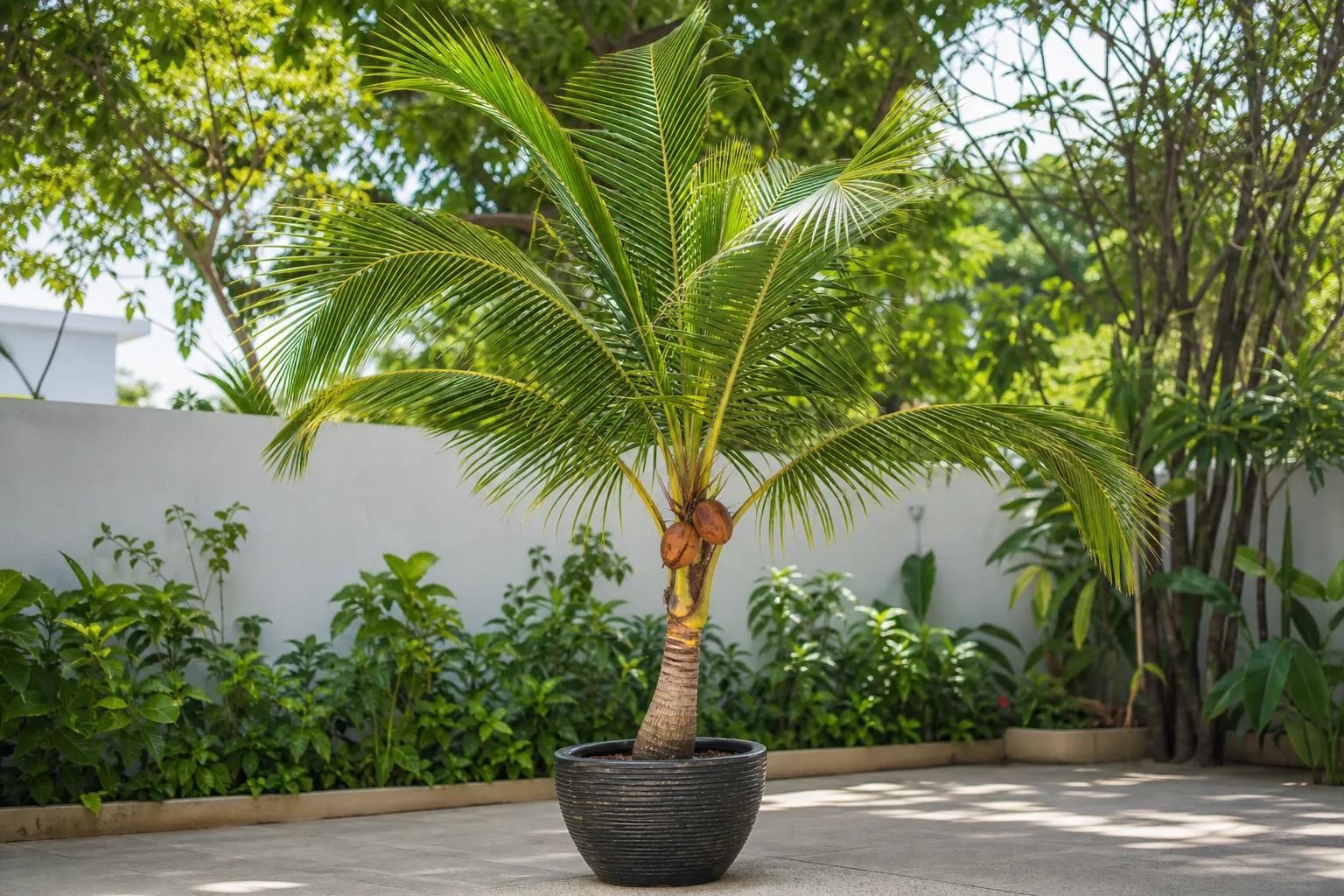
A coconut tree is a palm, but a palm tree is not necessarily a coconut tree. “Palm tree” is the broad landscape term for thousands of species in the palm family, Arecaceae. A coconut tree is the much more specific Cocos nucifera—the single species in the genus Cocos that produces the familiar large, fibrous coconut.
That relationship is the key to the whole comparison. If you are looking at a palm and want to know whether it is a coconut palm, do not rely on the tropical silhouette alone. Check the fruit, leaf shape, trunk, crown, and growing conditions in that order.
The short answer: a coconut is one kind of palm
Botanically, Cocos nucifera belongs to Arecaceae, the palm family. The family also includes date palms, fan palms, queen palms, areca palms, parlor palms, and many other plants that may look dramatically different from a coconut palm. The Kew Plants of the World Online profile for Cocos nucifera lists it as a wet-tropical tree native from Central Malesia to the southwest Pacific.
“Palm tree” is therefore a category, not a species name. Some palms are solitary and tall; some form clumps; some have fan-shaped leaves; some are short enough for a container. A coconut palm is one recognizable combination within that larger group: a solitary, usually smooth-trunked palm with long featherlike leaves and a large fibrous fruit.
Palms also grow differently from familiar broadleaf trees. They are monocot flowering plants, and their stems do not build a conventional layer of wood and bark through a vascular cambium. University of Florida IFAS explains that palm stems have a single growing point and permanent wounds, which is one reason topping, drilling, or cutting into a palm trunk is not a harmless landscaping shortcut.
Use these clues to identify a coconut palm
You can often make a reliable first identification without knowing the cultivar. Start with the most distinctive clue—fruit—then use the plant’s structure and setting to confirm it.
Check the fruit first
Large, oval to round fruits with a thick fibrous husk are the strongest field clue. A young coconut may be green or yellow-green and full of liquid; a mature one develops a brown, dry husk and a hard inner shell. The familiar three “eyes” are on the woody endocarp inside the husk, not on the smooth outer surface of every young fruit.
Botanically, the coconut is a drupe, or a fruit with a fleshy or fibrous layer around a hard seed-bearing layer. The National Tropical Botanical Garden describes the coconut’s fibrous mesocarp, woody endocarp, liquid endosperm, and solid flesh. That combination is not shared by every palm fruit, so a palm carrying coconuts is, for practical identification purposes, a coconut palm.
Do not use the absence of fruit as proof that a palm is not a coconut. A young palm may be years from reproductive maturity, a container plant may be stressed or undersized, and a marginal climate may support leaf growth without the sustained warmth needed for flowering and fruit development. Confirm with the leaves and trunk before ruling it out.
Look at the leaf: feather or fan?
The coconut palm has pinnate, or feather-shaped, leaves. Individual leaflets attach along a central rachis, giving each frond a long, airy profile. Mature coconut fronds are large and arching, not compact like the leaves of a parlor palm and not round like a fan palm.
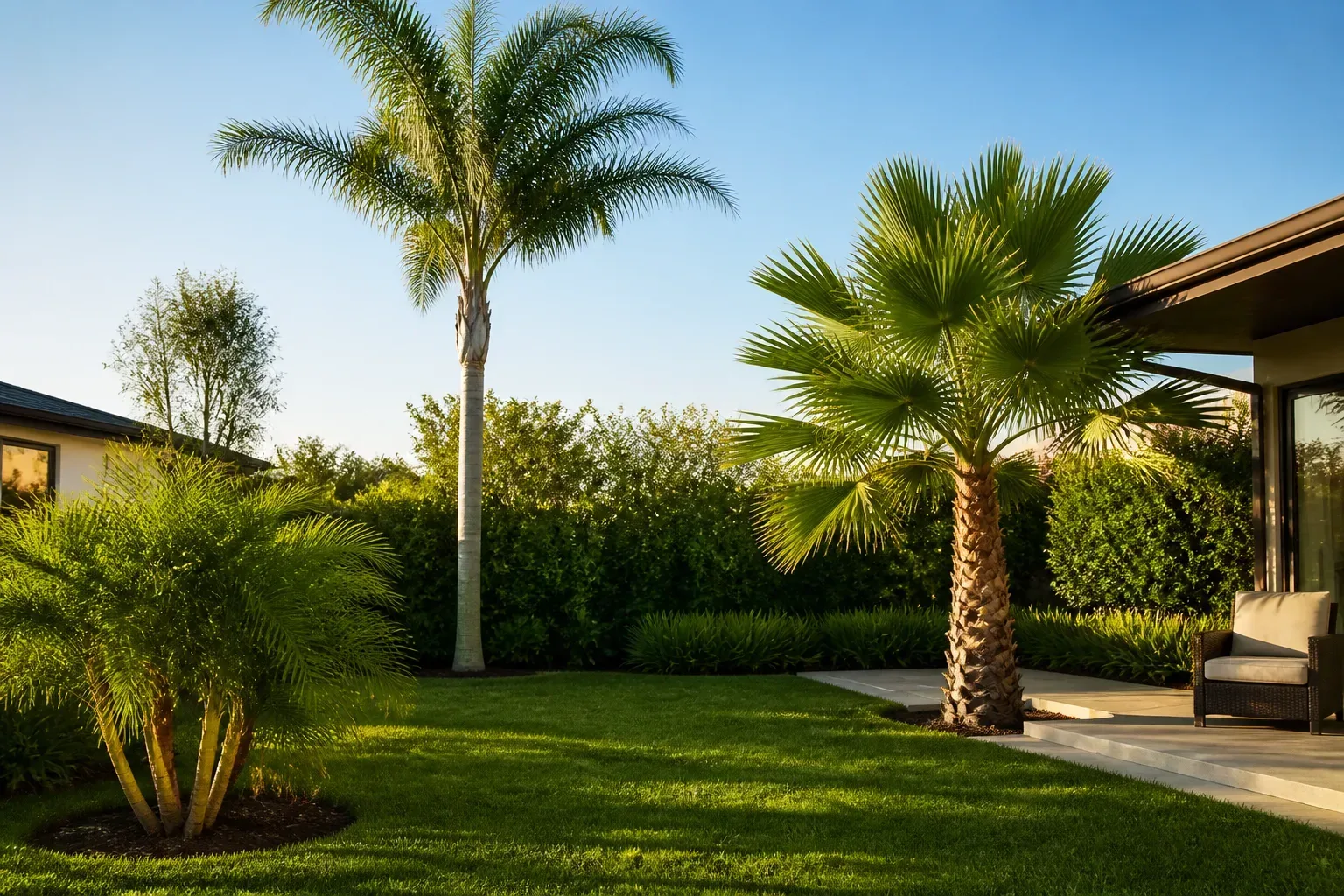
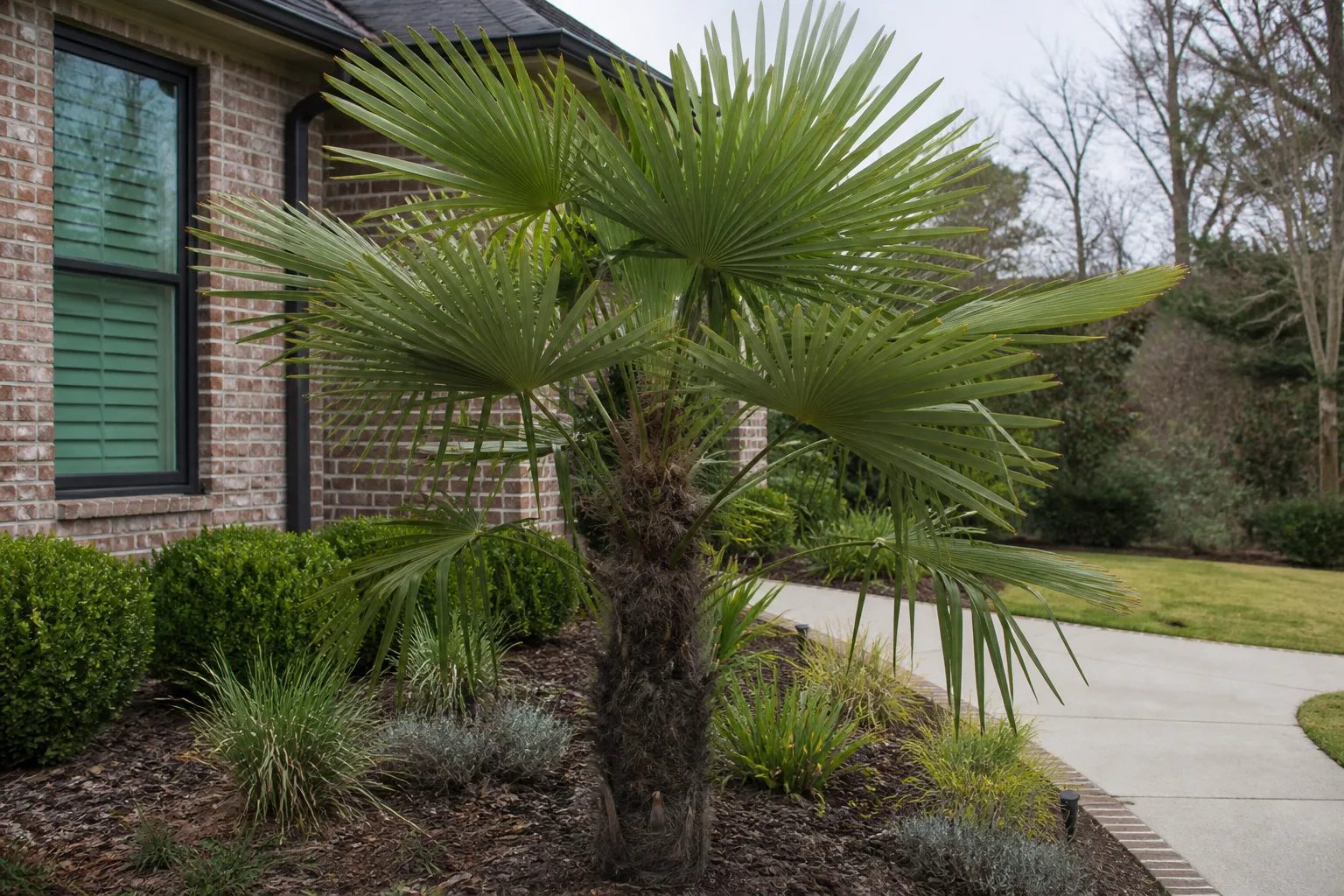
Other palms may also have pinnate leaves, so “feather-shaped” is a confirmation clue rather than a standalone diagnosis. A queen palm, for example, has arching pinnate leaves too. By contrast, Washingtonia and many other fan palms have palmate leaves, in which the leaf segments spread from one point like the fingers of a hand. Some palms fall between those forms and are called costapalmate.
The UF/IFAS palm morphology guide uses the coconut as an example of a pinnate-leaved palm and contrasts it with palmate and costapalmate palms. That vocabulary is useful when you are comparing two palms at a nursery: ask whether the leaflets are separated along a long central axis or joined into a fan-shaped blade.
Read the trunk and crown
A mature coconut palm usually has one tall, slender, gray to gray-brown trunk marked by regular ring-shaped leaf scars. The trunk often leans or curves slightly and may be thicker toward the base. Its crown is a relatively open burst of long fronds, with flower clusters and fruit developing beneath or among the leaves.
Other palms can have a smooth trunk, too, so inspect the whole plant. A palm with several stems emerging from the base is a clumping species, not the typical solitary habit of a coconut. A palm with a conspicuous smooth green crownshaft, a swollen “bottle” trunk, a shaggy skirt of dead leaves, or a dense tuft of short fronds is also showing a different growth pattern.
The crown matters because a palm has one main apical growing point per stem. New leaves and flowers emerge from that center. Removing or severely damaging the growing point can kill a single-stemmed palm, and old palm wounds do not close over the way wounds on a broadleaf tree can. Treat the crown as the plant’s engine, not as a place to thin aggressively.
Coconut palm vs. other palms at a glance
| Feature | Coconut palm (Cocos nucifera) | Other palms |
|---|---|---|
| Family | Arecaceae | Arecaceae |
| Species identity | One species in the genus Cocos | Many genera and thousands of species and cultivars |
| Leaf shape | Long, featherlike pinnate fronds | Pinnate, palmate, costapalmate, bifid, or other forms |
| Trunk habit | Usually one smooth, slender, ring-scarred trunk | Solitary, clumping, crownshafted, swollen, rough, or shaggy depending on species |
| Fruit | Large, fibrous coconut with water and flesh | Dates, small drupes, jelly-like fruits, edible hearts, or no useful harvest |
| Typical setting | Humid tropical lowlands and warm coastal landscapes | Tropical, subtropical, desert, Mediterranean, temperate-microclimate, or indoor settings depending on species |
| Main garden decision | Can the site support tropical growth and eventual fruiting? | Which species matches the site’s cold, light, water, and size limits? |
The table explains why a photo alone can mislead. A queen palm and a coconut palm may both have feather fronds and a single trunk, while a fan palm can be unmistakable from its leaves but still belong to the same family. Identification works best when you combine at least three clues instead of treating “palm-shaped” as a species diagnosis.
How coconut palms differ in size and growth
The coconut palm is not a small patio plant that happens to have a tall version. A full-size form can eventually reach roughly 20 to 30 meters in tropical conditions, while dwarf cultivars stay considerably shorter and are easier to manage when space is limited. NTBG describes the species as a long-lived, single-trunked palm with leaves roughly 4 to 6 meters long, and RHS lists it as a single-stemmed palm reaching about 25 meters in the tropics.
That height is a practical constraint, not just an impressive statistic. Leave room for a broad crown, avoid planting directly beside roofs and narrow paths, and consider where large fronds and fruit could land years from now. A dwarf cultivar solves a scale problem but does not turn a tropical palm into a cold-hardy one.
Full-size and dwarf forms—and when fruit appears
Seed-grown coconut palms do not produce identical plants on a predictable schedule. Tall and dwarf types differ in height, speed, fruit size, yield, and the age at which they begin flowering. Good conditions also matter: a palm that is warm, well lit, well rooted, and nutritionally balanced has a better chance of reaching reproductive maturity than one kept cool in a dim container.
As a practical expectation, horticultural guidance commonly places first fruit around six to ten years from seed, with considerable variation by cultivar and growing conditions. Gardening Know How gives that range and distinguishes early-bearing dwarf cultivars from taller forms. Treat the number as an estimate, not a promise. A nursery coconut grown as a temporary indoor decoration may never reach the light, root volume, warmth, or humidity needed for a meaningful crop.
Where coconut palms grow—and where other palms have the advantage
Both coconut palms and other palms are associated with warm climates, but “tropical-looking” is not a useful hardiness category. Species within Arecaceae occupy different habitats, from wet rainforest understories to dry desert landscapes and cool coastal microclimates. The right comparison is not coconut versus palm in the abstract; it is coconut versus the particular palm that fits your winter temperatures and soil.
Heat, cold, moisture, and salt are not interchangeable
Coconut palms perform best in warm, humid, frost-free conditions, often near tropical coasts. Kew describes the species as primarily wet tropical and notes its strong association with coastal lowlands. Coconut palms tolerate salt and wind better than many ornamental plants, but that does not mean they tolerate every seaside site: compacted soil, poor drainage, cold wind, and prolonged cool weather can still cause decline.
They also want moisture without stagnant roots. Use a sunny site with soil that drains freely after rain. A waterlogged planting hole can damage a coconut palm even when the surrounding climate is warm, while a dry inland site may require more reliable irrigation and humidity than a beachside location.
Other palms may be the better choice when cold is the limiting factor. Fan palms, needle palms, windmill palms, and some other species are selected specifically for greater cold tolerance, but the right choice depends on the lowest temperatures, exposure, and local recommendations. A palm’s family membership tells you little about its winter performance.
Indoor and container reality
You can grow a young coconut palm in a container, but the result is usually a foliage plant, not an indoor coconut orchard. RHS recommends full sun outdoors and describes frost-prone specimens as short-lived foliage plants in a warm conservatory or houseplant setting. Indoors, light through a window may keep a small plant alive for a while, yet the palm eventually outgrows the room, pot, or available light.
Container culture also changes the watering equation. The mix should stay evenly moist but drain rapidly; a decorative cachepot that holds runoff can create a permanently wet root zone. Use a container with drainage holes, empty the saucer after watering, and move the plant gradually into stronger light rather than placing a shade-grown nursery palm in sudden hot sun.
If you want a long-term indoor palm, choose a species bred or commonly grown for indoor conditions, such as a parlor, kentia, or areca palm. Those plants still need appropriate light and watering, but they are more realistic room-scale choices than a species that naturally becomes a 25-meter tropical tree. The RHS profile for queen palm shows the same principle outdoors: a related feather-leaved palm may look similar while having different size, fruit, and cultural expectations.
What other palms produce instead of coconuts
“Palm fruit” does not mean “coconut.” Many palms flower and fruit, but the fruits range from large commercial dates to small ornamental drupes. Some species are grown for palm hearts, oil, fibers, wax, timber-like stems, or landscape structure rather than a household harvest.
Fruit, flowers, and useful products vary by species
The coconut is unusual because one seed contains both liquid endosperm—the coconut water—and solid endosperm—the flesh that develops as the fruit matures. The fibrous husk can be processed into coir, while the shell and dried meat have additional food, craft, fuel, and industrial uses. Kew and NTBG both document the species’ broad food, fiber, fuel, and cultural uses.
Other palms make different trade-offs. Date palms are chosen for dates, queen palms for an ornamental canopy and small orange fruits, and many fan palms for leaf form and resilience. A clumping indoor palm may produce flowers only rarely in a home and is usually chosen for foliage. The correct question is not “Does this palm make fruit?” but “What fruit or useful part does this species produce, and is that the reason I am growing it?”
Which palm should you choose for your space?
Start with the job you want the plant to do, then check climate and mature size. A coconut palm is a good choice when its biology matches the site; it is a poor choice when the main appeal is simply a tropical silhouette that another palm could provide more reliably.
Choose a coconut palm if you want fruit and have the climate
Choose Cocos nucifera when you live in a genuinely warm, humid, frost-free region; have full sun and freely draining soil; can provide steady moisture without waterlogging; and have room for a tall crown and long fronds. A coastal or tropical garden with enough space is the natural fit.
Buy from a nursery that can identify the cultivar and its expected mature size. If fruit matters, ask whether the plant is a tall or dwarf type, whether it has a track record in your region, and how it was propagated. Do not choose a coconut on the assumption that every nursery palm will eventually produce a harvest.
Choose another palm if the site or purpose is different
Choose another palm when the site has regular frost, a small indoor footprint, limited sun, poor drainage that cannot be corrected, or a need for a different leaf shape. A fan palm can provide a bold architectural look without being mistaken for a coconut. A parlor or kentia palm is more sensible for a room. A cold-tolerant landscape palm can give you a tropical effect where a coconut would suffer repeated winter damage.
You should also choose another species when fruit is not the goal and you want less eventual height or a clumping habit. Matching the palm to the site is more important than matching a photograph. A healthy, appropriately sized palm will look more convincing than a stressed coconut struggling outside its climate range.
Use a simple three-gate test before buying: Can it survive the winter? Can it fit at maturity? Can you provide the light and drainage it needs? If any answer is no, keep the tropical look but change the species. This test is more useful than a nursery label that says “palm,” because the label describes a family of plants with very different limits. Take a photo of the candidate, record its scientific name, and compare its mature size and climate requirements before you pay for a plant that will always be fighting its location.
Common identification mistakes
Mistake 1: Calling every palm with feather fronds a coconut. Pinnate leaves are shared by many palms. Look for the fruit, ring-scarred solitary trunk, overall crown, and warm coastal or tropical setting together.
Mistake 2: Assuming a palm without fruit cannot be a coconut. Young palms, stressed plants, and indoor specimens may be nonfruiting. Use age and growing conditions as context, not as a substitute for leaf and trunk clues.
Mistake 3: Treating “tree” as a botanical diagnosis. The common name tells you the growth form people see. It does not tell you whether the plant is a broadleaf tree, a conifer, or a palm with monocot anatomy.
Mistake 4: Confusing a coconut with any brown fruit beneath a palm. Dates, ornamental palm drupes, and coconut fruits have different shapes, husks, and uses. Identify the palm before harvesting anything, and do not eat an unfamiliar palm fruit.
Mistake 5: Choosing by cold hardiness alone. A palm that survives a brief cold snap may still fail in a cold, wet winter or a shaded site. Check the species’ mature size, light, drainage, and humidity requirements as well as its temperature tolerance.
A practical planting and maintenance checklist
Before planting
- Confirm the name, preferably the scientific name Cocos nucifera if you specifically want a coconut palm.
- Check the site’s lowest winter temperatures against the palm’s documented requirements and local extension advice.
- Measure for the mature crown, not the nursery pot. Include roofs, wires, paths, pools, seating, and neighboring plants.
- Choose full sun and moisture-retentive but well-drained soil. Correct drainage before planting rather than trying to fix a permanently wet root zone later.
- Decide whether you want fruit, a landscape silhouette, or a container accent. Those goals may point to different palms.
During the growing season
- Water deeply enough to moisten the root zone, then let excess water drain; do not keep the soil saturated.
- Feed according to a palm-appropriate label and local extension guidance, especially in sandy or heavily leached soil.
- Remove only dead, broken, or clearly diseased fronds unless a qualified palm professional recommends otherwise. Never cut into the crown or trunk.
- Inspect the newest leaves and the growing point first. A damaged crown is more serious than a few old brown leaflets.
- Reassess the plant after a cold event, storm, or transplant. Do not fertilize or heavily prune a stressed palm until you know whether the growing point is alive.
- Under a mature fruiting coconut, keep play areas and frequently used paths out of the drop zone and use professional help for work at height.
Conclusion
The difference is simple once the taxonomy is clear: every coconut tree is a palm, but only Cocos nucifera is the coconut palm. Its long pinnate fronds, solitary ring-scarred trunk, large fibrous fruit, and warm humid habitat set it apart from the much wider range of palms that share the family name.
When you are identifying one in a garden, start with fruit, confirm the leaf shape, inspect the trunk and crown, and then test the climate and site against the plant’s needs. When you are choosing what to plant, decide whether you want coconuts or simply the look of a palm. That one decision prevents most mismatched plantings—and helps you select a palm that can actually thrive where you put it.



