How to Make Compost Tea for Your Garden
Make a small compost tea batch, understand what it can do for garden soil, and learn why clean equipment, no sugar, and careful application matter.
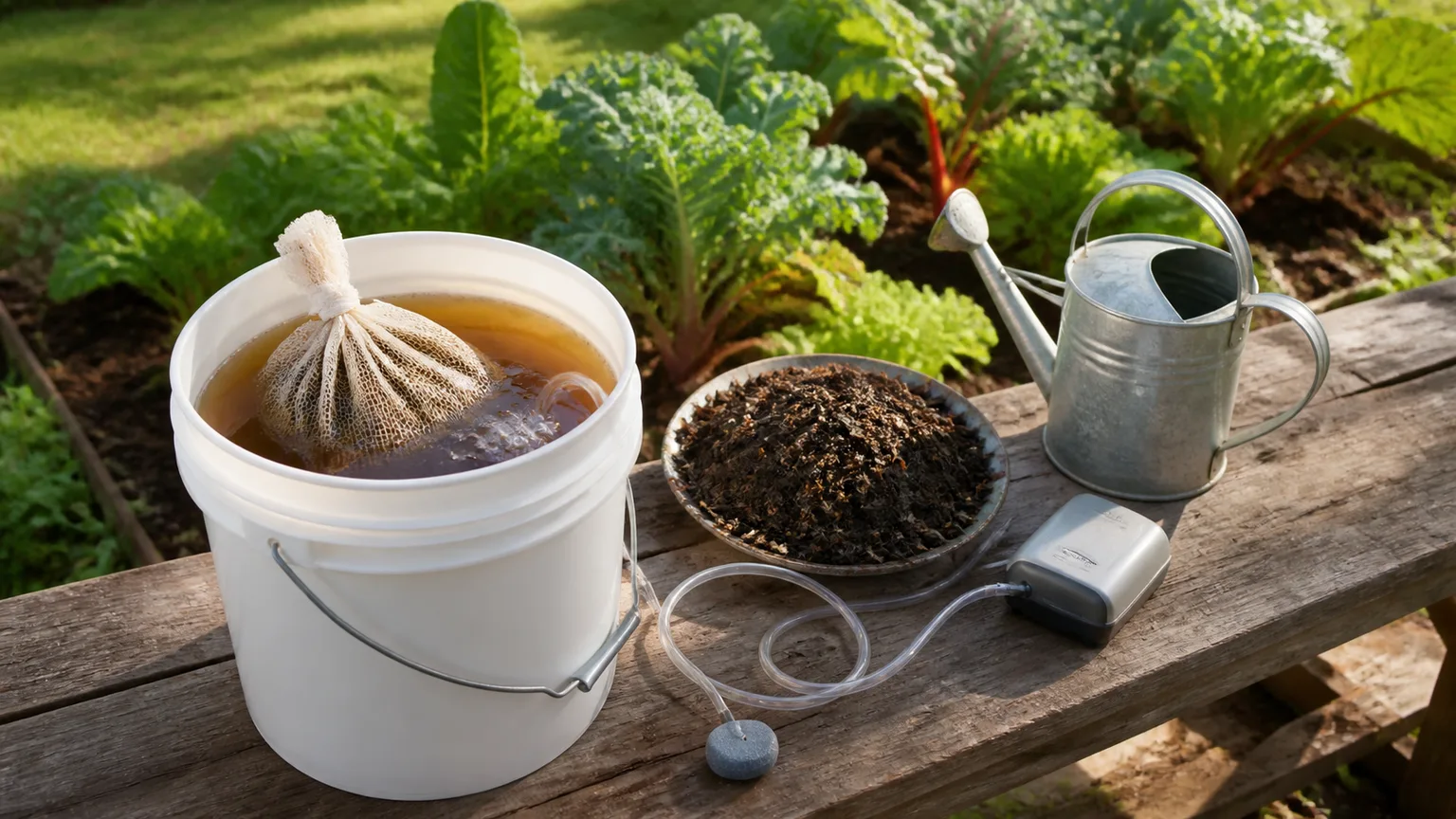
To make a small batch of compost tea, steep about 2 cups of mature, screened compost in 5 gallons of potable water, stir or aerate it, strain it, and apply the liquid promptly as a soil drench. Keep the recipe plain: clean equipment, finished compost, and no sugar or molasses. The result is a variable compost extract, not a measured fertilizer or a guaranteed disease treatment.
That distinction matters. Compost tea can carry some dissolved nutrients and organisms out of the compost, but it does not carry all of the solid compost’s benefits into the bucket. If your goal is dependable soil improvement, a thin layer of finished compost is usually the better use of your material. Brew tea when having a pourable extract is useful and you are comfortable treating the outcome as a small experiment.
The simple compost tea recipe at a glance
For a first batch, place 2 cups of screened, mature plant-based compost in a clean mesh bag and steep it in 5 gallons of potable water for about 12 to 24 hours. Stir the bucket several times during the steep, remove the bag, and pour the filtered liquid onto soil around established plants. Use it the same day rather than storing it for later.
This is a deliberately modest recipe. A gardening recipe cannot promise a precise nutrient concentration because compost varies, and an untested home brew cannot be certified pathogen-free. Starting with a small amount of tea lets you see whether the liquid fits your routine without committing an entire bed or adding a heavy, unknown dose.
If you want the microbes in the mixture to remain oxygenated while it brews, use an aquarium pump and air stone; if you do not have one, stir regularly and keep the steep short. A pump changes the process, but it does not make questionable compost safe or turn the tea into a standardized product. In either case, skip molasses, sugar, fish products, and other microbial foods for a beginner batch.
What compost tea is—and what it is not
Compost tea is water that has extracted some soluble compounds and microorganisms from finished compost. Gardeners make it by suspending compost in water, with or without active aeration, then removing the solids before applying the liquid to soil or foliage. The strength and biology of the result depend on the starting compost and the brewing conditions.
It is not simply “compost, but stronger.” Most of the stable organic matter stays in the compost solids, where it can improve soil structure and moisture handling over time. The liquid carries only a portion of what dissolves or suspends in water; it is not automatically a balanced feed, nor does its dark color show how much nitrogen, phosphorus, or potassium it contains.
The phrase “beneficial microbes” also needs a qualifier. A brew can contain organisms from the compost, but the gardener usually does not know which species are present, at what concentration, or whether they will persist after the liquid reaches a different soil. Brewing a living mixture is not the same as producing a defined microbial inoculant with a tested label.
Compost tea, leachate, and worm tea are different
Compost leachate is liquid that drains through a compost pile or bin. It may have passed over fresh scraps, concentrated salts, or materials of uncertain condition, so it is not interchangeable with a deliberate extract made from mature compost. Do not collect an unknown puddle under a bin and assume it is garden tea, especially for edible crops.
Worm tea is a loose name that can refer to an extract made from finished vermicompost, or to liquid drained from a worm bin. Those are different materials too. If the source is liquid runoff, the same caution applies: the contents and concentration are uncertain, so it should not be used as a foliar spray on food plants.
Manure tea is another separate category. Fresh or incompletely composted manure brings additional food-safety concerns and should not be substituted for plant-based mature compost in this beginner method. When in doubt, use finished compost directly rather than trying to rescue an unclear liquid by diluting it.
What compost tea may do for plants
The most defensible benefit is convenience: a liquid extract can be poured into the root zone of a dense planting where spreading solids would be awkward. Some compost-derived soluble nutrients and organic compounds move into the water, and the brew may transport organisms that were already in the mature compost. Those are plausible reasons gardeners use it as a supplemental input.
Whether those properties translate into visible improvement depends on the plant, soil, compost, climate, and brewing method. A plant growing in healthy, moist soil may show no obvious difference after a tea drench. A struggling plant may also show no response if the real problem is poor drainage, root damage, insufficient light, or a nutrient deficiency that the tea does not correct.
Compost tea is not a reliable standalone pesticide or fungicide. Some research has found disease-suppressive effects for particular composts and crop-pathogen combinations, but results are not universal. The UF/IFAS guide to organic vegetable gardening says studies of disease suppression are inconsistent and that compost tea does not provide a measurable amount of plant nutrition in the tested context. Treat it as an optional extract, not as a cure or a substitute for diagnosis.
For lasting soil gains, compost itself usually has the advantage. The solid material adds organic matter and feeds soil processes over time; tea does not reproduce that structure-building contribution. If the garden needs organic matter, top-dressing with finished compost or mulch is a more direct response than making the same compost disappear into a bucket.
What research says about the benefits and limits
Compost-tea research is real, but so is its variability. A 2025 peer-reviewed study in Frontiers in Plant Science tested a characterized aerated compost tea in protected Mediterranean growing conditions and reported crop responses for lettuce, onion, and chard. That result supports continued investigation; it does not show that any homemade brew will improve every plant in every garden.
A 2026 review in Applied Soil Ecology synthesized 39 peer-reviewed studies published from 2010 through 2025, covering 516 case studies. Its central finding is a useful reality check: disease suppression varied with the host plant, pathogen, feedstock, brewing conditions, and application. The review found higher average disease suppression for aerated teas in the collected cases, yet also reported substantial variability. “Aerated” alone is not a guarantee of efficacy.
Extension sources do not all frame usefulness the same way. Some practical guides present compost tea as a useful supplement; others emphasize that the nutrition is too variable to rely on and disease effects are inconsistent. The University of California Cooperative Extension discussion cautions against treating aerated tea as a dependable disease cure, while Rodale Institute’s practical guide describes extraction methods and their variation. Read the disagreement as a reason to narrow the claim: a specific characterized brew may work in a specific setting, while an ordinary bucket recipe cannot promise the same result.
Why one batch can behave differently from another
The starting compost is the first source of variation. A mature leaf-and-vegetable compost differs from a manure-rich pile in nutrient content and microbial community; even two finished backyard piles can differ because their feedstocks, moisture, temperature, and maturity differed. Appearance helps you spot immature material, but it does not give you a laboratory analysis.
Then the brewing conditions add another set of differences: compost-to-water ratio, temperature, water chemistry, exposure to air, mixing, duration, and how quickly the brew is applied. A cool 12-hour steep is not equivalent to a warm week-long fermentation. A clean bucket is not a microbial test, and a pleasant earthy smell cannot prove that pathogens are absent.
That variability is why you should not follow a universal weekly schedule. More frequent applications are not automatically more helpful, and every extra pour adds water and unknown soluble material. Try a modest application in a small area, keep other care consistent, and observe the plants over the next week or two before repeating it.
Choose safe compost, water, and equipment
Start with finished, mature compost: dark, crumbly material with an earthy smell and no recognizable fresh scraps or active heating. For the simple recipe here, choose plant-based compost with a known source. Do not use raw manure, pet waste, unfinished kitchen scraps, compost containing diseased material, or runoff from a bin.
Maturity and pathogen reduction are related but not identical. Compost that looks finished may not have gone through a documented process that reduces human pathogens. If your compost source includes manure or other animal materials, do not assume that making tea—or bubbling it—removes food-safety risks. A USDA Agricultural Research Service study summary reports that nutrient additives used in compost-tea experiments supported growth of E. coli and Salmonella from very low initial levels.
Use potable water and a bucket, mesh bag, stirring stick, and watering can that are clean and in good condition. If you want to reduce uncertainty from disinfectants, consult your local water provider about the treatment used rather than assuming that leaving tap water out overnight removes every treatment. Do not use a container that has held pesticide, fuel, detergent concentrate, or other chemicals.
Make a small, unamended compost tea batch
The most responsible first recipe has no added food for microbes. Sugar and molasses may stimulate rapid microbial growth, but they also change oxygen demand and can support unwanted organisms. The USDA ARS research above found pathogen growth when nutrient supplements were added; therefore, a home gardener should not treat sugar as a harmless shortcut to “more beneficial microbes.”
Gather the materials
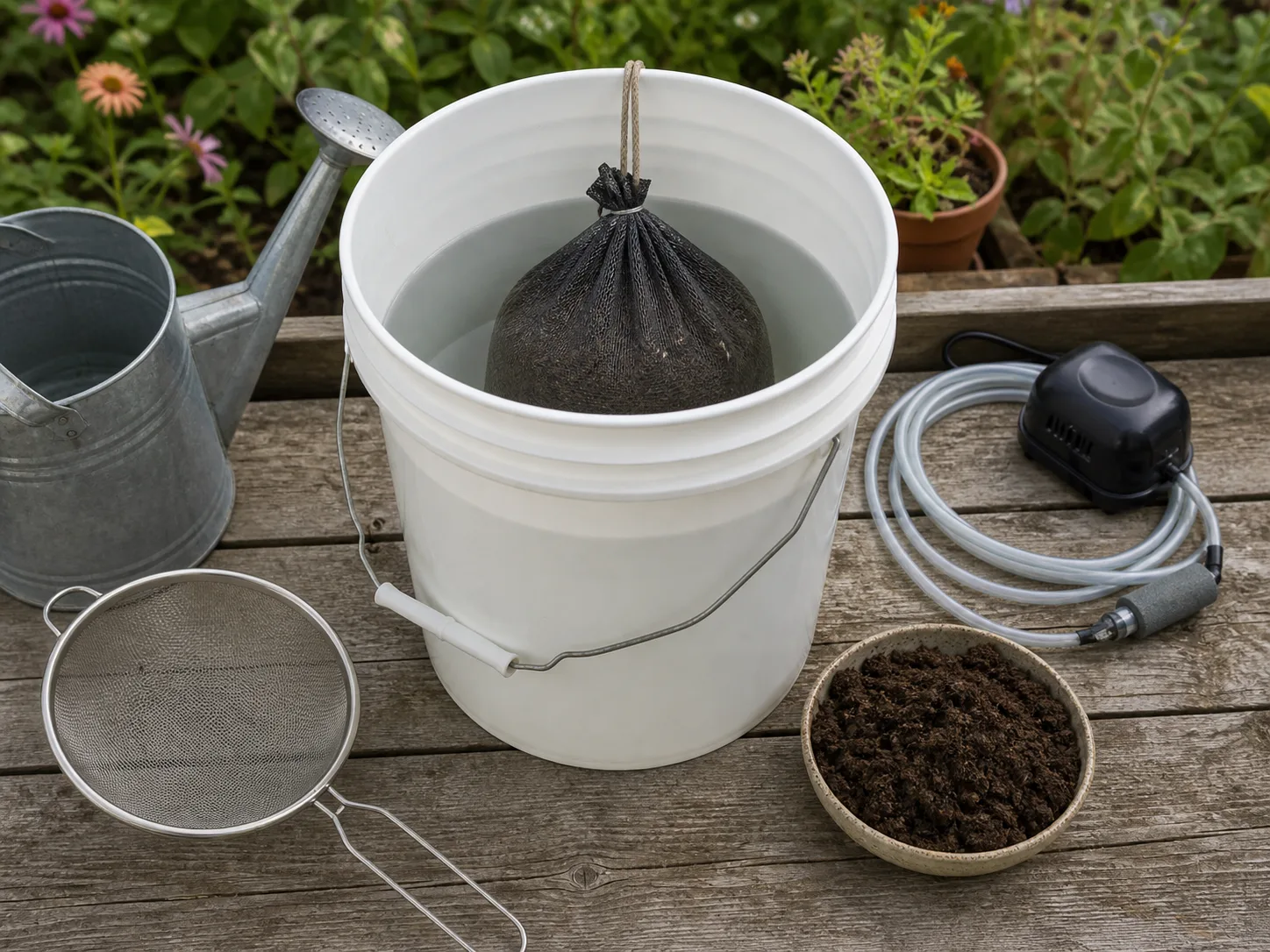
For one 5-gallon batch, set out:
- 5 gallons of potable water.
- About 2 cups of mature, screened plant-based compost.
- A clean mesh bag or tightly woven compost bag, if you want easier straining.
- A clean bucket, a long stirring tool, and a watering can.
- Optionally, an aquarium air pump, tubing, and air stone for active aeration.
The compost-to-water amount is a starting recipe, not a promise of a certain N-P-K value. Rodale Institute describes aerated extracts made at roughly 1:20 to 1:40 compost-to-water by volume, which places two cups in five gallons near the dilute end of that range. Other recipes use different amounts; changing the ratio changes the brew, but no household ratio makes it a standardized fertilizer.
Brew, strain, and use it promptly
- Wash and rinse the equipment. Remove soil and residue from the bucket, bag, stirrer, and watering can. Use equipment reserved for gardening inputs if possible.
- Fill the bucket with water. Leave enough headroom to stir without sloshing. Use cool or room-temperature water, not hot water that may damage organisms or icy water that slows extraction.
- Add screened compost. Put it into a mesh bag and submerge it, or stir loose compost directly into the water if you can filter it carefully afterward. Break up clumps so water reaches the compost evenly.
- Stir or aerate. For a simple short extract, stir thoroughly at the start and several times over the next 12 to 24 hours. If using an air pump, start it as soon as the compost goes in and keep it running during the brew.
- Check the batch, then strain. A mild earthy smell is ordinary, but smell is not a safety test. Remove the bag or strain loose solids through clean mesh so the watering can does not clog.
- Apply the same day. Pour the liquid into the root zone and clean the bucket and tools. Do not store the batch sealed in a warm garage, where oxygen conditions and microbial balance can change.
You do not need to chase the darkest possible color. Color depends on the compost and suspended particles, not on a calibrated nutrient level. A faint tea color can be the result of a perfectly ordinary extract; adding more compost simply to make it look stronger can create a brew whose concentration and behavior you still cannot measure.
Aerated or non-aerated: which method fits?
Aeration and steeping are two approaches, not a ranking from poor to superior. A pump moves air through the liquid and supports an oxygen-rich process while it is operating. A no-pump extract takes less equipment, but needs mixing and a short, controlled steep if you want to avoid leaving a bucket unattended for days.
| Method | What you do | Best fit | Main limitation |
|---|---|---|---|
| Short, non-aerated extract | Steep mature compost in water, stir several times, strain within about a day | A small trial when you have no pump | Oxygen and microbial conditions are less controlled than in an actively aerated brew |
| Aerated compost tea | Bubble air through the mixture with a pump and air stone while it steeps | A gardener who wants to run a repeatable, monitored process | Equipment cleanliness and working aeration matter; it still is not a safety guarantee or a proven disease treatment |
When to use an air pump
If you already have an aquarium pump, aerated brewing can be a reasonable experiment. Use a clean air stone and tubing, ensure bubbles circulate through the water rather than only in one corner, and do not leave the pump off for a long period while assuming the batch is still aerobic. Extension and horticulture recipes often use brewing windows around a day, but conditions—not a timer alone—determine what is happening.
Do not buy equipment because someone promises that aeration makes tea safe or cures disease. Air can support oxygen-loving organisms, but it does not sterilize the liquid, identify its organisms, or correct a contaminated input. In the literature, different teas made with different composts and systems have produced different results; an aquarium pump cannot remove that basic variability.
A simple steep without a pump
Without a pump, keep the batch small and brief. Stir it well several times during the day, keep the bucket out of direct sun and away from children or pets, and strain it within roughly 12 to 24 hours. This is a practical fresh extract, not a long fermentation recipe.
Some traditional recipes leave a bag in a bucket for several days and stir daily. A longer soak can extract more material, but it also gives oxygen and microbial conditions more time to change. For an untested home brew—especially when you cannot monitor dissolved oxygen or test microbes—there is little reason to prefer a long, warm steep over a fresh short extraction.
Apply compost tea where it can help
Use the tea as an optional root-zone drench on established plants in soil that is neither bone dry nor waterlogged. Do not pour any liquid input over a plant that is already wilting from overwatering, sitting in saturated soil, or suffering root rot. Fix the cause first; tea adds another wetting event and cannot reverse damaged roots.
Use a soil drench as the default
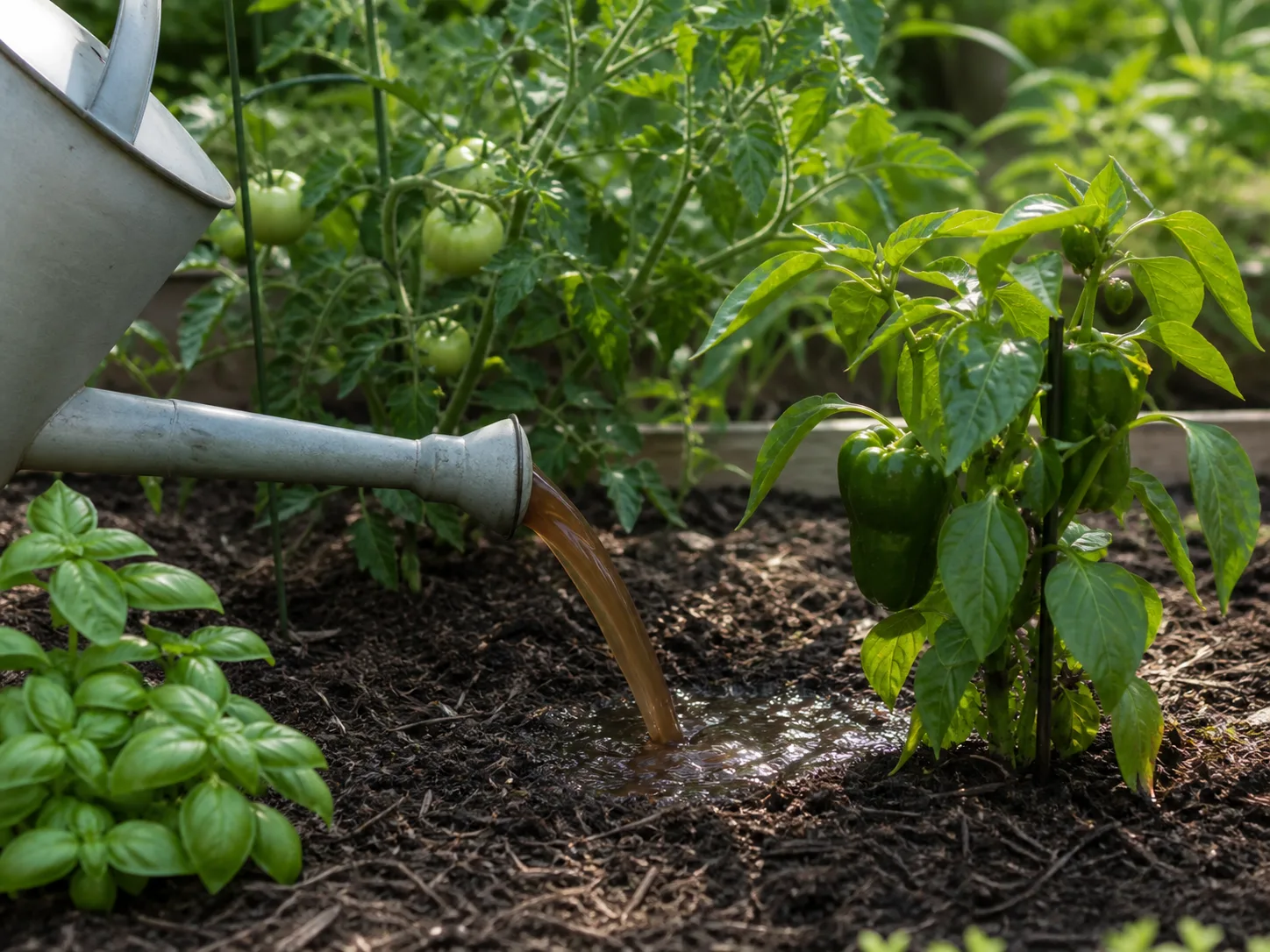
Pour a modest amount around the soil beneath the canopy, avoiding direct splashing onto stems, crowns, and foliage. If the soil is dry, pre-water lightly with plain water, then apply the tea; this helps prevent a concentrated patch from drying on the surface. For container plants, use only enough to wet the root zone without leaving the pot sitting in a full saucer.
Do not assume that a home dilution is required—or that a particular dilution makes every batch safe. If the soil or plants respond poorly, stop and return to ordinary water while you investigate. If you have a measured nutrient problem, a soil test and a fertilizer with a declared analysis are better tools than trying to guess the strength of compost tea.
Filter the brew more finely if you need to use a hose-end sprayer, but do not run homemade tea through drip emitters. Fine particles clog narrow openings, and organic residue left inside tubing can be hard to clean. A watering can gives you a clearer view of where the liquid goes and what it touches.
Set stricter limits for edible crops and leaf sprays
Avoid spraying homemade compost tea on leaves, herbs, or fruits that people will eat. A foliar spray puts the brew directly onto an edible surface, and neither a clear appearance nor an earthy odor demonstrates that it is free of human pathogens. The University of Arizona Cooperative Extension’s compost-tea guidance explains the food-safety concern and recommends keeping tea on non-edible plants or non-edible plant portions as a precaution.
For a home vegetable garden, the lowest-uncertainty choice is to use finished compost directly and reserve untested tea for ornamentals. If you still choose to use a soil drench near food crops, use only known mature plant-based compost, keep liquid off edible parts, apply before harvest rather than at harvest, wash hands and tools, and follow local extension or food-safety guidance. These steps reduce opportunities for exposure; they do not certify the liquid as pathogen-free.
For non-edible ornamentals, a foliar application is still optional and experimental. Strain thoroughly, test one plant first, spray during a cool part of the day, and avoid flowers that pollinators are visiting. Stop if leaves develop spotting, residue, or other damage. Do not use compost tea as a pesticide unless the product and its label are legally approved for that use in your location.
Know when to stop, discard, or choose compost instead
Discard a batch if it develops a strong sewage, rotten-egg, or putrid smell; if you find contamination in the bucket; or if you cannot verify what went into it. A bad odor signals that the brew is not proceeding as intended, but a good odor is not proof that a batch is safe. Do not try to fix a questionable brew by adding sugar, diluting it into a larger bucket, or spraying it on soil.
If the plants are healthy and the soil already receives compost, there may be no reason to brew at all. If you want to improve water retention or soil tilth, spread finished compost. If you need a specific nutrient, test the soil and choose an input with a known analysis. If you are trying to control a disease, identify the cause and use proven cultural practices or a labeled treatment rather than relying on homemade tea.
Compost tea works best as a small, deliberate choice: mature source material, clean tools, fresh application, modest expectations, and a clear idea of why liquid is more useful than solid compost for that particular job. When any of those conditions are missing, skip the brew.
Conclusion
Making compost tea is straightforward: steep screened, mature compost in potable water, keep the equipment clean, stir or aerate a short brew, strain it, and apply it promptly to soil. Keep the recipe unamended, especially by avoiding sugar or molasses, and treat every home batch as variable rather than as a known-strength fertilizer.
The liquid may be useful as a convenient root-zone extract, but research does not justify promises of weekly growth boosts or reliable disease control. For food crops, avoid foliar sprays and favor finished compost unless local guidance supports a specific process. If all your garden needs is organic matter or predictable nutrition, compost and a soil test are the more dependable next steps.



