How to Grow and Care for Golden Bamboo Indoors
Grow golden bamboo indoors with the right light, a roomy draining pot, steady moisture, and a plan for containing its vigorous rhizomes.
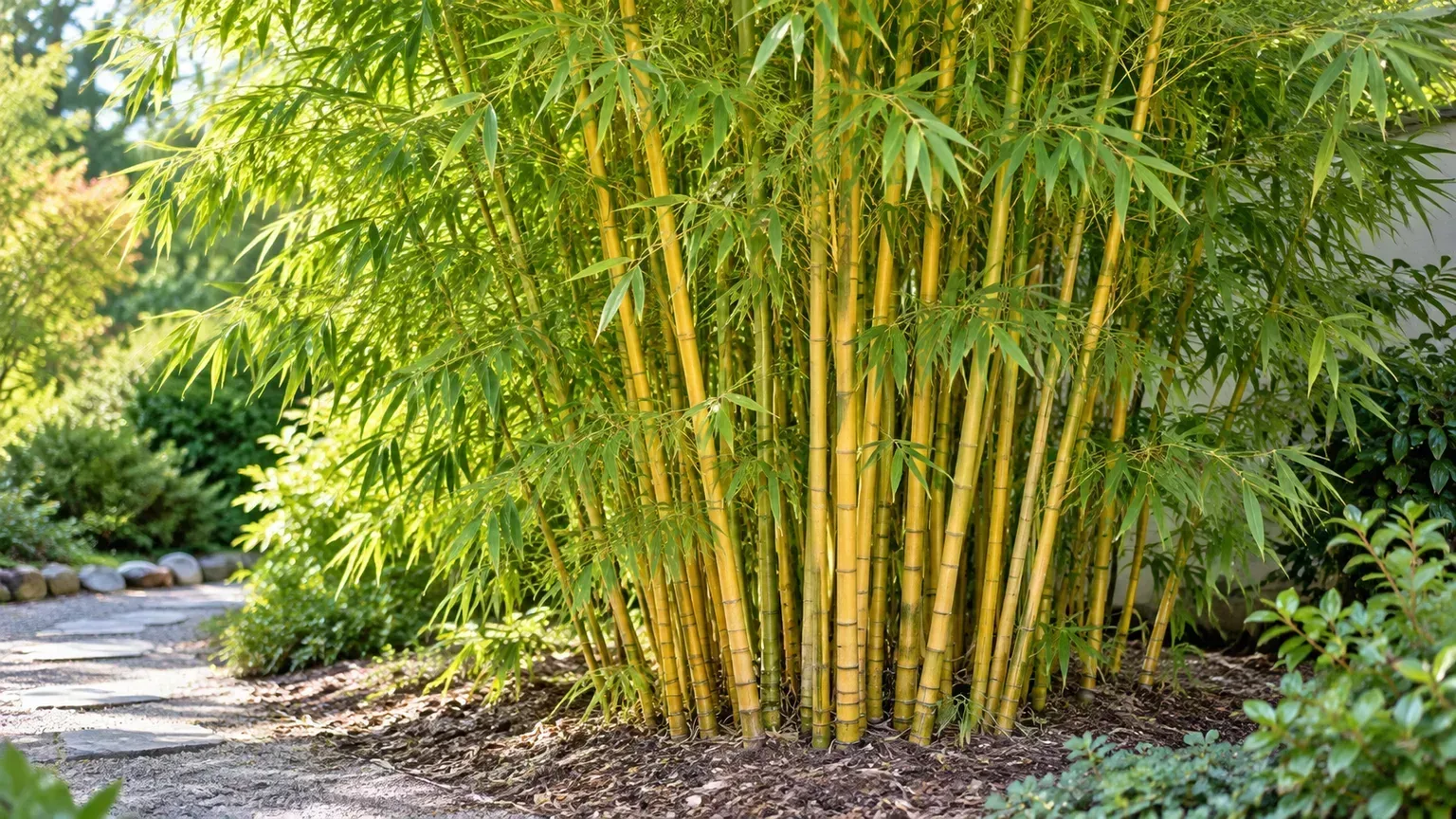
Golden bamboo (Phyllostachys aurea) can grow in a large indoor container, but it is not a small, low-light houseplant. It is a woody, running bamboo whose underground rhizomes spread quickly when they find room, and whose upright canes can grow beyond the scale of an ordinary apartment. The right question is less “Can I put bamboo inside?” than “Do I have enough light, floor space, and patience to manage a vigorous grass in a pot?”
If you have a very bright room, a sturdy container, and a plan to inspect the pot, golden bamboo can make a striking architectural plant. If your room is dim or you want a compact tabletop plant that lives in water, choose another plant; the familiar lucky bamboo is a different species with different care.
Quick Answer: Can Golden Bamboo Grow Indoors?
Yes, golden bamboo can be kept indoors in a container, especially in a bright sunroom, conservatory, or beside a large unshaded window. It is more demanding than common foliage houseplants because indoor light is often weaker than the full sun or partial shade this species handles outdoors, and a container eventually limits its expanding rhizomes. Indoor growth may be slower or less vigorous than outdoor growth, but there is no dependable indoor height cap: a small pot or dark corner is not a humane way to keep a tall plant miniature.
Treat it as a large, long-term container plant rather than a decorative cane arrangement. Before bringing one home, measure the window, ceiling clearance, and route for moving a heavy pot; decide where the plant can live if it needs seasonal outdoor light; and check that the species is appropriate in your area if it might ever leave the house. The NC State Extension Plant Toolbox profile describes it as a fast-growing, rhizomatous grass, while the RHS plant profile lists it as a large evergreen bamboo suited to patio containers as well as garden use.
Recognize Golden Bamboo Before You Buy
Golden bamboo has narrow green leaves arranged along slender, jointed canes. New canes are often green; older canes can become yellowish or golden with age and sun exposure. Some plants develop closely compressed lower stem joints, a distinctive feature of the species, but the plant is not always uniformly gold. The NC State profile notes that culm color becomes more yellow with direct sun and age, so a green nursery plant is not automatically mislabeled.
The species is native to China and belongs to the grass family, Poaceae. Unlike a shrub that grows a fixed trunk and a few branches, bamboo produces new culms from a network of underground stems called rhizomes. This biology explains both its beauty and its main practical challenge: the visible canes occupy a pot, but the expanding rhizome mass is what presses against the container, fills drainage openings, and eventually makes division or repotting necessary.
Golden Bamboo Is Not Lucky Bamboo
Lucky bamboo is usually Dracaena sanderiana, not a bamboo at all. Shops often sell its bare, spiraled stems in water or small decorative containers, which can make the name confusing, but it does not share the size, rhizomes, or care requirements of Phyllostachys aurea. Golden bamboo is a true bamboo: it needs a soil-filled pot, substantial light, and room for a spreading root system.
Check the botanical name on the nursery label before choosing a plant. If the label says Phyllostachys aurea, plan for a substantial container specimen. If you wanted a small plant that can sit on a desk, the golden bamboo label is a cue to reconsider rather than buy first and try to manage its size through poor light.
Is Your Room a Good Fit?
A bright conservatory or room with a broad, sunlit window is a better fit than an interior hallway or a corner several feet from glass. The plant can tolerate some shade outside, but a window filters and blocks light, and indoor positions lose intensity quickly with distance. If the only available spot is dim, a grow light can add useful light, but it cannot solve the separate problems of a too-small pot, low ceiling, or lack of room to service the plant.
Plan for a bulky container and top-heavy growth. A mature plant can be awkward to turn, repot, or carry through doorways, and a narrow pot may tip when the foliage catches a draft from an open door or fan. Decide whether the plant can stay indoors year-round or whether a protected patio or sunroom is available for part of the year. Seasonal moves can improve light, but they also require gradual acclimation and a safe way to move the container.
If you want the look of a leafy bamboo but cannot meet those conditions, a compact clumping bamboo suited to your climate or an unrelated indoor foliage plant may be a better purchase. Golden bamboo rewards the grower who enjoys managing roots and size; it is a poor choice when the goal is “set it in a dark room and forget it.”
Give It the Brightest Window You Have
Place golden bamboo as close as practical to your brightest unshaded window. In the Northern Hemisphere, a south- or west-facing window often provides the strongest light; in the Southern Hemisphere, look toward the equator-facing side. A large east-facing window can also work if it receives several hours of unobstructed morning sun. These directions are starting points, not substitutes for observing the plant and the actual light at your home.
The NC State profile describes golden bamboo as suited to full sun or partial shade and defines full sun as six or more hours of direct sunlight outdoors. That number is not a promise that six hours behind any window produces the same intensity. Glass, overhangs, trees, screens, and distance all reduce usable light. If new shoots become thin, lean strongly toward the glass, or emerge with sparse foliage, move the plant closer to a brighter window or add a grow light instead of feeding it more fertilizer.
Turn the pot occasionally if one side leans, but avoid rotating it constantly while it is settling into a new location. Direct sun through glass can heat leaves, especially in a hot room, so watch for bleached or dry patches after a sudden move from shade. Acclimate a nursery plant over several days: start in bright indirect light, then give it more direct exposure as the leaves adjust. A plant that has been grown outdoors in sun may need less adjustment than a shaded greenhouse specimen.
Choose a Pot That Contains the Rhizomes
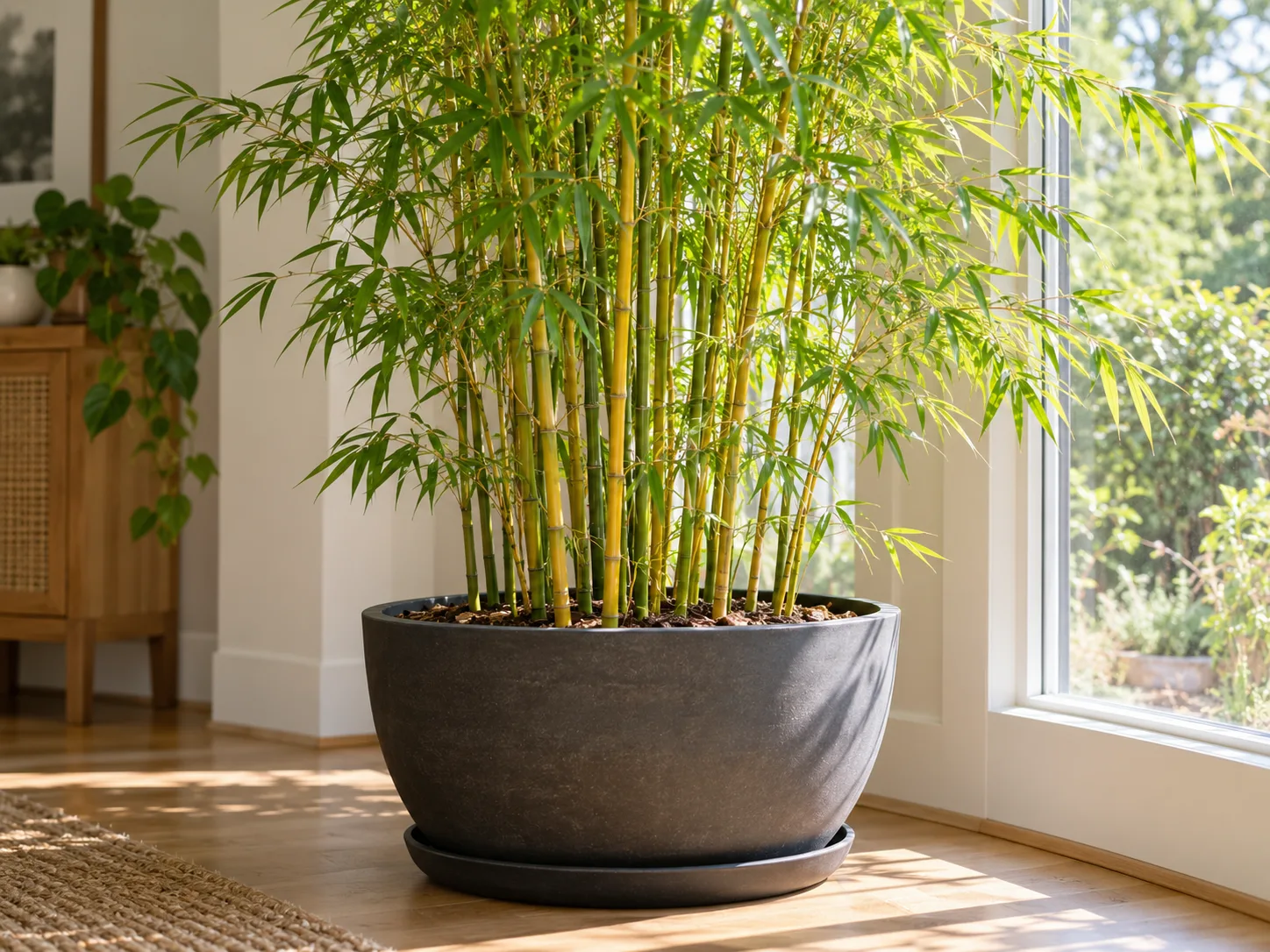
Choose a broad, stable container with several open drainage holes and enough weight to resist tipping. Running bamboo develops a dense root-and-rhizome mass, so width and a generous soil volume matter; a very tall, narrow vase is harder to water evenly and more difficult to work with when the roots need division. Container size is a trade-off: a larger pot can postpone root crowding, but it is also heavier, more expensive, and harder to move inside.
For an established specimen, horticulture references commonly treat about 10 gallons as a practical minimum, with larger containers giving the plant more room before it needs division. A young nursery plant can start in a smaller pot only if the root ball fits comfortably and there is a clear plan to move it up as it grows. The Gardener’s Path container guide and Gardening Know How’s pot-growing guide both emphasize ample root space and drainage; their size guidance is a starting point, not a guarantee that a particular indoor plant will stay small.
A pot contains rhizomes only while they remain inside it. Set outdoor containers on paving, a raised stand, or another surface that does not let roots reach soil below. Check the drainage holes and the ground under the pot periodically; rhizomes can push toward openings, and roots that find a crack or soil bed can turn a contained plant into a spreading one. Do not bury the pot in a garden bed or set it directly on bare earth and assume the container wall alone solves the problem. The UF/IFAS profile warns that golden bamboo can escape containment and spread through rhizomes, so prevention and monitoring matter even for container culture.
Indoors, use a waterproof saucer to protect floors, but empty it after watering. A saucer is not a water reservoir: leaving the pot standing in runoff keeps the lower mix saturated and can damage roots. If the plant is too heavy to lift, use a wheeled plant caddy rated for the filled pot’s weight, and lock it in place before watering or pruning.
Use Moisture-Retentive, Free-Draining Potting Mix
Golden bamboo grows best in fertile soil that holds some moisture but drains freely. For an indoor pot, use a quality peat-free, loam-based container compost or a houseplant mix amended with coarse material such as perlite or fine bark if it stays wet for too long. The RHS profile recommends a peat-free loam-based compost for container cultivation and describes the preferred soil as moist but well drained.
Avoid heavy garden soil in a pot. It can compact, leave little air around the roots, and stay wet for a long time indoors, where evaporation is slower than outside. At the other extreme, an extremely coarse mix can dry too quickly for a large leafy plant. The goal is a mix that takes water evenly and lets excess flow out of the base; if water sits on the surface or pours down a gap around a shrunken root ball, inspect the mix rather than adding more water on a calendar.
Use a container whose drainage holes are not blocked by a flat saucer or a layer of compacted soil. You do not need to fill the bottom with gravel to create drainage; the water must be able to pass through the entire mix and leave the pot. A small piece of mesh over a large hole can hold the mix in place while leaving the outlet open.
Water by Checking the Root Zone
Keep the mix evenly moist during active growth, but do not keep it waterlogged. Check the upper inch or two with a finger or wooden skewer and feel the weight of the pot: when the surface has begun to dry and the container feels lighter, water thoroughly until excess drains from the holes. Empty the saucer once drainage stops. In a bright, warm room, the pot can use water faster; in winter, a cooler or dimmer room usually slows growth and drying.
Do not follow a fixed rule such as “twice a week.” A large ceramic planter in a cool room and a smaller nursery pot beside a sunny window have different drying rates. For the first few weeks, check the soil every couple of days so you can learn the rhythm in your actual home. Once you know roughly how long the pot takes to dry, keep checking before watering rather than assuming that the same interval will hold through every season.
A bamboo plant should not sit in water, but neither should its root ball be allowed to dry to dust. If water runs straight through a dry, root-bound mass without wetting it, apply a slow first pass, pause, and water again so the mix can absorb moisture. If the center is still dry after that, the pot may be severely root-bound or the mix may have become water-repellent; inspect it and plan to repot rather than compensating with daily splashes.
The RHS bamboo growing guide notes that container-grown bamboo dries faster and needs regular, liberal watering through the growing season. That is a useful reminder to check more often in warm weather, not an instruction to keep the soil constantly saturated. Moisture and oxygen must reach the roots together; overwatering a poorly draining pot is not a way to provide adequate humidity.
Manage Temperature, Humidity, and Airflow
Stable household temperatures are generally easier on an indoor specimen than repeated swings beside a frequently opened exterior door. Keep the pot away from heating vents, air conditioners, radiators, and cold window drafts. These spots can dry foliage unevenly, chill the root ball, or make the pot alternate between hot and cold. If a winter window becomes very cold overnight, pull the plant a short distance from the glass while keeping it in bright light.
Golden bamboo does not need a special tropical humidity chamber to survive in a home. If leaf edges become dry, first check root moisture, direct hot sun, and airflow before buying a humidifier. Misting briefly wets foliage but does not correct a dry root ball or dim placement. A humidifier can help in a very dry room, but leave enough air movement around the leaves and do not let condensation or runoff keep the soil and canes constantly wet.
Temperature changes matter most when the plant moves between indoor and outdoor conditions. Do not transfer a plant from a stable room directly into strong sun, wind, or cold. Gradual changes give leaves and roots time to adjust and make it easier to tell whether a new symptom came from the move or from a care problem.
Feed During Active Growth, Not All Year
Bamboo is a grass and can use nutrients to support new foliage and canes, but fertilizer cannot make up for inadequate light or an exhausted root zone. Use a balanced liquid fertilizer at the label rate during the active growing season, following the RHS recommendation for monthly feeding of container-grown P. aurea. Stop or reduce feeding when growth slows in the darker part of the year, and do not apply concentrated fertilizer to a dry root ball.
If a container has been recently repotted into fresh compost, wait before adding a separate feed unless the mix label says it contains no nutrients. Excess fertilizer salts can build up in a closed pot, leaving pale or scorched leaf margins and stressing roots. If a white crust forms on the soil surface or pot rim, check feeding frequency and water quality, and make sure the pot drains freely before flushing the mix with clean water.
Prune Canes Without Expecting Pruning to Stop Spread
Pruning is mainly for appearance, clearance, and removing dead or damaged growth. Cut a dead cane close to the soil line with clean loppers or a pruning saw; remove a healthy cane at the base if it crowds a doorway or blocks too much light. The RHS plant profile recommends removing weak, dead, damaged, or spindly stems in spring and thinning canes to show their form.
Do not shear all the leaves off to make the plant shorter. A cane cut across the top will not resume upward growth from the cut point, but a healthy rhizome can send up new culms later. If height is becoming a problem, choose a manageable replacement or divide the plant and keep a smaller section rather than treating repeated topping as a reliable size-control plan. Pruning canes also does not stop underground rhizomes from expanding.
Repot or Divide When the Root Mass Crowds the Pot
There is no single repotting interval that fits every plant. Inspect the root ball when roots emerge from several drainage holes, when dense rhizomes push up at the soil surface, when watering no longer wets the center, or when the container dries out much faster than before. A few visible roots do not automatically mean an emergency, but a solid mat filling the pot means the plant is approaching a division or larger-container decision.
Repot in early spring when possible, before the most vigorous new growth. Pick a larger stable pot if you want to preserve the whole plant, or divide the root mass if the current plant has already grown beyond the space you have. The picture below shows why a bamboo root ball needs a container that can accommodate thick horizontal growth, not just a narrow opening around the canes.
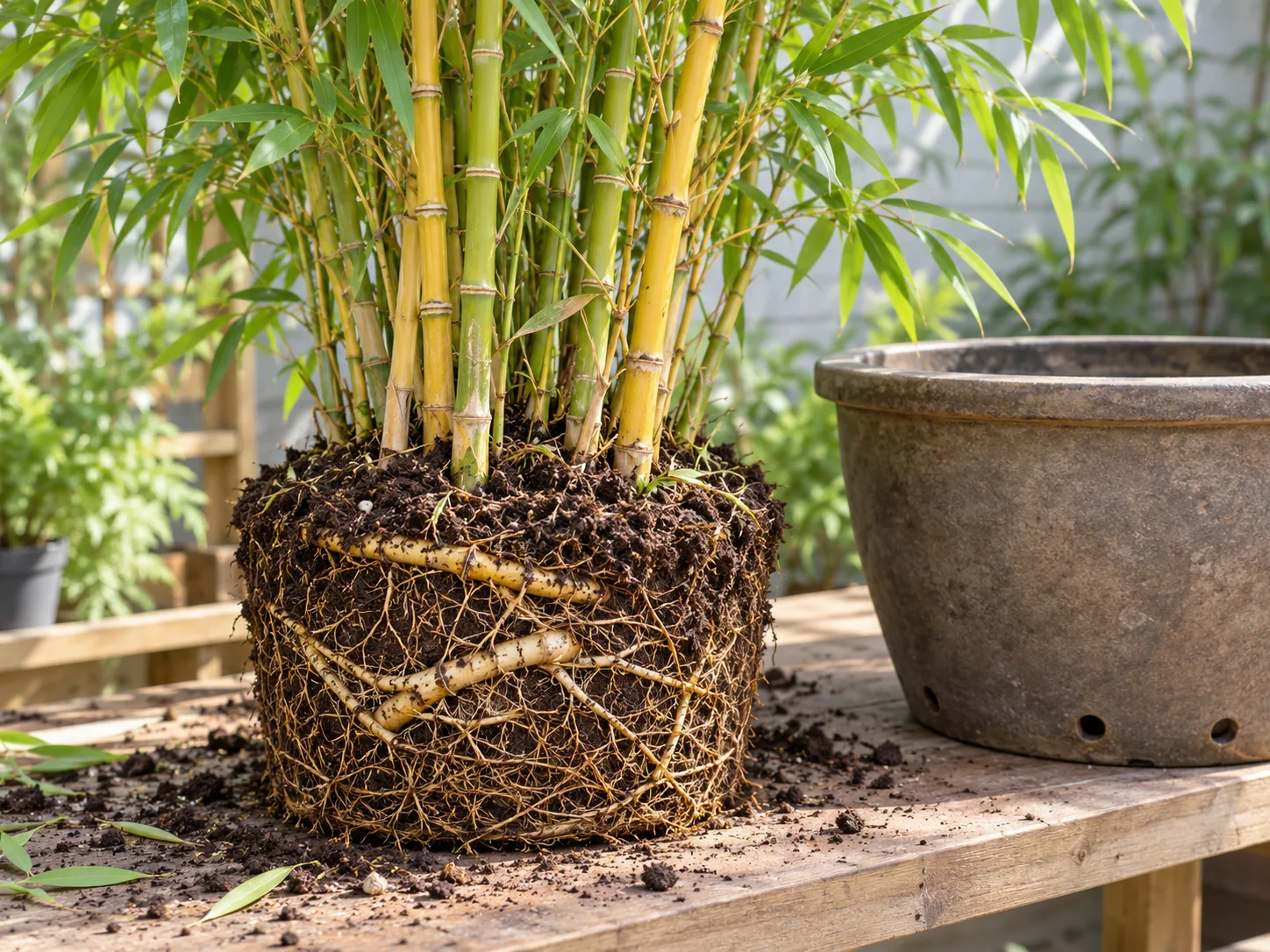
Water the plant the day before a planned division so the mix holds together. Slide the root ball out, protect the canes from snapping, and use a clean pruning saw or sharp spade to divide the mass into sections that each retain roots, rhizomes, and live buds. Replant one section at the same depth in fresh mix, keep it upright, and water it until the new soil is evenly moist. Avoid keeping more divisions than you have suitable containers and bright spots for; extra pieces should not be planted outdoors without checking local guidance.
If the plant is large, recruit help and prepare the destination pot before lifting it. Bamboo divisions can be heavy, and tearing the canes while wrestling with an undersized pot creates avoidable damage. Do not force a root mass into a smaller decorative cachepot by cutting indiscriminately; retain enough healthy root and rhizome tissue for the division to recover.
Propagate Through Rhizome Division
Division is the practical propagation method for a home grower. Golden bamboo rarely produces flowers and seed, and its new growth normally comes from rhizomes, so a rooted division gives you a more dependable start than trying to root a random piece of cane. The RHS profile lists spring division as its propagation method.
Choose a section with at least one healthy young shoot or visible bud plus a reasonable amount of root and rhizome. Use a clean saw or spade, pot the division promptly in fresh draining mix, and keep it evenly moist while it establishes. Set it in bright light without immediately exposing it to hot sun. A divided plant may pause before producing new growth; do not keep unpotting it to check progress if the canes remain firm and the mix is draining properly.
Do not distribute divisions casually. This species is a running bamboo, and whether it is considered invasive depends on the region and local conditions. The University of Maryland Extension overview and UF/IFAS profile document regional impacts in parts of the United States; check your state, province, or country’s invasive-plant listings before planting or giving a division to someone who may put it in the ground.
Diagnose Yellow Leaves, Brown Tips, and Weak Growth
A few older leaves yellowing and falling while the canes stay firm can be ordinary turnover. A sudden flush of yellowing, widespread browning, or weak new shoots deserves a check of soil moisture, drainage, light, and recent changes before you reach for fertilizer or filtered water. Leaf color alone does not identify one cause.
Start with the pot. If the root zone is dry and the pot is unusually light, water thoroughly and confirm that the root ball actually absorbs it. If the mix smells sour, remains wet for days, or the plant is losing leaves while the roots sit in soggy soil, stop watering, clear blocked drainage, and inspect the root mass for soft or decaying sections. A healthy golden bamboo can tolerate moist soil; constant saturation is the problem.
Next check light and placement. New culms that are weak or sparse can point to insufficient usable light, especially if the plant is far from a window. Brown, crispy edges may follow drying, direct heat, abrupt sun exposure, or salt accumulation, so compare the timing with a recent move, a missed watering, or a heavy feed. Avoid changing several things at once; correct the clearest cause, then watch the newest growth rather than expecting damaged leaf tissue to turn green again.
Match the Symptom to the Soil and the New Growth
Use this quick sequence before changing the routine:
- Feel the mix below the surface. Dry several inches down suggests the plant needs a thorough watering; wet soil with poor drainage means wait and correct the drainage problem.
- Check where damage starts. A few older inner leaves are less concerning than yellowing across the newest shoots or a rapid decline across the whole plant.
- Review the last change. A move to direct sun, a heater draft, repotting, or heavy feeding can explain symptoms that appear shortly afterward.
- Inspect the undersides of leaves and the canes. Look for webbing, clusters, or scale-like bumps. If you find pests, isolate the plant, rinse or wipe foliage, and follow a labeled treatment appropriate to the pest and indoor use.
- Change one factor and reassess. Give the plant time to show healthy new growth; do not increase water, fertilizer, and humidity all at once.
This approach avoids a common mistake: treating every yellow leaf as a water-quality issue. If the soil is wet, switching to filtered water will not restore oxygen to the roots; if the pot is dry, adding fertilizer can make the stress worse.
Move It Outdoors Gradually and Bring It Back Safely
A container can spend warm weather on a sheltered patio or balcony if the plant receives bright light and the pot is secure. Outdoor light and airflow can support stronger growth, but the change from indoor conditions should be gradual. Begin in bright shade or gentle morning sun for a few days, then increase exposure over one to two weeks while checking leaves for scorch and the pot for faster drying.
Keep the pot on a hard surface or raised stand, not bare garden soil. Inspect underneath and around every drainage opening so rhizomes cannot reach the ground. The pot should be heavy and stable enough to resist wind, and you should have a route to move it before winter conditions become damaging for a root ball in a container. Outdoor hardiness ratings for plants in the ground do not guarantee that the same roots will be insulated in a pot.
Before bringing the plant back inside, inspect leaves and canes for insects, rinse off debris, and let the container drain. Reverse the acclimation gradually: start in a bright sheltered spot, then move it indoors over several days. Do not wait until an unexpected cold snap or until the plant is already stressed to decide where it will overwinter. If you cannot provide good indoor light or safely move a very large planter, plan for a different container plant rather than leaving it in an exposed position by default.
Conclusion
Golden bamboo can grow indoors, but success depends on accepting what the plant is: a large, vigorous running bamboo that needs strong light, a generous draining pot, and regular attention to its expanding rhizomes. A bright sunroom or window and a stable container make the project realistic; a dark corner, water-filled vase, or undersized decorative pot does not.
Start with the botanical label, choose a pot you can service, and water when the root zone begins to dry rather than following a fixed schedule. Inspect the base and drainage openings, divide the root mass when it crowds the pot, and check local invasive-plant guidance before any outdoor planting. If the space cannot meet those needs, choosing a smaller plant now is easier than trying to force golden bamboo to stay small later.



