How to Grow and Care for the Pencil Cactus
Grow pencil cactus (*Euphorbia tirucalli*) indoors with the right light, soak-and-dry watering, gritty soil, and safe sap handling—plus propagation, pruning, and pet warnings.
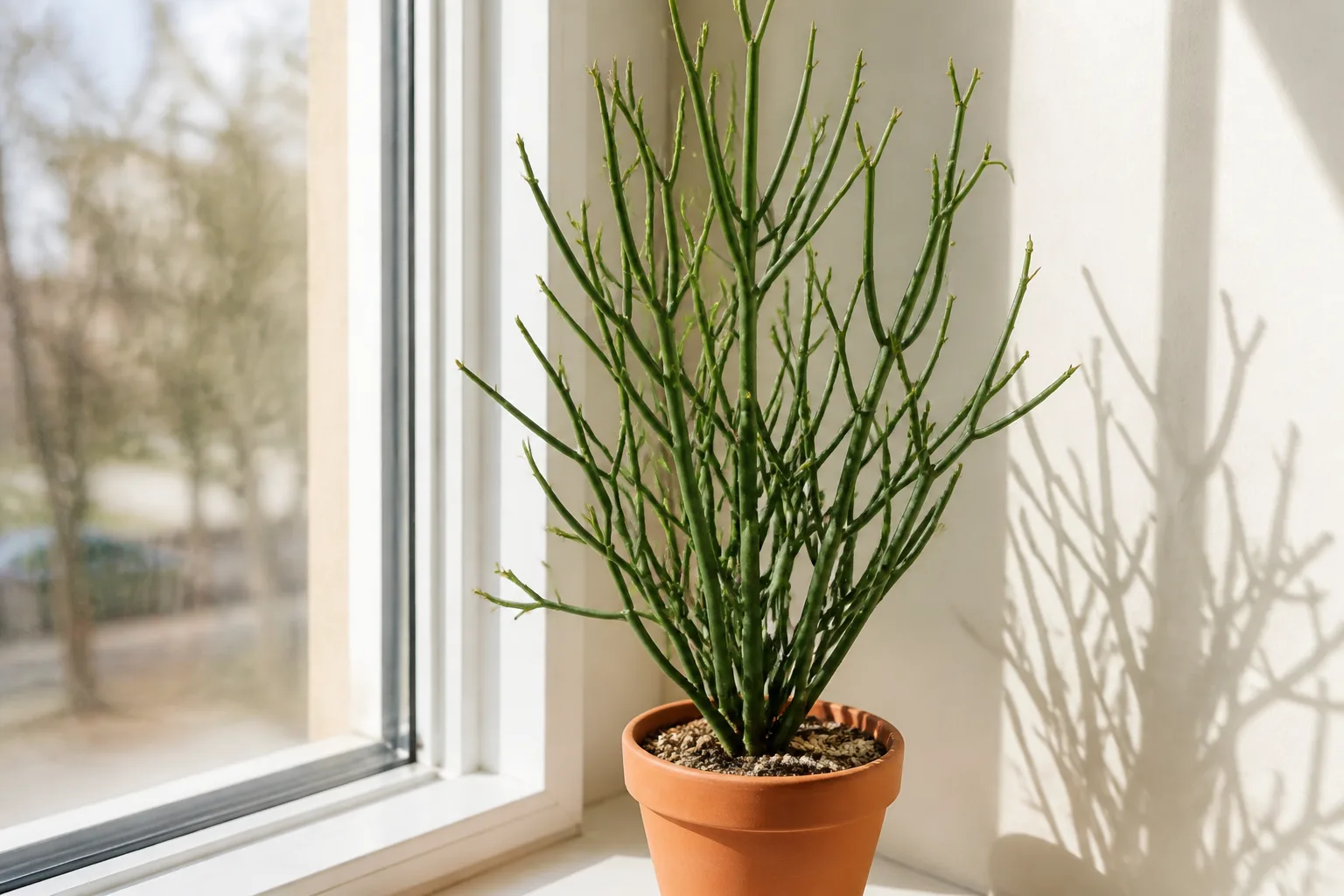
Pencil cactus care rewards growers who treat Euphorbia tirucalli like the succulent shrub it is—not like a leafy tropical, and not like a spine-covered desert cactus. Give it bright light, fast-draining soil, and long dry periods between deep waterings, and this sculptural euphorbia can live for years with minimal fuss. Ignore the sap risk or water on a houseplant schedule, and the same plant becomes a safety hazard or a rotting mess.
The pencil cactus—also called pencil tree, Indian tree spurge, or milk bush—is a spineless member of the spurge family (Euphorbiaceae). Its green, pencil-thick stems store water, tiny leaves drop early, and a milky latex runs through every cut surface. Indoors, most plants settle at 2 to 6 feet tall and 1 to 3 feet wide; in frost-free outdoor climates they can grow far larger. NC State Extension describes it as drought tolerant, fast growing, and reliably hardy in USDA zones 11 to 12, with established plants surviving in warm parts of zone 10.
Quick care checklist for a healthy pencil cactus
For a healthy indoor pencil cactus, place it in the brightest spot you have—ideally four to six hours of direct sun daily after acclimation. Use a pot with a drainage hole and a gritty succulent mix, then water only when the soil is dry throughout the root zone.
Keep night temperatures above about 50°F (10°C), avoid cold AC drafts, and wear gloves plus eye protection whenever you prune or propagate. Feed lightly once in spring, rotate the pot if growth leans toward the glass, and keep the plant away from pets and curious children because the sap is toxic on contact and if ingested.
Your first-week routine matters: confirm drainage, check for pests along stem joints, place the plant in bright but not suddenly harsh sun, and wait to water until you have tested the soil. Nursery plants are often grown under brighter light than your living room offers; moving straight into hot afternoon glass can scorch stems even when the long-term goal is a sunny window.
What the pencil cactus is (and what it is not)
Despite the common name, pencil cactus is not a cactus. True cacti belong to the family Cactaceae and usually carry areoles and spines. Euphorbia tirucalli is a stem succulent—a shrub whose photosynthesis happens mainly on smooth green branchlets rather than broad leaves. Those branchlets are fragile, cylindrical, and cluster at stem tips; mature woody branches are brown and support the top-heavy canopy.
The plant is native to semi-arid regions of Africa and southern Asia and has been cultivated worldwide as a houseplant, hedge, and barrier in dry climates. Flowers are small and yellowish, hidden by showy bracts at branch tips in spring and summer, but indoor specimens bloom inconsistently. What most growers notice instead is architecture: vertical green pencils, occasional orange-red stress color on certain cultivars, and a growth habit that can outpace expectations in good light.
Green form vs Firesticks cultivar
The standard green pencil cactus stays mostly green with orange tips in strong light. The popular Firesticks or Sticks on Fire selection—often sold as Euphorbia tirucalli ‘Rosea’ or similar—develops orange to red stem color when nights cool and light is bright. That color is a stress response, not a separate species, and it fades if the plant is moved to dimmer conditions.
Both forms share the same care: bright light, sparse water, excellent drainage, and strict sap precautions. Choose Firesticks if you want winter color drama; choose the green form if you prefer a cleaner vertical silhouette year-round.
Is a pencil cactus right for your home?
Pencil cactus is an excellent fit when you want a low-water, high-light statement plant and can place it safely. It tolerates travel-heavy schedules better than ferns or calatheas because it stores water in its stems and forgives occasional missed waterings—so long as you do not compensate with frequent shallow sips.
It is a poor fit when you have pets that chew plants, young children who grab branches, or only north-facing rooms without supplemental light. The latex sap causes contact dermatitis and can damage eyes; NC State Extension warns that ingestion can blister oral tissue and that eye exposure may cause temporary to permanent corneal injury. ASPCA Poison Control lists pencil cactus as toxic to dogs, cats, and horses, with irritating sap that can cause mouth and stomach upset and vomiting.
If you need a similar look with lower stakes, consider a non-toxic succulent with no caustic latex—but if you keep pencil cactus, treat sap handling as part of the care routine, not an afterthought.
Light requirements for compact, colorful growth
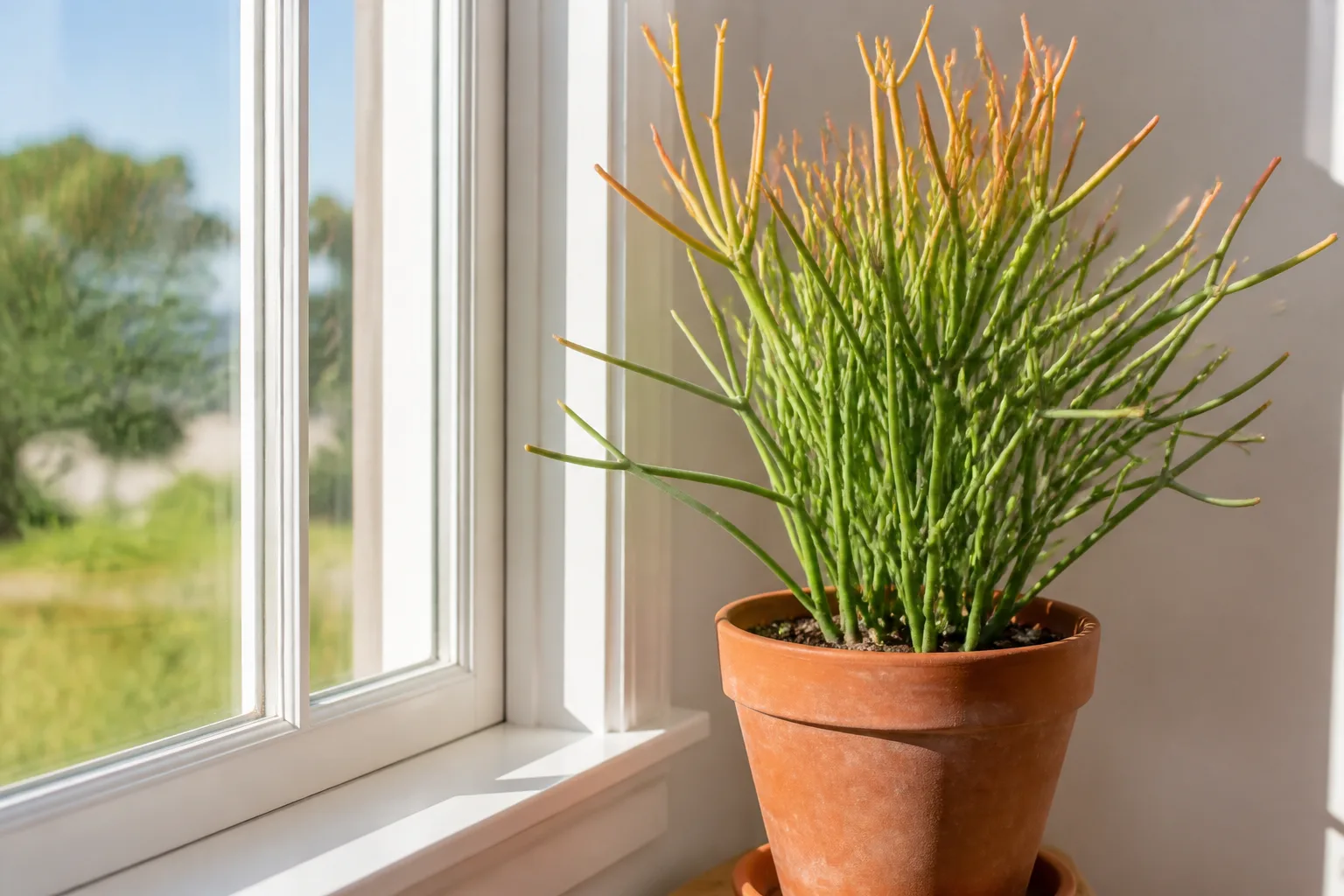
Pencil cactus wants full sun to very bright light. Penn State Extension recommends four or more hours of direct sunlight indoors, and NC State Extension notes that branch tips turn bright orange in strong sunlight on many plants. A south- or west-facing window is usually the best indoor placement in the Northern Hemisphere; an east window gives gentler morning sun.
Bright indirect light can keep a pencil cactus alive, but growth often becomes looser, greener, and more spaced between branch clusters. Low light produces stretching toward the window, thinner new stems, and a plant that looks tired rather than sculptural. If your only option is a dim room, a full-spectrum grow light 12 to 14 inches above the canopy for 12 to 14 hours daily is more reliable than hoping the plant adapts.
Outdoor summer placement is possible in frost-free climates or after the last frost in temperate zones. Site the pot where it receives morning sun and afternoon protection in hot-summer regions; in mild coastal climates, full sun often works year-round. Always bring container plants indoors before temperatures drop near 50°F.
Acclimate before stronger sun
When moving a pencil cactus from a shop, dim office, or winter windowsill into direct sun, increase exposure gradually over one to two weeks. Start with bright indirect light or gentle morning sun, then add stronger rays in small steps while watching for pale bleached patches or sudden shriveling on exposed stems.
The same rule applies before setting a houseplant outside for summer. A covered patio or bright morning position is a safer first stop than an exposed south wall. Reverse the process in fall: move back indoors before cold nights, and expect some leaf drop or color shift as light changes—usually not a crisis if watering stays conservative.
For deeper light troubleshooting, see the Pencil Cactus light guide.
Soil and pot choice that prevent rot
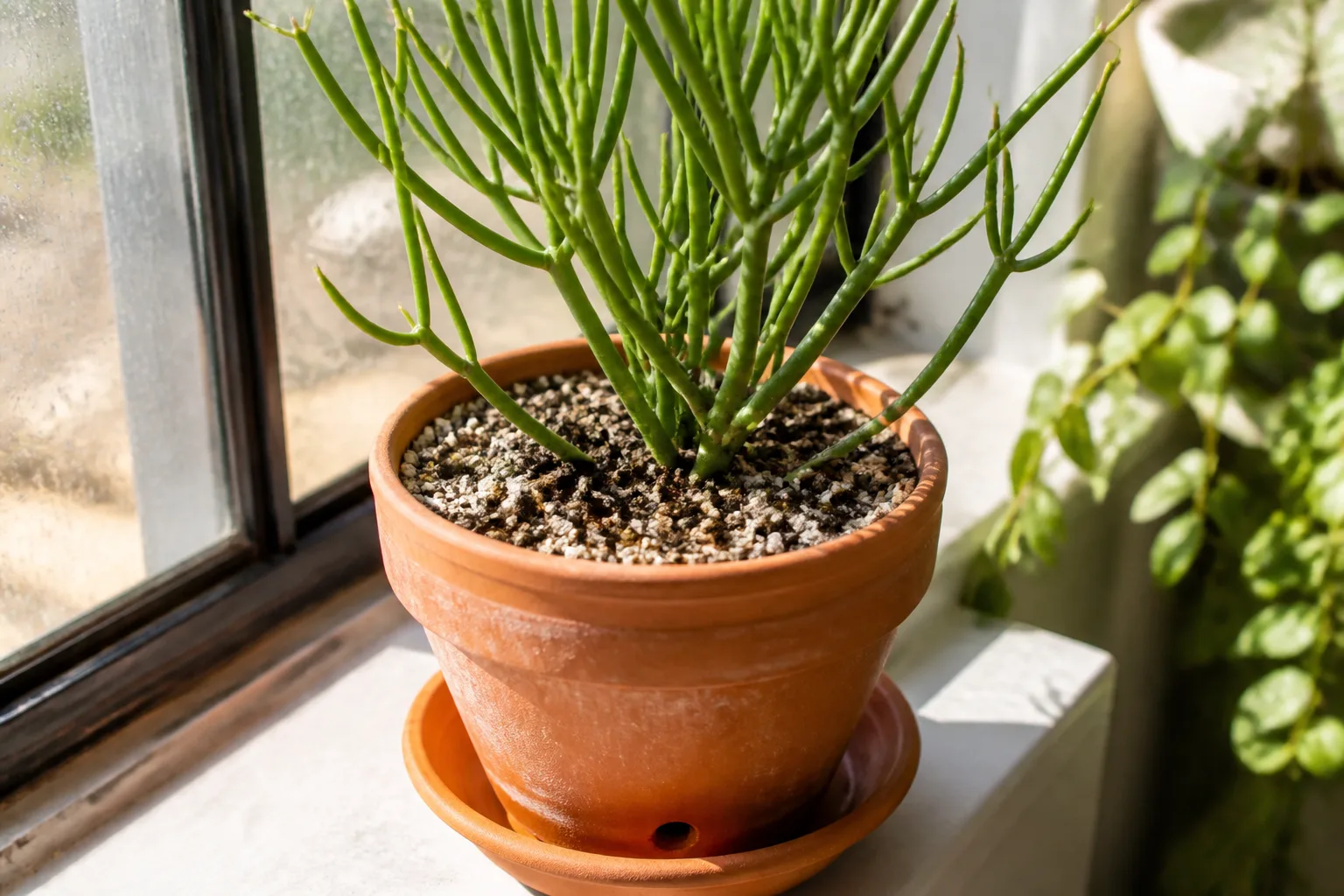
Pencil cactus needs fast-draining, low-organic soil—not rich potting mix that stays damp for days. NC State Extension recommends coarse loamy soil with gritty material such as coarse sand for indoor culture; commercial cactus and succulent mixes amended with extra perlite or pumice work well for most homes.
The pot matters as much as the mix. Choose a container with at least one drainage hole and preferably unglazed terracotta, which pulls moisture through porous walls and shortens dry-down time. Plastic can work in very bright, dry rooms if the mix is extra gritty, but it is less forgiving for beginners.
Avoid rocks at the bottom of the pot as a drainage shortcut—they create a perched water table that can keep lower roots wetter than the surface suggests. Instead, use a homogeneous gritty mix from top to bottom. A pencil cactus can stay slightly root-bound for years, but a top-heavy specimen in a too-small base will tip; balance stability with the rule that oversized pots stay wet longer.
More mix recipes and amendment ratios live in the Pencil Cactus soil guide.
Watering: the soak-and-dry rhythm indoors
Pencil cactus watering is simple in principle and easy to ruin in practice: soak the root zone thoroughly, then let the entire pot dry before watering again. NC State Extension suggests watering about every one to two weeks during active growth and allowing soil to dry between waterings. In most homes that translates to every two to three weeks in spring and summer and every four to eight weeks in fall and winter—but pot size, light, and mix always override the calendar.
Check dryness with a finger or skewer deep in the pot, or lift the pot and note weight. Surface dustiness alone is not enough; the lower mix can still hold moisture while the top looks dry. When you do water, wet the whole root ball until excess runs from the drainage hole, then empty the saucer. Never let the plant sit in standing water.
Overwatering is the primary indoor killer. Wet soil plus cool nights invites root rot, shown by soft stems at the base, black mushy tissue, or a sour smell from the mix. Underwatering is rarer and more reversible: slightly shriveled branch tips and a very light pot usually clear after one thorough soak.
The full soak-and-dry protocol—including winter specifics—is covered in the Pencil Cactus watering guide.
Winter watering and semi-dormancy
In shorter days and cooler rooms, pencil cactus growth slows and water demand drops sharply. This semi-dormant period is when rot risk is highest because evaporation slows while habits stay on a summer schedule. Cut back frequency, keep the plant above about 55°F (13°C) if possible, and skip fertilizer entirely until spring.
A pencil cactus in a heated room under grow lights that keeps pushing new tips may need intermediate winter water—perhaps every three weeks—but still far less than summer. When in doubt, wait an extra week; a slightly thirsty euphorbia recovers faster than a rotting one.
Temperature, humidity, and draft protection
Pencil cactus prefers warm, stable temperatures—roughly 65 to 75°F (18 to 24°C) during the day—with nights not falling below 50°F (10°C). Brief dips may not kill an established plant, but repeated cold stress causes leaf drop, color loss, and stalled growth.
Indoors, keep the pot away from cold window glass in winter, blasting AC vents, and frequently opened doors. Humidity is a non-issue: pencil cactus tolerates dry air and does not need misting. High humidity only becomes a problem when paired with slow-draining soil and infrequent dry-down.
Fertilizer: light feeding once a year
Pencil cactus is not a heavy feeder. One application of balanced liquid houseplant fertilizer diluted to half strength in early spring is enough for most indoor plants. The Old Farmer’s Almanac notes light feeding during the growing season; over-fertilizing can burn roots and leave brown corky spots on stems.
Skip feed in fall and winter. If the plant sits in very bright light and grows vigorously all year, a second light feeding in midsummer is optional—never more than twice annually indoors. Salt buildup in the mix is a sign to leach the pot with plain water or repot into fresh gritty mix.
See the Pencil Cactus fertilizer guide for dilution and timing details.
Pruning for shape and stability
Prune pencil cactus in early spring through summer when the plant is actively growing. Goals are usually height control, removal of dead wood, and narrowing a base that has grown too wide for a doorway or window.
Use sharp bypass pruners or scissors, and cut back to a joint or the base of a branch rather than leaving ragged stubs. Remove dead or damaged stems first, then shorten leggy tips to encourage bushier regrowth. Avoid stripping too much lower growth on tall specimens—the canopy is top-heavy, and a narrow base makes tipping more likely.
Wipe tools with rubbing alcohol after pruning because latex coats blades and can gum them up. Do not compost pruned material if pets or children might access the pile; sap remains irritating in cuttings.
Detailed shaping advice is in the Pencil Cactus pruning guide.
Sap safety during every cut
Treat every cut as a sap event. Wear gloves, long sleeves, and eye protection. Work over newspaper or a tray you can discard. If sap touches skin, wash immediately with soap and water. If sap enters the eyes, rinse with clean water for 15 minutes and seek medical care—NC State Extension specifically warns of corneal damage risk.
Keep kids and pets out of the work area until cleanup is finished. Bag pruned stems for trash rather than indoor compost.
Propagation from stem cuttings
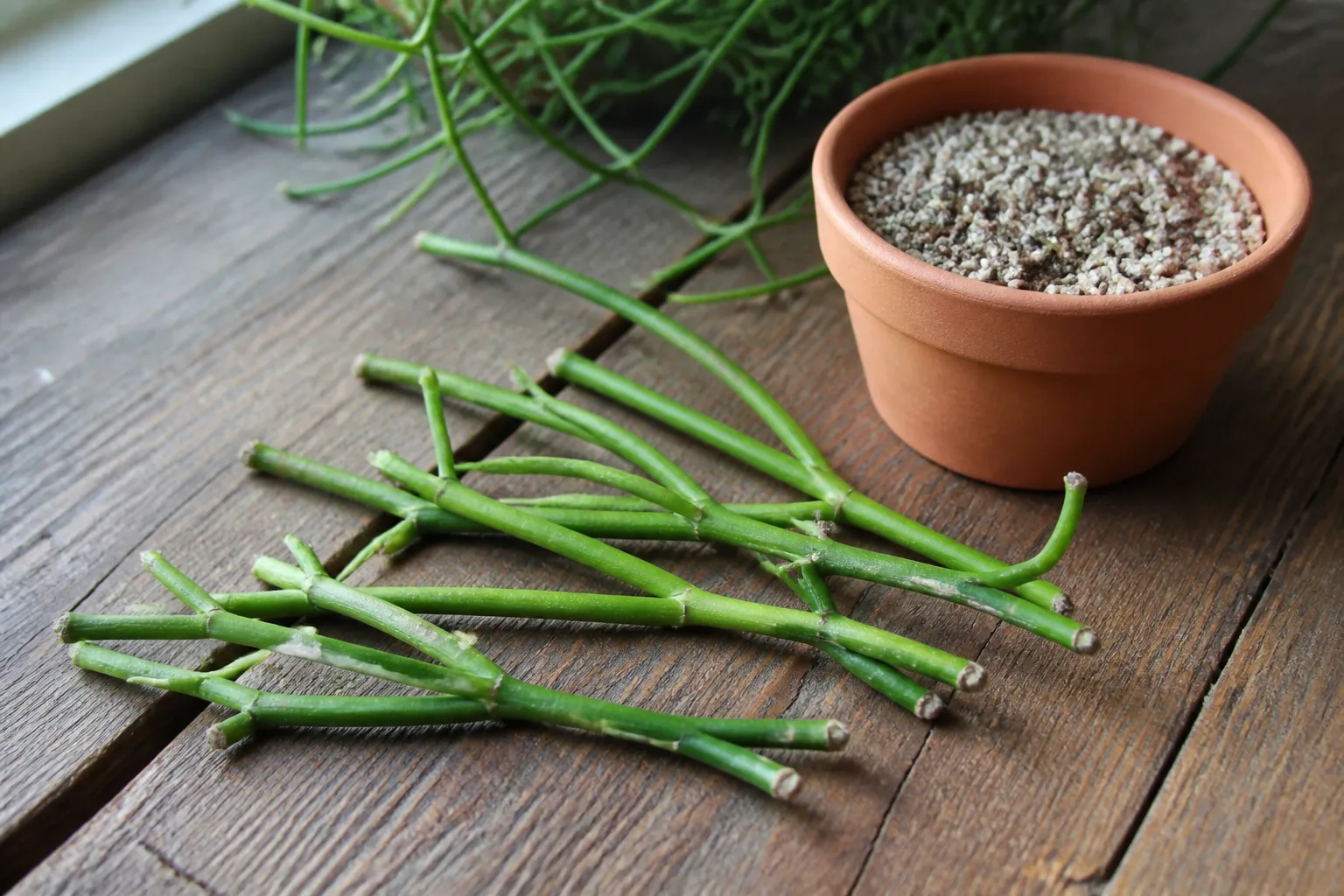
Pencil cactus propagates easily from 6-inch green stem cuttings taken in late spring or early summer. The steps are straightforward; the safety rules are not optional.
- Wearing gloves and eye protection, cut a healthy green branch with sterile pruners.
- Dip the cut end briefly in water to slow latex flow, or let it drip into a disposable cup.
- Lay the cutting in a dry, shaded spot for about one week until the cut end forms a firm callus.
- Plant the callused end in moist—not soggy—succulent mix in a small pot with drainage.
- Place in bright indirect light; water lightly when the top inch is dry until roots form in several weeks.
- Transition to normal soak-and-dry care once the cutting resists a gentle tug.
Failed cuttings are usually rotted (planted too wet, no callus) or dried out (no humidity around roots, harsh sun). Rooting hormone is optional; callus time and drainage matter more.
Full troubleshooting lives in the Pencil Cactus propagation guide.
Repotting a top-heavy pencil cactus
Repot when roots fill the pot or when the plant becomes unstable and tips easily—often every three to five years indoors, though fast growers in small pots may need sooner service. Spring is the best window; avoid repotting into wet soil.
Choose only one pot size up, with drainage holes and enough width at the base to support height. Let the soil dry partially, then unpot gently to avoid snapping brittle branches. Knock off old mix, trim black or mushy roots with sterile tools, and replant at the same depth in fresh gritty mix. Wait about a week before the first deep watering so cut roots can callus.
Large specimens are heavy; enlist help and plan the path before lifting. A leaning pencil cactus often needs a wider pot more than taller soil depth.
Step-by-step repot timing is in the Pencil Cactus repotting guide.
Pests, diseases, and overwatering damage
Pencil cactus is relatively pest-free indoors but not immune. Watch for spider mites (fine webbing, stippled stems), aphids on new growth, mealybugs in leaf axils, and occasionally scale on older wood. Outdoors, nematodes can be an issue in ground plantings in warm climates.
Treat isolated infestations with insecticidal soap or horticultural oil on a test area first—latex stems can be sensitive. Repeat applications beat a single heavy dose. Improve airflow and avoid overhead splashing that keeps stems wet.
Fungal and bacterial problems usually trace to overwatering or poor drainage, not mysterious pathogens. Correct culture before reaching for fungicides.
Toxicity, sap exposure, and pet safety
All parts of pencil cactus contain milky latex that is poisonous and caustic. NC State Extension lists contact dermatitis, oral blistering if eaten, and serious eye injury among risks. ASPCA classifies the plant as toxic to dogs, cats, and horses, with irritant sap that can cause vomiting—though ASPCA notes toxicity is sometimes “over-rated,” ingestion still warrants veterinary contact.
Human first aid: skin—wash with soap and water; eyes—flush 15 minutes and seek emergency care; ingestion—call poison control or seek medical advice.
Pet exposure: remove plant material from the mouth if safe to do so, rinse gently, and call your veterinarian or ASPCA Animal Poison Control at (888) 426-4435.
Display the plant on a stable stand out of reach, secure tall specimens against tipping, and warn houseguests who might brush past branches in a hallway.
Common problems and how to fix them
Stretching or leaning toward the window means insufficient light. Move gradually to a brighter spot or add a grow light; rotate the pot every few weeks.
Soft, mushy base stems signal overwatering or rot. Stop watering, confirm drainage, inspect roots, remove rotten tissue, and repot dry into fresh mix only after assessment.
Shriveled branch tips usually mean underwatering or root loss from past rot. Soak thoroughly once, then fix the dry-down routine—not a daily sprinkle.
Leaves yellowing and dropping can be normal seasonal shedding of tiny leaves, or stress from cold drafts, repotting, or watering swings. Check temperature and soil moisture before reacting.
Orange-red color fading on Firesticks often follows a move to lower light or warmer nights indoors. Increase light gradually; accept that indoor color may be subtler than outdoor winter displays.
Sticky tools and floors after handling are latex residue. Alcohol cleans metal; soap and water clean surfaces. Avoid touching face or eyes while working.
With good light, sparse water, and respect for the sap, pencil cactus is one of the more forgiving sculptural houseplants you can grow—provided you never treat it like a thirsty fern.
Conclusion
Pencil cactus rewards a simple contract: bright light, gritty soil, long dry periods, and careful handling of toxic latex. It is not a cactus, not pet-safe, and not suited to dim rooms—but in a sunny window with soak-and-dry watering, it grows fast, looks striking, and asks little beyond seasonal adjustment and occasional repotting.
Start with drainage, acclimate light, water only when the pot is truly dry, and wear protection whenever you cut. Link the basics here to the deeper Pencil Cactus plant hub for watering, light, soil, and propagation specifics, and you will have a plant that stays upright, colorful, and out of the emergency room.



