How to Grow and Care for a Jacaranda Tree
Plant a jacaranda tree in the right place, build a strong central leader, water by soil conditions, and troubleshoot yellow leaves, pests, and weak blooms.
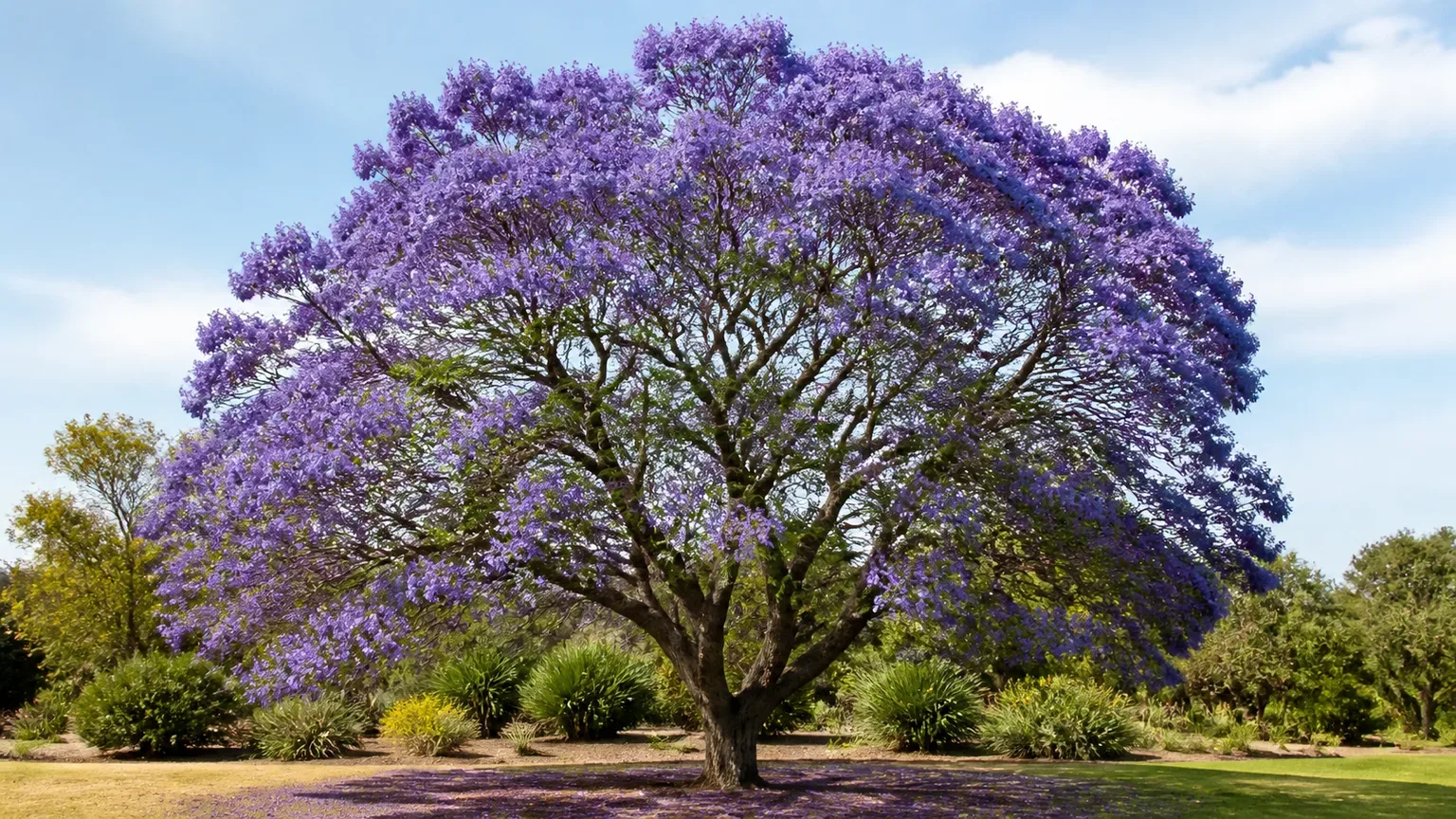
Jacaranda (Jacaranda mimosifolia) is a spectacular choice when you have a warm, sunny site and enough room for a large, spreading canopy. Its fern-like leaves create light shade, but the real show is the flush of lavender-blue, trumpet-shaped flowers that can appear before the new foliage. It is also a deciduous tree with surface roots, persistent pods, and branch structure that deserves attention while the tree is young.
The best jacaranda care plan is therefore not “water and wait.” Choose the site around the mature tree, plant it with the root flare at the correct depth, keep new roots evenly moist without waterlogging them, and train a single leader before competing stems become large. This guide covers those decisions, plus container limits, propagation, flowering, pests, and the leaf problems most often mistaken for one another.
Quick answer: is jacaranda right for your yard?
Grow jacaranda outdoors if your climate is warm enough to avoid regular freezing, your site receives full sun, and you can accommodate a tree roughly 25 to 50 feet tall with a broad crown. The species is commonly listed for USDA Zones 9B through 11, but a zone number is only a starting point: cold pockets, wind, soil drainage, and the age of the tree can change the outcome. NC State Extension lists full sun, good drainage, rapid growth, and a 25- to 50-foot mature height range for the species.
Choose another tree if you need a tidy planting beside a pool, a narrow path, a small foundation bed, or a site with regularly wet soil. Jacaranda can be a rewarding specimen or street tree, but the flowers, leaves, and flat seed capsules create seasonal cleanup, and poorly trained branches are more vulnerable to splitting. In Florida, UF/IFAS describes it as well adapted to Zones 9B through 11 and not a problem species there; that regional assessment should not be treated as a universal invasive-status ruling, so check your local plant list before planting in a tropical area. UF/IFAS assessment
Jacaranda tree at a glance
| Feature | What to expect |
|---|---|
| Botanical name | Jacaranda mimosifolia |
| Habit | Fast-growing, deciduous, spreading flowering tree |
| Mature size | Commonly about 25–50 feet tall; spread varies by site and pruning |
| Light | Full sun for the strongest growth and flowering; young trees tolerate some light shade |
| Soil | Well-drained sand, loam, or clay; avoid persistently saturated ground |
| Flowers | Lavender-blue to violet, lightly fragrant, in terminal clusters; timing varies by climate |
| Fruit | Flat, round, dry brown capsules containing winged seeds |
| Main trade-offs | Gorgeous bloom and dappled shade versus litter, surface roots, frost sensitivity, and weak or poorly formed branch unions |
The tree is native to southern and central South America and has bipinnate leaves that resemble a delicate fern. The leaves may be the main attraction in a cool climate where a container-grown plant never flowers, but in a warm landscape the leafless or lightly leafed canopy can be covered in flower panicles in spring or early summer. UF/IFAS describes the species’ foliage, flower form, fruit, size, and climate range in its extension plant profile.
Choose the planting site before you buy
Sun, space, roots, and litter
Give jacaranda the brightest open site available, ideally with at least six hours of direct sun. Full sun supports the heaviest flowering and fastest growth; a young tree can manage light shade, but shade is a poor trade if your main reason for planting is the bloom display. Ocean winds and locations without enough heat can also suppress flowers. UC IPM notes that full sun and moderate water favor growth, while ocean winds or insufficient heat can prevent flowers from forming.
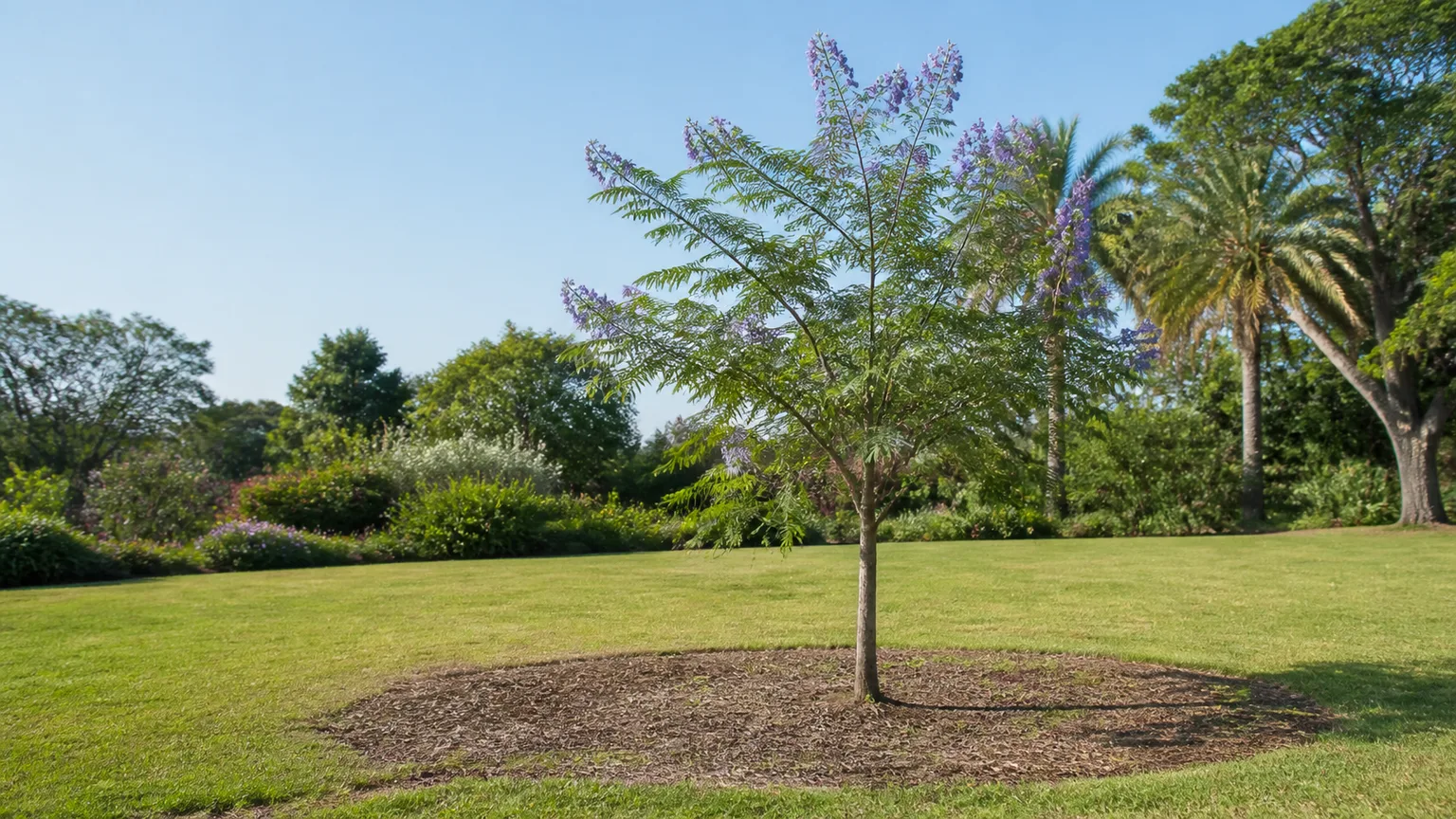
Measure the site from the future trunk, not from the small nursery pot. Keep the eventual canopy away from roofs, overhead wires, high-traffic paths, and structures where falling flowers or pods will be a nuisance. Give roots open, uncompacted soil rather than a tiny island surrounded by paving. UF/IFAS notes that jacaranda can form large surface roots and that the tree is susceptible to breakage, so the combination of space and early structural pruning matters more than a label calling it “fast growing.” UF/IFAS tree-selection guidance
The litter is not a sign of poor health. Flowers drop after the display, leaves fall as the tree enters its dry or cool season, and woody capsules can persist before opening. If you want purple flowers directly over a pool, a pristine patio, or a narrow walkway, admire jacaranda in a public planting instead and choose a tidier tree for your own space.
Soil and drainage
Jacaranda is happiest in soil that drains freely after a deep watering. Sandy or sandy-loam soil is ideal, but a clay site can work if water moves through it rather than standing around the root zone. Do not use a planting hole as a permanent bowl. If a test hole remains wet for a day after rain, solve the drainage problem or choose a different location.
Do not chase a particular pH with amendments unless a soil test shows a reason. The extension references describe tolerance of sand, loam, and clay when drainage is good, with acidic through slightly alkaline conditions reported across references. In practice, drainage, oxygen, and a site that is not compacted are more important than forcing a mildly acidic number. UF/IFAS lists sand, loam, clay, acidic and slightly alkaline soils, and well-drained conditions for jacaranda.
Plant a jacaranda for a strong start
Plant in spring or at the beginning of a reliably warm growing period, when the tree can establish roots before heat or cold becomes severe. In a frost-prone climate, keep a young tree protected in a container rather than gambling on an outdoor planting that will be killed by the first hard freeze. Inspect nursery stock before purchase: favor a straight trunk, a visible or findable root flare, evenly spaced main branches, and no circling roots that have become woody and tight.
Planting depth, first watering, and mulch
- Dig a hole about twice as wide as the root ball and no deeper than the root ball’s root flare requires. The trunk should widen into roots at or just above the finished soil line; do not bury that flare.
- Slide the tree out of its container and inspect the outside of the root ball. Loosen tightly circling roots at the surface and sides without shredding the whole root system.
- Set the tree upright with the strongest leader facing the direction that makes sense for the future canopy. Backfill with the soil you removed, firming it gently so there are no large air pockets.
- Water slowly over the entire root-ball and backfill area. Let the water soak in rather than running off the surface.
- Spread a two- to four-inch layer of organic mulch across a wide ring, but keep it several inches away from the trunk and leave the root flare visible. Penn State Extension recommends planting with the root flare visible, backfilling with native soil, watering deeply, and keeping mulch away from the trunk.
The first year is an establishment project, not a test of drought tolerance. A newly planted tree has a small, disturbed root system even if the canopy looks large. Check moisture several inches down and water the whole root zone when it is beginning to dry; in hot, windy weather the interval may be short, while heavy clay or rainy weather may require a longer pause. A slow hose or drip system is more useful than a quick splash at the trunk.
Mulch should spread outward, not upward. A wide, moderate layer reduces evaporation and turf competition; a volcano of mulch against the bark keeps the trunk wet, hides the root flare, and can create conditions for decay and girdling roots. Penn State’s tree-mulching guidance recommends a two- to four-inch layer, a wide ring, and no mulch against the trunk.
Seasonal care that supports growth and flowers
Watering, feeding, and drought decisions
Once established, jacaranda is fairly drought tolerant, but “drought tolerant” does not mean “never water.” During a prolonged dry spell, water slowly across the root zone rather than wetting only the trunk. Let the soil partly dry between deep waterings, especially in heavy ground. Roots need both water and oxygen, and saturated soil can produce wilting and yellowing that look exactly like drought stress because damaged roots can no longer supply the leaves. UC IPM explains that both under- and overwatering can cause decline, while waterlogged soil deprives roots of oxygen.
Use a simple decision rule: if the soil is dry several inches down and the tree is actively growing, water deeply; if it is still wet, improve drainage or wait; if the soil is moist but one branch is declining, investigate pests, salt, injury, or disease rather than adding more water. For a newly planted tree, regular watering is more important than a rigid calendar. Penn State’s current guidance uses more frequent watering immediately after planting, then gradually moves toward weekly watering through establishment, adjusted for meaningful rainfall and local conditions. Penn State Extension’s newly planted tree guidance
Fertilize lightly and only when there is a reason. A soil test, pale new growth, or a documented nutrient deficiency is a better trigger than the calendar. High-nitrogen lawn fertilizer spread beneath the canopy can push leafy growth at the expense of flowers and may encourage soft, pest-prone shoots. If the tree is growing steadily in decent soil, skip routine feeding and focus on sun, drainage, water, and structure.
Formative pruning and branch structure
The most valuable jacaranda pruning happens while the tree is young. Select one dominant central leader and remove or shorten competing leaders before they become thick. Space the main limbs up the trunk instead of allowing several stems to emerge from one tight fork. Branches with included bark—bark pressed into a narrow branch union rather than forming a strong open angle—are especially worth correcting early because a large union can split as the canopy gains weight or catches wind.
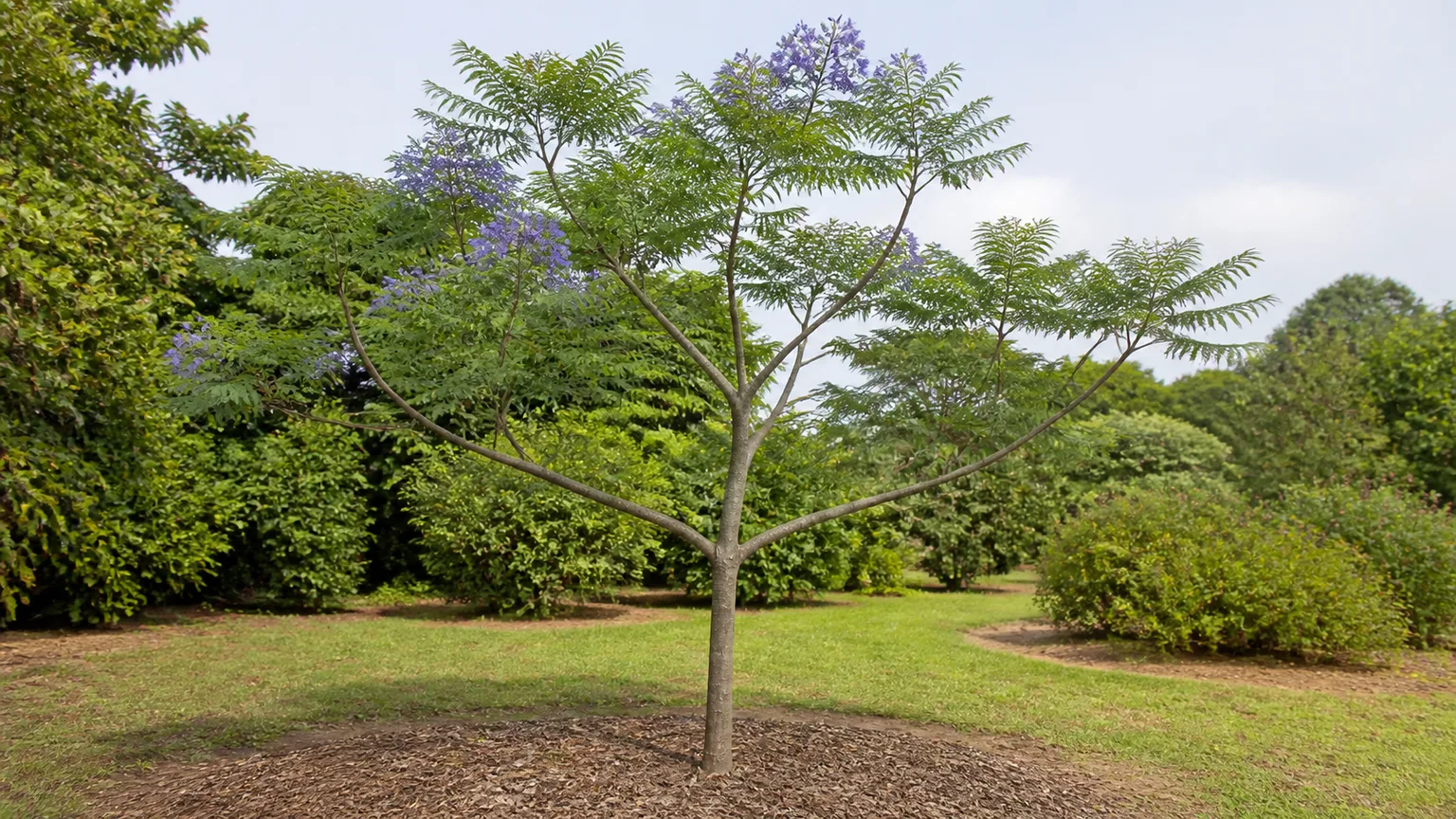
Plan a light structural inspection every few years during the first 15 to 20 years, while the tree is still easy to reach. UF/IFAS recommends maintaining a dominant leader, correcting competing stems, and preventing branches with included bark from becoming large; it also advises pruning after spring flowering when preserving the display matters. UF/IFAS tree-selection guidance
On an established tree, remove dead, broken, rubbing, or diseased branches and any growth that creates a genuine clearance problem. Make cuts just outside the branch collar; do not flush-cut the trunk, top the canopy, or remove large healthy limbs simply because the tree has grown faster than expected. If a mature jacaranda has a split trunk, a large crack, a hanging limb, or major branches over a house or road, hire a qualified arborist rather than attempting a high-risk correction from a ladder.
Growing jacaranda in a pot or indoors
A container is useful for overwintering a young tree, enjoying the foliage in a cool climate, or buying time while you decide whether the landscape has enough space. It is not a practical way to keep a full-size jacaranda permanently small. The roots and canopy eventually outgrow the pot, and a plant grown indoors may remain leafy without producing the heat, light, dry rest, and root room associated with outdoor flowering.
Use a free-draining container with a drainage hole and a coarse, airy mix. Move up only one container size when roots fill the current pot; an oversized pot stays wet longer and increases the risk of root trouble. Put the plant outdoors in warm weather where it receives strong light, acclimating it gradually if it has been inside. In winter, protect it from frost, reduce watering, and let the mix dry more between waterings while the tree is dormant. The RHS describes jacaranda as frost tender, suitable for summer outdoor growth or greenhouse culture in cool regions, and not a good permanent houseplant. RHS growing guide
If the plant has become tall and bare indoors, do not respond with a severe haircut and more fertilizer. First increase light, check the root zone for poor drainage, and decide whether the plant is meant to be a temporary foliage specimen. A dwarf cultivar may be easier to manage in a container, but “dwarf” does not erase the tree’s need for bright light and a cool, drier rest in winter.
Propagation: seeds versus semi-ripe cuttings
Choose propagation by the result you want. Seed is inexpensive and straightforward, but seedlings vary and can take many years to flower. A semi-ripe cutting is a clone of the parent and can preserve a valued flower color or habit, but rooting woody material is less predictable for a home grower. UF/IFAS lists seed, softwood cuttings, and grafting as propagation options and notes that cuttings or grafted plants are preferred when earlier flowering matters. UF/IFAS extension plant profile
Seeds versus cuttings
For seed, collect mature, dry capsules from a healthy tree, sow fresh seed in a clean, free-draining medium, and keep it warm and evenly moist. Do not bury it deeply or let the seed tray stay waterlogged. Give seedlings bright light as soon as they emerge, then pot them on before roots become crowded. A seed-grown tree may take up to about 10 years to develop flowers, so use seed when you enjoy the process or want a foliage plant—not when you need a guaranteed near-term bloom. NC State Extension notes that seed-grown trees may take up to 10 years to blossom.
For a cutting, take semi-ripe young growth in early summer, use a clean tool, and place the cutting in a sterile, free-draining propagation medium. High humidity and bottom heat around 68–75°F can improve the rooting environment, but avoid a sealed, constantly wet pot. Once roots are established, pot the cutting into a well-drained mix and let it develop a sturdy root system before moving it outdoors. The RHS recommends semi-ripe cuttings in early summer and bottom heat of about 20–24°C for propagation. RHS propagation guidance
Problems: yellow leaves, brown tips, pests, and disease
Diagnose the pattern before you treat it
Start with the root zone, not a spray bottle. Check whether the soil is dry, saturated, compacted, or salty; note whether all branches are affected or only one; inspect the undersides of leaves and tender shoots; and look for recent fertilizer, frost, heat, pruning, construction damage, or herbicide exposure. Yellowing and browning are symptoms, not diagnoses.
- Yellow leaves with dry soil or sparse growth: check light and establishment water first. Chronic drought can reduce flowering and cause leaf drop, but do not keep adding water if the soil is already wet.
- Yellow leaves in wet soil: improve drainage and pause irrigation. Saturated soil can kill roots and make a thirsty-looking tree worse.
- Brown margins or dead tips: consider drought, salt buildup, heat, wind, fertilizer excess, or spray injury. If the damage appeared soon after feeding, stop fertilizer and water normally rather than adding another product.
- Sticky leaves, curled new growth, or black sooty coating: inspect for aphids or scale. Aphids often cluster on soft new growth and produce honeydew; a strong water spray, pruning of localized infestations, and protection of natural enemies are useful first steps. UC IPM recommends nonchemical aphid control first and cautions against oils or soaps on drought-stressed plants, in high heat, or on sensitive foliage.
- One-sided, progressive scorch and dieback that does not recover after proper watering: seek an arborist or diagnostic laboratory. UC IPM lists oleander leaf scorch among jacaranda disorders, but its symptoms overlap with drought, salt injury, and root problems, so a photograph alone is not enough for a confident diagnosis. UC IPM jacaranda guidance
Do not use a broad-spectrum insecticide just because you see a few aphids. Mature trees often tolerate light infestations, and natural enemies can catch up when they are not destroyed by unnecessary sprays. If a treatment is genuinely needed, choose a product labeled for the plant and pest in your area, follow the label, avoid open flowers and pollinator activity, and never spray a heat- or drought-stressed tree.
Flowers, seed pods, cultivars, and regional cautions
Jacaranda usually flowers in spring or early summer, but the calendar varies widely with climate. Some trees bloom before the leaves flush; others flower later. A young tree that is healthy but not yet mature may simply need time, and a seedling can take close to a decade. Lack of flowers is more often a site or age problem than a signal that the tree needs more fertilizer: check full sun, winter temperatures, dry-season rhythm, drainage, and nitrogen coming from nearby turf.
After flowering, the tree may produce round, flat, brown capsules that open to release winged seed. Sweep or rake the fallen flowers and pods when they become slippery or visually troublesome, and remove volunteer seedlings if they appear where you do not want them. Regional status differs: UF/IFAS currently assesses jacaranda as not a problem species in Florida, while other warm regions may have different records or rules. Treat the local invasive-plant list as the deciding authority rather than assuming a Florida or California planting experience applies everywhere. UF/IFAS regional assessment
The species is the usual choice, but nurseries may also offer selections such as the white-flowered ‘Alba’. UF/IFAS notes that ‘Alba’ tends to have sparser flowers but a longer bloom period. Confirm the mature size, climate tolerance, and propagation method of any named selection before buying; a cultivar label is not a substitute for checking the planting site. UF/IFAS Gardening Solutions
Conclusion: give the tree room to become itself
Successful jacaranda care starts before the tree goes into the ground. Choose warmth, full sun, open soil, and generous clearance; plant with the root flare visible; water the whole root zone while the tree establishes; mulch widely but keep it off the trunk; and correct competing leaders before weak unions become large structural liabilities.
If your site is cold, wet, cramped, or directly beside a pool, jacaranda is probably the wrong tree even if you love its flowers. If the site fits, accept the seasonal litter and give formative pruning the same attention you give watering. That combination—right place, breathable soil, measured water, and early structure—does more for long-term flowers and safety than any single fertilizer or bloom-boosting product.



