How to Grow and Care for Red Spider Lily
Learn how to plant and care for Lycoris radiata, from exposed bulb necks and summer dormancy to winter foliage and safe division.
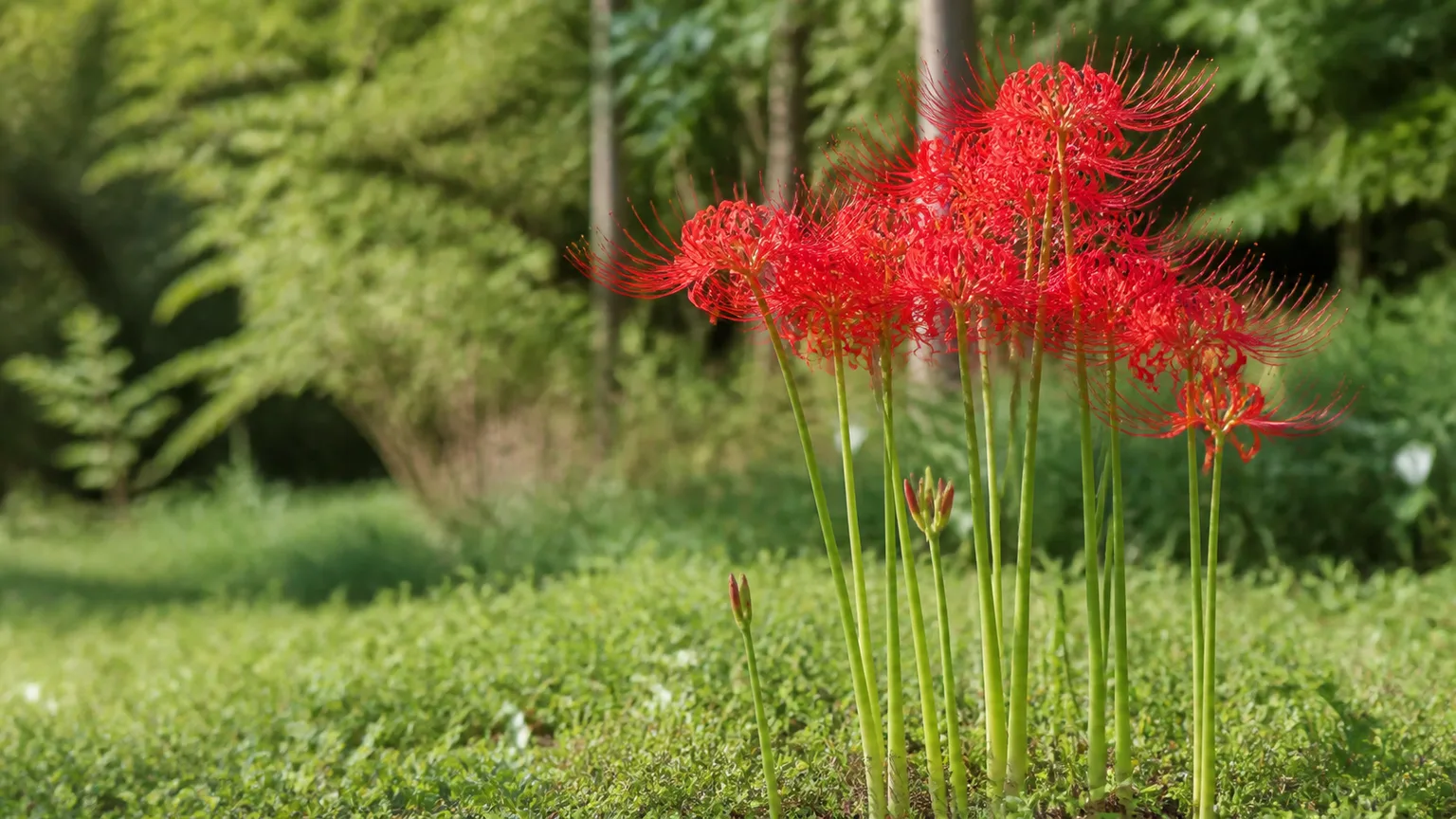
Red spider lily is one of the few garden bulbs that seems to ignore the usual rules. In late summer, leafless stems rise quickly and carry clusters of curling, scarlet flowers; only after the flowers fade do gray-green leaves arrive. That sequence is not a problem to correct. It is the key to growing Lycoris radiata well.
Most disappointing plants fail for a seasonal reason, not because they need more fertilizer. A bulb planted too deeply, kept wet through its summer rest, moved repeatedly, or stripped of green winter leaves may survive but skip flowering. The following care plan starts with the plant’s rhythm, then turns it into straightforward choices for a bed, border, or large container.
Red spider lily at a glance
Lycoris radiata is a perennial bulb in the amaryllis family, usually called red spider lily, hurricane lily, naked lily, or red surprise lily. It generally flowers from late summer into early fall on 1- to 2-foot scapes, with four to six—or sometimes more—reflexed red flowers per stem. NC State Extension notes that the bulbs naturalize through offsets, while Missouri Botanical Garden lists it for USDA Zones 6 through 10 (NC State Extension; Missouri Botanical Garden).
It is best treated as an outdoor landscape bulb, not an ordinary houseplant. It wants good drainage, a location where it can remain in place, and enough room for a substantial root system. Its showy flowers are easy to notice, but the plant performs because of the quiet work happening in the soil and the leaves that follow.
Before you plant, confirm that the label actually says Lycoris radiata. “Spider lily” is used for several unrelated or differently growing plants, including some Hymenocallis and Lycoris species with different cold tolerance and seasonal habits. The botanical name prevents a common disappointment: following sound red spider lily advice for a bulb that only shares a loose common name.
It is also worth separating naturalizing from invasiveness in the way you plan the garden. This species can make offset bulbs and form a broader colony over time, which is an advantage where you want a recurring fall display. Give it a defined section of the border and enough spacing to develop, then divide only when the clump is actually crowding its neighbors or you want more plants elsewhere.
Understand its unusual growth cycle
The red spider lily’s calendar has three distinct phases. It rests with no top growth during much of summer, produces flowers on bare stems in late summer or early fall, and then grows leaves from autumn into spring. The foliage eventually yellows and disappears in late spring, setting up the next summer rest (Missouri Botanical Garden).
That cycle explains two common mistakes. Watering as if the bulb were actively growing during its hot-season rest can invite rot, while cutting foliage soon after flowering removes the leaves that rebuild the bulb’s reserves. Think of the post-bloom leaves as next year’s flower budget: they are not ornamental at their peak, but they are essential.
Choose a site before you buy bulbs
Choose a place with organically rich, well-drained soil that does not hold standing water after rain. Red spider lily accepts full sun to partial shade, but both NC State Extension and Missouri Botanical Garden note that flowering is often best in partial shade. A few hours of sun with light afternoon protection can be a smart choice where summers are very hot (NC State Extension; Missouri Botanical Garden).
The best site also has a summer-dry bias. This does not mean desert soil or a bulb that never receives rain; it means the bed drains promptly and is not routinely irrigated through dormancy. The RHS specifically recommends fertile, well-drained soil that dries in summer, an especially useful filter for gardens with rainy, humid summers (RHS).
Use the surrounding plants as a site test. A bed that keeps bearded iris, lavender, or drought-tolerant perennials healthy through summer is often a better candidate than the soggy edge of a lawn or the bottom of a downspout. If your only sunny location is regularly wet in July and August, improve drainage first or select a deep container; moving a failing bulb from one wet bed to another rarely changes the outcome.
In-ground beds versus containers
An in-ground planting is usually the lower-maintenance route because the bulb can establish the extensive roots it needs without repeated disturbance. Use a mixed border, the front of a shrub bed, or a space among groundcovers and later-season perennials; surrounding plants help hide the bare patch left after the foliage dies back.
Containers work only when they are genuinely large and deep, have generous drainage, and can be protected from hard winter conditions. Missouri Botanical Garden warns that shallow or undersized pots can lead to poor growth and no flowers because the roots cannot develop properly. If your summer is persistently wet or your garden soil is heavy, a deep container under cover can be more realistic than trying to force the bulb into an unsuitable bed (Missouri Botanical Garden).
Plant bulbs at the depth that supports flowering
For red spider lily, the visible part of the bulb matters. Set the bulb with its pointed end up and leave the upper neck just above the soil surface rather than burying the entire bulb. Missouri Botanical Garden explains that covering the neck can discourage floral bud development, while NC State Extension gives a practical spacing range of 6 to 12 inches (Missouri Botanical Garden; NC State Extension).
Planting is often done in fall, but nursery stock and local climate can shift the ideal moment. The larger rule is to buy firm bulbs, establish them when you can water them in, and avoid treating them like tulips that must be buried several times their own height. Easy to Grow Bulbs also recommends planting with the top quarter-inch exposed, which agrees with the botanic-garden guidance (Easy to Grow Bulbs).
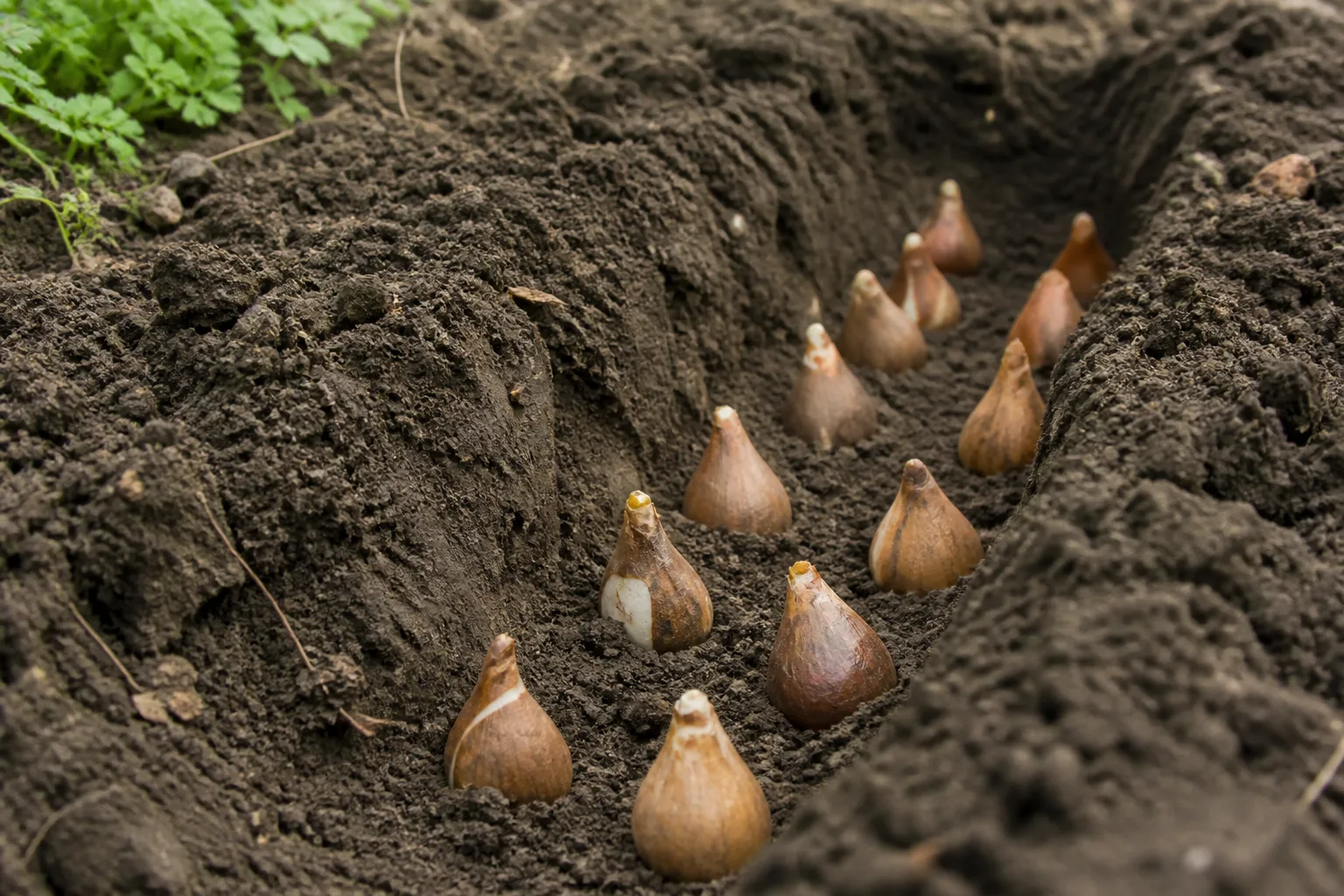
A reliable planting sequence
- Test the chosen spot after rain. If water remains pooled several hours later, move to a better-drained site or build up the bed rather than burying the bulb in a deeper hole.
- Loosen the soil wide enough for the roots, add mature compost only if the soil lacks structure, and set each bulb 6 to 12 inches from its neighbors.
- Backfill so the bulb’s neck remains above the finished soil line, then water once thoroughly to settle the soil. Do not add a thick, wet mulch layer directly over the exposed neck.
Do not panic if a newly planted bulb skips the first flowering season. Roots and bulbs need time to re-establish, and a bulb that was recently shipped, divided, or moved may prioritize recovery before it produces a strong scape. Pacific Bulb Society notes that Lycoris is often propagated by division because growing it from seed takes much longer to reach flowering size (Pacific Bulb Society).
Avoid packing the bulb into a heavily amended pocket surrounded by dense native clay. That can create a little bathtub that holds water at the roots, especially after a hard rain. If drainage is poor across the site, make a broad raised planting area or choose a container instead of trying to solve a whole-bed drainage problem with one shovelful of compost.
Give water according to the season
The simple watering rule is: moderate moisture while the plant is actively growing; much drier soil while it rests in summer. After planting, water enough to settle the root zone. During autumn leaf growth and the flowering period, water when the soil is becoming dry rather than letting a newly established planting stay drought-stressed for long stretches.
Once foliage has naturally yellowed and disappeared in late spring, stop routine irrigation unless exceptional drought is putting the bulbs at risk. The goal is not bone-dry soil at all costs; it is to avoid the prolonged wetness that turns a dormant bulb into a rot risk. NC State Extension explicitly advises fairly dry soil in the dormant season and cautions against overwatering because of root rot (NC State Extension).
The active-growth versus dormant-season rule
If you are not sure whether to water, look for the plant before reaching for a hose. Fresh fall or winter leaves mean the plant can use regular, measured moisture; a bare bed in summer means it is resting. This visual check is more reliable than following a weekly calendar, especially in climates where rainfall does not match the bulb’s needs.
Avoid using a constantly wet irrigation zone for red spider lily. A bulb planted beside thirsty annuals can be beautiful, but it needs its own drainage and watering logic. In a mixed border, group it with plants that tolerate a drier summer interval rather than with plants that demand daily moisture.
Rainfall should change your approach. In a rainy autumn, you may not need to supplement at all; in a dry autumn after leaves emerge, check the soil several inches down before watering. The aim is evenly moist root-zone soil, not a permanently saturated surface, so a deep occasional watering is more useful than frequent light sprinkling.
Feed lightly and protect the foliage
Red spider lily does not need aggressive feeding to make flowers. If your soil is reasonably fertile, use a modest bulb or balanced fertilizer in spring only if growth is weak, following the product label and keeping granules away from the bulb neck. The better investment is a well-chosen site, intact foliage, and drainage that does not turn the dormant season into a disease problem.
After flowering, resist the urge to fertilize heavily as a shortcut to bigger blooms. More fertilizer cannot compensate for a bulb that is buried, waterlogged, or repeatedly moved, and excessive nitrogen can favor soft growth over the storage reserves that matter. Let the foliage photosynthesize in peace; it is the plant’s most dependable method of recharging.
If you garden in a naturally lean sandy soil, a light top-dressing of compost around the planting zone after the foliage emerges can improve soil structure without turning the bulb into a high-feeding annual. Keep all organic material below the exposed neck and do not work it into the soil aggressively. The point is to support a healthy root zone, not to force a fast response from a dormant bulb.
Prune only after the leaves have finished their work
You can remove faded flower stems once they look untidy or leave them until they dry. Cutting flowers for a vase is also reasonable when you do not strip every stem from a small new clump; the flowering stalk itself is not the same as the later foliage. Easy to Grow Bulbs notes that cut flowers do not harm the plant, which makes this an easy way to enjoy the display indoors (Easy to Grow Bulbs).
The leaves are different. Do not tie them, braid them, cut them back green, or remove them because the bed looks sparse. Wait until they have naturally yellowed, browned, and released easily. That restraint is one of the most reliable ways to improve flower production without buying anything.
Manage winter in the colder edge of its range
The red spider lily’s practical hardiness is more nuanced than a zone number suggests because the leaves are present in winter. Missouri Botanical Garden reports successful outdoor culture in Zone 6b but emphasizes a sheltered site, since severe freezes can damage the winter foliage and reduce the following summer’s flowering even when the bulb itself survives (Missouri Botanical Garden).
In Zones 6 and 7, place bulbs near a south- or west-facing wall, in a protected courtyard, or beneath a deciduous canopy that moderates exposure without creating wet soil. After the ground cools, apply a loose, dry winter mulch around—not packed over—the bulb neck, and remove or thin it as spring warms. The RHS also recommends winter protection in colder areas and container culture under cover where summer conditions are too wet (RHS).
For a potted plant in a colder zone, protect the entire root ball rather than simply wrapping the exposed top. Move the container to an unheated but frost-protected garage, cold frame, or sheltered structure that stays cool enough for the natural cycle while avoiding repeated hard freezes. A warm living room is usually a poor substitute for winter protection because it changes light, temperature, and dormancy cues all at once.
Divide only when the clump needs it
Red spider lilies do not need routine lifting. They generally make fuller displays when left alone long enough to form a colony, so division is best reserved for a congested clump, a renovation project, or a gardener who wants to share offsets. Gardenia likewise recommends leaving the bulbs undisturbed and notes that offsets gradually form small colonies (Gardenia).
Divide when the plant is dormant and there is a clear reason to do it. Lift the clump gently, separate offset bulbs with attached roots where possible, and replant immediately at the same neck-above-soil level. Expect the moved offsets to spend a season or more settling in; division is propagation, not a guarantee of next year’s flowers.
Troubleshoot a red spider lily that will not bloom
Start with the bulb’s position before changing fertilizer or water. A bulb planted too deep is a frequent cause of foliage without flowers, and Missouri Botanical Garden specifically links buried necks to reduced floral bud development. Next, ask whether the foliage had time to mature, whether the plant was moved, and whether winter freezes damaged the leaves in a marginal climate (Missouri Botanical Garden).
| What you see | Likely cause | Best next step |
|---|---|---|
| Healthy leaves but no flower scape | Bulb neck buried, a recently moved bulb, or immature offsets | Check depth after dormancy; leave established bulbs alone for another cycle. |
| Strong flowers one year, none after a harsh winter | Winter foliage was freeze-damaged | Move future plantings to a sheltered site and use a dry protective mulch. |
| Soft bulb or collapsing growth | Prolonged wet soil, especially during dormancy | Improve drainage, stop summer irrigation, and remove rotted bulbs. |
| Sparse or pale foliage | Very low light, exhausted soil, or root disturbance | Improve the site rather than repeatedly feeding; allow a full foliage cycle. |
Work through that list in order instead of changing four variables at once. A gardener who digs a bulb, moves it, fertilizes it, and adds extra water in the same season cannot tell which condition was actually limiting flowering. Correct the clearest physical issue, then give the plant an intact cycle to respond.
Do not confuse a delayed bloom with a dead bulb. Red spider lily can remain quiet after shipping, division, or an unusually cold winter while it rebuilds roots and leaf reserves. If the bulb is firm and the seasonal foliage is healthy, patience is often the most useful treatment; if the bulb is soft or the site stays wet, a drainage correction is more urgent than more patience.
Soft bulbs, yellow leaves, and other warning signs
No serious insect or disease problems are typical when red spider lily is correctly sited, though NC State Extension mentions occasional narcissus bulb fly and warns against overwatering. Soft tissue, a sour smell, or a bulb that collapses when pressed is a drainage issue first: remove clearly rotted material, correct the site, and do not replant a sound bulb into the same soggy pocket (NC State Extension).
Yellow foliage is not automatically a problem. Leaves that yellow in late spring as the plant enters dormancy are expected, while yellowing soon after emergence may point to waterlogging, root disruption, or a site that is too dark. Diagnose the timing before treating it, because the same color can describe either a normal seasonal exit or a root-zone failure.
Keep red spider lily safely sited
Treat all parts of red spider lily, especially the bulbs, as ornamental and not edible. The RHS labels Lycoris radiata potentially harmful and advises protective handling for ornamental bulbs, while NC State Extension tags the plant as poisonous (RHS; NC State Extension).
Plant it where children and pets are unlikely to dig or chew the bulbs, wash hands after dividing, and keep lifted bulbs out of reach until they are replanted. If a person or animal may have ingested part of the plant, contact the appropriate local poison or veterinary service promptly rather than relying on online home remedies.
Design with its bare-stem flowering habit
The flowers are most effective when their surprise appearance is part of the design. Plant red spider lilies in groups rather than as isolated single bulbs, then weave them through low groundcovers, late-season perennials, or the front edge of a mixed border. Their bare scapes rise above neighboring foliage just when many summer flowers are fading.
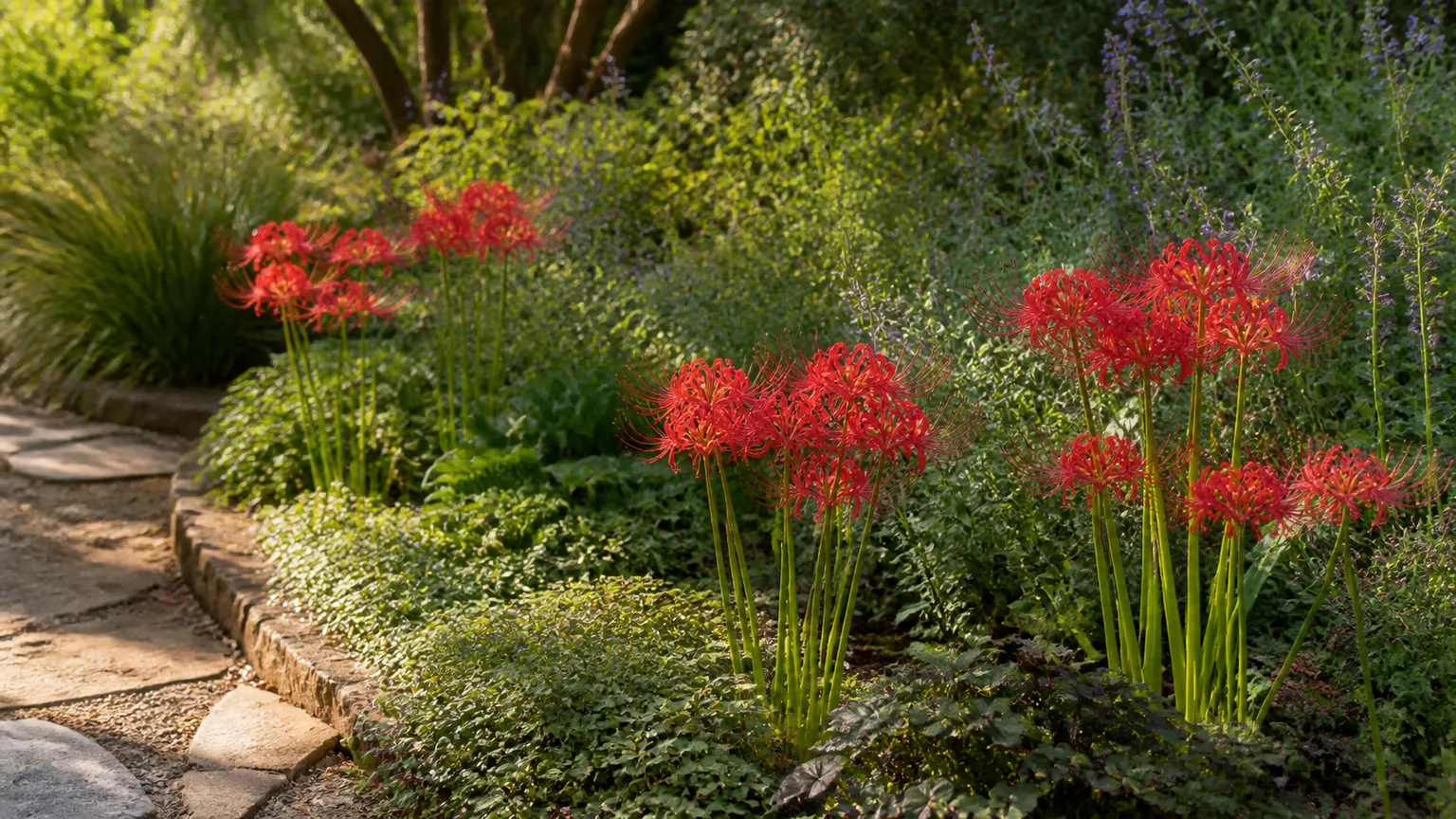
Do not place them where their winter leaves will be mistaken for a weed patch. A deciduous shrub border, a lightly shaded path edge, or a bed with spring-flowering companions works well because the changing foliage has visual company across the year. Gardenia recommends beds, borders, and large containers, and notes that groups create a stronger display than one bulb at a time (Gardenia).
Choose companions for timing rather than just flower color. Low evergreen groundcover can frame the bare fall scapes, while summer perennials can occupy the space during the bulb’s dormant period; avoid dense, thirsty roots that make digging or drainage difficult. The result is a planting that looks intentional in every phase instead of asking one bulb to provide year-round cover.
Conclusion
Red spider lily is easy only after you accept that it has its own schedule. Give it a well-drained place to stay, plant the neck above soil, keep summer dormancy relatively dry, and let the winter leaves finish their work. Those four decisions solve more problems than a complicated feeding routine ever will.
Once established, Lycoris radiata rewards patience with one of the garden’s best late-season surprises: vivid flowers on bare stems exactly when the border needs a new point of focus. Keep the bulb safe, avoid unnecessary disruption, and let each annual cycle strengthen the next.