Growing Strawberries in the Ground or in Containers
Compare growing strawberries in the ground and in containers. See how sun, soil, runners, watering, and upkeep affect harvests, and when a pot fits your space.
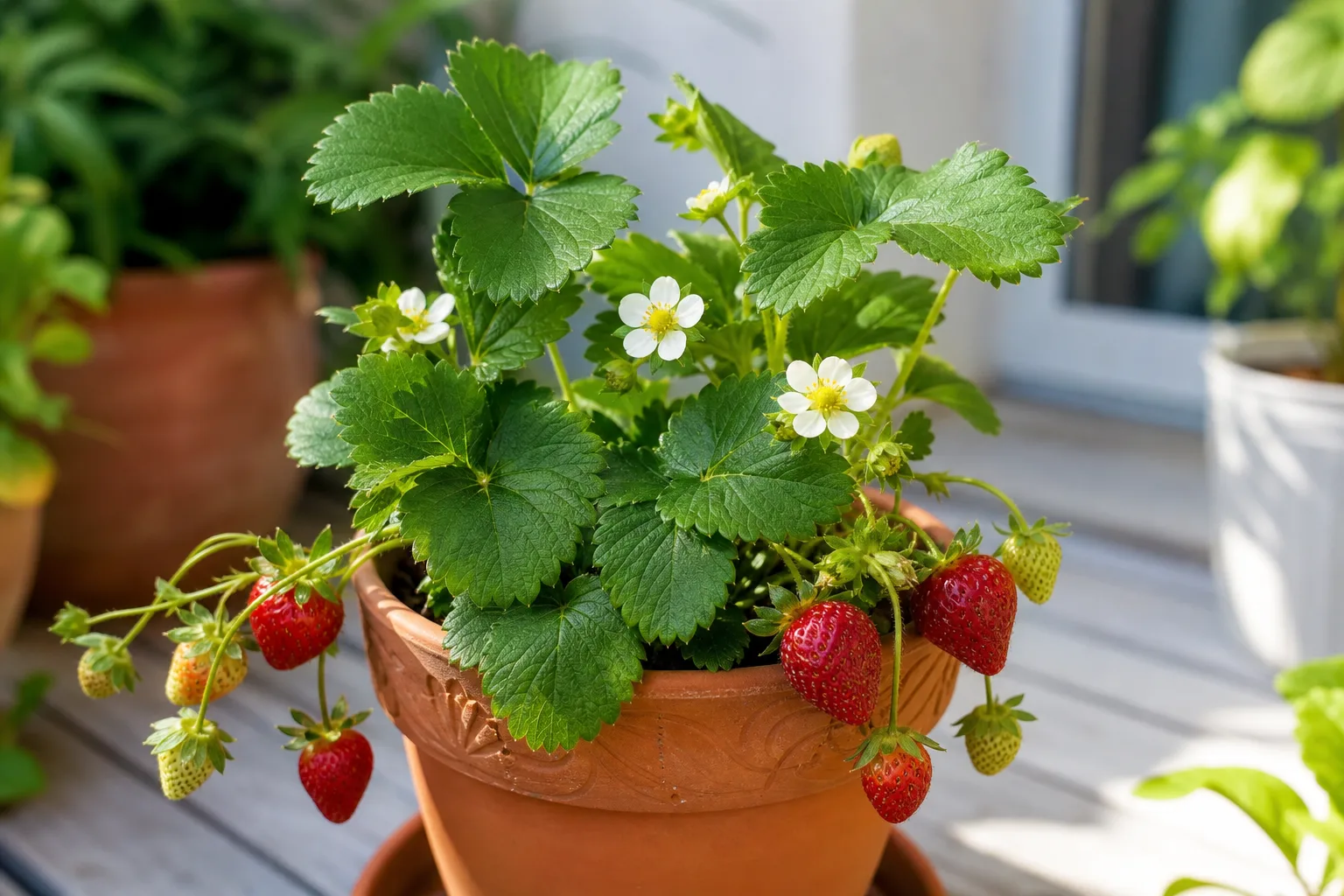
If you have a sunny patch with soil that drains well, growing strawberries in the ground is usually the better choice for a generous harvest that can expand over time. A bed gives you room for more plants, lets runners root where you want them, and holds more moisture around the shallow roots than a small pot does.
That does not mean strawberries struggle in containers. A roomy pot or trough can produce a satisfying crop on a balcony, keep berries away from some soil pests, or make a poor garden site usable. The trade-off is more frequent watering, limited space for runner growth, and extra attention to winter and summer temperature swings. The right answer depends less on the plant than on what your space can reliably provide.
Short answer: ground wins when harvest and low upkeep matter
Choose the ground if you want to grow several plants, use runners to fill a row, and harvest repeatedly without checking small pots every day in hot weather. In suitable soil, the surrounding ground acts as a larger root zone and a steadier water reservoir. That makes a well-planned bed easier to maintain once it is established, especially compared with several small containers.
Choose a container when you do not have a suitable garden plot, need to avoid a site with a history of strawberry disease, or want to move the plants for access or protection. A container is also useful for a small first trial. Just budget for a large enough vessel, free drainage, regular moisture checks, and a plan for protecting the root ball in winter where winters are cold.
Raised beds sit between the two. They preserve the room and runner-management advantages of a bed while improving drainage over heavy or compacted ground. They cost more to build and can warm, dry, or freeze faster than soil at ground level, so they solve a drainage problem rather than every strawberry-growing problem.
What “better” means: total harvest versus fruit per plant
The ground’s main advantage is usually more total fruit from the planting, not a guarantee that each individual plant bears more than a plant in a pot. A pot can grow productive strawberries when it has enough root space and regular care; its ceiling is simply set by how many plants it can hold and how well you keep that limited soil moist and aerated.
That distinction matters when you compare systems. A single container may be perfect for a handful of berries, while a modest bed may hold a row that produces enough to eat fresh, freeze, or share. Utah State University Extension estimates that a properly maintained 4-by-8-foot strawberry bed can produce about 10 to 15 pounds a year for three to five seasons under its local conditions. Treat that as an example of what a managed bed can do, not as a promise for every climate or cultivar. Utah State University Extension describes the yield estimate and the conditions that support it.
For a fair comparison, count the space the plants actually need, the time you can give them, and the years you expect to keep the planting. A pot often wins on convenience per plant: it is close to the kitchen, easy to inspect, and can be placed where the light is best. A bed tends to win when you have the ground area and want to grow enough plants for a recurring harvest without buying or filling multiple containers.
Why a bed scales better over several seasons
A strawberry bed is not simply a larger container. It gives the plant a continuous strip of soil and gives you the option to decide where each new daughter plant takes root. Those two differences matter because strawberries have shallow roots and many common garden types reproduce by runners.
A broader soil volume buffers moisture
Strawberry roots are concentrated near the soil surface. Penn State Extension notes that in heavier soils such as clay loams, about 90 percent of the roots may be in the top six inches; Utah State Extension describes most roots within the top 10 to 12 inches. The exact depth varies with the soil profile, but both sources point to the same practical issue: the root zone can dry or become waterlogged quickly. Penn State Extension and Utah State University Extension explain strawberry root placement and moisture sensitivity.
Ground soil is not automatically moist or well drained, but a prepared bed contains more soil around each plant than a small pot. That larger volume usually changes more slowly after watering and gives roots a wider area to draw from between irrigation cycles. It is a buffer, not permission to ignore the bed during a dry spell.
The difference becomes obvious in warm, windy weather. A container exposed on a patio loses moisture through its sides and top, and a hanging basket can dry faster still. Better Homes & Gardens advises checking potted strawberries daily so they stay consistently moist; in-ground plants also need irrigation when rain does not meet demand, but a bed is less likely to swing from wet to dry within a few hours.
Runner rows create room to renew the planting
Many strawberries send out runners, or stolons, that form daughter plants when they touch moist soil. In a June-bearing matted row, you can guide selected runners into the open row and let them root. That gradually creates a productive strip of plants without buying a new pot for every plantlet.
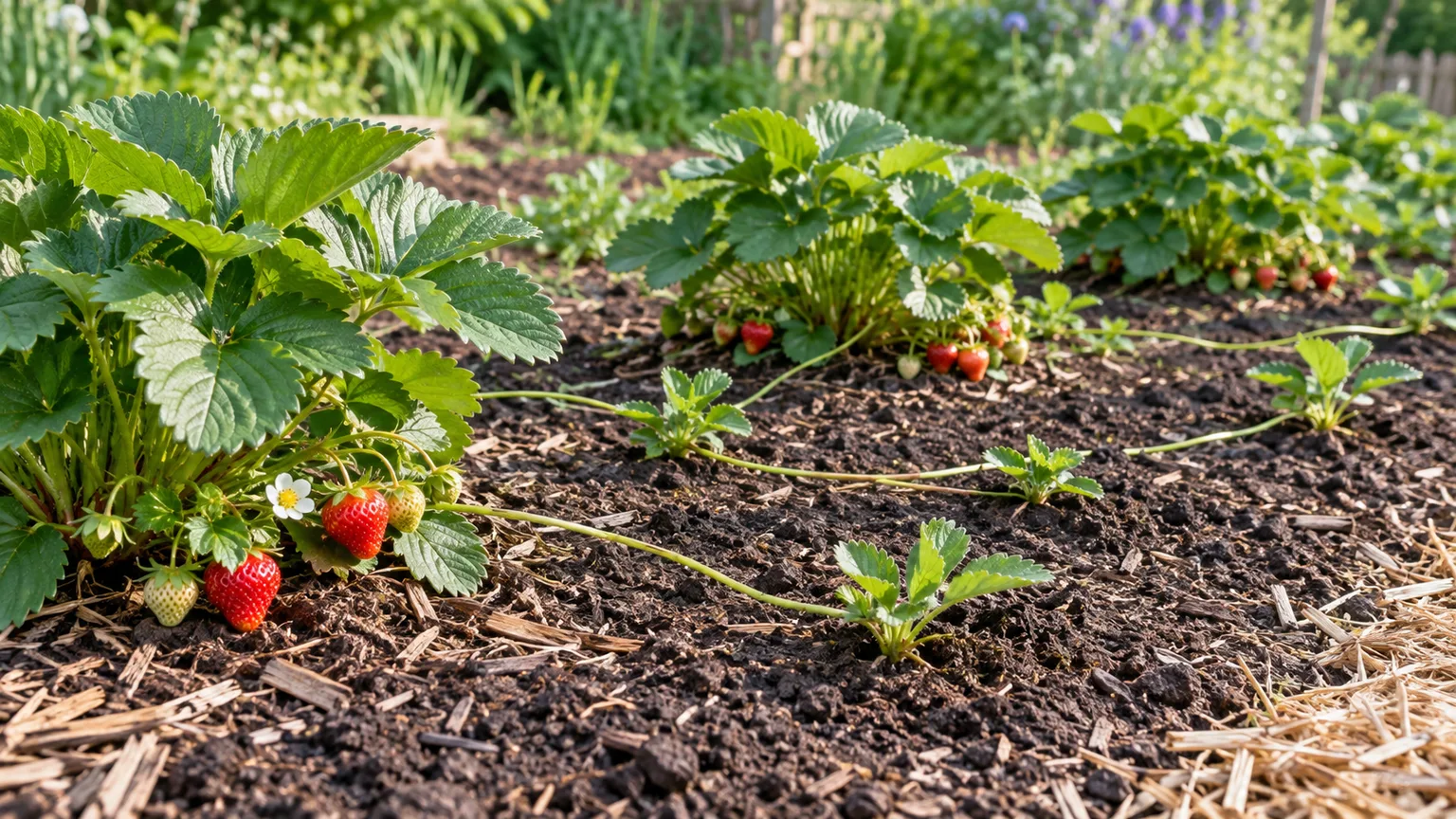
The same habit can become a problem if every runner is left to grow. Crowded plants compete for light, water, and airflow, and the berries become harder to find and pick. Extension guidance for established matted rows recommends narrowing and thinning the planting after harvest; in a container, runners are usually clipped unless you are deliberately rooting a small number in nearby pots.
Not every strawberry type makes the same number of runners. June-bearing cultivars commonly fill rows, while day-neutral and everbearing plants are often managed more compactly. Utah State Extension describes matted-row management for June-bearers and an annual-hill system in which runners are removed; the latter can also suit containers. The advantage of a bed is that it gives you a choice between containing runners and using them to renew the crop.
Ground or container at a glance
| Growing factor | In-ground bed | Container |
|---|---|---|
| Best fit | A sunny, well-drained plot and a larger recurring harvest | A patio, balcony, accessible growing height, or unsuitable garden soil |
| Total crop potential | More room for plants and rooted runners | Limited by the number of plants the vessel can support |
| Watering | Usually less frequent once established, but still needed in dry weather | More frequent checks; pots can dry quickly in sun, wind, and heat |
| Soil control | Depends on the site; may require testing, compost, drainage work, or rotation | Easier to choose the growing medium and replace it |
| Maintenance | Weeding, runner thinning, mulching, and periodic bed renewal | Watering, feeding, runner trimming, and container winter protection |
| Main risks | Poor drainage, weeds, soilborne disease, ground-level fruit damage, and wildlife | Drying or overheating, root crowding, uneven moisture, and greater winter exposure |
| Flexibility | Fixed in place; can be protected with covers or netting | Can be moved to adjust exposure or shelter, if the container is manageable |
This comparison assumes a productive site and a container with drainage and enough room. A waterlogged garden bed is a worse option than a well-run pot; a small strawberry jar that dries out every afternoon is a worse option than a properly prepared bed. The system matters, but the setup matters more.
Check the site before planting
Before you buy plants, look at the patch you plan to use after a heavy rain and during the sunniest part of the day. Those two observations quickly reveal whether the ground offers strawberries what a container cannot: dependable light and soil that stays moist without remaining saturated.
Sun and airflow matter more than the label “ground”
Aim for a spot that receives roughly eight hours of direct sun during the growing season. Utah State University Extension and Better Homes & Gardens both use eight hours as a full-sun benchmark for productive strawberries. In a very hot climate, afternoon heat can still stress plants, especially in dark pots; choose a locally recommended cultivar and use mulch or careful watering rather than putting the plants in deep shade.
Air movement matters because dense foliage stays wet longer and can favor fungal problems. Leave access between rows so you can pick fruit, remove weeds, and thin runners without stepping on plants. If the only sunny ground spot is cramped between a wall and fence, a container that can be moved a little farther into the light may be the more practical choice.
Containers have a real advantage when the best light changes through the season. You can move a pot to a sheltered position ahead of a cold snap or out of the hottest afternoon exposure. That mobility is useful, but it does not replace adequate daily sun: a pot kept in shade all season will not compensate for lost light simply because it is easy to move.
Drainage, soil history, and the raised-bed compromise
Strawberries need moist soil, not waterlogged soil. If the proposed patch stays puddled after rain, sits at the bottom of a slope, or has dense soil that is difficult to improve, do not plant straight into it and hope for the best. Poor drainage raises the risk of root and crown problems. A raised bed can lift the root zone above heavy soil and improve aeration; a container can bypass the ground entirely.
For an in-ground planting, remove perennial weeds before planting and test the soil so you know whether it needs amendment. Strawberries generally prefer fertile, well-drained, slightly acidic soil; Better Homes & Gardens gives a pH range of 5.3 to 6.5, while the Royal Horticultural Society describes the target more generally as slightly acidic. Use your local soil-test recommendation for the exact correction rather than adding lime or fertilizer by guesswork.
The ground’s long-term weakness is that soilborne disease can build up around repeated strawberry crops. Utah State Extension recommends avoiding a bed in the same place for more than five years and not following crops such as tomatoes, potatoes, peppers, eggplants, or okra, which can host Verticillium wilt. The exact rotation interval depends on local disease pressure, so check regional extension guidance before planting strawberries where those crops recently grew.
Raised beds solve some drainage problems, but they are not identical to planting directly in the ground. Their soil can warm earlier in spring, which can bring flowers into a period when late frost is still possible, and exposed roots may be more vulnerable to winter injury. They also need filling and occasional replenishment. Choose them when drainage or access is the main obstacle, not because a raised frame automatically produces better berries.
Build a productive in-ground strawberry patch
Once the site passes the light and drainage checks, make the bed easy to maintain from the start. Keep enough room to reach fruit and pull weeds, decide whether you want runners to fill a row, and avoid burying the crown during planting.
Choose plant type and timing for your climate
The main strawberry types differ in when they fruit and how they spread. June-bearing varieties concentrate much of their crop into one season, and their runners can fill a matted row. Day-neutral and everbearing plants tend to produce in repeated flushes or over a longer period, depending on climate, and are often managed with runners removed so the mother plants have room to fruit.
Those labels do not predict the exact harvest dates in every region. Heat can interrupt fruiting, spring frost can damage open flowers, and the same variety may perform differently in different soils. Buy disease-free plants of a cultivar recommended locally, then use the nursery or extension guidance for planting season and first-year flower removal. Penn State Extension, for example, uses different first-year flower and runner practices for June-bearing and day-neutral plants.
For a classic ground bed, June-bearing strawberries are a natural fit if you want a concentrated crop and room for a row to expand. If you prefer smaller harvests across more of the season, look at day-neutral or everbearing types suited to your climate. A pot can grow any of these, but compact habits are often easier to manage in limited soil.
Plant at the right depth and spacing
Set the plant so its roots are covered but the crown—the compressed stem where leaves emerge—sits at the soil surface. If you bury the crown, it can rot; if the crown and roots are left too exposed, they dry out. Spread bare roots downward and outward rather than folding them into a tight bundle, then firm the soil gently and water to settle it around the roots.
Spacing depends on the cultivar and growing system. For a June-bearing matted row, Penn State and Utah State Extension give a common starting range of 18 to 24 inches between plants, with rows roughly three to four feet apart. Day-neutral or hill systems can be planted more closely, and local recommendations may differ. Leave enough room to walk, harvest, weed, and narrow the row later.
Water newly planted strawberries thoroughly, then add mulch after the bed is established. Straw or another clean mulch helps limit weeds and keeps fruit from resting directly on damp soil. Keep mulch away from the crown itself so it does not stay wet against the growing point. A simple, accessible row with clean fruit is more useful than a dense patch that looks full but is difficult to tend.
Keep a bed productive without turning it into a tangle
An in-ground bed needs maintenance, but it does not need daily attention when its soil, spacing, and runner plan are sound. Focus on three recurring jobs: keep moisture reasonably even, keep weeds from competing with the shallow roots, and prevent the planting from becoming too crowded to harvest.
Water, mulch, weed, and feed according to need
Water when the root zone begins to dry, giving the soil a thorough soak rather than frequent splashes that wet only the surface. Strawberries are sensitive to both water shortage and excess. Utah State Extension describes irrigation every three to five days during hot summer weather in its dry Utah context; do not copy that calendar automatically in a cooler or wetter climate. Check the soil and weather, and avoid leaving roots in standing water.
When practical, water near the soil rather than over flowers and fruit. Wet fruit and dense foliage take longer to dry and can increase rot problems. Straw mulch reduces soil splash and helps conserve moisture, while an open row makes it easier to spot weeds before they shade or outcompete the plants.
Do not feed by habit. A soil test helps show whether the bed needs fertilizer, and heavy nitrogen can favor leaves and runners over fruit. Extension programs provide region-specific amounts for different systems; use the test and product directions instead of borrowing a fertilizer rate intended for another state, bed size, or strawberry type. Container plants may need more regular feeding because their finite growing medium is watered more often, but the same restraint applies.
Harvest, direct runners, and renew aging plants
Pick fully colored fruit often during the harvest period so overripe berries do not sit under foliage and attract pests. As fruit develops, keep it off wet bare soil with straw or another suitable mulch. Birds and squirrels can find berries in either a bed or a pot; if you use netting, stretch it taut over a frame and secure the edges so wildlife cannot become entangled.
After harvest, decide which runners belong in the bed. Guide only a limited number into open spaces, and remove the rest before they crowd established crowns or block paths. A matted row is meant to fill a defined strip, not the entire garden. For day-neutral or everbearing systems managed as hills, remove runners so the plants stay spaced and easier to care for.
Older beds gradually lose vigor and can accumulate disease. Utah State Extension says a well-managed planting may produce well for several seasons, while the RHS advises replanting a healthy bed after about three or four years to avoid disease buildup. Those are useful planning ranges, not a universal expiration date. If berries shrink, plants weaken, or disease recurs, replace the planting in a different location rather than repeatedly adding fertilizer to tired soil.
Choose a container when access or site conditions call for it
A pot is the sensible choice when you lack a patch with enough sun and drainage, are gardening on a balcony or paved patio, need plants at a reachable height, or want to avoid planting into ground with a problematic crop history. The ability to move a container can also help you shelter flowers from a late frost or reduce intense afternoon heat.
Containers may keep fruit cleaner and less accessible to some ground-level slugs and snails, but they do not create a pest-proof garden. Birds can still reach hanging fruit, and container-grown strawberries can face other pests, including vine weevil in regions where it occurs. If your garden soil is healthy and a bed is possible, a container is not automatically a lower-maintenance option.
Give the pot enough room, drainage, and a winter plan
Start with a wide, stable container that has open drainage holes and enough surface area to space plants about eight inches apart. A trough, large pot, or growing bag is easier to keep evenly moist than a small vessel with many narrow planting pockets. The RHS notes that traditional strawberry pots can be harder to keep healthy and productive, despite their familiar appearance. Choose a container for the root space and access it provides, not just for the number of side holes.
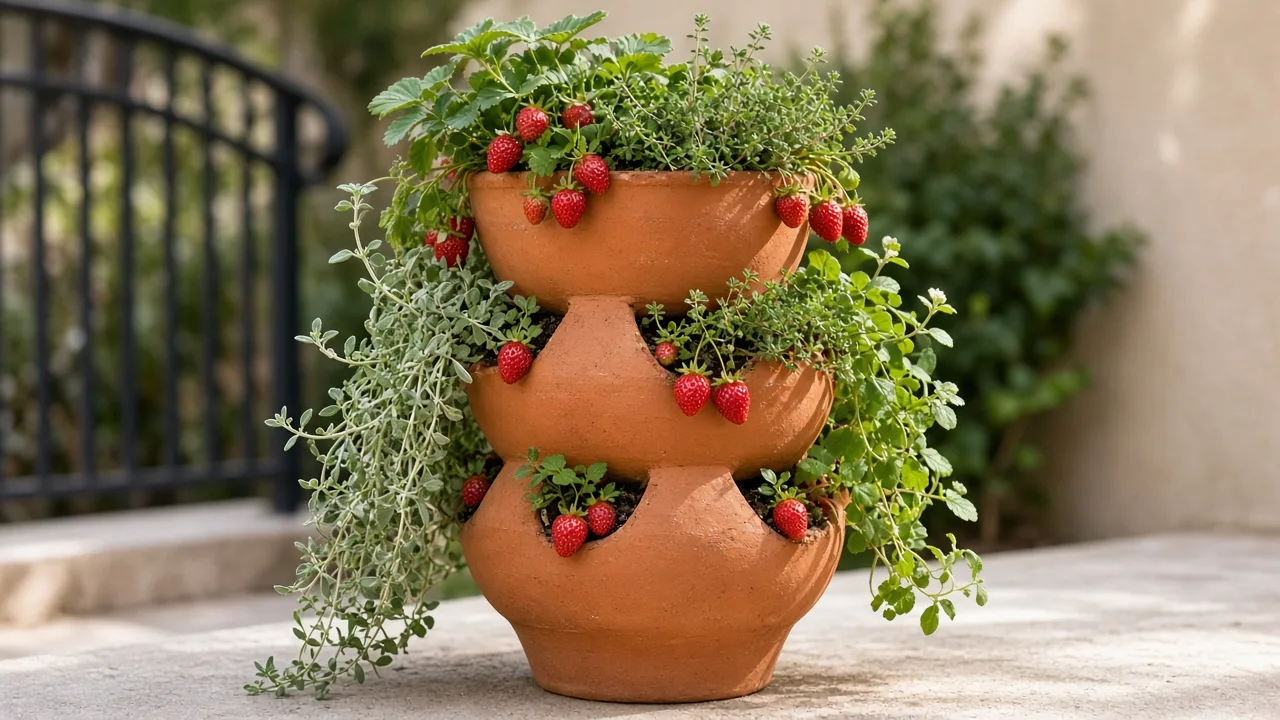
Use a container growing medium rather than dense garden soil, and keep each crown level with the surface. The RHS recommends a large vessel filled with multipurpose or soil-based compost. Avoid filling a decorative pot so tightly that water runs down the sides without wetting the root ball. After watering, excess water should drain freely; the pot should not sit in a saucer full of water.
Expect to check moisture more often than you would in a bed, especially in a sunny or windy spot. Better Homes & Gardens recommends daily checks for potted strawberries. Feel the medium rather than following a fixed schedule: water thoroughly when it is drying, then let excess drain. If leaves wilt on a hot afternoon, check the medium and the pot temperature before assuming the plant needs a permanent move into shade.
Limit runners unless you want to propagate a few daughters in separate small pots. In a finite container, runners compete with the fruiting plant for water and space. Feed according to the growing medium’s directions during active growth, and stop or reduce feeding when the plant is dormant. Overfertilizing does not compensate for a cramped root zone or inconsistent watering.
Containers need a winter plan as well. Roots in a pot are surrounded by air-exposed walls, so they can experience colder swings than plants rooted in the ground. Where the cultivar is hardy outdoors, group containers in a sheltered spot and insulate them as needed; in colder climates, an unheated garage or shed can protect dormant plants, with occasional light watering so the medium does not dry completely. Do not keep them in a warm room that prevents normal dormancy. If you cannot protect the pot or monitor its moisture through winter, a ground bed may be the easier long-term system.
Conclusion
For most gardeners with a sunny, well-drained patch, growing strawberries in the ground is better when the goal is a larger harvest that can renew itself through runners. The bed’s extra soil volume buffers moisture, accommodates more plants, and supports a multi-year planting with manageable upkeep. Prepare the site, leave room to reach the rows, and thin runners so the patch stays productive instead of crowded.
Choose a container when the yard, soil, access, or flexibility makes a bed impractical. Give it enough root space, check moisture frequently, and protect it from temperature extremes. If the ground is almost right but drains poorly, a raised bed can be the useful middle choice. The best system is the one that gives strawberries reliable sun and moisture while fitting the time and space you actually have.