How Often to Water Hydrangeas: A Soil-First Schedule
Learn how often to water hydrangeas, when new plants and pots need more, and how to tell thirst from heat stress or overwatering.
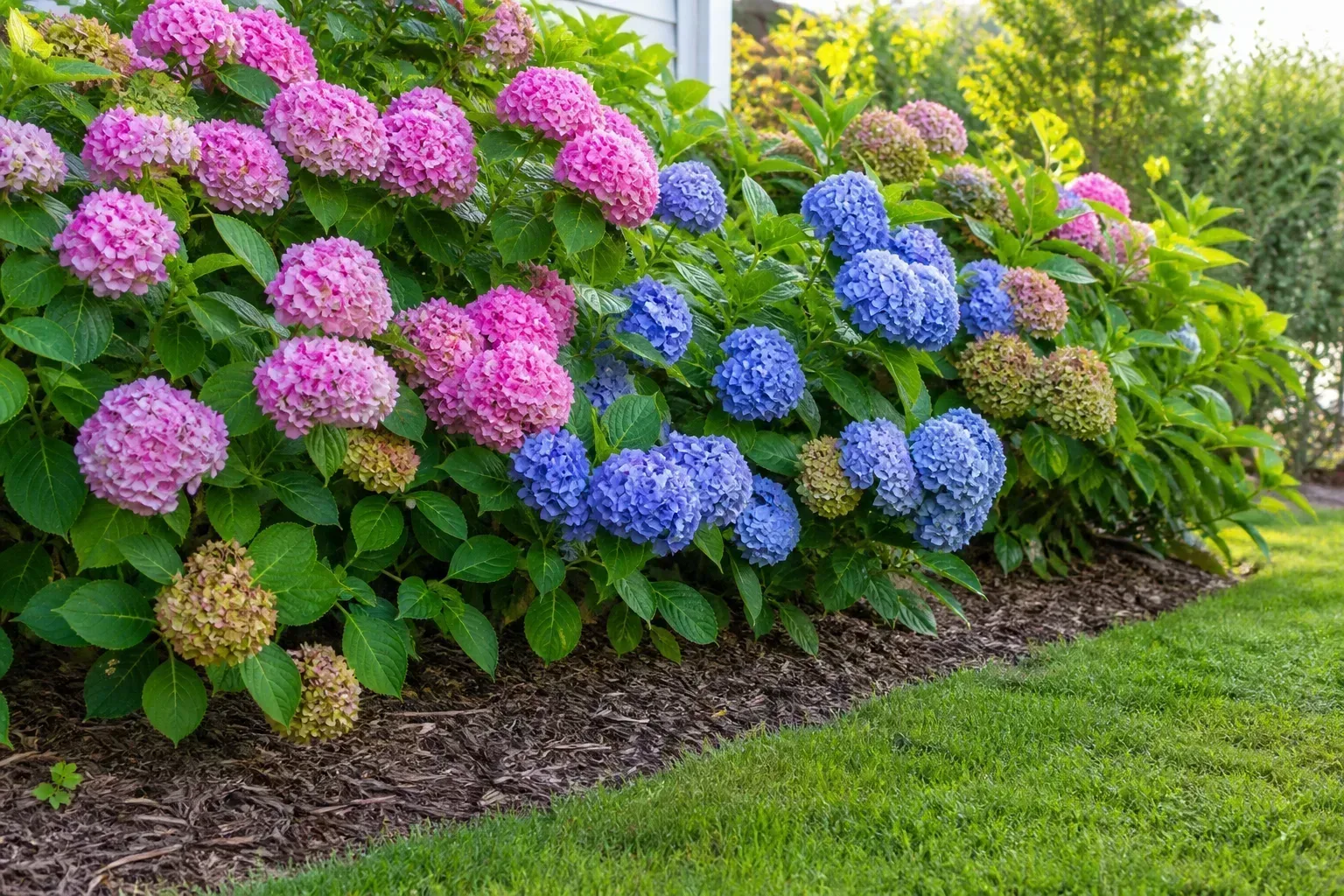
Hydrangeas need evenly moist soil, but that does not mean watering on the same day every week. A newly planted shrub in sandy soil, an established hydrangea under mulch, and a small plant in a dark container can all need different amounts of water at the same time.
The dependable rule is simple: check the soil several inches down, then water slowly and deeply when the root zone is drying. If the soil is already moist and a plant droops only during a hot afternoon, more water may make the real problem—heat, sun, or poor drainage—worse.
The quick answer: water by root-zone moisture, not the calendar
For an established hydrangea growing in the ground, start by checking the soil two or three times a week during hot, dry weather. Water when the root zone is dry several inches below the surface, which may work out to about once or twice a week during a prolonged dry spell. In cooler, rainy, or humid conditions, the interval can be longer.
Newly planted hydrangeas need closer attention because their roots occupy a small area and have not yet explored the surrounding soil. Check them daily during the first couple of weeks, then keep checking frequently through the first growing season. A container-grown hydrangea may also need a daily check in hot weather because its limited soil volume warms and dries faster than garden soil.
Use this as a starting schedule, not a prescription:
| Situation | How often to check | When to water |
|---|---|---|
| Newly planted in the ground | Daily at first; more often in heat or wind | When the root ball or nearby soil is drying several inches down; water slowly until the whole planting area is moist |
| Established in-ground shrub | Two or three times weekly during dry weather | When the root zone is dry several inches down; water deeply, then let the surface dry slightly before checking again |
| Container hydrangea | Daily during hot weather; morning and late afternoon checks may be needed in extreme heat | When the potting mix is dry below the surface; soak until water drains, then empty the saucer |
| Cool, rainy, or dormant period | After a long dry spell or when rainfall has been absent | Only if the root zone is actually drying and the ground is not frozen or waterlogged |
The RHS recommends watering newly planted hydrangeas as needed during the first growing season, watering mature plants during hot, dry spells, and moving containers to a shadier place in summer. Its growing guide for shrubby hydrangeas also pairs moisture retention with good drainage—a combination that matters more than any universal number of days.
Read the soil before you reach for the hose
Leaves are useful signals, but they are not a moisture meter. Large hydrangea leaves can droop in hot sun even when the soil is damp, while roots in compacted or waterlogged soil can struggle to supply the leaves despite abundant water.
The 60-second moisture check
Move mulch aside and test the soil in the root zone, not right against the stems. Push a finger, wooden plant label, or narrow trowel several inches down. The top inch can be dry while the soil below is still cool and moist, so do not decide from the surface alone.
Use the texture as well as the depth:
- Dry, dusty, and loose several inches down: water slowly and deeply.
- Cool, slightly damp soil that holds together lightly: wait and check again later.
- Wet, slick, or sour-smelling soil: stop watering and investigate drainage.
- A dry pocket beside a wet root ball: apply water in stages so it spreads instead of running through a gap.
A moisture meter can help with a large container or a deep bed, but it is not a substitute for learning how water moves through your soil. Test in more than one spot, especially on a slope, near a downspout, under a dense mulch layer, or around a newly planted root ball.
Homes & Gardens’ hydrangea watering guidance makes the same practical point: check the soil before watering, then reassess later if heat has caused temporary wilt. That check prevents the common cycle of seeing limp leaves, adding water immediately, and keeping already-damp roots wet.
Water deeply enough to reach the active roots
A deep watering is a slow delivery that wets the root zone beyond the surface crust. It is not a flood, and it is not a quick sprinkle over the flowers. Hydrangea foliage is dense enough to intercept overhead water, leaving the soil near the stems surprisingly dry while the leaves stay wet.
Aim water at the soil line and move around the plant’s root zone rather than holding a hose against one stem. For a mature shrub, include the area beneath and just beyond the canopy. That is where fine feeder roots are likely to be taking up water, not only in the small circle immediately around the trunk-like base.
How to make water soak in instead of run off
Use a gentle flow from a watering wand, hose, soaker hose, or drip line. If the soil is very dry or compacted, apply the first pass slowly, pause for a few minutes, and then make a second pass. This is more effective than increasing the flow until water streams away down a slope or along the edge of a dry root ball.
After watering, test the soil again in two or three places. If the surface is muddy but the soil below is still dry, the application was too fast or the soil is resisting water. If water is still standing hours later, the issue is drainage, not an invitation to add more.
Do not make daily shallow sprinkles your normal routine. Frequent surface wetting can create a shallow moisture pattern and leaves the deeper root zone dependent on the next sprinkle. Occasional deep watering, adjusted to what the soil actually does, gives you a more useful rhythm.
A practical hydrangea watering schedule
The schedule changes as a hydrangea’s roots, container, and weather change. Think of the following stages as checkpoints for adjusting your routine, not as rigid dates.
Newly planted hydrangeas
For the first two or three weeks, check a new shrub every day. Water the original root ball and the surrounding soil when either is beginning to dry several inches down. The root ball can dry faster than the bed around it, or the surrounding clay can stay wet while the potting mix inside the root ball dries, so check both areas.
Continue frequent checks through the first growing season, especially after planting in summer. A new hydrangea in morning sun and afternoon shade will usually be easier to establish than the same plant beside a hot wall, exposed lawn, or reflective paving. North Carolina State Extension notes that hydrangeas in direct sun all day often need additional watering, and it lists both leaf spot and powdery mildew among problems that can develop under some conditions.
Do not compensate for weak establishment by leaving a new plant in standing water. If the planting hole drains slowly, improve the site or ask a local extension service for advice. Roots need moisture and oxygen; a permanently saturated hole can produce the same wilt that you were trying to prevent.
Established hydrangeas in the ground
Once a shrub has spent a couple of growing seasons in the same spot, its root system can draw from a wider area. That increases resilience, but it does not make the plant drought-proof. Check established plants two or three times a week during a dry, hot period and water when the soil is dry several inches down.
As a starting point, one or two deep waterings per week may be enough during a prolonged dry spell in ordinary garden soil. Sandy soil, strong wind, tree-root competition, full afternoon sun, and a thin mulch layer shorten the interval. Clay soil, rain, shade, and a thick but correctly applied mulch layer lengthen it.
The RHS guidance recommends watering even mature hydrangeas during hot, dry spells and improving moisture retention with organic matter and mulch. That is more useful than telling every gardener to water on the same weekday because it accounts for the conditions that actually remove water from the soil.
Hydrangeas in containers
Pots need more frequent checks because the root zone is smaller, exposed on all sides, and often warmer than the ground. In summer, check a container every morning; in extreme heat, check again in the late afternoon. A small, dark pot on a sunny patio can dry out far faster than a large, light-colored container in dappled shade.
When the mix is dry below the surface, water thoroughly until a little drains from the bottom. If water immediately runs down the sides and out, the mix may have shrunk away from the pot or become difficult to re-wet; apply water slowly in two or three rounds. Confirm that the drainage holes are open, and empty any saucer so the pot does not sit in water.
Move a container to bright dappled shade during a heat wave rather than trying to solve a hot root ball with repeated watering. The RHS specifically recommends regular moisture checks and moving containerized hydrangeas to a shadier spot in summer. If a pot dries out twice a day despite sensible shade and thorough watering, the long-term fix may be a larger container, a better-draining but moisture-retentive mix, or a better location.
Morning is the default, but plant condition comes first
Early morning is the best routine time for most outdoor hydrangeas. The soil has time to absorb water before the hottest part of the day, and any splash on foliage has a chance to dry. Water at the base rather than over the leaves and flower heads; NC State Extension lists powdery mildew and leaf spot among hydrangea problems, and keeping routine irrigation off the foliage reduces unnecessary wetness.
Evening watering is not automatically harmful, especially when the soil is dry and the plant needs water. It is simply less forgiving when foliage stays wet overnight, airflow is poor, or the plant is already prone to leaf disease. Midday is also not forbidden: if a container is truly dry and wilting, water it rather than waiting for a perfect clock. The root zone’s condition outranks a schedule rule.
Heat and wilting: decide between thirst and temporary stress
Wilting is a water-balance symptom, not a diagnosis. A hydrangea can droop because the soil is dry, because leaves are losing water faster than roots can replace it in afternoon heat, or because damaged roots are sitting in wet soil.
When wilt points to dry soil
Underwatered hydrangeas often stay limp into the evening, especially when the soil is dry below the surface. Leaves and flower heads may feel less resilient, edges can become brown and papery, and a container may feel unusually light when lifted. Water that disappears into cracks or runs off the bed without soaking the root zone is another clue that the plant is not receiving the water you thought you applied.
If the root zone is dry, shade the plant during the hottest hours and water slowly at the soil line. Do not spray the leaves as the main treatment. After the first pass has soaked in, check again and add a second pass if deeper soil is still dry. A wilted plant may not stand upright immediately; judge the trend over the next several hours and the following morning.
When wilt points to heat and sun
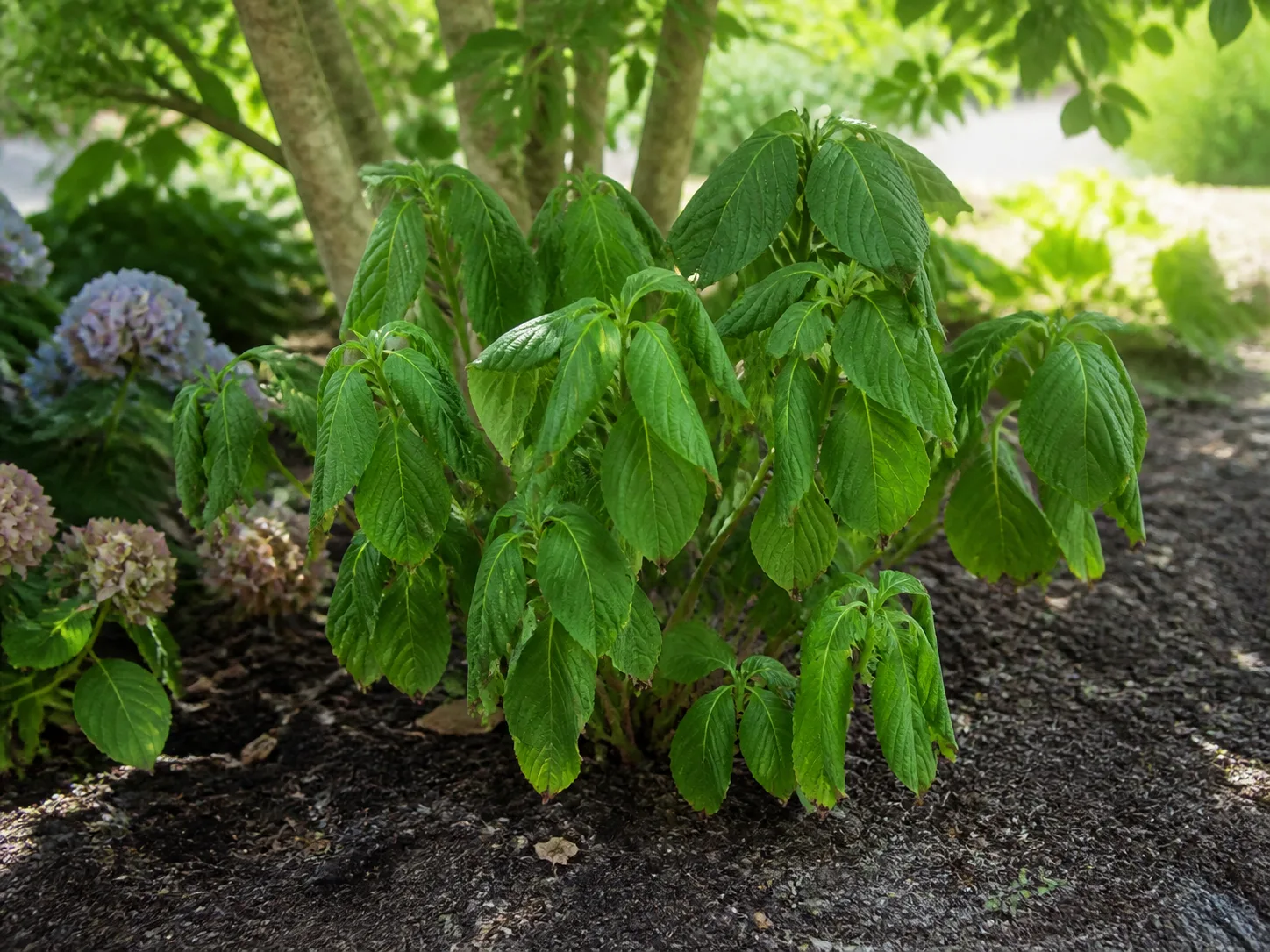
Temporary heat wilt usually appears during the hottest, brightest part of the afternoon and improves as the air cools. Leaves may hang while remaining green and flexible, and the plant may look much better in the evening or next morning when the soil is still damp.
If the soil is moist, do not keep watering to correct the afternoon appearance. Move a container to dappled shade or give a vulnerable in-ground shrub temporary shade above the foliage with room for air movement. Hydrangeas with broad leaves—especially bigleaf, mophead, lacecap, and mountain types—can lose water quickly in heat even when the soil is not yet dry.
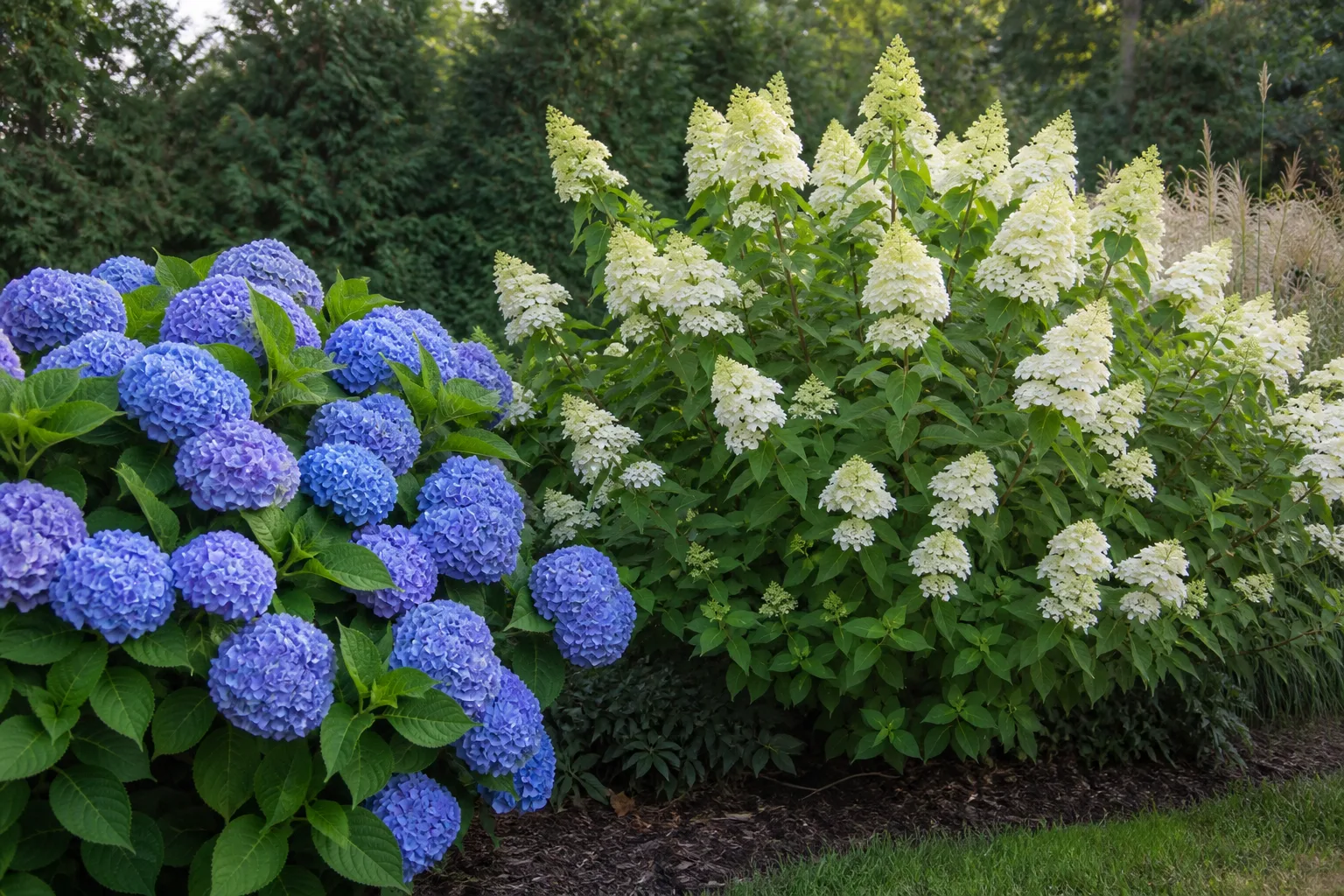
The RHS reports that traditional mophead and lacecap hydrangeas are among the types most vulnerable to intense heat and drought, while panicle hydrangeas generally perform better when they grow in moisture-retentive soil. Its research on hydrangeas in hotter summers recommends dappled shade for containers, deep watering rather than little and often, mulch, and choosing a site that reduces heat exposure.
When wilt points to wet roots
Persistent wilt in wet soil is a warning to stop adding water. Roots in saturated soil have less air available, and damaged roots cannot reliably move water to the leaves. Yellowing leaves, soft or mushy tissue, a sour smell, algae at the soil surface, and water that remains in the planting hole are reasons to investigate drainage.
In a pot, check that the drainage holes are open and that the saucer is not full. In the ground, look for compacted clay, a low spot, a downspout, or a hard layer that traps water. Allow excess water to leave before watering again. If the plant continues to decline, inspect the roots or seek a local diagnosis rather than alternating between drought and flooding.
Mulch and drainage make the schedule more reliable
Mulch slows evaporation and moderates soil temperature, giving the root zone a larger margin between watering checks. Spread about 2 to 3 inches of organic mulch over the area beneath the canopy, extending outward as space allows. Keep a bare gap around the stems so the mulch does not stay pressed against the plant base.
The RHS guide describes a mulch layer of about 2 inches and a gap around the base to reduce soil drying. Savvy Gardening also recommends a 2- to 3-inch layer for maintaining consistent moisture, while warning against piling mulch against the plant. Mulch is useful only when it is applied as a broad, thin ring; a deep mound against the stems can keep the base too wet and hide problems.
Drainage is the other half of the equation. Add organic matter before planting where appropriate, but do not assume that adding a little material to the surface will fix a compacted or waterlogged site. A hydrangea needs a root zone that holds moisture between waterings while allowing excess water and air to move through it.
Hydrangea type and planting site change water demand
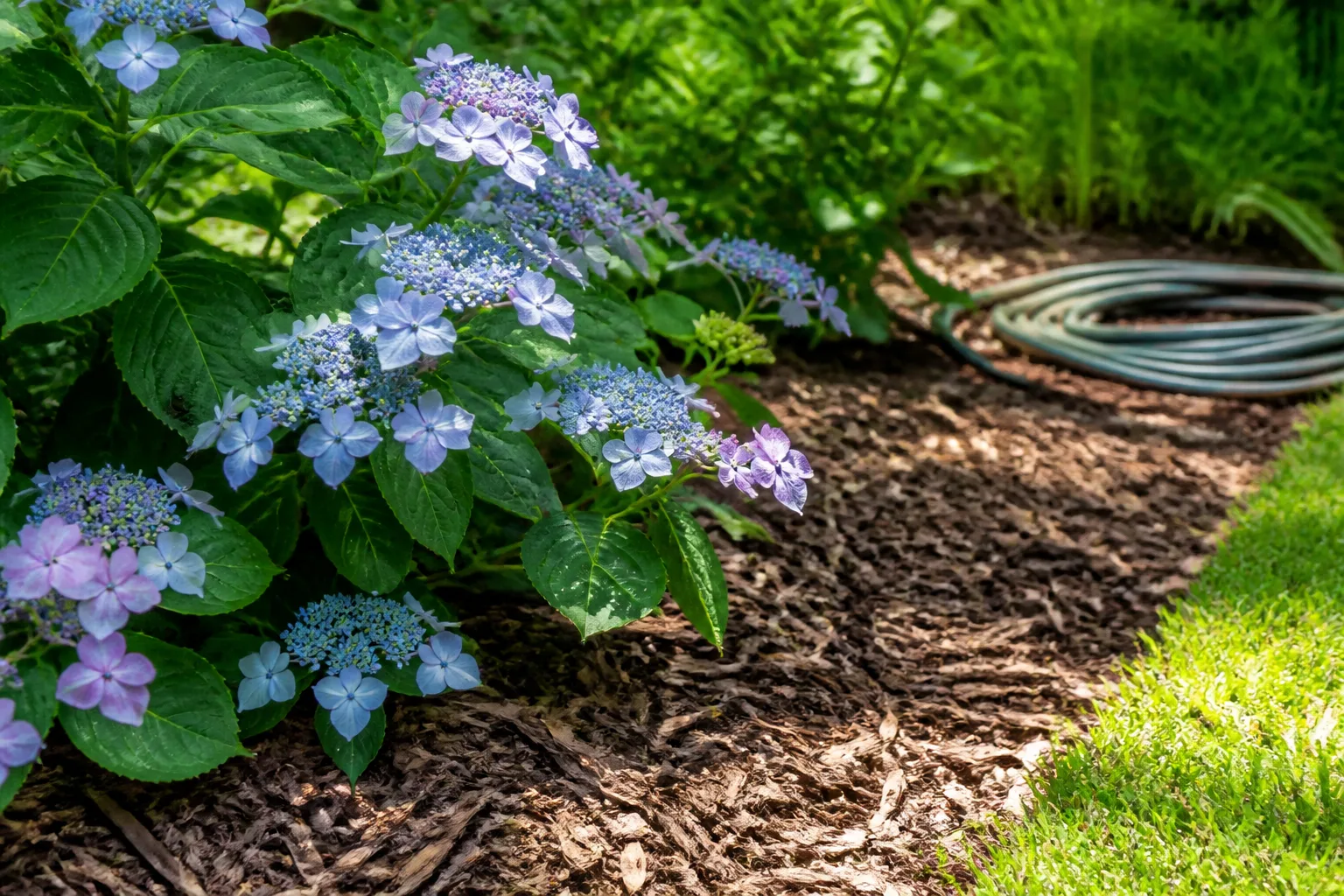
“Hydrangea” covers several species with different tolerances. Type does not replace a soil check, but it helps explain why one shrub wilts sooner than another in the same weather.
Bigleaf and mountain hydrangeas generally prefer consistent moisture and afternoon protection in hot climates. Oakleaf and smooth hydrangeas can be more forgiving once established, while panicle hydrangeas are often better candidates for brighter sites. Even a relatively adaptable panicle hydrangea needs water during establishment and prolonged drought.
The Gardeners’ World profile of bigleaf hydrangea describes moist but well-drained soil and full sun to partial shade, with shelter from drying winds. The right interpretation is not “full sun always works”; it is that light, wind, soil, and local heat must be considered together. A hot western exposure beside concrete is very different from gentle morning sun with afternoon shade.
If a hydrangea wilts in the same location every summer despite a sensible moisture check, treat the pattern as site information. Move a container, add afternoon protection, transplant an in-ground shrub during a cool suitable season, or choose a type better matched to the exposure. Repeatedly increasing water is not a sustainable fix for a root zone that is overheating or draining poorly.
Adjust the routine for rain, seasons, and exposure
Rain changes the schedule only if it reaches the roots. A brief shower may wet the leaves and mulch while leaving dry soil beneath a dense canopy. After a light rain, check below the surface instead of crossing watering off the list automatically. After a long soaking rain, skip irrigation until the soil has begun to dry.
Spring and fall usually require fewer checks than hot summer, but a newly planted shrub can still dry out during a windy or unusually warm stretch. In winter, deciduous hydrangeas may need little supplemental water while dormant, yet a container or exposed evergreen tissue can dry during a long mild spell. Check the mix when conditions are dry, and do not water frozen or already waterlogged soil.
Reduce water loss by grouping container plants, shielding them from drying wind, and keeping grass from competing directly with a young shrub. Improve the soil before the next hot season rather than trying to correct every dry-down with a longer hose session. A reliable schedule is built from several small advantages—site, soil, mulch, and timing—not from one magic interval.
A step-by-step rescue for a wilted hydrangea
When a hydrangea looks limp, use this order so you do not turn temporary heat stress into root stress:
- Check the clock and the pattern. Note whether the wilt appeared only in afternoon heat or has continued through the evening and morning.
- Feel the root zone. Test several inches down below the mulch and in more than one spot. Check the original root ball and surrounding soil on a new planting.
- Give shade if the plant is hot. Move a container or provide temporary overhead shade with air movement. Do not wrap the foliage in plastic.
- Water only if the soil is dry. Apply a slow, deep soak at the soil line. Use two passes if the soil is crusted or water is running off.
- Correct the next bottleneck. Add a correctly spaced mulch ring for a dry site, repair a blocked drain for wet soil, or move a container from hot paving.
- Wait before pruning. Remove only clearly dead or broken material. Heat wilt alone is not a pruning signal.
Do not fertilize a severely wilted plant to force recovery. Fertilizer does not replace functioning roots, and salts can add stress when a container or dry root ball is already struggling. Do not hard-prune a bigleaf, lacecap, mountain, or oakleaf hydrangea simply because it looks bad after a hot day; many of these types form next season’s flowers on older stems. The RHS recommends different pruning windows for old-wood and new-wood hydrangeas, so identify the type before cutting.
Conclusion: keep the root zone evenly moist, not constantly wet
The best hydrangea watering schedule is a repeatable observation: check below the surface, water deeply when the root zone is drying, and adjust for plant age, container size, rain, wind, soil, and heat. Established in-ground shrubs may need only one or two deep waterings during a dry week, while new plants and containers deserve much more frequent checks.
When leaves droop, look at the soil and the time of day before reaching for the hose. Dry soil calls for a slow soak; damp soil during an afternoon wilt calls for shade and observation; wet soil calls for drainage troubleshooting. That distinction keeps hydrangeas hydrated without keeping their roots waterlogged.



