How Often to Deadhead Petunias So They Keep Blooming
Learn how often to deadhead petunias, where to cut, and when self-cleaning types need only a light trim for a fuller, longer bloom display.
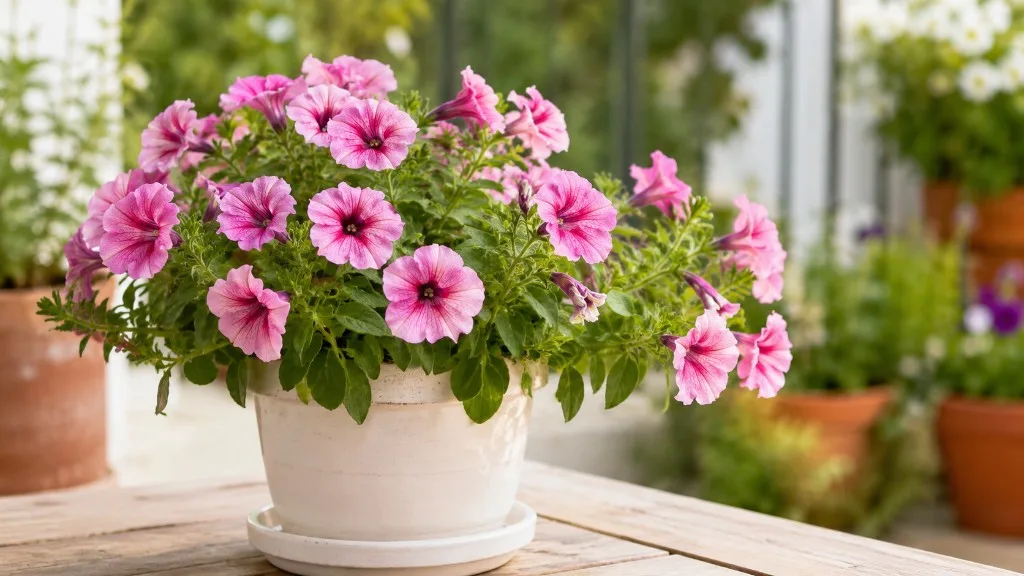
For most traditional petunias, a weekly deadheading check is a good baseline. During peak bloom, hot weather, or a stretch of heavy rain, check every day or two and remove only the flowers that have clearly finished. That keeps the task small and prevents a mass of seed-forming flowers from building up.
There is no single mandatory interval. A petunia in a sheltered garden bed may look fine after a week, while a fast-growing hanging basket can produce enough spent blooms to justify a quick pass every few days. The variety matters too: many modern Wave and Supertunia types are bred to shed spent flowers on their own.
The short answer: check often, deadhead when blooms fade
Deadhead when a flower has lost its color, collapsed, become papery, or looks worse than the surrounding blooms. Do not remove a flower simply because it has been open for a certain number of days; rain, heat, wind, and the plant’s variety change how long each bloom stays attractive.
If you want one practical rule, inspect petunias whenever you water them and make a quick pass at least once a week. A Penn State Extension explanation of deadheading notes that the useful interval can range from a day to several weeks because flower life and weather vary. For petunias, which bloom repeatedly through the season, the shorter end of that range is usually more useful.
You will not harm a healthy petunia by missing a few flowers or waiting an extra week. The immediate consequence is usually a less tidy plant and more opportunity for seed formation, not sudden plant failure. Resume the routine when you can rather than trying to “catch up” by cutting the whole plant indiscriminately.
First identify the petunia before setting a schedule
Petunia labels are more useful than a generic calendar. Look for words such as grandiflora, multiflora, spreading, Wave, Supertunia, self-cleaning, or the cultivar name. If the tag is gone, use the flower size, growth habit, and whether old blooms disappear cleanly or remain attached as clues—but treat the result as a working guess.
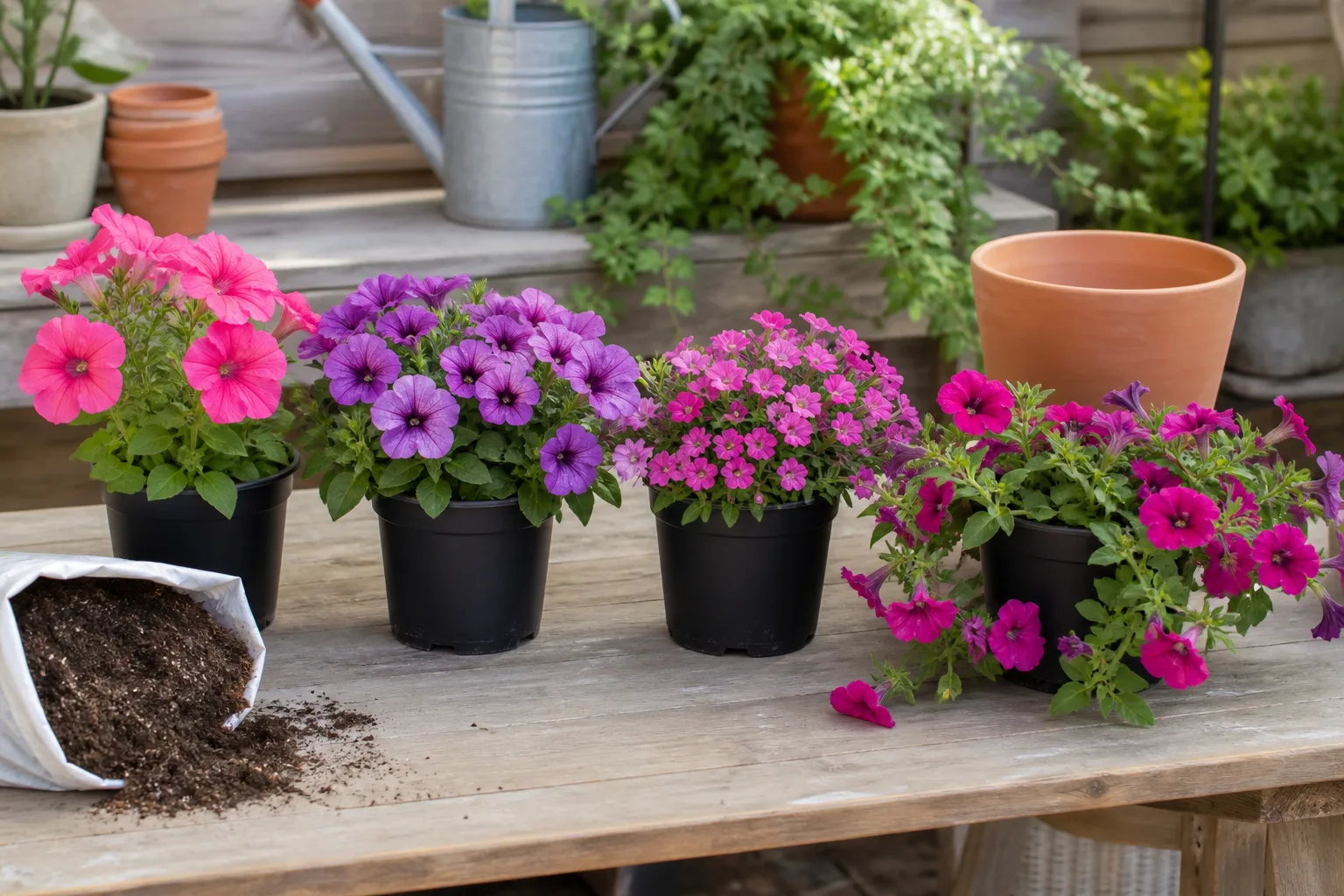
Large-flowered and double types
Large-flowered and double petunias often benefit most visibly from regular deadheading. Their large blooms can hang on the plant after fading, and the green structure beneath the petals can continue developing toward a seed capsule. In these types, a weekly check is reasonable, with a faster pass when the plant is flowering heavily.
Multiflora and smaller-flowered petunias may look less messy as they age, but they can still benefit from removing obvious spent flowers. The goal is not to make every stem perfectly bare; it is to remove the faded flowers that are easy to see without disturbing fresh buds.
The UF/IFAS petunia profile makes the same useful distinction: deadheading is more necessary for large-flowered and double forms, while many smaller-flowered cultivars are self-cleaning. That is a better guide than assuming every petunia needs identical care.
Self-cleaning Wave and Supertunia types
“Self-cleaning” means the spent corolla drops or dries away without requiring you to remove each flower for continued bloom. It does not mean the plant never needs attention. You may still need to remove a few stuck, damaged flowers, clear diseased material, or trim long stems when the plant becomes open and tired.
Check the plant tag before scheduling daily deadheading. Proven Winners’ Supertunia care guidance says Supertunias are self-cleaning and separates deadheading from trimming; its instructions recommend an occasional light haircut for spindly growth. Many Wave types are also marketed as self-cleaning, but cultivar names and care claims differ, so do not assume that every plant sold as a trailing petunia behaves the same way.
What deadheading changes—and what it cannot do
Deadheading removes a fading flower before the plant invests as much energy in developing seeds. The practical benefit is a cleaner display and, for varieties that set seed readily, a stronger incentive to keep producing flowers instead of moving further into reproduction. The Royal Horticultural Society’s deadheading guide describes the practice as removing fading flowers to keep plants attractive and encourage more blooms.
That is a useful explanation, but deadheading is not a bloom switch. A petunia without enough light, consistent moisture, or available nutrients may remain sparse even after every old flower is removed. Deadheading also cannot reverse root damage, severe heat stress, pest damage to buds, or the natural slowdown that occurs when the season becomes too cold.
Think of deadheading as removing one obstacle from a plant that already has the resources to grow. It is most effective when paired with suitable light, moisture, feeding, and a cultivar whose growth habit matches your container or garden bed.
How to deadhead a petunia without cutting new buds
You can deadhead a petunia with your fingers, small scissors, or clean bypass snips. Work slowly at first. Petunias often hold unopened buds close to fading flowers, and a rushed haircut can remove the next flush along with the old bloom.
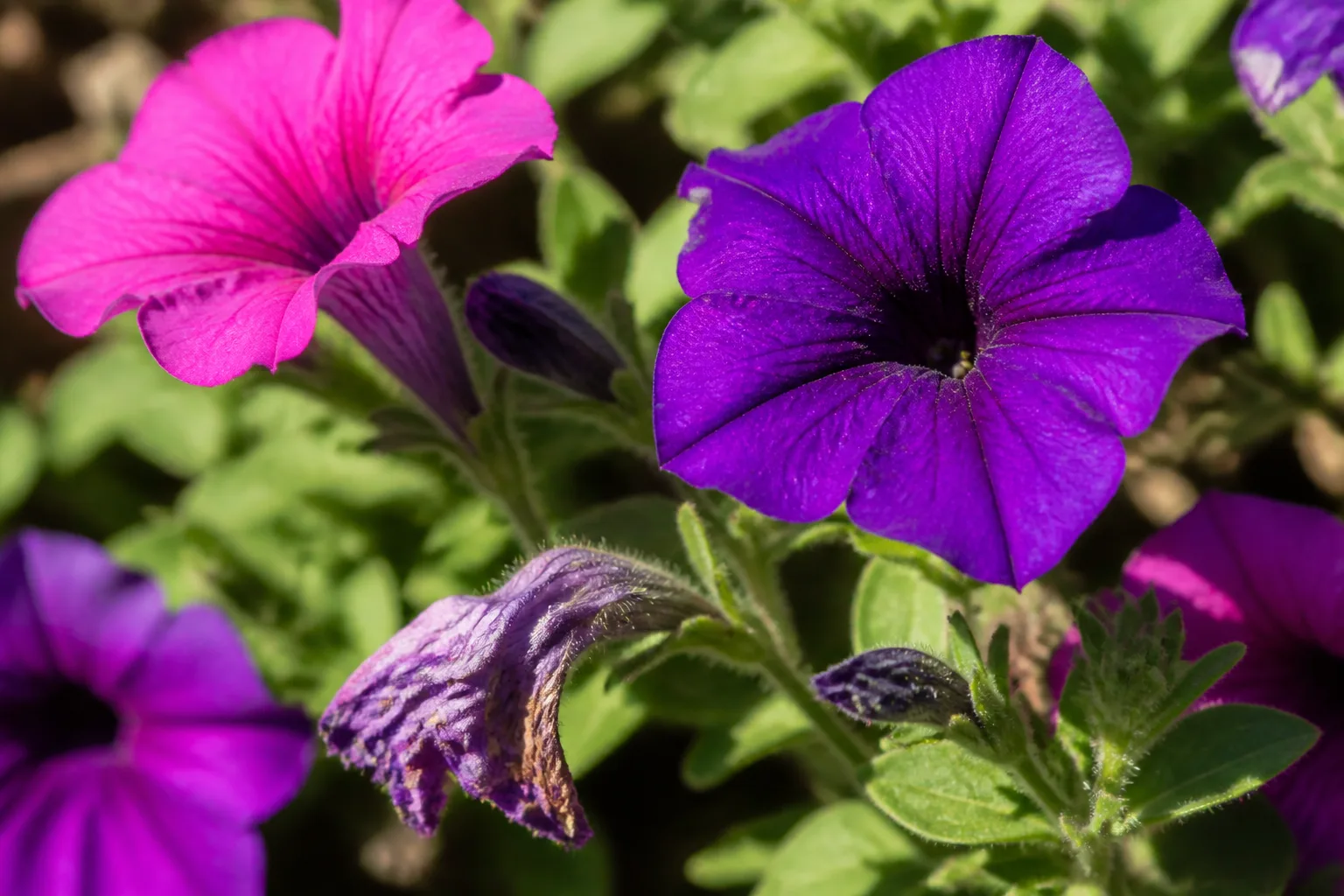
Start with a flower that has truly finished. The petals may be faded, limp, rain-battered, or folded inward. Follow the flower down to the green base where it joins its slender flower stalk. Do not pull off only the colored petals; the green base can contain the reproductive portion that develops seeds.
The Gardening Know How deadheading walkthrough specifically advises removing the faded flower and the ovary beneath it. On a petunia, that means taking the whole spent flower structure rather than leaving a small green pod behind.
For a quick hand deadhead, hold the stalk just below the green base and pinch through it with a thumbnail. Remove the flower, its base, and the short stalk attached to it. If the stalk is tough, use sharp scissors or pruners instead of tugging hard enough to bend the branch.
For a cleaner cut, trace the thin flower stalk down to where it meets a leafy stem. Cut just above a healthy leaf pair or node, while keeping nearby unopened buds in place. The RHS guidance for bedding plants lists petunias among plants that can be pinched with finger and thumb, while Better Homes & Gardens’ petunia instructions recommends following the flower stalk to its base when using snips.
If you are moving from one plant to another, wipe soil and plant residue from your tools. Disinfect the blades when you have cut diseased tissue or suspect a problem, and allow them to dry before cutting healthy stems. Clean tools are especially helpful when plants are crowded in a container and stems touch one another.
Choose a frequency for your garden
Use the plant’s appearance to choose among three workable routines:
- Once a week: a sensible minimum for ordinary garden-bed petunias and plants that are blooming moderately.
- Every two or three days: the best compromise for a full container, a large-flowered variety, or a plant in peak summer bloom.
- Daily quick pass: useful for a showy hanging basket, a plant exposed to pounding rain, or a gardener who prefers removing a few flowers at a time. This should take minutes, not become an obligation to inspect every stem.
The RHS describes regular deadheading as removing flowers once they start to fade, with the exact timing depending on the plant. For petunias, the right schedule is the one that removes visibly spent flowers before they dominate the display while leaving fresh buds alone.
You can also use a percentage cue: if roughly one-quarter of the visible flowers are faded or stuck to the plant, it is time for a pass. That is not a scientific threshold; it is a practical visual trigger that keeps you from either cutting too early or waiting until the plant looks neglected.
Adjust the routine for containers, baskets, and beds
Petunias in a hanging basket usually deserve the most frequent inspection. They are exposed on all sides, produce a large number of flowers, and can dry faster than a garden bed. While watering, lift the stems enough to see inside the basket, where spent flowers and hidden seed-forming bases collect.
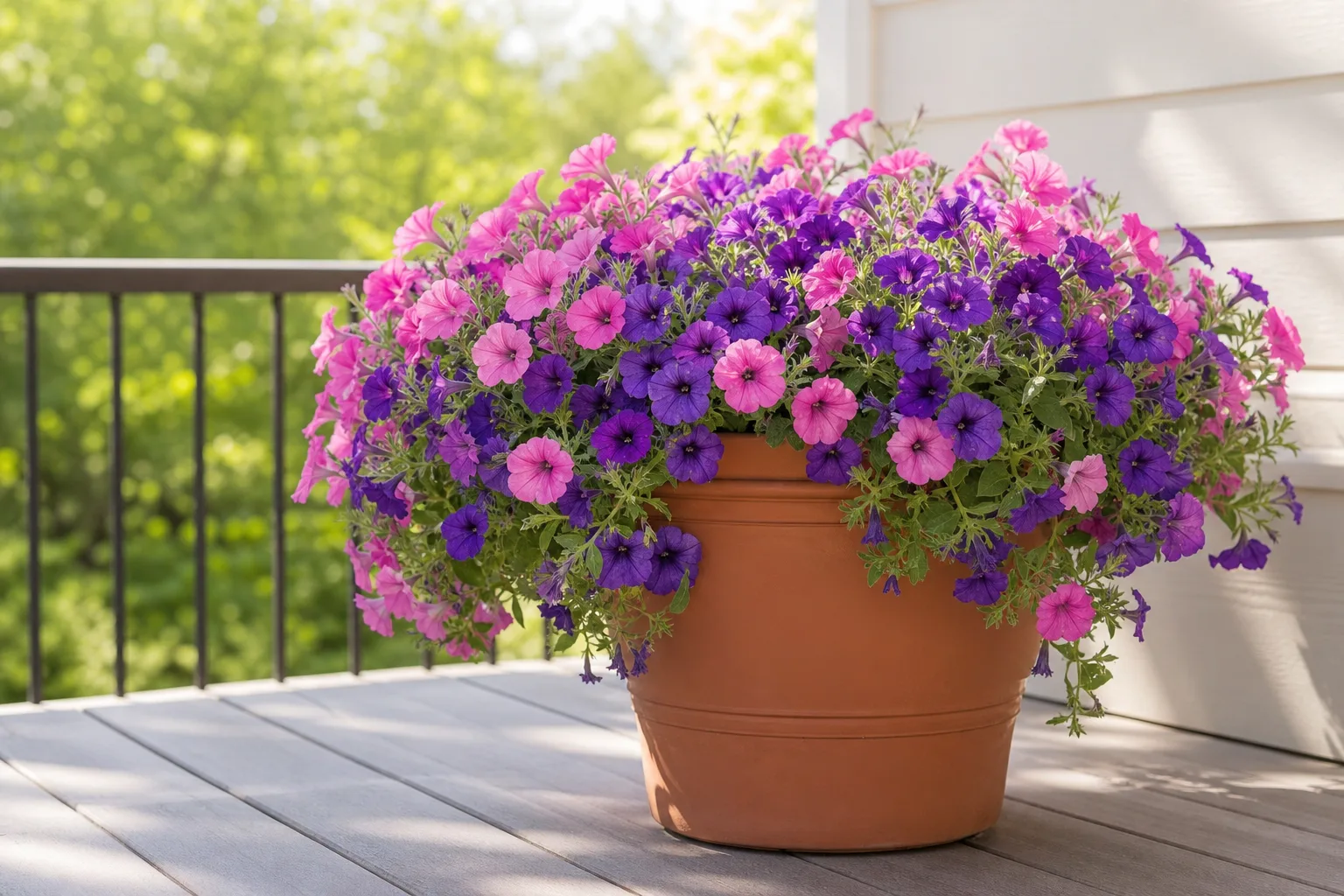
Petunias in a small container also dry quickly. A dry plant may stop producing new flowers even if you deadhead perfectly, so check soil moisture at the root zone rather than watering on a fixed weekday. Remove water from a saucer after the soil has drained; constantly soggy roots create a different problem from a missed deadhead.
Petunias in a garden bed generally need less frequent grooming because they have more root volume and the display is spread across a larger area. Walk the bed once or twice a week, remove the most obvious spent blooms, and accept that a few hidden flowers will remain. Neatness matters, but the plant does not require cosmetic perfection.
Rain changes the schedule in both directions. It can shorten the life of open flowers and leave petals stuck to foliage, so inspect after a storm once the plant has dried. Do not handle saturated plants more than necessary, and avoid spreading wet, damaged tissue around the canopy.
Deadheading versus trimming leggy petunias
Deadheading removes individual spent flowers. Trimming shortens live stems to restore branching, shape, and density. Confusing the two is one of the easiest ways to over-cut a petunia: a plant with a few dead blooms needs a few precise cuts, while a plant with long, bare stems may need a planned haircut.
If the stems have stretched and flowers are concentrated at their ends, first check light and moisture. Then trim selectively, shortening the longest stems just above a healthy leaf node. A light trim of about 15 to 20 percent is a conservative starting point for a self-cleaning or trailing petunia; if a conventional plant is severely leggy, a larger midseason cut may be appropriate, but expect a short pause before the next flush.
Do not shear through a mass of unopened buds just to make the plant symmetrical. The Proven Winners guidance treats trimming as a separate occasional task, and Better Homes & Gardens likewise describes cutting back a leggy plant as a larger intervention than removing a single flower.
Give petunias the conditions that support reblooming
Light, water, and weather
Petunias flower best with substantial direct light. Aim for roughly six hours of sun when your climate allows, while watching for heat that makes containers dry abruptly. UF/IFAS lists full sun and well-drained soil kept moist as core conditions, and Proven Winners gives six hours of direct sun as an ideal target for Supertunias.
Water deeply enough to moisten the root zone, then allow the surface to begin drying before watering again. Containers and baskets may need water much more often than beds in hot, windy weather. The finger test—checking the mix below the surface instead of judging only by its appearance—is more reliable than a calendar.
Heat waves, cold nights, prolonged rain, and high humidity can all reduce flower quality. A stressed plant may need several days of stable conditions before it resumes strong growth. If a petunia is wilting at midday but the soil is wet, do not respond with more water; check drainage, root health, and air movement instead.
Feeding for a long container season
Containers hold a limited amount of root-zone nutrition, and repeated watering can move soluble nutrients through the drainage holes. A balanced fertilizer used according to its label can help support a long flowering season, especially in baskets and small pots. Avoid assuming that more fertilizer will replace missing sunlight or correct a waterlogged root zone.
UF/IFAS recommends monthly balanced fertilizer or a controlled-release product for its regional petunia guidance, while container-focused recommendations from Better Homes & Gardens and Proven Winners use more frequent feeding for actively growing potted plants. The difference reflects the growing setup and product, not a reason to stack schedules. Choose one label-directed program and reduce feeding when growth slows or temperatures fall.
Troubleshoot a petunia that still is not blooming
If deadheading has not improved flowering after a couple of weeks, stop removing more stems and check the basics in order. Look at the plant’s light exposure, feel the soil below the surface, inspect drainage holes, and ask whether the container has been fed during a long growing season.
Too little light produces stretched stems and fewer buds. Repeated drying can cause bud drop or a pause in flowering, while constantly wet soil can damage roots and leave the plant unable to support new growth. In a very hot climate, afternoon protection may prevent collapse, but too much shade can also reduce the energy available for flowers.
Look closely at unopened buds and the undersides of leaves. Chewed or missing buds point to a pest problem rather than a deadheading problem. Sticky leaves, distorted new growth, stippling, or webbing call for separate pest identification; cutting more flowers will not address the cause.
Also check whether the plant is simply a self-cleaning cultivar. If old flowers disappear but new buds continue, there may be no maintenance problem at all. A light trim for shape can be useful later, but do not turn a naturally self-cleaning plant into a daily deadheading project.
Common deadheading mistakes
Removing petals but leaving the base. The green part below the petals is easy to miss, but it is the part worth removing when the goal is to interrupt seed development.
Cutting fresh buds with every spent bloom. Petunia buds can sit close to old flowers. Work one bloom at a time and cut only the stalk you can identify.
Using a weekly rule as a rigid requirement. Weekly is a baseline, not a deadline. A rainy week may call for a check sooner; a cool, quiet week may not.
Calling a haircut deadheading. Removing a third of the plant is pruning. It can be appropriate for leggy growth, but it is not necessary every time you see a spent flower.
Expecting deadheading to fix every bloom problem. Poor light, uneven moisture, depleted container mix, pests, and temperature stress can all limit flowering.
Overwatering after a hot day. A wilted plant can be thirsty, but wet soil plus wilting suggests a root or drainage problem. Feel the mix before adding more water.
When leaving spent flowers is the better choice
Leave a flower when it is still attractive, when you are saving seed, or when the cultivar is known to be self-cleaning and continues producing buds. You can also leave a few blooms if you want the plant to develop seed rather than maximizing the current flower display.
It is also fine to leave a few hidden flowers in a large bed. The RHS notes that a delay of several days or even a week does not greatly change flowering performance for many plants. Deadheading should improve the way you garden, not make a low-stakes maintenance task feel like a daily test.
Remove promptly when a flower is diseased, slimy after prolonged wet weather, or trapped against foliage in a way that encourages decay. Bag suspicious diseased material rather than placing it in home compost, and clean your tools before moving to another plant.
A simple five-minute petunia routine
Once or twice a week, start at the outside of the plant and work inward. Remove the most obviously faded flowers, follow each stalk only as far as the first sensible leaf pair or node, and stop whenever a fresh bud is in the way.
As you work, check the soil moisture, look for stretched stems, and scan the undersides of leaves. If the plant is healthy but leggy, schedule a separate light trim; if it is dry, water the root zone; if it is not flowering despite good care, investigate light, nutrition, temperature, and pests instead of increasing the deadheading frequency.
This routine gives traditional petunias the regular attention they need while respecting the lower-maintenance habit of self-cleaning varieties. It also keeps the task small enough to continue through the whole blooming season.
Conclusion
For most petunias, check at least weekly and deadhead whenever flowers clearly fade. In a peak-bloom container or hanging basket, a quick check every day or two keeps the plant tidier; in a garden bed, a weekly pass is usually enough. Self-cleaning Wave and Supertunia types may need little or no individual deadheading, though they can still benefit from occasional shaping.
Remove the whole spent flower and its green base, protect unopened buds, and keep deadheading separate from trimming. If flowers still slow down, inspect light, water, feeding, weather, and pests—the plant needs more than clean stems to keep blooming.



