How to Keep Cats Out of Your Christmas Tree Safely
Anchor your tree, skip tinsel, and place ornaments where paws cannot reach. Five vet-backed ways to keep cats out of your Christmas tree this year.
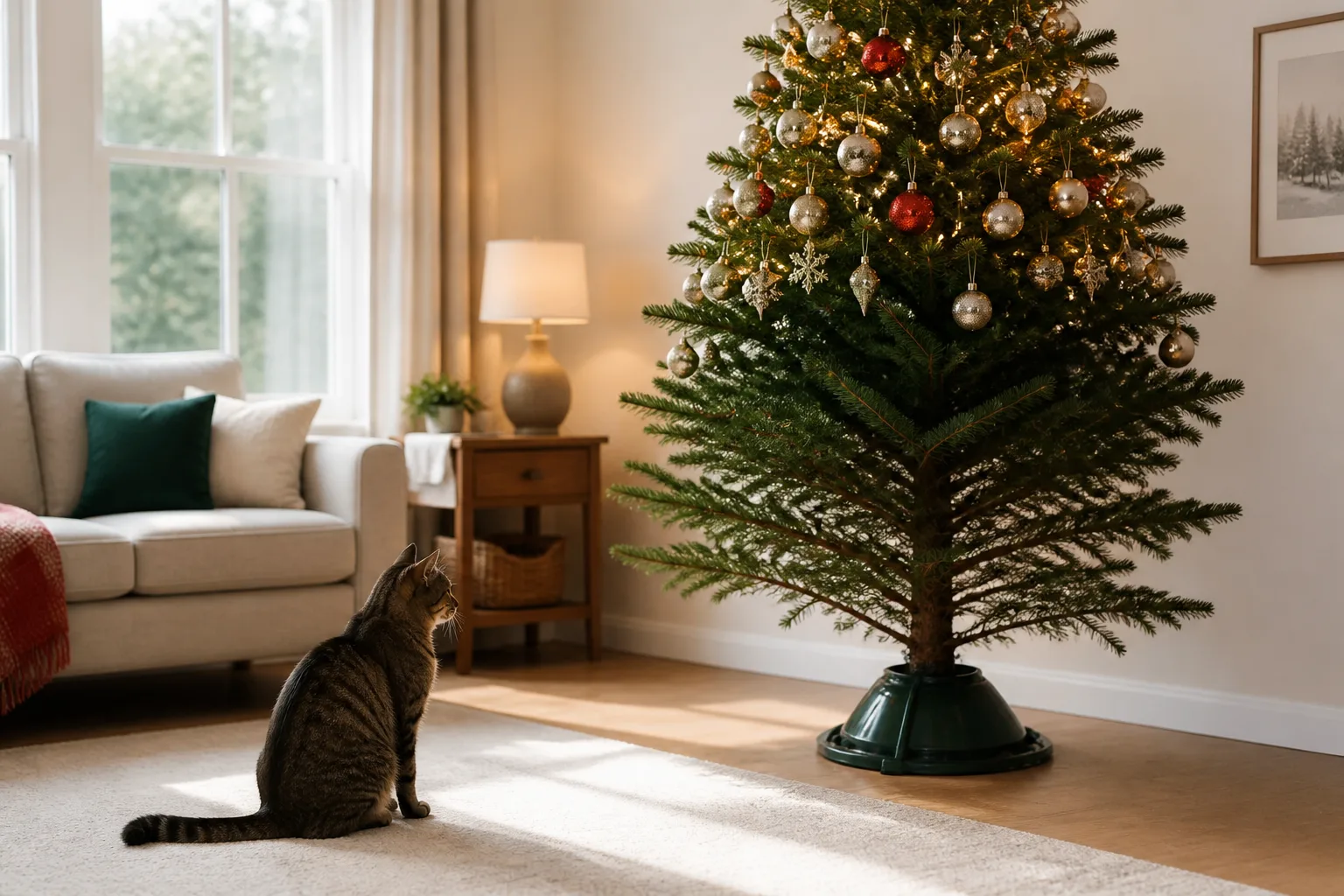
A Christmas tree is a vertical playground covered in dangling prey. Your cat is not being spiteful when they bat ornaments at 2 a.m. — they are doing exactly what a healthy indoor hunter does when something new, tall, and shiny appears in the living room. The goal is not to win a battle of wills. It is to make the tree boring, hard to reach, and physically stable while giving your cat better outlets for the same instincts.
These five methods work as a stack, not a menu. Anchor first, then place, then decorate, then block the trunk, then redirect energy. Skip a layer and the tree will still look like fair game.
Why Your Cat Treats the Tree Like a New Climbing Gym
Novelty, Height, and Prey Drive in One Package
Cats explore vertical space. A floor-to-ceiling tree with swaying branches offers height, hiding spots, and movement — the same features that make a cat tree appealing. Add glass balls that spin when swatted and you have a prey simulator running 24 hours a day.
Most tree attacks spike in the first week after setup. The tree is new, smells different (especially with a live cut tree), and your cat has not yet learned that it is off limits. That window is when placement and anchoring matter most, before climbing becomes a habit.
Hazard Checklist: What Can Actually Hurt Your Cat
Tinsel, Needles, Tree Water, and Live Wires
Keeping cats out of the tree is not only about saved ornaments. Several common holiday setups carry real medical risk.
Tinsel and long ribbon are among the most dangerous decorations for cats. The ASPCA warns that ingested tinsel can cause severe vomiting, dehydration, and intestinal obstruction that may require surgery. Thin string-like material can anchor under the tongue while the rest moves through the gut — a linear foreign body that can cut through intestinal tissue.
Tree needles from fir, spruce, and pine are mildly toxic when chewed, mainly because of sap and oils. PetMD notes that a large ingestion can irritate the mouth and stomach, and fallen needles can contribute to gastrointestinal obstruction. Call your veterinarian or the Pet Poison Helpline if your cat eats needles.
Tree water is easy to overlook. Cats drink from the stand. Preservatives, fertilizers, and sugar substitutes — especially xylitol — can cause illness ranging from stomach upset to seizures and organ damage. The ASPCA recommends covering the stand so pets cannot reach the water. Bacteria also grow quickly in standing tree water and can cause nausea and diarrhea.
Lights and cords deliver electrical shock if chewed. Use cord protectors, battery-operated lights where practical, and keep plugs behind furniture. Broken glass ornaments add mouth lacerations and intestinal injury on top of the mess.
Run light strings tight along inner branches rather than draping loops at cat eye level. Unplug the tree when you leave home if your cat has ever chewed cords — battery-operated LED sets remove the wall plug entirely and are worth the swap in high-risk households.
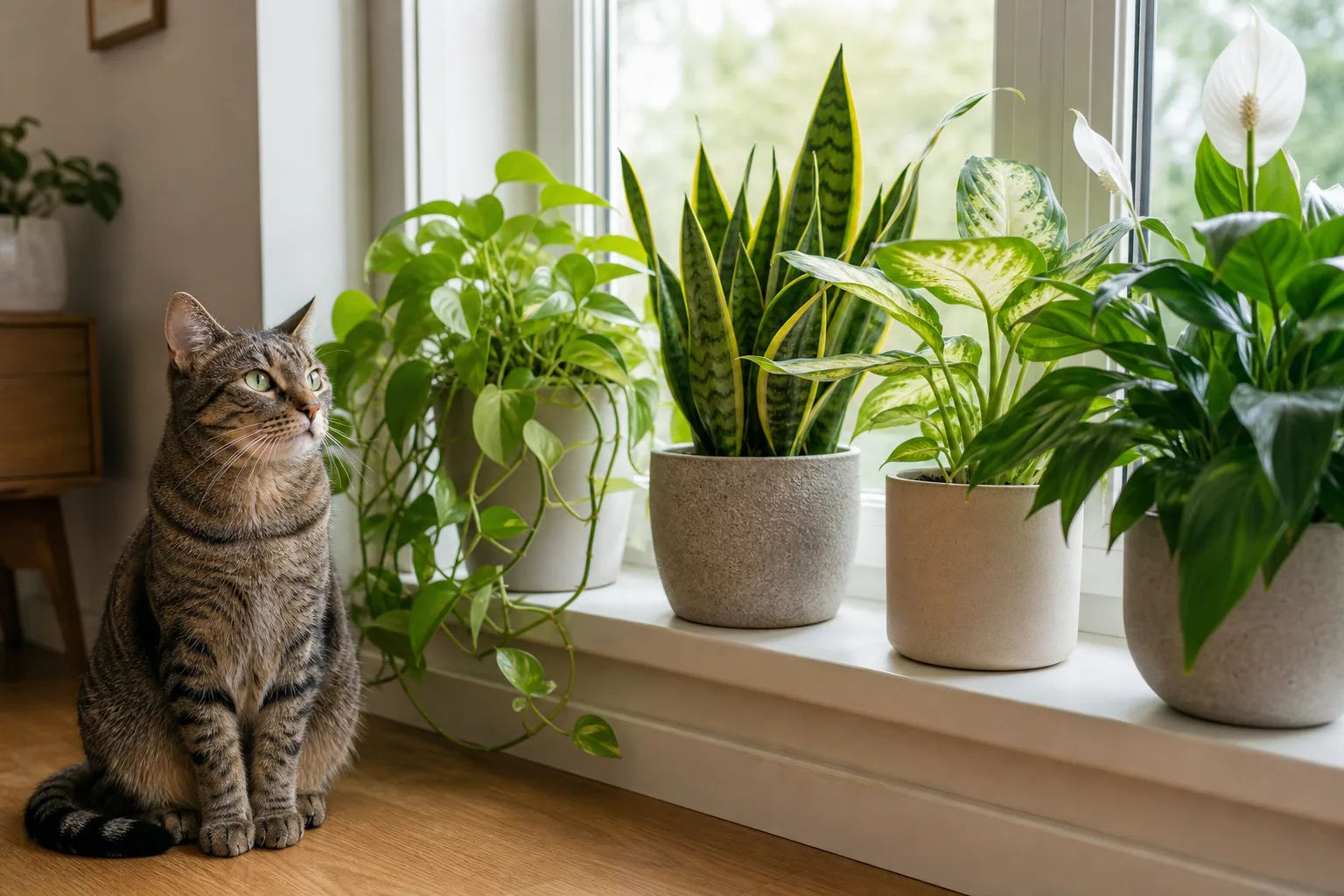
If you keep houseplants year-round, review toxic plants for cats separately — poinsettia, holly, mistletoe, and lilies on holiday bouquets carry their own risks beyond the tree itself.
Real Tree or Artificial Tree With Cats?
Neither option is automatically safe. Live trees shed needles, need water in an open stand, and may carry pesticide residues from tree farms. Artificial trees remove water and needle-drop problems but still offer climbable branches and shed plastic or flocking if chewed.
Low-shed varieties such as Nordmann fir (NC State Extension) drop fewer needles than some traditional choices, which means less floor debris for cats to chew. If your cat is a chronic chewer, an artificial tree plus daily needle sweeps under a live tree is often the less stressful compromise.
Whichever you choose, the five methods below still apply. A fake tree does not solve tipping, tinsel, or ornament hooks.
Artificial trees suit owners who want zero tree water and minimal needle cleanup. Look for tightly woven branches that do not leave large gaps a kitten can wedge into, and avoid heavily flocked trees if your cat licks surfaces. Live trees bring scent and tradition but need daily needle vacuuming and a covered stand from day one.
Some cat owners split the difference: a small tabletop tree in a closed room for display and a larger bare tree in the living room only after the cat has passed the first-week training sequence below.
Way 1: Anchor the Tree So a Jump Cannot Tip It
Weighted Stands, Wall Ties, and Low Center of Gravity
A cat that lands mid-tree applies force several feet above the base. A lightweight stand on carpet is a tipping machine waiting for its first pounce.
Start with the stand. Use a stand rated for your tree height and trunk diameter, then add weight. Some owners slide gym plates or sandbags onto the stand legs; others choose stands with built-in water reservoirs that double as ballast. Fill the reservoir fully on live trees — empty stands are top-heavy.
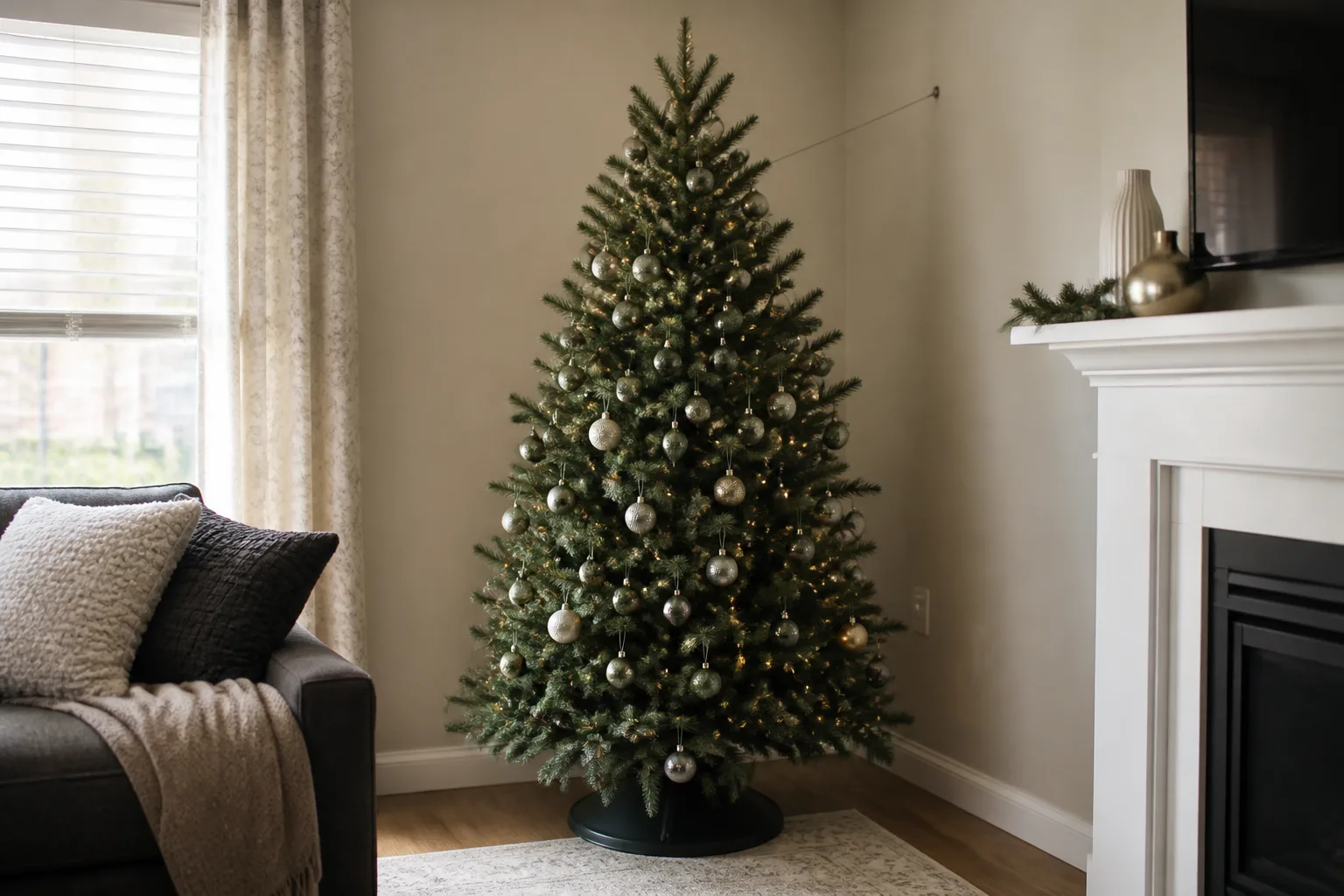
Tie the tree to the wall or ceiling. A clear fishing line or thin cable from the upper trunk to a wall hook or ceiling eye screw stops tip-over even when the tree flexes. Position the tie high enough that it is invisible behind the star but low enough to catch lateral sway. Two ties at different angles work better than one.
Keep the tree short if you must. A 6-foot tree on a sturdy base survives cat traffic better than a 9-foot tree that reaches the ceiling fan. Trimming the trunk before setup lowers the center of gravity.
Blue Cross recommends securing the tree firmly so it cannot fall on a pet. A fallen tree can fracture bones and crush cats under branches and a heavy stand.
Way 2: Place the Tree Away From Launch Zones
The Two-Foot Rule and Furniture Mapping
Cats rarely climb a tree from a standing start on open floor. They jump from couches, shelves, windowsills, and railings onto mid-branches.
Walk the room before you set the stand. Mark every surface within about two horizontal feet and one vertical leap of the planned tree spot. Move the tree until no launch pad sits within easy range. In tight living rooms, that may mean pulling the tree away from the sofa even if the corner was your first design choice.
Corners can help because they limit rear access, but a corner beside a side table is worse than an open wall with no furniture nearby. Block unused launch paths with temporary furniture shifts for December if needed.
Avoid high-traffic cat highways. If your cat sprints the same path from kitchen to bedroom every evening, do not put the tree on that route. Novelty plus motion equals a chase target.
Measure before you commit. Tape a circle on the floor where the stand will sit, then walk your cat’s usual routes for a day. You will notice perches you forgot — the back of a recliner, a windowsill behind curtains, a bookshelf beside the TV. Each one is a launch pad if it sits within jumping distance.
Rentals and open floor plans make this harder. When you cannot move furniture far, angle the tree so the most tempting branch faces a blank wall instead of the sofa. A tree skirt alone does not block jumps; distance and anchoring do.
Way 3: Decorate With Cat-Safe Ornaments Only
The Bottom-Third Rule and Tinsel Alternatives
Assume your cat will reach the lower branches at least once. Decorate accordingly.
Leave the bottom third bare or hang only soft, unbreakable ornaments — felt, fabric, wood, or thick plastic shatterproof balls. No glass on the lower half, period. Move heirloom glass higher, near the trunk, where branches are stiffer and harder to bat.
Skip tinsel entirely. It is light, moves like prey, and causes some of the most expensive emergency surgeries of the season. Use wide fabric ribbon looped loosely on upper branches if you want shine, or paper garlands that are less appealing to swallow.
Replace metal hooks with ribbon loops tied to branches. Hooks detach when batted and become swallow hazards. Wired ornaments should be twisted firmly onto branch tips so they do not spin freely at eye level.
Fake snow spray and edible salt-dough ornaments belong off the tree in cat homes. Fake snow may contain chemicals; salt dough can cause dangerous sodium imbalances if eaten, per ASPCA holiday guidance.
For year-round plant safety beyond December, see non-toxic plants for cats and low-light plants safe for cats when you refresh indoor greenery after the holidays.

Way 4: Change Texture at the Trunk and Base
Burlap, Foil, Skirts, and Covered Tree Wells
Cats explore with paws and mouths. Changing what the trunk and stand feel like can reduce interest without sprays that stain carpet.
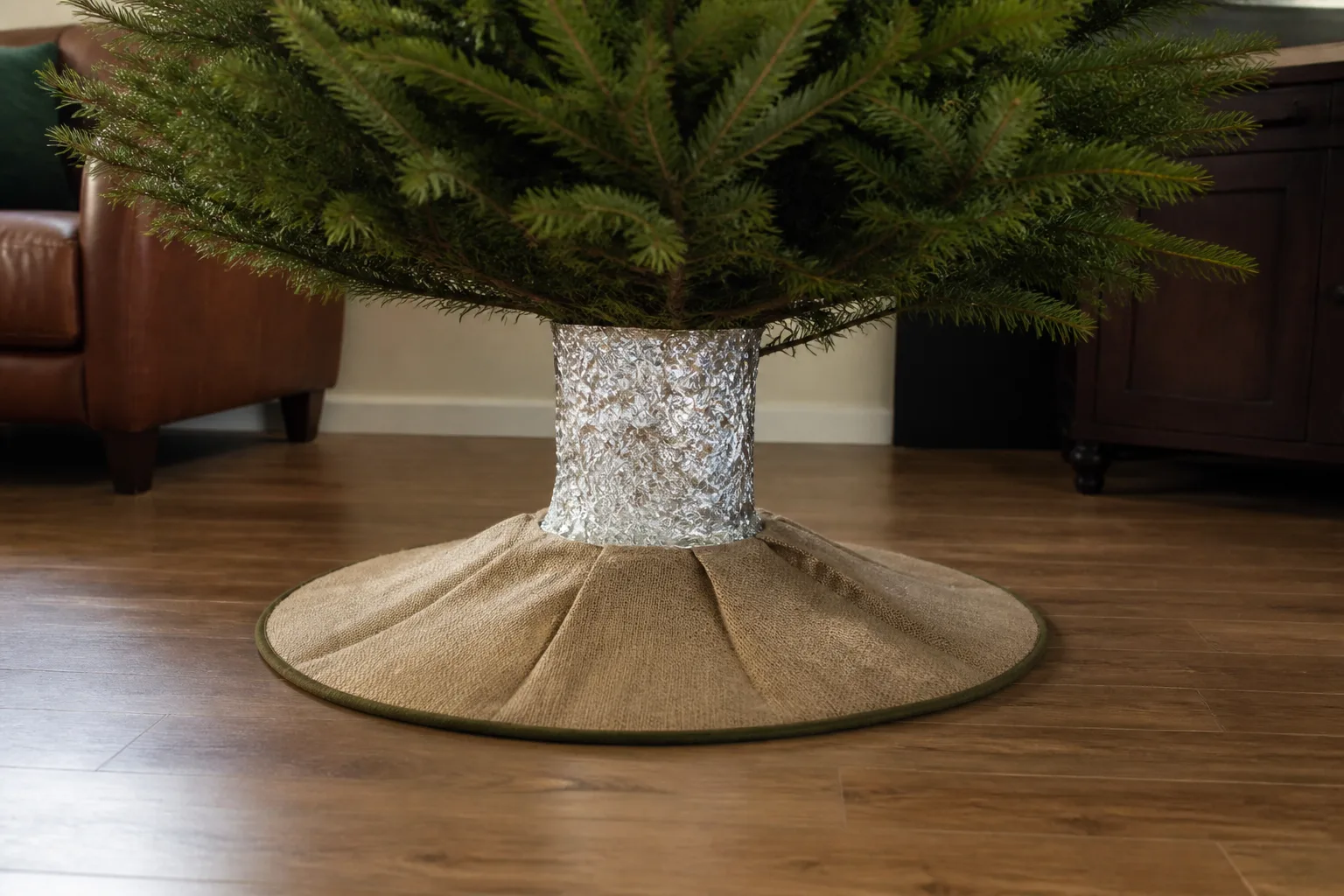
Wrap the trunk in burlap, jute webbing, or a layer of aluminum foil from the stand to the first branches. Many cats dislike foil’s crinkle and slick feel under claws. Burlap doubles as rustic decor and hides cords running up the trunk.
Cover the tree well completely on live trees. A fitted tree skirt over a rigid cover on the water bowl stops drinking and keeps paws out of stagnant water. Weigh the skirt edges so it cannot be burrowed under.
Use a tree collar or box around the stand to block access from below. Some owners build a simple plywood box with a center hole — stable, coverable, and heavy enough to add anchoring weight.
Scent deterrents can supplement texture. Citronella and citrus oils are irritating to cats but can be toxic if ingested; use commercial cat-safe deterrent sprays on the skirt or floor mat around the base, not on ornaments your cat might lick. Reapply after vacuuming.
Texture tricks alone rarely work on a determined climber. Pair them with anchoring and placement.
Way 5: Redirect Boredom Before It Hits the Branches
Toys, Scratchers, and Scheduled Play
Many tree raids are boredom with extra glitter. A cat that has already hunted, climbed, and scratched elsewhere has less drive to invent a new sport at midnight.
Add a tall scratching post near — but not touching — the tree before you decorate. Redirect clawing to sisal when the trunk wrap is off limits.
Rotate interactive toys during tree setup week: wand toys, treat puzzles, and cardboard scratchers refreshed daily. Ten minutes of structured play before you hang lights burns the same energy that would otherwise go into branch shaking.
Introduce the tree in stages. Set up the bare tree for two or three days before adding lights, then ornaments over another few days. Supervise the first encounters. A spritz of water or a calm “no” is less useful than tossing a toy the other direction when you see stalking behavior.
Consider timed feeders for cats food-motivated enough to choose kibble over ornaments. A puzzle meal during your decorating session keeps paws busy.
Build a predictable play schedule during December: two short wand-toy sessions daily, one before you leave for work and one before bed. Cats that have already stalked, pounced, and caught a toy are less likely to treat ornaments as substitute prey at midnight.
Cardboard scratchers refreshed weekly give an approved shredding outlet. Place one in the same room as the tree but farther from the trunk than the scratching post, so your cat has two legal textures besides bark and foil.
Enrichment does not mean unlimited treats. It means predictable outlets so the tree stops being the only interesting thing in the room.
When a Gate or Closed Room Is the Right Answer
Some cats — kittens, newly adopted cats, and high-energy climbers — will defeat every hack. That is not a training failure. It is biology meeting physics.
A tall pet gate across the tree room doorway, or keeping the tree in a room with a closable door, is the safest option when:
- Your cat has already chewed lights or eaten tinsel in a past year
- You cannot anchor to walls in a rental
- You work long hours and cannot supervise a newly set-up tree
PetMD advises that if safety-proofing fails, excluding the cat from the tree room is better than repeated emergency visits. You can still enjoy the tree through a glass door without risking linear foreign bodies or electrocution.
Small apartments sometimes fit a tree only in the living room where the cat spends all day. In that case, a tall adjustable gate with a cat door blocked off, or confining the cat to a bedroom with litter box and toys while you are at work, beats leaving an unsecured tree unsupervised.
First-Week Setup: Train the Tree Before the Ornaments
Use this sequence the first year you try a full mitigation stack — or any year you change tree type or room:
Day 1–2: Bare tree only, anchored and placed. Reward calm sniffing; redirect jumps with toys.
Day 3: Add lights, cords protected and trunk wrapped. Supervise evening checks.
Day 4–5: Hang unbreakable lower ornaments, fragile upper ornaments, no tinsel.
Ongoing: Vacuum needles daily on live trees, check wall ties weekly, and lower any ornament that migrates downward after cat traffic.
Repeating the same sequence each December retrains faster than surprising your cat with a fully decorated tree on a single afternoon.
What to Do If Your Cat Still Gets In
If you find your cat in the tree, do not yank them out by the belly — claws hook into branches and skin tears. Clap softly, offer a toy lure, or wait until they choose to back down.
After any incident, inspect for swallowed hooks, broken glass, chewed cord insulation, or missing tinsel strands. Vomiting, gagging, drooling, lethargy, or refusing food within 24 hours warrants an immediate vet call.
For suspected toxin or foreign material ingestion, contact ASPCA Animal Poison Control at (888) 426-4435 (fee may apply) or your emergency veterinarian. Bring a photo of the tree setup and any chewed material.
If climbing becomes nightly despite the full stack, move to a gated room rather than escalating punishment. Stress increases exploration in many cats, not less.
Conclusion
Keeping cats out of the Christmas tree is a layered safety project, not a single product purchase. Anchor the tree so it cannot fall, place it beyond jump range, decorate the lower branches as if your cat has already won, block the trunk and water, and tire your cat out before the ornaments go on. Skip tinsel, cover tree water, and protect every cord.
Most households find a workable balance with those five methods. The ones that do not are still succeeding when they choose a closed room over a midnight ER visit. Your cat can have a calm holiday — and you can keep the tree upright — when the setup respects how cats actually behave, not how we wish they would.



