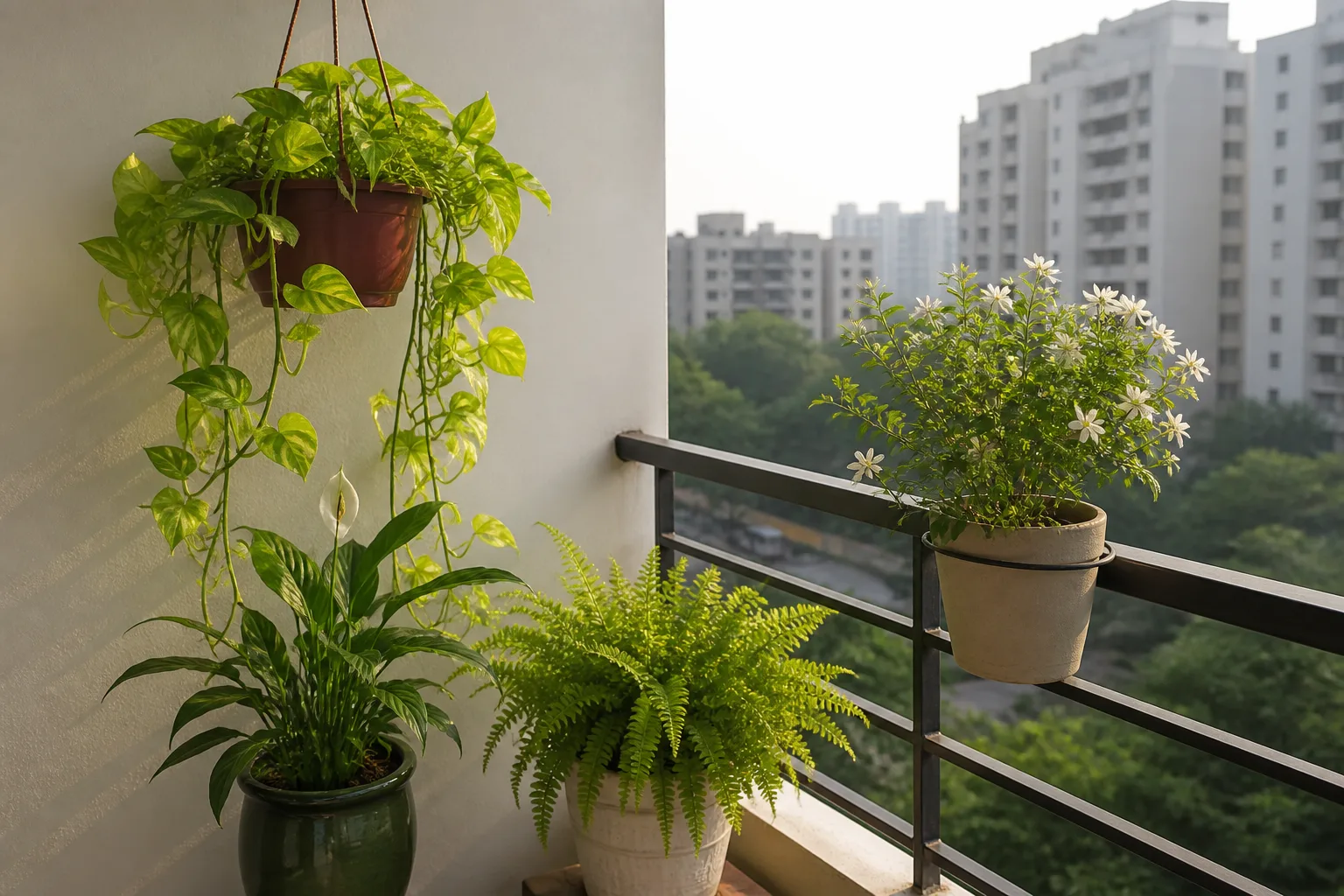
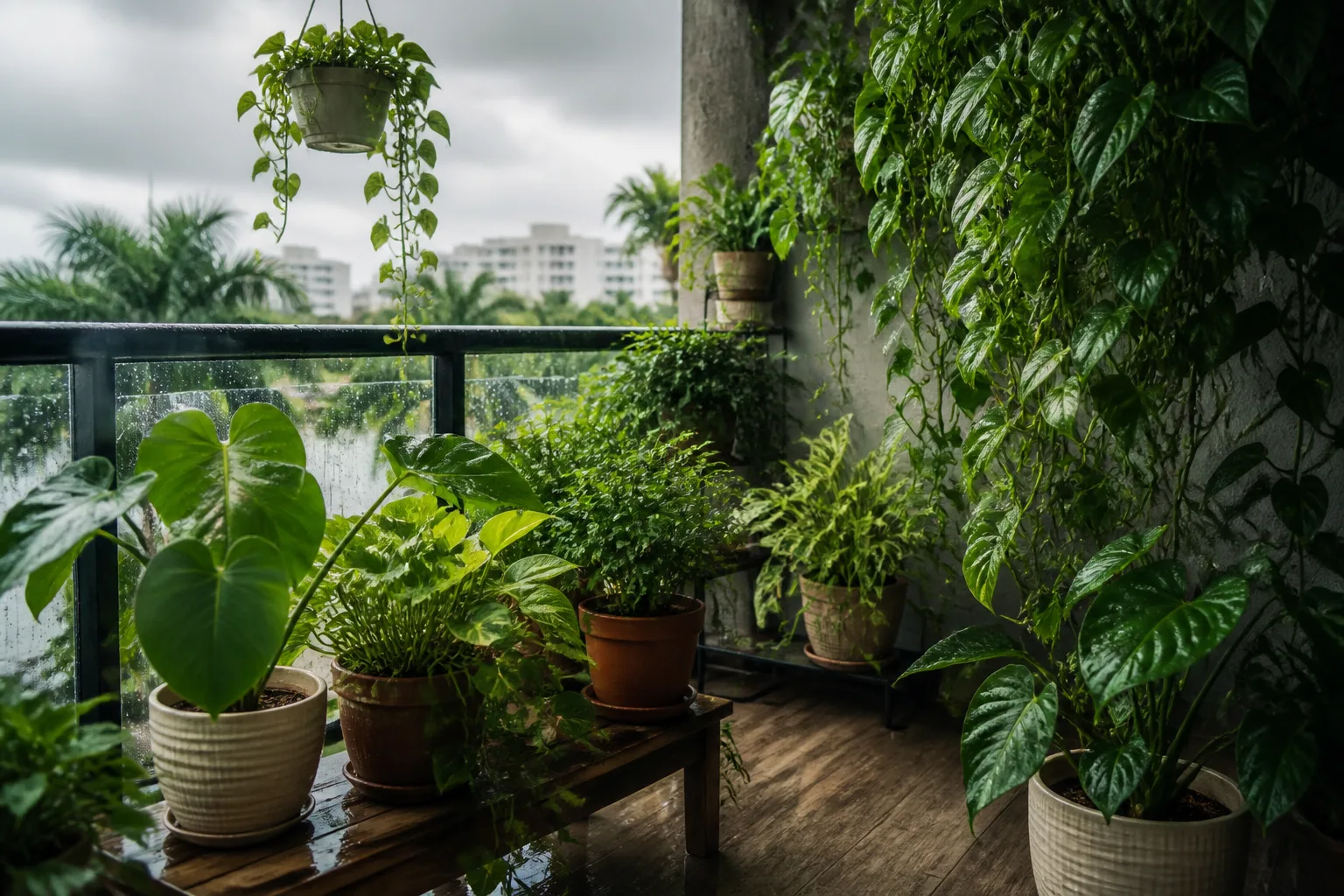
Low-Light Plants for Indian Flats and Apartments
Eight low-light plants for Indian flats — north rooms, tower shade, AC — with situation shortlists, monsoon watering, and pet flags.
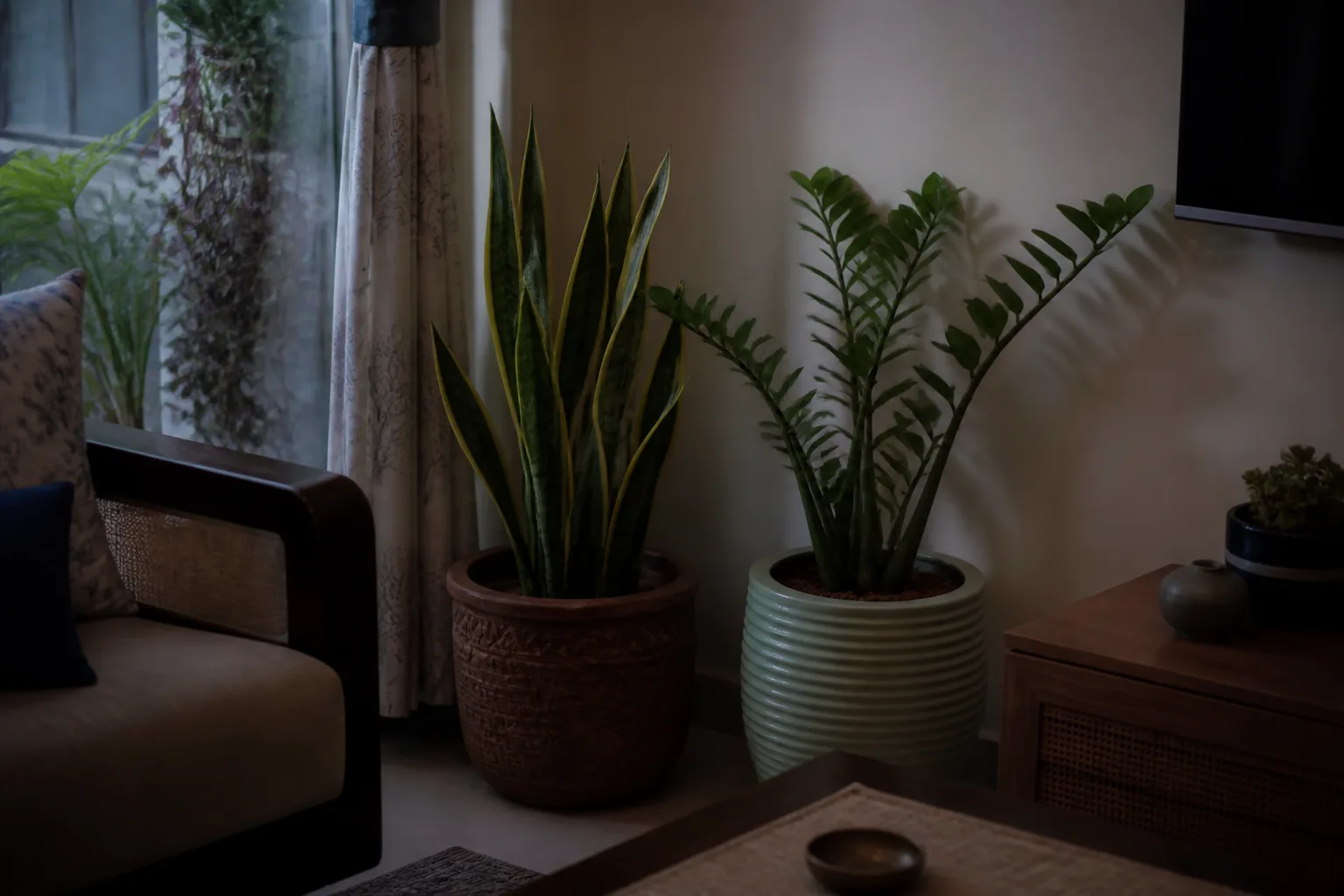
Buy a plant labeled for “bright indirect light,” park it in a north-facing Indian 2BHK, water it every Sunday — and watch it stretch, fade, then rot. The nursery tag described a soft sun patch near a bright window. Your flat may only offer sky brightness between towers, a shaft window, or a bedroom that sees daylight around AC outdoor units. That is real low light, not a balcony sun problem and not a windowless bathroom with no grow light.
This shortlist is for dim Indian apartments — north rooms, hallway corners near a window, AC offices, and sills that never get a strong sun patch. For foot-candle ranges, shadow tests, and a broader dim-room list, use best low-light indoor plants. For heat-and-light across whole homes, see indoor plants for India. Here the question is narrower: which inventory plants still look intentional when the flat never delivers a bright window patch.
The eight picks are snake plant, ZZ plant, golden pothos (money plant), aglaonema, syngonium, cast iron plant, peace lily, and spider plant. They are not interchangeable — some survive deep shade, some only look good at the brighter edge of “low,” and several are toxic if pets chew them.
Written by Sai Ananth (LeafyPixels lead writer; grows money plant, snake plant, and ZZ plant in Indian apartment rooms) and reviewed by Dr. Priya Menon (botanist and indoor plant specialist, LeafyPixels Editorial Review Board) on 2026-08-02.
What Counts as Low Light in an Indian Flat
University of Georgia Extension treats light as the first limiting factor indoors and notes that north-facing windows give the least light and heat year-round. A northern sill can sit near 200 foot-candles on a clear winter day — usable for some green foliage plants, harsh for variegated showpieces that need stronger light to keep their pattern. (UGA Extension)
In Indian apartments that physics meets local layout:
- North-facing living rooms and bedrooms with one window onto a shaft or neighboring wall
- East or west windows that never “feel” bright because eaves, grille work, or the next tower cut the beam
- AC-cooled rooms that feel comfortable to you but dry leaves and slow soil dry-down in dim corners
- Monsoon months when outdoor light softens and humid air keeps potting mix wet for days
“Bright indirect” usually means a plant could sit near a bright window without harsh midday sun on the leaf. Low light means soft ambient brightness — enough to cast a faint shadow at noon, not enough to grow a monstera or rubber plant well. If you cannot see a soft hand shadow at plant height during the brightest hour, you are in survival-only territory even for snake plant and ZZ plant.
UGA also links low light with overwatering as the most common indoor stress pair: plants make less sugar, use less water, and rot when soil stays wet. (UGA Extension) Clemson Extension’s rule still applies — water by soil moisture, not by calendar. (Clemson HGIC)
How These Plants Were Selected
Only plants from the LeafyPixels inventory with live /plants/ hubs were considered. Criteria:
- Documented low-light or deep-shade tolerance from extension sources (not Instagram “thrives anywhere” claims)
- Realistic pot culture in Indian flats (nursery availability, AC rooms, small footprints)
- Distinct role (corner survivor, trailing shelf plant, color, flowering, pet-safer option)
- Honest “thrive vs tolerate” note for north-facing and tower-shade rooms
- Clear India-season caveat (monsoon wet soil, summer AC dryness, tip burn from hard water where relevant)
Excluded on purpose: monstera and fiddle-leaf types that get leggy without bright light; sun-loving balcony plants; heavily pink/white variegated cultivars that go green or sparse in true low light.
Species biology and toxicity come from US extension and ASPCA sources. India flat placement, monsoon dry-down intervals, and AC-room observations below are editorial synthesis from Indian apartment growing practice — they are not claims that NC State or UGA pages are Indian climate authorities. Monsoon calendar timing is cross-checked against the India Meteorological Department: southwest monsoon normally sets in over Kerala around 1 June and usually covers the country around 15 July. (IMD)
Observed in Indian Flats (Case Notes)
These are illustrative apartment notes used while building this shortlist — not lab trials. Pot sizes and intervals vary with mix, pot material, and how hard the AC runs.
| Setting (illustrative) | Noon shadow test | Plants that held | Watering pattern observed |
|---|---|---|---|
| North bedroom, mid-rise tower, AC most evenings (Bengaluru-style) | Faint hand shadow 1–2 m from sill | Snake plant in 15–20 cm pot; ZZ on floor away from vent | Snake plant often 3–4 weeks between waterings in monsoon; shorter gaps only when mix was bone-dry deep |
| Shaft-facing living shelf with sky brightness (Mumbai-style) | Clearer shadow on sill, none in room center | Green money plant trail; silver aglaonema on side table | Money plant: water when top half of mix dry; empty saucer same day |
| Dry inland AC flat, hard municipal water (Delhi NCR-style cue) | Soft shadow near north window | Spider plant hung nearer sill; cast iron in darkest usable corner | Tip burn on spider plant common; lengthen intervals in AC + empty saucers |
West balconies and terrace heat need a different list — start with balcony plants for Indian summer, not this page.
Start Here by Flat Situation
Skip the full cards if you already know your room:
- Darkest north bedroom / hallway with a window: snake plant, ZZ plant, cast iron plant
- Shelf near a north sill (soft daytime brightness): golden pothos, syngonium, spider plant
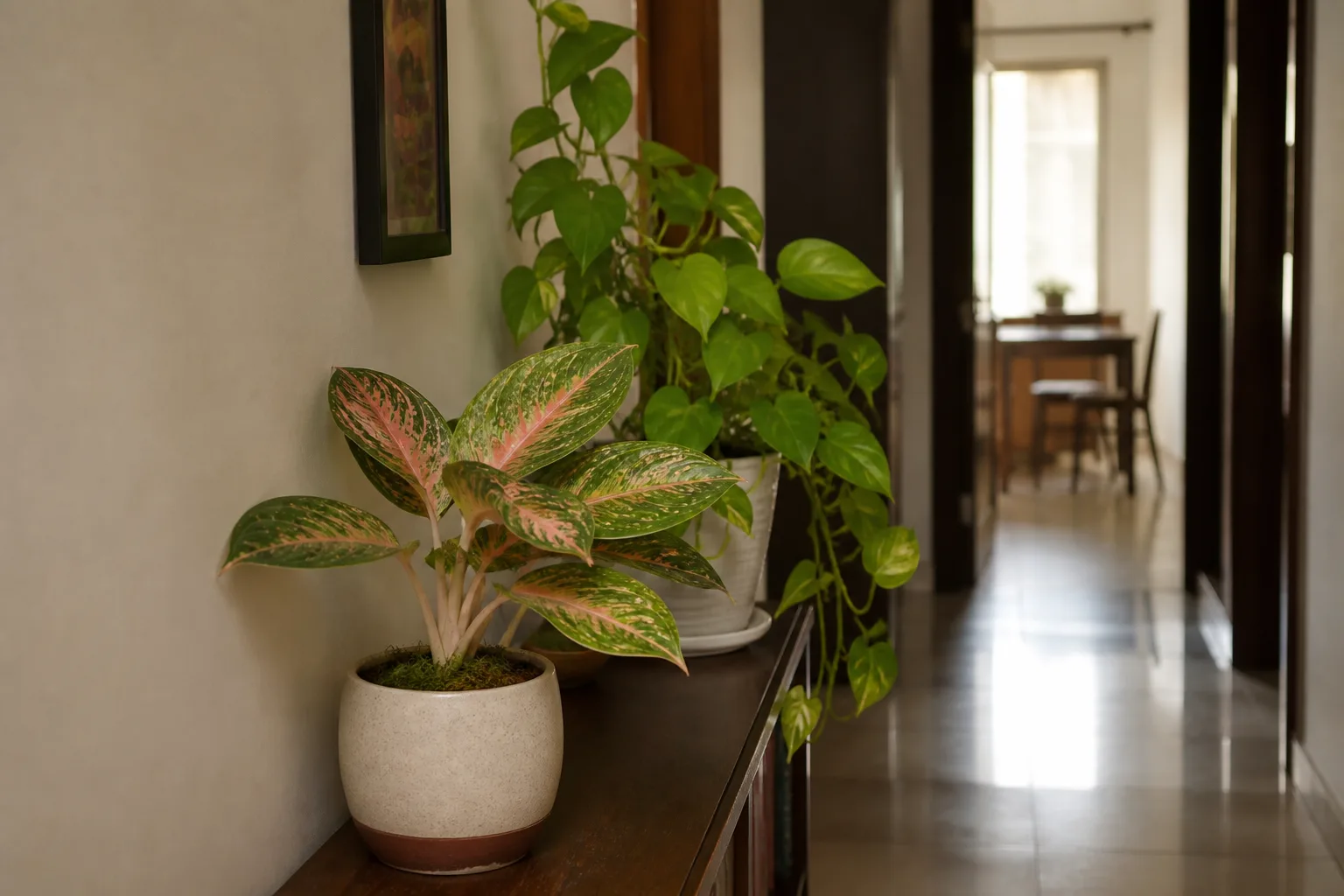
- Want leaf color without a bright balcony: green or silver aglaonema
- Want flowers in a dim living room: peace lily closer to the window (roughly within 1–1.5 m of a north sill), not the far wall
- Pets that chew: prioritize spider plant and cast iron plant; keep aroids, snake plant, and ZZ off the floor — confirm species against ASPCA before floor-level placement, and call a vet or ASPCA Animal Poison Control if ingestion is suspected
- Often away / forgetful watering: snake plant and ZZ plant
- Monsoon-prone overwaterers: snake plant, ZZ plant, cast iron plant (not peace lily left in a saucer)
Quick Comparison: Role, Light Floor, Water, Pet Risk
| Plant | Best for | Light floor | Watering in dim rooms | Pot size | Best season note | Difficulty | Pet risk |
|---|---|---|---|---|---|---|---|
| Snake plant | Dark corners, bedrooms | Very low | Dry thoroughly | Small–medium | Easy year-round; less water in monsoon | Easy | Toxic (ASPCA) |
| ZZ plant | AC rooms, travel | Very low | Deep dry-down | Medium | Slow in deep shade; do not “help” with water | Easy | Toxic (ASPCA) |
| Golden pothos | Shelves, money-plant trails | Low–moderate | Top half dry | Small–medium | Faster near brighter sill | Easy | Toxic (ASPCA) |
| Aglaonema | Living-room color | Low | Slightly moist, not soggy | Medium | Green types hold better than pink flash | Easy | Toxic (ASPCA) |
| Syngonium | Tabletop, kitchen shelf | Low–moderate | Top inch dry | Small | Trim to keep juvenile arrow leaves | Easy | Toxic (ASPCA) |
| Cast iron plant | Deepest shade | Very low | Partly dry | Medium | Slow; patience required | Easy | Non-toxic (ASPCA) |
| Peace lily | Flowering foliage | Low–moderate | Moist, not swampy | Medium | Blooms less in deep shade | Easy–medium | Toxic (ASPCA) |
| Spider plant | Hanging / pet homes | Low–moderate | Dry top inch | Small–medium | Tip burn if hard water + dry AC | Easy | Non-toxic (ASPCA) |
Deep-Shade Survivors
1. Snake Plant
Best for: North bedrooms, dark corners, forgetful owners
Sunlight: Tolerates very low light; green forms hold better than high-contrast variegation
Water: Dry thoroughly between waterings
Difficulty: Easy
Snake plant (Dracaena trifasciata) is the default survivor when the flat never sees a strong sun patch. NC State Extension notes it tolerates very low light with careful watering and well-drained soil; overwatering is the usual kill shot. (NC State Extension) Penn State Extension agrees it tolerates low-light areas very well, and root rot follows soggy mix. (Penn State Extension) ASPCA lists snake plant as toxic to dogs and cats. (ASPCA)
Indian home care tip (editorial): In a dim AC bedroom during monsoon, expect many snake plants in 15–20 cm pots to want water only every few weeks — check deep in the pot, not the calendar. Empty saucers the same day.
Common mistake: Weekly watering because “indoor plants like moisture.”
Deeper care: snake plant watering · snake plant hub
2. ZZ Plant
Best for: AC living rooms, offices, weeks away from home
Sunlight: Survives very low / fluorescent light; grows better with bright indirect
Water: Allow soil to dry completely
Difficulty: Easy
ZZ plant (Zamioculcas zamiifolia) stores water in thick rhizomes. NC State notes it can grow in very low light, even fluorescent-only interiors, though it prefers bright indirect light. (NC State Extension) NC State also notes medium toxicity to cats and dogs; ASPCA includes ZZ among houseplants that can cause trouble for pets. (ASPCA)
Put ZZ three metres from a north window when you still want a glossy upright shape. Growth will be slow; that is expected.
Indian home care tip (editorial): Pair with AC rooms where soil dries slowly. Do not “revive” a stalled ZZ with extra water.
Common mistake: Fertilizing and flooding a non-growing ZZ in deep shade.
Deeper care: ZZ plant hub · ZZ watering
3. Cast Iron Plant
Best for: The darkest usable corner that still gets daytime sky glow
Sunlight: Dense / heavy shade; intolerant of direct sun
Water: Regularly in warm months; sparingly when cool — never swamp
Difficulty: Easy (slow)
Cast iron plant (Aspidistra elatior) survives neglect and dense shade. NC State tags it for low light and heavy shade, including indoor pots. (NC State Extension) ASPCA lists it as non-toxic to cats and dogs. (ASPCA)
Availability in some Indian cities is spottier than money plant, but when you find it, it is the honest answer for a dim entryway that kills everything else.
Indian home care tip (editorial): Buy once, use free-draining mix, and leave it alone — a furniture-plant, not a weekly hobby.
Common mistake: “Encouraging” it with frequent fertilizer and water in a dark monsoon flat.
Deeper care: cast iron plant hub
Near-Window and Shelf Growers
4. Golden Pothos (Money Plant)
Best for: Shelves, hanging baskets, beginners who want visible growth
Sunlight: Low to moderate; solid green forms handle lower light better than heavy variegation
Water: Let the top half of the mix dry
Difficulty: Easy
In India this is usually sold as money plant. Botanically it is golden pothos (Epipremnum aureum). NC State tags it as heavy-shade tolerant, notes that low light can cause loss of variegation, and warns that root rot follows overwatering. (NC State Extension) ASPCA lists golden pothos as toxic to cats and dogs (insoluble calcium oxalates). (ASPCA)
Money plant fits when your flat is dim but not cave-dark — a shelf near a north window or a bookcase that gets sky brightness. Deep interior hallways with no window still stretch stems into sparse vines.
Indian home care tip (editorial): Prefer greener cuttings for the darkest rooms; save marble/neon types for brighter sills. During monsoon, check the pot, not the leaf.
Common mistake: Buying a neon cultivar for a north shaft window, then blaming “bad luck” when it reverts and goes leggy.
Deeper care: golden pothos hub · propagation
5. Syngonium (Arrowhead Vine)
Best for: Tabletops, kitchen shelves, compact Indian nursery staples
Sunlight: Bright shade to low-moderate indoor light; avoid harsh sun
Water: Dry the top inch between waterings
Difficulty: Easy
Syngonium (Syngonium podophyllum) is everywhere in Indian plant shops for a reason: juvenile arrowhead leaves stay compact, and the plant tolerates ordinary apartment light better than diva tropicals. NC State recommends avoiding full sun that burns or bleaches foliage. (NC State Extension) ASPCA lists arrow-head vine as toxic to dogs and cats (insoluble calcium oxalates). (ASPCA)
Indian home care tip (editorial): Pinch climbing stems if you want the juvenile arrow look on a desk. In monsoon, prioritize airflow and drainage.
Common mistake: Decorative pots with no drainage in a dim, wet room.
Deeper care: syngonium hub · syngonium watering
6. Spider Plant
Best for: Hanging planters, shelves, homes with pets
Sunlight: Prefers medium light; tolerates deep shade; intolerant of harsh direct sun
Water: Dry the top inch in low light
Difficulty: Easy
Spider plant (Chlorophytum comosum) prefers medium light yet can tolerate deep shade. NC State also notes fluoride/chlorine tip burn from some tap waters. (NC State Extension) ASPCA lists spider plant as non-toxic to cats and dogs. (ASPCA) TNAU Agritech lists Chlorophytum among good hanging-basket plants and reminds growers to match hanging displays to available light — flowering and variegated types need a spot nearer a window.
Indian home care tip (editorial): Hang it where it gets sky brightness from a north or east window. In peak AC months, brown tips are often water quality plus dry air — see hard water and houseplants.
Common mistake: Parking it in a closed balcony that gets afternoon glare through glass.
Deeper care: spider plant hub · spider plant light
Color and Flower Trade-offs
7. Aglaonema (Chinese Evergreen)
Best for: Living-room color without a bright balcony door
Sunlight: Excellent low-light foliage plant; deep shade to partial shade
Water: Keep lightly moist; never leave sitting in a saucer
Difficulty: Easy
NC State describes aglaonema as an excellent plant for low-light indoor locations. (NC State Extension) ASPCA lists Chinese evergreen as toxic to dogs and cats (insoluble calcium oxalates). (ASPCA) Silver-green types usually look more honest in dim Indian flats than flashy pink cultivars that need more light to keep color.
Place it where you can see the leaves from the sofa — a side table a few feet from a north window — not behind a curtain in a dead corner.
Indian home care tip (editorial): Wipe dusty leaves in dry AC season so the limited light you have reaches the leaf. UGA notes dust shades foliage and reduces usable light. (UGA Extension)
Common mistake: Treating pink aglaonema like a low-light miracle the same way as green forms.
Deeper care: aglaonema hub · aglaonema light
8. Peace Lily
Best for: A flowering foliage plant in moderate low light
Sunlight: Partial to deep shade; no direct sun — flowers better nearer the window
Water: Keep moist but not soggy; dry slightly between waterings
Difficulty: Easy–medium
Peace lily (Spathiphyllum) prefers partial to deep shade; NC State notes brown tips can come from excess sun, underwatering, or low humidity. (NC State Extension) ASPCA lists peace lily as toxic to cats and dogs. (ASPCA)
In Indian flats it is a better “living room near a north window” plant than a hallway end-table plant. Deep shade keeps foliage but cuts flowering. Aim for roughly within 1–1.5 m of a north sill if you want spathes; farther back is mostly green survival. AC tip burn is common — dry air and salts, not a need for daily misting rituals.
Indian home care tip (editorial): Water from below occasionally if the top crusts, then dump leftover saucer water. In monsoon, lengthen the gap even if leaves look soft — check the root zone.
Common mistake: Reading dramatic wilt as a demand for a permanently wet pot.
Deeper care: peace lily hub · peace lily problems
Fix a Leggy Money Plant This Week
If your money plant is all stems and small leaves:
- Move it to the brightest safe low-light spot you have (north sill shelf beats room center).
- Snip above a node and root cuttings in water or mix — greener forms for darker rooms.
- Stop calendar watering; let the top half of the mix dry.
- If noon at plant height still casts almost no shadow, add a small grow light instead of buying a fourth plant — see not enough light.
Indian Climate Care for Dim Rooms
Summer + AC. Cool air slows evaporation. Dim corners stay wet longer than a sunny sill even when the thermostat feels “dry.” Water less often than balcony plants. Keep foliage away from direct AC vents. For AC-room specifics, see indoor plants in air-conditioned rooms.
Monsoon. After onset (often from early June in Kerala, advancing north through July per IMD), outdoor light softens and humidity rises. (IMD) Clemson’s moisture-check approach matters most now: if the mix is still cool and damp at finger depth, wait. (Clemson HGIC) Empty saucers; fungus gnats love permanently moist low-light pots — see fungus gnats and monsoon houseplant care in India.
Hard water / RO. Tip burn on spider plant and peace lily is often water quality plus dry AC air, not a light deficiency. Flush pots occasionally — see hard water and houseplants.
Dust. Wipe leaves so scarce light is not blocked — especially aglaonema, peace lily, and money plant.
Expectation setting. UGA notes that under insufficient light, plants prioritize maintenance over growth; if light is too low for maintenance sugars, decline follows. (UGA Extension) A healthy low-light plant in an Indian flat often looks stable, not explosively leafy.
Coastal Humid vs Dry Inland AC Flats
Coastal humid cities (Mumbai, Chennai, Kochi cues) keep mix wet longer in monsoon — favor snake plant, ZZ, and cast iron if you overwater, and prioritize drainage holes. Dry inland flats with long AC seasons (Delhi NCR, Jaipur, inland Decuru cues) dry leaf tips faster even while pots stay wet in dark corners — hang spider plant nearer the sill, watch peace lily tips, and do not answer tip burn with more misting. For region-focused care, see houseplant care in coastal India and houseplant care in dry India.
When a Grow Light Beats Another Nursery Plant
If noon at plant height produces almost no shadow, stop buying “unkillable” labels. A small LED grow light on a timer beats a fourth dying pothos. For spectrum and placement basics, use the grow lights complete guide.
Pet Safety in Indian Flats
ASPCA lists golden pothos (money plant), snake plant, ZZ plant, Chinese evergreen (aglaonema), arrow-head vine (syngonium), and peace lily as toxic to cats and dogs if ingested. Spider plant and cast iron plant are listed as non-toxic, though any plant material can still upset a stomach if chewed. Keep toxic plants off the floor; confirm each species before floor-level placement; contact a veterinarian or ASPCA Animal Poison Control if a pet chews a listed plant.
How This Differs From a General Low-Light List
The best low-light indoor plants guide focuses on foot-candles, thrive-versus-tolerate behavior, and dim rooms anywhere. This page owns Indian flat layout, AC dryness, monsoon wet soil, nursery names like money plant, and situation shortlists for north rooms and tower shade. Do not treat the two as duplicate top-tens — use both when you need physics plus India placement.
Common Mistakes
- Trusting “bright indirect” nursery tags for a shaft-window flat
- Watering every Sunday in monsoon while the mix never dries
- Buying neon/pink variegated cultivars for true north rooms
- Leaving saucers full under peace lily or money plant
- Parking toxic aroids on the floor with chewing pets or toddlers
Related guides
- Best low-light indoor plants — foot-candles, thrive vs tolerate, and a broader dim-room shortlist
- Indoor plants for India — heat, AC, and whole-home Indian picks beyond dark rooms
- Monsoon houseplant care in India — wet-season watering and rot prevention
- Not enough light — diagnose stretch, fade, and survival-only corners
- Grow lights complete guide — when the flat is too dark for another nursery plant
- Balcony plants for Indian summer — heat and sun lists (not for north rooms)
Conclusion
For low light plants in Indian apartments, start with honesty about the room — north sill, tower shade, or near-window shelf — then match the plant.
- Most reliable survivors: snake plant and ZZ plant
- Best everyday Indian staple: golden pothos (money plant), with greener forms in darker rooms
- Best pet-safer pair: spider plant and cast iron plant
- Best color / flower trade-offs: aglaonema and peace lily nearer the window
- Best compact nursery pick: syngonium
Water for the dim room you have, not the watering meme you saw online — especially after monsoon onset. When you want the broader physics of low light, keep best low-light indoor plants open beside this flat-specific shortlist.