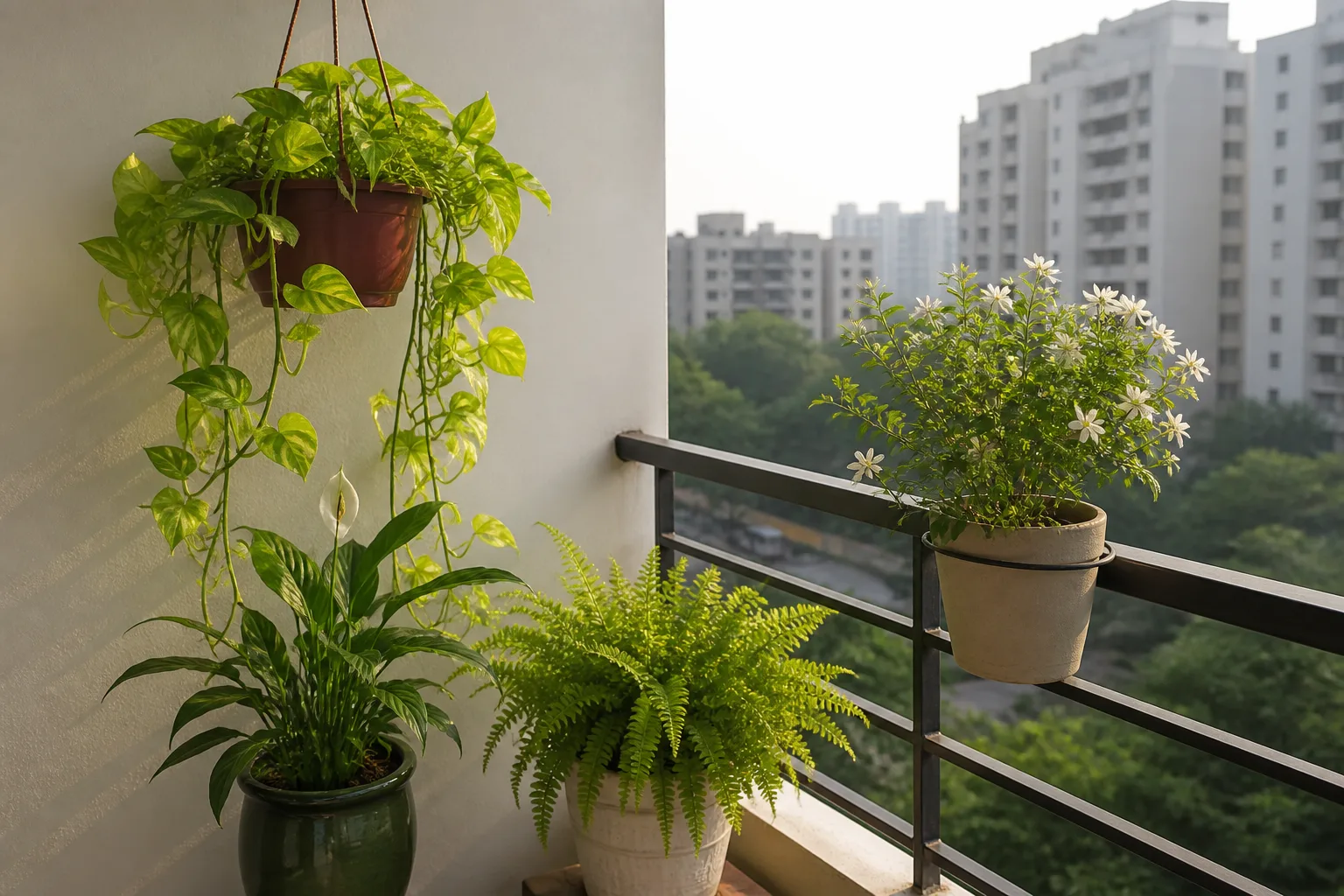
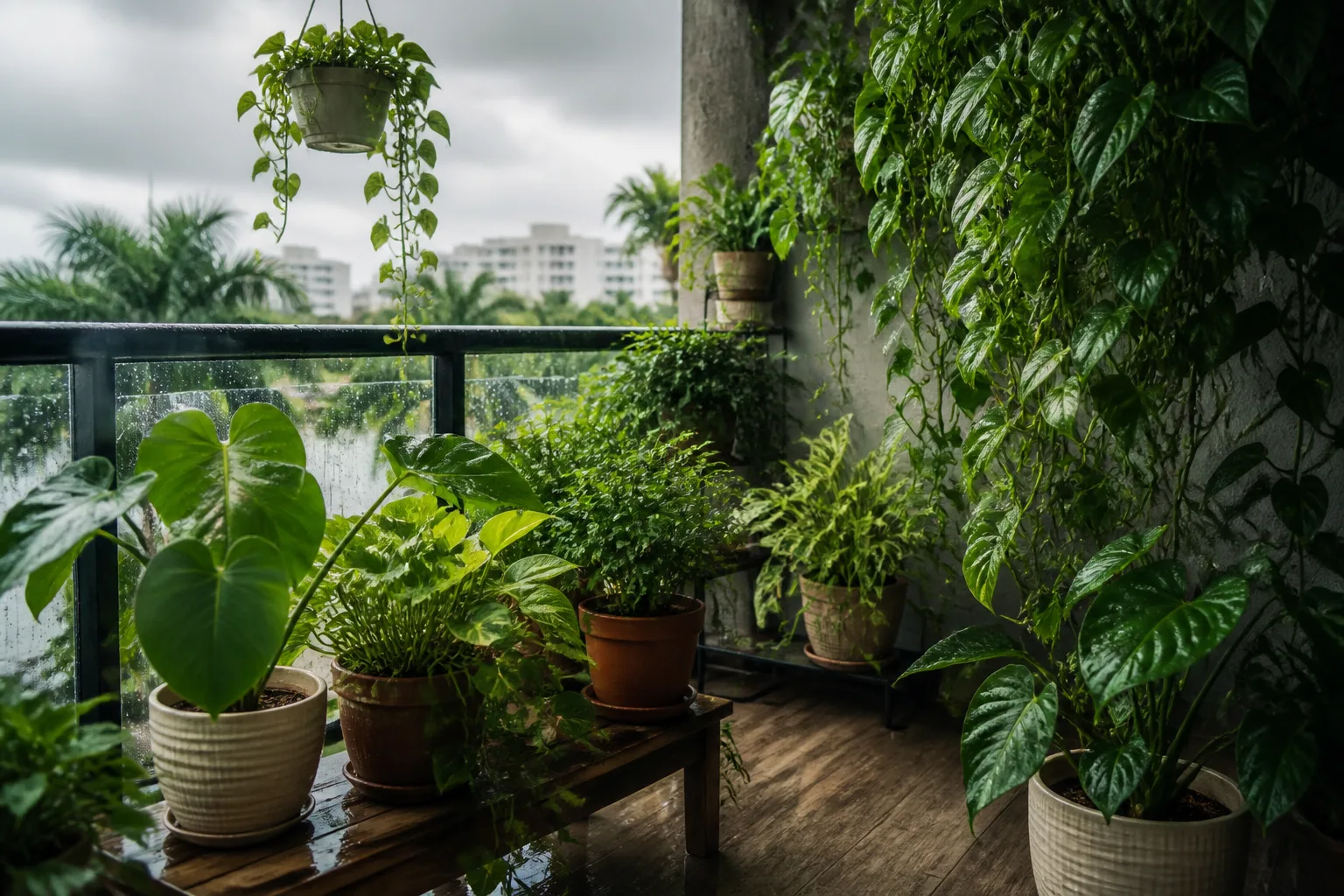
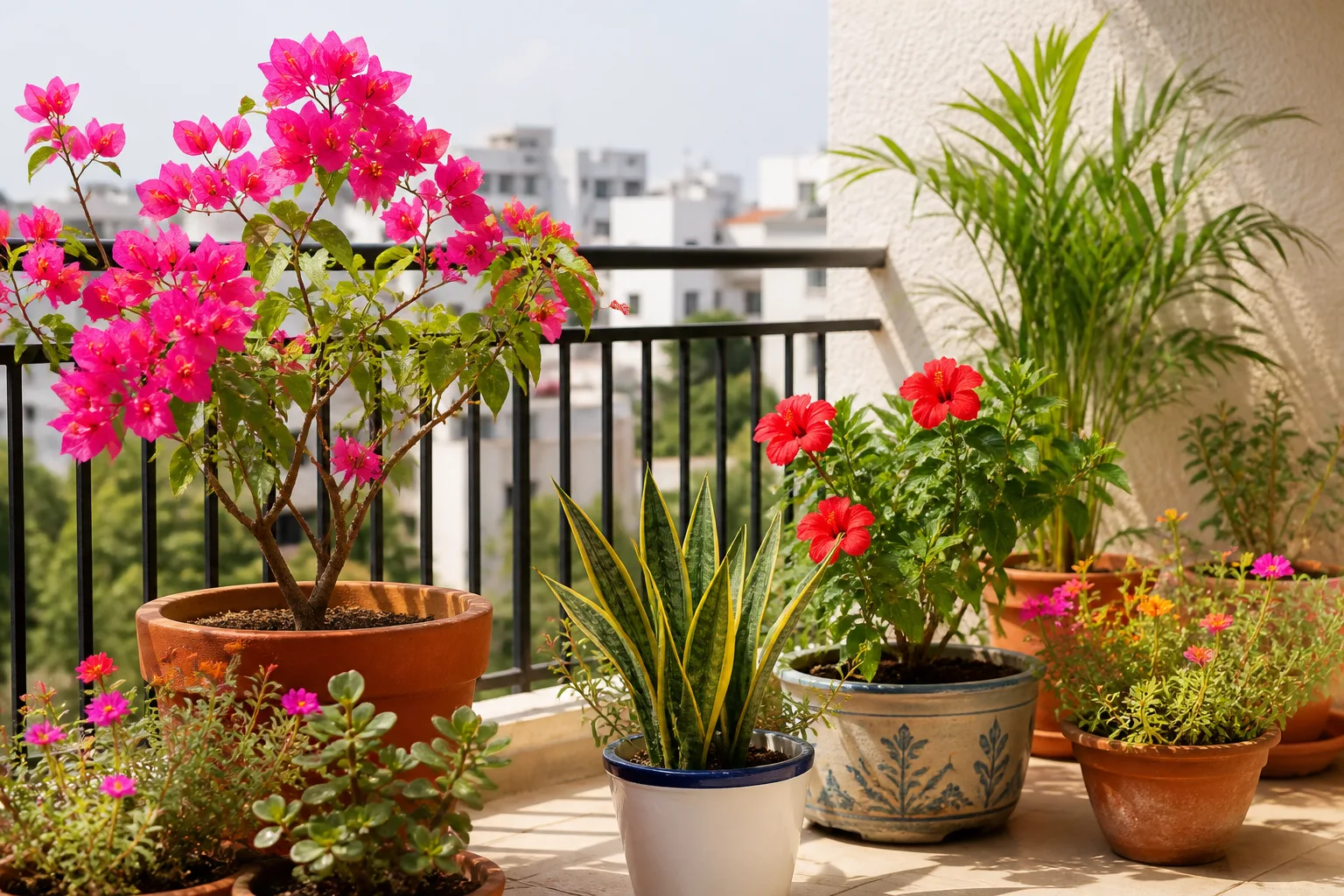
Houseplant Care in Coastal India: Humidity, Salt Air, Fungus
Coastal India houseplant care: stretch watering in sticky air, rinse salt spray, cut mildew with airflow, and know when monsoon mode starts.
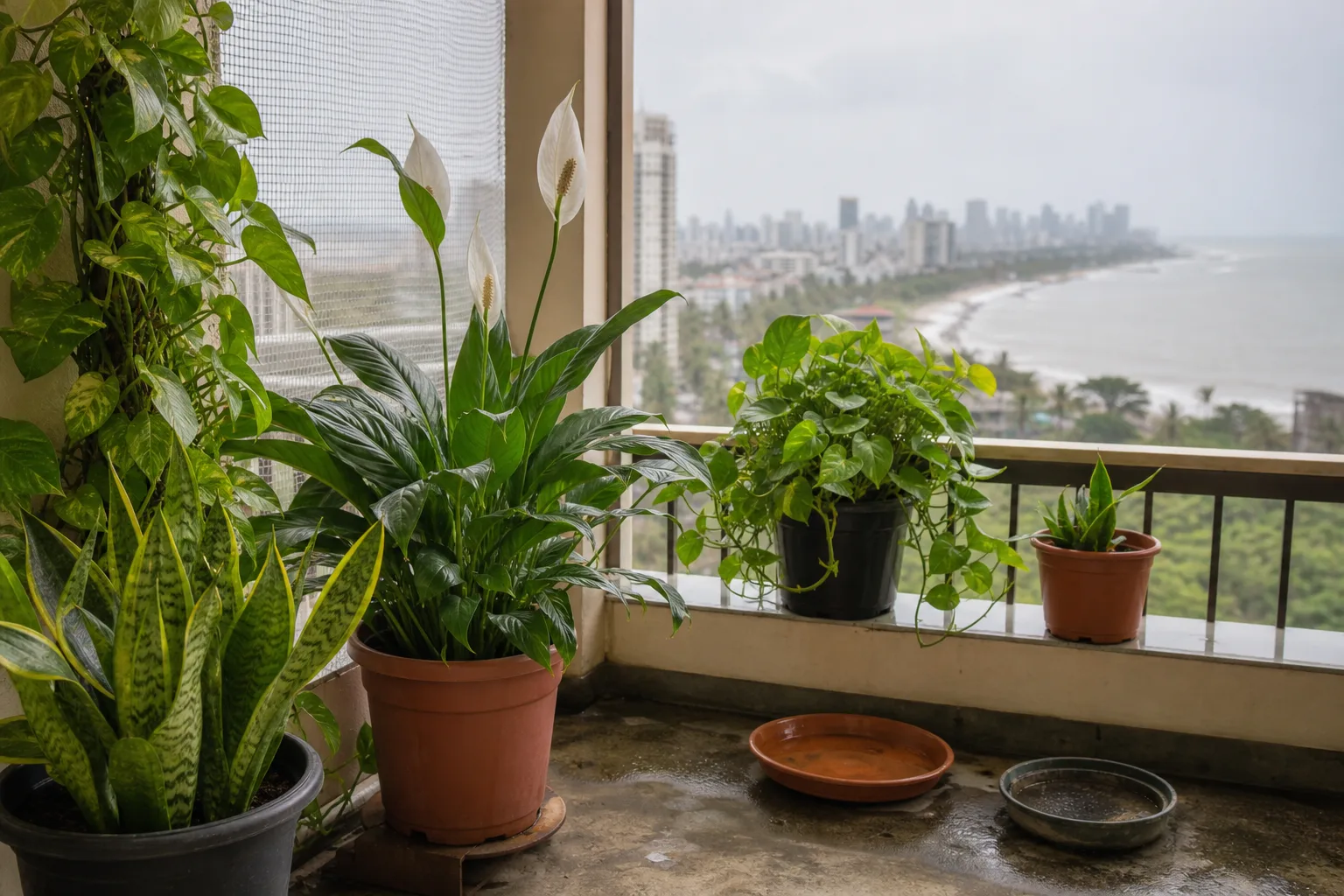
On a sea-facing Mumbai balcony in late May, a peace lily in a 15 cm plastic pot still felt heavy four mornings after a thorough watering — the mix never reached the dry-down that same plant hit in three days the previous April. Two rails away, a soft philodendron facing the breeze developed crisp brown margins on the windward leaves after a stretch of salty nights. Behind mosquito netting in a Kochi flat, another grower’s crowded shelf grew soft white flour on living leaves after a daily misting habit that felt “caring” and did nothing useful. Sticky air, salt film, and stagnant corners — not a shortage of love — are what knock coastal houseplants sideways.
This is a coastal playbook for Indian flats and balconies from Mumbai and Kochi to Chennai, Visakhapatnam, and Kolkata. It is not a duplicate of a general houseplant humidity guide and not a second monsoon calendar. You will learn how to water when the air already holds moisture, how to tell salt burn from mildew, how to cut fungal pressure with airflow instead of mist, how AC bedrooms differ from open sea rails, and when to hand off to monsoon houseplant care in India. For broader species picks, see indoor plants for Indian homes.
What Makes Coastal India Different for Houseplants
Most viral houseplant advice assumes dry heated rooms in temperate winters. Coastal Indian flats and balconies often run the opposite risk for much of the year. Relative humidity stays high even on bright days. Windows stay shut against rain, mosquitoes, and noise. Balcony pots catch salt film, splash, and overnight damp. Growth may continue, but evaporation from mix and leaves drops hard — so a May watering habit becomes a June–September root problem.
Year-Round Humidity vs Inland Dry Air
Penn State Extension notes that ASHRAE recommends indoor relative humidity roughly between 30% and 60% for human comfort, and that many tropical houseplants prefer more moisture than a winter-heated home supplies. On the Indian coast, you are often already inside or above that band. The practical implication is inverted: you rarely need pebble trays or misting to “add humidity,” and you often need to stop practices that keep leaves and media wet for hours.
Measure once with a cheap hygrometer at plant height before you invent a humidity project. If the reading already sits comfortably for people, treat humidity as a disease-and-dry-down constraint, not a deficiency to fix. Inland plateau homes in Pune, Bengaluru, or Hyderabad can swing drier between rains; coastal west and east shelves often do not. For the opposite problem — arid zones and sealed AC flats — use houseplant care for dry Indian climates instead of stretching this page.
Salt Air and Sea-Facing Balconies
UC IPM’s salinity guidance is clear that foliage exposed to excess sodium from sea spray can discolor from tips and margins inward, often more severely on the windward side facing the ocean breeze. Roots exposed to high salts struggle to take up water, so plants can look drought-stressed even when the pot feels moist. Foliage is generally more sensitive than roots to salt contact.
On Indian sea-facing balconies, that shows up as crisp brown margins on the side of the plant that faces the breeze, sticky dust that never quite looks like ordinary city grime, and slower recovery after fertilizing. It is not the same as dry-air crispy tips inland. Rinse strategy and plant placement matter more than buying another humidifier. As a rule of thumb, soft tropicals within a few hundred meters of open sea need a buffer — glass, a wall, or a covered corner — unless the cultivar is known to handle wind and salt.
West Coast vs East Coast vs Inland: Quick Placement Notes
| Setting | What usually hits first | Practical plant move |
|---|---|---|
| West coast (Mumbai, Konkan, Kochi stretch) | Early sticky RH; SW monsoon arrives early and lingers; trays stay wet overnight | Stretch watering early; cover soft tropicals; empty saucers after every damp night |
| East / southeast (Chennai, Visakhapatnam, parts of Kolkata stretch) | Humid sea air year-round plus later NE rains in many years | Keep wet-culture rules until local dry-down returns — not only until “September” |
| Inland plateau (Pune, Bengaluru, Hyderabad) | Drier spells between rains; coastal advice overstates salt and understates dry AC weeks | Prefer the dry-India or monsoon playbooks when RH drops or rains dominate |
These are placement heuristics, not forecasts. Your pot weight is the real meter.
Monsoon Overlap on the Coast
Coastal care and monsoon care overlap, but they are not identical. The India Meteorological Department tracks southwest monsoon onset over Kerala with criteria that typically bring early-June onset in many years, then progressive coverage inland. On the west coast, humid, cloudy, splashy conditions can arrive early and linger; east and southeast coasts add later northeast rains in many years.
Use pot dry-down as your trigger: when mixes that once dried in a day take three or more, you are already in wet-season logic even if the national map still looks “pre-monsoon.” This coastal page stays focused on the year-round humidity-and-salt stack; hand deep slug, gnat, and post-withdrawal calendar tactics to the monsoon guide when that flip happens.
How High Humidity Changes Watering and Soil
Clemson Extension’s watering factsheet is blunt: overwatering is the main cause of death in potted plants because roots need oxygen as well as water. Missouri Botanical Garden adds that waterlogged roots lose oxygen, decay, and leave plants open to pathogens such as Phytophthora. Coastal humidity simply makes that failure mode easier to hit.
Stretch Your Watering Interval
There is no safe fixed interval for “Mumbai plants” or “Chennai plants.” Check the top of the mix with a finger, lift the pot, and water only when the species’ preferred dry-down depth is reached. In sticky weeks, many tropical foliage plants stretch about 50–100% beyond their peak-summer schedule — for example, a peace lily that needed water every three days in a bright April room may need six to seven days in the same plastic pot once nights stay humid. Snake plant, ZZ plant, and jade stretch further; ferns still want moisture but still hate a permanently soggy base.
Water at the soil line with a narrow spout. Leave foliage dry whenever you can. If you bottom-water, cap the soak and empty the saucer — do not leave the root ball sitting in a coastal-humidity bathtub. Technique details live in how to water indoor plants the right way.
Drainage, Saucers, and Pot Choices
Wisconsin Horticulture advises drainage holes, pasteurized commercial mix (not garden soil), and — critically — no gravel layer at the bottom of the pot, because rocks can inhibit drainage rather than improve it. Empty saucers within about 20–30 minutes. Prefer mixes with chunk (bark, perlite, coco chips) over heavy, peat-only bags that stay cold and wet for days.
Terracotta breathes and can help on humid coasts if you accept faster dry-down in brief sunny spells. Plastic holds moisture longer — useful for thirsty plants in AC rooms, risky for succulents on closed monsoon balconies. Compare materials in terracotta vs plastic pots. Upsize pots slowly; oversized media mass stays wet longer than the plant can use.
For Indian terrace and roof-container culture, TNAU Agritech’s roof-garden guidance stresses purpose-built drainage so plants are not left drowning while structures shed water — the same logic applies to balcony pots: free outlets, empty trays, and media that holds air as well as moisture. That is not a reason to put gravel inside a nursery pot.
Fungus Pressure: Mildew, Leaf Spot, Root Rot, Mold/Gnats
Clemson’s houseplant disease factsheet notes that true disease is less common indoors when conditions are dry and clean — but humid, crowded, splash-prone setups change the odds. Coastal India stacks those odds: closed mosquito-net balconies, overlapping leaves, wet nights, and summer watering habits.
Powdery mildew looks like soft white or gray flour on leaves that does not wipe off like ordinary dust. Penn State Extension describes favoring conditions that include high relative humidity at night, lower humidity by day, and temperatures roughly in the 70–80°F (22–27°C) band — a familiar coastal apartment range. Many powdery mildews are inhibited by free water on leaves, so the risky pattern is stagnant humid air, not necessarily “any humidity” (Colorado State Extension).
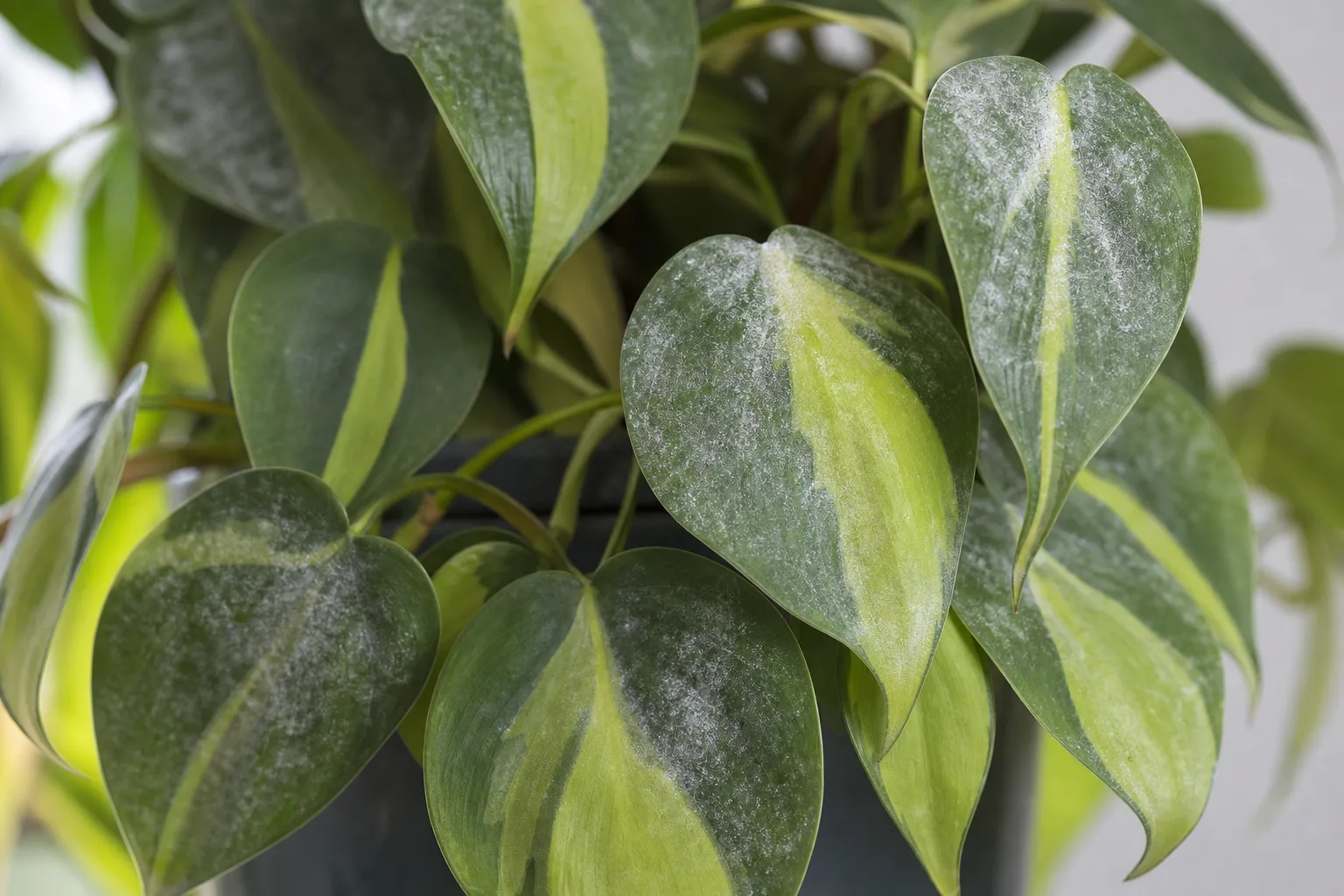
Isolate infected plants, remove the worst leaves into trash (not compost), stop misting, improve spacing, and add gentle airflow. If patches keep expanding after a week of cultural cleanup, use a product labeled for powdery mildew on ornamentals and follow the label — including oil-versus-sulfur timing rules. Full path: houseplant powdery mildew.
Fungal leaf spots often start as small brown lesions with yellow margins and expand when leaves stay wet. On coastal balconies, rain splash and evening showers do the misting for you. Bring soft tropicals under cover during multi-day wet spells, water only at the soil line, and thin crowded shelves so leaves dry after incidental wetting.
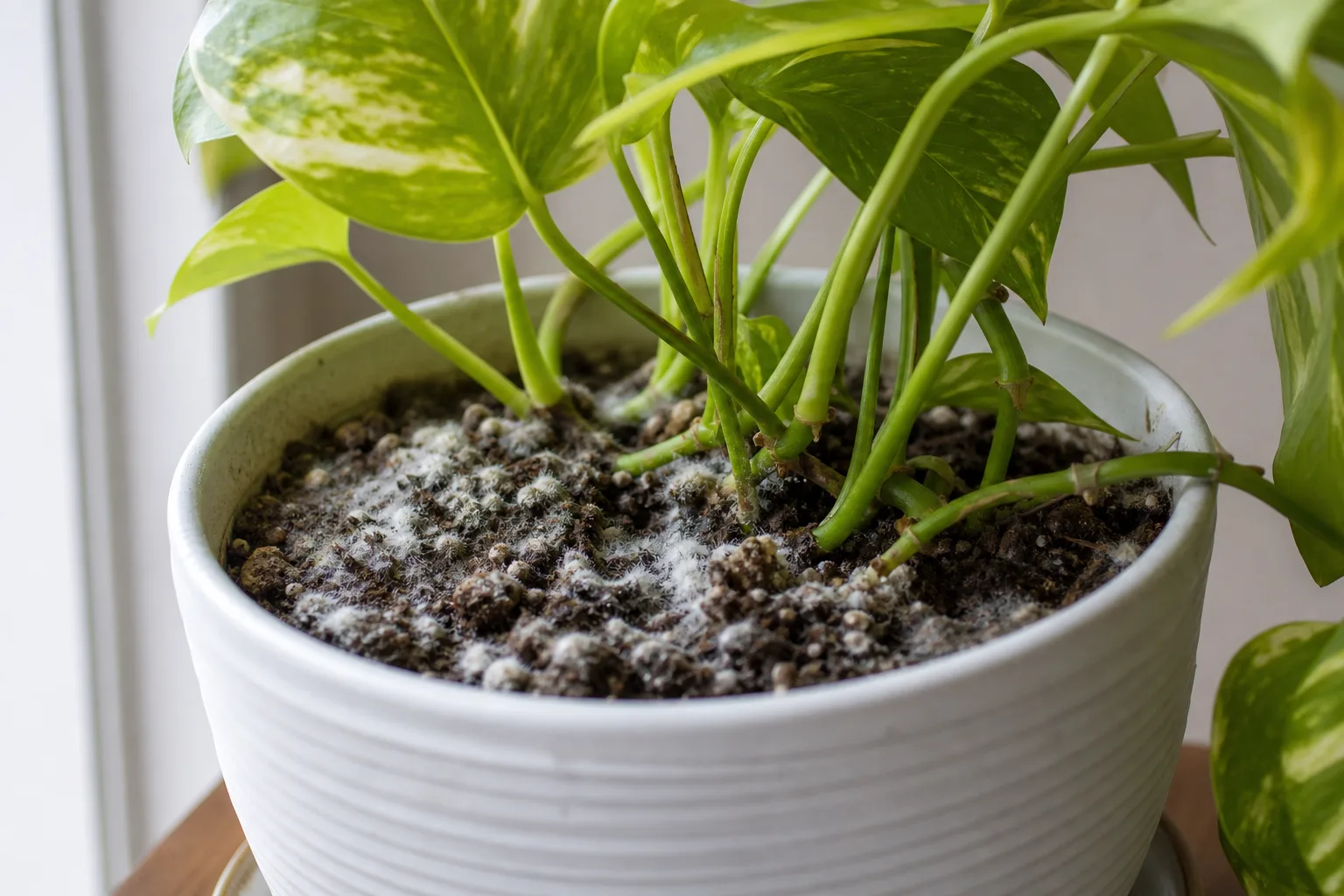
Wisconsin Horticulture describes the classic wet-wilt: the plant wilts even though the soil is wet, growth stalls, leaves yellow, and roots turn soft and brown with a foul smell. Common pathogens include Pythium, Phytophthora, Rhizoctonia, and Fusarium. Often the most honest fix is to discard a severely rotted plant, sanitize tools, and restart in fresh mix with better dry-down. Salvage path and limits: houseplant root rot.
Surface mold on mix is often a saprophyte on damp organic matter — scrape and dry down (mold on potting soil). Watch for fungus gnats; UC IPM ties management to allowing the surface to dry, improving drainage, and sanitation. Sticky traps help adults; they do not fix a permanently wet pot.
Salt Spray vs Fertilizer Burn vs Mildew
| Look | Pattern | Likely cause | First move |
|---|---|---|---|
| Crisp brown tips/margins, worse on the breeze-facing side | Windward, tip-inward | Sea spray / foliar salt | Rinse foliage morning after windy salt days; buffer placement |
| Hard white/gray crust on rim or soil surface | Chalky, scrapes as mineral film | Fertilizer or hard-water salts | Leach with thorough watering; empty saucer; cut feed |
| Soft white/gray flour on living leaf tissue | Spreads on blades; may look dusty | Powdery mildew | Isolate, stop misting, airflow; see mildew guide |
| Discrete brown spots with yellow margins | Scattered lesions, often after wet leaves | Fungal leaf spot | Dry foliage, thin canopy, remove bad leaves |
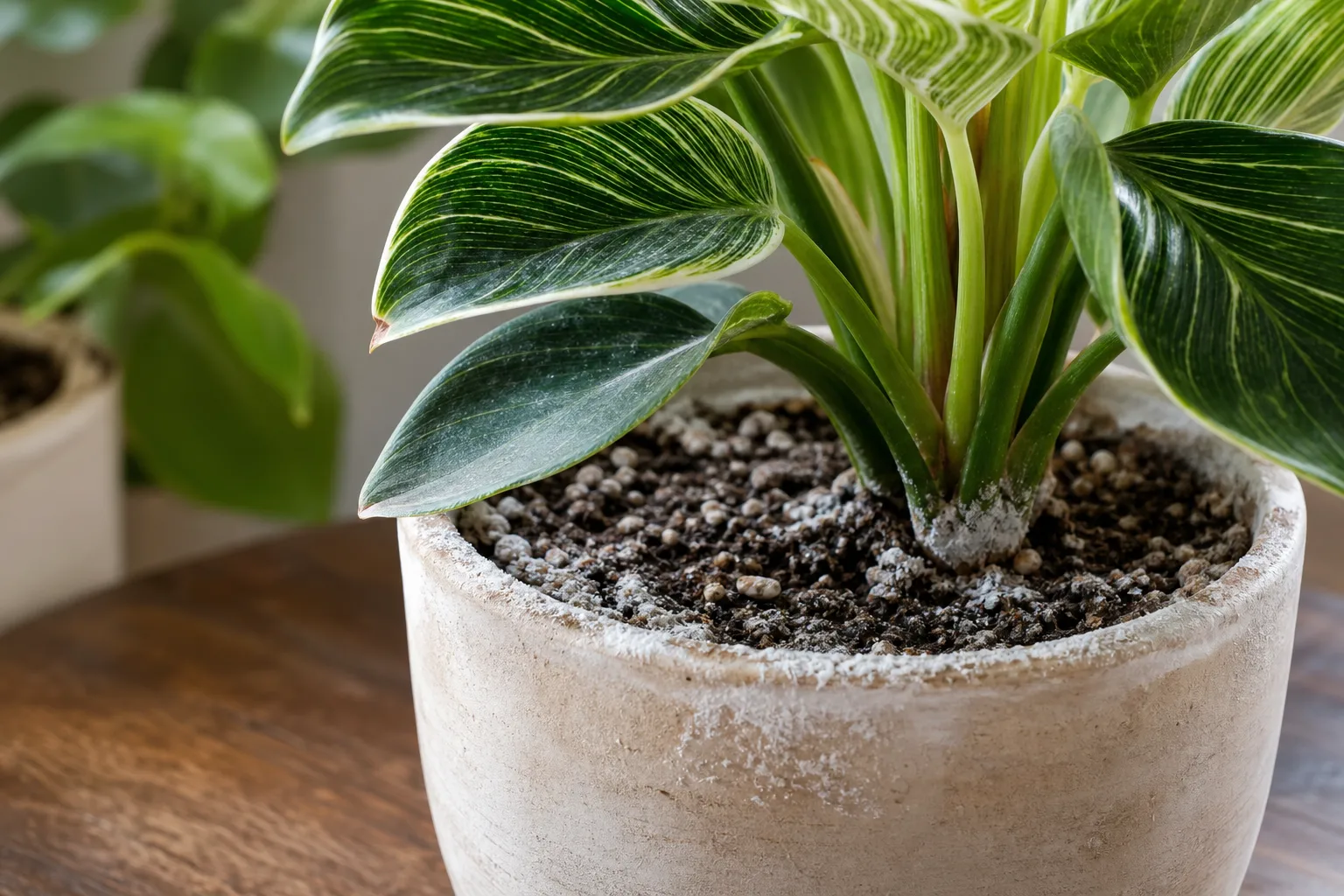
Coastal balcony tactics:
- Prefer a covered or buffered position for soft foliage near open sea.
- After windy salt days, rinse foliage with clean water in the morning so leaves dry before night.
- When you water, occasionally leach: water thoroughly so excess drains, then empty the saucer — UC IPM describes leaching as moving salts below the root zone with low-salt water, without leaving the pot waterlogged. If your tap leaves heavy chalk, see hard water for houseplants and RO water for indoor plants for leach-water choices.
- Cut fertilizer strength and frequency in slow, humid months; salts from feed add to the load.
Airflow Fixes That Matter More Than Misting
Penn State is clear that misting raises humidity only until droplets evaporate — often minutes — so it does not solve dry-air problems and, on the coast, mainly wets leaves. Skip misting as a coastal “care ritual.”
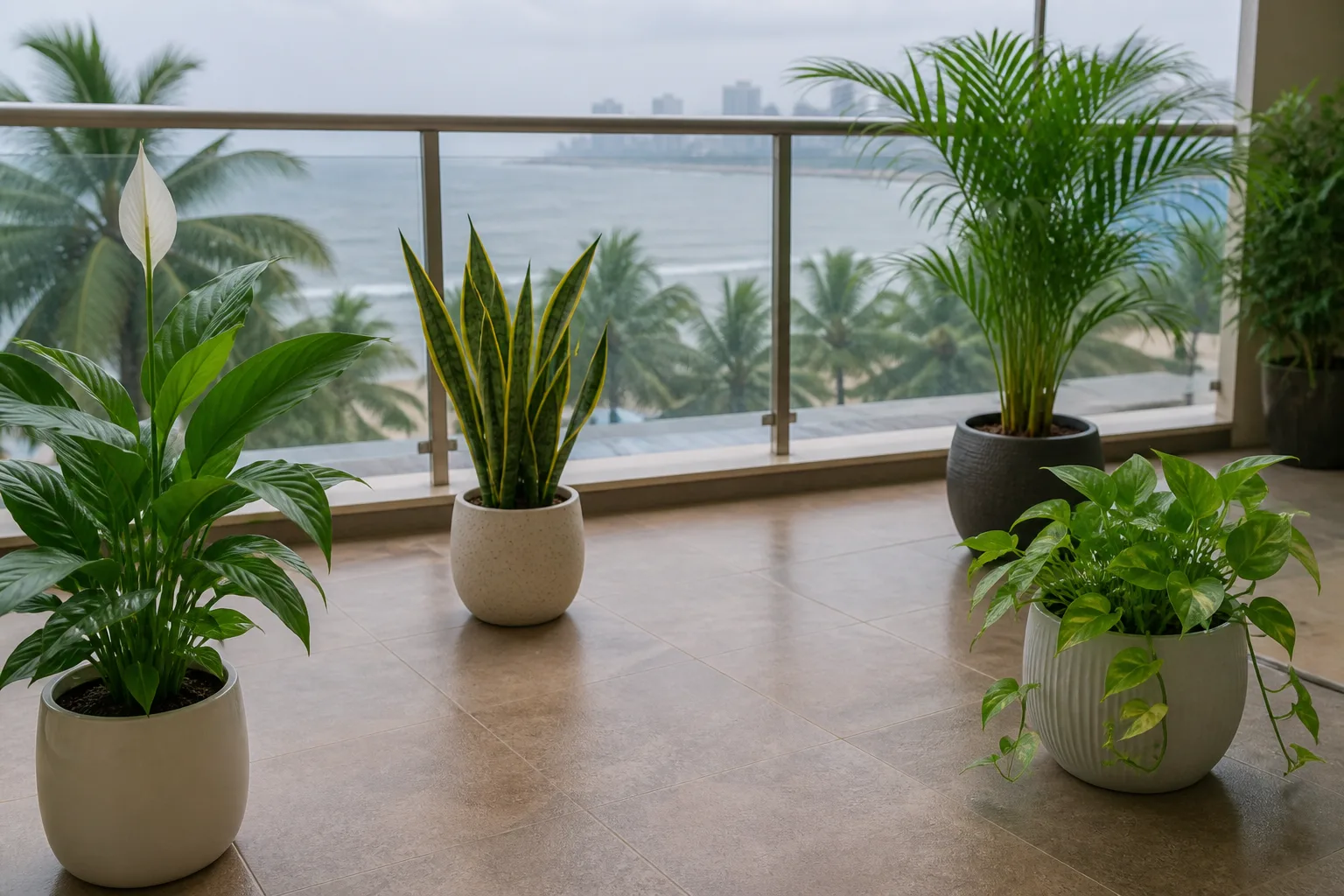
Prioritize moving air without a cold blast on wet foliage. Space pots so leaves do not touch. Crack a window on rain-free mornings, run a ceiling fan on low, or place a small oscillating fan across the room — not aimed as a wind tunnel at one plant. Open mosquito-net balconies when weather allows. Grouping plants still raises local humidity through transpiration; on the coast that can help calatheas in an AC bedroom and hurt a packed monsoon shelf — thin groups when you see mildew or mold.
AC Rooms vs Open Sea Rails
| Spot | Typical coastal trap | Better move |
|---|---|---|
| Open sea-facing rail | Salt film + windward tip burn + splash | Buffer soft plants behind glass/wall; rinse after salt nights; tougher balcony cultivars only |
| Closed mosquito-net balcony | Stagnant humid air → mildew, mold, gnats | Space pots, open netting on dry mornings, stop misting |
| AC bedroom / sealed living room | Cool dry air near vent, wet pots if you water on balcony schedule | Drought-tolerant plants nearer vents; humidity lovers away from blast; water by pot weight in that room — see indoor plants in air-conditioned rooms |
| West-facing hot rail inland of the coast | Scorch + afternoon heat, less salt | Heat and light rules from west-facing balcony plants in India; still stretch watering when RH spikes |
AC does not “cancel” coastal humidity for every plant in the flat. It dries the pocket near the vent while closed halls and balconies can stay swampy. Place by microclimate, not by city label alone.
Plants That Cope Better on the Coast
Match plants to the stack you actually have: humidity tolerance is easy on the coast; salt exposure and wet-media tolerance are the real filters.
Indoors with bright filtered light, pothos, philodendron, snake plant, ZZ plant, aglaonema, and many ferns handle sticky air if you respect dry-down. On open sea-facing rails, favor tougher balcony plants and keep soft tropicals behind glass or on a sheltered wall. Succulents and cacti can grow in coastal AC rooms but rot quickly on closed, rain-splashed monsoon balconies — give them the brightest dry corner, not the wettest “fresh air” ledge.
Pet homes still need toxicity checks species by species. Coastal resilience is not the same as pet safety.
First-Hand Notes From Coastal Weeks
These are editorial apartment and balcony observations used to calibrate advice on this page — not controlled trials.
- Mumbai sea-facing rail, plastic 15 cm peace lily (late May, pre-monsoon sticky week): Pot still heavy on day four after a full soak; the same plant in brighter, slightly less humid April weather had been ready by day three. Stretching to a six-to-seven-day check — and emptying the saucer within 20 minutes — stopped the wet-wilt slide without changing the mix.
- Chennai windward philodendron after a salt-breeze stretch: Tip and margin burn concentrated on the ocean-facing side; inland-facing leaves looked nearly normal. Morning rinse with clean water plus moving the pot one meter behind a glass buffer cut new burn over the next fortnight. Overwatering would have made the “drought look” worse because salt-stressed roots already struggle to drink.
- Kochi closed mosquito-net balcony, crowded shelf: Soft white patches appeared on living leaves after daily misting. Stopping mist, spacing pots, and running a low fan across the room (not into wet foliage) halted new patches within about a week; badly coated leaves were removed to trash.
- Terracotta vs plastic on the same humid ledge: A snake plant in terracotta lightened enough to water about two days sooner than an identical plant in plastic during a cloudy coastal week. Plastic was fine for a thirsty fern in an AC room; plastic on the closed wet balcony was the faster path to gnats.
Log one dry-down observation of your own each Sunday — city, aspect, pot material, days-to-light — so monsoon onset is obvious in your data, not only on a national map.
A Weekly Coastal Care Routine
Use this as a Sunday loop, then adjust mid-week only when pots feel light.
- Walk the collection and lift pots — water only the light ones that meet their dry-down depth.
- Empty every saucer and check trays under balcony pots after overnight damp.
- Space or rotate crowded shelves; remove yellow or spotted leaves into trash.
- On sea-facing balconies after windy days, rinse foliage early and let it dry.
- Scan for white powder (mildew), discrete leaf spots, wet-wilt, and fungus gnats.
- Skip fertilizer in slow, cloudy weeks; resume lightly when new growth is steady and pots dry on schedule.
- Log one dry-down observation (for example, “peace lily, plastic, south rail: six days”) so the monsoon flip is obvious.
Common Mistakes in Coastal Apartments
Watering on a fixed calendar copied from May Instagram advice is the fastest path to root rot. Misting “for humidity” in already humid air mainly feeds leaf disease. Packing twenty plants into a closed balcony corner for aesthetics creates a fungus greenhouse. Adding a gravel layer “for drainage” can worsen perched water. Ignoring windward tip burn leads people to overwater a salt-stressed plant that already cannot drink well. Spraying random kitchen remedies on mildew without changing airflow wastes time and can burn leaves.
Another quiet mistake: treating every coastal problem as a monsoon problem in December, or ignoring monsoon mode in July because the living room AC feels dry. Track the pot, not only the calendar or the thermostat.
When to Shift Into Full Monsoon Mode
Flip to full monsoon rules when local cues stack: prolonged high RH, cloudy light, trays filling overnight, and dry-down stretching hard. On the west coast that often arrives with or just after early southwest rains; on some east/southeast stretches it returns with northeast rains later in the year. Bring soft tropicals and cuttings under cover, stretch watering further, prioritize airflow, and stop misting entirely.
When skies clear and pots dry like early summer again, ramp watering and light gradually — do not shock shade-softened leaves with sudden west-rail sun. For the season-deep playbook (gnats, slugs, post-withdrawal ramp), use monsoon houseplant care for India rather than stretching this coastal page into a second calendar guide.
Related Guides
- Houseplant humidity guide — click when you need RH measurement and humidifier decisions (usually inland or AC winters, not coastal misting)
- Powdery mildew on houseplants — click when soft white flour spreads on living leaves after cultural cleanup stalls
- Fungal leaf spot — click for wet-foliage spots vs salt-burn patterns
- Root rot — click for wet-wilt salvage limits
- Mold on soil — click for surface saprophytes and tray wetness
- Monsoon houseplant care in India — click when pot dry-down collapses for weeks
- Indoor plants for India — click for species shortlists beyond coastal filters
- Dry Indian climate care — click if your home is arid or sealed-AC dry, not coastal sticky
Author: Sai Ananth, LeafyPixels lead content writer. Reviewer: Dr. Priya Menon, botanist and indoor plant specialist on the LeafyPixels Editorial Review Board. Coastal dry-down day ranges and balcony notes above are apartment observations; humidity, salinity, disease, and monsoon-timing claims are tied to the cited primary sources.
Conclusion
Coastal houseplant success in India is a humidity-and-salt problem first, a watering-schedule problem second, and a spray problem last. Let sticky air slow your watering the way those Mumbai plastic pots demanded, give leaves moving air instead of mist, rinse and place against sea spray the way the Chennai windward burn required, and treat fungus as a culture issue — wet media, crowded shelves, wet nights — before you reach for chemicals. Use monsoon mode when your pots say so, and keep salt-facing balconies honest about what soft foliage can survive. Do that consistently and the same collection that struggled through one humid season becomes the one that coasts through the next.