How to Plant Grass Seed on an Existing Lawn
Learn how to overseed an existing lawn: timing by grass type, prep steps, seed rates, watering, and mistakes that kill germination.
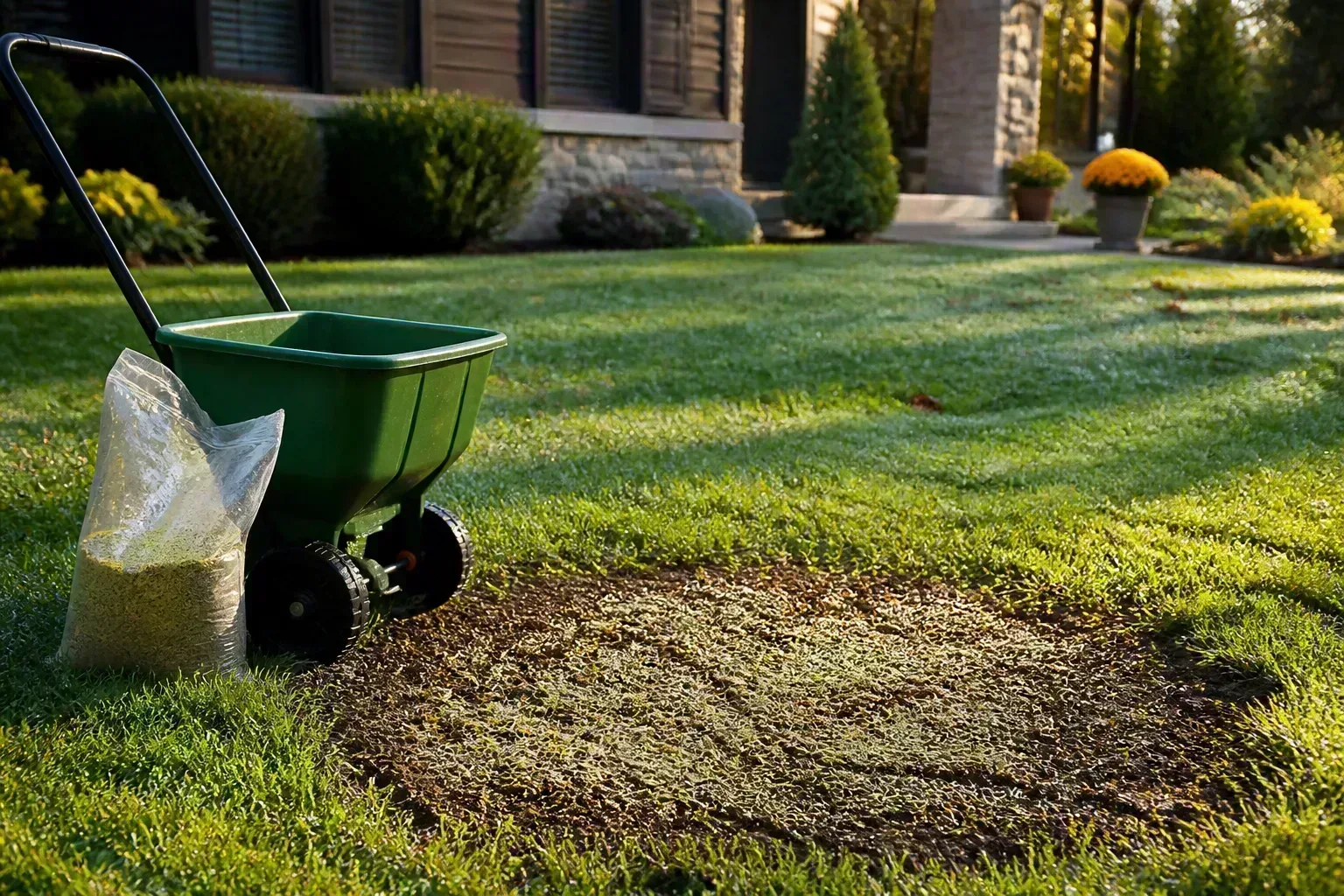
You do not need to kill your entire yard and start from bare dirt to get thicker grass. Overseeding—sowing new seed directly into an existing lawn—is how most homeowners fill thin areas, refresh tired turf, and stay ahead of weeds without the cost and disruption of sod or a full renovation. The job is straightforward once you understand one non-negotiable rule: seed must touch soil, not sit on top of matted thatch or dead grass.
Done at the right time with compatible seed and honest prep, overseeding can transform a patchy lawn in a single season. Done casually—seed tossed on unmowed turf in midsummer after a pre-emergent application—it will fail quietly and expensively.
What Overseeding Does—and When It Beats a Full Renovation
Overseeding means planting grass seed over turf that is already there. The goal is not a brand-new lawn from scratch; it is to increase density, introduce improved cultivars of the same species, fill bare spots, and improve the lawn’s ability to recover from traffic, drought, and disease.
Penn State Extension describes lawn renovation without tilling as a faster, less expensive alternative to full establishment when the grade is acceptable and drastic soil work is unnecessary. That is the sweet spot for overseeding: the lawn’s shape is fine, but the grass stand is thin, weedy, or aging.
Overseeding vs. spot repair vs. kill-and-reseed
These three projects get lumped together, but they are different jobs:
- Spot repair targets isolated bare patches—dog wear, shovel scars, tree-root zones. You prep only the patch, seed heavily there, and may skip whole-lawn steps. Our guide on when to overseed bare patches covers timing for those smaller jobs.
- Overseeding treats the whole lawn (or large sections) to increase overall thickness. Prep is lighter than renovation but still requires seed-to-soil contact across the area.
- Kill-and-reseed renovation uses a non-residual herbicide like glyphosate to kill everything, then aggressive dethatching, aeration, and reseeding. Colorado State Extension reserves this for lawns with heavy weed pressure, wrong grass species for the site, or thatch so thick seed cannot reach soil. It works—but it is a different weekend.
If more than about 40 percent of the lawn is bare soil or dead vegetation, overseeding alone usually will not catch up. Renovation or sod may be the honest answer.
Overseeding makes sense when turf is thin but still alive, weeds are occasional rather than dominant, grade and drainage are acceptable, and you want to introduce a better cultivar without starting over. Skip overseeding (for now) if the lawn is mostly shade and your existing grass is sun-loving bermudagrass, if chinch bugs or grubs are actively killing turf, or if you applied pre-emergent herbicide this spring and still expect crabgrass control—those products stop turf seed from germinating too. Fix the underlying problem first; seed second.
Choose the Right Timing for Your Grass Type
Calendar dates matter less than grass type and soil temperature. Cool-season and warm-season lawns live on opposite clocks.
Best windows for cool-season lawns
For Kentucky bluegrass, perennial ryegrass, tall fescue, and fine fescues, late summer into early fall is the gold-standard overseeding window in most northern and transition-zone yards. Penn State Extension notes that late-August and September soils are warmer than spring, which speeds germination, while upcoming cool fall weather favors seedling survival. Seedlings get two mild growing seasons—fall and spring—before summer stress.
Aim to finish overseeding roughly six weeks before your typical first frost so young plants root deeply enough to survive winter. Early fall beats late fall; seed that germinates too close to freezing weather may winter-kill.
Spring overseeding is the backup plan. Once soil at 2 inches holds around 55°F and rising, cool-season seed can germinate. Weed competition is higher, and summer heat arrives faster, so spring works best for light touch-ups—not rescuing a lawn on life support. If you missed fall, spring beats doing nothing, but manage expectations.
Warm-season overseeding and Southern winter color seeding
Bermudagrass, zoysiagrass, and buffalograss establish best when they are actively growing in late spring through midsummer, once soil temperatures stay warm. Colorado State Extension recommends seeding warm-season grasses from April through July and avoiding late-season plantings that may not harden off before cold weather.
In the South, a different overseeding trick is common: sowing cool-season ryegrass over dormant warm-season turf for winter green color. Annual ryegrass dies out when heat returns; perennial ryegrass may persist and require reseeding for even coverage. Clemson HGIC and southern extension offices discuss this practice for aesthetic winter lawns—not as a permanent species change. Mow the warm-season grass, choose a cool-season seed, and time planting for fall when warm-season turf is slowing but soil is still warm enough for ryegrass germination.
Pre-emergent herbicide conflicts you cannot ignore
This is the mistake that generates the most “my seed never came up” emails. Standard pre-emergent herbicides (crabgrass preventers applied in early spring) create a chemical barrier in the soil that stops seeds from sprouting—including the turfgrass seed you want.
Rule: Do not overseed in the same season you applied pre-emergent unless the product label explicitly allows it and gives a waiting interval. For most homeowners, that means choosing: crabgrass prevention or spring overseeding, not both. Fall overseeding sidesteps the conflict entirely because pre-emergent timing targets spring-germinating weeds. If crabgrass was your problem last year, see our guide on natural ways to prevent crabgrass for integrated strategies that respect seeding windows.
Match Seed to the Lawn You Already Have
Overseeding is not an excuse to grab whatever bag is on sale. Seed must be compatible with the grass already living in your yard and suited to sun, shade, and traffic on that site.
Compatible species combinations
Colorado State Extension offers practical mixing rules worth memorizing:
- Perennial ryegrass into Kentucky bluegrass: acceptable—ryegrass germinates fast and acts as a nurse grass while bluegrass fills in.
- Fine fescue into bluegrass: acceptable for shady or low-input areas.
- Tall fescue into bluegrass: generally not recommended—different texture, color, and mowing height look mismatched.
- Cool-season seed into buffalograss: do not—different water and temperature needs.
- Buffalograss into cool-season lawns: also a poor match.
When in doubt, match the dominant species already in your lawn. If you inherited a mystery blend, choose a high-quality sun or shade mix labeled for your region rather than jumping species.
For speed on compacted or thin turf, perennial ryegrass is the renovation workhorse: it germinates quickly and roots penetrate slightly firm soil better than some bluegrasses, according to Penn State Extension. Tall fescue and fine fescue can overseed successfully too—but aerate aggressively first so seed reaches loosened soil.
Our fast-growing grass seeds guide compares species by germination speed if you need quick green while slower partners establish.
How to read the seed label before you buy
Cheap seed is expensive. Look for:
- Named cultivars, not anonymous “variety not stated” filler.
- 0% weed seed on the label (Colorado State Extension recommends zero).
- High pure live seed and recent germination test date.
- Endophyte-enhanced fine fescues or ryegrasses if you want better drought and pest tolerance—optional but useful.
Buy slightly more than calculated. Spreader overlap and border overlap eat bag weight faster than math suggests.
Prep the Existing Lawn So Seed Actually Reaches Soil
Throwing seed on unmowed, thatchy turf is how overseeding earns its bad reputation. Prep scale matches lawn stress: healthy lawns need less; struggling lawns need more.
Mow short, rake, and clear debris
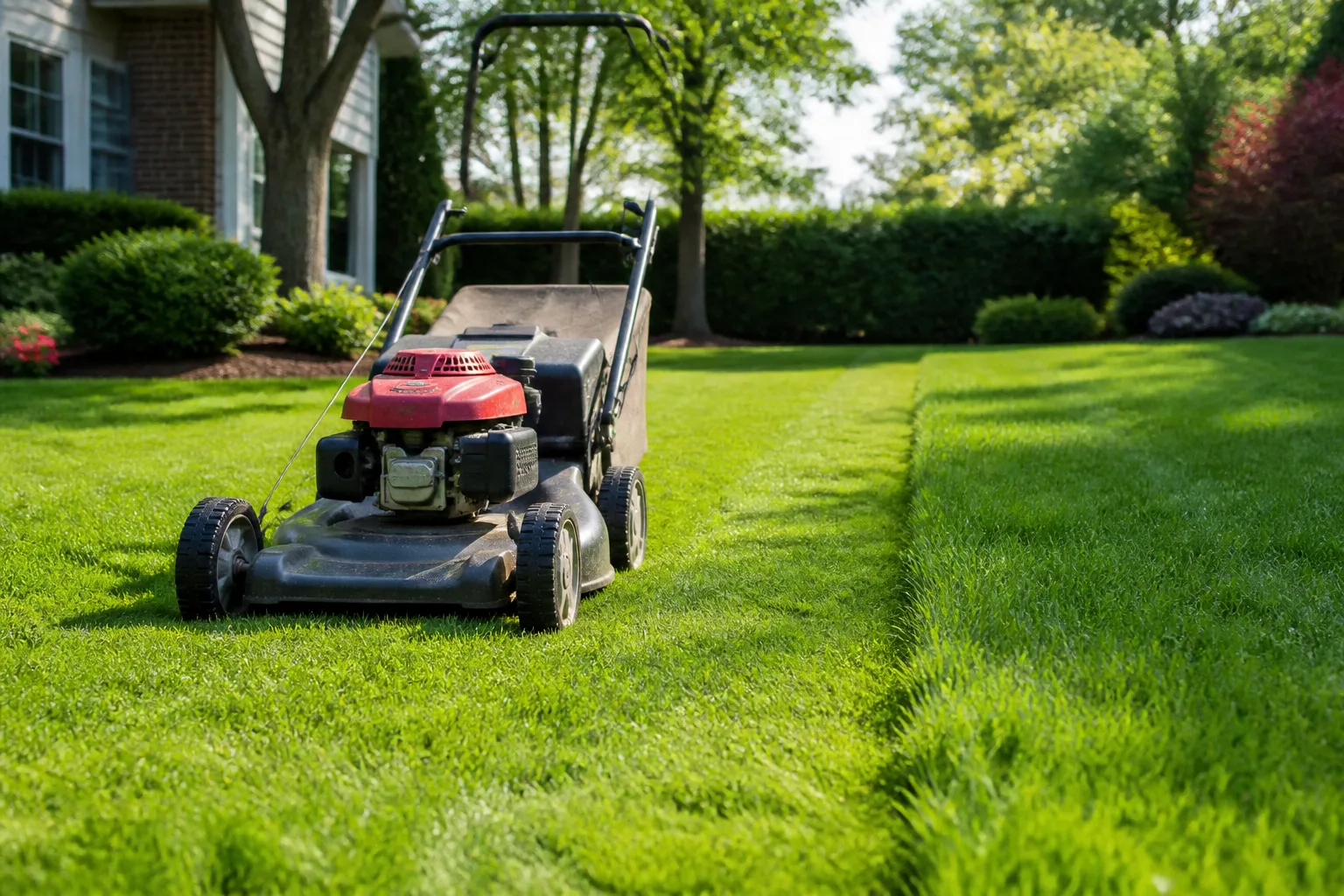
For any overseeding job, mow existing grass shorter than usual—about 1.5 to 2 inches—then bag or rake clippings. Short blades let light reach seed and reduce competition from tall, established leaves. On thin lawns, follow with a leaf rake or dethatching rake across the area to scratch soil surface and pull up dead material.
If the lawn is healthy and only needs thickening, mowing short plus light raking may be enough. If you can push your finger through a spongy thatch mat and never feel firm soil, escalate.
When to dethatch or aerate first
Thatch is a tangled layer of living and dead stems above soil. A little is normal; more than about ½ to 1 inch blocks water, fertilizer, and seed from reaching soil. Run a dethatcher or power rake in multiple directions until you expose soil, then rake and remove debris. Our dethatcher vs. aerator guide explains which machine fits your lawn’s actual problem.
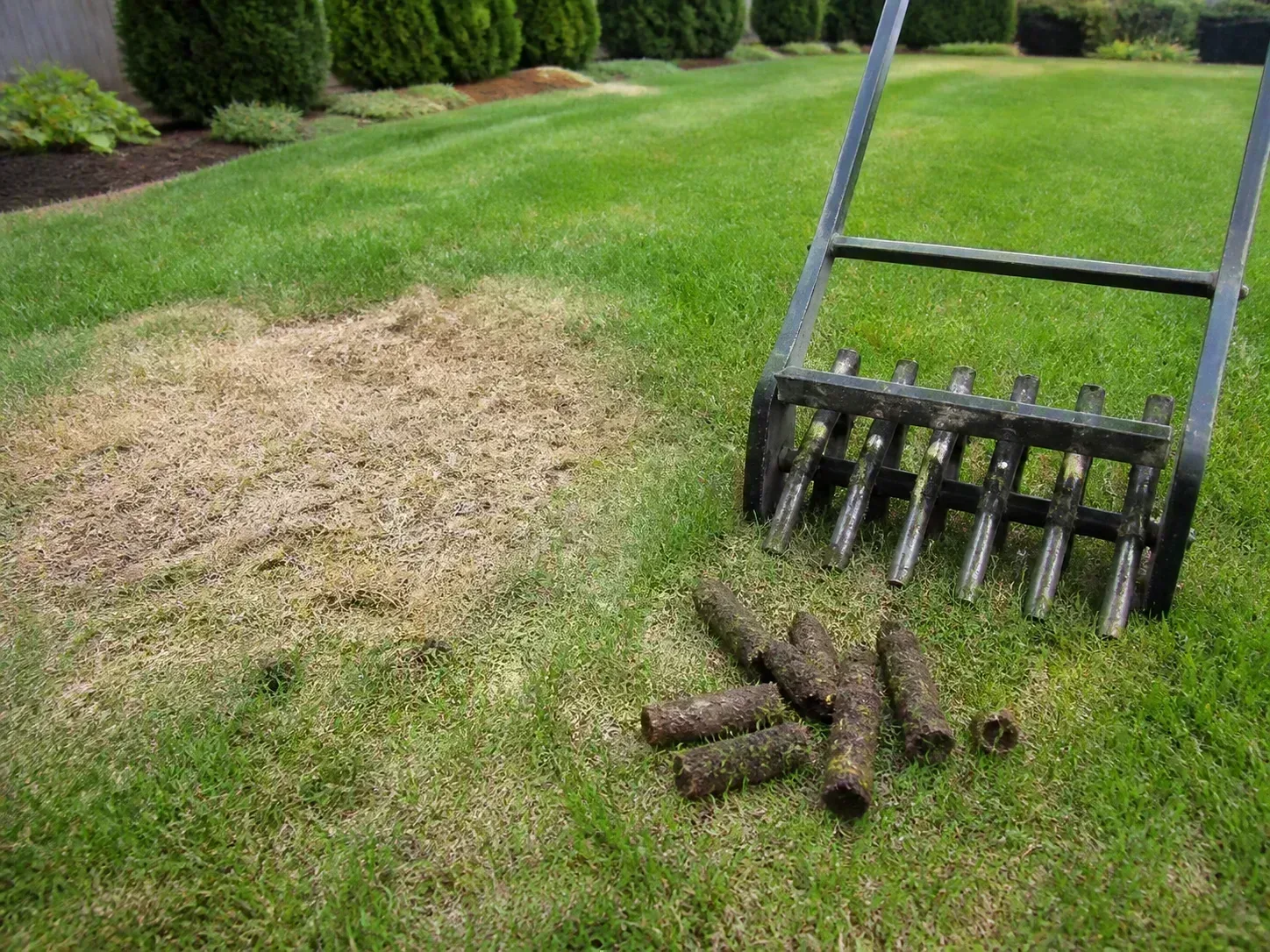
Core aeration pulls soil plugs and relieves compaction. Aerate before overseeding when:
- Soil is hard underfoot or water runs off instead of soaking in.
- You are overseeding a large thin area, not one dog spot.
- You plan to topdress with compost after aerating.
Penn State Extension recommends aerating, then slicing or dethatching lightly to break up cores and mix amendments into holes. Holes should be roughly 1 to 3 inches deep and a few inches apart—overlap passes until open soil is visible. Seed falling into aeration holes germinates reliably; seed on top of undisturbed thatch does not.
Do not pile soil over tree roots to “help” seed. A ¼-inch light topdressing of compost on low spots is fine; burying surface roots harms trees.
Soil testing and light topdressing rules
Before you buy four bags of seed, soil test. County extension offices and university labs report pH, phosphorus, potassium, and lime needs cheaply. Overseeding into acidic, nutrient-starved soil produces weak seedlings that fade by summer regardless of watering discipline.
Apply lime or phosphorus/potassium amendments per test results before seeding if recommended. Nitrogen comes primarily through starter fertilizer at seeding time—not tilled deep into soil where young roots cannot reach it yet.
Step-by-Step: Spread Seed on an Existing Lawn
Once soil is visible in patches or holes, you are ready to seed. Work on a calm day so wind does not redistribute your work.
Calibrate your spreader and apply at overseeding rates
Use a drop or broadcast spreader set to the overseeding rate on the seed bag—not the new-lawn rate. Too little seed leaves thin results; too much creates crowded, disease-prone turf that scalps under the mower.
Penn State Extension lists typical overseeding / renovation rates per 1,000 square feet:
| Species | Overseeding rate (lb / 1,000 sq ft) |
|---|---|
| Perennial ryegrass | 4–6 |
| Kentucky bluegrass | 1–2 |
| Tall fescue | 4–5 |
| Fine fescue | 3–4 |
Technique:
- Load half the seed needed for the area.
- Walk in parallel paths across the lawn (north-south).
- Load remaining seed.
- Walk perpendicular paths (east-west) for even coverage.
- Lightly rake or drag a mat to work seed into the top ¼ inch of soil—some seed visible on the surface is normal.
On large properties, a slit seeder cuts shallow grooves and drops seed in one pass—worth renting if you are not aerating aggressively by hand.
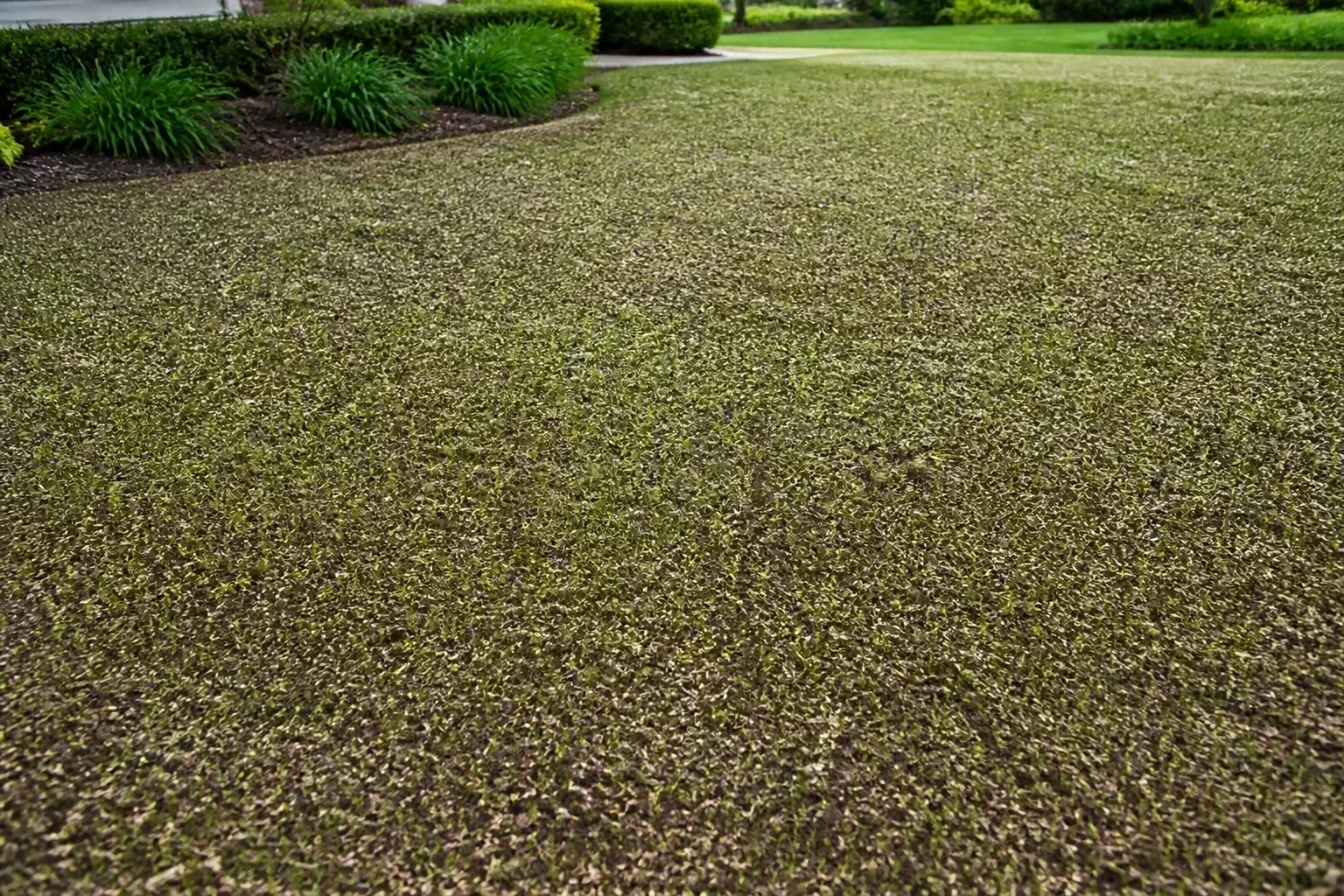
Starter fertilizer, mulch, and optional topdressing
Apply starter fertilizer immediately before or after seeding. Penn State Extension suggests 0.5 to 1 pound of nitrogen per 1,000 square feet from a product like 10-10-10, 16-8-8, or 20-10-10. More than about 1.5 lb N / 1,000 sq ft can burn seedlings. Starter fertilizer supplements soil-test phosphorus and potassium; it does not replace them.
Where bare soil is exposed—common after dethatching—spread a thin straw mulch (one bale per 1,000 sq ft is a common benchmark) to reduce seed washout and bird feeding. Do not bury seed under heavy mulch; you should still see soil texture through the layer. Pelletized paper mulches work on small areas but are costly for whole yards.
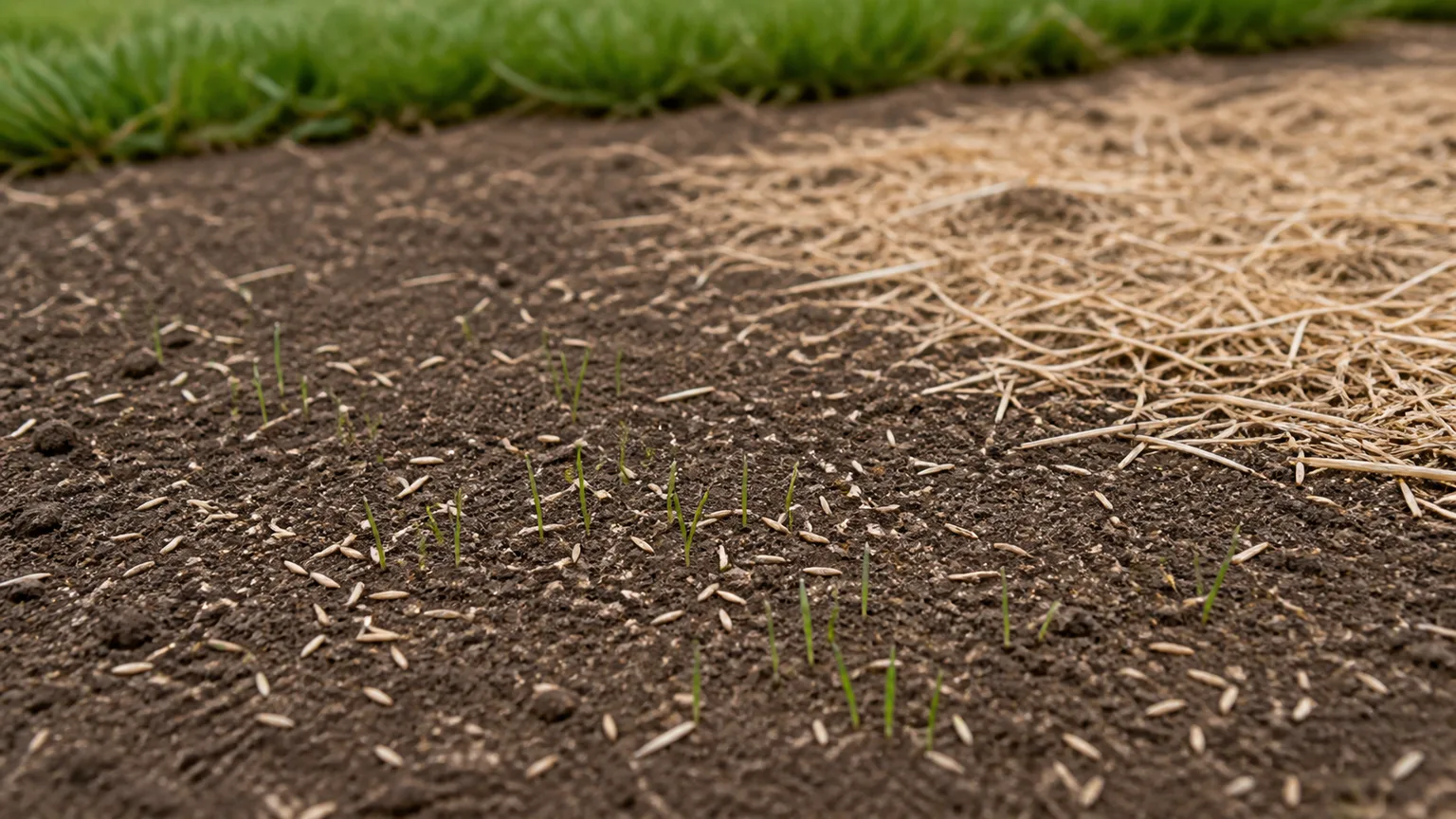
Water lightly immediately after mulching to settle seed and activate fertilizer salts into the surface.
Watering, Traffic, and First Mows After Overseeding
New seed on an existing lawn needs the same moisture discipline as a bare seedbed—even though older grass roots are still below. The established turf can fool you into thinking the ground is wet when the seed zone is dust.
For the first 2 to 3 weeks, keep the top ½ inch of soil consistently moist, not flooded. That usually means light watering two to four times per day for short intervals—just enough to prevent drying between cycles. A misting nozzle or oscillating sprinkler with a coffee-can audit helps confirm you are applying ⅛ to ¼ inch per session rather than drowning low spots.
Once seedlings are up and you mow once, shift toward deeper, less frequent irrigation to drive roots down. Our how often to water new grass seed guide breaks phases by week if you want a calendar.
Foot traffic is the silent killer. Keep kids, pets, and furniture off the overseeded area until you have mowed at least two to three times and soil feels firm—not spongy—underfoot. Colorado State Extension advises limiting traffic until new grass matures.
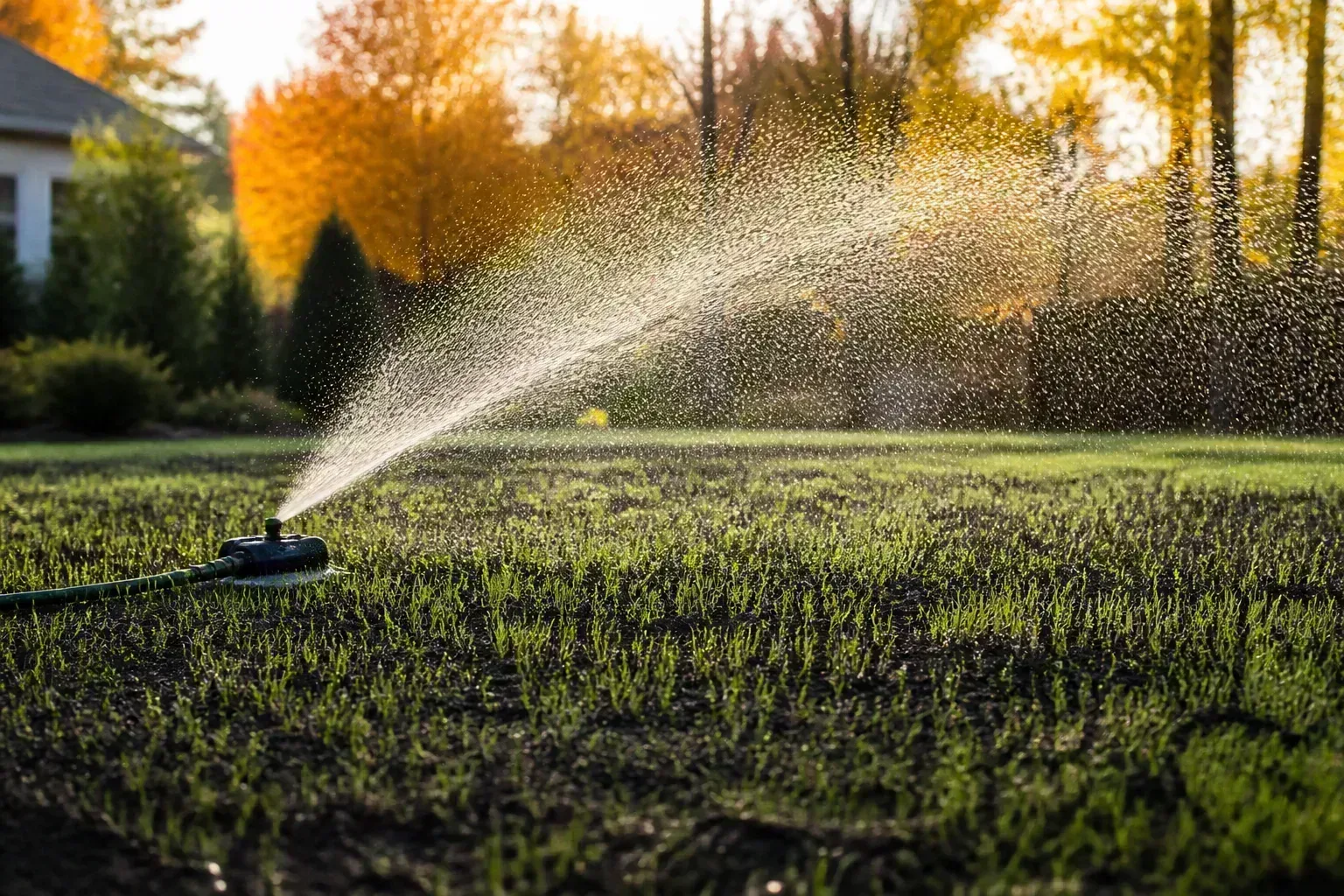
Mow when new grass reaches about 2.5 to 3 inches tall—often 3 to 4 weeks after germination depending on species and weather. Set the deck to remove only the top third, targeting a finished height appropriate for your grass type (tall fescue higher than ryegrass mixes, for example).
Do not apply broadleaf weed killers until the lawn has been mowed five to six times, per Colorado State Extension—herbicides that stress mature weeds will kill immature turfgrass too.
About 4 to 8 weeks after starter fertilizer, a follow-up feeding of ½ lb nitrogen per 1,000 sq ft helps thicken the stand if fall rains or irrigation support growth (Penn State Extension). Skip heavy fall nitrogen if your region shuts down growth early.
Expect 3 to 8 weeks from seed to first safe mow and longer before the lawn tolerates party traffic. Our how long grass seed takes to grow timeline explains species differences so you do not panic at normal slow bluegrass.
Common Overseeding Mistakes That Waste Your Weekend
Even experienced gardeners lose seedlings to these predictable errors:
- Seeding without soil contact — seed on thatch = bird food.
- Overseeding right after pre-emergent — wait or seed in fall instead.
- Wrong species blend — tall fescue polka dots in a bluegrass lawn look permanent.
- Summer overseeding cool-season grass — heat and drought cook seedlings unless you can irrigate like a golf course.
- Overwatering — puddles rot seed; aim for moist, not swampy.
- Skipping soil test — fixing pH once beats reseeding every year.
- Mowing too soon or with dull blades — uproots seedlings that have not anchored.
- Herbicide too early — kills the grass you just planted.
If seed fails twice in the same spot, stop repeating the same steps. Test soil, check shade and drainage, and consider whether aeration alone or renovation is the real fix. Sometimes the grass species is wrong for the site—and no amount of seed fixes four hours of direct shade under maples.
Conclusion
Planting grass seed on an existing lawn is one of the highest-return jobs in yard care when the lawn still has a skeleton of healthy grass to build on. Match timing to your grass type, choose compatible seed, mow short, expose soil through raking or aeration, spread at true overseeding rates, and keep the surface evenly moist until seedlings knit together.
Fall remains the best default for cool-season overseeding; spring is the backup; warm-season lawns follow summer soil warmth; Southern winter color seeding is its own specialty play with ryegrass. Respect the pre-emergent calendar, delay weed sprays until new grass has been mowed repeatedly, and treat overseeding as the start of a season-long care shift—not a single afternoon task.
Get those pieces right and you can thicken a tired lawn without the demolition of starting over from bare ground.