How to Fix Leggy Basil and Grow Bushier Plants
Fix leggy basil with a simple light-and-pruning reset. See where to cut, how much to remove, how to water, and when to restart from cuttings.
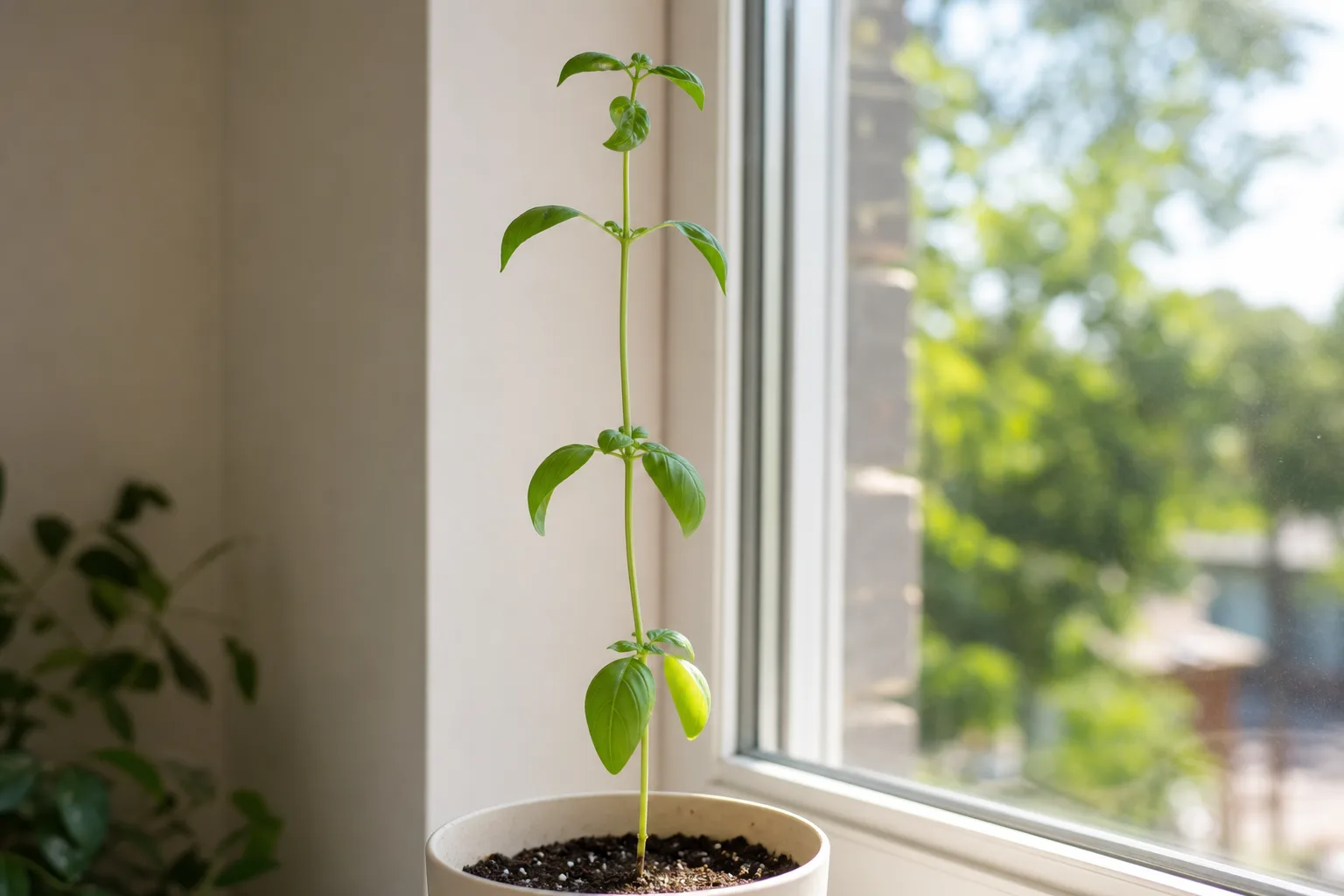
If your basil is tall, thin, leaning toward a window, and carrying more bare stem than leaves, it is usually not too late to save it. The reliable fix is a sequence, not a single dramatic haircut: give the plant enough usable light, correct its water stress, remove competing flower growth, and then cut each stretched stem just above a healthy leaf node.
Do not expect the old stem to shrink or fill in along every bare section. The goal is to replace weak, stretched growth with new side shoots that develop under better conditions. If the roots are healthy and the plant still has green nodes, even a scraggly basil can make a useful late-season recovery.
The quick fix: correct light, then prune above a healthy node
Start by moving the plant to its brightest suitable position before pruning. Outdoor basil generally wants full sun, and Penn State Extension describes that as roughly six to eight hours of direct light; indoors, a bright window may be enough in summer but often becomes inadequate as the sun angle and day length change. Penn State Extension’s basil profile also emphasizes warmth, well-drained soil, regular moisture, and pinching the growing tips to encourage branching.
Once the plant is no longer sitting in weak light, identify the strongest living nodes on the stretched stems. Remove flower spikes, then cut back only as far as the lowest node that has green leaves or small side shoots. Keep the first session modest—about one-third of the leafy growth at most—and give the plant time to respond before cutting again.
That order matters. Pruning removes leaf area, while better light supplies the energy needed for the remaining leaves and new shoots. If you cut first and return the basil to the same dim corner, it may produce another thin stem from the next growing point.
What leggy basil looks like—and what it is not
Leggy basil has long gaps between leaf pairs, thin green stems, sparse foliage, and a tendency to lean toward the strongest light source. The leaves may be smaller or paler than expected, especially near the newest growth, but the plant can still smell like basil and feel firm at the base.
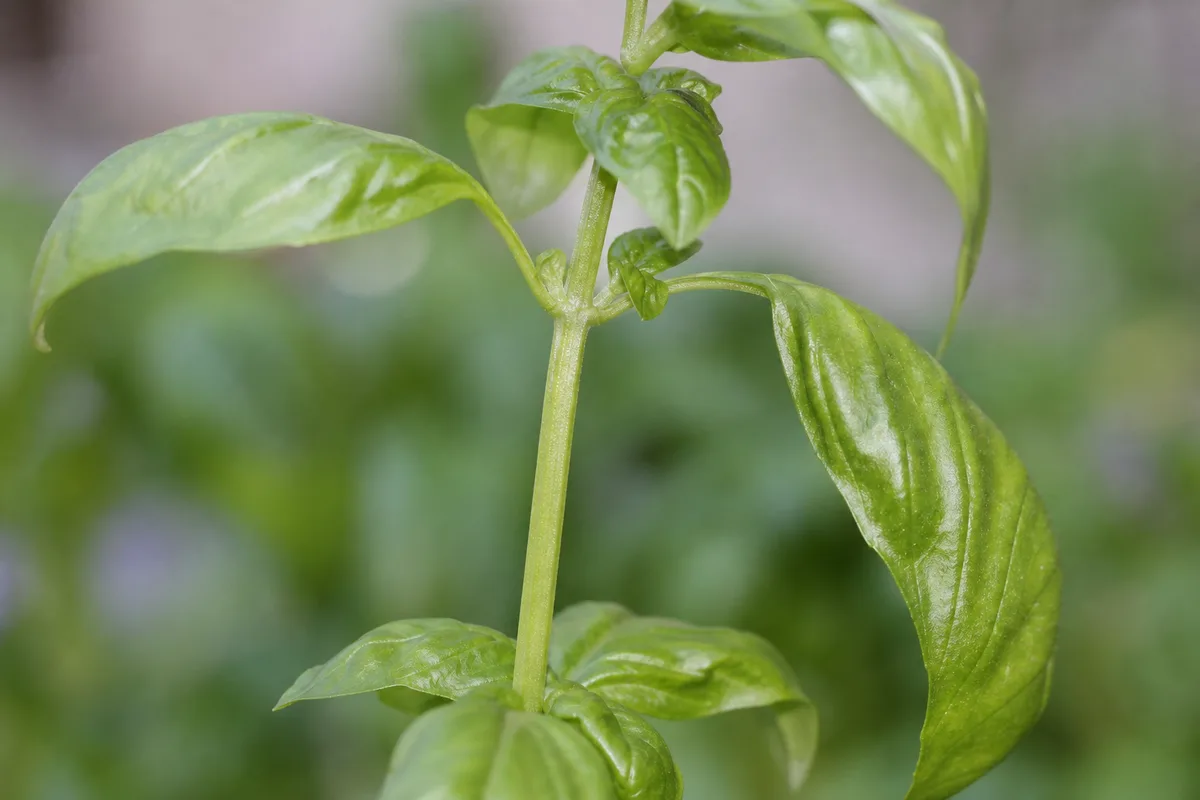
Long internodes and sparse leaves show the stretched growth pattern that makes basil look leggy.
The technical word for light-driven stretching is etiolation, but you do not need a light meter to make a useful first diagnosis. Look at the spacing between leaves, the direction of the lean, and whether the newest growth is reaching toward a window or lamp. Then check the soil and underside of the leaves so you do not mistake a different problem for legginess.
Leggy vs. bolting, wilting, and disease
Legginess and bolting often overlap, but they are not the same thing. A leggy plant is defined by stretched stems and wide internodes; a bolting plant is shifting toward reproduction, with flower buds or flower spikes appearing and the leaf harvest becoming less tender. Basil can be both leggy from low light and bolting because it is mature, hot, crowded, or drought-stressed.
Wilting is different again. A thirsty basil may droop across the whole plant and recover after the root ball is thoroughly watered, while a leggy basil remains tall and widely spaced even when the soil moisture is corrected. If the soil stays wet for days and the lowest leaves turn yellow, investigate poor drainage or root damage instead of adding more water.
Disease clues also change the plan. Penn State Extension describes basil downy mildew as yellowing on the upper leaf surface with gray, downy growth on the undersides; that is not a pruning problem. Remove and isolate clearly diseased material, keep foliage dry when watering, and avoid treating a plant with spreading disease as though it only needs a haircut.
The simplest field test is to ask three questions: Are the gaps between leaves unusually long? Is the plant reaching for light? Are the roots and remaining leaves otherwise sound? If the answers are yes, yes, and mostly yes, a light-and-pruning reset is appropriate.
Why basil stretches
Basil is a warm-season herb that naturally grows upward, but a healthy plant also branches outward from its leaf nodes. Stretching happens when the plant keeps extending the main shoot without receiving enough light, being pinched, or having conditions that support sturdy leafy growth. It is a growth strategy, not a sign that the plant has forgotten how to grow.
The Royal Horticultural Society describes basil as a tender herb that thrives in warmth and sunshine and stays bushy when the shoot tips are harvested regularly. Its basil growing guide also notes that containers need regular watering and that dry conditions can bring on flowering sooner.
Low light is the main driver
Light is the first variable to investigate because pruning cannot compress an internode that has already formed. Basil in a dim kitchen, behind a balcony railing, under a tree, or several feet from a window may continue growing, but the new leaves arrive farther apart and the stem leans toward the brightest side.
Outdoor basil usually has the best chance of staying compact in a warm, sheltered, full-sun location. In very hot climates, brief afternoon protection can prevent scorch or severe wilt, but shade for most of the day is not a legginess cure. The useful question is not “Is the room bright to me?” but “Does the basil canopy receive strong direct light for enough of the day?”
Indoors, a window’s direction and obstructions matter more than the label “sunny.” A south-facing window can still be shaded by a neighboring building, a deep overhang, insect screen, or a second row of plants. Rotate the pot every few days for even growth, but do not use rotation as a substitute for more light if the internodes continue lengthening.
Heat, drought, crowding, and flowering can compound it
Heat does not always create the original stretch, but it can speed up a weak plant’s growth and push mature basil toward flowers. Drought and repeated wilting add stress, while crowded stems compete for light and air. The plant may then look tall and sparse even when the first trigger was a small pot or an obstructed window.
RHS recommends keeping basil evenly moist once established, especially in containers, while Penn State Extension warns that basil is susceptible to drought and water stress. Water stress does not mean the soil should remain saturated. Basil needs moisture at the roots and drainage below them; a pot that holds water can turn a light problem into yellow leaves and root decline.
Flowering is a separate priority decision. If your goal is tender leaves, pinch developing flower stems as soon as you see them and continue harvesting shoot tips. If you are growing a flowering type for bees, saving seed, or enjoying the flowers, allow some stems to bloom and accept that leaf quality and vegetative production may decline sooner.
The rescue sequence: reset light, water, and flowers
Treat the rescue as a short reset over several days rather than a panic prune. The sequence below protects the part of the plant that can actually regrow.
Check the light before you cut
Move a potted basil gradually if it is going from a dim indoor spot to intense outdoor sun. A sudden change can cause leaf scorch even though the final location is better. Start it in bright shade or gentle morning sun, then increase direct exposure over several days; a plant already acclimated to full sun can move more quickly.
For an outdoor plant, clear competing foliage and choose the brightest place that still has airflow. For an indoor plant, put the pot close enough to the window that the canopy receives direct light, or use a suitable grow light when the window cannot deliver it. Keep the source above or slightly in front of the canopy so the new shoots do not immediately lean sideways.
Wait long enough to see that the plant is no longer making a dramatic reach toward the light. You do not need to delay every cut for weeks, but correcting the direction of growth before a hard reset prevents the most common failure: a freshly pruned plant stretching again from the same low-light location.
Water deeply, then let excess drain
Before pruning, feel the soil several inches down or lift the pot to judge its weight. If the mix is dry and the leaves are limp, water slowly until moisture runs from the drainage holes, then empty the saucer. If the soil is already damp, do not water again just because you are pruning.
Use the soil surface and the plant’s condition as your guide rather than a fixed calendar. Containers can dry quickly in sun and wind, while a large decorative pot may stay wet long after the top looks dry. A well-drained potting mix and a container with an open drainage hole give you more room to correct a mistake than a dense, waterlogged mix.
Water at the soil line when possible. RHS advises watering in the morning and avoiding wet roots overnight, and Penn State recommends watering the soil rather than the leaves. Keeping foliage dry also reduces the conditions that favor leaf disease, especially when a dense plant is recovering.
How to prune leggy basil without stopping regrowth
Basil pruning and basil harvesting are essentially the same job: you remove the tip and leave a node positioned to produce side shoots. Fine Gardening makes the same practical connection in its pruning and harvesting guidance, while also advising gardeners not to remove more than one-third of the plant at one time.
Find a node and make the cut
Use sharp, clean scissors or snips. Cleaning the blades before you begin limits the chance of dragging debris or sap from another plant into a fresh cut, and a sharp blade makes a small wound instead of crushing the stem.
Start at the top of a leggy stem and trace downward. A leaf node is the point where a pair of leaves joins the stem; on basil, you may also see tiny side shoots tucked into the angle above those leaves. Choose the lowest node that still has healthy green leaves or visible side buds, but leave enough foliage below it to support recovery.
Cut just above the node, leaving a short piece of stem above the leaf pair. Cutting too far below the node removes the growing point you want to activate; cutting several inches above it leaves another bare stub that the plant may not fill in. A slightly angled cut can help shed water, but accurate placement matters more than the exact angle.
Do not strip every large lower leaf from the plant. Those leaves are the plant’s working solar panels while new shoots develop. Instead, remove the weak tip and any damaged or diseased leaves separately, preserving as much healthy foliage as the rescue plan allows.
Epic Gardening’s basil pruning instructions describe the repeating pattern clearly: basil nodes form a branching point, and cutting above one encourages the shoots below to grow outward. Once those shoots have several new leaf pairs, you can repeat the cut on each branch rather than taking a single blunt cut across the whole plant.
Decide how much to remove
For a mildly stretched basil, remove only the longest tips and flower spikes. This is the best choice when the plant is small, recently transplanted, thirsty, or recovering from heat. You are shaping the next flush, not trying to make the plant short in one afternoon.
For a larger plant with healthy roots and many green leaves, cut the worst stems back to strong nodes and leave the shorter, leafier branches in place. A useful upper limit is about one-third of the total leafy growth in one session. If the plant is stressed, use less than that and wait for new growth before making another reduction.
Sometimes the bare section is so long that there is no good node near the height you want. Do not cut into a completely leafless, brown, or brittle section just to make the plant look tidy. Make the deepest cut at a lower living node, or use the healthy tip as a cutting and keep the rooted plant as a recovery project.
After pruning, the plant may look lopsided. That is temporary. Branching from several staggered nodes produces a fuller canopy than a perfectly level haircut, and the new shoots will gradually hide the old stem if the light stays strong.
Indoor windows and grow lights: make new growth compact
Indoor basil is often sold in a bright shop and then placed in a home that provides much less light. A windowsill can look sunny while the plant receives only a short period of direct rays, especially in fall and winter. If the newest leaves keep appearing far apart after you have moved the pot closer to the glass, the light is still the limiting factor.
Use a grow light when the window cannot provide a stable bright period. Place the light so it illuminates the whole canopy, follow the manufacturer’s distance guidance, and use a timer for a consistent daily schedule. Watch the plant rather than chasing a universal wattage or distance: continued leaning suggests insufficient coverage, while bleached patches or crispy edges suggest excessive intensity or heat.
Keep the basil warm and away from cold glass at night or drafts from an exterior door. Penn State Extension’s summer basil notes list basil as cold-sensitive and recommend warm conditions for growth; a plant that is simultaneously underlit and chilled may stop producing useful new leaves even after pruning.
Give the canopy room. Do not wedge the pot behind taller houseplants, and rotate it so one side does not permanently face the light. A grow light can correct intensity, but it cannot correct a pot that is crowded, waterlogged, or repeatedly moved between hot sun and cold air.
After pruning: care for the next two weeks
The first two weeks are when you find out whether the reset worked. Keep the plant in its improved light, check moisture more often than usual, and avoid adding several new stresses at once. A pruned basil does not need to be pampered with constant watering or a large fertilizer dose; it needs stable conditions.
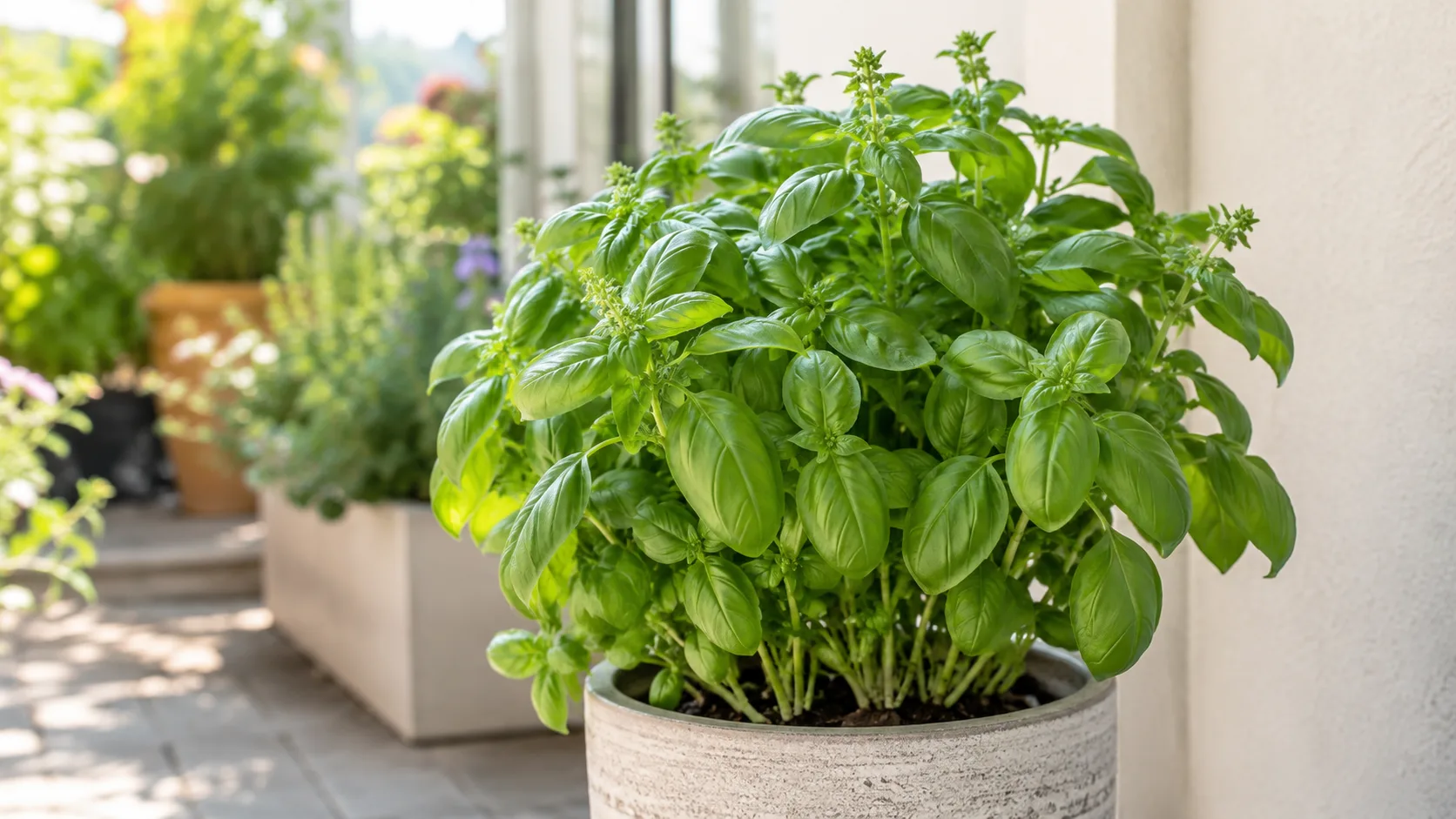
Healthy basil carries a full canopy of leaves and multiple growing tips—the shape to aim for after the reset.
Look for small leaves opening at the saved nodes and for new shoots pointing sideways rather than one replacement stem racing upward. The timing varies with temperature, light, variety, and root health, so judge progress by new growth rather than a rigid promise of a certain number of days. If nothing changes after the plant has had steady warmth, moisture, and strong light, inspect the roots, stem base, and leaves for a second problem.
Hold fertilizer until the plant is actively making new growth, and then use only a label-directed, balanced feed if the soil is depleted or the plant is container-grown. RHS notes that ground-grown basil often needs no extra feeding, while containers can run short of nutrients; it also cautions against high-potassium tomato feeds because they encourage flowering. Fertilizer is not a substitute for light, and excess fertilizer can create lush but weak growth or reduce flavor.
Pinch flower buds as they appear if leaf production is the goal. Remove yellowing leaves only when they are clearly declining, and keep fallen leaves off the soil surface. A little open space around the stems helps air move through the recovering canopy.
Harvest in a way that keeps basil bushy
Harvesting is maintenance, not a reward you postpone until the plant is enormous. When you remove a stem at a node, the plant gets an opportunity to branch; when you pluck random leaves from the bottom, you take away photosynthetic area without removing the tip that controls the shape.
Follow each branch from its growing tip to the next strong leaf pair. Cut just above that pair, taking the tender tip and leaves as a usable harvest. Repeat across several branches rather than emptying one side of the plant, and leave enough green leaves below the cuts to keep the plant productive.
Check the plant at least weekly during fast summer growth. Epic Gardening recommends regular trimming and explains that pinching just above leaf nodes encourages the small shoots at those nodes to develop; its harvest guidance also warns against pulling fragile stems. Penn State Extension recommends harvesting through the growing season, preferably before flowers open and, for freshness, during the cooler part of the day.
If the plant has flowered, remove the flower stems when you want to extend leafy harvests, but do not treat every flower as an emergency. RHS notes that basil flowers provide nectar for bees and other insects. With several plants, you can keep most pinched for cooking and allow one to flower for pollinators or seed.
Use the harvest promptly or keep cut stems in water at room temperature for short-term use. If you have more basil than you can cook, root healthy non-flowering tips in water or freeze leaves for later; a planned harvest is better than letting a crowded plant bolt because you were waiting for a single large picking.
When to restart with cuttings or fresh plants
A leggy basil is worth rescuing when the stem is green and flexible, the roots smell fresh rather than sour, and several nodes still have healthy leaves or side buds. It is also worth keeping if the plant is a favorite cultivar that is difficult to replace or if the growing season still has enough warmth left for new shoots to mature.
Take a cutting when the upper growth is healthy but the mother plant is too bare below the top nodes. Cut a non-flowering tip several inches long, remove the lower leaves, and place the stem in clean water with no leaves submerged. RHS notes that basil cuttings root readily and can be potted once roots form; change the water if it becomes cloudy and move the cutting to bright, warm light.
Start fresh when most of the stem is leafless and woody, the plant has persistent root or stem rot, disease is spreading, or cold weather is about to end the season. A new sowing or a healthy replacement can be more productive than spending weeks waiting for a plant with no viable nodes. If you are keeping the old plant for cuttings, discard clearly diseased material rather than propagating from it.
Common mistakes that make legginess return
Pruning without fixing the light is the biggest mistake. The cut may make the plant look shorter, but it does not change the amount of energy reaching the new leaves. Move the plant or improve the light first, then prune.
Cutting below every leaf pair removes the side shoots you need. Look closely at the node before you snip, and leave a short stem above it. If you cannot find a living node, do not force a neat shape; use a healthy tip as a cutting or wait for a lower shoot.
Removing all the leaves at once can starve the recovery. Basil needs remaining green leaves to support new growth, so keep the lower canopy unless a leaf is diseased or badly damaged. A series of moderate cuts is safer than one extreme reset.
Watering on a schedule instead of by soil condition creates a second problem. Dry basil needs a thorough drink, but wet basil needs air and time to drain. Check the root zone, the pot’s drainage hole, and the saucer before adding more water.
Adding fertilizer as the first rescue step is another common detour. A plant in weak light cannot use extra nutrients to make compact growth, and overfeeding can produce soft, overrapid shoots or encourage flowers. Wait for active regrowth, then feed lightly only if the container mix and plant condition justify it.
Leaving flower spikes in place tells the plant to keep prioritizing reproduction when you want leaves. Pinch them early, but remember that flowering is natural and can be a deliberate choice for pollinators or seed.
Keeping supermarket basil crowded can make the problem look mysterious. Retail pots often contain many seedlings competing in one small root zone; separating them carefully into several well-drained containers may be more effective than repeatedly pruning the crowded clump. If the root ball is badly tangled or the plant is already declining, replace it with a healthy transplant or start from seed.
Expecting old bare stems to refill leads to overhandling. Pruning activates viable nodes; it does not create new buds on every empty section. Judge the rescue by the quality of new shoots, not by whether the original stem becomes leafy from base to tip.
Conclusion
To bring back leggy basil, fix the growing conditions before you reach for the scissors. Give it strong, appropriate light, keep the soil evenly moist but well drained, remove flower spikes when leaf production is the priority, and cut stretched stems just above healthy nodes while leaving enough foliage for recovery.
Check the plant weekly and harvest the tips in a way that keeps creating side shoots. If the roots and nodes are healthy, the basil can become useful again; if the plant has no viable growth points, disease, or too little season left, a cutting or fresh plant is the more honest route to a bushy harvest.