How to Make Garlic Spray for Garden Pests
Learn a simple garlic-water spray recipe, how to dilute and apply it, which pests it may deter, and when garlic is not enough.
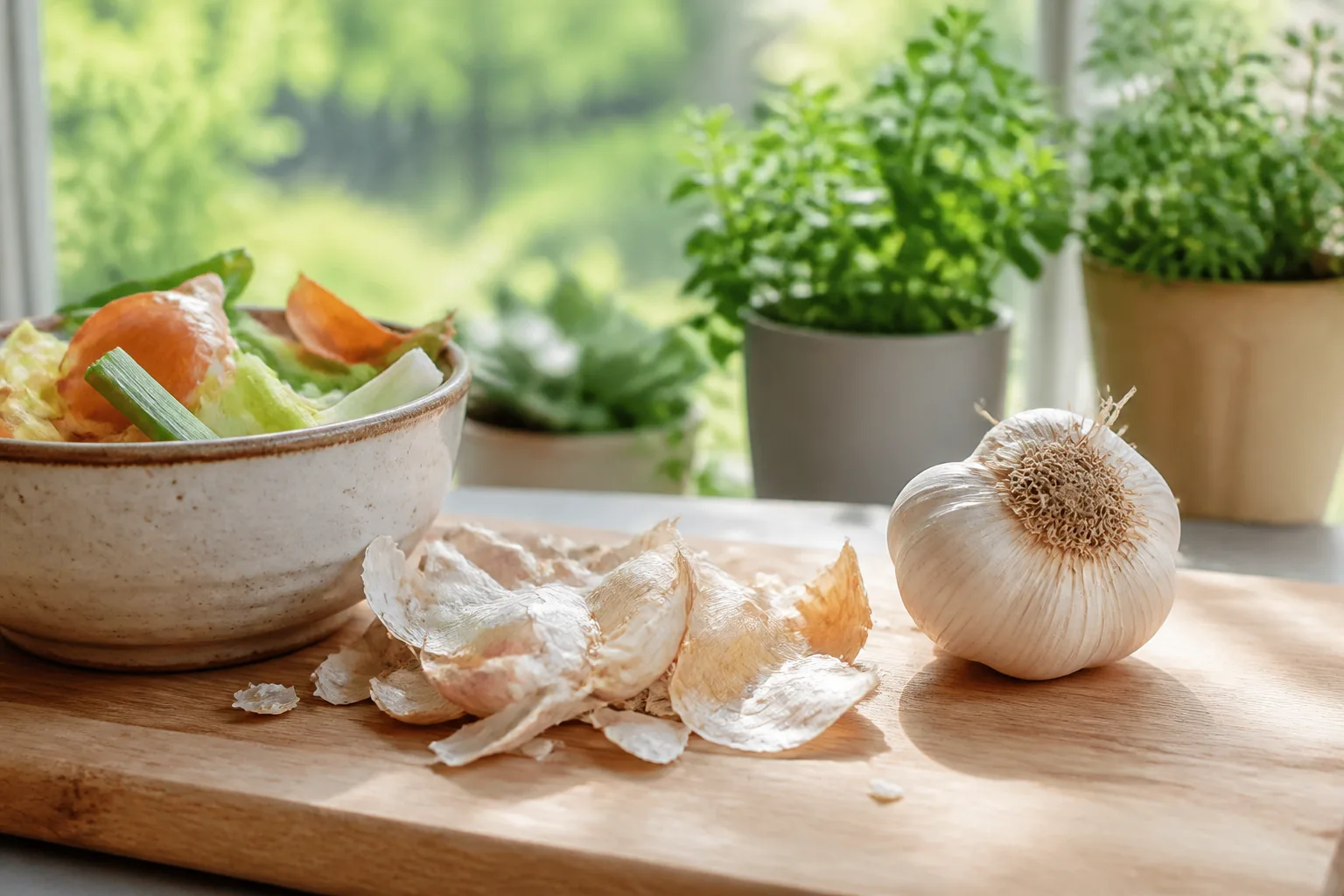
Garlic spray can be a useful natural pest deterrent, but it works best as a small part of a larger plan. The strong odor and sulfur compounds in garlic may discourage some insects and other garden pests from settling on treated foliage, while direct coverage can sometimes reduce exposed soft-bodied pests. It will not identify the pest for you, clear a serious infestation overnight, or replace sanitation, physical removal, barriers, and good growing conditions.
The safest way to try it is to make a plain garlic-water concentrate, dilute it generously, test it on a few leaves, and apply it only where a confirmed pest is active. That approach also avoids the most common homemade-spray mistake: adding several untested ingredients, increasing the concentration, and assuming “natural” means harmless.
The Quick Answer: Garlic Is a Deterrent, Not a Cure-All
To make a basic garlic spray, blend four to five garlic cloves with about 4 cups of water, strain the liquid extremely well, and dilute one part of the concentrate with 10 parts water before spraying. This starting point reflects practical horticulture recipes, not a universal pesticide label; the garlic variety, water volume, plant species, pest, weather, and coverage all change the result (Gardening Know How, Epic Gardening).
Use the spray when you have identified a pest and can see where it is feeding. Apply it to the affected leaves and stems during a cool, calm part of the day, keep it off open flowers, and check the plant for damage over the next 24 to 48 hours. If the pest population is still growing after one or two careful applications, stop increasing the garlic concentration. Change the management method instead.
What Garlic Can and Cannot Do
Garlic’s role is easiest to understand if you separate three actions:
- Deterrence: The odor may make treated foliage less attractive to some pests for a limited time.
- Direct contact: A wet spray can affect a pest that it actually hits, especially when soap or oil is present—but those additives also change the plant and wildlife risks.
- Pest management: Garlic spray can reduce pressure while you remove pests, improve airflow, repair barriers, or correct a source problem.
Those are not the same as eradication. A spray sitting on one leaf cannot reach eggs hidden in soil, larvae inside a stem, a caterpillar under dense foliage, or slugs arriving from damp hiding places at night. Even practical gardening sources that recommend garlic spray describe repeated applications and incomplete control rather than a single treatment that eliminates every pest (Epic Gardening).
Think of garlic spray as a short-lived signal on the plant, not a force field around the garden. Rain, irrigation, ultraviolet light, new growth, and the pest’s life cycle all reduce how long the effect lasts. If the underlying conditions keep favoring the pest, the next generation will arrive after the smell fades.
Identify the Pest Before You Reach for the Spray
“Something is eating my plant” is not enough information to choose a treatment. Look at the pest, the damage pattern, and the location before mixing anything. Aphids clustered on tender growth, whiteflies lifting from the underside of leaves, beetles chewing irregular holes, caterpillars leaving frass, and slugs making ragged nighttime damage are different problems even when the leaves look similarly tattered.
Integrated pest management begins with identification and monitoring, then asks whether the damage is severe enough to justify control. UC IPM describes that sequence as identifying the pest, assessing its numbers and damage, preventing the problem, combining management tools, and evaluating the result afterward (UC Statewide IPM Program). That is a better starting point than spraying every plant because one leaf has a hole.
Pests Garlic May Discourage
Garlic spray is most reasonable as a trial when pests are exposed on the foliage and the goal is to make the plant less inviting. Practical garden sources commonly discuss garlic in connection with aphids, whiteflies, thrips, ants, some beetles, caterpillars, armyworms, slugs, and snails. That list describes pests gardeners may try it against, not a guarantee that the same mixture will work on all of them.
The best candidates are pests you can see and target directly. For example, a light garlic-water treatment may be worth testing on the new growth where a small aphid colony is beginning. It is much less convincing as the only response to a mature beetle population, a caterpillar hiding inside a curled leaf, or a slug problem that is being fed by constant nighttime moisture.
Start with the smallest area that matters. Treat one plant or one row, leave a similar untreated plant if you have enough space, and compare fresh damage over several days. You do not need a laboratory trial to make a garden decision, but you do need a baseline; otherwise you cannot tell whether the spray helped, the weather changed, or the pest simply moved.
Problems Garlic Spray Will Not Solve Well
Garlic spray is a poor first choice when the problem is not a surface pest. It will not fix root-feeding larvae, stem borers, soil-borne disease, nutrient deficiency, drought stress, overwatering, virus symptoms, or damage caused by animals. A strong smell can also distract you from the real cause: leaves may be torn by wind, chewed by a night-feeding pest, or marked by a fungal disease rather than an insect.
It is also a weak stand-alone answer when the pest is protected. Aphids under tightly curled leaves, scale insects under waxy covers, thrips inside flowers, and larvae inside plant tissue may not receive enough direct exposure. In those cases, identification, pruning of heavily damaged tissue, washing, exclusion, a targeted biological control, or a labeled product may be more effective than making the garlic mixture stronger.
Do not spray a whole vegetable garden simply because one plant has damage. Broad coverage can expose pollinators and predators to a substance they did not need to encounter, while leaving the actual host plant or breeding site untreated.
A Simple Garlic-Water Spray Recipe
This recipe is designed to be a small, plain starting batch. It leaves out dish soap, oil, hot pepper, and essential oils so you can evaluate garlic by itself and reduce the number of variables that can scorch leaves or affect non-target organisms.
You will need:
- 4 to 5 fresh garlic cloves
- 4 cups of water
- A blender, food processor, mortar and pestle, or knife
- A bowl or jar
- Cheesecloth, a fine sieve, or a paper coffee filter
- A clean spray bottle
- A measuring cup for dilution
If you are treating edible crops, use clean equipment that has not held household cleaners or other garden chemicals. Label the bottle with the date and the contents. Do not store it in a food container that could be mistaken for a beverage.
Blend, Strain, and Dilute the Concentrate
- Crush the cloves. Peel them if you want a cleaner mixture, then crush or mince them thoroughly. More exposed surface area releases more of the garlic’s soluble and volatile compounds into the water.
- Blend with the water. Add the crushed garlic and water to a blender and process until the mixture is as smooth as practical. If you are using a knife, mince it finely and let it sit in the water while you work.
- Strain more than once. Pour the liquid through cheesecloth or a coffee filter into a clean jar. Small particles clog spray nozzles and leave concentrated bits on leaves, where they can increase the chance of injury.
- Dilute before it touches a plant. Mix one part of the strained concentrate with 10 parts water. For a small test batch, measure ¼ cup concentrate and add 2½ cups water. Make only what you can use soon; practical recipes note that homemade garlic mixtures lose potency over time (Gardening Know How, Epic Gardening).
- Agitate and label. Swirl the diluted spray before filling the bottle. Write the dilution and date on masking tape so you do not forget what is inside.
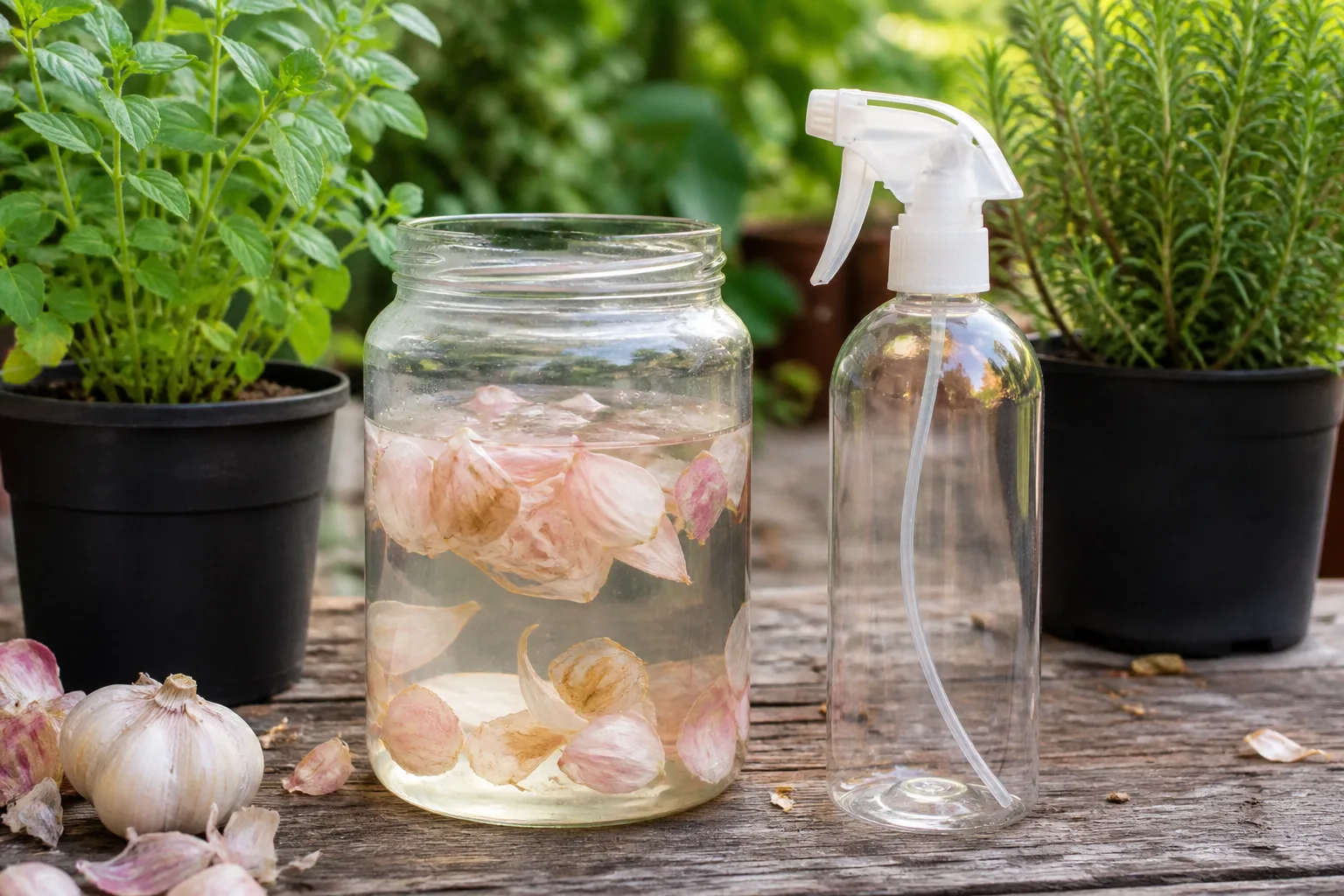
A strained garlic preparation and clean spray bottle make the treatment easier to measure and apply consistently.
The mixture is a homemade botanical preparation, not a registered product with a tested rate for every crop and pest. That distinction matters. Treat the 1:10 dilution as a conservative starting point for a small patch test, not as permission to double the garlic whenever the first application seems ineffective.
How to Apply Garlic Spray Without Scorching Plants
Application technique often matters more than the recipe. A weak spray that reaches the pest is more useful than a strong spray that runs off the leaf, pools in a flower, or dries in hot sun.
Patch-Test and Choose the Right Timing
Before treating the entire plant, spray two or three leaves—ideally one older leaf and one tender leaf. Wait at least 24 hours and look for bronzing, bleached spots, translucent patches, curled edges, or a dull film. If damage appears, rinse the plant with clean water and do not use that mixture on the rest of the crop.
Apply in the early evening or another cool period when the leaves can dry without intense direct sun. Epic Gardening recommends early-evening application for garlic spray, and the RHS warns that homemade mixtures containing oils, washing-up liquid, or essential oils can scorch plants and harm organisms because they are not properly tested (Epic Gardening, RHS). Do not spray before a hot afternoon, during a heat wave, or onto drought-stressed plants.
Choose a calm day. Wind turns a targeted treatment into drift, and drift is especially undesirable when the garden is flowering or when nearby plants are edible. If rain is likely immediately after application, wait unless you are treating an urgent, visible problem and can accept that the spray may wash off.
Cover the Pest, Not the Whole Garden
Shake the bottle and mist the upper and lower leaf surfaces, stems, and tender growth where the pest is actually present. The underside matters for aphids, whiteflies, mites, and thrips, but do not force the liquid into every flower or spray open blooms. Stop when the foliage is evenly damp; leaves do not need to drip.
Treat a small patch first, then reassess after two or three days. If fresh damage has slowed and the plant shows no injury, repeat only while the pest is present. Practical sources commonly suggest about weekly use and reapplication after rain, but a fixed schedule is not automatically right for every crop or climate (Gardening Know How, Epic Gardening). Use the lightest frequency that gives you a measurable benefit.
Do not spray right before harvest if the crop will carry a strong odor or residue. Follow the crop’s washing and harvest practices, and never assume a homemade spray has the same preharvest interval as a labeled product. For leafy greens and herbs, targeted treatment away from harvestable tissue is the safer choice.
Should You Add Soap, Oil, Hot Pepper, or Onion?
The short answer is not at first. Adding ingredients can change how the liquid spreads, how long it stays wet, how it interacts with the leaf cuticle, and what it does to beneficial insects. It also makes it impossible to tell whether garlic itself helped.
Hot pepper may add an irritant effect, but it also creates a skin and eye exposure problem and can make a spray more unpleasant for children, pets, and wildlife. Essential oils are concentrated plant extracts, not automatically gentle plant tonics. Vegetable oils can increase coverage or smother some pests, but they can also increase leaf injury in heat or sun and may not mix evenly without an appropriate emulsifier.
Onion is another strongly scented allium, but adding more pungent material does not create a tested rate for your crop. If the plain garlic-water treatment fails, first ask whether the pest was identified correctly and whether the spray reached it. Escalating the recipe is not the same as improving the treatment.
Why Household Dish Soap Is a Risky Shortcut
Dish soap is often included in homemade recipes because it helps wet a leaf and can disrupt the bodies of small soft-bodied insects on direct contact. That does not make every dish detergent an insecticidal soap. Household products can contain fragrances, degreasers, solvents, or other ingredients that are harsher on plant tissue than a product formulated and labeled for garden use.
The RHS specifically warns that homemade brews containing washing-up liquid and similar ingredients may pollute the environment or harm plants by scorch. Epic Gardening likewise distinguishes a mild surfactant such as castile soap from harsher dish soap in its discussion of homemade sprays (RHS, Epic Gardening).
For a garlic deterrent, leave dish soap out. If you need a contact treatment for aphids, whiteflies, or another pest that a soap product is labeled to control, use a commercial insecticidal soap exactly as its label directs and do not assume it can be mixed with garlic concentrate. Test it separately. More ingredients mean more chances of incompatibility, leaf injury, and non-target exposure.
Protect Beneficial Insects, Pets, and Edible Crops
“Organic,” “natural,” and “homemade” describe where an ingredient came from; they do not guarantee that a spray is harmless. The garlic mixture may deter a pest, but a wet spray can also contact predators, pollinators, soil organisms, or animals that investigate the smell. RHS guidance notes that oils and soaps can kill non-target species, while UC IPM recommends selecting and applying pest-control materials in ways that minimize risk to beneficial and non-target organisms (RHS, UC Statewide IPM Program).
Use these guardrails:
- Spray only the affected plant or a defined patch, not every flowering plant in the yard.
- Keep garlic spray off open flowers, especially when bees, hoverflies, butterflies, and other pollinators are visiting.
- Avoid spraying directly on lady beetles, lacewings, hoverfly larvae, predatory mites, and spiders that are already reducing the pest population.
- Do not spray into ponds, streams, birdbaths, or areas where runoff can collect.
- Keep the bottle away from children and pets, and rinse measuring equipment after use.
- Wash edible crops thoroughly and follow all crop-specific food-safety practices; never treat a homemade mixture as if it had a commercial product’s label directions.
Garlic itself is a serious ingestion concern for companion animals. ASPCA lists garlic (Allium sativum) as toxic to dogs, cats, and horses, with possible signs including vomiting, weakness, panting, blood in the urine, and damage to red blood cells (ASPCA Animal Poison Control). A diluted foliar spray is not the same exposure as eating cloves, but that is not a reason to leave garlic concentrate where a pet can drink it or lick wet foliage. Store leftovers securely, keep pets away until treated leaves are dry, and contact a veterinarian or animal poison service if ingestion may have occurred.
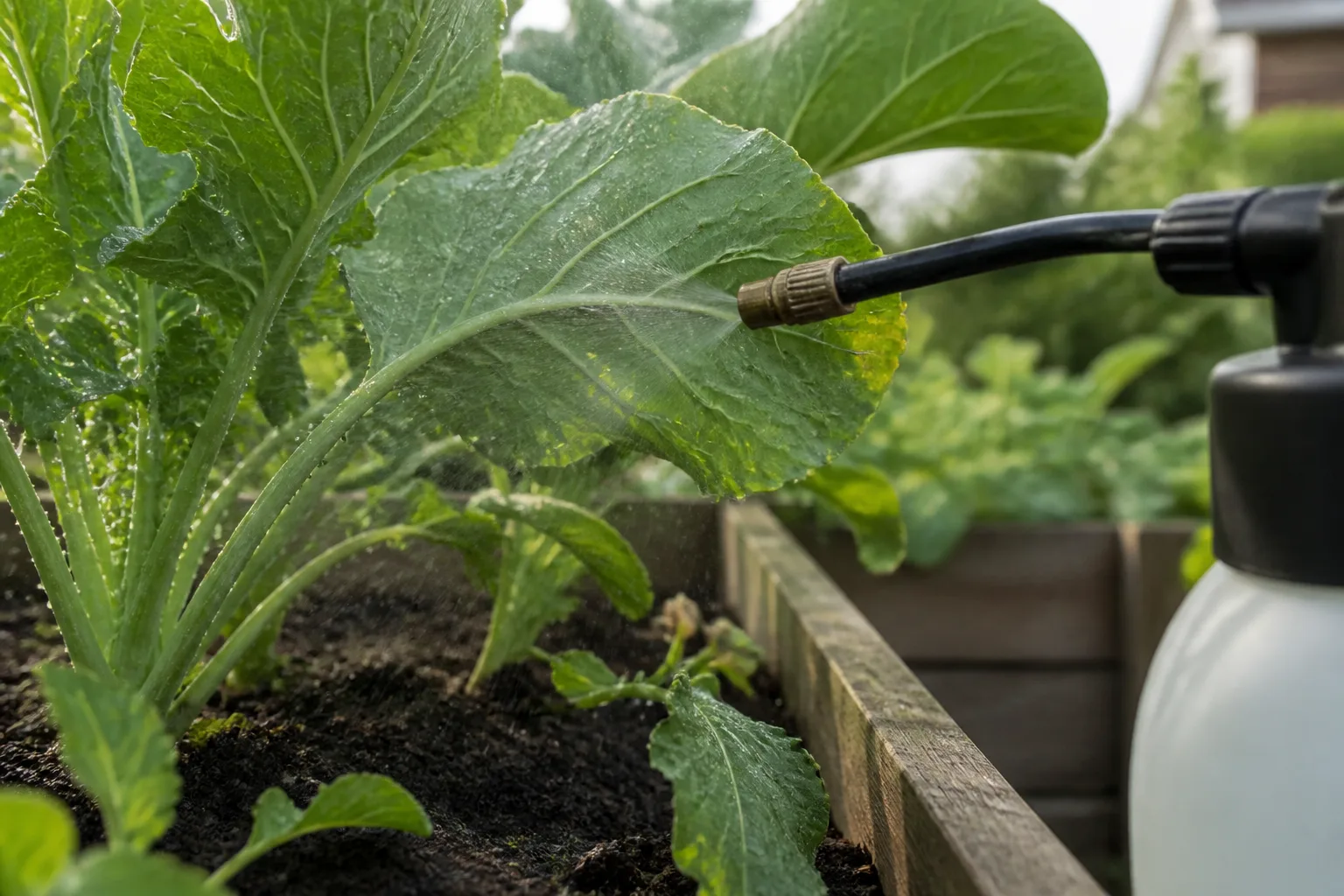
Targeted leaf coverage is the goal; avoid turning a pest treatment into a broadcast spray across the whole garden.
Build an IPM Plan Around Garlic Spray
Garlic becomes more useful when it sits inside an integrated pest management routine. The point is not to avoid every intervention; it is to choose the least disruptive combination that controls unacceptable damage. UC IPM describes IPM as an ecosystem-based process that combines biological, cultural, physical, and chemical controls, using pesticides only when monitoring shows they are needed (UC Statewide IPM Program).
Source Control and Mechanical Follow-Up
Begin with a short inspection at the same time each day for a week. Check new growth, leaf undersides, flower buds, the soil line, mulch, nearby weeds, and the edges of containers. Note the pest, the number you see, the amount of new damage, the weather, and the action you took. This turns “the plant looks worse” into a useful pattern.
Then match the first control to the pest:
- Aphids: Wash small colonies off with a firm but plant-safe stream of water, prune badly infested tips, and look for ants protecting the colonies. RHS recommends washing aphid colonies from plants and encouraging natural predators such as hoverflies (RHS).
- Caterpillars and beetles: Hand-pick visible insects and inspect the undersides of leaves. Use insect netting where it fits the crop and season.
- Slugs and snails: Search at dusk or early morning, remove hiding places that stay excessively wet, and hand-pick. Garlic spray is not a substitute for addressing the habitat that keeps them active.
- Whiteflies and thrips: Use a hand lens, shake a leaf over white paper, and check whether the pest is on the underside, in flowers, or at the growing point. A broad spray can also hit natural enemies without reaching protected stages.
- Ants: Find out whether they are simply passing through, farming aphids, or nesting under a pot or paving. Spraying leaves will not remove the colony or its food source.
Watering and sanitation matter too. Overly wet conditions can strengthen some pest and disease cycles, while stressed or weakly growing plants often tolerate feeding damage poorly. Keep beds free of dense volunteer weeds where they harbor pests, remove badly infested plant debris, and avoid pushing soft, succulent growth with excessive nitrogen.
Planting garlic nearby can be a useful garden-design experiment, but it should not be treated as proof of protection. A companion plant does not put a uniform garlic film on the crop, and results depend on spacing, wind, pest pressure, crop variety, and timing. Grow garlic because you want the harvest and the garden diversity; use a targeted treatment when monitoring shows one is justified.
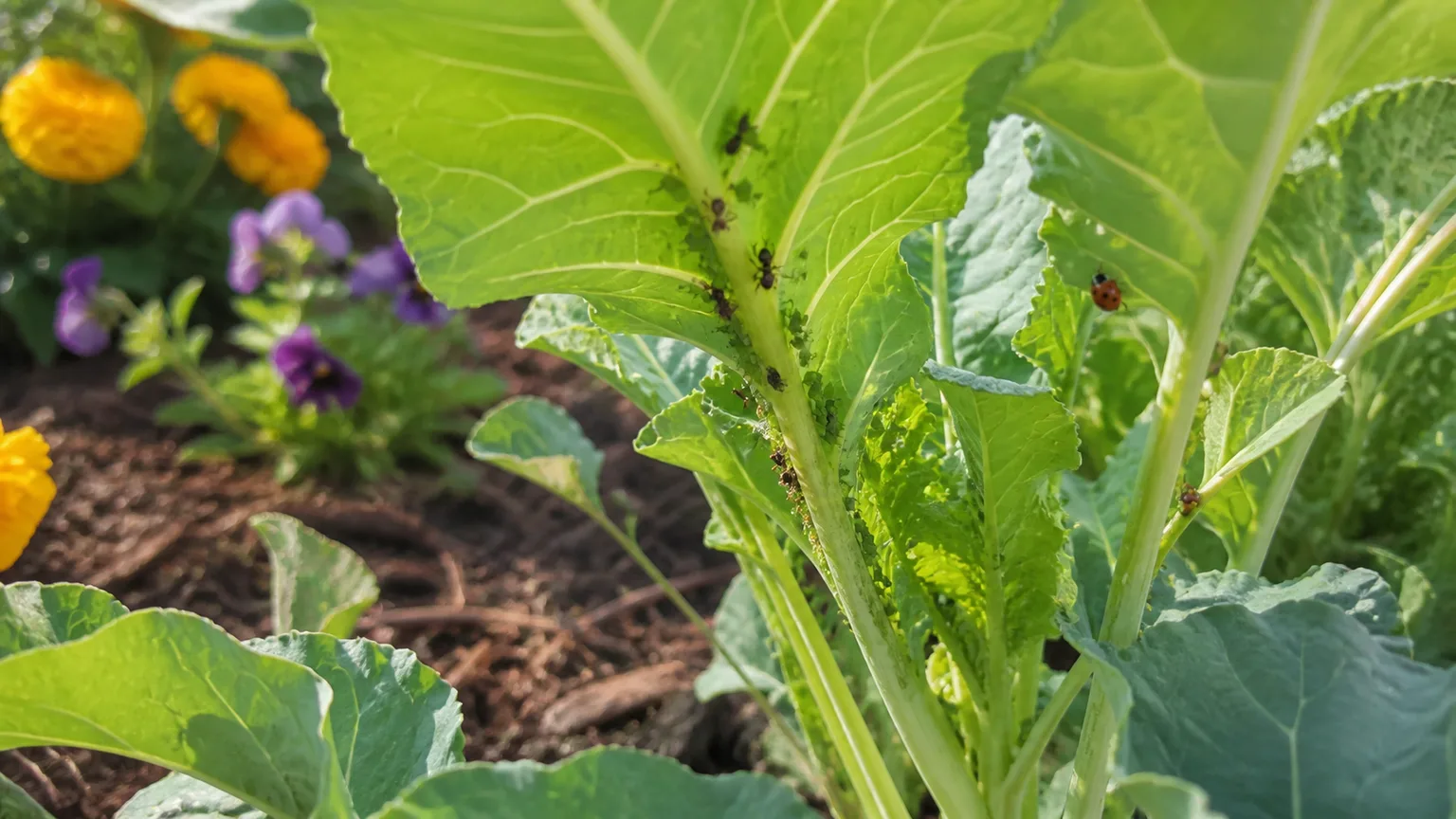
Inspect the pest and the surrounding beneficial insects before deciding whether a spray is justified.
Troubleshoot Failure and Decide on the Next Step
If garlic spray seems useless, do not immediately add more cloves. Work through this checklist:
- Was the pest identified correctly? A fungal spot, chewing mammal, nutrient problem, or root pest will not respond to a leaf spray.
- Was the pest exposed? Look under leaves, inside flowers, in curled growth, and at the soil surface. Contact requires contact.
- Was the mixture too weak, too old, or poorly strained? Homemade garlic water loses strength and clogged nozzles produce uneven coverage.
- Did rain or irrigation wash it off? Check the weather and the timing before assuming the ingredient failed.
- Was there a new source of pests? Weeds, infested nursery plants, ants, nearby crops, and open windows can keep pressure high.
- Is the damage actually increasing? A few old holes may remain even after the pest is gone. Judge new damage and live pest numbers, not the appearance of already injured leaves.
Stop using the spray if leaves show scorch, the plant wilts after treatment, or beneficial insects are being hit. Rinse foliage with clean water if the product is still wet, move container plants out of harsh sun, and wait for new growth before trying any other foliar treatment.
Move to a labeled product or professional help when the pest threatens the crop, spreads rapidly, affects many plants, is hidden inside stems or soil, or may transmit a serious plant disease. A labeled product gives you crop, pest, rate, timing, and safety directions that a homemade recipe cannot. Ask a local extension service, nursery professional, or licensed pest manager for identification before escalating if you are unsure.
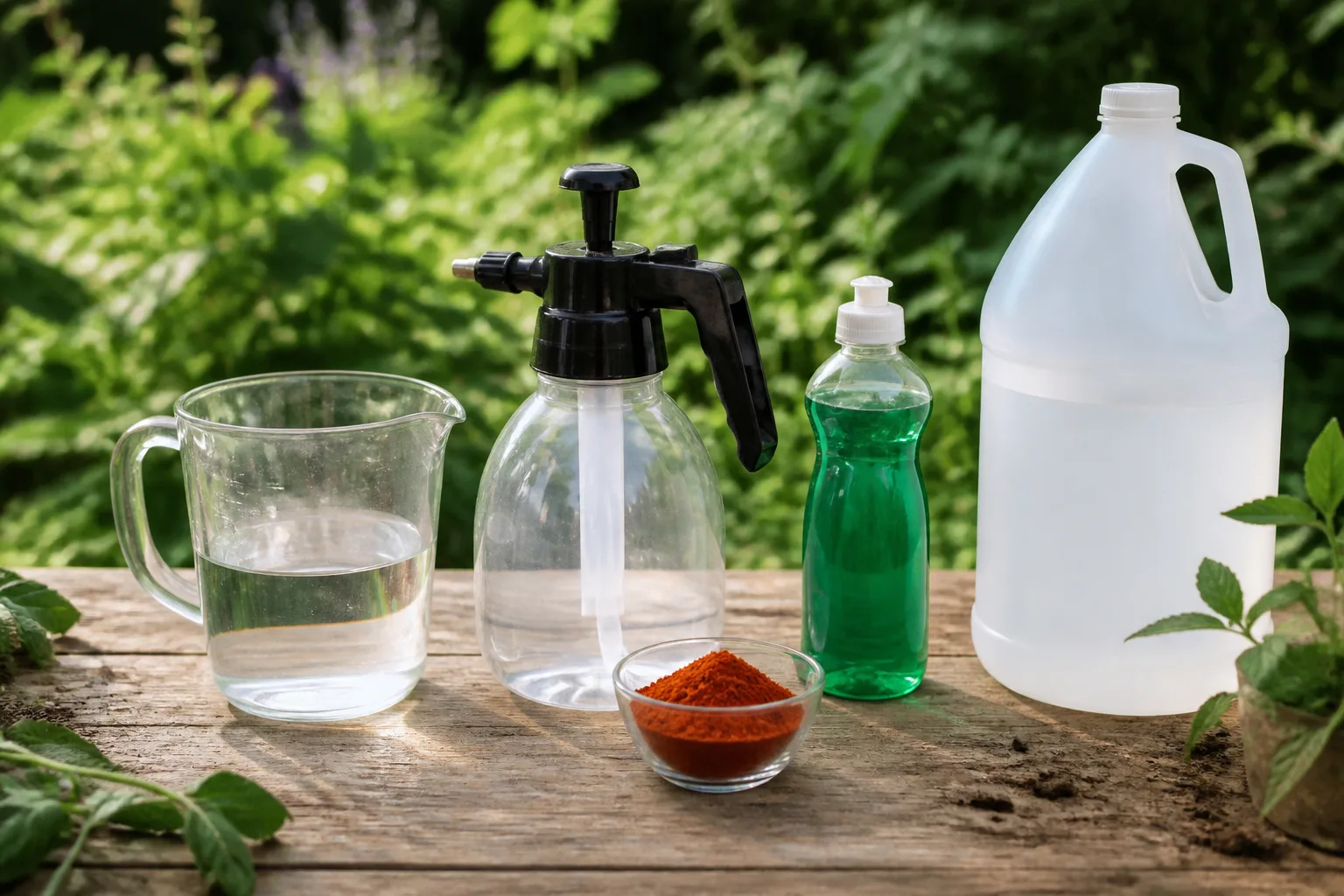
Measuring materials before mixing helps prevent the common mistake of making an increasingly concentrated homemade spray when the real problem is misidentification or poor coverage.
Conclusion
Garlic spray is worth trying when you have a small, visible pest problem and want a low-cost deterrent that fits a broader IPM plan. Make a plain garlic-water concentrate, strain it carefully, dilute it, patch-test it, and apply it only to the affected foliage in cool conditions. Leave household dish soap, oil, hot pepper, and essential oils out unless you have a specific, separately tested reason to use them.
The most important step is not the recipe. Identify the pest, monitor fresh damage, remove pests or breeding sites mechanically, protect beneficial insects, and decide honestly whether the garlic treatment is helping. If it is not, stop increasing the strength and choose a more targeted, labeled, or expert-supported solution.



