How to Grow and Care for Ivory Silk Lilac
Plant and care for Ivory Silk lilac in full sun with practical guidance on spacing, first-year watering, pruning, flowering, pests, and blight.
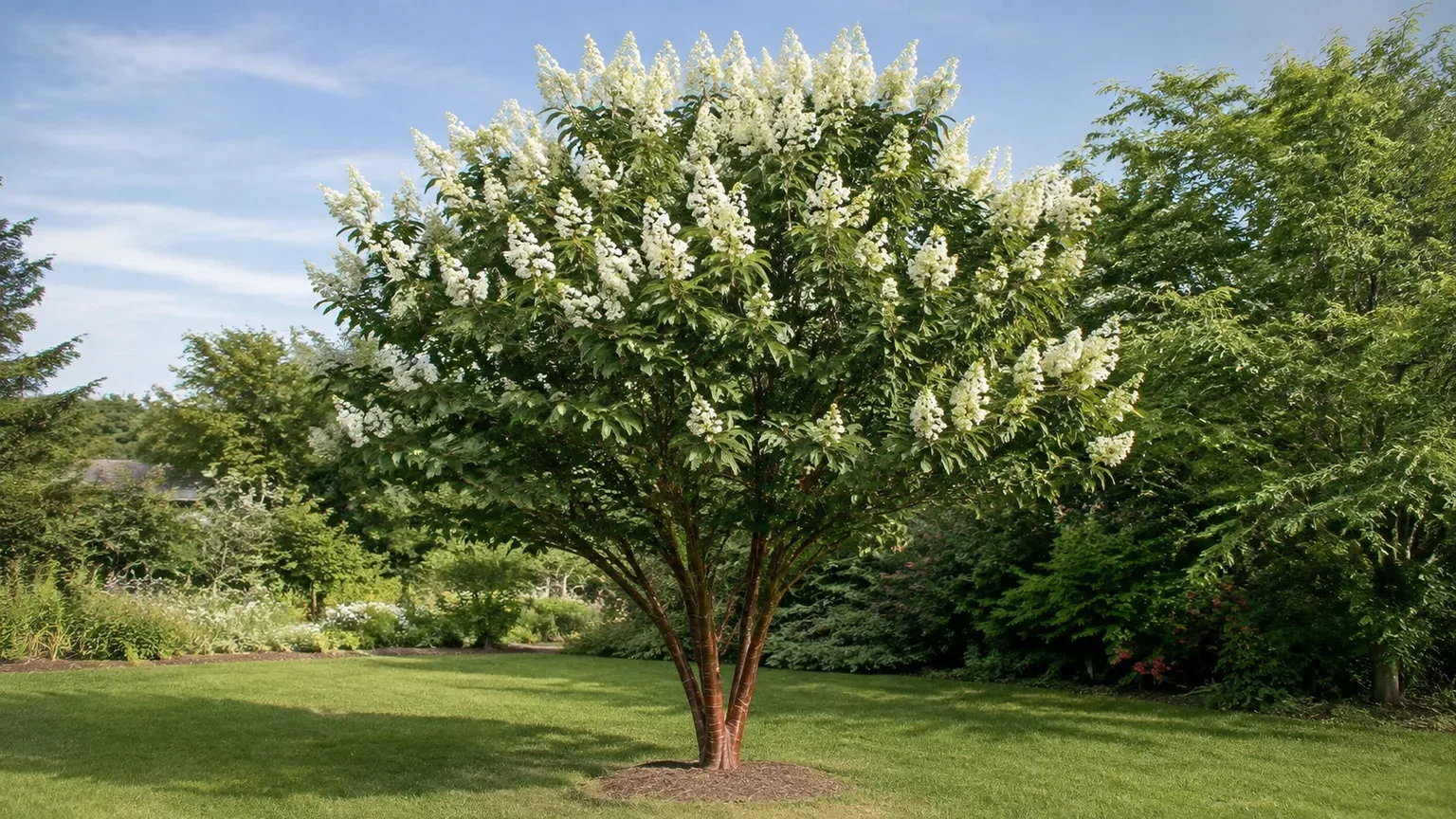
Ivory Silk lilac (Syringa reticulata ‘Ivory Silk’) is a small flowering tree with a surprisingly useful combination of traits: large creamy-white flower panicles in early summer, polished reddish-brown bark, a manageable but real mature canopy, and better tolerance of urban conditions than many delicate ornamentals. It is a Japanese tree lilac, not simply a common lilac trained onto a trunk, so its timing, scent, and pruning needs deserve their own plan.
The most important care decision happens before planting. Give this deciduous tree full sun, good drainage, and enough room for a 20- to 25-foot tree with a 15- to 20-foot spread. Water deeply while it establishes, keep nitrogen modest, and prune with a purpose—usually after flowering for size control, or during dormancy for structural corrections. The Oregon State University Department of Horticulture describes the species as a trouble-free small tree or shrub with showy white clusters, while Purdue Arboretum notes its broad soil adaptability and attractive bark (Oregon State University, Purdue Arboretum Explorer).
What makes Ivory Silk lilac different from shrub lilacs
The name “lilac tree” can create the wrong expectation. Traditional French lilacs are usually multi-stemmed shrubs valued for spring flowers and strong perfume. ‘Ivory Silk’ is a compact cultivar of Japanese tree lilac that can be sold in a single-trunk tree form or allowed to grow as a multi-stemmed large shrub. Its leaves are broad and dark green, its bark develops a cherry-like reddish-brown sheen, and its flowers arrive after many familiar lilacs have finished.
That later show is one of its best landscape qualities. In many temperate gardens, the bloom window falls in early summer, often around June or July, but a warm spring, local exposure, and the tree’s age can move the date. The flowers are creamy white panicles rather than the dense purple or pink clusters people associate with old-fashioned lilacs. Fragrance is also variable: some horticultural references call the blooms fragrant, while others describe a lighter or even privet-like scent. Plant it for the flowers, bark, and form first; treat scent as a pleasant bonus rather than a guarantee.
Choose a site that fits the mature tree
Choose the brightest practical position, ideally one that receives at least six hours of direct sun. The tree can tolerate some partial shade, but shade is a common reason for sparse flowering, a thinner crown, and slower drying after rain. Morning sun is helpful in humid areas because it dries leaves and flowers earlier; afternoon sun is valuable for maximum bloom but can increase drought stress beside reflective walls or pavement.
‘Ivory Silk’ is generally listed for USDA hardiness zones 3 through 7. That range describes average winter minimums, not every condition that shapes success. A tree can survive winter in a suitable zone yet struggle in a hot, humid site with poor airflow, reflected heat, or irrigation that keeps the soil saturated. If your garden regularly has long, hot summers, prioritize an open site with moving air and reliable drainage rather than planting it in a damp corner simply because it is sunny.
Plan for the larger end of the published range when clearance matters. A mature tree may be about 20 to 25 feet tall and 15 to 20 feet wide, and some references allow up to 30 feet in favorable conditions. Gardenia lists a 20- to 25-foot height, 15- to 20-foot spread, and a spacing range of roughly 15 to 20 feet (Gardenia’s cultivar profile). Do not tuck it beneath utility lines, against a wall, beside a narrow foundation bed, or where branches will block a driveway in a few years.
Think about the canopy as well as the roots. Leave room for air to pass around the crown, and avoid crowding it against a dense hedge or another tree. A foundation planting can work if the bed is broad enough and the mature spread is measured from the trunk, not from the edge of the nursery container. The roots are not known for being an aggressive, surface-destroying system, but no woody plant should be planted where the soil stays waterlogged beside a foundation.
The soil does not need to be perfect. Purdue describes the species as widely adapted to different soils, and Gardenia lists clay, loam, sand, and a broad pH tolerance. The practical requirement is drainage: water should soak away rather than remain pooled around the root ball. If a hole fills with water after a normal rain, fix the site or choose another one; adding a little compost to a chronically wet hole will not solve the underlying problem.
Plant Ivory Silk lilac correctly
Plant a container-grown tree in spring after the ground is workable or in early fall while the soil is still warm. Spring planting gives roots a full growing season but can demand more watering as temperatures rise. Early fall often offers milder air and naturally moist soil, but the tree still needs enough time to establish before the ground freezes. Avoid planting into frozen soil, a saturated bed, or a heat wave when you cannot keep the root zone evenly moist.
Before digging, set the container on the proposed spot and look at the tree from the windows and paths it will frame. Confirm mature clearance now. If the tree is balled and burlapped, plan to remove all visible rope and as much wrapping as the root ball allows after it is in the hole; never leave synthetic ties around the trunk. For a container tree, slide it out carefully and inspect for circling roots. Loosen only the outer roots that are tightly bound—do not tear the root ball apart.
Use this sequence:
- Dig a hole two to three times wider than the root ball but no deeper than the root ball’s soil height.
- Set the tree so the root flare—the point where the trunk broadens into major roots—is level with or slightly above the surrounding soil. A deep-planted tree can look stable at first while its buried trunk and roots remain chronically wet.
- Turn the best-facing branches toward the view, then backfill with the soil you removed. Amend the entire planting bed only when the native soil genuinely needs improvement; do not create a rich, loose pocket surrounded by hard clay.
- Water slowly until the full root ball and surrounding soil are wet. This settles soil around roots better than tamping hard.
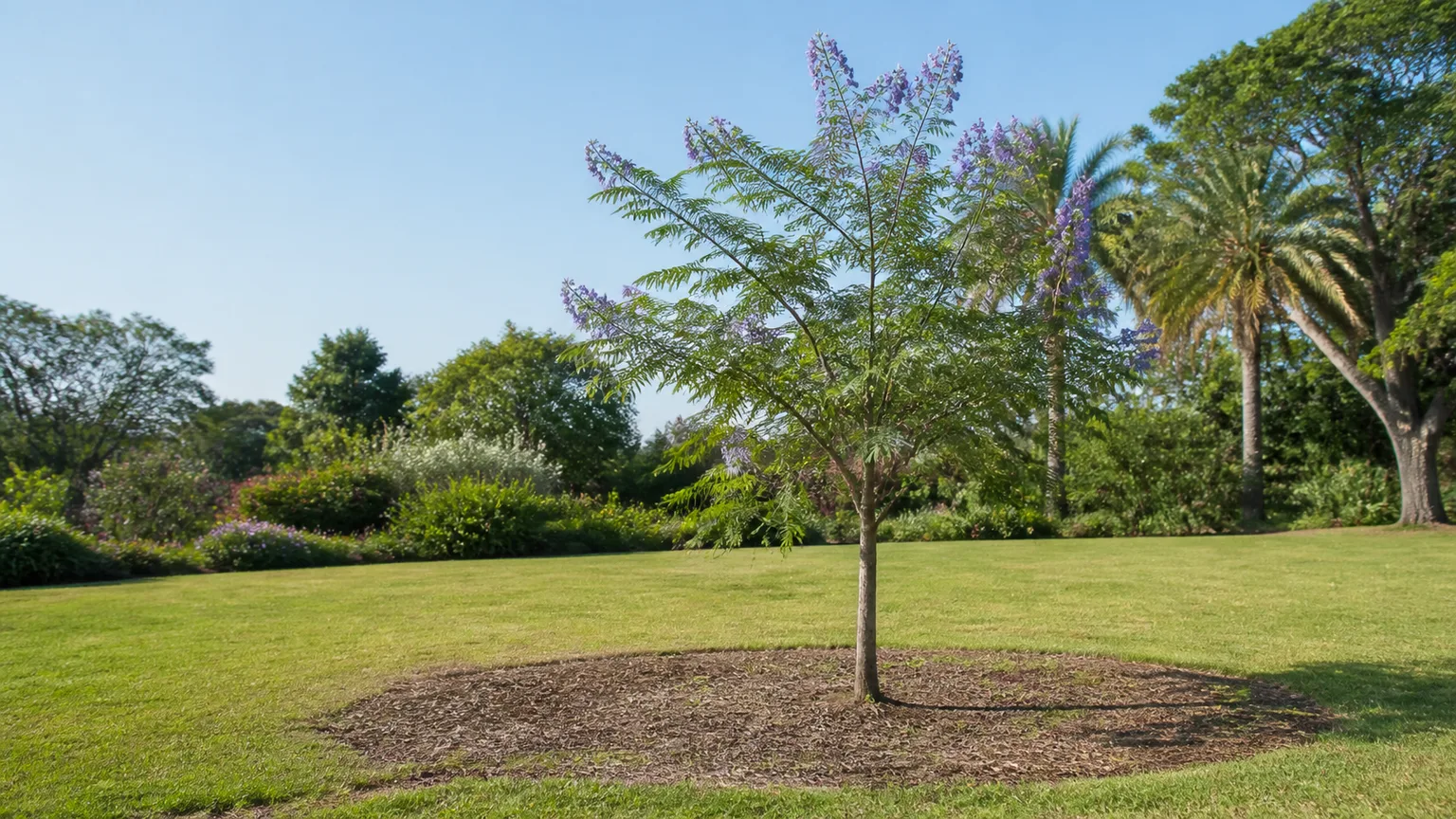
- Spread about 2 to 3 inches of organic mulch over the root zone, widening it as the tree grows. Keep mulch several inches away from the trunk so the bark stays dry.
The planting hole should be wide because new roots spread outward, not because the tree needs a deep reservoir. A mulch ring also reduces competition from grass and makes moisture easier to monitor, but it is not a substitute for drainage. A broad, shallow ring is healthier than a volcano of mulch against the trunk.
Watering during establishment and drought
For the first growing season, check the soil rather than following a calendar blindly. Push a finger or hand trowel 2 to 4 inches into the soil near the root ball, or use a moisture probe if your soil makes that test difficult. If that zone is dry and there has been little rain, water slowly and thoroughly. During hot weather, a deep soak every few days is more useful than a token splash every day because it wets the developing root zone without keeping the surface constantly soggy.
Continue active monitoring through the second growing season, especially in sandy soil, beneath roof eaves, or beside pavement. A young tree may need weekly irrigation during dry periods, but rainfall, soil texture, temperature, and mulch all change the actual interval. Water at the soil surface or with a soaker line; frequent overhead sprinkling wets foliage without reliably wetting the root ball and can increase disease pressure.
Once established, Japanese tree lilac is relatively drought tolerant, not drought-proof. During a prolonged hot, dry spell, water the root zone deeply before leaves wilt, particularly if the tree is carrying a heavy flower crop or growing in a restricted lawn strip. Yellowing leaves and wilting can indicate thirst, but they can also follow waterlogged roots. Check the soil and drainage before increasing irrigation.
Soil, fertilizer, and mulch that support flowering
Ivory Silk lilac performs in average soil as long as it drains. A slightly acidic to neutral soil is a comfortable target, but do not add lime or sulfur just because a generic lilac recipe says to. Test the soil if growth is poor or the site has a history of construction fill, and correct a documented deficiency rather than guessing from leaf color.
Fertilizer is rarely the first answer to weak bloom. Too much nitrogen can push soft leafy growth at the expense of flowers and can make a tree more vulnerable to stress. If a soil test or repeated weak growth indicates a need, apply a modest, slow-release tree-and-shrub fertilizer in early spring and follow the label. MyGardenLife similarly recommends established trees be fed only every two to three years when needed, with package rates followed carefully (MyGardenLife care guidance). Never pile fertilizer against the trunk or apply a concentrated lawn product over the root zone.
Mulch is more valuable as a moisture and temperature buffer than as a yearly nutrient dose. Keep the layer shallow enough that rain can reach the soil, pull it back from the trunk, and refresh only what has decomposed. Grass competition can rob a new tree of water, so a clean, mulched ring usually helps more than a larger dose of fertilizer.
Pruning for a strong frame and reliable blooms
What to prune and what to leave alone
Start by identifying the plant’s intended form. A tree-form ‘Ivory Silk’ should have one trunk or a deliberately selected group of permanent trunks with clear space beneath the crown. A shrub-form plant can keep several stems from the base. Do not force a multi-stemmed shrub into a tree by repeatedly topping the canopy; choose the form at planting and guide it gradually.
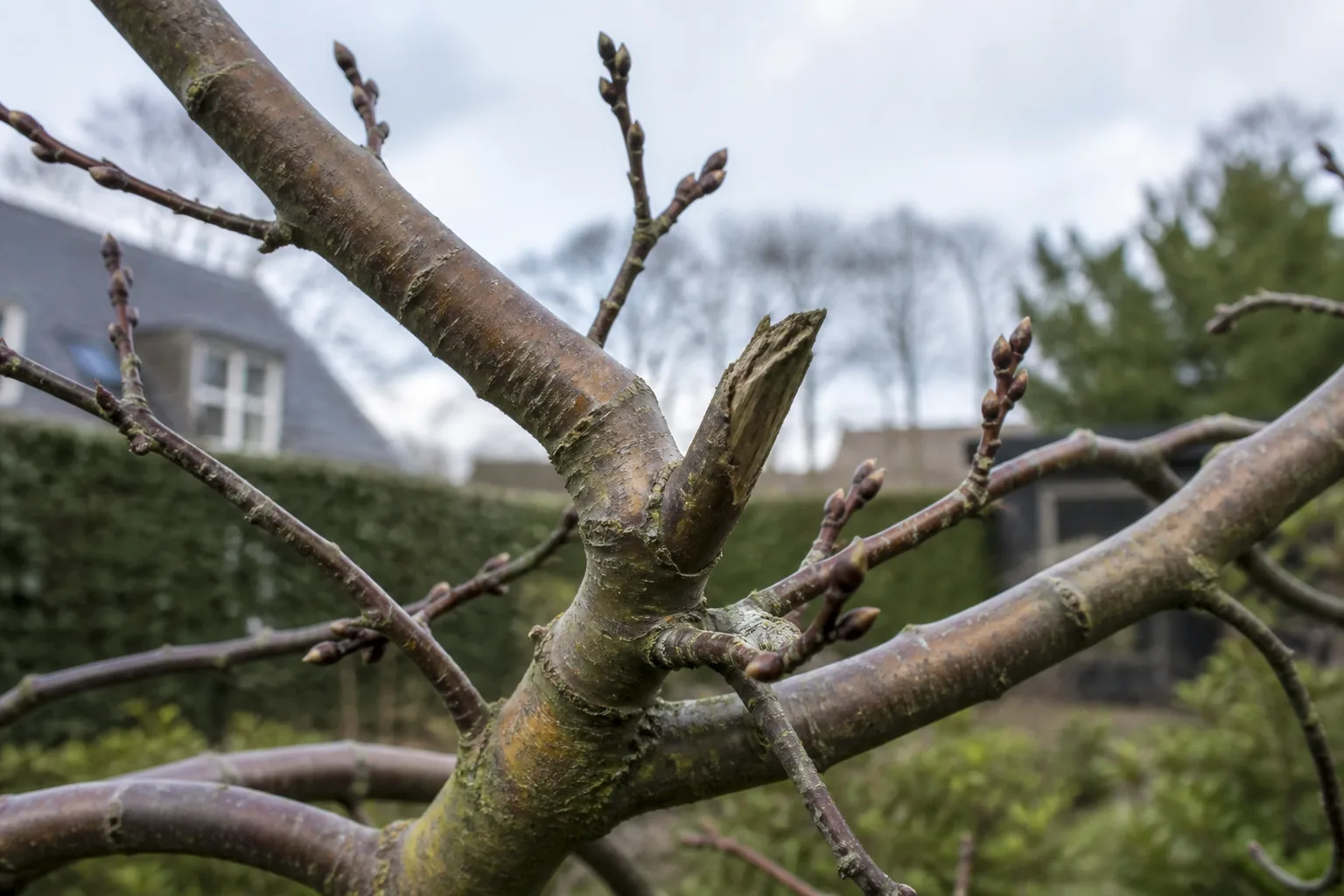
Remove dead, broken, rubbing, inward-growing, or badly placed branches. On a young tree, correct competing leaders and narrow, weakly attached forks while branches are small. Preserve the natural outline and avoid stripping the lower canopy simply to make the trunk look taller. Small cuts made just outside the branch collar close more effectively than flush cuts, which remove protective trunk tissue.
Pruning timing and safe tools
For routine shaping and size control, prune immediately after flowering. This gives the tree time to produce new growth and flower buds for the next season. If you wait until late winter to shorten lots of live branches, you may remove the buds formed on the previous season’s growth and reduce the upcoming display. Dead, broken, or hazardous wood is the exception and can be addressed when noticed if it is safe to reach.
Do not use annual shearing on this tree. It produces an unnatural outer shell, encourages dense twig growth, and does not solve structural problems. On an older, crowded specimen, reduce congestion gradually by removing selected stems or branches at their origin rather than cutting every branch to the same height. A drastic renovation can be stressful and may leave large wounds; if major limbs are involved, hire an arborist.
Use sharp, clean hand pruners for small twigs, loppers for reachable medium branches, and a pruning saw for larger wood. A pole pruner is not a license to work from an unstable ladder or near power lines. If the cut is overhead, the branch is heavy, or the tree is close to a utility, stop and get professional help. The broader principles in our guide to why dormant-season pruning works and how to clean garden tools apply, but bloom timing still takes priority for this lilac.
Flowers, fragrance, and bloom timing
Expect a short but conspicuous early-summer display rather than months of continuous flowers. The panicles can be large—Gardenia describes clusters about 6 to 12 inches long—and they stand out against dark foliage. The species also forms tan, dry capsules after flowering; leaving some can add late-season texture, while removing spent clusters keeps the tree tidier.
Deadheading is optional, not a cure-all. Remove spent panicles soon after flowering if you want to prevent seed formation and improve the tree’s appearance. Make the cut just above a pair of leaves or a strong side branch, taking care not to remove the new shoots that will carry next year’s flower buds. Deadheading can redirect some energy, but it cannot compensate for shade, drought stress, immature age, or excess nitrogen.
Why a healthy tree may flower lightly
Use this order when blooms disappoint:
- Check light first. A tree receiving less than about six hours of direct sun may grow leaves but set fewer flowers.
- Check timing. A young transplant may need several seasons to settle, and a late freeze can damage flower buds without killing the tree.
- Check pruning history. Late-winter shortening may have removed the buds that were already formed.
- Check moisture. Drought during bud formation or transplant establishment can reduce the next display.
- Check fertilizer. Lush shoots and large leaves with few flowers can point to excess nitrogen.
The fragrance question has no single satisfying answer. Gardenia and MyGardenLife describe the flowers as fragrant, while Oregon State notes a scent similar to privet and Purdue records that some observers find the flowers malodorous. Climate, nose, cultivar stock, and flower age may all affect the experience. If fragrance is your primary reason for planting, visit a flowering specimen locally before purchasing.

Pests and diseases: what to watch for
This tree is often low maintenance, but “resistant” is not the same as immune. Healthy trees in a sunny, airy site usually have fewer issues than crowded, drought-stressed, or overfertilized trees. Inspect new growth, the undersides of leaves, and branch junctions when you water.
Bacterial blight and wet-weather damage
Bacterial blight can begin as dark brown, dead leaf spots with yellow halos. As symptoms progress, leaves may curl, and black streaks can appear on twigs; severe infections can kill shoot tips, leaves, and blossoms. University of Wisconsin–Madison Extension identifies Pseudomonas syringae pv. syringae as the cause and notes that wind and rain spread it, with entry through natural openings or wounds (Wisconsin Horticulture bacterial blight guidance).
When you see suspicious spots, do not immediately reach for fertilizer or a broad pesticide. First compare the pattern: isolated older spots after a dry spell are not the same as rapidly expanding blotches and black twig streaks after wet weather. Prune infected twigs 10 to 12 inches below visible symptoms in dry conditions when possible, disinfect tools between cuts, and dispose of diseased material responsibly. Avoid overhead irrigation, thin crowded growth for airflow, and correct chronic stress.
The Wisconsin guidance lists 70% alcohol as a practical tool disinfectant and gives bleach as an alternative that requires contact time followed by rinsing and oiling to reduce rust. For recurring, diagnosed disease, a local extension office or plant clinic can help determine whether a labeled product is appropriate. Do not improvise pesticide concentrations or spray a copper product during weather or growth stages where it may injure foliage.
Powdery mildew, borers, and scale
Powdery mildew appears as a pale, dusty coating, often late in the season when nights are cool and foliage is dense. It can look alarming without causing major injury. Improve spacing and airflow, water the soil instead of the canopy, and remove badly affected fallen leaves. A crowded, shaded tree is more likely to show mildew than one growing in full sun.
Lilac borers and scale insects may occur, especially on stressed trees, but their presence does not automatically justify treatment. Look for holes, sawdust-like frass, dieback, sticky residue, or clusters of immobile bumps on stems. Remove a small affected branch when appropriate and seek local diagnosis for a trunk or main-branch infestation. Keeping the tree watered during drought and avoiding bark injuries are useful preventive measures.
Propagation and choosing tree form versus shrub form
Home propagation is not the most efficient way to obtain ‘Ivory Silk’. Named cultivars may not come true from seed, and lilac cuttings can be slow or inconsistent without the right timing and humidity. A nursery-grown plant gives you the cultivar’s known form and lets you select a single-trunk or multi-stemmed habit from the start.
If you are choosing between forms, use the site to decide. A tree form creates a visible trunk and a canopy that works over a lawn, path, or low border. A shrub form is useful for a broad informal screen or a softer transition, but it needs more horizontal room and may send up basal shoots. Ask the nursery how the plant was trained and whether the graft or trunk structure is visible; the label “lilac tree” alone does not describe the final architecture.
A simple Ivory Silk lilac care calendar
Late winter: Inspect the bare framework. Remove dead or damaged wood, crossing branches, and small structural defects while you can see the branching clearly. Do not perform a heavy height reduction simply because the tree is dormant.
Spring: Check mulch depth and expose the root flare if it has been buried. Feed only if the soil or the tree’s growth indicates a need. Begin monitoring moisture as leaves expand, and water a new tree before the soil around the root ball dries deeply.
Early summer: Enjoy the flowers, then prune for routine shape immediately after bloom. Remove spent panicles if desired. Keep irrigation at the soil line and watch for drought stress, black twig streaks, and unusual leaf spotting during wet weather.
Summer: Water deeply during extended heat, especially in the first two years. Do not respond to a few yellow leaves with a high-nitrogen lawn fertilizer. Check that the canopy still has space and that grass has not grown into the mulch ring.
Fall: Rake diseased leaves if blight or mildew was present, replenish a thin mulch layer, and water thoroughly before the ground freezes if the fall has been dry. Avoid elective heavy pruning that would remove next year’s flower buds.
Where this tree works best in a landscape
Use Ivory Silk lilac as a specimen near a patio, path, or front-yard view where its flowers and bark can be noticed without crowding the house. It can also anchor a mixed border, frame a lawn, or provide a small amount of filtered shade after the flowers fade. Its tolerance of urban conditions makes it useful near streets and driveways, provided the root zone is not sealed in compacted pavement and the canopy has clearance.
Pair it with plants that accept the same sun and drainage rather than choosing companions only by flower color. Low perennials, ornamental grasses, and bulbs can occupy the mulch-ring edge, but leave a clear trunk zone and do not create a dense wall of vegetation that traps humidity. If deer pressure is a concern, published horticultural references commonly describe the tree as relatively deer resistant, but browsing behavior varies by season and food availability. Our low-maintenance front-yard landscaping guide can help you plan the surrounding structure without shrinking the tree’s mature space.
The best placement is the one that still looks sensible after the two-week flower show ends. Reddish bark, dark foliage, a rounded crown, and winter branch structure give the tree value outside bloom season, but only if the plant is not forced into a narrow bed or repeatedly cut back to fit it.
Conclusion: give the roots time and the canopy room
Ivory Silk lilac is an excellent choice when you want a small ornamental tree with white early-summer flowers and year-round woody structure. Its care is straightforward: plant at the correct depth in full sun, protect the root ball with deep first-two-year watering and a clean mulch ring, fertilize only when justified, and prune after flowering for routine shaping.
The two mistakes that cost the most are choosing a site that is too tight and treating every problem as a fertilizer problem. Measure the mature canopy before planting, let the soil—not the calendar—tell you when a new tree needs water, and use the pattern of symptoms and weather to guide disease decisions. With those basics right, ‘Ivory Silk’ can settle into a dependable specimen that earns its space long after the flowers have faded.