Maranta Leuconeura Care: Light, Water, Humidity
Stop crispy edges on Maranta leuconeura with bright indirect light, even watering, 50–60% humidity, and smarter water quality.
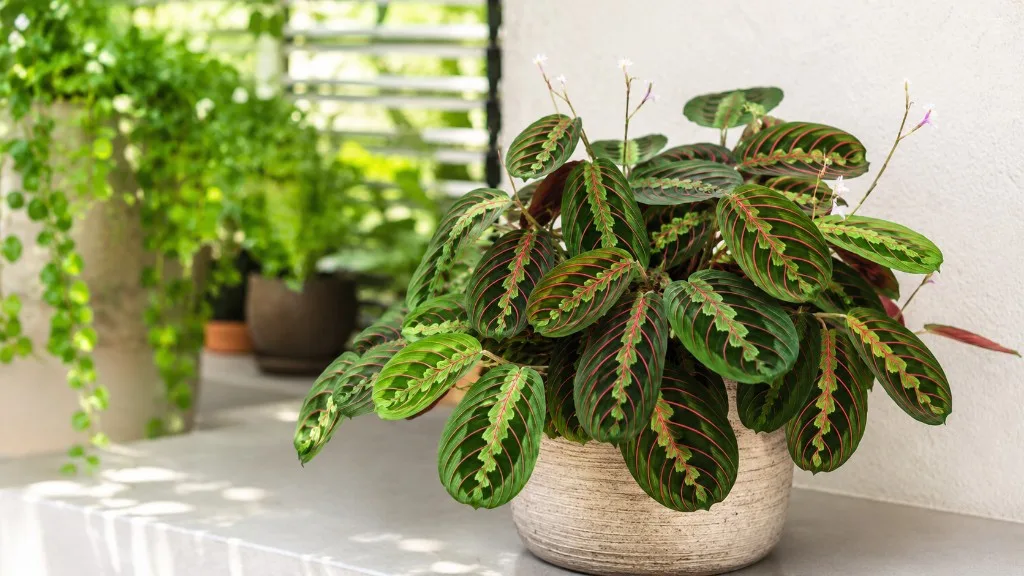
Prayer Plant Care at a Glance
Maranta leuconeura — the classic prayer plant — stays beautiful when the room stays steady. Give it bright indirect light, evenly moist but never soggy soil, humidity closer to 50–60% or higher, warm temperatures above about 60°F (15°C), and water that does not load the mix with fluoride and salts. Miss one of those for long enough and the plant answers with crispy edges, daytime curl, brown tips, faded herringbone veins, or nightly folding that goes quiet.
This species is a low, rhizome-spreading evergreen in the Marantaceae family, native to Brazil, typically about 6–12 inches tall and spreading wider by short rhizomes. (NC State Extension) Missouri Botanical Garden describes it as a houseplant that wants bright indoor light without strong direct sun, consistently moist soil in active growth, and help raising humidity. (Missouri Botanical Garden) The RHS lists moist but well-drained compost and filtered or shaded positions under glass, with high humidity maintained at all times. (RHS)
The practical rule is consistency. Do not bake the pot on hot glass, then drown it because the leaves curled. Do not let the mix go bone dry for a week, then compensate with a permanent saucer of water. Prayer plants forgive less drama than pothos, and slightly more than many calatheas — but “slightly more forgiving” is not the same as “ignore humidity.”
| Care factor | Best range or method | What to avoid |
|---|---|---|
| Light | Bright indirect / dappled | Harsh midday direct sun |
| Water | Top inch beginning to dry, then soak and drain | Standing water on crowns or in saucers |
| Humidity | About 50–60% RH or higher at leaf height | Dry heat vents, misting as your only plan |
| Temperature | Steady ~65–80°F (18–27°C) | Below ~60°F, cold drafts, AC blast |
| Soil | Moisture-retentive, airy mix | Dense peat brick or cactus-dry mix |
| Feeding | Monthly half-strength in active growth | Heavy winter feed, dry-soil fertilizing |
| Water quality | Filtered, distilled, or rainwater when tips burn | High-fluoride tap without flushing |
Who This Guide Is For (and How We Reviewed It)
This guide is for indoor growers whose prayer plant looks fine in summer and then crisps, curls, or stops folding once heating season starts — and for anyone buying a patterned Maranta who wants the environment right before chasing fertilizer or a bigger pot.
Written by Sai Ananth and reviewed by the LeafyPixels Review Board (editorial horticulture review against extension and botanical-garden primary sources). We checked care recommendations against NC State Extension, Missouri Botanical Garden, RHS plant and poorly-houseplant guidance, University of Illinois Extension prayer-plant notes, Penn State and UNH humidity guidance, Clemson indoor watering basics, and the ASPCA toxic-plant database, then pressure-tested the advice against LeafyPixels Maranta cluster pages and real heated-home constraints.
Honest experience notes from our shelves (not a lab trial): In a heated apartment living room in winter, a cheap hygrometer clipped at leaf height on a red-veined ‘Erythroneura’ often read 28–34% RH while the thermostat sat near 70°F (21°C). With soil still evenly moist, daytime curl and papery margins showed within about 7–10 days. After placing a cool-mist humidifier 2–3 feet away and holding 55–60% RH at the same meter for two weeks, new leaves opened with clean margins; old brown tissue did not reverse. A rabbit-tracks form (var. kerchoveana) in the same room with the same meter stayed cosmetic-cleaner at ~45% RH, but still crisp-edged when the meter dipped into the low 30s for several consecutive nights. Watering intervals in a 6-inch plastic pot with our airy mix were typically every 5–7 days in bright warm growth and 9–12 days in cooler, dimmer winter light — always confirmed by finger check and pot weight, never by calendar alone.
Humidity percentages and day counts below are editorial indoor targets tied to those conditions. Your pot size, mix, and climate will shift the calendar. Use a hygrometer and soil checks before you repot or feed hard.
What Healthy Maranta leuconeura Looks Like
A healthy prayer plant looks alert: firm patterned leaves, clean margins, and a visible nyctinasty cycle — blades roughly parallel to the soil by day, then rising toward a vertical “prayer” posture after dark. (NC State Extension) That movement is driven by turgor changes in the pulvinus at each leaf base. When folding weakens, treat it as an early warning, not a curiosity.
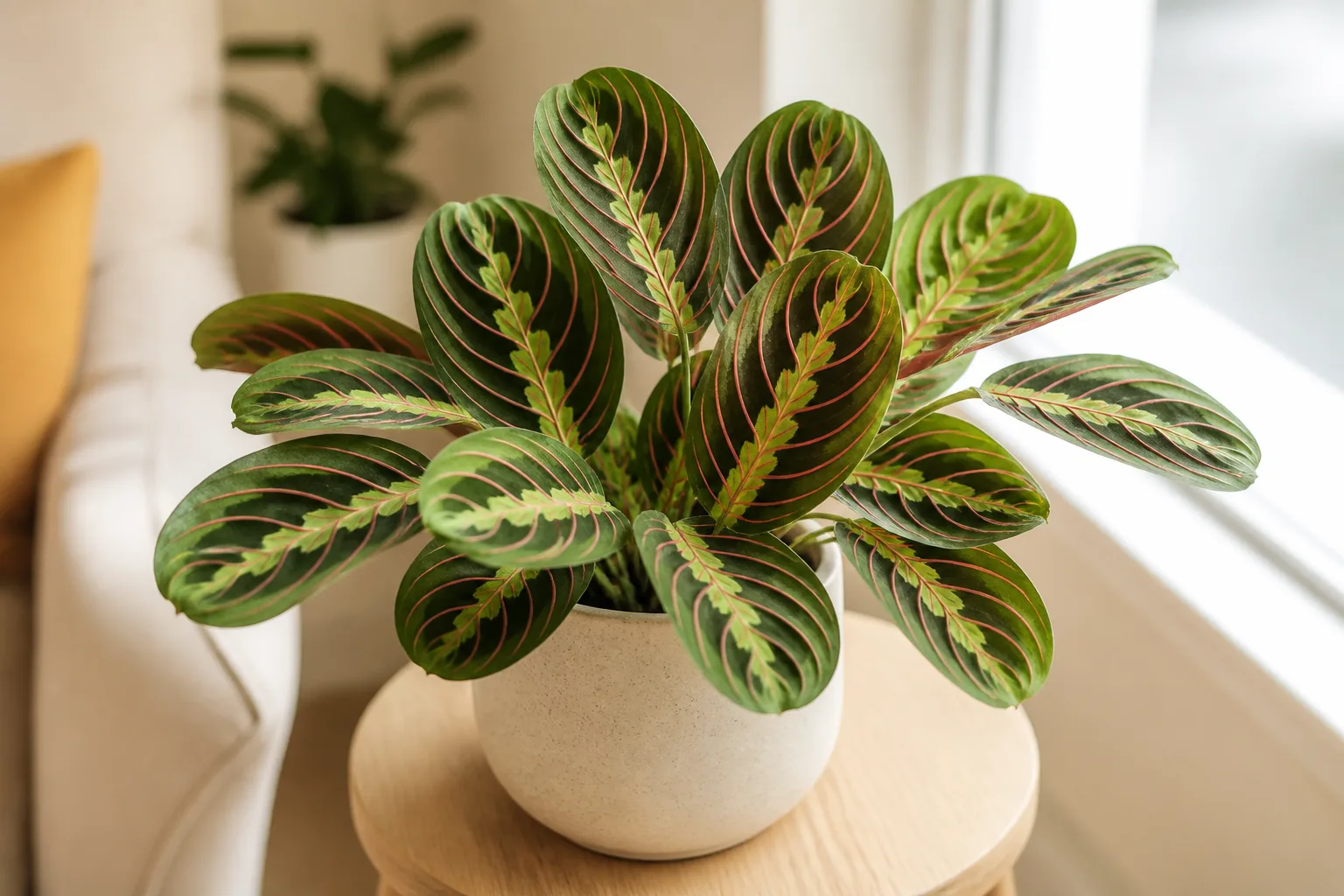
Gentle nightly lift differs from stress curl: tight rolling through the day, papery margins, or collapse while soil is wrong. Diagnose in order: soil moisture, humidity at leaf height, light on the newest leaves, water quality, roots, then pests.
Scoreboard rule: damaged brown tissue will not turn green again. Judge recovery by the newest fully opened leaf over one to two weeks — clean margins, strong contrast, and a return of night folding mean the environment is working.
One failure mode we see with grow lights: leaving LEDs on 24 hours flattens the day–night cue. The plant may stay open at night even when soil and humidity are fine. Restore a real dark period of several hours; folding often resumes within about a week once moisture and temperature are also stable.
Cultivar Notes: Rabbit Tracks vs Red-Veined Herringbone
Most nursery plants are selections of M. leuconeura with different markings. Care stays the same; edge sensitivity is what changes.
| Selection | Look | Edge sensitivity (editorial) | Best first placement |
|---|---|---|---|
| Rabbit tracks (var. kerchoveana) | Dark blotches along the midrib | Slightly more forgiving of average humidity | Bright living room with humidifier nearby |
| Red-veined / herringbone (‘Erythroneura’ and similar) | Bold red fishbone veins | Tip and margin burn show earliest | East window + measured 55–60% RH |
| Lemon / lime types | Yellow-green center striping | Pattern fades fast in deep shade | Bright indirect; avoid hot glass |
| Tricolor / Fascinator types | Red veins + yellow center | Same humidity logic as red-veined | Sheer-filtered bright light |
NC State lists common names including Cathedral Windows, Herringbone Plant, Prayer Plant, Rabbit Tracks, and Red-Veined Prayer Plant, and notes that leaf color fades in low light and low fertility. (NC State Extension) At purchase, judge the newest leaf — clean margins and strong contrast predict your next month better than older leaves with cosmetic tip burn.
Light Without Bleaching
Place M. leuconeura in bright indirect light. Missouri Botanical Garden is clear: bright indoor light, but no strong direct sun, because too much sun bleaches the leaf colors you bought the plant for. (Missouri Botanical Garden) NC State lists dappled sunlight outdoors and notes the plant tolerates low to medium light indoors while remaining intolerant of direct sunlight. (NC State Extension) The RHS similarly points to shaded or filtered positions. (RHS)
Safest placement: near an east window, a few feet from bright south or west glass, or behind a sheer curtain. Morning sun for a short stretch is usually fine. Midday beams on thin patterned tissue create bleached patches and crispy sun-facing edges that never turn green again.
Low light is survivable — Maranta is often easier than calathea in dim apartments — but pattern contrast fades and growth slows. Dim plants also use water slowly, so the same watering habit that worked in summer can tip into overwatering by November. Details live on the Maranta light guide.
Watering for Even Moisture and Crown Safety
Keep the mix consistently moist in active growth, then hold back so the surface can dry a bit more in winter. (NC State Extension) Missouri Botanical Garden matches that seasonal split: moist while growing, reduced moisture from autumn into late winter. (Missouri Botanical Garden) RHS cultivation language stays the dual target: moist but well-drained, watering moderately and reducing in winter. (RHS)
Working check: press into the top inch (about 2 cm). If it feels cool and clings, wait. If it is dry and crumbly during active growth, water thoroughly until a little drains, then empty the saucer within about 30 minutes. Clemson Extension reminds growers that overwatering is the main cause of death in many potted plants because roots need oxygen as well as water, and that wet-soil and dry-soil stress can look similar until you check the root zone. (Clemson HGIC)
Watch the crown. University of Illinois Extension’s prayer-plant guidance warns not to let water stand on the crowns because stems rot readily where leaves meet the rhizome. (University of Illinois Extension) Water the soil surface, not the leaf joints — especially on cool mornings. Daytime curl with a light pot usually means thirst; limp yellowing with wet soil usually means roots are losing oxygen.
For seasonal rhythm, crown-rot caution, and water-quality depth, use the Maranta watering guide and the general how to water indoor plants the right way framework.
Humidity You Can Measure
NC State is blunt: Maranta is intolerant of low humidity. (NC State Extension) Missouri Botanical Garden recommends a humidified room and/or a pebble tray. (Missouri Botanical Garden) RHS plant details call for high humidity under glass. (RHS)
Indoors, aim for roughly 50% RH minimum, with 55–60% or higher producing cleaner edges on thin cultivars like red-veined ‘Erythroneura’. Winter heating often drops homes below 30% RH, which is exactly when prayer plants crisp while the soil still feels fine. (Penn State Extension) University of New Hampshire Extension likewise frames winter dryness as a common houseplant stressor and points growers toward measurable humidity solutions. (UNH Extension)
Decision rule for dry heated apartments vs humid bathrooms: If your leaf-height meter sits under ~45% RH, a humidifier near the plant is the primary fix — not misting. Grouping plants helps modestly. Pebble trays and misting are weak primary strategies: Penn State notes misting raises humidity only until droplets evaporate — often minutes — and pebble trays rarely change room RH in a meaningful way. (Penn State Extension) A bright bathroom can work when light and temperature are still good; a dark bathroom with wet crowns is a different failure.
Use a cheap hygrometer at leaf height, not across the room on the floor. For broader RH strategy, see the houseplant humidity guide and the Maranta low humidity problem page.
Water Quality: Fluoride, Salts, and When to Switch
NC State specifically warns that Maranta leaves burn with high fluorides and over-fertilization. (NC State Extension) Fluoride injury on sensitive foliage typically shows as tip and margin necrosis that spreads inward — and drought stress or salt toxicity can look similar. (Pacific Northwest Extension)
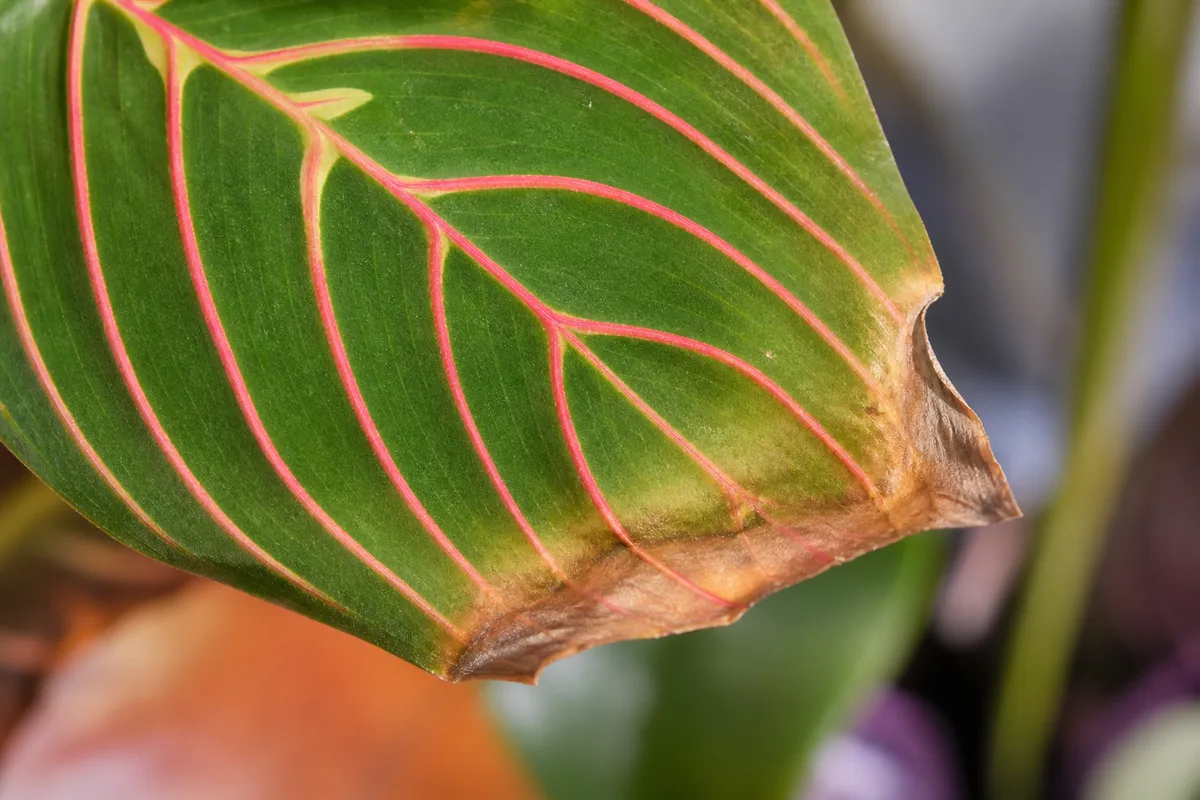
Protocol:
- Stabilize humidity and soil moisture first for 10–14 days.
- If new tips still brown while RH is stable and the mix is not dry, switch to filtered, distilled, or rainwater and flush the pot until runoff runs clearer.
- Overnight tap water may off-gas some chlorine; it does little for fluoride.
- Skip fertilizer until new leaves open clean.
- Distilled water is not mandatory forever — use it when tip burn persists after humidity is fixed, or if your municipal supply is known to be hard/fluoridated and Maranta keeps scarring.
Trim dead tips only after new leaves prove the fix. Old necrosis is cosmetic, not a progress meter. Symptom depth: brown tips.
Temperature and Draft Limits
Keep prayer plants in normal warm living temperatures — roughly 65–80°F (18–27°C) — and treat 60°F (15°C) as a soft floor. Missouri Botanical Garden notes the plant prefers temperatures that do not dip below 60°F and is intolerant of frost. (Missouri Botanical Garden) NC State flags intolerance of low temperatures and cold drafts. (NC State Extension)
Cold glass, heater blasts, and AC vents create one-sided curl and edge burn that look like watering mistakes. Pull pots a few inches off freezing windowsills at night. Sudden swings matter as much as absolute lows.
Soil, Pot Shape, and Drainage
Use a moisture-retentive, well-aerated mix — a damp sponge with holes, not mud and not cactus grit. Missouri Botanical Garden recommends a soil-based potting mix kept consistently moist but not waterlogged. (Missouri Botanical Garden) RHS wants moist but well-drained media. (RHS) Root rot follows poorly drained soils. (NC State Extension)
A dependable starting recipe: about 60% peat-free potting compost + 20% perlite + 20% coco coir by volume. That is an editorial blend matched to Marantaceae dual needs, not a single lab recipe from one extension sheet. Choose pots with drainage holes. Because rhizomes spread horizontally near the surface, wide, shallow containers usually beat deep cylinders that hold unused wet soil below the root zone. Keep crowns at their previous depth when you repot. Mix ratios and drainage tests: Maranta soil guide.
Diagnose Crispy Edges, Curl, and Brown Tips
These three symptoms dominate prayer-plant troubleshooting, and they often share a moisture story: leaves lose water faster than shallow rhizomes can replace it. RHS poorly-houseplant guidance links low air humidity with shrivelled or crispy foliage and lists grouping or damp-pebble trays as local measures — while warning humidity is rarely the whole answer. (RHS) Missouri Botanical Garden’s indoor environmental problems overview likewise groups tip browning and leaf stress with humidity, watering, and light imbalances. (Missouri Botanical Garden)
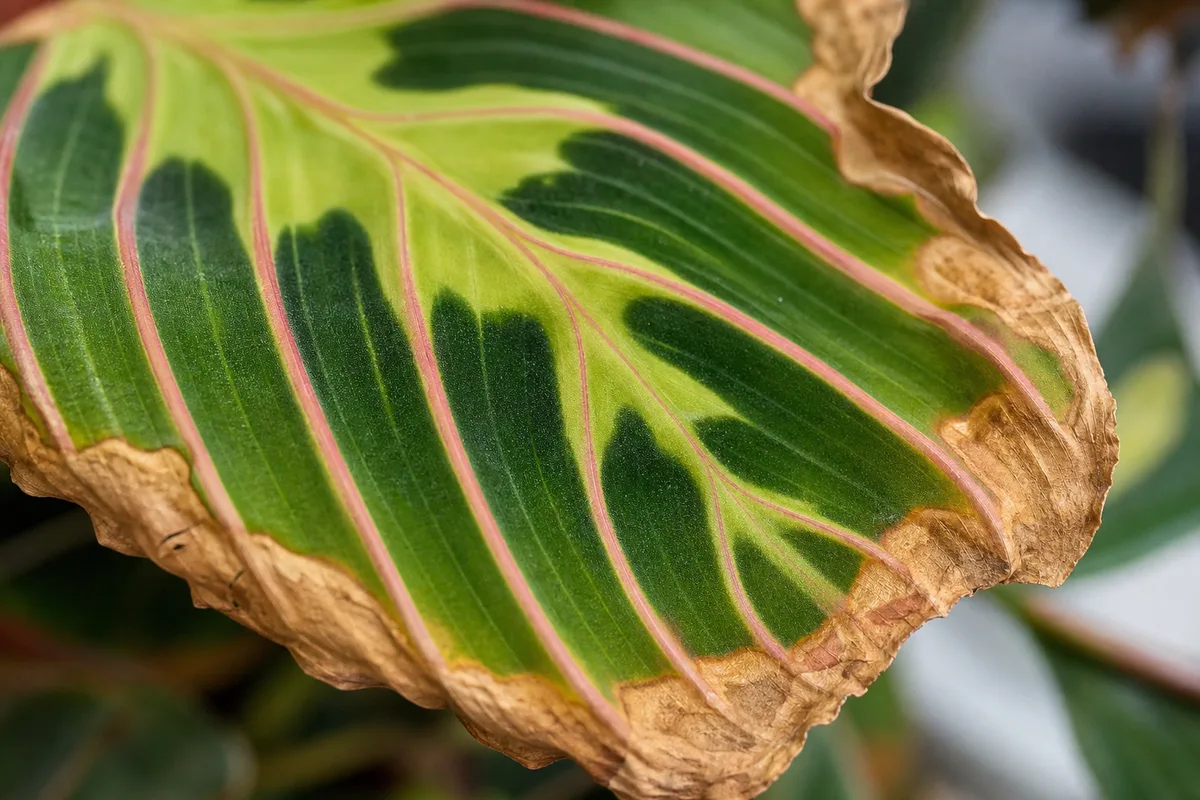
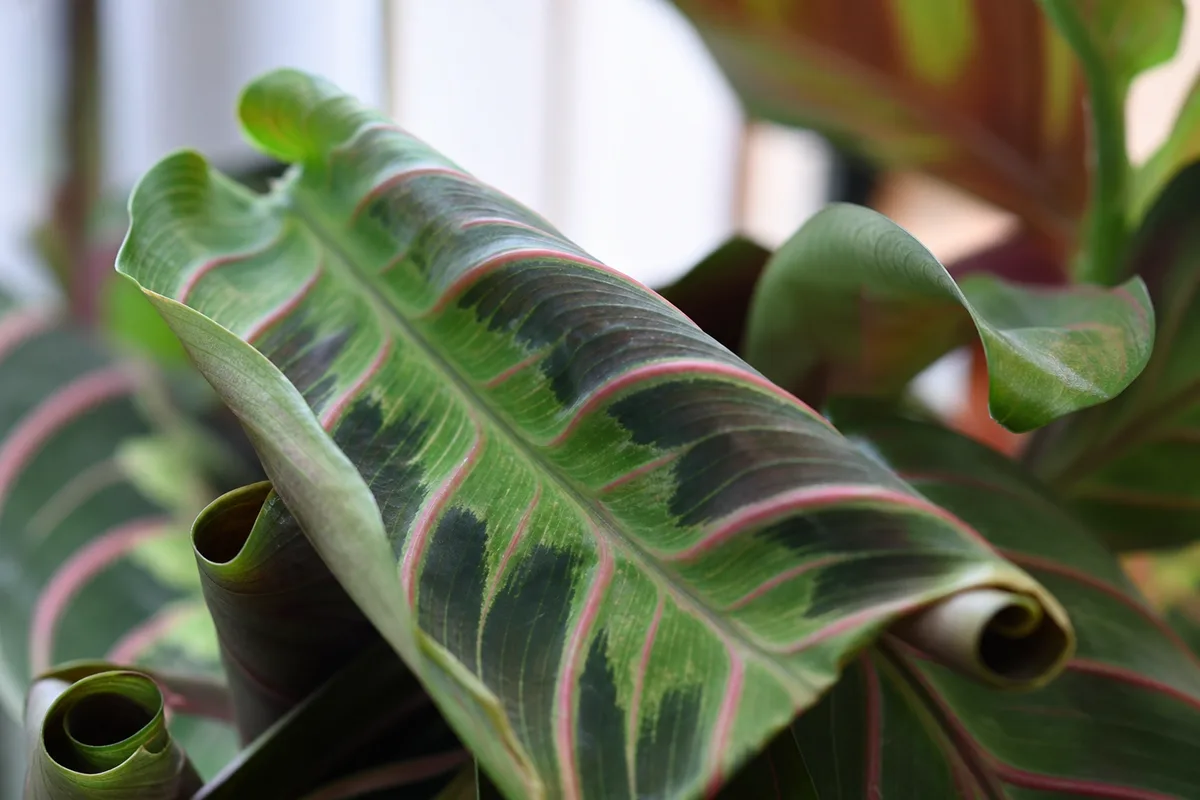
Crispy edges feel papery and tan; damaged tissue does not reverse. Curling is often a conservation response — margins roll inward during the day when air or soil is too dry. Brown tips may be dry air, underwatering, fluoride/salt burn, or fertilizer burn.
Humidity vs Underwatering vs Fluoride
| Pattern | Likely driver | First move |
|---|---|---|
| Mix dry at 2 cm + light pot + daytime curl | Underwatering | Thorough soak, then reset check cadence (watering) |
| Mix evenly moist + RH under ~45% + margin crisp | Low humidity | Humidifier to ~55–60% (low humidity, crispy leaves) |
| Moist mix + stable humidity + tip burn / salt crust | Fluoride or fertilizer salts | Filtered/rainwater + monthly flush (brown tips) |
| Bleached patches on window side | Direct sun / heat | Filter light; do not add water as a “fix” |
Compare stressed margins to a healthy leaf: clean, flexible edges with intact pattern contrast. If only older leaves are scarred and new ones open clean, you are already improving — keep the environment and stop stacking changes.
Yellow Leaves, Overwatering, and Root Rot
Yellowing with wet mix, soft stems, sour soil, or fungus gnats points to oxygen-starved roots — not thirst. Stop watering, inspect rhizomes, improve drainage, and follow overwatering or root rot guidance if tissue is mushy and brown. Yellow older leaves alone on an otherwise firm plant can be normal senescence; remove them and watch the newest growth.
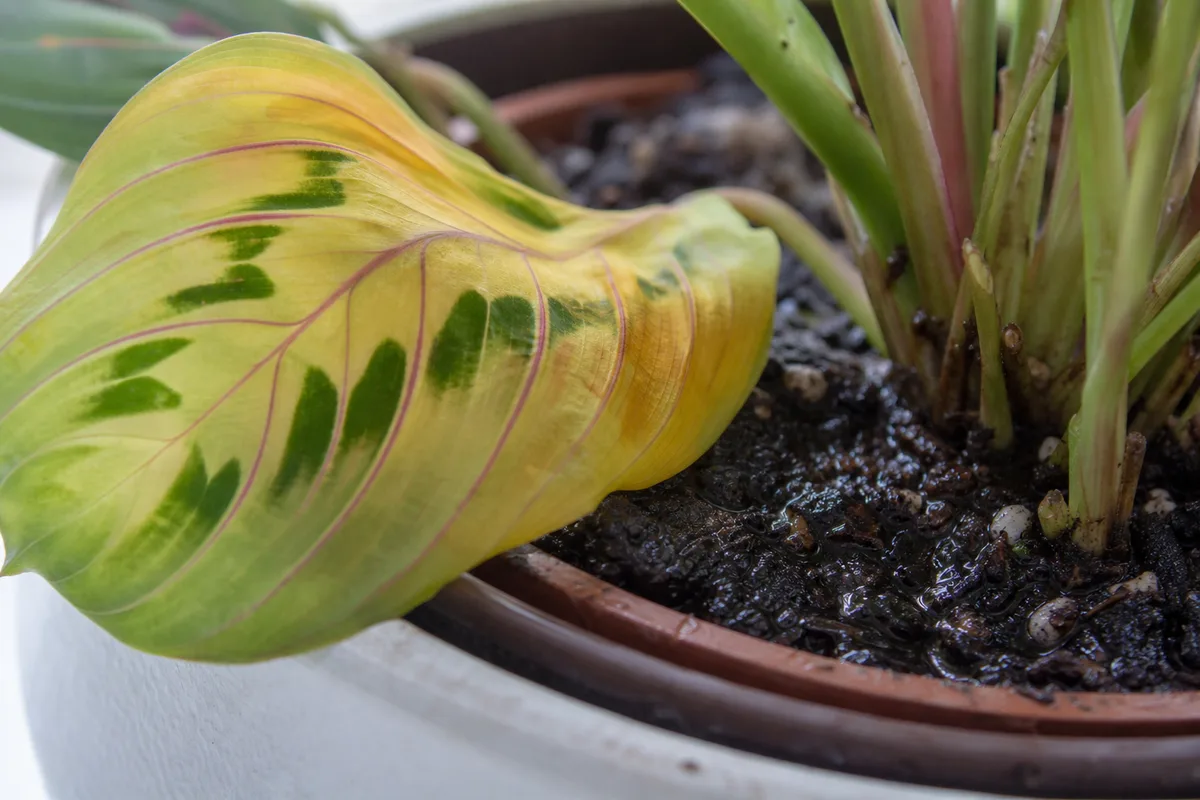
Remember the light link: a plant moved into a dim corner keeps the summer watering habit and sits wet for days. Lower water volume when light drops. Wilt with wet soil is a root problem until proven otherwise. For the full symptom map, open the problems hub.
Spider Mites and Dry-Air Pests
NC State notes no serious pest pressure when conditions are good, but spider mites and mealybugs can appear. (NC State Extension) Missouri Botanical Garden also lists spider mites, mealybugs, and thrips among watch items. (Missouri Botanical Garden) Dry heated rooms favor mites. Look for fine stippling and webbing under leaves — the same dry air that crisps margins also invites them.
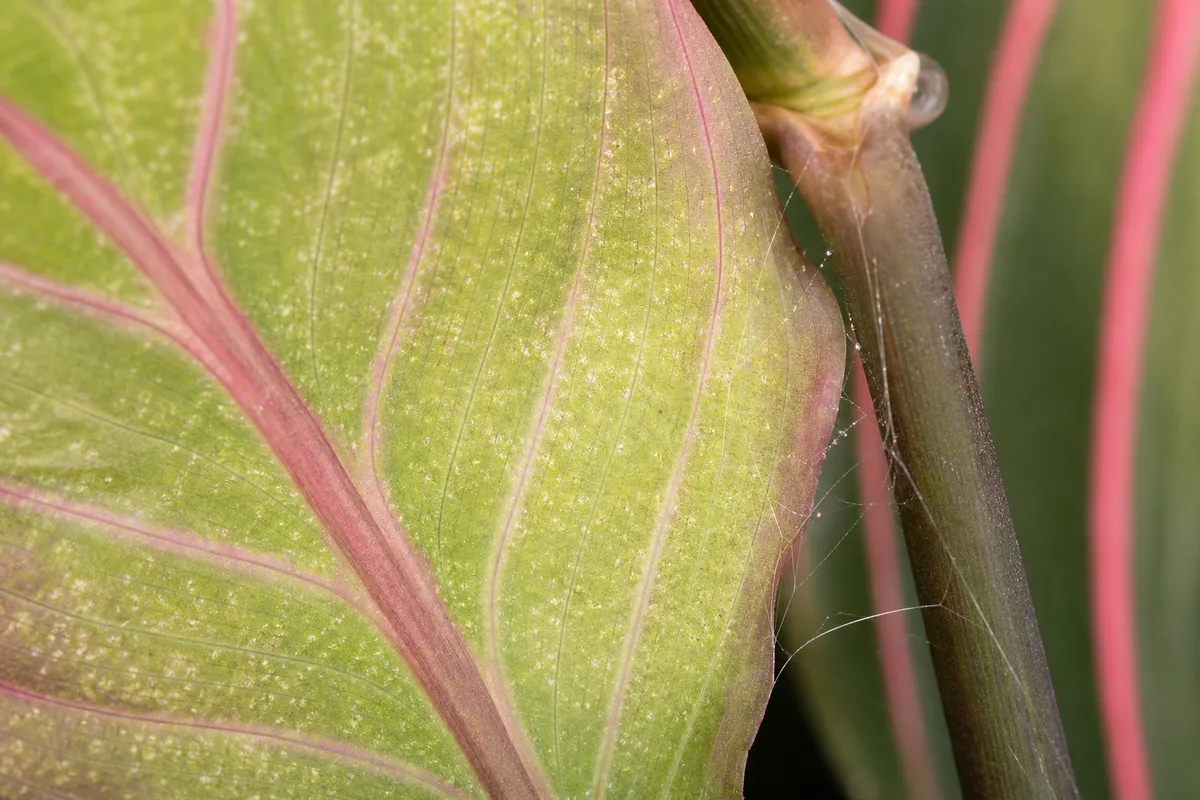
Raise humidity, rinse foliage, and treat with a label-appropriate indoor soap if needed; test a leaf first because thin Marantaceae foliage can be spray-sensitive. Avoid routine overhead misting as pest control — wet joints raise rot risk without solving dry air. See spider mites for species-specific steps.
Feeding, Repotting, and Division Basics
Feed lightly. Missouri Botanical Garden suggests monthly fertilizer in the growing season and a substantial cutback from autumn to late winter. (Missouri Botanical Garden) NC State warns over-fertilization burns leaves. (NC State Extension)
Product-agnostic example: a balanced liquid such as 10-10-10 or 20-20-20 diluted to half the label rate (for example, if the label says 1 tsp per gallon, use ½ tsp) on already-moist soil once a month while new leaves are appearing in spring and summer. Skip feed on stressed, freshly repotted, or winter-resting plants. Deeper cadence and burn recovery: Maranta fertilizer.
Repot every 1–2 years or when rhizomes crowd the surface and water races through. Spring is ideal. Step up only one pot size with fresh airy mix — details on the repotting guide.
Rhizome division checklist (at repotting):
- Water the day before so the root ball holds together.
- Tip out, tease apart natural clumps so each division has several leaves plus firm rhizome and roots.
- Discard soft, black, or foul-smelling tissue with clean tools.
- Pot each piece at the same crown depth in fresh moist mix; do not bury deeper.
- Keep bright indirect light and higher humidity for 10–14 days; water when the top inch begins to dry — do not keep swampy.
- Expect slower growth for a couple of weeks; judge success by firm new leaves, not by old damaged margins.
NC State lists rhizomatous division as the standard route; stem cuttings also root when humidity and warmth are stable. (NC State Extension) Step-by-step photos and cutting options: propagation.
Pet Safety for Cats and Dogs
The ASPCA lists prayer plant as non-toxic to dogs, cats, and horses. (ASPCA) Trade labels are messy — the same common name is used for Maranta and some Calathea relatives — so verify the botanical name on the tag when pet safety matters.
Non-toxic is not an invitation to let pets shred the pot. Any plant fiber can cause mild stomach upset. If a pet eats a large amount or shows persistent symptoms, call your veterinarian or ASPCA Animal Poison Control at 888-426-4435. Elevate hanging growth if chewing is routine.
Maranta vs Calathea in Real Homes
Both are Marantaceae with patterned leaves, and shops blur the names. Maranta leuconeura stays low and rhizomatous, shows dramatic nightly folding, and usually handles average-home humidity slips a bit better than the fussier calatheas. Many plants sold as calathea are botanically Goeppertia and still want stricter humidity and steadier moisture. If Maranta crisps in your dry winter, a calathea will not magically thrive in the same corner — fix humidity infrastructure first, then browse the Calathea care hub or the Calathea care guide only if you can hold RH.
Real-home placement favors rooms with stable warmth and occasional humidity: a bright bathroom with a usable window, a kitchen shelf away from the stove, or a living-room spot a few feet from an east exposure. Avoid fridge tops, single-pane winter sills, and HVAC aimed at the canopy. Hanging baskets look excellent with trailing rhizomes, but ceiling air is often drier — pair baskets with a humidifier if heat rises toward a vent.
First 14 Days After Purchase
Use this as a printable-style checklist — change only one major variable at a time.
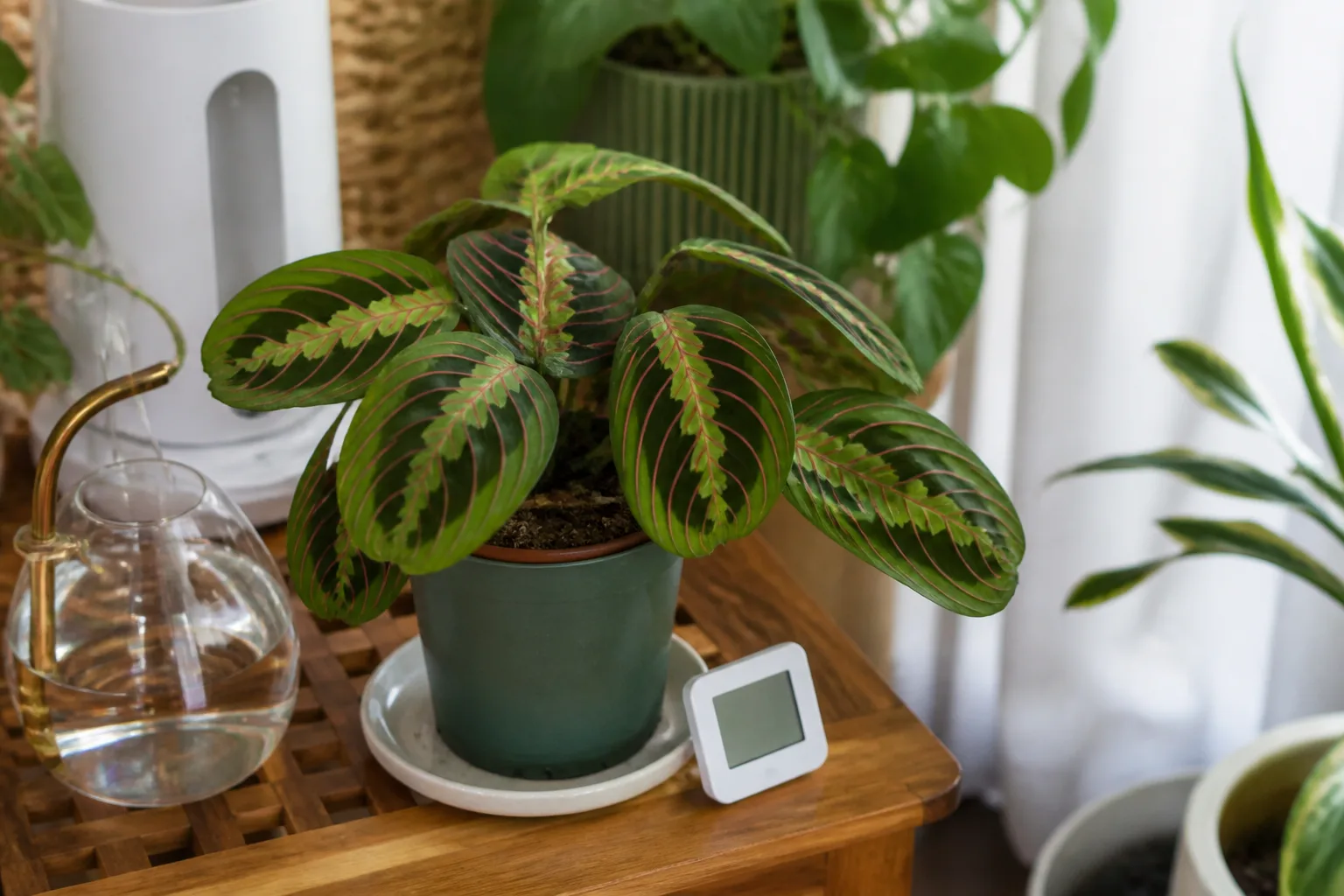
- Day 0–2: Quarantine away from other plants. Confirm botanical name. Check undersides for mites. Do not repot unless roots are rotting or the mix smells sour.
- Day 1: Place in bright indirect light. Clip a hygrometer at leaf height. Note baseline RH and pot weight after a thorough drain-through water if the nursery mix is bone dry.
- Days 2–7: Water only when the top inch begins to dry. Aim humidifier toward 55–60% RH if the meter is under 45%. Keep nights dark if you use grow lights.
- Days 7–14: Watch the newest leaf, not the scarred shipping edges. Night folding should be visible if moisture and temperature are stable. If daytime curl continues with moist soil, raise RH before adding fertilizer.
- After day 14: Only then consider a gentle half-strength feed (active growth season), a pot upgrade, or division — and only if roots or rhizomes clearly need it.
Canonical hub for cultivar notes and the full topic/problem cluster: Maranta leuconeura care hub.
Related Maranta Guides
- Maranta leuconeura care hub — overview and cluster navigation
- Maranta watering — seasonal dry-down, crown safety, water quality
- Maranta light — window placement, pattern fade, grow lights
- Maranta soil — mix ratios, shallow pots, drainage
- Maranta fertilizer and propagation — feeding cadence and division depth
- Low humidity, crispy leaves, curling leaves, brown tips — symptom-first leaf-edge fixes
- Houseplant humidity guide — RH tools and winter dry-air strategy
- How to water indoor plants the right way — soil-check watering that transfers to Maranta
Conclusion
7-day recovery checklist when edges crisp or leaves curl:
- Check pot weight and the top inch — water thoroughly only if dry, then empty the saucer.
- Read RH at leaf height; if under ~45%, run a humidifier toward 55–60%.
- Confirm bright indirect light and no hot midday beams or heater blast.
- Stop misting as your humidity plan; keep water off crowns.
- Pause fertilizer for at least a week.
- If humidity is already stable and tips keep browning, switch to filtered or rainwater and flush once.
- Judge success on the next new leaf and the return of nightly folding — not on old brown margins.
When those seven checks are steady, prayer-plant care stays boring in the best way. Use the Maranta hub when you need deeper topic or problem pages after the environment is set.