Houseplant Mosaic Virus: vs Variegation, Diagnosis, No Cure
Mottled leaves on a houseplant? Compare mosaic virus with variegation and nutrient stress, then isolate, discard, and sanitize correctly.
Strange light-and-dark patches appear on a leaf that looked fine last month. The pattern looks artistic until the next leaf unfurls smaller, twisted, and worse. At that point you are not shopping for a prettier cultivar — you are deciding whether this is genetic variegation, a nutrient or light problem, or a plant virus that has no cure and can hitchhike through your collection on sap, tools, or insects.
This guide is a houseplant-first path for mosaic virus concerns: what the mottling actually means, how to separate it from lookalikes, how viruses move indoors, and why the real “fix” is isolation, discard when risk is high, and hard sanitation — not a spray schedule. Written by Sai Ananth; horticulture review by Dr. Ananya Rao (Ph.D. Horticulture; LeafyPixels Editorial Review Board).
What Mosaic Virus Means on Indoor Plants
“Mosaic virus” is a symptom name more than a single pathogen name. Growers use it for irregular chlorotic mottling — pale green, yellow, or cream patches mixed with darker green — often with streaks, ringspots, vein banding, leaf distortion, or stunting. Many different viruses can produce that look. The Royal Horticultural Society describes viral leaf symptoms as pale green or yellow patterns including spots, streaks, mottle, mosaic, oakleaf patterns, ring spots, vein clearing, and vein banding, sometimes with necrotic tissue, narrowed leaves, or puckering (RHS plant viruses).
Viruses are submicroscopic infectious particles that reproduce only inside living plant cells. Missouri Botanical Garden notes that viruses and related phytoplasmas cause dwarfing, mottled chlorophyll loss, yellowing, rings, and necrotic areas, and that symptoms can mimic herbicide injury, other diseases, or environmental stress (Missouri Botanical Garden — viruses). Indoors, true viral disease is less common than watering mistakes or pests, but when it is present it matters because the pathogen is systemic. You cannot prune it out the way you prune a fungal leaf spot.
UC IPM reminds growers that disease only occasionally plays a major role in houseplant life if the plant arrived healthy, and that foliar diseases common outdoors are often uncommon indoors because humidity and splash are lower (UC IPM houseplant problems). That context should calm panic over every mottled leaf — and sharpen attention when mottling is irregular, progressive on new growth, paired with distortion, and unexplained by cultivar or care. Home “mosaic” labels usually remain presumptive until a lab test names the virus.
Common Mosaic-Type Viruses and Indoor Risk Levels
You rarely need the exact virus name to choose a safe home response, but knowing the usual suspects helps you judge collection risk.
| Virus / group | Typical indoor concern | Main spread indoors | Collection risk if confirmed/suspected |
|---|---|---|---|
| Cucumber mosaic virus (CMV) | Yellow mottling, distortion, stunting on soft ornamentals and many hosts | Aphids (brief probes) + tools/fingers | High — enormous host range |
| Tobacco mosaic virus (TMV) and tobamoviruses | Mosaic/mottle on susceptible hosts; often vigor loss | Mechanical (hands, tools, tobacco products) | High wherever you share shears |
| Dasheen mosaic virus (DsMV) and aroid viruses | Mottling on philodendron, dieffenbachia, related foliage | Mostly vegetative/mechanical via infected stock | High on dense aroid shelves |
| INSV / TSWV | Ringspots, mottling, necrosis, distortion | Thrips | High if thrips are already present |
| “Beautiful virus” cultivars (e.g. Abutilon mosaic) | Intentional ornamental mosaic | Stock-dependent | Low for that named cultivar — not a free pass for random mottling |
Cucumber mosaic virus (CMV) is one of the most common plant viruses worldwide. It causes yellow mottling, distorted leaves, and stunted growth on a huge host range that includes many vegetables and ornamentals (RHS cucumber mosaic virus). APS notes CMV can infect roughly 1,200 plant species across more than 100 families (APS Education Center — CMV). Indoors, that wide host range is why a symptomatic begonia, petunia, or lily near aphids is a bigger collection risk than a one-off cosmetic blemish.
Tobacco mosaic virus (TMV) and related tobamoviruses are mechanically stable viruses that move easily on contaminated hands, tools, and tobacco products. Missouri Botanical Garden notes that tobacco mosaic remains viable for years without a host, spreads primarily by mechanical methods, and that gardeners can contaminate hands from tobacco products or infected plants before touching healthy ones (Missouri Botanical Garden — tobacco mosaic virus).
Dasheen mosaic virus (DsMV) and other aroid viruses matter for philodendron, dieffenbachia, and related foliage plants. Mottling on a solid-green aroid that worsens node by node is a different problem than the stable cream patterning on a Marble Queen pothos.
Impatiens necrotic spot virus (INSV) and Tomato spotted wilt virus (TSWV) are thrips-vectored viruses with enormous host ranges and highly variable symptoms — ringspots, mottling, necrosis, and distortion. RHS links their importance to western flower thrips as the principal vector (RHS plant viruses). If you already have thrips on houseplants, virus risk is part of that pest problem, not a separate mystery.
Some ornamental mosaics are “beautiful viruses” intentionally retained in cultivars — RHS cites Abutilon mosaic virus as an example that creates desirable variegation (RHS plant viruses). That exception does not make every mottled houseplant a collector’s prize. Most unwanted mosaics reduce vigor, distort growth, and threaten neighbors.
Symptoms That Point Toward Viral Mosaic
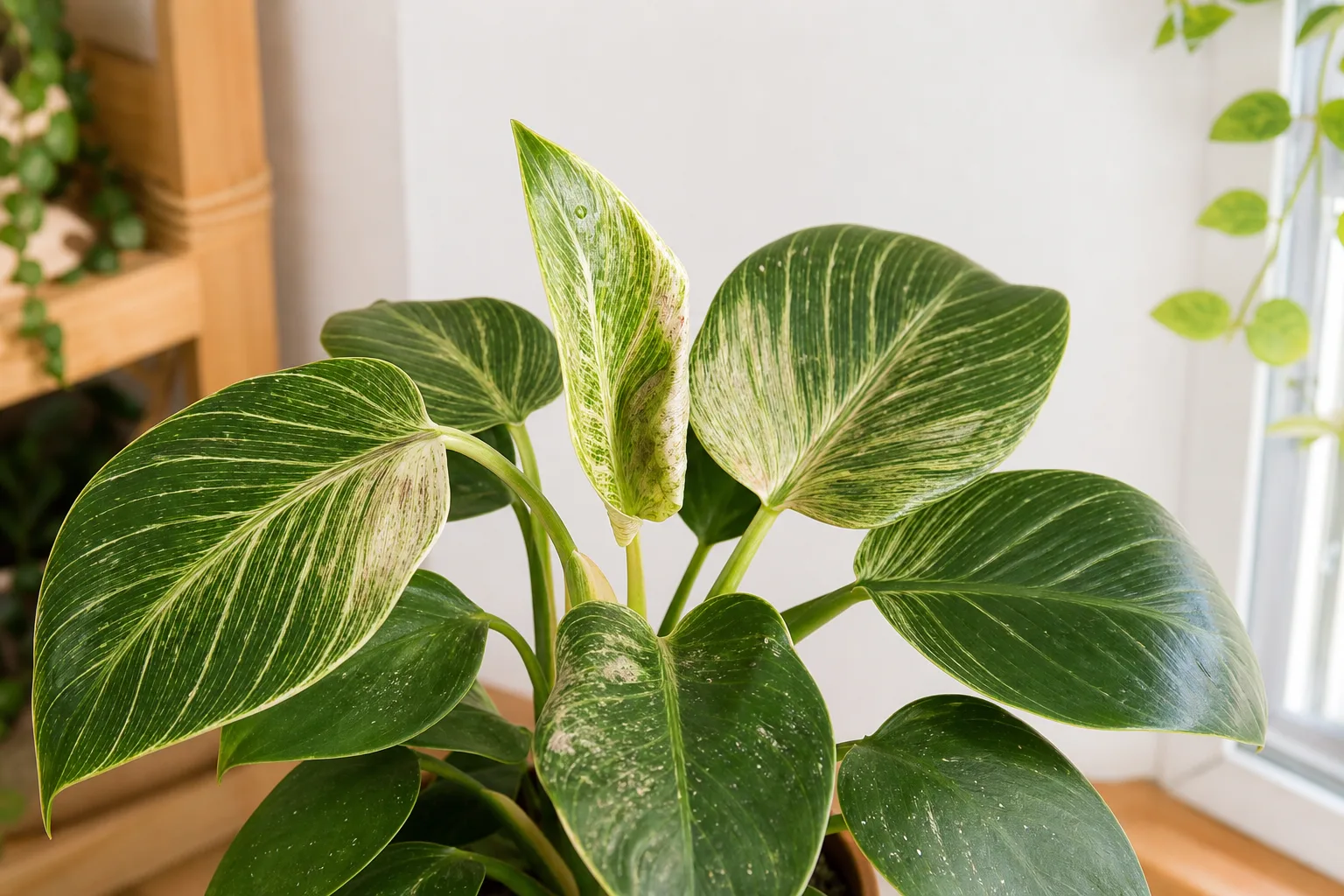
Viral mosaic usually looks uneven and “wrong” for the plant’s known cultivar. Expect irregular light and dark green islands, yellow mottling that does not follow a neat sector pattern, chlorotic streaks along veins, ringspots, oakleaf patterns, downward curling or puckered blades, shortened internodes, and overall stunting. On flowering plants you may see color breaks — white or pale streaks in petals — which RHS lists among CMV flower symptoms (RHS cucumber mosaic virus).
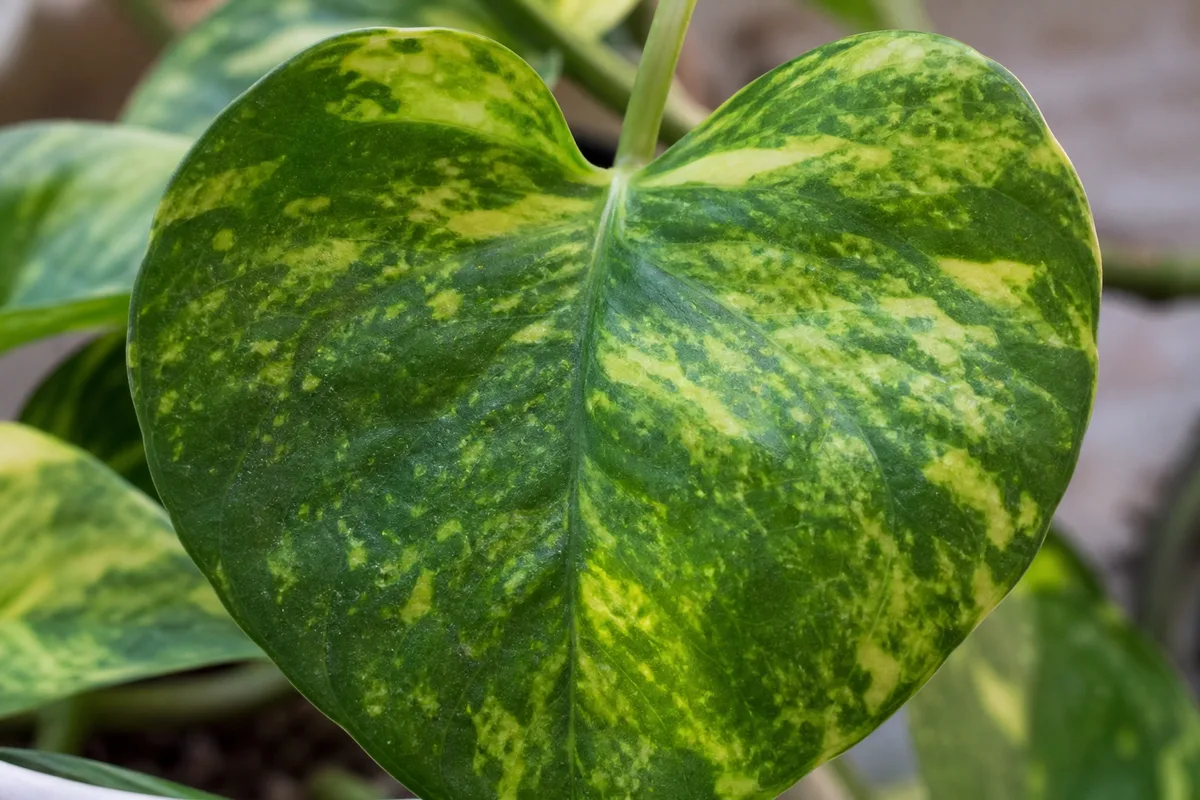
UC IPM describes cucumovirus mosaic on peppers as lighter overall color with mosaic on younger leaves, zigzag leaf veins, stunting, leaf curling, and oak-leaf necrotic patterns on older leaves (UC IPM — cucumber mosaic on peppers). Translate that indoor: watch the newest leaves first. Older, finished leaves can show residual patterns, but systemic viruses keep writing themselves into new tissue.
Missouri Botanical Garden’s indoor-plant visual guide states the classic virus signs as mottled foliage or ring-spots, notes that viruses circulate internally so no treatment removes them, and recommends discarding a diagnosed plant because many viruses infect a wide range of plants (Missouri Botanical Garden — indoor plant problems).
Irregular mottling on new foliage is the pattern that deserves isolation — not every cream sector on a variegated cultivar.
Patterns That Appear on New Growth First
Use growth direction as a diagnostic clock. Genetic variegation tends to repeat a cultivar-consistent pattern as each leaf opens. Nutrient and light problems often affect batches of leaves after a care change and may improve once you fix the cause. Viral mosaic tends to keep appearing on successive new leaves even when watering, light, and fertilizer are corrected — and the newest leaves may be the most distorted.
Transient or temperature-dependent symptoms exist. RHS notes that virus symptoms are often more obvious in spring as plants become active, and that some virus–host combinations produce transient symptoms that fade later in the season (RHS plant viruses). Indoors, that means one clean leaf after a mottled one does not automatically clear the plant. Watch several nodes over two to four weeks while the plant stays isolated.
Mosaic vs Variegation vs Nutrient Deficiency
This is the decision that saves healthy plants and stops unnecessary discards. Mottling is a visual category. Cause is not.

Stable Cultivar Variegation
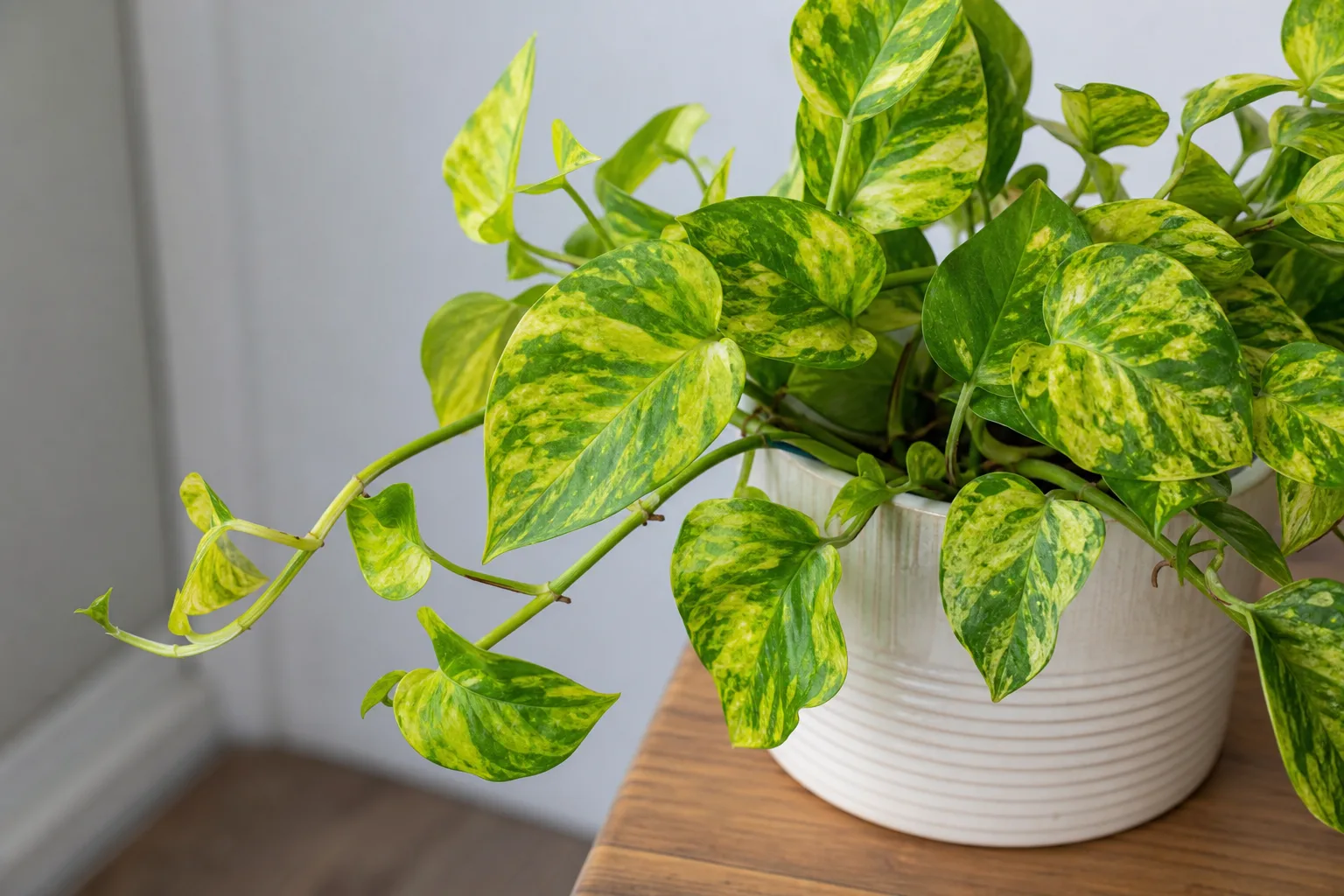
Stable variegation is genetic (or a stable chimera) and usually present from purchase. Patterns are cream, white, yellow, silver, or pink sectors that repeat along the vine or across the canopy in a cultivar-typical way. Marble Queen pothos, many philodendron cultivars, and variegated rubber plants look “mosaic” to beginners because light tissue sits next to green tissue — but the pattern is expected and does not come with progressive stunting or random ringspots.
Reversion is the opposite scare: a variegated plant pushed into low light may produce greener leaves. That is not a spreading infection. It is the plant allocating more chlorophyll. Treat it as a light problem, not a virus emergency. For species-level pattern checks, start with the plant’s own page — for example pothos mosaic virus walks the variegation-versus-virus tree for that genus.
Nutrient and Light Stress Lookalikes
Nutrient issues and light stress create yellowing that people mislabel as mosaic. Magnesium deficiency often yellows between veins while veins stay greener. Nitrogen shortage fades older leaves more uniformly. Iron chlorosis hits newest leaves with pale tissue and greener veins. Excess light bleaches the window-facing side. Cold water splash, fluoride tip burn, and salt crust injury create spots or edge browning that can sit next to uneven green — Clemson HGIC covers brown tips, salt deposits, and yellowing from cultural causes among houseplant disorders (Clemson HGIC).
Cultural yellowing usually improves — or at least stops expanding on new leaves — after you correct light, flush salts, or adjust fertilizer. Viral patterns do not “grow out” because you changed the watering schedule. If mottling corrects after a feed and light fix, it was never a good virus candidate. For feeding basics that rule out deficiency mottling, see the indoor fertilizing guide.
| Feature | Suspected mosaic virus | Genetic variegation | Nutrient / light stress |
|---|---|---|---|
| Pattern shape | Irregular mottling, streaks, ringspots, oakleaf | Cultivar-typical sectors or marbling | Interveinal yellowing, uniform fade, window-side bleach |
| Where it shows | Especially new growth; may distort leaves | Present from purchase; repeats along growth | Often after care change; may hit old or new leaves by nutrient type |
| Growth effect | Stunting, puckering, reduced leaf size common | Plant otherwise vigorous if light is adequate | Improves when cause is fixed |
| Contagious? | Yes via sap, tools, cuttings, sometimes insects | No | No |
| First move | Isolate; do not propagate; consider discard | Confirm cultivar; adjust light if reverting | Correct light, water, and fertilizer; wait for clean new leaves |
| Spray role | None — no chemical virus cure | None needed for patterning | None for “mosaic”; fix culture first |
How Mosaic Viruses Spread Indoors
Viruses cannot walk. They need a ride. RHS explains that plant viruses have no self-dispersal and rely on vectors — including humans — and that once inside cells they hijack nucleic acid and protein synthesis to replicate (RHS plant viruses; RHS cucumber mosaic virus).
Sap, Tools, Hands, and Cuttings
Mechanical transmission is the indoor story you control. Contaminated pruning knives, scissors, stakes, and fingers can move infectious sap from a symptomatic plant to a healthy one. RHS advises washing hands and tools after handling suspect plants, recommends disinfectant such as Virkon S for tools where available, and states clearly: do not propagate from any plant suspected of virus infection (RHS plant viruses). For CMV specifically, RHS notes aphids are the main outdoor vector but that tools and fingers can also transmit, so wash with soapy water before touching healthy plants (RHS cucumber mosaic virus).
Vegetative propagation is how commercial and hobby collections move viruses fastest. A cutting, division, or graft from an infected mother plant is usually infected. That is why a “free cutting” with odd mottling is never a bargain. Seed is safer for many viruses — RHS notes only a minority of viruses are seed-transmitted — but most houseplants in collections are cloned, not grown from seed (RHS plant viruses).
Aphids, Thrips, and Other Vectors
Aphids transmit CMV in a nonpersistent, stylet-borne way: they can acquire and transmit during brief probes lasting under a minute, then lose transmission ability within hours (APS Education Center — CMV; UC IPM — cucumber mosaic on peppers). That is why insecticide sprays often fail to stop virus movement in the field — aphids transmit before a contact poison kills them (UC IPM — cucumber mosaic on peppers; RHS cucumber mosaic virus). Indoors, the practical lesson is still useful: keep aphids off the collection, isolate mottled plants, and do not assume a soap spray “cures” virus after aphids already probed.
Thrips vector INSV and TSWV. Whiteflies move some viruses outdoors. Missouri Botanical Garden lists feeding insects or mites alongside mechanical spread on hands and tools (Missouri Botanical Garden — viruses). If you are fighting aphids on houseplants, treat virus prevention as part of that pest plan — remove heavily infested soft growth, wash leaves, and quarantine newcomers. Pair thrips control with the dedicated thrips houseplants guide.
Step-by-Step Diagnosis at Home
Work in order. Guessing “virus” on day one creates unnecessary discards; ignoring progressive mosaic creates unnecessary outbreaks.
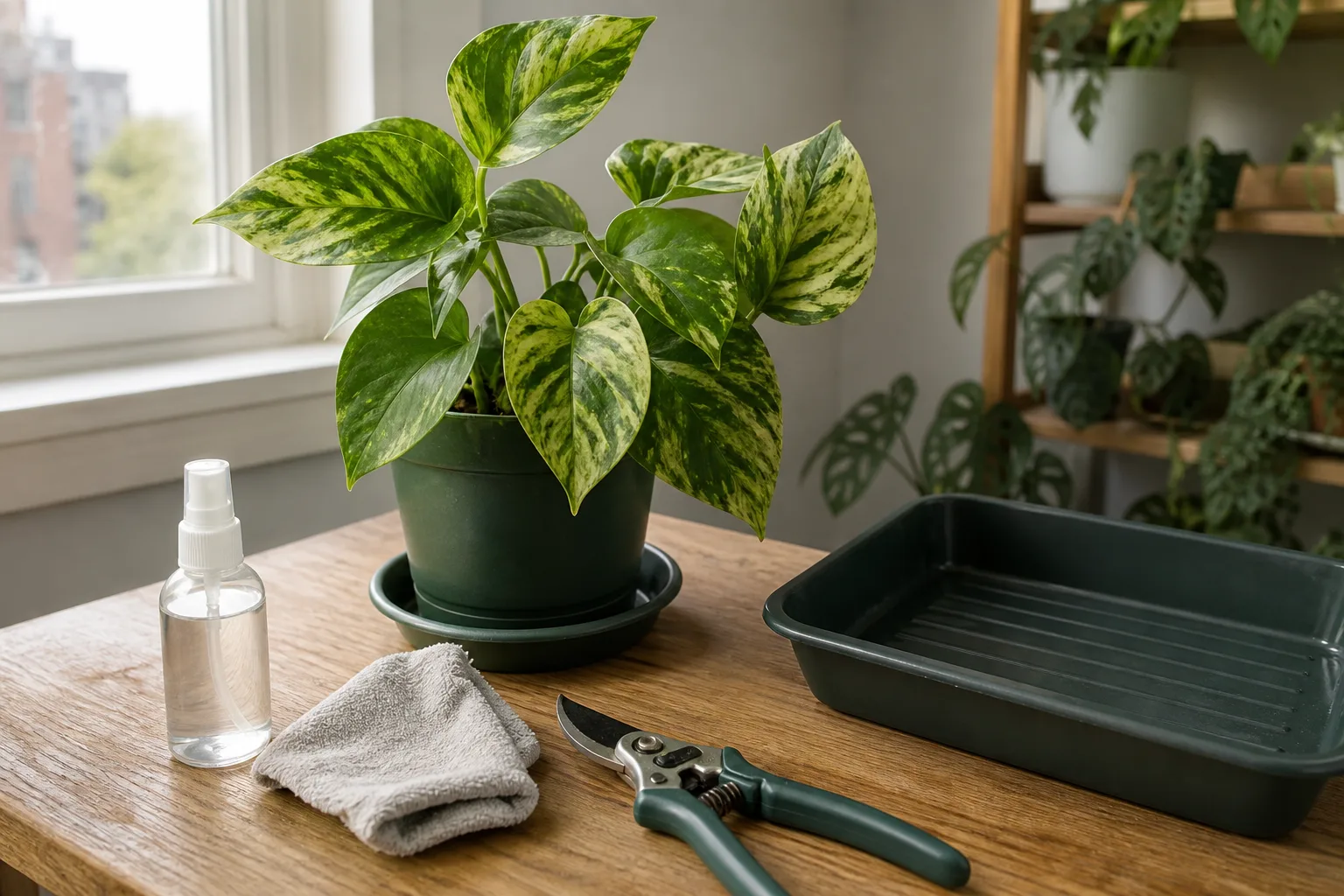
1. Isolate immediately. Move the plant away from touching neighbors. Use a separate tray. Do not share shears until you finish the case.
2. Identify the cultivar. Ask whether mottling matches known variegation. Photograph the newest three leaves and compare to purchase photos or the nursery label.
3. Scout for pests. Check undersides and growing tips for aphids, thrips (silvery scarring, black frass), mites, and whiteflies. Pest damage and virus can coexist; thrips scarring alone is not proof of INSV, but thrips raise the stakes.
4. Review recent care. Did light drop, fertilizer stop, or salts crust the pot rim? Clemson’s cultural yellowing and tip-burn patterns are common indoor false alarms (Clemson HGIC). Correct obvious culture issues and watch new leaves for two weeks while isolation continues.
5. Score virus likelihood. Raise suspicion when irregular mottling plus distortion appears on successive new leaves of a previously solid-green plant, stunting persists despite good care, ringspots or oakleaf patterns appear, or matching symptoms show on other species after shared tools.
6. Decide keep, test, or discard. Mild cosmetic mottling on a low-value plant that you can keep isolated forever is a personal risk tolerance call — RHS allows keeping plants when symptoms are tolerable, while warning that infected plants can act as reservoirs, especially for wide-host viruses like CMV and TSWV (RHS plant viruses). For a crowded shelf of aroids, discard is usually the cheaper collection insurance.
Score collection risk as: shelf density × wide-host virus likelihood × isolation feasibility. Dense shelves plus CMV/TSWV suspicion plus “I will share shears anyway” usually means discard. A single ornamental on a separate table that you never prune near other plants is a different equation.
When Lab Testing Is Worth It
Home diagnosis cannot name the virus with certainty. Serology (ELISA) and molecular tests used by university clinics and private labs can. APS notes that CMV symptoms can be confused with other viruses and that ELISA is preferred for confirmation in crops (APS Education Center — CMV). Pay for testing when the plant is rare or expensive, when you need confirmation before discarding a large specimen, or when symptoms stay ambiguous after two to four weeks of isolation and cultural correction.
Practical referral path: contact your state cooperative extension plant diagnostic clinic or a university plant disease clinic and ask about ornamental/houseplant virus testing (ELISA or molecular panels). Ship samples exactly as the clinic instructs — usually fresh symptomatic leaves packed cool, never a whole muddy pot unless asked. For ordinary retail foliage, the field decision — isolate and discard if progressive mosaic plus distortion — is usually enough without a lab bill.
There Is No Cure — Containment and Disposal
There is no home spray, systemic insecticide, fungicide, neem oil, or fertilizer that removes a plant virus from infected tissue. RHS states there are no chemical controls for plant viruses (RHS plant viruses; RHS cucumber mosaic virus). Missouri Botanical Garden is equally direct for indoor plants: once diagnosed, discard, because viruses circulate internally and no treatment is effective (Missouri Botanical Garden — indoor plant problems; Missouri Botanical Garden — viruses).
Containment is the treatment. Bag the plant and put it in household trash — do not compost diseased indoor material if that compost might return to other pots. Destroy cuttings and fallen leaves the same way. Do not “save the good vine” unless a lab cleared the stock; systemic infection means asymptomatic tissue can still carry virus.
Sanitize Tools, Pots, and Hands
After handling a suspect plant, wash hands with soap and water before touching anything else. Wash tools with soapy water; where you need stronger disinfection, Clemson recommends scrubbing reused pots clean and rinsing in one part bleach to nine parts water to kill disease organisms (Clemson HGIC). Use the bleach rinse outdoors or with good ventilation, wear gloves and eye protection, never mix bleach with other cleaners, and rinse pots with clean water after the soak so residual bleach does not sit against roots. UC IPM emphasizes preventing bacterial and other pathogen spread by avoiding contaminated hands and pruning tools (UC IPM houseplant problems). Replace porous stakes and string that wicked sap. Wipe shelves and drip trays.
If you smoked or handled tobacco before pruning solanaceous plants or other TMV-susceptible hosts, wash hands first — Missouri Botanical Garden flags tobacco products as a common inoculum source and recommends soap-and-water handwashing before plant work, especially for smokers (Missouri Botanical Garden — tobacco mosaic virus). Keep a dedicated “dirty” shear for quarantine plants until the case closes.
Prevention for the Rest of Your Collection
Prevention is quarantine and hygiene, not a weekly virus spray.
Buy plants that look vigorous and free of mottling, ringspots, and distorted tips. UC IPM urges thorough inspection before bringing plants indoors and rejecting plants with disease symptoms that will not disappear (UC IPM houseplant problems). Quarantine new arrivals for two to three weeks away from the main shelf. Sanitize tools between plants as a habit, not only during outbreaks. Control aphids and thrips early — see the indoor plant pest guide for a collection-wide workflow. Do not accept unlabeled cuttings with odd patterns. Keep weeds out of outdoor-adjacent plant rooms if you rotate pots to a balcony; RHS notes chickweed and groundsel can harbour CMV (RHS cucumber mosaic virus).
Houseplants Where Mosaic Concerns Show Up Most
Concern spikes on plants people buy for patterned foliage — pothos, philodendron, monsteras — because variegation and virus share vocabulary. It also spikes on soft ornamentals that aphids love: petunia, begonia, and many herbs started from cuttings. Orchids carry their own virus complex (including odontoglossum ringspot and cymbidium mosaic) that presents as streaks and mosaic on leaves. Hoya can show thrips-vectored virus symptoms. African violets and other gesneriads get labeled “mosaic” when ringspots or mottling appear after thrips or after buying infected stock.
When the plant is a known variegated cultivar, start with cultivar pattern literacy. When the plant was solid green and new leaves suddenly mosaic and distort, raise virus priority. For disease category framing across fungi, bacteria, and viruses, use the broader houseplant diseases identification guide. For discrete leaf lesions rather than systemic mottling, see leaf spot disease on houseplants.
First-Hand Notes From Diagnosing Mottled Houseplants
These are LeafyPixels editorial observations from indoor setups reviewed while drafting species mosaic pages — single-setup notes, not controlled trials or lab-confirmed diagnoses.
Marble Queen false alarm (February 2026): A newly purchased Marble Queen pothos arrived with bold cream sectors that a buyer flagged as “mosaic virus.” Day-0 photos matched the cultivar pattern on every leaf; growth tips were vigorous with no puckering. After two weeks in normal bright indirect light, new leaves repeated the same sectoring without ringspots or stunting. Outcome: kept on the main shelf — genetic variegation, not infection.
Shared-shear aroid suspicion (April 2026): A solid-green heartleaf philodendron developed irregular yellow mottling and a puckered newest leaf about ten days after we had pruned a distorted nursery cutting with the same scissors. We isolated the philodendron on Day 0, bagged the cutting, and stopped sharing tools. By Day 14, two more new leaves showed irregular mottling plus reduced size. Outcome: discarded both plants, bleach-rinsed the pot, soap-washed shears — neighbor aroids stayed clean over the next month. Presumptive mechanical spread; no ELISA run.
Petunia + aphids, then discard (May 2026): A balcony petunia mixed with houseplant overflow showed yellow mosaic on young leaves plus a light aphid colony. Isolation and soapy-water aphid cleanup cleared insects within a week, but Day-14 new growth stayed mottled and smaller. Outcome: bagged and trashed the petunia; washed trays; no aphids returned on nearby foliage plants. Wide-host CMV-type risk outweighed keeping a soft annual near the collection (RHS cucumber mosaic virus; APS Education Center — CMV).
Related Guides (Open When…)
- Mosaic virus symptom hub — open when you need a species-indexed starting point for mottling and ringspots
- Houseplant diseases identification and treatment — open when virus is only one of several disease patterns to place
- Leaf spot disease on houseplants — open when lesions are discrete spots rather than systemic mottling
- Aphids on houseplants — open when soft growth has aphids and CMV-type risk is on the table
- Thrips on houseplants — open when silvery scarring raises INSV/TSWV concern
- How to tackle indoor plant pests at home — open for quarantine and collection-wide pest workflow
- Not enough light on houseplants — open when a variegated plant is “reverting” greener
- Pothos mosaic virus — open for variegation vs virus checks on a common vine
- Petunia mosaic virus — open for aphid-prone flowering annuals
- African violet mosaic virus — open for ringspot and mottling checks on gesneriads
Conclusion
Use this Day-0 to Day-14 path instead of hoping mottling “grows out”:
- Day 0: Photograph the newest three leaves; isolate the plant on its own tray; stop sharing shears; do not take cuttings.
- Day 0–1: Confirm cultivar variegation vs irregular mottling; scout for aphids and thrips; note any recent care changes (light, fertilizer, salts).
- Day 1–7: Correct obvious culture issues; keep isolation; watch whether new leaves stay patterned-but-typical (variegation) or irregular-and-distorted (virus suspicion).
- Day 7–14: Score keep / test / discard using shelf density × wide-host risk × isolation feasibility. Lab-test rare plants; discard progressive mosaic-plus-distortion on crowded shelves.
- After discard or keep: Sanitize hands, tools, and pots (soap wash; 1:9 bleach rinse on scrubbed pots with ventilation and PPE); bag trash — do not compost into mixes that return to other pots.
Houseplant mosaic virus is a systemic problem with a blunt toolkit: isolate, differentiate from variegation and nutrient stress, stop propagation, and discard when progressive mottling plus distortion puts the rest of the collection at risk. There is no curative spray. Hygiene and quarantine protect the shelf that one mottled cutting never becomes.