How to Grow and Care for Jade Pothos: Light, Water & More
Jade pothos care made clear: choose the right light, water by soil dryness, prune and root cuttings, and troubleshoot yellow leaves and leggy vines.
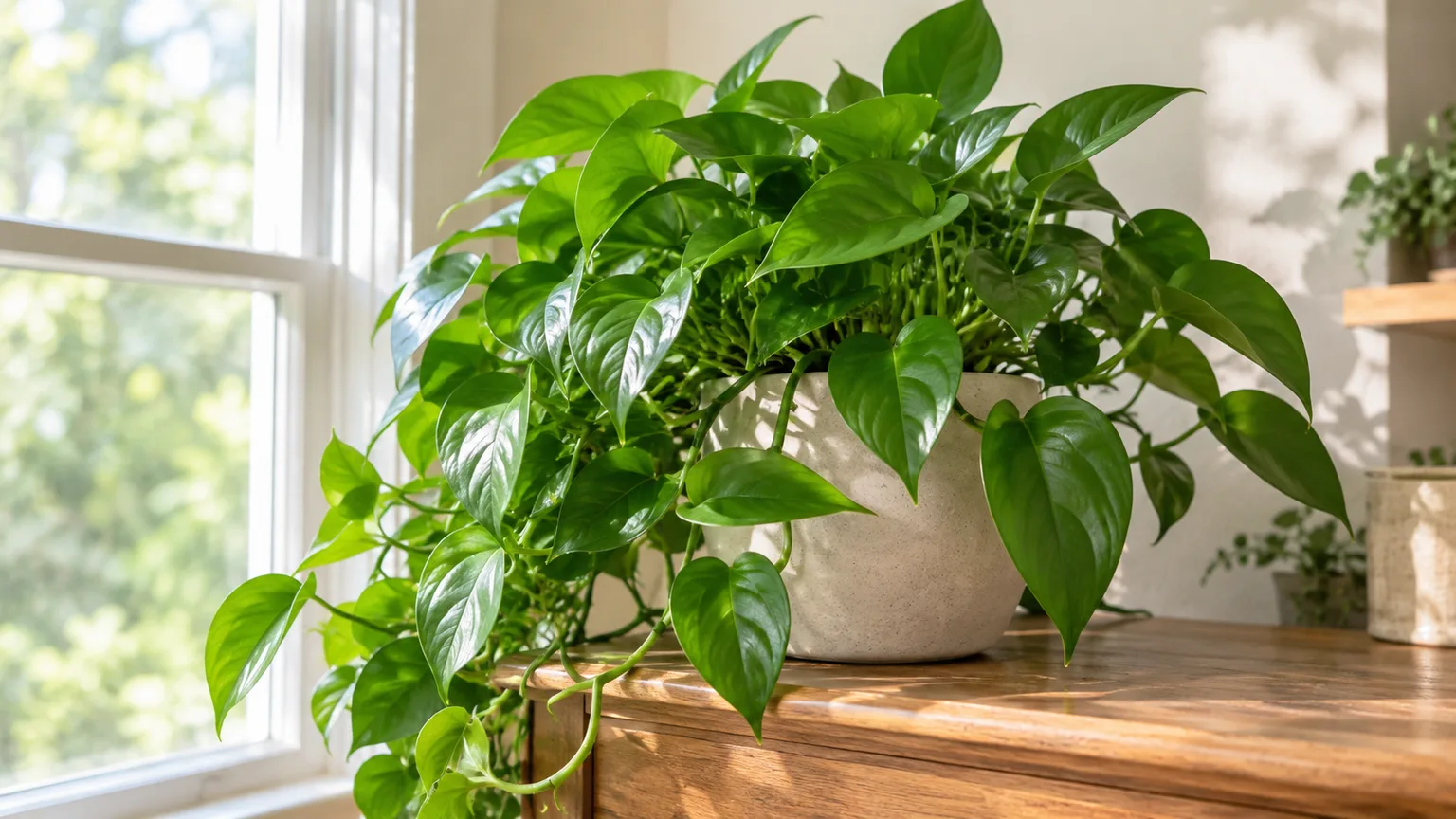
Jade pothos (Epipremnum aureum ‘Jade’) is an all-green, trailing houseplant that tolerates lower light and missed waterings better than many fussier tropical plants. It still grows best when its roots get air between thorough waterings and its vines receive steady indirect light. The simple rule is to check the soil before watering, then adjust placement and pruning to the growth you want.
Jade pothos at a glance
Jade is a cultivar of Epipremnum aureum, the species commonly sold as pothos or devil’s ivy. Its leaves are glossy and solid dark green rather than marked with the yellow or white patches seen on many other pothos cultivars. North Carolina State Extension lists Jade among the species’ cultivars and describes it as a solid-dark-green selection suited to lower-light interiors (North Carolina State Extension).
| Care question | Practical starting point |
|---|---|
| Where should it go? | In bright, indirect light; it can tolerate a dimmer spot, with slower and leggier growth |
| When should I water? | When the top 1–2 inches of mix feel dry; water thoroughly and empty the saucer |
| What soil works? | A loose indoor potting mix amended with perlite or fine orchid bark |
| What pot should I use? | A container with drainage holes, only slightly larger than the root ball |
| Does it need extra humidity? | Usually not; normal household humidity is adequate |
| How should I feed it? | A balanced houseplant fertilizer at a conservative label rate during active growth |
This baseline is more reliable than a weekly watering reminder because the mix dries at different speeds in a small plastic nursery pot, a large ceramic cachepot, a sunny room, and a cool winter corner. Start with the checks below, then keep notes for your plant’s own conditions. Once you know how long its soil takes to dry, care becomes predictable without putting it on a rigid schedule.
Give it bright, indirect light
The best everyday placement is near a bright window where sunlight does not sit directly on the leaves for hours. An east-facing window often gives gentle morning light; a north-facing window or a spot set back from a brighter south- or west-facing window can also work. If the only available window gets intense afternoon sun, use a sheer curtain or move the plant back from the glass until the light feels bright but filtered.
Jade pothos tolerates lower light partly because its leaves are uniformly green, but “tolerates” does not mean it will keep producing compact, leafy vines in a dark corner. In weak light, growth slows, the gaps between leaves can lengthen, and new leaves may come in smaller. Move it gradually closer to a window if vines are stretching; avoid shifting it straight from deep shade into hot direct sun, which can scorch foliage that has not acclimated.
Use the plant’s newest growth as your placement test. If leaves emerge at a steady pace and the vine spacing remains fairly compact, the spot is working; if the vine extends with long bare sections, try brighter indirect light before increasing fertilizer. Rotate the pot a quarter-turn every few weeks if one side leans toward the window, and wipe dust from the leaves so the foliage stays clean and easy to inspect.
Water when the soil has dried, not by calendar
Check the potting mix before watering. Push a finger about an inch into the surface, or insert a wooden skewer near the pot’s edge; if the upper layer still feels cool and damp or the skewer comes out dark with wet mix, wait and check again later. When the top 1–2 inches have dried, water slowly over the soil until excess drains from the bottom, then empty the saucer or cachepot.
That “dry a little, then soak” rhythm gives roots moisture without leaving them in stagnant, airless mix. Jade pothos can tolerate a short dry spell, but repeatedly letting the entire root ball bake dry may cause limp leaves, crispy edges, or a long pause in growth. Conversely, watering whenever the surface looks pale, or leaving the pot standing in runoff, keeps roots wet long enough to encourage rot. North Carolina State Extension and the RHS both emphasize well-drained media and letting the compost dry between waterings (RHS growing guide).
The interval changes with the plant’s environment. A small pot in warm bright light may dry quickly, while a large pot, dense soil, cool room, or winter slowdown can keep the center damp for much longer. Use the leaf posture as supporting evidence, not the only test: mild drooping with dry soil can indicate thirst, but drooping while the mix is wet points toward root stress or another cause. If water runs down the sides without wetting the center, the root ball may have become very dry; water in two slow passes a few minutes apart.
Use airy potting mix and a pot with drainage
Start with a quality indoor potting mix that holds some moisture but does not stay dense and soggy. If the mix is heavy or remains wet for many days, blend in perlite, pumice, or small orchid-bark pieces to open it up. A practical starting blend is about three parts houseplant mix to one part perlite or fine bark; you can adjust the proportion if your home is especially dry or cool.
The container matters as much as the recipe. Choose a pot with open drainage holes, and use a saucer only to catch runoff—not as a water reservoir. If you prefer a decorative pot without holes, keep the plant in a draining nursery pot inside it, then remove that inner pot for watering and let it drain completely before returning it. Adding a gravel layer to the bottom does not substitute for drainage holes or make a sealed pot safe.
Avoid choosing a very large pot to “give it room to grow.” Unused mix around a small root ball stays wet longer than the roots can take up water, so a size jump can create the same root-rot conditions as overwatering. Jade pothos does not need a specialized recipe or a potting medium that drains instantly; aim for a loose mix that gets wet evenly, releases excess water, and dries at a reasonable pace in your room.
Keep it warm; ordinary room humidity works
Typical comfortable indoor temperatures suit pothos. A warm room around 65–85°F (18–29°C) is a useful range, but protecting the plant from cold drafts and sharp temperature swings matters more than maintaining an exact thermostat setting. Keep it away from a door that opens to freezing weather, cold glass in winter, and direct blasts from heating or air-conditioning vents.
Average household humidity is usually sufficient. If the air is so dry that several plants develop crispy margins, a room humidifier may help the collection, but jade pothos does not require a pebble tray or daily misting to survive. Misting briefly wets the leaves and does little to change room humidity for long; focus first on watering consistently and keeping the plant away from hot, dry airflow.
Jade pothos is grown as a houseplant in most climates because it is tropical and cannot take frost. In a frost-free region, it can be grown outdoors in a sheltered, warm location, but it still needs protection from harsh sun and excess water. If you move a plant outside for summer, acclimate it gradually to outdoor light and bring it back inside before nights turn cold.
Fertilize lightly during active growth
Jade pothos is not a heavy feeder. If it is producing healthy leaves in fresh potting mix, you can skip fertilizer for a while; fertilizer is a supplement, not a substitute for adequate light, drainage, and watering. When the plant is actively growing in spring and summer, use a balanced liquid houseplant fertilizer at the label’s conservative rate every six to eight weeks, or follow a product label that recommends a different interval.
Do not feed a plant whose roots are waterlogged, whose soil is bone dry, or whose growth has slowed during a dark winter. Fertilizer salts can accumulate in a pot and show up as crust on the soil or browning leaf tips. If you suspect buildup, water the mix thoroughly in a sink and let it drain, then resume feeding only when active growth returns; do not add extra fertilizer to “fix” yellow leaves without checking the roots and light first.
Fresh potting mix often contains enough nutrients for the first stretch after repotting, so wait before fertilizing a newly potted plant. If you use a slow-release product, follow its package instructions and avoid layering another fertilizer on top. A modest routine produces steady growth; trying to force rapid vine extension can create weak, stretched stems if the plant does not also have enough light.
Prune for shape and fuller growth
Pruning controls length, removes damaged growth, and gives you cuttings to propagate. Use clean, sharp scissors and cut just above a leaf node—the small joint where a leaf and bud attach to the vine. Removing a vine’s tip may encourage a shoot from a node below the cut, but one cut will not magically fill an empty pot: a bare section has no leaves to restore, and a sparse root system may not support a sudden flush of growth.
For a fuller-looking container, shorten overly long vines and root the healthy tips, then plant the rooted cuttings back into the same pot once they have established. Several vines growing from the soil surface make a pot look denser than one long strand draped over its edge. You can repeat this selectively through the active growing season rather than cutting every stem back at once.
Remove yellow leaves that are fully spent and any soft, blackened stem sections. If one lower leaf yellows occasionally while the rest of the plant is growing, that can be normal aging; if many leaves yellow together, pause before pruning and troubleshoot moisture, light, and roots. Spring and summer are convenient times for heavier shaping because the plant can resume growth, but a small cleanup cut can be made whenever a vine becomes damaged or awkward.
Propagate from stem cuttings with nodes
The cutting must include a node, not just a leaf. A node is the small joint on the vine where a leaf attaches; it can produce roots and a new shoot, while a detached leaf blade by itself will not become a full pothos plant. North Carolina State Extension notes that pothos vines root readily in water, and horticulture guides describe water and soil as practical starting media (Epic Gardening; Gardening Know How).
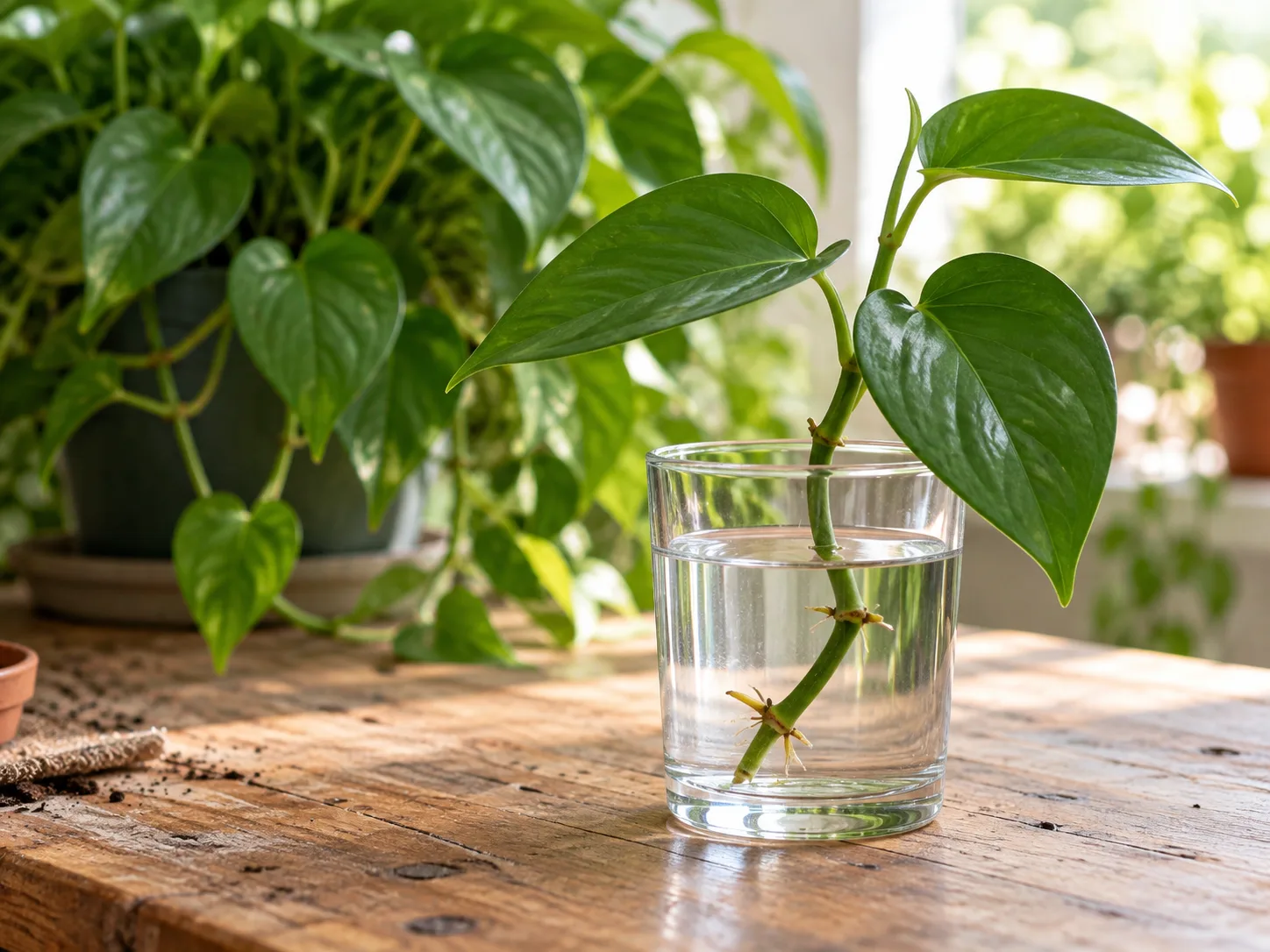
Choose a healthy, actively growing vine and make a clean cut just below a node. Each piece should have at least one node and preferably one or two leaves; remove any leaf that would sit underwater or below the soil line. You can root the cutting in water by submerging the node and keeping the leaves dry, or place the node directly into a small pot of lightly moist, airy mix.
For water rooting, set the glass in bright indirect light and top it up as water evaporates. Replace the water if it turns cloudy or develops debris, and wait for several inches of roots with side branches before potting the cutting. In soil, keep the mix lightly moist while the cutting establishes—not saturated—and give it a gentle tug only after a few weeks to see whether it resists. Rooting speed varies with warmth, light, and the cutting’s condition, so look for roots rather than a promised number of days.
Choose the method that matches the plant’s future home. Water rooting makes it easy to watch root development, but a cutting that grows in water for a long time can take time to adjust when moved into potting mix. Soil rooting avoids that transition but requires a careful balance: a node that stays wet without air can rot before it makes roots. Do not use rooting hormone as a substitute for a viable node or healthy parent plant.
Repot only when roots need more room
Do not repot by the calendar. Check the drainage holes and root ball: roots circling densely around the outside, emerging from several drainage holes, or filling most of the container are stronger clues than a vine that simply looks long. If the plant dries unusually fast despite thorough watering, or growth stalls while the roots are crowded, gently slide it out to inspect before deciding. RHS guidance allows epipremnums to remain in their original pot for several years and recommends a slightly larger container once roots crowd the space.
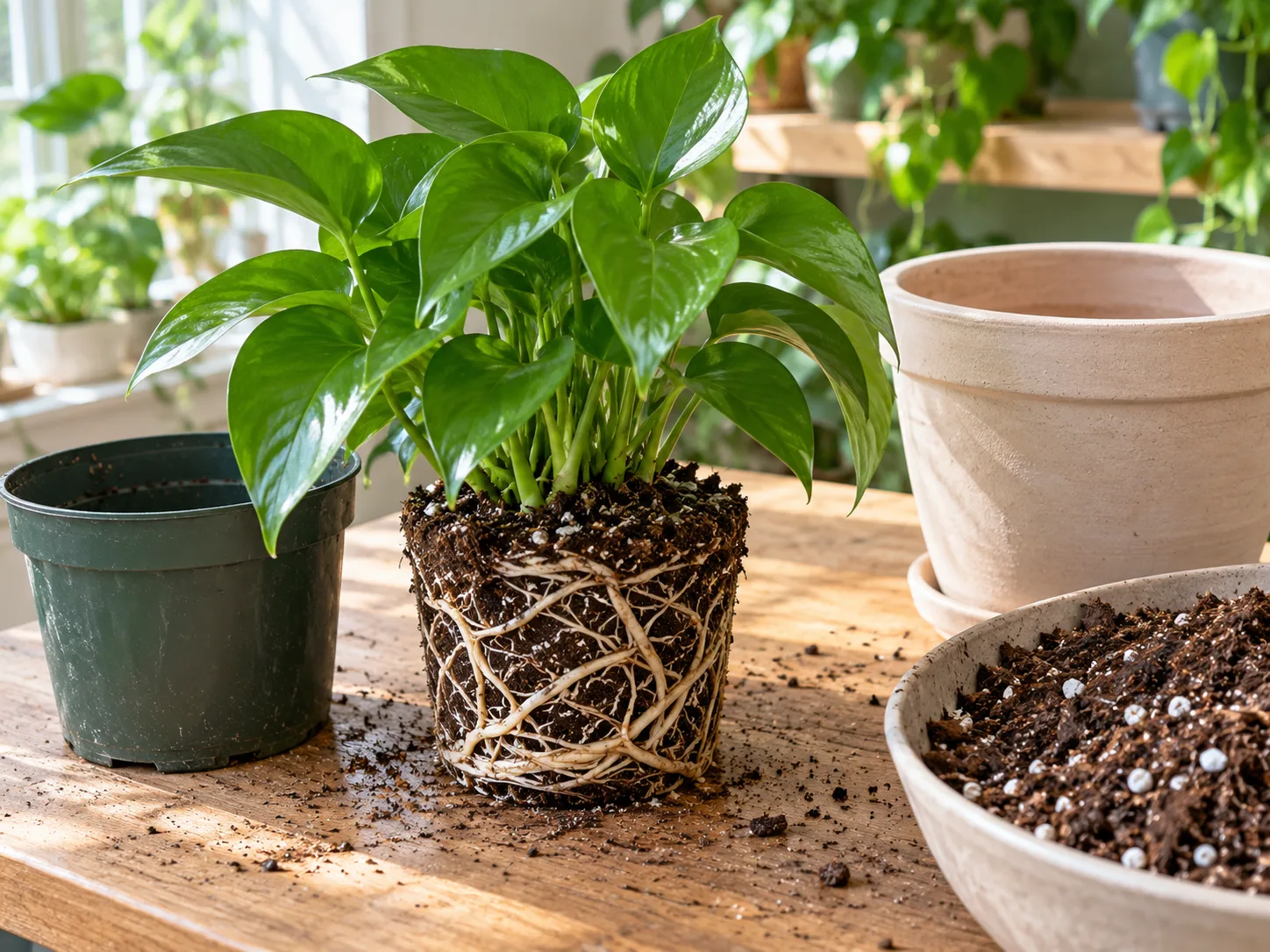
Choose a pot only one size larger, with drainage holes, and use fresh airy mix around the root ball. Ease the plant out while supporting the base; loosen only the outer circling roots if they form a tight mat. Firm, pale or tan roots are generally healthy, while mushy dark roots and a sour smell suggest rot. Trim only clearly soft, damaged roots with clean scissors, then pot the plant at the same depth it was growing before.
After repotting, water the new mix through once and let it drain, then return the plant to bright indirect light. Do not place a small root ball into a pot several sizes wider or keep watering on the old schedule; the extra soil may now take longer to dry. If the roots are healthy and the plant is merely untidy, pruning is often less stressful than repotting.
Choose trailing or climbing growth
Jade pothos can trail from a shelf or hanging planter, or climb if you provide a support. In its native tropical habitat, Epipremnum aureum uses aerial roots to attach to surfaces; the RHS describes these roots as the way the vines grip bark and climb. Indoors, a moss or coir pole, rough plank, or sturdy trellis gives the stems a vertical path. Attach vines loosely with soft ties, leaving room for the stems to thicken.
Trailing is the lower-maintenance choice and makes it easy to prune and inspect the plant. Climbing keeps vines contained and can encourage more upright growth, but the support needs to stay stable and may need replacement as the plant grows. Aerial roots may cling to a wall or furniture if the vine is placed directly against it, so keep the plant on a removable support if you want to protect painted surfaces.
Pothos can develop larger, more mature foliage as it climbs in good light, but a moss pole alone does not guarantee giant leaves. Indoor light, support, plant maturity, and consistent care all matter. If your priority is simple maintenance rather than a climbing display, let it trail and trim the longest stems before they tangle.
Identify Jade and separate it from similar plants
Look for uniformly green leaves with a glossy surface and a sturdy vining habit. A little variation between individual leaves can happen, but repeated yellow, cream, or white speckles usually mean the plant is another cultivar or a mixed pot, not the classic all-green Jade form. Labels use “pothos” for several different plants, so check the leaf pattern and botanical name before applying cultivar-specific expectations.
| Plant commonly confused with Jade | How to tell it apart |
|---|---|
| Golden pothos | Same species, but leaves usually show yellow streaks or speckles |
| Pearls and Jade pothos | Same species, with green leaves patterned in white or cream and gray-green speckling |
| Satin pothos | A different genus, Scindapsus; leaves often have silvery markings and a softer, matte look |
North Carolina State Extension lists ‘Jade,’ ‘Golden Pothos,’ and ‘Pearls and Jade’ as separate Epipremnum aureum cultivars. The distinction matters most when you compare photos, buy a plant, or decide whether unusual markings are part of its expected appearance. Jade’s solid leaves make it a good choice when you want a green vine without the high-contrast pattern of a variegated cultivar, but they do not make it a no-light plant.
Troubleshoot common Jade pothos symptoms
One symptom can have several causes, so check the soil and the pattern of affected leaves before changing your routine. Ask three questions: Is the mix dry or wet? Are one or two older leaves affected, or is the problem spreading across new growth? Did the plant recently move, get repotted, or sit near a cold window? Those clues help you change one factor at a time instead of watering, fertilizing, and repotting all at once.
Yellow leaves: check the soil before changing care
If one older leaf near the base yellows while the rest of the vine looks healthy, remove it and watch the next few weeks; older leaves do not last forever. If several leaves yellow together, check moisture first. Yellow leaves with consistently wet mix, a heavy pot, or a sour smell point toward root stress, so let the mix dry and inspect drainage rather than adding more water. Persistent decline may require unpotting the plant to remove rotted roots and replace dense, waterlogged mix.
If the pot is dry well below the surface and the leaves are limp, water thoroughly and allow the excess to drain. If yellowing appears on the window-facing side with pale, scorched patches, move the plant out of direct sun. Do not assume yellow means “needs fertilizer”: feeding a plant with compromised roots will not restore roots that cannot absorb nutrients.
Brown edges: separate dryness from root stress
Dry, crisp edges often follow a long dry spell, hot airflow, or a root ball that is not absorbing water evenly. Check the center of the pot rather than watering by the leaf alone; if the mix is dry, soak it slowly and let it drain. If the mix is still wet, do not add more water—inspect the drainage hole and consider whether compacted soil or an oversized pot is holding moisture around the roots.
Brown tips can also follow fertilizer-salt buildup or physical damage. If you see a crust on the mix, flush the pot and reduce feeding; if only one leaf is marked, trim the damaged part for appearance but do not expect it to turn green again. Jade pothos does not need a daily misting routine to prevent every brown edge, so correct the cause you can verify first.
Long bare vines: improve light, then prune
Long gaps between leaves usually mean the vine is reaching for better light, especially if new leaves are smaller than older ones. Move the plant to a brighter indirect position and give it time to adjust; increasing fertilizer will not shorten the internodes already formed. Once the vine has healthy new growth, prune the bare or overly long section above a node and root the leafy tip if you want another plant.
If the vine has dropped leaves only at the base, look at the whole plant before cutting it back. Older leaves may have been shaded by crowded growth, but repeated leaf loss can also follow poor light, dry spells, or saturated roots. A simple fix for a sparse pot is to propagate several cuttings and replant them after rooting rather than expecting one old stem to refill the container by itself.
Inspect for pests before treating
Pothos is generally easy to maintain, but indoor vines can still pick up mealybugs, scale, or spider mites. Inspect leaf undersides, the joints where leaves meet stems, and any crowded section of vine; cottony white clusters suggest mealybugs, hard bumps may be scale, and fine stippling or webbing can point to spider mites. A quick check every time you water makes it easier to catch a small problem before it spreads to nearby plants.
If you find pests, isolate the plant and remove heavily infested leaves or vines. Rinse the foliage or wipe both leaf surfaces and stems, then use an insecticidal soap labeled for houseplants if needed; follow the product label and test it on a small area first. Recheck the plant and repeat only as the label directs, because one treatment may miss eggs or insects hidden at leaf joints. Avoid applying concentrated homemade detergents, which can damage foliage, and do not treat a plant for pests unless you have identified a pest or clear evidence of one.
Keep it away from pets and small children
Pothos contains insoluble calcium oxalates. The ASPCA lists golden pothos as toxic to cats and dogs and notes signs such as oral irritation, drooling, vomiting, and difficulty swallowing (ASPCA Animal Poison Control). Because Jade is a cultivar of the same species, treat its leaves and stems as unsuitable for chewing; do not rely on a hanging basket if a pet can reach the trailing vines or fallen leaves.
Place the plant where children and animals cannot access it, collect pruning scraps promptly, and wash your hands after handling cut stems. If a pet chews the plant or develops symptoms, contact a veterinarian or animal poison-control service for case-specific guidance instead of waiting for the symptoms to pass. A plant can be easy to grow and still be the wrong fit for a home where curious pets can reach it.
Conclusion
Jade pothos grows well when its roots alternate between thorough watering and partial drying, its leaves receive steady indirect light, and its pot drains freely. Use the soil—not a calendar—to decide when to water, and repot only when the roots have filled their space. Prune above nodes to control the vines, and root those cuttings to make a sparse pot look fuller. If growth or leaf color changes, check light and root-zone moisture before reaching for fertilizer or a larger pot. Keep the plant out of reach of pets, and this adaptable all-green vine can remain a useful, low-fuss part of an indoor plant collection.