Monstera Adansonii Care Guide: Light, Water, Soil
Keep Swiss cheese vine healthy: bright indirect light, check-the-mix watering, aroid soil, and climbing support for larger fenestrations.
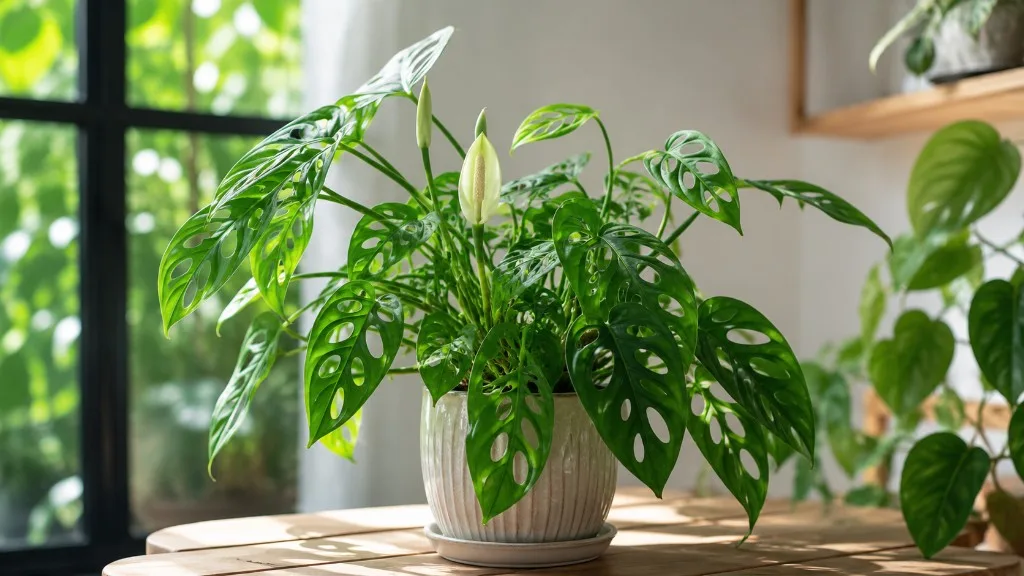
Monstera adansonii — the Swiss cheese vine — is the smaller, faster Monstera people buy for hanging baskets, moss poles, and shelf trails. Heart-shaped leaves punched with closed oval holes are the payoff; thin leaf tissue that marks from dry air, hot sun, and watering swings is the trade-off. Good Monstera adansonii care is short and specific: bright filtered light for fenestrations, water only after the upper mix dries, a chunky draining mix, and a deliberate choice between climbing for leaf size or trailing for display.
If you already own a large split-leaf plant, that is usually Monstera deliciosa — use the Monstera deliciosa beginner guide instead of treating this page as a smaller copy of that encyclopedia.
What You’re Trying to Achieve With Swiss Cheese Vine
A healthy adansonii looks like this: firm new leaves, internodes that are not stretched, roots in mix that dries on a predictable cycle, and — once stems mature — clearer fenestrations on successive leaves. You are not trying to force holes overnight. Existing leaves will not grow new holes. You are trying to give the next flush enough light, support, and steady moisture to express what the plant can already do.
Two display goals change the routine:
- Climbing display — train a leader on a moist moss pole or trellis for larger, more perforated leaves.
- Trailing display — hang or shelf-cascade for length and density; expect smaller leaves and sometimes fewer holes on long trailers.
Pick one primary goal, then match pot size and watering to that setup. Shared calendars between a tiny hanging basket and a deep pole pot are how one plant crisps while the other sits wet.
What Monstera Adansonii Is (and Why Tags Confuse It)
Trade names pile up: Swiss cheese vine, Adanson’s monstera, cheese plant, five holes plant, and sometimes “Swiss cheese plant” — a nickname also used for Monstera deliciosa. Trust the botanical name on the tag more than the nickname.
Botanical ID, Family, and Native Range
Monstera adansonii belongs to the arum family Araceae. Kew Plants of the World Online accepts the species as a climber of the wet tropical biome across tropical America. North Carolina Extension describes it as a tender evergreen climber that uses aerial roots to ascend toward filtered canopy light, with heart-shaped leaves and unique oval holes.
That origin drives indoor care. A rainforest climber wants bright indirect light, warmth, moderate to high humidity, and a mix that stays moist without going anaerobic. It does not want desert dryness, a dark corner treated as a low-light filler, or a sealed decorative pot with nowhere for water to leave.
Adansonii vs Deliciosa vs Lookalikes
Penn State Extension notes that adansonii shares common names with deliciosa but stays denser and more vigorous as a houseplant vine, with much smaller leaves and oval holes. Indoors, Penn State lists about 3–8 feet tall and 1–3 feet wide; outdoors in habitat it can climb taller.
| Trait | Monstera adansonii | Monstera deliciosa |
|---|---|---|
| Habit | Fast, dense vine | Larger climbing aroid |
| Leaves | Thin; closed oval holes | Thick; splits/holes with age |
| Indoor scale | Baskets, poles, shelves | Floor plant with support |
| Stress speed | Marks and wilts quickly | Hides root stress longer |
Monstera obliqua is the rare lookalike with paper-thin leaves and extreme hole-to-tissue ratios. Affordable “obliqua” in shops is almost always adansonii. Hold a mature leaf to light: adansonii stays opaque; true obliqua looks skeletal. For genus-wide ID without care overlap, see types of Monstera plants. Variegated forms such as ‘Archipelago’ follow the same care rules with less scorched tolerance in direct sun.
Care Snapshot for Swiss Cheese Vine
Healthy care is a system, not a product stack. Get placement, drainage, and moisture checks right before fertilizer rituals or decorative cachepots.
| Factor | Baseline target | Deeper guide |
|---|---|---|
| Light | Bright indirect; filter hot afternoon sun | Light guide |
| Water | Top 3–5 cm dry, then soak and drain | Watering guide |
| Soil | Chunky aroid mix; open drainage | Soil guide |
| Humidity | Aim ~50–60%+; avoid cold drafts | Hub + humidity problem pages |
| Support | Moss pole/trellis for larger leaves; trailing OK | Pruning |
| Feed | Half-strength monthly in active growth | Fertilizer |
Penn State summarizes Monstera houseplant basics as bright light without harsh direct sun, humidity preferably above 50%, and watering after the top 1–2 inches dry. NC State adds species specifics: partial shade outdoors, moist well-drained slightly acidic soil, high humidity, and a stake, trellis, or moss pole in the pot. Your room changes the interval — judge the pot, not someone else’s Tuesday routine.
Light Requirements for Fenestrated Growth
Bright, indirect light is the growth engine for Swiss cheese vine. It drives leaf size, internode spacing, and how boldly new fenestrations show. Medium light keeps a plant alive with smaller leaves and longer gaps between nodes. Dim corners produce leggy vines that look thirsty even when the mix is wet.

Window Placement, Scorch Risk, and Hole Development
NC State lists partial shade (about 2–6 hours of direct sun outdoors) and warns that direct sun scorches leaves. Indoors, that usually maps to an east window, a few feet back from west or south glass, or sheer-filtered south light. Thin adansonii leaves scorch faster than deliciosa after a shop-to-window leap.
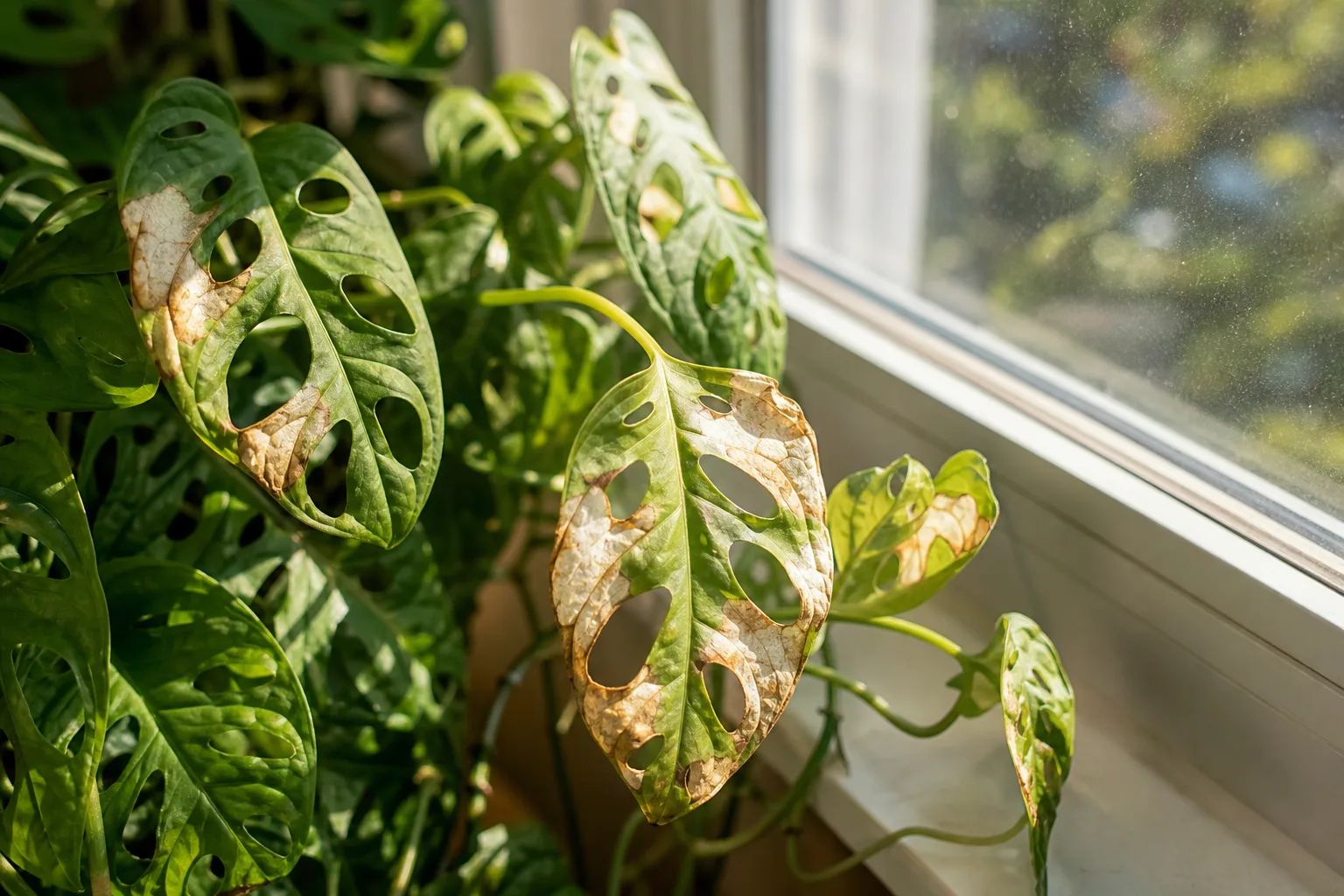
Watch the newest leaf, not old scars. Bleached patches, crisp midday edges, or curling toward heat mean too much direct exposure. Small solid leaves, long bare internodes, and pale color mean too little usable light. Move gradually over one to two weeks, then relearn how fast the pot dries — brighter light shortens the watering interval. A full-spectrum grow light for 12–14 hours on a timer helps north rooms and winter days; keep fixtures far enough that thin leaves do not feel warm.
RHS notes that distinctive holes often appear once plants are a few years old, that low light tends to produce fewer holes, and that a climbing plant often produces larger, more mature leaves with more fenestrations. Existing leaves will not grow new holes; improve conditions for the next flush.
Fenestration Decision Tree
When new leaves stay mostly solid, work through this order:
- Juvenility — young cuttings and short stems often fenestrate lightly even when healthy. Wait for stem maturity before declaring failure.
- Light — if internodes stretch and leaves stay small, raise usable light first (east window, sheer-filtered south, or a timered grow light).
- Support — if the vine trails long without a leader climbing, add a moss pole or trellis and train nodes against moist support.
- Humidity / moisture during unfurling — stuck, half-open leaves with brown edges usually point to dry air or uneven watering while the leaf opens. Stabilize those, then judge the next two or three leaves.
- Root stress — chronically wet or bone-dry mix stalls growth; fix the root zone before expecting mature leaf patterning.
Stuck new leaves are a humidity-and-moisture signal, not a fertilizer emergency. Pair placement fixes with the dedicated Monstera Adansonii light guide when light is the main bottleneck.
Watering: Check the Mix, Not the Calendar
Water when the top 3–5 cm (1–2 inches) of mix feel dry and the pot feels lighter than right after a soak. Then water thoroughly until runoff appears, and empty saucers and cachepots so roots never sit in stale water. Penn State ties this dry-down rule to Monstera houseplants and flags overwatering as a root-rot risk. NC State wants moist, well-drained soil — even moisture between drinks, not a permanent swamp. RHS advises allowing compost to become almost dry before a thorough watering, never leaving the pot standing in water, and watering slightly less in winter. Clemson HGIC gives the same practical test — finger-check the mix, water thoroughly until runoff, then empty the saucer so roots do not sit in leftover water.
In many bright homes the interval lands around every 7–10 days in active growth and 10–14 days in winter, but that is a check reminder, not a contract. Hard water and salt buildup can show as brown tips even when humidity is acceptable; room-temperature filtered or rain water helps in hard-water areas, and an occasional flush washes salts through.
Hanging Baskets vs Moss-Pole Climbers
Container form changes everything. Trailing vines raise leaf-to-soil ratio; poles add aerial-root surfaces that benefit from light moisture on the support when you water the pot.
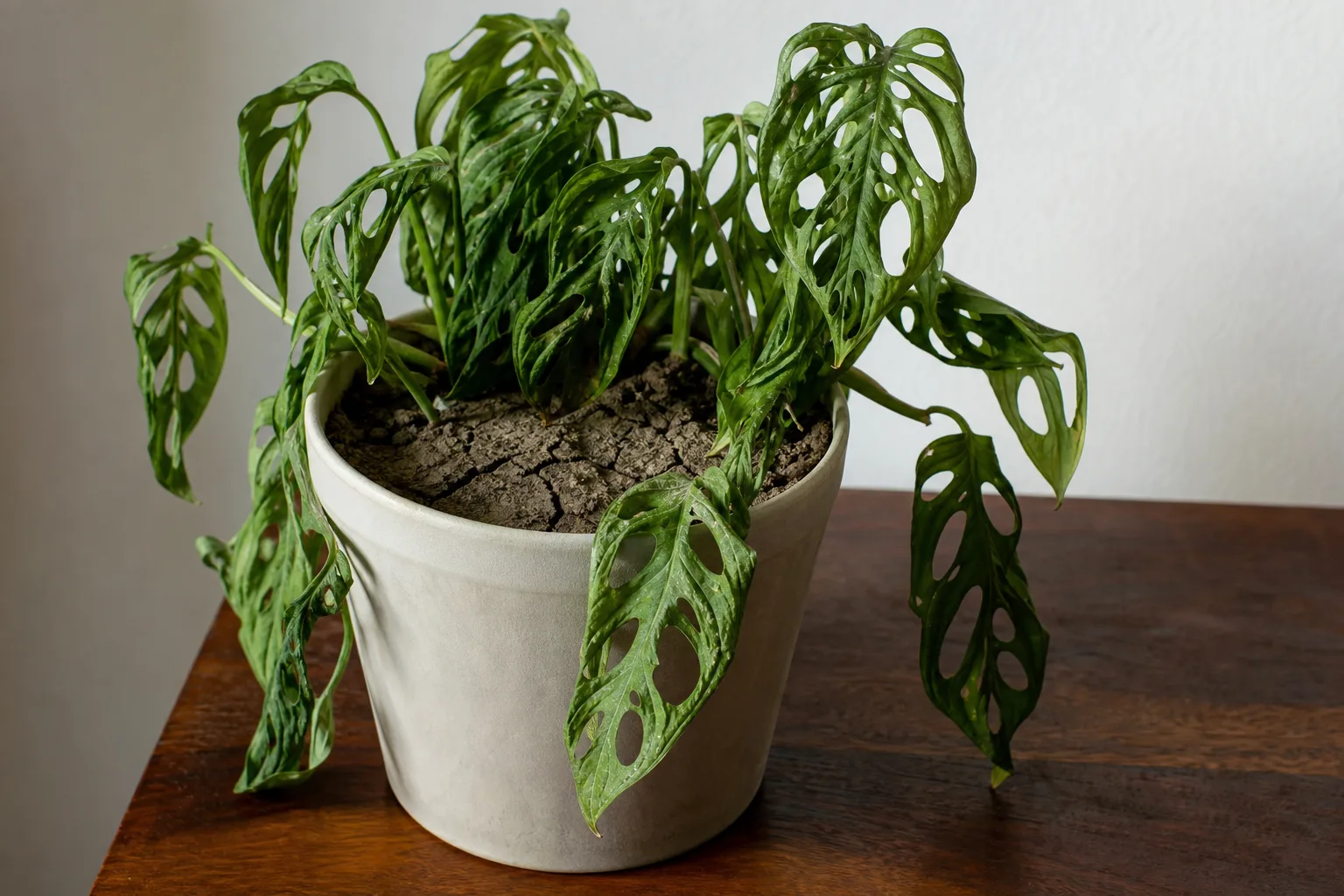
LeafyPixels observation (not an extension interval): In the same east-facing room at roughly 45–55% relative humidity, a 15 cm (6 inch) hanging basket of adansonii typically needed water every 4–6 days in warm active growth — the hanging rim and airflow dried the mix fast. A 20 cm (8 inch) floor pot on a moss pole in the same room often still felt heavy at day 9–12. Shared “water every Sunday” habits underwatered the basket and overwatered the pole plant. Always check each pot separately.
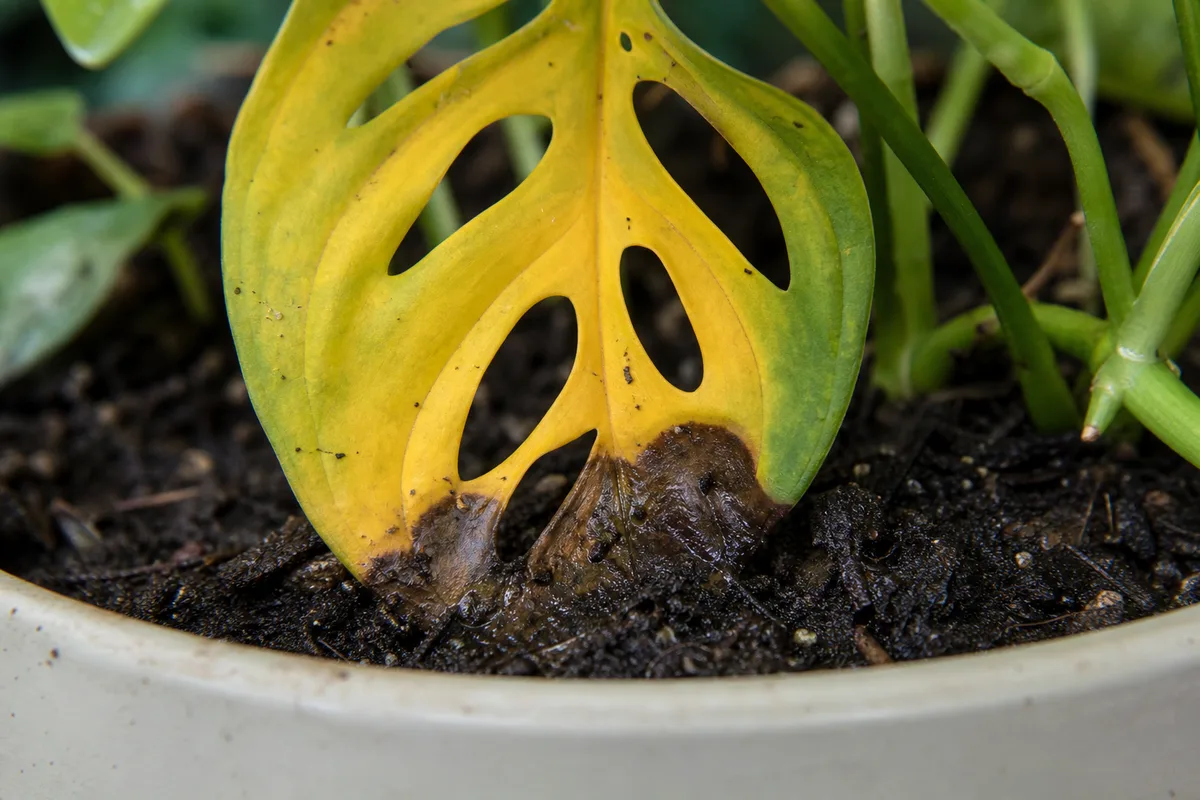
Chronic drought crisps margins and stalls unfurling. Chronic wetness yellows lower leaves, softens stems, and leads to root rot. Depth checks and pot weight beat surface color; see the watering guide for basket-specific timing. Decorative hanging pots without drainage turn every drink into a guess — use a nursery pot with holes inside the decorative shell, then empty runoff.
Climbing Support vs Trailing Displays
In habitat, adansonii climbs with aerial roots. Indoors, a moss pole, coir totem, stake, or trellis is not required for survival, but it strongly shapes leaf size and fenestration. NC State explicitly recommends providing structure in the container. RHS notes wild vines scramble toward light and produce stem roots that attach to supports — a moss-covered pole recreates that surface at home, and once a plant “feels” it is climbing it often produces larger, more mature leaves with more holes.
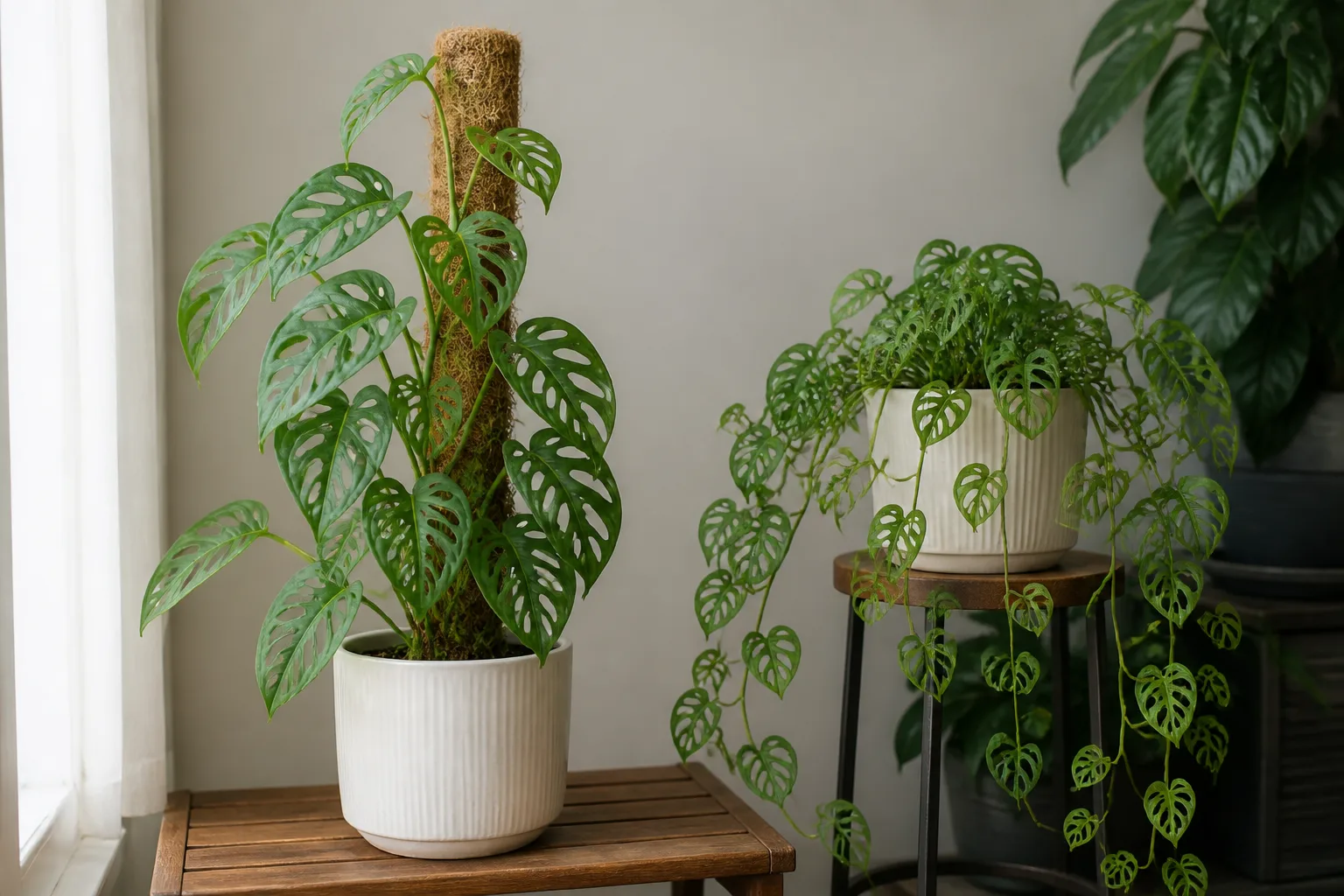
LeafyPixels observation: After we trained a long trailer’s main leader onto a moist moss pole under the same east window (no other care changes), the next two to three leaves were larger with clearer oval fenestrations than the prior trailing flush. Older trailing leaves did not add holes. That matches the RHS maturity-and-climbing pattern; it is not a guarantee that every cutting fenestrates on a fixed calendar.
Trailing from a shelf or hanging basket remains a valid display choice. Expect smaller leaves and sometimes fewer holes on cascading stems. Many growers climb the main stem and let side shoots trail. Tie stems loosely so nodes contact moist moss; water the pole lightly when you water the pot so aerial roots stay engaged. Prune just above a node to branch a lanky trailer — see pruning when you want a fuller pot rather than endless length. Wear gloves when pruning; NC State flags contact-dermatitis risk.
Humidity, Temperature, and Seasonal Rhythm
NC State recommends high humidity via a humidifier or pebble tray and warns against cold drafts and temperatures below 50°F (10°C). Penn State prefers humidity above 50% for Monstera and a warm range around 60–85°F. RHS frames Swiss cheese plants as warmth-and-humidity lovers in filtered light, roughly 18–25°C (65–77°F).
A practical home target is 50–60% relative humidity, with higher levels producing lusher unfurling in dry climates. Average 30–40% household air often means brown edges, stuck new leaves, and more spider-mite pressure. A small humidifier near the plant beats daily misting; misting is a brief bump that can leave wet foliage prone to spotting if airflow is poor.
Seasonal calendar (home apartments):
| Season | Light / placement | Water | Feed / other |
|---|---|---|---|
| Spring–summer | Brightest filtered spot; watch for scorch as sun strengthens | Check baskets often; active growth drinks faster | Half-strength monthly if growing |
| Fall–winter | Move closer to windows or add grow lights as days shorten | Stretch intervals; still soak when the top mix is dry | Pause or cut fertilizer; keep off cold glass |
Keep plants off frosty ledges, away from heater blasts, and clear of AC vents. Thin leaves show temperature stress faster than deliciosa. Pair humidity with gentle airflow — stagnant damp air around crowded vines invites leaf spots, while constant hot dry wind crisps margins.
Soil, Drainage, and Pot Choice
Aroid roots need oxygen and moisture together. Dense peat that collapses into mud is a common root-rot partner. A workable indoor recipe is standard potting mix plus about 20–25% perlite and 10–15% orchid bark, aiming for a chunky, well-draining mix near pH 5.5–7.0. That matches NC State guidance for moist, well-drained, slightly acidic to neutral soil and Penn State advice to amend mixes with bark, charcoal, or perlite. RHS prefers an open, well-drained, slightly acidic compost so roots do not rot in soggy media.
Shift ratios by container: hanging baskets can use a slightly moisture-retentive chunky mix so they do not crisp in two days; deep floor pots on poles benefit from more bark/perlite so the core does not stay anaerobic. Drainage holes are mandatory. Terracotta dries faster; plastic holds moisture longer; hanging baskets dry quickest. Move up only one pot size at repotting. If water sits for a week, the mix is too dense or the pot is too large. Refresh structure via the soil guide rather than drowning the plant to compensate.
Fertilizer, Repotting, and Propagation
Adansonii is a moderate feeder. During spring and summer growth, a balanced liquid houseplant fertilizer at half label strength, applied about monthly to already-moist soil, is enough for most homes. Penn State discusses regular feeding for Monstera through the growing season; scale back in winter when light and growth slow. Wisconsin Horticulture reminds growers that fertilizer is for active growth and that overfertilization burns leaves — follow the product label and do not feed to “fix” a plant stuck in wet soil.
Never fertilize dry mix, freshly stressed plants, or vines recovering from rot. Fresh potting mix often carries a starter charge — wait a few weeks after repotting. White crust on the rim means salts are accumulating; flush with plain water and skip the next feed. Fertilizer cannot fix dim light, compacted soil, or chronic overwatering — correct those first, then use the fertilizer guide for fine-tuning.
Repot every one to two years, or sooner when roots circle drainage holes, water runs straight through, or the plant dries within a day of watering. Spring into early summer is the best window. Water the day before, step up one pot size, refresh chunky aroid mix, and install a moss pole while the root ball is accessible. Details live on the repotting guide. Do not repot on day one from the nursery unless the mix is failing — quarantine, learn dry-down speed, and stabilize first.
NC State lists stem cuttings as the recommended propagation strategy. Each cutting needs at least one node — roots form at nodes, not from leaf tissue alone. Water propagation in bright indirect light typically shows roots in about three to six weeks; change water regularly and pot into moist aroid mix when roots are an inch or two long. Propagate only from healthy, pest-free parents. Step-by-step aftercare sits on the propagation guide.
Common Problems and How to Diagnose Them
Most Swiss cheese vine problems are environmental. Diagnose in this order: soil moisture and roots → light → pests → humidity and water quality. NC State flags spider mites, mealybugs, aphids, whiteflies, and scale, plus root rot from overwatering and leaf spots when foliage stays wet in stagnant air. Wisconsin Horticulture reinforces the same houseplant pattern: match water to light, quarantine new plants, and treat spider mites as a hot-dry-air problem.
| What you see | Likely cause | First check |
|---|---|---|
| Yellow lower leaves + heavy wet pot | Overwatering / early rot | Unpot if stems soften; see overwatering |
| Crisp margins + light dry pot | Underwatering or dry air | Soak thoroughly; raise humidity |
| Bleached midday patches | Sun scorch | Move out of direct beams |
| Fine webbing, stippling | Spider mites | Isolate; rinse; fix dry air — spider mites |
| Long bare internodes, solid small leaves | Low light / no climb | Brighten and add support |
| White crust on pot rim | Fertilizer / hard-water salts | Flush; skip next feed |
Isolate new plants when you can. Sticky residue usually means honeydew from sap suckers. Soft stems and foul soil mean unpot and inspect for rot before adding more water or fertilizer. For symptom pages, start from the hub problem list or guides like yellow leaves, brown tips, and leggy growth.
Pet Toxicity and Household Safety
Treat Monstera adansonii as not pet-safe. The ASPCA lists Swiss cheese plant (Monstera) as toxic to cats and dogs due to insoluble calcium oxalates, which cause oral irritation, drooling, vomiting, and difficulty swallowing. UF/IFAS states that all Monstera species — including Adanson’s monstera (M. adansonii) — are toxic to dogs, cats, and humans, with needle-like calcium oxalate crystals as the main agent. NC State also notes toxicity to humans and pets and recommends gloves because of contact-dermatitis risk.
Hanging vines add reach risk: cascading stems near a cat tree or dog’s eye level are easy chew targets. Keep vines out of reach. If ingestion is suspected, contact a veterinarian and ASPCA Animal Poison Control at (888) 426-4435. Choose a genuinely pet-safer species for floor pots in animal homes rather than hoping training beats curiosity.
What We Observed and How This Guide Was Reviewed
Written by Sai Ananth (B.Pharmacy, Andhra University; LeafyPixels lead writer — pharmacognosy background and indoor growing practice) and reviewed by the LeafyPixels Review Board (editorial roster includes extension-trained master gardeners and horticultural writers; standards summarized on the About page) on 2026-08-02.
How this page was built: recommendations were checked against Kew Plants of the World Online, NC State Extension, Penn State Extension, RHS Swiss cheese plant guidance, Wisconsin Horticulture houseplant care, ASPCA toxicity listings, and UF/IFAS EP639, plus LeafyPixels plant-care cluster data. Basket vs pole dry-down timings and the moss-pole fenestration note above are LeafyPixels observational notes from the same east-facing room (about 45–55% RH); they are guidance for checking pots separately, not universal schedules. Extension citations cover light, humidity floors, watering principles, climbing support, and toxicity. Human editorial review focused on species differentiation from deliciosa, pet-safety wording, and labeling observational vs extension-backed numbers.
Related Monstera Adansonii Guides
Use this page for the full care framework. Use the hub and topic pages when one axis needs depth:
- Monstera Adansonii hub — overview, tools, and problem index
- Light — windows, fenestration signals, grow lights
- Watering — hanging baskets vs moss poles
- Soil — aroid mix structure and drainage
- Propagation — node cuttings in water or moss
- Types of Monstera — species ID without care encyclopedia overlap
- How to water indoor plants — check-the-mix mindset for any pot
Conclusion
Treat Monstera adansonii as a thin-leaved rainforest climber: bright indirect light for fenestrations, water only after the upper mix dries, chunky draining soil, and a deliberate climbing-or-trailing choice. Keep humidity out of desert range, feed lightly only in active growth, and keep vines away from pets. When something fails, fix moisture and light before stacking products — then use the Monstera Adansonii hub for topic depth and symptom pages.